Archive for dark matter

Authentic Tidings of Invisible Things

Posted in Poetry, The Universe and Stuff with tags , , , , on January 5, 2013 by telescoper

One of my very first blog posts (from way back in 2008) was inspired by an old book of poems by William Wordsworth that I’ve had since I was a child. I was reading it again this evening and came across this short excerpt, near the end of the book, from The Excursion, and entitled for the purposes of the book The Universe a Shell. It struck me as having a message for anyone who works on the science of things either too big or too small to be sensed directly on a human scale, so I thought I’d post it.

I decided to scan it in rather than copy it from elsewhere on the net, as I really love the look of that old faded  typeface on the yellowing paper, even if it is a bit wonky because it went over two pages. I’ve been fond of Wordsworth for as long as I can remember and, like a few other things, that’s something I’ll never feel the need to apologize for…

Shell-a

Shell-b

Dark Matter: Dearth Evaded

Posted in Astrohype, The Universe and Stuff with tags , , , , , , on May 23, 2012 by telescoper

While I’m catching up on developments over the last week or so I thought I’d post an update on a story I blogged about a few weeks ago. This concerns the the topic of dark matter in the Solar Neighbourhood and in particular a paper on the arXiv by Moni Bidin et al. with the following abstract:

We measured the surface mass density of the Galactic disk at the solar position, up to 4 kpc from the plane, by means of the kinematics of ~400 thick disk stars. The results match the expectations for the visible mass only, and no dark matter is detected in the volume under analysis. The current models of dark matter halo are excluded with a significance higher than 5sigma, unless a highly prolate halo is assumed, very atypical in cold dark matter simulations. The resulting lack of dark matter at the solar position challenges the current models.

In my earlier post I remarked that this  study   makes a number of questionable assumptions about the shape of the Milky Way halo – they take it to be smooth and spherical – and the distribution of velocities within it is taken to have a very simple form.

Well, only last week a rebuttal paper by Bovy & Tremaine appeared on the arXiv. Here is its abstract:

An analysis of the kinematics of 412 stars at 1-4 kpc from the Galactic mid-plane by Moni Bidin et al. (2012) has claimed to derive a local density of dark matter that is an order of magnitude below standard expectations. We show that this result is incorrect and that it arises from the invalid assumption that the mean azimuthal velocity of the stellar tracers is independent of Galactocentric radius at all heights; the correct assumption—that is, the one supported by data—is that the circular speed is independent of radius in the mid-plane. We demonstrate that the assumption of constant mean azimuthal velocity is physically implausible by showing that it requires the circular velocity to drop more steeply than allowed by any plausible mass model, with or without dark matter, at large heights above the mid-plane. Using the correct approximation that the circular velocity curve is flat in the mid-plane, we find that the data imply a local dark-matter density of 0.008 +/- 0.002 Msun/pc^3= 0.3 +/- 0.1 Gev/cm^3, fully consistent with standard estimates of this quantity. This is the most robust direct measurement of the local dark-matter density to date.

So it seems reports of the dearth were greatly exaggerated..

Having read the paper I think this is a pretty solid refutation, and if you don’t want to take my word for it I’ll also add that Scott Tremaine is one of the undisputed world experts in the field of Galactic Dynamics. It will be interesting to see how Moni Bidin et al. respond.

This little episode raises the question that, if there was a problem with the assumed velocity distribution in the original paper (as many of us suspected), why wasn’t this spotted by the referee?

Of course to a scientist there’s nothing unusual about scientific results being subjected to independent scrutiny and analysis. That’s how science advances. There is a danger in all this, however, with regard to the public perception of science. The original claim – which will probably turn out to be wrong – was accompanied by a fanfare of publicity. The later analysis arrives at a much less spectacular conclusion,  so will probably attract much less attention. In the long run, though, it probably isn’t important if this is regarded as a disappointingly boring outcome. I hope what really matters for scientific progress is people doing things properly. Even if it  don’t make the headlines, good science will win out in the end. Maybe.

Milky Way Satellites and Dark Matter

Posted in Astrohype, Bad Statistics, The Universe and Stuff with tags , , , , on May 4, 2012 by telescoper

I found a strange paper on the ArXiv last week, and was interested to see that it had been deemed to merit a press release from the Royal Astronomical Society that had been picked up by various sites across the interwebs.

The paper, to appear in due course in Monthly Notices of the Royal Astronomical Society, describes a study of the positions and velocities of small satellite galaxies and other object around the Milky Way, which suggest the existence of a flattened structure orientated at right angles to the Galactic plane. They call this the “Vast Polar Structure”. There’s even a nifty video showing this arrangement:

They argue that this is is evidence that these structures have a tidal origin, having been thrown out   in the collision between two smaller galaxies during the formation of the Milky Way. One would naively expect a much more isotropic distribution of material around our Galaxy if matter had fallen into it in the relatively quiescent way envisaged by more standard theoretical models.

Definitely Quite Interesting.

However, I was rather taken aback by this quotation by one of the authors, Pavel Kroupa, which ends the press release.

Our model appears to rule out the presence of dark matter in the universe, threatening a central pillar of current cosmological theory. We see this as the beginning of a paradigm shift, one that will ultimately lead us to a new understanding of the universe we inhabit.

Hang on a minute!

One would infer from this rather bold statement that the paper concerned contained a systematic comparison between the observations – allowing for selection effects, such as incomplete sky coverage – and detailed theoretical calculations of what is predicted in the standard theory of galaxy formation involving dark matter.

But it doesn’t.

What it does contain is a simple statistical calculation of the probability that the observed distribution of satellite galaxies would have arisen in an exactly isotropic distribution function, which they conclude to be around 0.2 per cent.

However, we already know that galaxies like the Milky Way are not exactly isotropic, so this isn’t really a test of the dark matter hypothesis. It’s a test of an idealised unrealistic model. And even if it were a more general test of the dark matter hypothesis, the probability of this hypothesis being correct is not what has been calculated. The probability of a model given the data is not the same as the probability of the data given the model. To get that you need Bayes’ theorem.

What needs to be done is to calculate the degree of anisotropy expected in the dark matter theory and in the tidal theory and then do a proper (i.e. Bayesian) comparison with the observations to see which model gives the better account of the data. This is not any easy thing to do because it necessitates doing detailed dynamical calculations at very high resolution of what galaxy like the Milky Way should look like according to both theories.

Until that’s done, these observations by no means “rule out” the dark matter theory.

On the Dearth of Dark Matter in the Solar Neighbourhood

Posted in Astrohype, The Universe and Stuff with tags , , , , , , , , on April 22, 2012 by telescoper

I’m a bit late getting onto the topic of dark matter in the Solar Neighbourhood, but it has been generating quite a lot of news, blogposts and other discussion recently so I thought I’d have a bash this morning. The result in question is a paper on the arXiv by Moni Bidin et al. which has the following abstract:

We measured the surface mass density of the Galactic disk at the solar position, up to 4 kpc from the plane, by means of the kinematics of ~400 thick disk stars. The results match the expectations for the visible mass only, and no dark matter is detected in the volume under analysis. The current models of dark matter halo are excluded with a significance higher than 5sigma, unless a highly prolate halo is assumed, very atypical in cold dark matter simulations. The resulting lack of dark matter at the solar position challenges the current models.

As far as I’m aware, Oort (1932, 1960) was the first to perform an analysis of the vertical equilibrium of the stellar distribution in the solar neighbourhood. He argued that there is more mass in the galactic disk than can be accounted for by star counts. A reanalysis of this problem by Bahcall (1984) argued for the presence of a dark “disk” of a scale height of about 700 pc. This was called into question by Bienaymé et al. (1987), and by Kuijken & Gilmore in 1989. In a later analysis based on a sample of stars with HIPPARCOS distances and Coravel radial velocities, within 125 pc of the Sun. Crézé et al. (1998) found that there is no evidence for dark matter in the disk of the Milky Way, claiming that all the matter is accounted for by adding up the contributions of gas, young stars and old stars.

The lack of evidence for dark matter in the Solar Neighbourhood is not therefore a particularly new finding; there’s never been any strong evidence that it is present in significant quantities out in the suburbs of the Milky Way where we reside. Indeed, I remember a big bust-up about this at a Royal Society meeting I attended in 1985 as a fledgling graduate student. Interesting that it’s still so controversial 27 years later.

Of course the result doesn’t mean that the dark matter isn’t there. It just means that its effect is too small compared to that of the luminous matter, i.e. stars, for it to be detected. We know that the luminous matter has to be concentrated more centrally than the dark matter, so it’s possible that the dark component is there, but does not have a significant effect on stellar motions near the Sun.

The latest, and probably most accurate, study has again found no evidence for dark matter in the vicinity of the Sun. If true, this may mean that attempts to detect dark matter particles using experiments on Earth are unlikely to be successful.

The team in question used the MPG/ESO 2.2-metre telescope at ESO’s La Silla Observatory, along with other telescopes, to map the positions and motions of more than 400 stars with distances up to 13000 light-years from the Sun. From these new data they have estimated the mass of material in a volume four times larger than ever considered before but found that everything is well explained by the gravitational effects of stars, dust and gas with no need for a dark matter component.

The reason for postulating the existence of large quantities of dark matter in spiral galaxies like the Milky Way is the motion of material in the outer parts, far from the Solar Neighbourhood (which is a mere 30,000 light years from Galactic Centre). These measurements are clearly inconsistent with the distribution of visible matter if our understanding of gravity is correct. So either there’s some invisible matter that gravitates or we need to reconsider our theories of gravitation. The dark matter explanation also fits with circumstantial evidence from other contexts (e.g. galaxy clusters), so is favoured by most astronomers. In the standard theory the Milky Way is surrounded by am extended halo of dark matter which is much less concentrated than the luminous material by virtue of it not being able to dissipate energy because it consists of particles that only interact weakly and can’t radiate. Luminous matter therefore outweighs dark matter in the cores of galaxies, but the situation is reversed in the outskirts. In between there should be some contribution from dark matter, but since it could be relatively modest it is difficult to estimate.

The study by Moni Bidin et al. makes a number of questionable assumptions about the shape of the Milky Way halo – they take it to be smooth and spherical – and the distribution of velocities within it is taken to have a very simple form. These may well turn out to be untrue. In any case the measurements they needed are extremely difficult to make, so they’ll need to be checked by other teams. It’s quite possible that this controversy won’t be actually resolved until the European Space Agency’s forthcoming GAIA mission.

So my take on this is that it’s a very interesting challenge to the orthodox theory, but the dark matter interpretation is far from dead because it’s not obvious to me that these observations would have uncovered it even if it is there. Moreover, there are alternative analyses (e.g. this one) which find a significant amount of dark matter using an alternative modelling method which seems to be more robust. (I’m grateful to Andrew Pontzen for pointing that out to me.)

Anyway, this all just goes to show that absence of evidence is not necessarily evidence of absence…

Heart of Darkness

Posted in Astrohype, The Universe and Stuff with tags , , , , , on March 6, 2012 by telescoper

Now here’s a funny thing. I’ve been struggling to keep up with matters astronomical recently owing to pressure of other things, but I could resist a quick post today about an interesting object, a galaxy cluster called Abell 520. New observations of this complex system – which appears to involve a collision between two smaller clusters, hence its nickname “The Train Wreck Cluster” – have led to a flurry of interest all over the internet, because the dark matter in the cluster isn’t behaving entirely as expected. Here is the abstract of the paper (by Jee et al., now published in the Astrophysical Journal):

We present a Hubble Space Telescope/Wide Field Planetary Camera 2 weak-lensing study of A520, where a previous analysis of ground-based data suggested the presence of a dark mass concentration. We map the complex mass structure in much greater detail leveraging more than a factor of three increase in the number density of source galaxies available for lensing analysis. The “dark core” that is coincident with the X-ray gas peak, but not with any stellar luminosity peak is now detected with more than 10 sigma significance. The ~1.5 Mpc filamentary structure elongated in the NE-SW direction is also clearly visible. Taken at face value, the comparison among the centroids of dark matter, intracluster medium, and galaxy luminosity is at odds with what has been observed in other merging clusters with a similar geometric configuration. To date, the most remarkable counter-example might be the Bullet Cluster, which shows a distinct bow-shock feature as in A520, but no significant weak-lensing mass concentration around the X-ray gas. With the most up-to-date data, we consider several possible explanations that might lead to the detection of this peculiar feature in A520. However, we conclude that none of these scenarios can be singled out yet as the definite explanation for this puzzle.

Here’s a pretty picture in which the dark matter distribution (inferred from gravitational lensing measurements) is depicted by the bluey-green colours and which seems to be more concentrated in the middle of the picture than the galaxies, although the whole thing is clearly in a rather disturbed state:

Credit: NASA, ESA, CFHT, CXO, M.J. Jee (University of California, Davis), and A. Mahdavi (San Francisco State University)

The three main components of a galaxy cluster are: (i) its member galaxies; (ii) an extended distribution of hot X-ray emitting gas and (iii) a dark matter halo. In a nutshell, the main finding of this study is that the dark matter seems to be stuck in the middle of the cluster with the X-ray gas, while the  visible galaxies seem to be sloshing about all over the place.

No doubt there will be people jumping to the conclusion that this cluster proves that the theory of dark matter is all wrong, but I think that it simply demonstrates that this is a complicated object and we don’t really understand what’s going on. The paper gives a long list of possible explanations, but there’s no way of knowing at the moment which (if any) is correct.

The Universe is like that. Most of it is a complete mess.

Astronomy in Darkness

Posted in The Universe and Stuff with tags , , , , , , , , on January 14, 2012 by telescoper

Yesterday, being the second Friday of the month, was the day for the Ordinary Meeting of the Royal Astronomical Society (followed by dinner at the Athenaeum for members of the RAS Club). Living and working in Cardiff it’s difficult for me to get the specialist RAS Meetings earlier in the day, but if I get myself sufficiently organized I can usually get to Burlington House in time for the 4pm start of the Ordinary Meeting, which is open to the public.

The distressing news we learnt on Thursday about the events of Wednesday night cast a shadow over the proceedings. Given that I was going to dinner afterwards, for which a jacket and tie are obligatory, I went through my collection of (rarely worn) ties, and decided that a black one would be appropriate. When I arrived at Burlington House I was just in time to hear a warm tribute paid by a clearly upset Professor Roger Davies, President of the RAS and Oxford colleague of the late Steve Rawlings. There then followed a minute’s silence in his memory.

The principal reaction to this news amongst the astronomers present was one of disbelief and/or incomprehension. Some  friends and colleagues of Steve clearly knew much more about what had happened than has so far appeared in the press, but I don’t think it’s appropriate for me to make these public at this stage. We will know the facts soon enough. A colleague also pointed out to me that Steve had spent most of his recent working life as a central figure in the project to build the Square Kilometre Array, which will be the world’s largest radio telescope. He has died just a matter of days before the announcement will be made of where the SKA will actually be built. It’s sobering to think that one can spend so many years working on a project, only for something wholly unforeseen to prevent one seeing it through to completion.

Anyway, the meeting included an interesting talk by Tom Kitching of the University of Edinburgh who talked about recent results from the Canada-France-Hawaii Telescope Lensing Survey (CHFTLenS). The same project was the subject of a press release because the results were presented earlier in the week at the American Astronomical Society meeting in Austin, Texas. I haven’t got time to go into the technicalities of this study – which exploits the phenomenon of weak gravitational lensing to reconstruct the distribution of unseen (dark) matter in the Universe through its gravitational effect on light from background sources – but Tom Kitching actually contributed a guest post to this blog some time ago which will give you some background.

In the talk he presented one of the first dark matter maps obtained from this survey, in which the bright colours represent regions of high dark matter density

Getting maps like this is no easy process, so this is mightily impressive work, but what struck me is that it doesn’t look very filamentary. In other words, the dark matter appears to reside predominantly in isolated blobs with not much hint of the complicated network of filaments we call the Cosmic Web. That’s a very subjective judgement, of course, and it will be necessary to study the properties of maps like this in considerable detail in order to see whether they really match the predictions of cosmological theory.

After the meeting, and a glass of wine in Burlington House, I toddled off to the Athenaeum for an extremely nice dinner. It being the Parish meeting of the RAS Club, afterwards we went through a number of items of Club business, including the election of four new members.

Life  goes on, as does astronomy, even in darkness.

Have you been Drexlered?

Posted in The Universe and Stuff with tags , , , , on October 10, 2011 by telescoper

Every time something interesting is announced in astrophysics or cosmology – which is quite often, these days – I get an email from a chap called Jerome Drexler. Last week’s announcement of the 2011 Nobel Prize for Physics  proved to be no exception and this morning I got yet another message.

It’s interesting that Drexler always writes about himself in the third person, e.g.

Beginning in 2002, Bell Labs-educated (under a three year
fellowship) applied physicist Jerome Drexler utilized this same astronomical set of non-homogeneous-expansion-rate data in conjunction with his dark matter cosmology to find a compatible explanation for the accelerating expansion of our universe. The compatible explanation he discovered did not use either Friedmann’s solutions or the General Theory of Relativity, which rely entirely on gravitational forces. The successful results from his endeavor are reported in Chapter 21 of Drexler’s March 2008 paperback book entitled “Discovering Postmodern Cosmology” and in Chapter F of his October 2009 paperback book “Our Universe via Drexler Dark Matter.”

Indeed, having read a few of Drexler’s publications – none of which has actually appeared in an authentic scientific journal – it seems that his output will be of much greater interest to psychologists than physicists. Drexler, you see, insists that the dark matter, whose presence astronomers have inferred from the dynamics of self-gravitating systems, exists in the form of highly relativistic protons.

There are many problems with this suggestion, most of which will be obvious to anyone with first-year undergraduate knowledge of physics. Most important of all is the fact that protons are charged and therefore accelerate in the presence of a magnetic field. Protons accelerating in the Milky Way’s magnetic field would produce copious electromagnetic radiation and would not therefore be at all dark! Still, we don’t want a little bit of basic physics get in the way of a mania for self-promotion.

Incidentally, it’s not a crazy idea that dark matter could be charged but, if it is, it must consist of particles with mass many thousands of times greater than that of a proton. That way their inertia will keep their acceleration low and restrict the radiation they produce.

I’ve often thought that it might be an interestingly novel way of teaching physics to get students to unpick contributions like this. I’ve got a filing cabinet full of similar “alternative” theories of the Universe and from time to time give one to a student to find fault with. Usually it doesn’t take long. Sometimes they’re wrong, sometimes they’re not even that. I’ll therefore leave it to my highly educated and knowledgeable readership to suggest other failings of the Drexler Universe.

I don’t know what I did to deserve the honour of being placed on Drexler’s mailing list and in any case suspect that I’m just one among many recipients of his missives. I’m sure others have tried to convince him that his model doesn’t make any sense from the point of view of physics, but I’m sure that their attempts have fallen on stony ground. It’s another aspect of the psychology of such individuals that it is inconceivable to them (a) that they could be wrong about anything and (b) that anyone else might know more than they do. Real scientists have quite the opposite attitude.

Here’s how Jerome Drexler describes himself on his email:

Jerome Drexler is a former member of the technical staff and group supervisor at Bell Labs, former research professor in physics at New Jersey Institute of Technology (NJIT), founder and former Chairman and chief scientist of LaserCard Corp. (Nasdaq: LCRD). He has been awarded 76 U.S. patents (see Google Scholar), honorary Doctor of Science degrees from NJIT and Upsala College, a degree of Honorary Fellow of Israel’s Technion, an Alfred P. Sloan Fellowship at Stanford University, a three-year Bell Labs graduate study fellowship in applied physics, the 1990 “Inventor of the Year Award” for Silicon Valley and recognition as the original inventor in 1978 of the now widely-used digital optical disk “Laser Optical Storage System” and the LaserCard(R) nanotech data memory used in six countries. He is a member of the Board of Overseers of New Jersey Institute of Technology and an Honorary Life Member of the Technion-Israel Institute of Technology Board of Governors.

Anyone know any more about Professor Doctor Mr Drexler? If so, the comments box awaits your contribution…

What’s the Matter?

Posted in The Universe and Stuff with tags , , , , , on September 19, 2011 by telescoper

I couldn’t resist a quick comment today on a news article to which my attention was drawn at the weekend. The piece concerns the nature of the dark matter that is thought to pervade the Universe. Most cosmologists believe that this is cold, which means that it is made of slow-moving particles (the temperature of  a gas being related to the speed of its constituent particles).  They also believe that it is not the sort of stuff that atoms are made of, i.e. protons, neutrons and electrons. In particular, it isn’t charged and therefore can’t interact with electromagnetic radiation, thus it is not only dark in the sense that it doesn’t shine but also transparent.

Cold Dark Matter (CDM) particles could be very massive, which would make them much more sluggish than lighter ones such as neutrinos (which would be hot dark matter), but there are other, more complicated, ways in which some exotic particles can end up in a slow-motion state without being massive.

So why do so many of us think the dark matter is cold? The answer to that is threefold. First, this is by far the simplest hypothesis to work on. In other words, good old Occam’s Razor. It’s simple because if the dark matter is cold there is no relevant physical scale associated with the speed of the particles. Everything is just dominated by the gravity, which means there are fewer equations to solve. Not that it’s exactly easy even in this case: huge supercomputers are needed to crunch the numbers.

The second reason is that particle physics has suggested a number of plausible candidates for non-baryonic candidates which could be cold dark matter particles. A favourite theoretical idea is supersymmetry, which predicts that standard model particles have counterparts that could be interesting from a cosmological point of view, such as the fermionic counterparts of standard model bosons. Some of these candidates could even be produced experimentally by the Large Hadron Collider.

The final reason is that CDM seems to work, at least on large scales. The pattern of galaxy clustering on large scales as measured by galaxy redshift surveys seems to fit very well with predictions of the theory, as do the observed properties of the cosmic microwave background.

However, one place where CDM is known to have a problem is on small scales. By small of course I mean in cosmological terms; we’re still talking about many thousands of light-years! There’s been a niggling worry for some time that the internal structure of galaxies, especially in their central regions,  isn’t quite what we expect on the basis of the CDM theory. Neither do the properties of the small satellite galaxies (“dwarfs”) seen orbiting the Milky Way seem to match what what we’d expect theoretically.

The above picture is taken from the BBC website. I’ve included it partly for a bit of decoration, but also to point out that the pictures are both computer simulations, not actual astronomical observations.

Anyway, the mismatch between the properties of dwarf galaxies and the predictions of CDM theory, while not being exactly new, is certainly a potential Achilles’ Heel for the otherwise successful model. Calculating the matter distribution on small scales however is a fearsome computational challenge requiring enormously high resolution. The disagreement may therefore be simply because the simulations are not good enough; “sub-grid” physics may be confusing us.

On the other hand, one should certainly not dismiss the possibility that CDM might actually be wrong. If the dark matter were not cold, but warm (or perhaps merely tepid), then it would produce less small-scale structure whilst not messing up the good fit to large-scale structure that we get with CDM.

So is the Dark Matter Cold or Warm or something else altogether? The correct answer is that we don’t know for sure, and as a matter of fact I think CDM is still favourite. But if the LHC rules out supersymmetric CDM candidates and the astronomical measurements continue to defy the theoretical predictions then the case for cold dark matter would be very much weakened. That might annoy some of its advocates in the cosmological community, such as Carlos Frenk (who is extensively quoted in the article), but it would at least mean that the hunt for the true nature of dark matter would be getting warmer.

Never mind the Higgs, where’s the Supersymmetry?

Posted in The Universe and Stuff with tags , , , , , on July 25, 2011 by telescoper

There’s been a big conference on High Energy Physics going on in Grenoble since last Thursday, which I’ve been following a little bit via Tweets from various participants and links to blog articles contained therein. The media seem to be almost exclusively focussed on the Higgs boson but, as is made clear in a Guardian blog article by John Butterworth, the situation is that the latest data from the Large Hadron Collider do not provide clear evidence for it yet. Strangely, though, the Guardian ran another piece at the weekend claiming that “CERN scientists suspect a glimpse of the Higgs”, which appears to have been based on a blog article which offers various possible interpretations of a set of measurements which lie at the margin of statistical significance. It must be very frustrating not having a clear detection, but this  strikes me as clutching at straws. Far better to wait for more data before speculating in public. Nobody really expected to see the Higgs so soon, so it’s surely better to wait for more data rather than  over-interpreting what’s there. Let’s put it down to overenthusiasm.

However the real point of the latest news is not in my view the lack of, or marginal nature of, evidence for the Higgs Boson. It’s the extremely strong limits that have been placed on supersymmetry. This is of particular (geddit?) interest to me as a cosmologist because supersymmetric theories provide us with plausible candidates for the non-baryonic dark matter we think pervades the Universe.  The possibilities include fermionic counterparts of the bosons that mediate the standard model interactions. The photon, for example, which is a boson, mediates the electromagnetic interaction between charged particles; in SUSY theories it would have a fermionic partner called a photino. There would also be the Higgsino (assuming there is a Higgs!), gluino, gravitino and so on. Supersymmetry is a beautiful idea and many theorists love it to bits, but there isn’t a shred of evidence that has anything to do with the way nature is.

The search for supersymmetry is thus more directly relevant to my work than the Higgs, in fact, but the Large Hadron Collider was largely “sold” to politicians and the public in terms of the quest for the Higgs.  That’s the MacGuffin, as Alfred Hitchcock would have said. Actually the LHC will do many other things, but I guess it’s easier to make the case for funding to government if you have one Big Idea rather than lots of smaller ones.

Anyway, a piece from New Scientist today hits the nail on the head. While the Higgs search may or may not be producing tantalising clues, the searches for supersymmetry has drawn a complete blank. Zilch. Nada. Not the merest smidgeon of a scintilla. The class of supersymmetric theories is broad and no doubt many possibilities remain viable; the current measurements only rule out the “minimal” variety. But I think this is a timely reminder not to take nature for granted. Perhaps an  ugly fact is about to slay a beautiful hypothesis…

UPDATE: Bookmaker Paddy Power has shortened the odds on a Higgs discovery this year from 12-1 against to 3-1 on.

Haloes, Hosts and Quasars

Posted in The Universe and Stuff with tags , , , , , , , , on July 20, 2011 by telescoper

Not long ago I posted an item about the exciting discovery of a quasar at redshift 7.085. I thought I’d return briefly to that topic in order (a) to draw your attention to a nice guest post by Daniel Mortlock on Andrew Jaffe’s blog giving more background to the discovery, and (b) to say  something  about the theoretical interpretation of the results.

The reason for turning the second theme is to explain a little bit about what difficulties this observation might pose for the standard “Big Bang” cosmological model. Our general understanding of galaxies form is that gravity gathers cold non-baryonic matter into clumps  into which “ordinary” baryonic material subsequently falls, eventually forming a luminous galaxy forms surrounded by a “halo” of (invisible) dark matter.  Quasars are galaxies in which enough baryonic matter has collected in the centre of the halo to build a supermassive black hole, which powers a short-lived phase of extremely high luminosity.

The key idea behind this picture is that the haloes form by hierarchical clustering: the first to form are small but  merge rapidly  into objects of increasing mass as time goes on. We have a fairly well-established theory of what happens with these haloes – called the Press-Schechter formalism – which allows us to calculate the number-density N(M,z) of objects of a given mass M as a function of redshift z. As an aside, it’s interesting to remark that the paper largely responsible for establishing the efficacy of this theory was written by George Efstathiou and Martin Rees in 1988, on the topic of high redshift quasars.
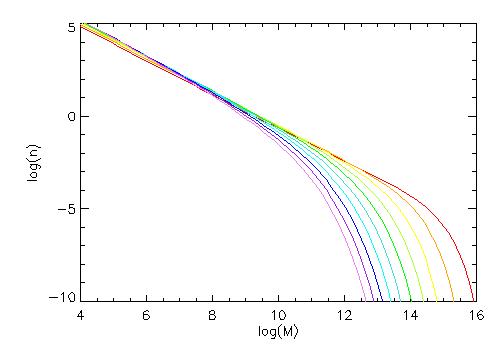
Anyway, courtesy of my estimable PhD student Jo Short, this is how the mass function of haloes is predicted to evolve in the standard cosmological model (the different lines show the distribution as a function of redshift for redshifts from 0 to 9):

It might be easier to see what’s going on looking instead at this figure which shows Mn(M) instead of n(M).

You can see that the typical size of a halo increases with decreasing redshift, but it’s only at really high masses where you see a really dramatic effect.

The mass of the black hole responsible for the recently-detected high-redshift quasar is estimated to be about 2 \times 10^{9} M_{\odot}. But how does that relate to the mass of the halo within which it resides? Clearly the dark matter halo has to be more massive than the baryonic material it collects, and therefore more massive than the central black hole, but by how much?

This question is very difficult to answer, as it depends on how luminous the quasar is, how long it lives, what fraction of the baryons in the halo fall into the centre, what efficiency is involved in generating the quasar luminosity, etc.   Efstathiou and Rees argued that to power a quasar with luminosity of order 10^{13} L_{\odot} for a time order 10^{8} years requires a parent halo of mass about 2\times 10^{11} M_{\odot}.

The abundance of such haloes is down by quite a factor at redshift 7 compared to redshift 0 (the present epoch), but the fall-off is even more precipitous for haloes of larger mass than this. We really need to know how abundant such objects are before drawing definitive conclusions, and one object isn’t enough to put a reliable estimate on the general abundance, but with the discovery of this object  it’s certainly getting interesting. Haloes the size of a galaxy cluster, i.e.  10^{14} M_{\odot}, are rarer by many orders of magnitude at redshift 7 than at redshift 0 so if anyone ever finds one at this redshift that would really be a shock to many a cosmologist’s  system, as would be the discovery of quasars at  redshifts significantly higher than seven.

Another thing worth mentioning is that, although there might be a sufficient number of potential haloes to serve as hosts for a quasar, there remains the difficult issue of understanding how precisely the black hole forms and especially how long that  takes. This aspect of the process of quasar formation is much more complicated than the halo distribution, so it’s probably on detailed models of  black-hole  growth that this discovery will have the greatest impact in the short term.