Not really time for a proper post today but I’m grateful to one of my PhD students for coming to the rescue by pointing out this clip in which our own Professor Mike Disney tell us everything he knows about cosmology. The video lasts 2 minutes and 48 seconds.
Archive for dark matter
The Cosmos according to Disney
Posted in The Universe and Stuff with tags Cosmology, dark matter, Mike Disney on May 25, 2011 by telescoperSeeing Dark Matter..
Posted in The Universe and Stuff with tags Abel 1689, astronomy, Cosmology, dark matter, Gravitational Lensing on November 13, 2010 by telescoperI found this intruiging and impressive image over at Cosmic Variance (there’s also a press release at the Hubble Space Telescope website with higher resolution images). It shows the giant cluster of galaxies Abell 1689 with, superimposed on it, a map of the matter distribution as reconstructed from the pattern of distortions of background galaxy images caused by gravitational lensing.

This picture confirms the existence of large amounts of dark matter in the cluster – the mass distribution causing lensing quite different from what you can see in the luminous matter – but it also poses a problem, in that the matter is much more concentrated in the centre of the cluster than current theoretical ideas seem to suggest it should be…
You can find the full paper here.
A New Theory of Dark Matter
Posted in Science Politics, The Universe and Stuff with tags astroparticle physics, bosons, Cosmology, dark matter, fermions, Keith Mason, Particle Physics on November 6, 2010 by telescoperSince this week has seen the release of a number of interesting bits of news about particle physics and cosmology, I thought I’d take the chance to keep posting about science by way of a distraction from the interminable discussion of funding and related political issues. This time I thought I’d share some of my own theoretical work, which I firmly believe offers a viable alternative to current orthodox thinking in the realm of astroparticle physics.
As you probably know, one of the most important outstanding problems in this domain is to find an explanation of dark matter, a component of the matter distribution of the Universe which is inferred to exist from its effects on the growth of cosmic structures but which is yet to be detected by direct observations. We know that this dark matter can’t exist in the form of familiar atomic material (made of protons, neutrons and electrons) so it must comrpise some other form of matter. Many candidates exist, but the currently favoured model is that it is made of weakly interacting massive particles (WIMPs) arising in particle physics theories involving supersymmetry, perhaps the fermionic counterpart of the gauge bosons of the standard model, e.g. the photino (the supersymmetric counterpart of the photon).
However, extensive recent research has revealed that this standard explanation may in fact be incorrect and circumstantial evidence is mounting that supports a radically different scenario. I am now in a position to reveal the basics of a new theory that accounts for many recent observations in terms of an alternative hypothesis, which entails the existence of a brand new particle called the k-Mason.
Standard WIMP dark matter comprises very massive particles which move very slowly, hence the term Cold Dark Matter or CDM, for short. This means that CDM forms structures very rapidly and efficiently, in a hierarchical or “bottom-up” fashion. This idea is at the core of the standard “concordance” cosmological model.
However, the k-Mason is known to travel such huge distances at such high velocity in random directions between its (rare) encounters that it not only inhibits the self-organisation of other matter, but actively dissipates structures once they have been formed. All this means that structure formation is strongly suppressed and can only happen in a “top-down” manner, which is extremely inefficient as it can only form small-scale structures through the collapse of larger ones. Astronomers have compiled a huge amount of evidence of this effect in recent years, lending support to the existence of the k-Mason as a dominant influence (which is of course entirely at odds with the whole idea of concordance).
Other studies also provide pretty convincing quantitative evidence of the large mean free path of the k-Mason.
Although this new scenario does seem to account very naturally for the observational evidence of collapse and fragmentation gathered by UK astronomers since 2007, there are still many issues to be resolved before it can be developed into a fully testable theory. One difficulty is that the k-Mason appears to be surprisingly stable, whereas most theories suggest it would have vanished long before the present epoch. On the other hand, it has also been suggested that, rather than simply decaying, the k-Mason may instead transform into some other species with similar properties; suggestions for alternative candidates emerging from the decay of the k-Mason are actively being sought and it is hoped this process will be observed definitively within the next 18 months or so.
However the biggest problem facing this idea is the extreme difficulty of detecting the k-Mason at experimental or observational facilities. Some scientists have claimed evidence of its appearance at various laboratories run by the UK’s Science and Technology Facilities Council (STFC), as well as at the Large Hadron Collider at CERN, but these claims remain controversial: none has really stood up to detailed scrutiny and all lack independent confirmation from reliable witnesses. Likewise there is little proof of the presence of k-Mason at any ground-based astronomical observatory, which has led many astronomers to conclude that only observations done from space will remain viable in the longer term.
So, in summary, while the k-Mason remains a hypothetical entity, it does furnish a plausible theory that accounts, in a broad-brush sense, for many disparate phenomena. I urge particle physicists, astronomers and cosmologists to join forces in the hunt for this enigmatic object.
NOTE ADDED IN PROOF: The hypothetical “k-Mason” referred to in this article is not to be confused with the better-known “strange” particle the k-Meson.
Astronomy Look-alikes, No. 40
Posted in Astronomy Lookalikes, The Universe and Stuff with tags Cosmology, dark matter, large-scale structure of the Universe, look-alikes on September 10, 2010 by telescoperObviously someone else has already noticed the remarkable similarity between the structure of the human brain and that revealed by computer simulations of the large-scale structure of the Universe.

Does this mean that dark matter is really just all in the mind?
Cosmology on its beam-ends?
Posted in Cosmic Anomalies, The Universe and Stuff with tags Cosmic Microwave Background, Cosmology, Dark Energy, dark matter, WMAP on June 14, 2010 by telescoperInteresting press release today from the Royal Astronomical Society about a paper (preprint version here) which casts doubt on whether the Wilkinson Microwave Anisotropy Probe supports the standard cosmological model to the extent that is generally claimed. Apologies if this is a bit more technical than my usual posts (but I like occasionally to pretend that it’s a science blog).
The abstract of the paper (by Sawangwit & Shanks) reads
Using the published WMAP 5-year data, we first show how sensitive the WMAP power spectra are to the form of the WMAP beam. It is well known that the beam profile derived from observations of Jupiter is non-Gaussian and indeed extends, in the W band for example, well beyond its 12.’6 FWHM core out to more than 1 degree in radius. This means that even though the core width corresponds to wavenumber l ~ 1800, the form of the beam still significantly affects the WMAP results even at l~200 which is the scale of the first acoustic peak. The difference between the beam convolved Cl; and the final Cl is ~ 70% at the scale of the first peak, rising to ~ 400% at the scale of the second. New estimates of the Q, V and W-band beam profiles are then presented, based on a stacking analysis of the WMAP5 radio source catalogue and temperature maps. The radio sources show a significantly (3-4σ) broader beam profile on scales of 10′-30′ than that found by the WMAP team whose beam analysis is based on measurements of Jupiter. Beyond these scales the beam profiles from the radio sources are too noisy to give useful information. Furthermore, we find tentative evidence for a non-linear relation between WMAP and ATCA/IRAM 95 GHz source fluxes. We discuss whether the wide beam profiles could be caused either by radio source extension or clustering and find that neither explanation is likely. We also argue against the possibility that Eddington bias is affecting our results. The reasons for the difference between the radio source and the Jupiter beam profiles are therefore still unclear. If the radio source profiles were then used to define the WMAP beam, there could be a significant change in the amplitude and position of even the first acoustic peak. It is therefore important to identify the reasons for the differences between these two beam profile estimates.
The press release puts it somewhat more dramatically
New research by astronomers in the Physics Department at Durham University suggests that the conventional wisdom about the content of the Universe may be wrong. Graduate student Utane Sawangwit and Professor Tom Shanks looked at observations from the Wilkinson Microwave Anisotropy Probe (WMAP) satellite to study the remnant heat from the Big Bang. The two scientists find evidence that the errors in its data may be much larger than previously thought, which in turn makes the standard model of the Universe open to question. The team publish their results in a letter to the journal Monthly Notices of the Royal Astronomical Society.
I dare say the WMAP team will respond in due course, but this paper spurred me to mention some work on this topic that was done by my friend (and former student) Lung-Yih Chiang. During his last visit to Cardiff we discussed this at great length and got very excited at one point when we thought we had discovered an error along the lines that the present paper claims. However, looking more carefully into it we decided that this wasn’t the case and we abandoned our plans to publish a paper on it.
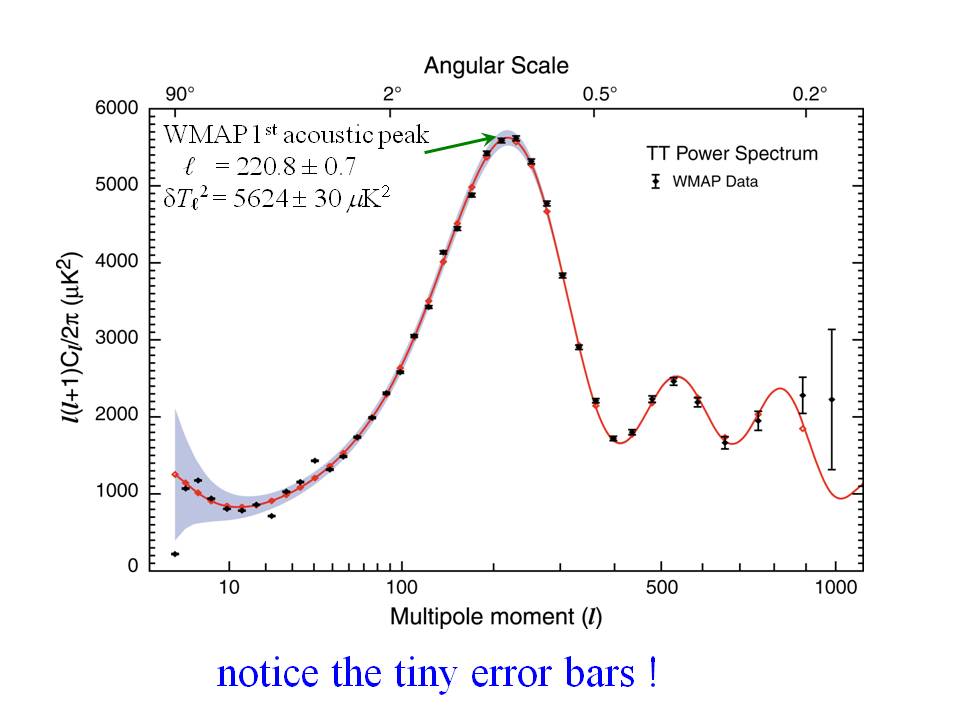
Let me show you a few slides from a presentation that Lung-Yih gave to me a while ago. For a start here is the famous power-spectrum of the temperature fluctuations of the cosmic microwave background which plays an essential role in determining the parameters of the standard cosmology:
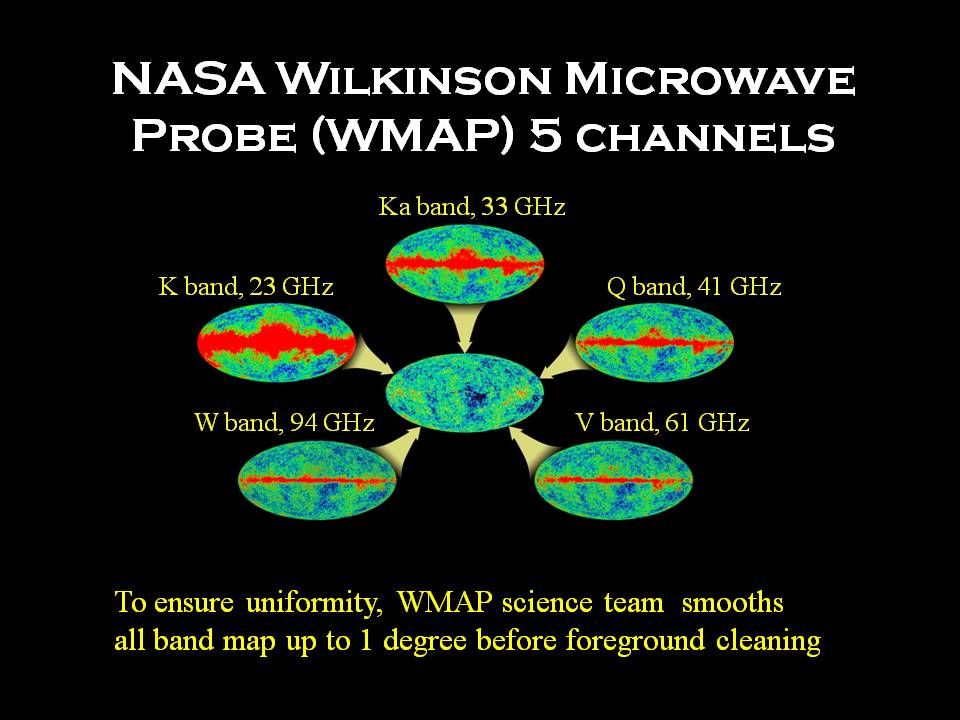
The position of the so-called “acoustic peak” plays an important role in determining the overall curvature of space-time on cosmological scales and the higher-order peaks pin down other parameters. However, it must be remembered that WMAP doesn’t just observe the cosmic microwave background. The signal it receives is heavily polluted by contamination from within our Galaxy and there is also significant instrumental noise. To deal with this problem, the WMAP team exploit the five different frequency channels with which the probe is equipped, as shown in the picture below.
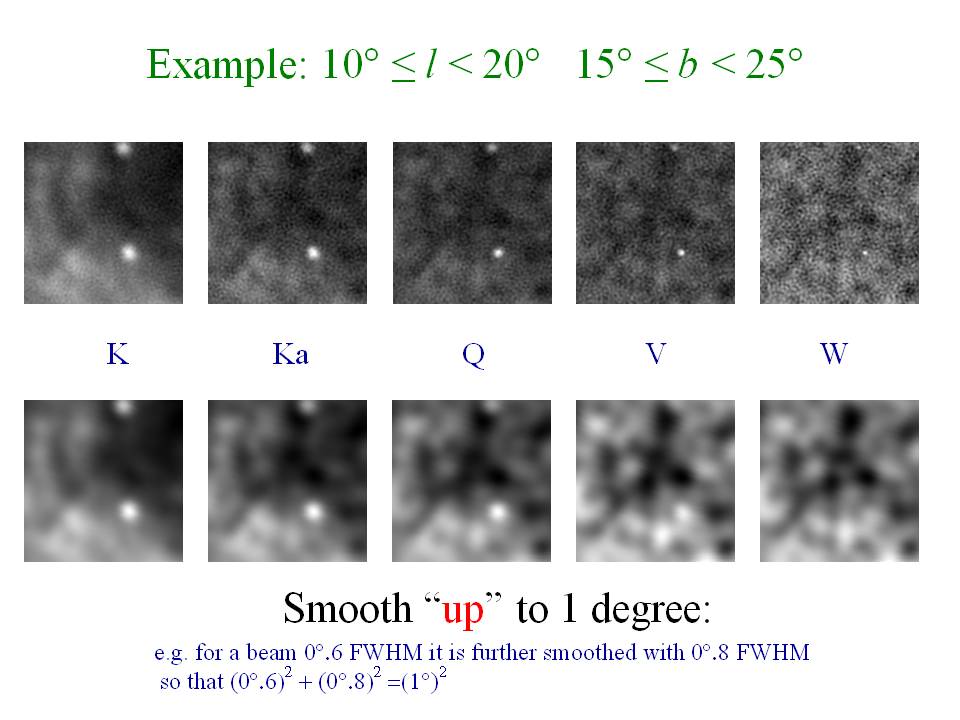
The CMB, being described by a black-body spectrum, has a sky temperature that doesn’t vary with frequency. Foreground emission, on the other hand, has an effective temperature that varies with frequency in way that is fairly well understood. The five available channels can therefore be used to model and subtract the foreground contribution to the overall signal. However, the different channels have different angular resolution (because they correspond to different wavelengths of radiation). Here are some sample patches of sky illustrating this
At each frequency the sky is blurred out by the “beam” of the WMAP optical system; the blurring is worse at low frequencies than at high frequencies. In order to do the foreground subtraction, the WMAP team therefore smooth all the frequency maps to have the same resolution, i.e. so the net effect of optical resolution and artificial smoothing produces the same overall blurring (actually 1 degree). This requires accurate knowledge of the precise form of the beam response of the experiment to do it accurately. A rough example (for illustration only) is given in the caption above.
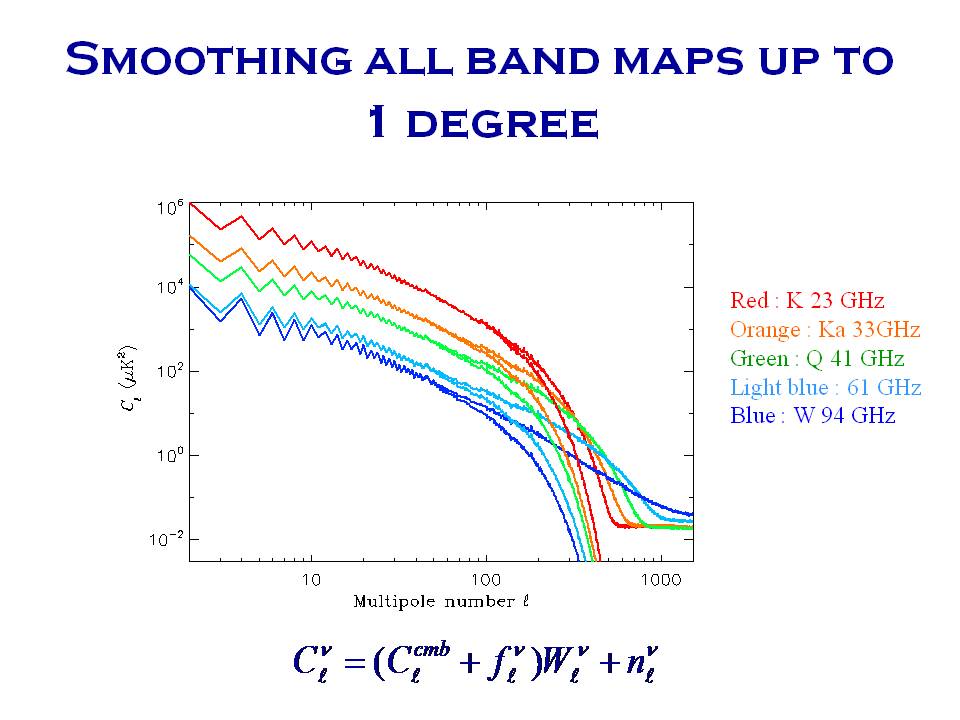
Now, here are the power spectra of the maps in each frequency channel
Note this is Cl not l(l+1)Cl as in the first plot of the spectrum. Now you see how much foreground there is in the data: the curves would lie on top of each other if the signal were pure CMB, i.e. if it did not vary with frequency. The equation at the bottom basically just says that the overall spectrum is a smoothed version of the CMB plus the foregrounds plus noise. Note, crucially, that the smoothing suppresses the interesting high-l wiggles.
I haven’t got space-time enough to go into how the foreground subtraction is carried out, but once it is done it is necessary to “unblur” the maps in order to see the structure at small angular scales, i.e. at large spherical harmonic numbers l. The initial process of convolving the sky pattern with a filter corresponds to multiplying the power-spectrum with a “window function” that decreases sharply at high l, so to deconvolve the spectrum one essentially has to divide by this window function to reinstate the power removed at high harmonics.
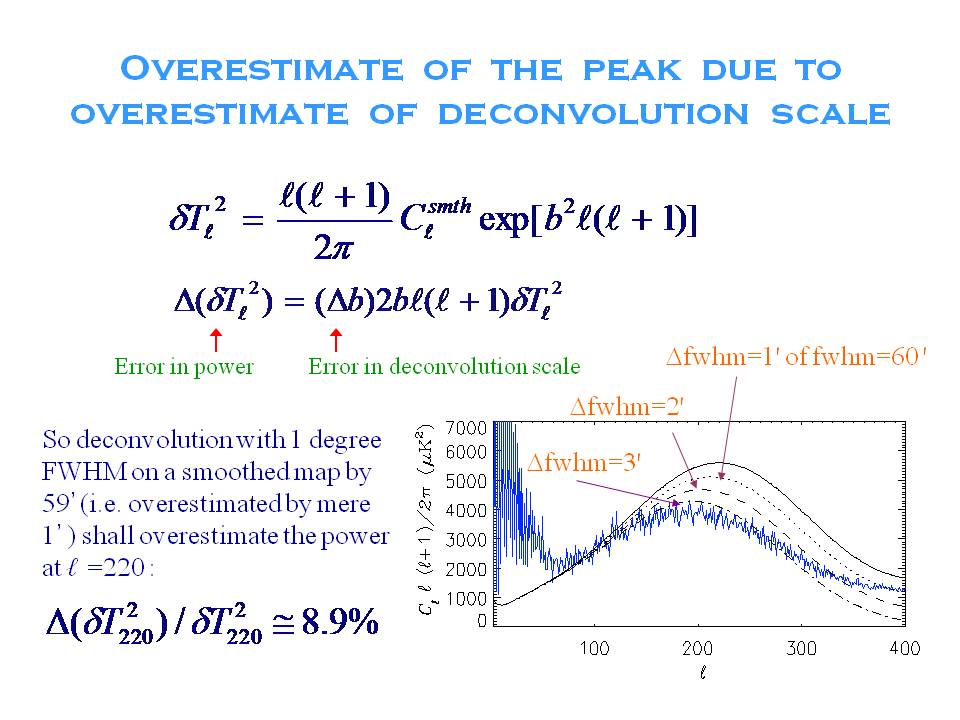
This is where it all gets very tricky. The smoothing applied is very close to the scale of the acoustic peaks so you have to do it very carefully to avoid introducing artificial structure in Cl or obliterating structure that you want to see. Moreover, a small error in the beam gets blown up in the deconvolution so one can go badly wrong in recovering the final spectrum. In other words, you need to know the beam very well to have any chance of getting close to the right answer!
The next picture gives a rough model for how much the “recovered” spectrum depends on the error produced by making even a small error in the beam profile which, for illustration only, is assumed to be Gaussian. It also shows how sensitive the shape of the deconvolved spectrum is to small errors in the beam.
Incidentally, the ratty blue line shows the spectrum obtained from a small patch of the sky rather than the whole sky. We were interested to see how much the spectrum varied across the sky so broke it up into square patches about the same size as those analysed by the Boomerang experiment. This turns out to be a pretty good way of getting the acoustic peak position but, as you can see, you lose information at low l (i.e. on scales larger than the patch).
The WMAP beam isn’t actually Gaussian – it differs quite markedly in its tails, which means that there’s even more cross-talk between different harmonic modes than in this example – but I hope you get the basic point. As Sawangwit & Shanks say, you need to know the beam very well to get the right fluctuation spectrum out. Move the acoustic peak around only slightly and all bets are off about the cosmological parameters and, perhaps, the evidence for dark energy and dark matter. Lung-Yih looked at the way the WMAP had done it and concluded that if their published beam shape was right then they had done a good job and there’s nothing substantially wrong with the results shown in the first graph.
Sawangwit & Shanks suggest the beam isn’t right so the recovered angular spectrum is suspect. I’ll need to look a bit more at the evidence they consider before commenting on that, although if anyone else has worked through it I’d be happy to hear from them through the comments box!
Dark Horizons
Posted in Cosmic Anomalies, The Universe and Stuff with tags Cold Dark Matter, Cosmic Microwave Background, Cosmology, Dark Energy, Dark Flow, dark matter, Horizon on March 21, 2010 by telescoperLast Tuesday night I gave a public lecture as part of Cardiff University’s contribution to National Science and Engineering Week. I had an audience of about a hundred people, although more than half were students from the School of Physics & Astronomy rather than members of the public. I’d had a very full day already by the time it began (at 7pm) and I don’t mind admitting I was pretty exhausted even before I started the talk. I’m offering that as an excuse for struggling to get going, although I think I got better as I got into it. Anyway, I trotted out the usual stuff about the Cosmic Web and it seemed to go down fairly well, although I don’t know about that because I wasn’t really paying attention.
At the end of the lecture, as usual, there was a bit of time for questions and no shortage of hands went up. One referred to something called Dark Flow which, I’ve just noticed, has actually got its own wikipedia page. It was also the subject of a recent Horizon documentary on BBC called Is Everything we Know about the Universe Wrong? I have to say I thought the programme was truly terrible, but that’s par for the course for Horizon these days I’m afraid. It used to be quite an interesting and informative series, but now it’s full of pointless special effects, portentous and sensationalising narration, and is repetitive to the point of torture. In this case also, it also portrayed a very distorted view of its subject matter.
The Dark Flow is indeed quite interesting, but of all the things that might threaten the foundations of the Big Bang theory this is definitely not it. I certainly have never lost any sleep worrying about it. If it’s real and not just the result of a systematic error in the data – and that’s a very big “if” – then the worst it would do would be to tell us that the Universe was a bit more complicated than our standard model. The same is true of the other cosmic anomalies I discuss from time to time on here.
But we know our standard model leaves many questions unanswered and, as a matter of fact, many questions unasked. The fact that Nature may present us with a few surprises doesn’t mean the whole framework is wrong. It could be wrong, of course. In fact I’d be very surprised if our standard view of cosmology survives the next few decades without major revision. A healthy dose of skepticism is good for cosmology. To some extent, therefore, it’s good to have oddities like the Dark Flow out in the open.
However, that shouldn’t divert our attention from the fact that the Big Bang model isn’t just an arbitrary hypothesis with no justification. It’s the result of almost a century of vigorous interplay between theory and observation, using an old-fashioned thing called the scientific method. That’s probably too dull for the producers of Horizon, who would rather portray it as a kind of battle of wills between individuals competing for the title of next Einstein.
Anyway, just to emphasize the fact that I think questioning the Big Bang model is a good thing to do, here is a list of fundamental questions that should trouble modern cosmologists. Most of them are fundamental, and we do not have answers to them.
Is General Relativity right?
Virtually everything in the standard model depends on the validity of Einstein’s general theory of relativity (or theory of general relativity…). In a sense we already know that the answer to this question is “no”.
At sufficiently high energies (near the Planck scale) we expect classical relativity to be replaced by a quantum theory of gravity. For this reason, a great deal of interest is being directed at cosmological models inspired by superstring theory. These models require the existence of extra dimensions beyond the four we are used to dealing with. This is not in itself a new idea, as it dates back to the work of Kaluza and Klein in the 1920s, but in older versions of the idea the extra dimensions were assumed to be wrapped up so small as to be invisible. In “braneworld models”, the extra dimensions can be large but we are confined to a four-dimensional subset of them (a “brane”). In one version of this idea, dubbed the Ekpyrotic Universe, the origin of our observable universe lies in the collision between two branes in a higher-dimensional “bulk”. Other models are less dramatic, but do result in the modification of the Friedmann equations at early times.
It is not just in the early Universe that departures from general relativity are possible. In fact there are many different alternative theories on the market. Some are based on modifications of Newton’s gravitational mechanics, such as MOND, modifications of Einstein’s theory, such as the Brans-Dicke theory, as well as those theories involving extra dimensions, such as braneworld theory, and so on
There remain very few independent tests of the validity of Einstein’s theory, particularly in the limit of strong gravitational fields. There is very little independent evidence that the curvature of space time on cosmological scales is related to the energy density of matter. The chain of reasoning leading to the cosmic concordance model depends entirely this assumption. Throw it away and we have very little to go on.
What is the Dark Energy?
In the standard cosmology, about 75% of the energy density of the Universe is in a form we do not understand. Because we’re in the dark about it, we call it Dark Energy. The question here is twofold. One part is whether the dark energy is of the form of an evolving scalar field, such as quintessence, or whether it really is constant as in Einstein’s original version. This may be answered by planned observational studies, but both of these are at the mercy of funding decisions. The second part is to whether dark energy can be understood in terms of fundamental theory, i.e. in understanding why “empty space” contains this vacuum energy. I think it is safe to say we are still very far from knowing how vacuum energy on a cosmological scale arises from fundamental physics. It’s just a free parameter.
What is the Dark Matter?
Around 25% of the mass in the Universe is thought to be in the form of dark matter, but we don’t know what form it takes. We do have some information about this, because the nature of the dark matter determines how it tends to clump together under the action of gravity. Current understanding of how galaxies form, by condensing out of the primordial explosion, suggests the dark matter particles should be relatively massive. This means that they should move relatively slowly and can consequently be described as “cold”. As far as gravity is concerned, one cold particle is much the same as another so there is no prospect for learning about the nature of cold dark matter (CDM) particles through astronomical means unless they decay into radiation or some other identifiable particles. Experimental attempts to detect the dark matter directly are pushing back the limits of technology, but it would have to be a long shot for them to succeed when we have so little idea of what we are looking for.
Did Inflation really happen?
The success of concordance cosmology is largely founded on the appearance of “Doppler peaks” in the fluctuation spectrum of the cosmic microwave background (CMB). These arise from acoustic oscillations in the primordial plasma that have particular statistical properties consistent owing to their origin as quantum fluctuations in the scalar field driving a short-lived period of rapid expansion called inflation. This is strong circumstantial evidence in favour of inflation, but perhaps not strong enough to obtain a conviction. The smoking gun for inflation is probably the existence of a stochastic gravitational wave background. The identification and extraction of this may be possible using future polarisation-sensitive CMB studies even before direct experimental probes of sufficient sensitivity become available. As far as I am concerned, the jury will be out for a considerable time.
Despite these gaps and uncertainties, the ability of the standard framework to account for such a diversity of challenging phenomena provides strong motivation for assigning it a higher probability than its competitors. Part of this is that no other theory has been developed to the point where we know what predictions it can make. Some of the alternative ideas I discussed above are new, and consequently we do not really understand them well enough to know what they say about observable situations. Others have adjustable parameters so one tends to disfavour them on grounds of Ockham’s razor unless and until some observation is made that can’t be explained in the standard framework.
Alternative ideas should be always explored. The business of cosmology, however, is not only in theory creation but also in theory testing. The great virtue of the standard model is that it allows us to make precise predictions about the behaviour of the Universe and plan observations that can test these predictions. One needs a working hypothesis to target the multi-million-pound investment that is needed to carry out such programmes. By assuming this model we can make rational decisions about how to proceed. Without it we would be wasting taxpayers’ money on futile experiments that have very little chance of improving our understanding. Reasoned belief in a plausible working hypothesis is essential to the advancement of our knowledge.
Cosmologists may appear a bit crazy (especially when they appear on TV), but there is method in their madness. Sometimes.
Dark Matter Rumour
Posted in The Universe and Stuff with tags CDMS, Cosmology, dark matter on December 8, 2009 by telescoperIn between a morning session – technically a “half-away-day” discussing Strategic Issues in the Development of Postgraduate Research at Cardiff University (zzzz..) and tootling off to Bristol this afternoon to give a recapitulation of my public lecture on the Cosmic Web to the South-West Branch of the Institute of Physics in Bristol, I don’t have time to post much today.
I will, however, take the opportunity to do what the blogosphere does best, which is to spread unfounded (or perhaps partly founded rumours). If it’s true this one is a biggy, but I’m not responsible for any loss or damage arising if it turns out to be untrue…
The rumour (which I first heard about here and then, a bit later, there) is that the Cryogenic Dark Matter Search (CDMS) experiment (which is based down a mine in Minnesota, but run from the University of California at Berkeley) is about to announce the direct discovery of dark matter.
I don’t have any inside information, but it is alleged that the collaboration has had paper accepted in Nature – and they generally only publish really significant results rather than upper limits (unless they are to do with gravitational waves). Nature articles are embargoed until publication, meaning that the collaboration can’t release the results or talk about them until December 18…
..so I guess you will just have to wait!