There’s news today of another discovery by ESA’s Euclid mission, of a quasar at redshift 8.13. That is now the record-holder for the most distant quasar ever observed. It’s only a matter of months since Euclid held the previous records (of redshifts 7.69 and 7.77) respectively. It was picked up by the Euclid Wide Survey and then analysed by a number of ground-based telescopes and ultimately by JWST, which revealed its redshift.
Here’s is the image
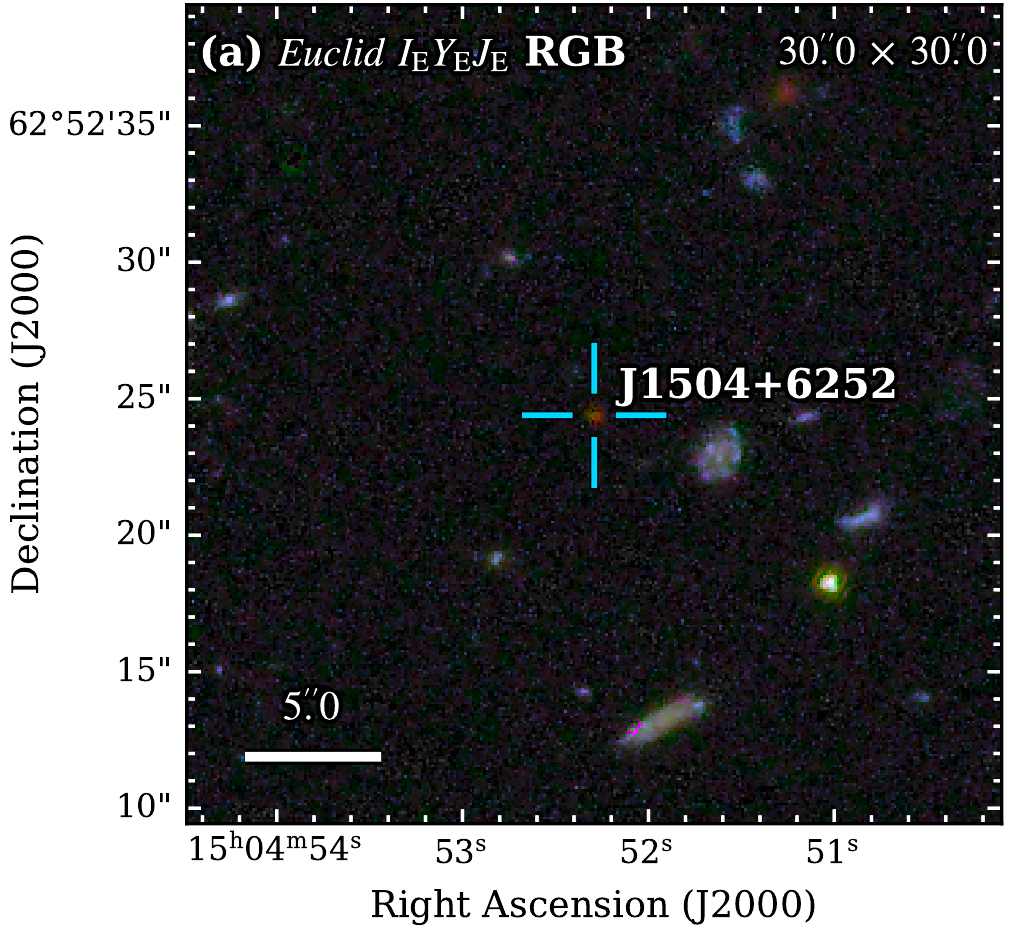
Quasars at high redshift are particularly interesting from an astrophysical point of view because they give an idea of how quickly structures form in the early Universe. It takes an enormous concentration of mass to power the intense luminosity of a quasar and there isn’t much time for that to have happened if the quasar is in place at a redshift z > 8, which corresponds to less than 5% of the current age of the Universe.
This story has another element of interest. The identification number given to the object is J1504+6252, but its nickname is Dún Aonghasa. According to the Euclid story
Dún Aonghasa is named after the prehistoric cliff-top fort on Inis Mór, located at the Atlantic edge of Ireland where land gives way to a vast oceanic horizon. Likewise, J1504+6252 stands at the current observational frontier of quasars illuminating the threshold to even earlier cosmic times waiting to be explored.
I’ve never been to Inis Mór – it’s one of the trips I must make when I’ve retired – but Dún Aonghasa is indeed a spectucular site:
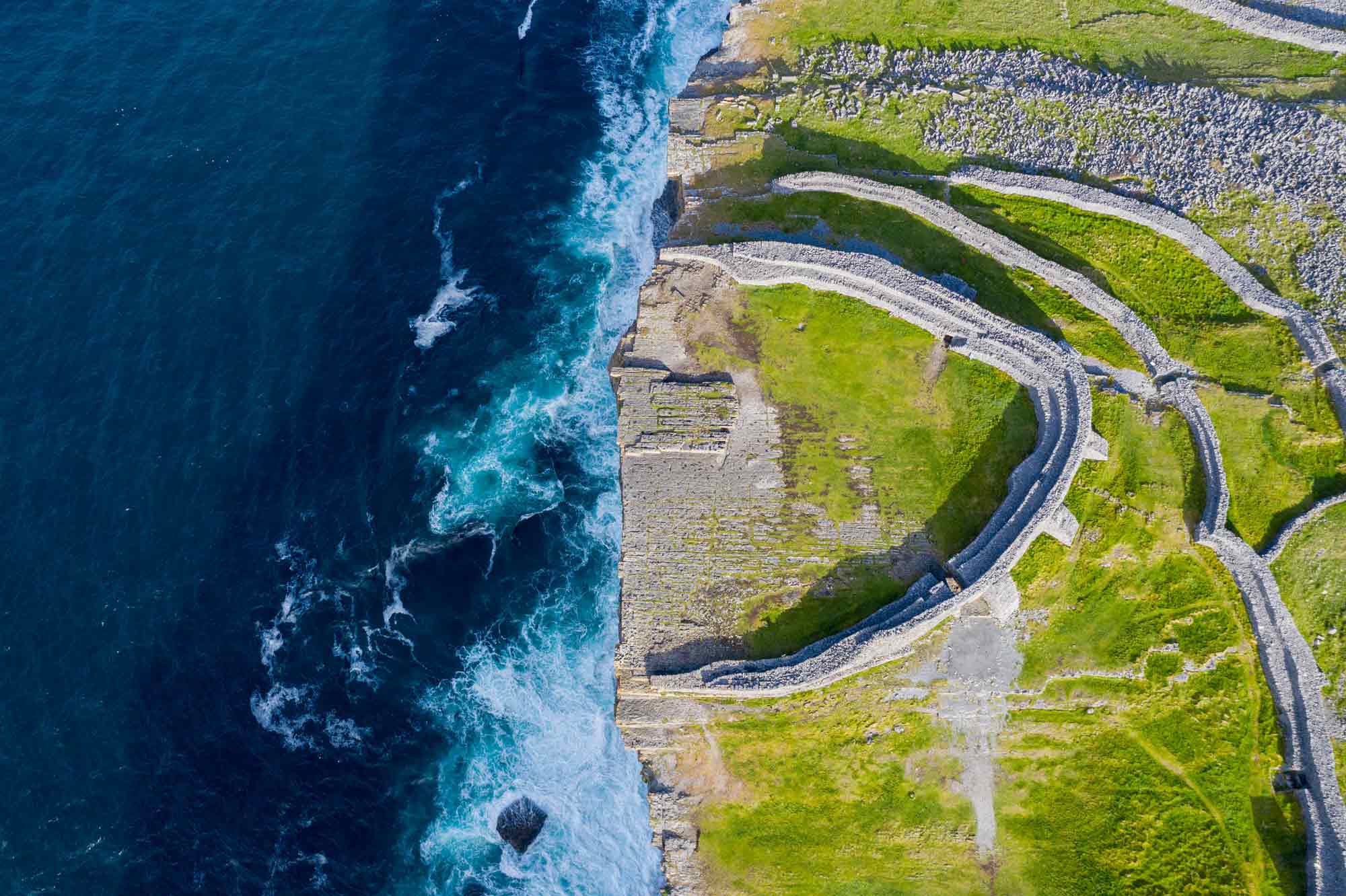
The location, on the largest of the Aran Islands, is on the edge of a cliff, with a 100-metre sheer drop to the sea. Like the quasar named after it, the origins of the fort of Dún Aonghasa are shrouded in mystery.The original construction probably dates from the Bronze Age (around 1100 BCE) but it has been extensively rebuilt at different stages over the centuries into the late mediaeval period. Recent studies indicate that at the time it was first built, sea levels were much lower and it was on a hill about 1km from the coast. Over the years, the encroaching sea and consequent coastal erosion resulted in about half the structure falling into the sea. One can still see the large stone slab which was originally in the centre and whose purpose is unknown. It’s in many ways as mysterious as the black hole at the centre of the quasar…
I’ve always been fascinated by the connections between cosmology and archaeology. Both disciplines involve trying to reconstruct the distant past from observations and measurements made at the present, though the timescales and techniques differ substantially. There is a nice illustration of this in the association of prehistoric Irish hill fort with the quasar found by Euclid. I wonder who can have suggested this link? 😉


