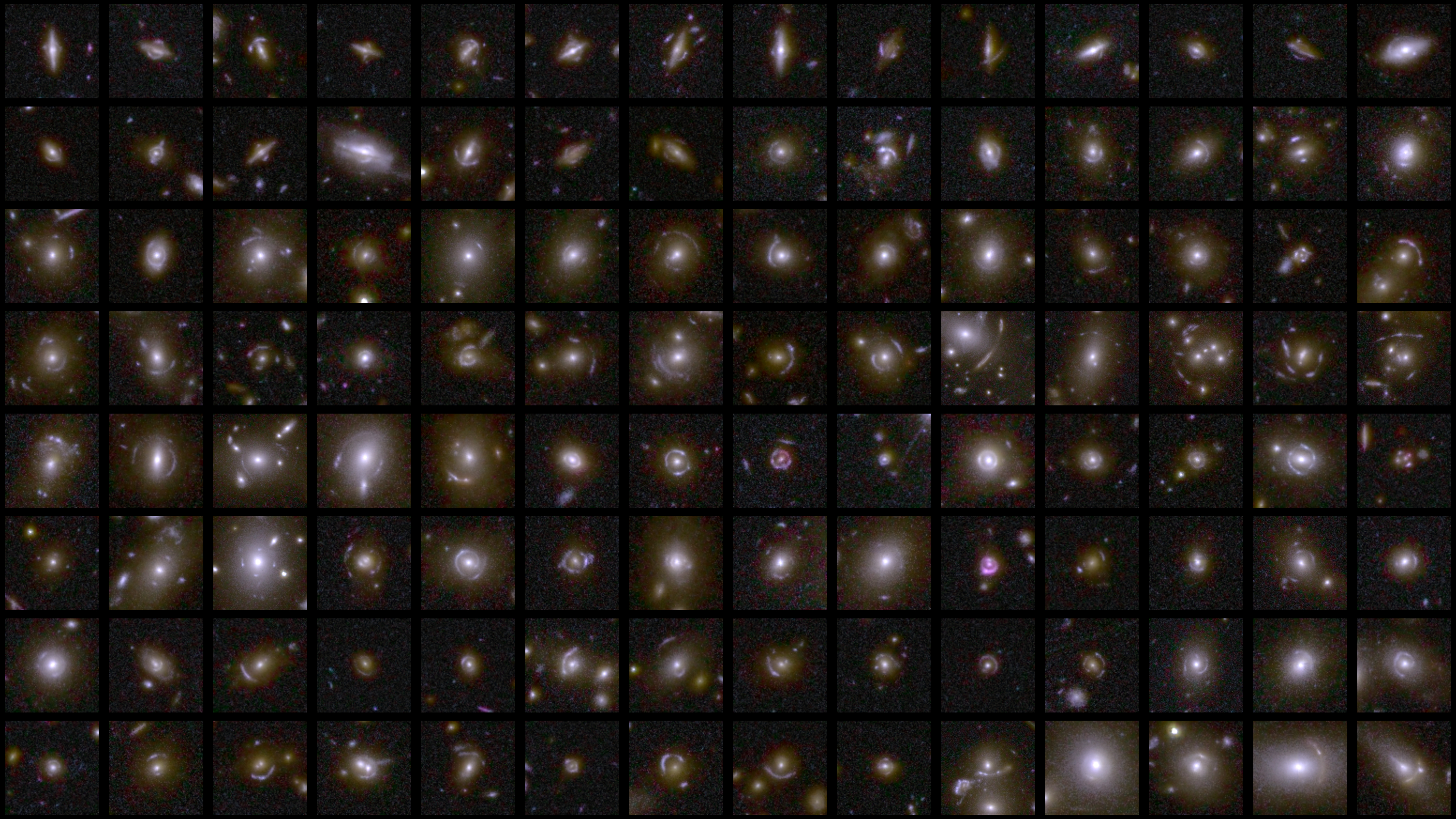
I’m sharing the text of a press release from Euclid here to encourage readers to join in this new Zooniverse project.
–o–
In brief
With the launch of Space Warps, a new citizen science project on the Zooniverse platform, you can now join in the search to find rare and elusive strong gravitational lenses in never-before-seen images captured by the European Space Agency’s Euclid space telescope. The project aims at shining a light on dark matter in galaxies and providing clues about mysterious dark energy.
In-depth
Warps in spacetime do not only show up in science fiction movies like Interstellar. In real life, we can see the warping effect that gravity has on spacetime in the form of gravitational lensing.
The enormous gravity of a massive object – such as a galaxy or cluster of galaxies – distorts the shape of spacetime and can bend the light rays coming from a distant galaxy behind. By warping spacetime, the foreground galaxy acts like a magnifying glass.
Light from the background object that would be obscured doesn’t travel in a straight line anymore. Instead, it curves around the intervening mass, often producing multiple images, stretched arcs, or even a complete ring known as ‘Einstein ring’, like the one recently discovered by Euclid.
Strong gravitational lenses offer a striking demonstration of Einstein’s theory of general relativity, showing that matter in the Universe can act as a natural telescope, bringing distant objects into sight.
ESA’s Euclid telescope is revolutionising the studies of strong gravitational lensing by providing very sensitive imaging over large swaths of the sky in unprecedented detail. This is exactly what is needed to identify rare gravitational lenses.
In March 2025, 500 galaxy-galaxy strong lenses were found nestled in just the first 0.04% of Euclid data, most of them previously unknown. This pioneering catalogue was created thanks to the combined effort from citizen scientists, artificial intelligence (AI) and researchers.
Early glimpse of new Euclid images
As Euclid continues its survey, sending around 100 GB of data back to Earth every day, ESA and the Euclid Consortium once again need help from citizen scientists to identify strong gravitational lenses in a large data set.
For this, the Space Warps team has launched a citizen science project based on new Euclid images, which will be part of the future Euclid Data Release 1. While this data is not public yet, by participating in this new citizen science project you can get an early glimpse of these new images of galaxies captured by the telescope.
For this project, you will be inspecting new high quality imaging data from Euclid in which many previously unknown strong lenses are hiding. About three hundred thousand images pre-selected by AI algorithms will be shown, which are fine-tuned with the results from the initial citizen-science Euclid strong lens search. These are the highest ranked candidates from a whopping 72 million galaxies from DR1 that were classified by the AI algorithms. Scientists expect that this exquisite high-quality data will reveal more than 10 000 new lenses.
What can we learn from strong lenses
The Euclid mission explores how the Universe has expanded and how its structure has changed through cosmic history using mainly two methods: weak lensing and baryonic acoustic oscillations. From this, scientists can learn more about the role of gravity and the nature of dark matter and dark energy.
Strong gravitational lenses can also provide insights into these central questions. For example, strong lensing features can ‘weigh’ individual galaxies and clusters of galaxies. This reveals the total matter (whether dark or light) and traces the distribution of dark matter. By studying strong lenses across cosmic time, scientists can trace the expansion of the Universe and its apparent acceleration. This will provide additional insight into the role of dark energy.
“We’ve already seen the success of combining AI with visual inspection by citizen volunteers and scientists on Space Warps, efficiently finding hundreds of high‑probability lens candidates in an initial small Euclid search in 2024”, explains Aprajita Verma, Space Warps’ co-founder and project lead at the University of Oxford, UK.
“In this brand new DR1 data, 30 times larger than the initial search and together with our improved AI algorithms, we are expecting to find more than 10 000 high quality lens candidates. This is more than four times the number of lenses than we have been able to find since the first gravitational lens was discovered nearly 50 years ago.”
This step-change is possible thanks to Euclid. The mission can map large areas of the sky with unique sharpness, an ideal combination for finding rare objects like strong gravitational lenses.
“We can’t wait to see what we will find within this unprecedented dataset. Join us on Space Warps to take part in this exciting search!” concludes Aprajita.
About Euclid
Euclid was launched in July 2023 and started its routine science observations on 14 February 2024. The goal of the mission is to reveal the hidden influence of dark matter and dark energy on the visible Universe. Over a period of six years, Euclid will observe the shapes, distances and motions of billions of galaxies out to 10 billion light-years.
Euclid is a European mission, built and operated by ESA, with contributions from NASA. The Euclid Consortium – consisting of more than 2000 scientist from 300 institutes in 15 European countries, the USA, Canada, and Japan – is responsible for providing the scientific instruments and scientific data analysis. ESA selected Thales Alenia Space as prime contractor for the construction of the satellite and its service module, with Airbus Defence and Space chosen to develop the payload module, including the telescope. NASA provided the detectors of the Near-Infrared Spectrometer and Photometer, NISP. Euclid is a medium-class mission in ESA’s Cosmic Vision Programme.


