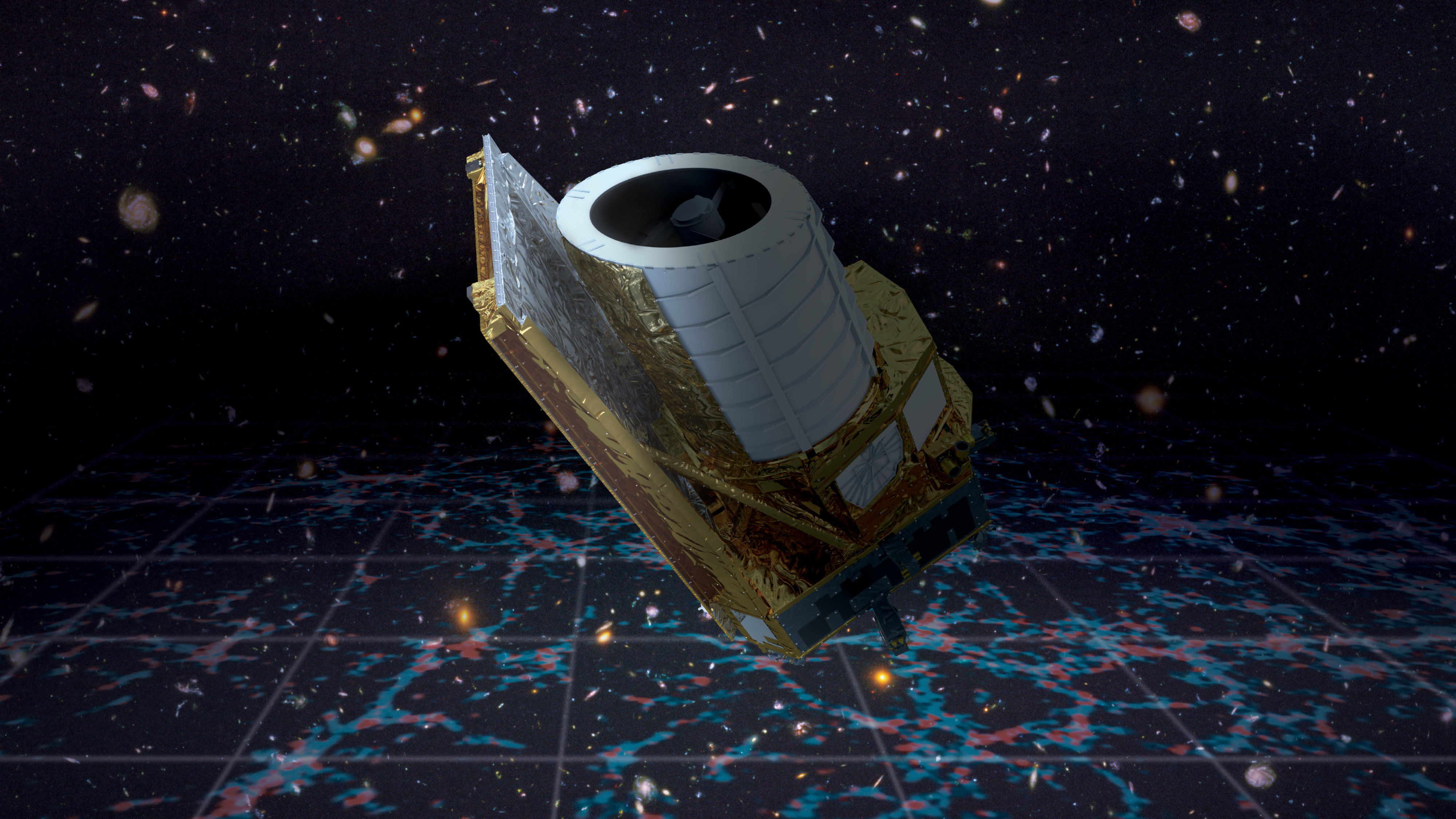
The Euclid Consortium is celebrating the first year of the journey of the European Space Agency’s Euclid Mission into space! Over the past 52 weeks, Euclid has been scanning the cosmos, uncovering new insights into dark matter, dark energy, and the structure of the universe. The Euclid Consortium has produced a slideshow, showcasing the key moments and discoveries from the first year in space.
The slideshow can be seen on YouTube here:
Here is a poster:
This can also found in interactive form here where you can click on each of the 52 images to see what it’s about.
P.S. The subtitle of the poster is “first year of a big journey to new physics”. There’s no guarantee that Euclid will find any new physics, rather than confirming our existing ideas, but it might.
Today sees the launch of a new initiative between Galaxy Zoo (part of the Zooniverse conglomerate) and the Euclid Consortium which I am delighted to be able to promote on this blog. What follows the graphic is the text of the announcement which is being promoted across social media today. I’ll start with a little factoid which might surprise you: already in November 2023, before science operations even began, Euclid had sent back to Earth more data than the Hubble Space Telescope has done in in its entire lifetime.
Thanks to a new Galaxy Zoo project launched today, you can help identify the shapes of thousands of galaxies in images taken by ESA’s Euclid space telescope. These classifications will help scientists answer questions about how the shapes of galaxies have changed over time, and what caused these changes and why.
In its mission to map out the Universe, Euclid will image hundreds of thousands of distant galaxies. In November 2023 and May 2024, the world got its first glimpse at the quality of Euclid’s images, which included a variety of sources, from nearby nebulas to distant clusters of galaxies. In the background of each of these images are hundreds of thousands of distant galaxies.
This square astronomical image shows thousands of galaxies across the black expanse of space. The closest thousand or so galaxies belong to the Perseus Cluster.
For the next six years, the spacecraft is expected to send around 100 GB of data back to Earth every day. That’s a lot of data, and labelling that through human effort alone is incredibly difficult.
That’s why ESA and Euclid consortium scientists have partnered with Galaxy Zoo. This is a citizen science project on the Zooniverse platform, where members of the public can help classify the shapes of galaxies.
Euclid will release its first catalogues of data to the scientific community starting in 2025, but in the meantime any volunteer on the Galaxy Zoo project can have a glimpse at previously unseen images from the telescope.
You could be the first person to lay eyes on a galaxy
The first set of data, which contains tens of thousands of galaxies selected from more than 800 000 images, has been made available on the platform, and is waiting for you to help classify them.
If you partake in the project, you could be the first to lay eyes on Euclid’s latest images. Not only that, you could also be the first human ever to see the galaxy in the image.
The Galaxy Zoo project was first launched in 2007, and asked members of the public to help classify the shapes of a million galaxies from images taken by the Sloan Digital Sky Survey. In the past 17 years, Galaxy Zoo has remained operational, with more than 400 000 people classifying the shapes of galaxies from other projects and telescopes, including the the NASA/ESA Hubble Space Telescope and the NASA/ESA/CSA James Webb Space Telescope.
Humans and AI working together
These classifications are not only useful for their immediate scientific potential, but also as a training set for Artificial Intelligence (AI) algorithms. Without being taught what to look for by humans, AI algorithms struggle to classify galaxies. But together, humans and AI can accurately classify limitless numbers of galaxies.
At Zooniverse, the team has developed an AI algorithm called ZooBot, which will sift through the Euclid images first and label the ‘easier ones’ of which a lot of examples already exist in previous galaxy surveys. When ZooBot is not confident on the classification of a galaxy, perhaps due to complex or faint structures, it will show it to users on Galaxy Zoo to get their human classifications, which will then help ZooBot to learn more.
On the platform, volunteers will be presented with images of galaxies and will then be asked several questions, such as “Is the galaxy round?”, or “Are there signs of spiral arms?”.
After being trained on these human classifications, ZooBot will be integrated in the Euclid catalogues to provide detailed classifications for hundreds of millions of galaxies, making it the largest scientific catalogue to date, and enabling groundbreaking new science.
This project makes use of the ESA Datalabs digital platform to generate a large number of cutouts of galaxies imaged by Euclid.
Thanks to a new Galaxy Zoo project launched today, you can help identify the shapes of thousands of galaxies in images taken by ESA’s Euclid space telescope. These classifications will help scientists answer questions about how the shapes of galaxies have changed over time, and what caused these changes and why.
The first set of data, which contains tens of thousands of galaxies selected from more than 800 000 images, has been made available on the platform, and is waiting for you to help classify them.
Examples of Euclid galaxies to classify are shown in this image.
Euclid Galaxy Zoo galaxies to classify. Forty galaxies are shown against a black background. The galaxies are all different in shape, some look like spirals, some look barred, or smooth. Image credit: ESA/Euclid/Euclid Consortium/NASA, CC BY-SA 3.0 IGO or ESA Standard Licence
Euclid is a European mission, built and operated by ESA, with contributions from NASA. The Euclid Consortium – consisting of more than 2000 scientists from 300 institutes in 15 European countries, the USA, Canada and Japan – is responsible for providing the scientific instruments and scientific data analysis. ESA selected Thales Alenia Space as prime contractor for the construction of the satellite and its service module, with Airbus Defence and Space chosen to develop the payload module, including the telescope. NASA provided the detectors of the Near-Infrared Spectrometer and Photometer, NISP. Euclid is a medium-class mission in ESA’s Cosmic Vision Programme.
It was officially announced at last year’s Euclid Consortium Meeting in Copenhagen that I had been appointed to the role of Chair of the Euclid Consortium Diversity Committee (ECDC). Following the tradition, a similar announcement was made at the Rome meeting this year that from 1st July there would be a new Chair in the form of Helmut Dannerbauer, who is based at the Instituto de Astrofísicas de Canarias on Tenerife. There are still a few loose ends to tie up, not helped by my computer problems, but I’m gradually winding up my activity on the ECDC and handing things over to Helmut.
As I pointed out in my post last year, I was in the final year of my stint on the ECDC when I was made Chair so it was always envisaged that I would serve for only one year. I only agreed to do it, in fact, because I had my sabbatical coming up. I definitely wouldn’t have been able to do the job alongside a full teaching and other workload and didn’t even consider continuing after my sabbatical was over.
Instead of trying to describe the role and activities of the ECDC generally, I will direct you to the information given on the brand new Euclid Consortium website which is a one-stop shop for everything to do with Euclid. You can find specific information about Equity, Diversity and Conduct there and/or on the ECDC’s own public website here from which I’ve taken a screengrab of the nice banner:
Just for information, the Euclid Consortium has about 2600 members so it really is a very large organization. It is also very international, with many people working in countries they were not born in and whose language is not their first. It is the aim of the ECDC to encourage a positive and inclusive environment within it for the benefit of everyone in it. The diversity in Euclid has many dimensions, including gender, nationality, ethnicity, and career stage as well as type of work; Euclid comprises specialists in instrumentation, software engineering, observational astronomy and theory to name but a few. The aim of the ECDC is to try to make sure everyone can work together in an inclusive environment.
It has been good to see over the few years some policies have been implemented to allow a greater diversity among leadership roles in the Euclid Consortium, especially by having a planned programme of rotating chairs and coordinators. I think this and other inititiatives are making a difference.
Euclid was launched a year ago yesterday, and the past twelve months have involved a huge amount of hard work by everyone concerned and not a little tension in some parts. The stress will continue as we head towards DR1, the first main Data Release, in 2026. The Euclid Consortium has a Code of Conduct to remind members to behave professionally towards their fellow workers at all times.
I’d like to wish all the new members of the ECDC, and those continuing, all the best in the future. I’d also like to extend personal thanks to those members who are leaving this year, especially Marc, Florence and Chiara. We have had regular telecons virtually every fortnight for the last year and I’ve enjoyed everyone’s contribution to the discussions.
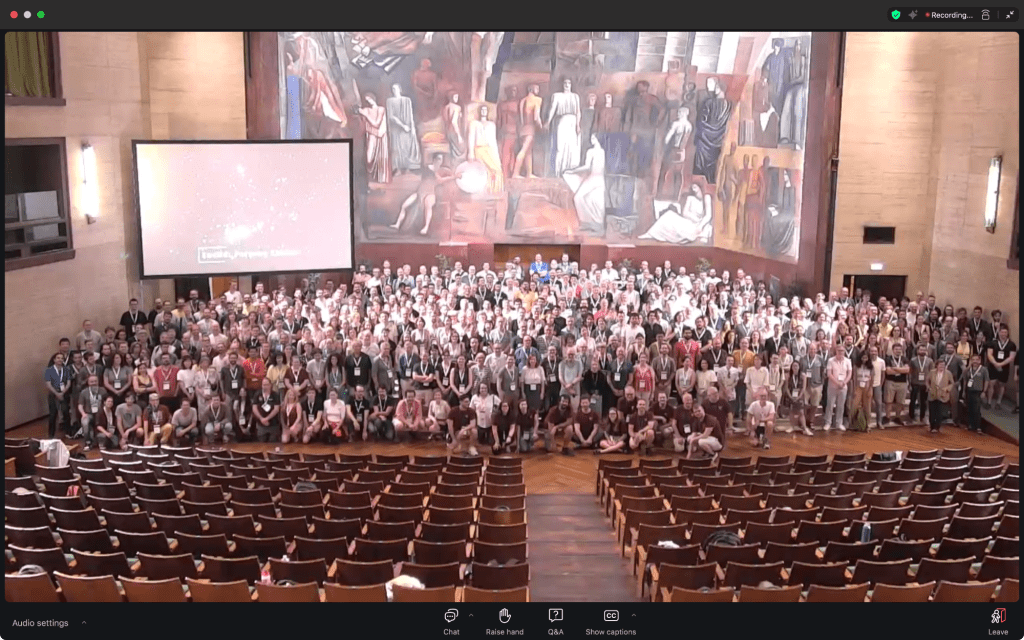
I thought I’d share the conference photograph from last week’s annual Euclid Consortium Meeting in Rome, along with a big “Thank You” to the organizers (both LOC and SOC). It’s a huge amount of work to organise a meeting of over 600 people. Although I was only there for a couple of days, I thought it went very well.
Next year’s meeting will be in Leiden in March so I probably won’t be able to attend because of teaching. But guess where it will be in 2026? Barcelona!
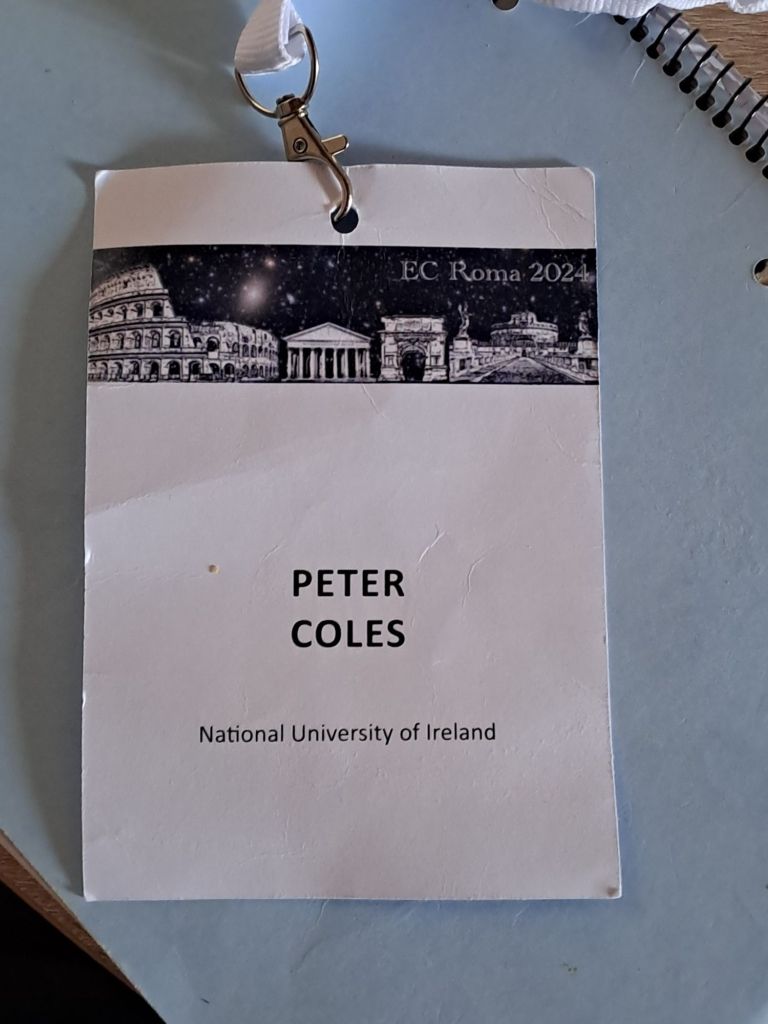
Among the various items of Euclid Merch in the goody bag given to attendees at the annual Euclid Consortium Meeting in Rome are a nice bag, a cap, a notebook, and a mystery object:
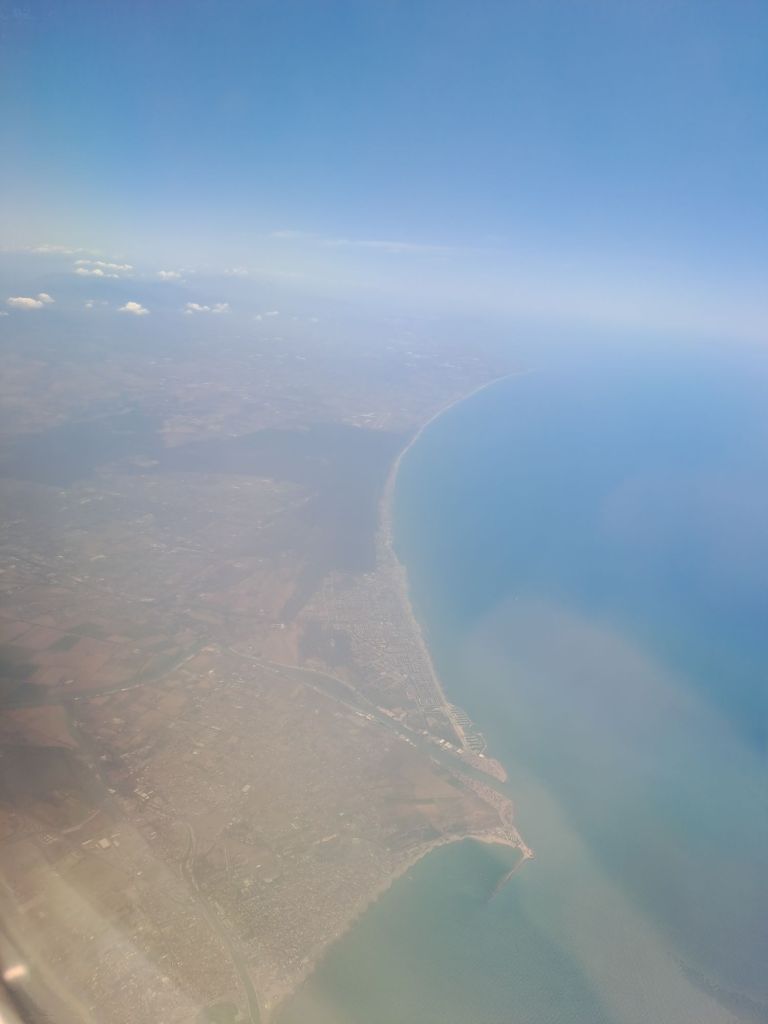
This morning, I took a short (~ 90 minute) flight from the pleasantly warm (23°C) Barcelona to the swelteringly hot (31°C) city of Rome. It’s actually forecast to be 39°C on Thursday and 40°C on Friday. Fortunately, I’m not staying that long!
The occasion for this trip is the annual Euclid Consortium Meeting, which is being held at the Università degli Studi di Roma “La Sapienza“. The main sessions are in the splendid Aula Maxima thereof, with its imposing mural:
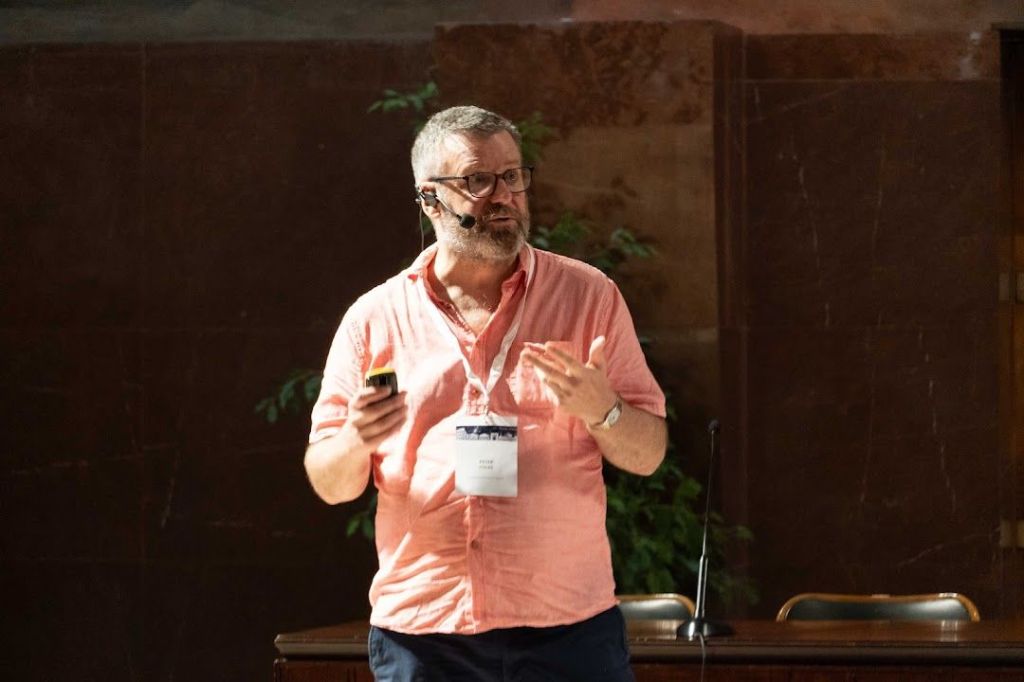
I’m giving a talk there in the first plenary session tomorrow…
It’s a hectic time ahead of a Big Event on Thursday 23rd May, which will include the publication of five new Early Release Observations (EROs). I’m not at liberty to say what they are until after 12 noon (CEST) on Thursday except that they’re very pretty. You can watch the live stream here:
Thursday will also see the release of ten scientific papers related to the EROs; they will appear on arXiv on Friday 24th May. These will be the first science results from the Euclid mission.
But that’s not all! Thursday will also see the publication of five papers from the Euclid Consortium (of which I am the sole member based in Ireland). These will be the principal technical reference papers aimed at the astronomical community about the Euclid mission, covering the instruments, cosmology and other astronomy science possibilities, as well as the cosmological simulations used to assist the analysis of the mission. One of these, the main overview paper for the mission, has over a thousand authors (one of whom is your truly).
Thursday’s announcements are likely to significant level of press interest. That’s not only due to the European Space Agency’s own social media feeds and the like, but also local activities in Ireland. For example, there’s this from Science Foundation Ireland using this, from the Little Book of Irish Research:
I have also written a piece for RTÉ Brainstorm, as a kind of update on the one I wrote last year on the occasion of the launch; this will go live after the embargo is lifted on Thursday.
I just heard some excellent news about Euclid so thought I would post a quick update here. I won’t say much because there will no doubt be official communications from the European Space Agency and the Euclid Consortium. You can find a variety of Euclid-related posts on this blog here.
Over the past few months, there has been a huge amount of activity relating to commissioning the instruments, verifying their performance, and measuring parameters of the optical system that will be needed for analysis of the huge amount of data due to come from Euclid. All this effort fed into the Mission Commissioning Results Review (MCRR) which concluded yesterday that all was well.
This is an important milestone for Euclid because, in ESA parlance, it marks the change from a project to a mission. Until commissioning, there is a project manager who works with ESA and the industrial contractors to ensure everything functions properly; when nominal operations start the project team is disbanded and the mission team takes over; and so it came to pass that the Project Manager (Giuseppe Racca) handed over the reins to the Mission Manager (Pierre Ferruit).
That’s when the role of the Euclid Consortium increases substantially. In particular the Science Ground Segment (SGS), which includes the pipelines that will process the data, has been declared to be ready for business. You can read more about the SGS here but here’s a graphic that shows how data comes from the telescope, external telescopes, or simulations, then run through their respective pipelines for VIS, NISP, or external data, then are merged into a coherent format. Pipelines then extract scientific information and compute science data products for further analysis
Each element of this diagram is rather complex. Here, for example, is the organization of the Science Data Centre (SDC) component of the Science Ground Segment at the bottom of the above picture, consisting of computing centers responsible for implementing and running the data processing pipelines:
Anyway, the immediate upshot of all this is that full surveying activities of Euclid can now proceed. The Euclid mission will conduct primarily two different surveys: a “Wide Survey”, covering about 15,000 square degrees on the sky, and a “Deep Survey” of about 50 square degrees, where the instruments will observe three fields much longer than the rest of the sky to capture much fainter galaxies and hence look further out into space. I understand that the Wide Survey will commence in earnest on 14th February.The timescale from now is that the first full set of survey data (DR1) will be available internally to the Euclid Consortium in May or June 2025 and will be made public a year later (i.e. by June 2026).
That doesn’t mean that Euclid will be silent until 2026. In fact, the first batch of post-launch papers will come out very soon, in May 2024. This will include science papers resulting from the Early Release Observations – the data from these will also be made public at the same time – as well as an overview paper for the whole mission and papers describing the details of NISP and VIS instruments using measurements made during commissioning. There will also be a release in May 2025 of data from the Deep Survey patch of about 50 square degrees.
Time for another nice little video explainer about Euclid. This one is largely about the role of large computer simulations (particularly the Flagship simulation) in preparing for (and in future in analyzing) the Euclid survey.
The full blurb accompanying the video is appended here:
ESA’s Euclid mission will create a 3D-map of the Universe that scientists will use to measure the properties of dark energy and dark matter and uncover the nature of these mysterious components. The map will contain a vast amount of data, it will cover more than a third of the sky and its third dimension will represent time spanning 10 billion years of cosmic history.
But dealing with the huge and detailed set of novel data that Euclid observations will produce is not an easy task. To prepare for this, scientists in the Euclid Consortium have developed one of the most accurate and comprehensive computer simulations of the large-scale structure of the Universe ever produced. They named this the Euclid Flagship simulation.
Running on large banks of advanced processors, computer simulations provide a unique laboratory to model the formation and evolution of large-scale structures in the Universe, such as galaxies, galaxy clusters, and the filamentary cosmic web they form. These state-of-the-art computational techniques allow astrophysicists to trace the motion and behavior of an extremely large number of dark-matter particles over cosmological volumes under the influence of their own gravitational pull. They replicate how and where galaxies form and grow, and are used to predict their distribution across the celestial sphere.
Explore the Euclid Flagship simulation in this video and get a sneak preview of the structure of the dark Universe, as we currently model it. New insights will be brought to you by the Euclid mission in the coming years.
It was officially announced at the Euclid Consortium Meeting in Copenhagen this morning that I have been appointed to the role of Chair of the Euclid Consortium Diversity Committee (ECDC). This has been in the pipeline for a while, but I have refrained from saying anything publicly until the appointment was endorsed by the Euclid Consortium Lead (ECL) and Euclid Consortium Board (ECB) which has now happened.
The previous Chair, Prof. Mathilde Jauzac, is stepping down because her term on the ECDC has come to an end. I’ve been a member of the ECDC for three years during which time Mathilde has done a brilliant job as Chair and she’ll be a very difficult act to follow in this role. There was a standing ovation in the room this morning when Mathilde finished delivering her final ECDC report. It will be down to me to deliver next year’s report, at the 2024 Euclid Consortium Meeting, which will be in Rome.
Instead of trying to describe the role and activities of the ECDC generally, I will direct you to the information given on the brand new Euclid Consortium website which is a one-stop shop for everything to do with Euclid. You can find specific information about Equity, Diversity and Conduct there and/or on the ECDC’s own public website here from which I’ve taken a screengrab of the nice banner:
Just for information, the Euclid Consortium has about 2700 members so it really is a very large organization, and it is the aim of the ECDC to encourage a positive and inclusive environment within it for the benefit of everyone in it.
I’m looking forward to this role for the next year. I have only one year left of my term left on the ECDC so I will almost certainly be Chair for one year only. As regular readers of this blog – both of them – will know, I am on sabbatical next year which means I should have time to take on this responsibility, which I wouldn’t be able to do if I had my full teaching and admin load.
The views presented here are personal and not necessarily those of my employer (or anyone else for that matter).
Feel free to comment on any of the posts on this blog but comments may be moderated; anonymous comments and any considered by me to be vexatious and/or abusive and/or defamatory will not be accepted. I do not necessarily endorse, support, sanction, encourage, verify or agree with the opinions or statements of any information or other content in the comments on this site and do not in any way guarantee their accuracy or reliability.