Among the various items of Euclid Merch in the goody bag given to attendees at the annual Euclid Consortium Meeting in Rome are a nice bag, a cap, a notebook, and a mystery object:

Can anyone suggest what this item does?
(Wrong answers preferred.)
Among the various items of Euclid Merch in the goody bag given to attendees at the annual Euclid Consortium Meeting in Rome are a nice bag, a cap, a notebook, and a mystery object:
Can anyone suggest what this item does?
(Wrong answers preferred.)
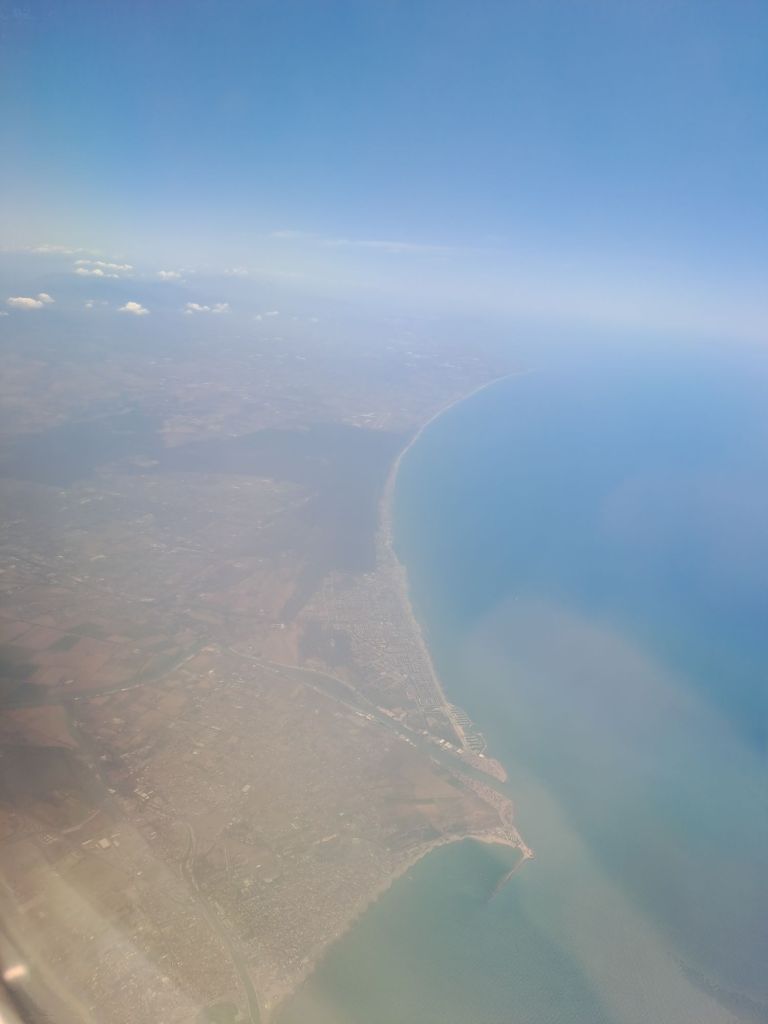
This morning, I took a short (~ 90 minute) flight from the pleasantly warm (23°C) Barcelona to the swelteringly hot (31°C) city of Rome. It’s actually forecast to be 39°C on Thursday and 40°C on Friday. Fortunately, I’m not staying that long!
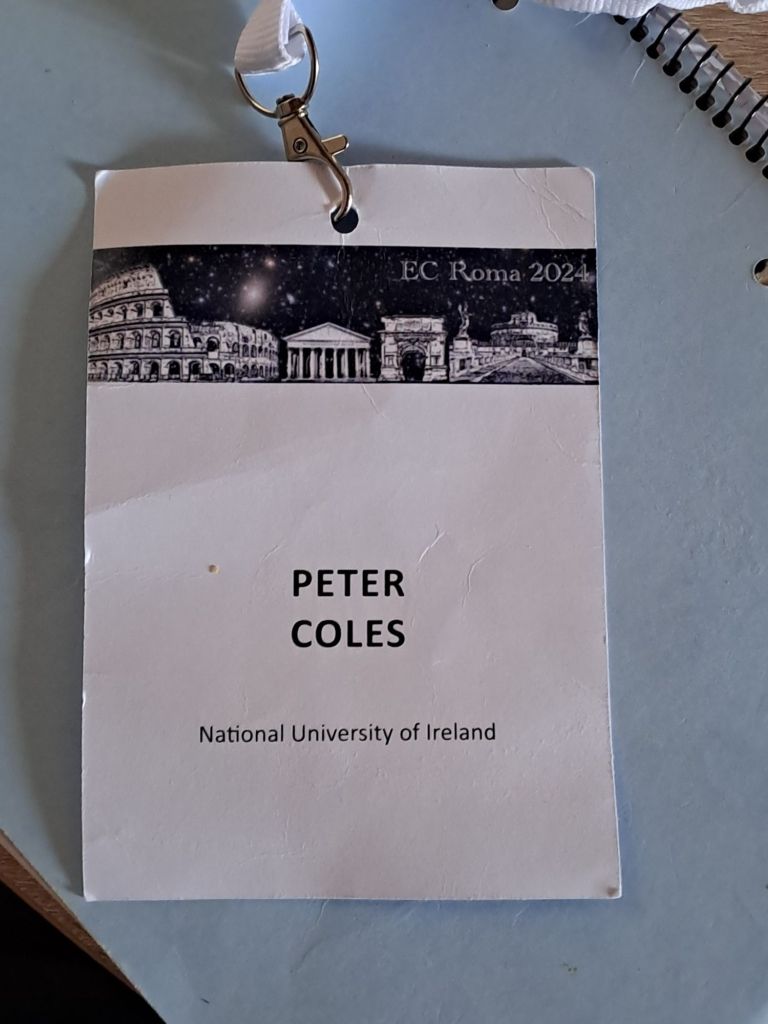
The occasion for this trip is the annual Euclid Consortium Meeting, which is being held at the Università degli Studi di Roma “La Sapienza“. The main sessions are in the splendid Aula Maxima thereof, with its imposing mural:

I’m giving a talk there in the first plenary session tomorrow…
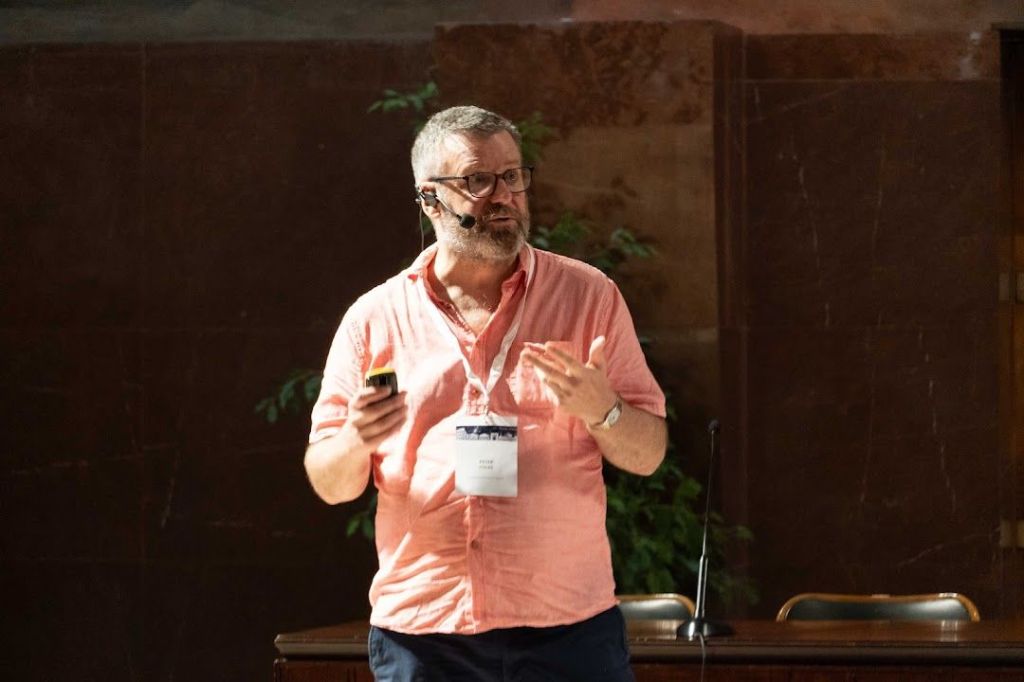
Update: here’s me giving my plenary talk:
It’s a hectic time ahead of a Big Event on Thursday 23rd May, which will include the publication of five new Early Release Observations (EROs). I’m not at liberty to say what they are until after 12 noon (CEST) on Thursday except that they’re very pretty. You can watch the live stream here:
Including the five released on November 7th 2023 that will bring the total to ten. All the ERO pictures will be available on the ESA archive here.
Thursday will also see the release of ten scientific papers related to the EROs; they will appear on arXiv on Friday 24th May. These will be the first science results from the Euclid mission.
But that’s not all! Thursday will also see the publication of five papers from the Euclid Consortium (of which I am the sole member based in Ireland). These will be the principal technical reference papers aimed at the astronomical community about the Euclid mission, covering the instruments, cosmology and other astronomy science possibilities, as well as the cosmological simulations used to assist the analysis of the mission. One of these, the main overview paper for the mission, has over a thousand authors (one of whom is your truly).
Thursday’s announcements are likely to significant level of press interest. That’s not only due to the European Space Agency’s own social media feeds and the like, but also local activities in Ireland. For example, there’s this from Science Foundation Ireland using this, from the Little Book of Irish Research:

I have also written a piece for RTÉ Brainstorm, as a kind of update on the one I wrote last year on the occasion of the launch; this will go live after the embargo is lifted on Thursday.
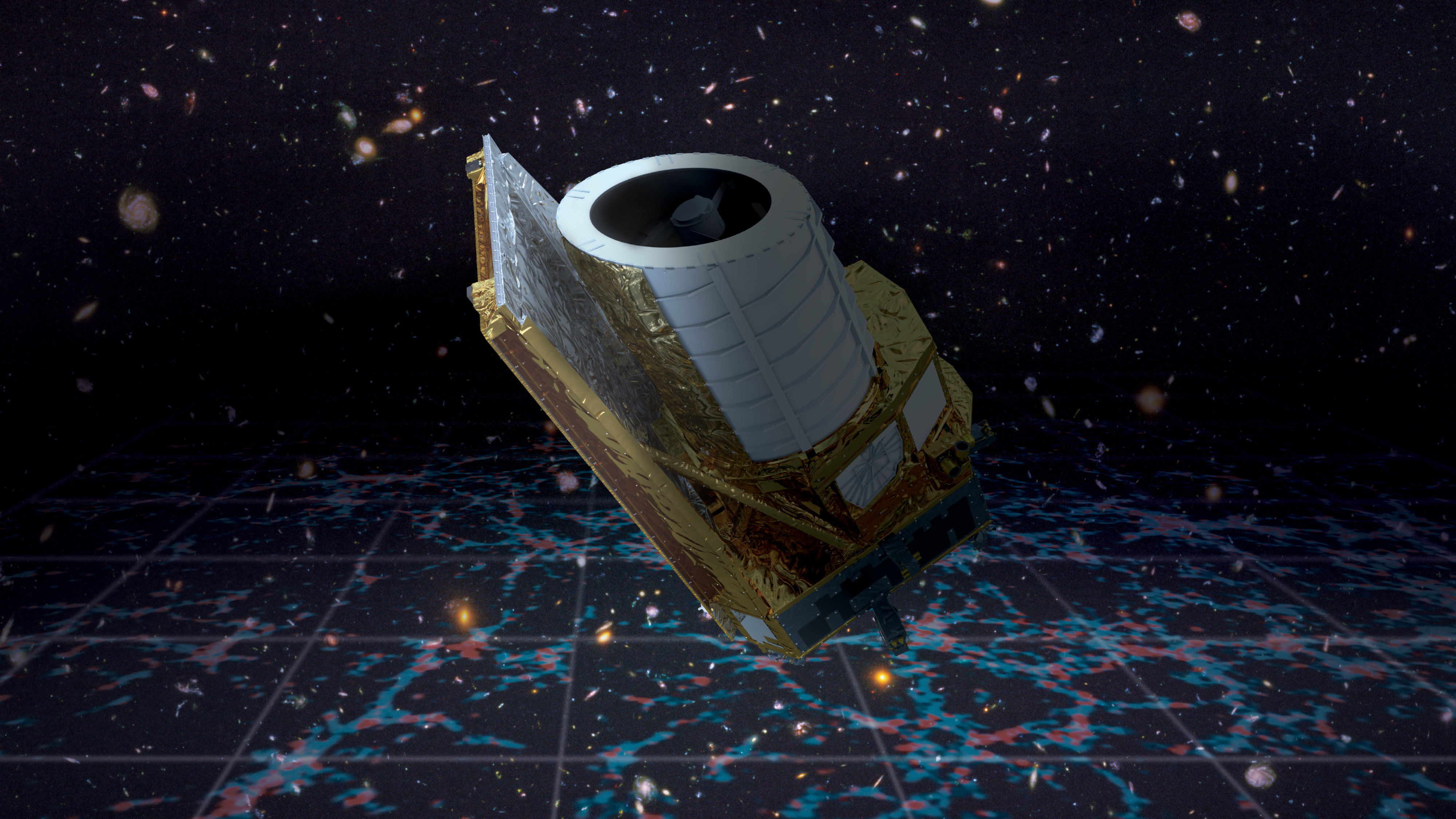
I just heard some excellent news about Euclid so thought I would post a quick update here. I won’t say much because there will no doubt be official communications from the European Space Agency and the Euclid Consortium. You can find a variety of Euclid-related posts on this blog here.
Over the past few months, there has been a huge amount of activity relating to commissioning the instruments, verifying their performance, and measuring parameters of the optical system that will be needed for analysis of the huge amount of data due to come from Euclid. All this effort fed into the Mission Commissioning Results Review (MCRR) which concluded yesterday that all was well.
This is an important milestone for Euclid because, in ESA parlance, it marks the change from a project to a mission. Until commissioning, there is a project manager who works with ESA and the industrial contractors to ensure everything functions properly; when nominal operations start the project team is disbanded and the mission team takes over; and so it came to pass that the Project Manager (Giuseppe Racca) handed over the reins to the Mission Manager (Pierre Ferruit).
That’s when the role of the Euclid Consortium increases substantially. In particular the Science Ground Segment (SGS), which includes the pipelines that will process the data, has been declared to be ready for business. You can read more about the SGS here but here’s a graphic that shows how data comes from the telescope, external telescopes, or simulations, then run through their respective pipelines for VIS, NISP, or external data, then are merged into a coherent format. Pipelines then extract scientific information and compute science data products for further analysis

Each element of this diagram is rather complex. Here, for example, is the organization of the Science Data Centre (SDC) component of the Science Ground Segment at the bottom of the above picture, consisting of computing centers responsible for implementing and running the data processing pipelines:

Anyway, the immediate upshot of all this is that full surveying activities of Euclid can now proceed. The Euclid mission will conduct primarily two different surveys: a “Wide Survey”, covering about 15,000 square degrees on the sky, and a “Deep Survey” of about 50 square degrees, where the instruments will observe three fields much longer than the rest of the sky to capture much fainter galaxies and hence look further out into space. I understand that the Wide Survey will commence in earnest on 14th February.The timescale from now is that the first full set of survey data (DR1) will be available internally to the Euclid Consortium in May or June 2025 and will be made public a year later (i.e. by June 2026).
That doesn’t mean that Euclid will be silent until 2026. In fact, the first batch of post-launch papers will come out very soon, in May 2024. This will include science papers resulting from the Early Release Observations – the data from these will also be made public at the same time – as well as an overview paper for the whole mission and papers describing the details of NISP and VIS instruments using measurements made during commissioning. There will also be a release in May 2025 of data from the Deep Survey patch of about 50 square degrees.
So, the board is set. The pieces are moving.

Time for another nice little video explainer about Euclid. This one is largely about the role of large computer simulations (particularly the Flagship simulation) in preparing for (and in future in analyzing) the Euclid survey.
The full blurb accompanying the video is appended here:
ESA’s Euclid mission will create a 3D-map of the Universe that scientists will use to measure the properties of dark energy and dark matter and uncover the nature of these mysterious components. The map will contain a vast amount of data, it will cover more than a third of the sky and its third dimension will represent time spanning 10 billion years of cosmic history.
But dealing with the huge and detailed set of novel data that Euclid observations will produce is not an easy task. To prepare for this, scientists in the Euclid Consortium have developed one of the most accurate and comprehensive computer simulations of the large-scale structure of the Universe ever produced. They named this the Euclid Flagship simulation.
Running on large banks of advanced processors, computer simulations provide a unique laboratory to model the formation and evolution of large-scale structures in the Universe, such as galaxies, galaxy clusters, and the filamentary cosmic web they form. These state-of-the-art computational techniques allow astrophysicists to trace the motion and behavior of an extremely large number of dark-matter particles over cosmological volumes under the influence of their own gravitational pull. They replicate how and where galaxies form and grow, and are used to predict their distribution across the celestial sphere.
Explore the Euclid Flagship simulation in this video and get a sneak preview of the structure of the dark Universe, as we currently model it. New insights will be brought to you by the Euclid mission in the coming years.
It was officially announced at the Euclid Consortium Meeting in Copenhagen this morning that I have been appointed to the role of Chair of the Euclid Consortium Diversity Committee (ECDC). This has been in the pipeline for a while, but I have refrained from saying anything publicly until the appointment was endorsed by the Euclid Consortium Lead (ECL) and Euclid Consortium Board (ECB) which has now happened.
The previous Chair, Prof. Mathilde Jauzac, is stepping down because her term on the ECDC has come to an end. I’ve been a member of the ECDC for three years during which time Mathilde has done a brilliant job as Chair and she’ll be a very difficult act to follow in this role. There was a standing ovation in the room this morning when Mathilde finished delivering her final ECDC report. It will be down to me to deliver next year’s report, at the 2024 Euclid Consortium Meeting, which will be in Rome.
Instead of trying to describe the role and activities of the ECDC generally, I will direct you to the information given on the brand new Euclid Consortium website which is a one-stop shop for everything to do with Euclid. You can find specific information about Equity, Diversity and Conduct there and/or on the ECDC’s own public website here from which I’ve taken a screengrab of the nice banner:

Just for information, the Euclid Consortium has about 2700 members so it really is a very large organization, and it is the aim of the ECDC to encourage a positive and inclusive environment within it for the benefit of everyone in it.
I’m looking forward to this role for the next year. I have only one year left of my term left on the ECDC so I will almost certainly be Chair for one year only. As regular readers of this blog – both of them – will know, I am on sabbatical next year which means I should have time to take on this responsibility, which I wouldn’t be able to do if I had my full teaching and admin load.
With the European Space Agency’s Euclid mission now scheduled for launch in the 3rd Quarter of 2023 a lot of work has been put in recently in developing the Euclid mission’s public website. For those of you not in the know, there is a summary on the new website:
ESA’s Euclid mission is designed to explore the composition and evolution of the dark Universe. The space telescope will create a great map of the large-scale structure of the Universe across space and time by observing billions of galaxies out to 10 billion light-years, across more than a third of the sky. Euclid will explore how the Universe has expanded and how structure has formed over cosmic history, revealing more about the role of gravity and the nature of dark energy and dark matter.
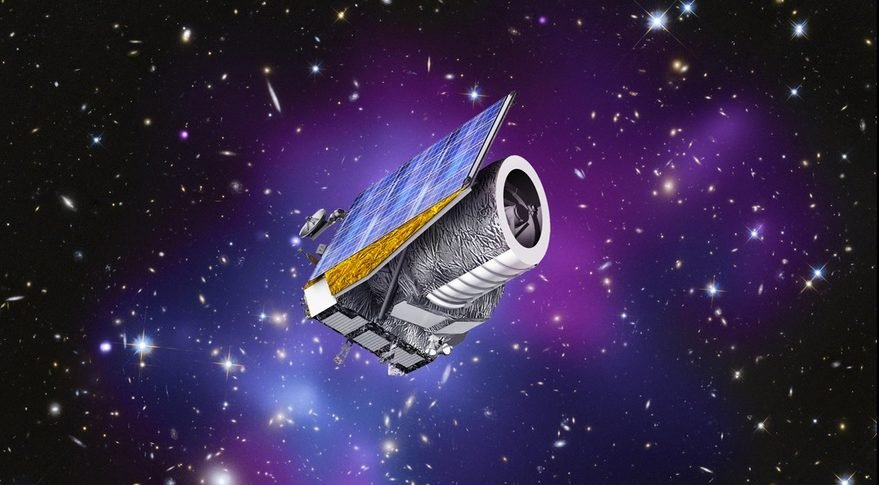
The public website is can be found here. Check it out. Many more stories, pictures and videos will be added over the forthcoming weeks but in the mean time here is a taster animated movie that shows various elements of the Euclid spacecraft, including the telescope, payload module and solar panels.
Even more information about the science to be done with Euclid can be found on the Euclid Consortium website, which is being revamped ahead of the launch.
I’m a bit fragile today. I don’t know why, but it may be connected with our Departmental Christmas partylast night. I’m glad I didn’t have too much to drink. Ahem.
Anyway, in my current condition I only have time for a short post to pass on the news that I today saw official confirmation that, negotiations having been successfully completed, the European Space Agency’s Euclid mission will indeed be launched by SpaceX, on a Falcon 9 rocket.
Various working meetings have been scheduled to start next week between ESA, SpaceX and Thales Alenia Space – Italia (TAS-I, who constructed the vehicle). The launch period is confirmed to be somewhere in the 3rd Quarter of 2023 and may even be as early as 1st July 2023. The actual launch window of one month will be agreed on the 1st of February.
Now there will be intense activity preparing the Euclid vehicle for launch as well as readying the Ground Segment – the bit that collects and processes the data.
The 2023 Annual Euclid Consortium Meeting, scheduled to be in Copenhagen in from 19th to 23rd June will be the last such meeting before the launch. I am very much looking forward to attending it.
Six months ago when Russia invaded Ukraine there was considerable debate about the practicality of sanctions on Putin’s regime. The discussion largely centered around whether economic sanctions would be effective and whether they would harm the nations imposing them more than they would Putin. At the time it seemed to me this was the wrong way of looking about it. The main issue as far as I was concerned was not their likely efficacy, but the ethical and moral dimension of doing business with a warmongering state. A similar issue came up frequently in the 1980s over South Africa, for example. The issue was not for me whether not buying South African oranges would end apartheid; it was about whether I personally felt morally comfortable with doing business with a racist state. Russia is not the only country or entity nowadays with whom I would feel very uncomfortable being involved, but it is one.
Ethical considerations are however often compromised by practical issues. A complete ban on Russian oil and gas imports would cause devastation in the short term, for example, so Western sanctions on Putin have concentrated elsewhere.
Individuals also make ethical decisions about what products they buy, which employers they work for, which countries they visit, and so on. These are of course private matters but people have a right to voice their opinions and argue their case.
At least an individual can decide their own position with unanimity. It’s somewhat more complicated in an organization or group as there are likely to be dissenting views. Nevertheless, I think it is good to have these discussions out in the open. That’s what should happen in a free society and in a well-run organization.
You may nor may not agree with the blog post by Arthur Loureiro about Elon Musk and SpaceX that was published here last week, but I think it raises a similar question: with whom do you feel comfortable doing business?
I suspect that I’m not alone in agreeing with Arthur’s discomfort about Elon Musk. As a matter of fact I think he’s a thoroughly nasty piece of work. Many people no doubt also felt moral discomfort at the prospect of Euclid being launched on a Soyuz spacecraft. In the end the decision will probably be based on pragmatism rather than ethics, but I think it was right for Arthur to raise the issue publicly and I am glad to have been able to make his views public via this website. There are limits and we need to discuss where those limits lie.
P.S. I am glad that the Euclid Consortium has stated aims to be as diverse and inclusive as possible. I am also aware that there are members of the Consortium who disagree with its EDI policies. I’ve observed in many organizations that those who disfavour diversity and inclusion often complain about having diversity “forced upon them”. I shall refrain from commenting further.
The following is a guest post from Arthur Loureiro who is Euclid Science Ground Segment Senior Scientist at the The University of Edinburgh. Opinions expressed here are personal and do not reflect those of the Euclid Collaboration nor the University of Edinburgh.
This guest post is based on an open letter sent by Arthur Loureiro & Gabriele Mainetti to the Euclid Consortium Diversity Committee.
–o–
According to news outlets, the European Space Agency is considering using Elon Musk’s SpaceX to send the Euclid Space Telescope to L2. SpaceX is seen as an alternative to fill the gap left by the Soyuz spacecraft – removed by Roscosmos as a consequence of the Russian invasion of Ukraine. Russia made its first invasion of Ukraine back in 2014 and, since then, ESA had plans to use the future Ariane 6 rocket to deliver Euclid. But the plan to use Ariane 6 went to space (differently from Euclid) as Ariane Space signed their largest contract ever with… Bezos! The comic book vilan billionaire doesn’t seem to have enough rockets in his back garden. He needs to cut the queue ahead of Euclid to send more space junk low-orbit satellites for Amazon.
So, off to SpaceX we (seem to) go.
The issue is that SpaceX’s CEO is known to be a complicated figure (to say the least!). Musk has attacked multiple times subjects at the core of the Euclid Collaboration’s values. We cannot claim to care for diversity, inclusion, equality, LGBTQIA+ rights, climate change, vaccines, and democracy and close a deal with such a vile figure. Launching the Euclid telescope via SpaceX would mean dumping millions of euros in the pockets of someone who is very vocal against these values.
In case our telescope decides to hitch a $50+M hike in SpaceX’s Falcon 9, the Euclid Collaboration has an EDI challenge ahead.
Personally, as one of the few Latin Americans involved in Euclid, it feels like a slap in the face to know we will be doing business with him. Musk has zero respect for the fragile democracy we have in our southern continent. In 2020, for example, Musk said “We will coup whoever we want. Deal with it” about the coup against the elected president Evo Morales in Bolivia. For context, the coup was mainly motivated by gaining access to Bolivia’s Lithium reserve. I find this statement absurdly disturbing. Reminiscents of a (hopefully) long gone colonial epoch.
I cannot speak for the group, but I suspect the feeling must be similar for the LGBTQIA+ community within Euclid. Musk has consistently and openly attacked the LGBTQIA+ community on multiple fronts. For the (few) women in the Collaboration, I imagine the feeling is of absolute repulse and disgust. On top of other issues Musk has with women, the telescope they have been working for will be (possibly) launched by SpaceX where recent accusations of sexual harassment have been raised against the CEO.
As a collective and diverse group of scientists, engineers, and academics, are we endorsing Musk and his attitudes by signing a multi-million dollar contract with his company?
As a collaboration that endorses the values of EDI, science, and democracy, what are we going to do to mitigate the damage caused by paying this person and company so much money?
How are we going to deal with the bitter taste (to say the least) left for those members of the EC that has been directly or indirectly attacked by Musk and his followers?
Euclid must fly to its final destination at L2. We cannot wait to see all that our Dark Universe mission has to reveal to us! If ESA decides to use Musk’s SpaceX, that is beyond the Euclid Collaboration’s decision power. However, the Collaboration can and must discuss how to avoid being linked in any way, shape or form to this despicable figure before we change from ESA’s Euclid Mission to Elon’s Euclid Mission. Credit to Musk must be avoided at all costs as the cost will be Euclid’s shot at being a diverse and inclusive Collaboration.

 In the Dark