Archive for European Space Agency

Dark Energy’s Day

Posted in The Universe and Stuff with tags , , , on October 4, 2011 by telescoper

Following hard on the heels of the announcement of a Nobel Prize for cosmology earlier this morning, the European Space Agency has this afternoon officially announced the two candidates which have been chosen for its next M-class missions from a shortlist of three.

One of the successful candidates, EUCLID, is directly relevant to the topic covered by the Nobel Prize announced this morning. “Euclid will address key questions relevant to fundamental physics and cosmology, namely the nature of the mysterious dark energy and dark matter. Astronomers are now convinced that these substances dominate ordinary matter. Euclid would map the distribution of galaxies to reveal the underlying ‘dark’ architecture of the Universe.”

Now that it’s definitely been selected, I hope to devote time in due course for a longer post about EUCLID’s capabilities and intentions, but in the meantime I’ll just say that it’s been a very good day for Dark Energy.

P.S. The other successful candidate is called Solar Orbiter. Commiserations to advocates of the third mission on the shortlist of three, PLATO. Close, but no cigar…

JWST: Over and Out?

Posted in Science Politics, The Universe and Stuff with tags , , , , on August 23, 2011 by telescoper

News filtered through recently that the cost of the James Webb Space Telescope, which is already  threatened with cancellation owing to cuts in NASA’s budget, is now estimated to be around $8.7 billion dollars, about $2.2 billion higher than previous figures. In fact about a decade ago, when I was a lad, and chair of the old PPARC Astronomy Advisory Panel, the price tag of  the NGST (Next Generation Space Telescope), as it was then called, was put at significantly less than one billion dollars.

The implications of cancelling JWST are profound on both sides of the Atlantic. As Mark McCaughrean explains in detail over on the e-astronomer, the European Space Agency has already made a substantial investment in JWST and planned future contributions include the launch and substantial operating costs. The instrument development is nearly finished, but whether there will actually be a telescope to put instruments on remains to be seen. It’s clear that this, together with previous unilateral decisions by NASA, is putting some strain on the relationship with ESA.

There were many who reacted to the initial suggestion that JWST should be cancelled by arguing that it was mere political posturing by Republicans in the House of Representatives and that it could and would be reversed if appropriate campaigning took place. To this end there has been, e.g.,  a letter to the White House Science Advisor (here for non-US astronomers and there for US ones). There’s also been a letter of support from the President of the Royal Astronomical Society. NASA’s administrators have also apparently come up with a plan to divert funds from other projects to support it. These efforts notwithstanding I get the distinct feeling that cancellation of JWST is a very real prospect and it goes without saying that the chances of avoiding it are not helped by  the increased estimated expense.

I’ve talked about this to a number of astronomers and cosmologists over the summer and found very mixed views not only about  (a) whether JWST will be cancelled or not but also about (b) whether it should be cancelled or not. Even astronomers have expressed exasperation with the spiralling cost of JWST and pointed out that if we had known a decade ago that it would take so long and involve such an outlay then it would never have gone ahead in the first place.

So let me try a straw poll:

The Curious Case of the Twisted Ring

Posted in The Universe and Stuff with tags , , , , , , , on July 21, 2011 by telescoper

Just time for a quickie this morning, prompted by the appearance of our own Professor Matt Griffin on the Today programme on BBC Radio 4 earlier on talking about newly published results from the Herschel Space Observatory. I didn’t hear it live as I’m strictly a Radio 3 person, but it must have made a pleasant change from stories about the imminent collapse of the euro and continuing extraordinay revelations about widespread corruption involving the British media, police force and political establishment. Among all this doom and gloom it’s nice to hear news of something that’s actually successful.

Anyway, the news from Herschel is that it has unveiled a ring structure in the centre of our Milky Way galaxy. The ribbon of gas and dust is more than 600 light years across and appears to be twisted, for reasons which have yet to be explained. The origin of the ring could yield important clues about the history of the Milky Way.

Warmer gas and dust from the Centre of our Galaxy is shown in blue in the  image below, while the colder material appears red. The ring, in yellow, is made of gas and dust at a temperature of just 15 degrees above absolute zero. The bright regions are denser, and include some of the most massive and active sites of star formation in our Galaxy.

and here it is with the curious ring drawn on with crayons:

The central region of our Galaxy is dominated by an elongated structure, rather like a bar, which stirs up the material in the outer galaxy as it rotates over millions of years and is probably connected with the spiral structure seen in the disk of the Milky Way. The ring seen by Herschel lies right in the middle of this bar, encircling the region which harbours a super-massive black hole at the centre of our galaxy. The ring of gas is twisted, so we see two loops which appear to meet in the middle. These are seen in yellow in the image above, tilted slightly such that they run from top-left to bottom-right. Secondly, it seems to be slightly offset from the very centre of our Galaxy. The reason for the ring’s twist and offset are unknown, but understanding their origin may help explain the origin of the ring itself. Computer simulations indicate that bars and rings such as those we see in the centre of our Galaxy can be formed by gravitational interactions, either within the Milky Way itself or between it and the nearby Andromeda galaxy, M31.

For the experts, and others interested, the scientific paper containing these results can be found here.

The Next Decade of Astronomy?

Posted in Science Politics, The Universe and Stuff with tags , , , , , , , on August 14, 2010 by telescoper

I feel obliged to pass on the news that the results of the Decadal Review of US Astronomy were announced yesterday. There has already been a considerable amount of reaction to what the Review Panel (chaired by the esteemed Roger Blandford) came up with from people much more knowledgeable about observational astronomy and indeed US Science Politics, so I won’t try to do a comprehensive analysis here. I draw your attention instead to the report itself  (which you can download in PDF form for free)  and Julianne Dalcanton’s review of, and comments on, the Panel’s conclusions about the priorities for  space-based and ground-based astronomy for the next decade or so over on Cosmic Variance.  There’s also a piece by Andy Lawrence over on The e-Astronomer’s blog. I’ll just mention that Top of the Pops for space-based astronomy is the Wide-Field Infrared Survey Telescope (WFIRST) which you can read a bit more about here, and King of the Castle for the ground-based programme is the Large Synoptic Survey Telescope (LSST). Both of these hold great promise for the area I work in – cosmology and extragalactic astrophysics – so I’m pleased to see our American cousins placing such a high priority on them. The Laser Interferometer Space Antenna (LISA), which is designed to detect gravitational waves, also did very well, which is great news for Cardiff’s Gravitational Physics group.

It will be interesting to see what effect – if any – these priorities have on the ranking of corresponding projects this side of the Atlantic. Some of the space missions involved in the Decadal Review in fact depend on both NASA and ESA so there clearly will be a big effect on such cases. For example, the proposed International X-ray Observatory (IXO) did less well than many might have anticipated, with clear implications for  Europe (including the UK).  The current landscape  of X-ray astronomy is dominated by Chandra and XMM, both of which were launched in 1999 and which are both nearing the end of their operational lives. Since X-ray astronomy can only be done from space, abandoning IXO would basically mean the end of the subject  as we know it, but the question is how to bridge the  the gap between the end of these two missions and the start of IXO even if it does go ahead but not until long after 2020? Should we keep X-ray astronomers on the payroll twiddling their thumbs for the next decade when other fields are desperately short of manpower for science exploitation?

On a more general level, it’s not obvious how we should react when the US gives a high priority to a given mission anyway. Of course, it gives us confidence that we’re not being silly when very smart people across the Pond endorse missions and facilities similar to ones we are considering over here. However, generally speaking the Americans tend to be able to bring missions from the drawing board to completion much faster than we can in Europe. Just compare WMAP with Planck, for instance. Trying to compete with the US, rather than collaborate, seems likely to ensure only that we remain second best. There’s an argument, therefore, for Europe having a programme that is, in some respects at least, orthogonal to the United States; in matters where we don’t collaborate, we should go for facilities that complement rather than compete with those the Americans are building.

It’s all very well talking of priorities in the UK but we all know that the Grim Reaper is shortly going to be paying a visit to the budget of the  agency that administers funding for our astronomy, STFC. This organization went through a financial crisis all of its very own in 2007 from which it is still reeling. Now it has to face the prospect of further savage cuts. The level of “savings” being discussed  – at least 25%  -means that the STFC management must be pondering some pretty drastic measures, even pulling out of the European Southern Observatory (which we only joined in 2002). The trouble is that most of the other ground-based astronomical facilities used by UK astronomers have been earmarked for closure, or STFC has withdrawn from them. Britain’s long history of excellence in ground-based astronomy now hangs in the balance. It’s scary.

I hope the government can be persuaded that STFC should be spared another big cut and I’m sure that there’s extensive lobbying going on.  Indeed, STFC has already requested input to its plans for the ongoing Comprehensive Spending Review (CSR). With this in mind, the Royal Astronomical Society has produced a new booklet designed to point out the  relevance of astronomy to wider society. However I can’t rid from my mind the memory a certain meeting in London in 2007 at which the STFC Chief Executive revealed the true scale of STFC’s problems. He predicted that things would be much worse at the next CSR, i.e. this one. And that was before the Credit Crunch, and the consequent arrival of a new government swinging a very large axe. I wish I could be optimistic but, frankly, I’m not.

When the CSR is completed then STFC will have yet again to do another hasty re-prioritisation. Their Science Board has clearly been preparing:

… Science Board discussed a number of thought provoking scenarios designed to explore the sort of issues that the Executive may be confronted with if there were to be a significant funding reduction as a result of the 2010 comprehensive spending review settlement. As a result of these deliberations Science Board provided the Executive with guidance on how to take forward this strategic planning.

This illustrates a big difference in the way such prioritisation exercises are carried out in the UK versus the USA. The Decadal Review described above is a high-profile study, carried out by a panel of distinguished experts, which takes detailed input from a large number of scientists, and which delivers a coherent long-term vision for the future of the subject. I’m sure not everyone agrees with their conclusions, but the vast majority respect its impartiality and level-headedness and have confidence in the overall process. Here in the UK we have “consultation exercises” involving “advisory panels” who draw up detailed advice which then gets fed into STFC’s internal panels. That bit is much like the Decadal Review. However, at least in the case of the last prioritisation exercise, the community input doesn’t seem to bear any obvious relationship to what comes out the other end. I appreciate that there are probably more constraints on STFC’s Science Board than it has degrees of freedom, but there’s no getting away from the sense of alienation and cynicism this has generated across large sections of the UK astronomy community.

The problem with our is that we always seem to be reacting to financial pressure rather than taking the truly long-term “blue-skies” view that is clearly needed for big science projects of the type under discussion. The Decadal Review, for example, places great importance on striking a balance between large- and small-scale experiments. Here we tend slash the latter because they’re easier to kill than the former. If this policy goes on much longer, in the long run we’ll end up a with few enormous expensive facilities but none of the truly excellent science that can be done from using smaller kit.  A crucial aspect of this that that science seems to have been steadily relegated in importance in favour of technology ever since the creation of STFC.  This must be reversed. We need a proper strategic advisory panel with strong scientific credentials that stands outside the existing STFC structure but which has real influence on STFC planning, i.e. one which plays the same role in the UK as the Decadal Review does in the States.

Assuming, of course, that there’s any UK astronomy left in the next decade…

The Planck Sky

Posted in The Universe and Stuff with tags , , , , , , , on July 5, 2010 by telescoper

Hot from the press today is a release of all-sky images from the European Space Agency’s Planck mission, including about a year’s worth of data. You can find a full set of high-resolution images here at the ESA website, along with a lot of explanatory text, and also here and here. Here’s a low-resolution image showing the galactic dust (blue) and radio (pink) emission concentrated in the plane of the Milky Way but extending above and below it. Only well away from the Galactic plane do you start to see an inkling of the pattern of fluctuations in the Cosmic Microwave Background that the survey is primarily intended to study.

It will take a lot of sustained effort and clever analysis to clean out the foreground contamination from the maps, so the cosmological interpretation will have to wait a while. In fact, the colour scale seems to have been chosen in such a way as to deter people from even trying to analyse the CMB component of the data contained in these images. I’m not sure that will work, however, and it’s probably just a matter of days before some ninny posts a half-baked paper on the arXiv claiming that the standard cosmological model is all wrong and that the Universe is actually the shape of a vuvuzela. (This would require only a small modification of an earlier suggestion.)

These images are of course primarily for PR purposes, but there’s nothing wrong with that. Apart from being beautiful in its own right, they demonstrate that Planck is actually working and that results it will eventually produce should be well worth waiting for!

Oh, nearly forgot to mention that the excellent Jonathan Amos has written a nice piece about this on the BBC Website too.

Dust

Posted in Poetry, The Universe and Stuff with tags , , , on July 4, 2010 by telescoper

I was reading through a collection of poems by Rupert Brooke this lazy sunday afternoon and found this. I haven’t posted much poetry recently so thought I’d add it here. I’m sure my many friends who work on astrophysical dust will enjoy it, especially those involved with the European Space Agency’s  Herschel Space Observatory. Apparently they’re all “passionate about dust”. If that’s true I wonder if one of them might want to write a wikipedia entry on the subject, because for some reason there isn’t one…

When the white flame in us is gone,
And we that lost the world’s delight
Stiffen in darkness, left alone
To crumble in our separate night;

When your swift hair is quiet in death,
And through the lips corruption thrust
Has still’d the labour of my breath –
When we are dust, when we are dust !

Not dead, not undesirous yet,
Still sentient, still unsatisfied,
We’ll ride the air, and shine, and flit,
Around the places where we died,

And dance as dust before the sun,
And light of foot and unconfined,
Hurry from road to road, and run
About the errands of the wind.

And every mote, on earth or air,
Will speed and gleam, down later days,
And like a secret pilgrim fare
By eager and invisible ways,

Nor ever rest, nor ever lie,
Till, beyond thinking, out of view,
One mote of all the dust that’s I
Shall meet one atom that was you.

Then in some garden hush’d from wind,
Warm in a sunset’s afterglow,
The lovers in the flowers will find
A sweet and strange unquiet grow

Upon the peace; and, past desiring,
So high a beauty in the air,
And such a light, and such a quiring,
And such a radiant ecstasy there,

They’ll know not if it’s fire, or dew,
Or out of earth, or in the height,
Singing, or flame, or scent, or hue,
Or two that pass, in light, to light,

Out of the garden, higher, higher. . . .
But in that instant they shall learn
The shattering ecstasy of our fire,
And the weak passionless hearts will burn

And faint in that amazing glow,
Until the darkness close above;
And they will know – poor fools, they’ll know!
One moment, what it is to love.

Clustering in the Deep

Posted in Bad Statistics, The Universe and Stuff with tags , , , , , , on May 27, 2010 by telescoper

I couldn’t resist a quick lunchtime post about the results that have come out concerning the clustering of galaxies found by the HerMES collaboration using the Herschel Telescope. There’s quite a lengthy press release accompanying the new results, and there’s not much point in repeating the details here, so I’ll just show a wonderful image showing thousands of galaxies and their far-infrared colours.

Image Credit: European Space Agency, SPIRE and HERMES consortia

According to the press release, this looks “like grains of sand”. I wonder if whoever wrote the text was deliberately referring to Genesis 22:17?

.. they shall multiply as the stars of the heaven, and as the grains of sand upon the sea shore.

However, let me take issue a little with the following excerpt from said press release:

While at a first glance the galaxies look to be scattered randomly over the image, in fact they are not. A closer look will reveals that there are regions which have more galaxies in, and regions that have fewer.

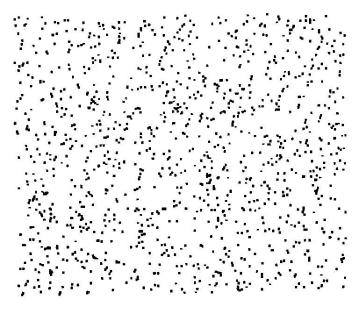
A while ago I posted an item asking what “scattered randomly” is meant to mean. It included this picture

This is what a randomly-scattered set of points actually looks like. You’ll see that it also has some regions with more galaxies in them than others. Coincidentally, I showed the same  picture again this morning in one of my postgraduate lectures on statistics and a majority of the class – as I’m sure do many of you seeing it for the first time –  thought it showed a clustered pattern. Whatever “randomness” means precisely, the word certainly implies some sort of variation whereas the press release implies the opposite. I think a little re-wording might be in order.

What galaxy clustering statistics reveal is that the variation in density from place-to-place is greater than that expected in a random distribution like that shown. This has been known since the 1960s, so it’s not  the result that these sources are clustered that’s so important. In fact, The preliminary clustering results from the HerMES surveys – described in a little more detail in a short paper available on the arXIv – are especially  interesting because they show that some of the galaxies seen in this deep field are extremely bright (in the far-infrared), extremely distant, high-redshift objects which exhibit strong spatial correlations. The statistical form of this clustering provides very useful input for theorists trying to model the processes of galaxy formation and evolution.In particular, the brightest objects at high redshift have a propensity to appear preferentially in dense concentrations, making them even more strongly clustered than rank-and-file galaxies. This fact probably contains important information about the environmental factors responsible for driving their enormous luminosities.

The results are still preliminary, but we’re starting to see concrete evidence of the impact Herschel is going to have on extragalactic astrophysics.

Cosmic Vision

Posted in Science Politics, The Universe and Stuff with tags , , , , , , , , , on February 20, 2010 by telescoper

It’s nice to have a bit of science stuff to blog about for a change. Just this week the European Space Agency (ESA) has  announced the results of its recent selection process for part of its Cosmic Visions programme, which represents ESA’s scientific activity for the period 2015-2025.

The selection process actually began in 2007, with over 50 proposals. This list was then whittled down so that there were six candidate missions under consideration for the so-called M-class launch slots (M meaning medium-sized), and three in the L-class list of larger missions. The latest exercise was to select three of the M-class missions for further study. They succeeded in selecting three, but have also kept another, much cheaper, mission in the frame.

As far as I understand it, only two M-class missions are actually envisaged so the race isn’t over yet, but the missions still in the running are:

PLATO.  The PLATO mission is planned to study planets around other stars. This would include terrestrial planets in a star’s habitable zone, so-called Earth-analogues. In addition, PLATO would probe stellar interiors by through stellar seismology. In some sense, this mission is the descendant of a previous proposal called Eddington. (PLATO stands for PLAnetary Transits and Oscillations of stars – I’ll give it 3/10 for quality of acronym).

EUCLID. Euclid would address key questions relevant to fundamental physics and cosmology, namely the nature of the mysterious dark energy and dark matter. Astronomers are now convinced that these substances dominate ordinary matter. Euclid would map the distribution of galaxies to reveal the underlying ‘dark’ architecture of the Universe. I don’t think this is meant to be an acronym, but I could be wrong. Perhaps it’s European Union Cosmologists Lost in Darkness?

SOLAR ORBITER. Disappointingly, this is neither an acronym nor a Greek person. It would take the closest look at our Sun yet possible, approaching to just 62 solar radii. It would deliver images and data that include views of the Sun’s polar regions and the solar far side when it is not visible from Earth.

These are the three main nominations, but the panel also decided to endorse another mission, SPICA, because it is much cheaper than the approximately 500 Million Euro price tag on the other contenders. SPICA would be an infrared space telescope led by the Japanese Space Agency JAXA. It would provide ‘missing-link’ infrared coverage in the region of the spectrum between that seen by the ESA-NASA Webb telescope and the ground-based ALMA telescope. SPICA would focus on the conditions for planet formation and distant young galaxies.

Many of Cardiff’s astronomers will be very happy if SPICA does end up being selected as it is the one most directly related to their interests and also their experience with Herschel which is, incidentally,  continuing to produce fantastic quality data. If SPICA is to happen, however, extra money will have to be found and that, in the current financial climate, is far from guaranteed.

Which of these missions will get selected in the end is impossible to say at this stage. There are dark mutterings going on about how realistic is the price tag that has been put on some of the contenders. Based on past experience, cost overruns on space missions are far from unlikely and when they happen they can cause a great deal of damage in budgets. Let’s hope the technical studies do their job and put realistic figures on them so the final selection will be fair.

Whatever missions fly in the end, I also hope that the Science and Technology Research Council (STFC) – or whatever replaces it – remembers that these are science missions, and its responsibility extends beyond the building of instruments to fly on them. Let’s to hope we can count on their support for research grants enabling us to answer the science questions they were designed to address.

Astronomy Look-alikes, No. 12

Posted in Astronomy Lookalikes with tags , , on January 30, 2010 by telescoper

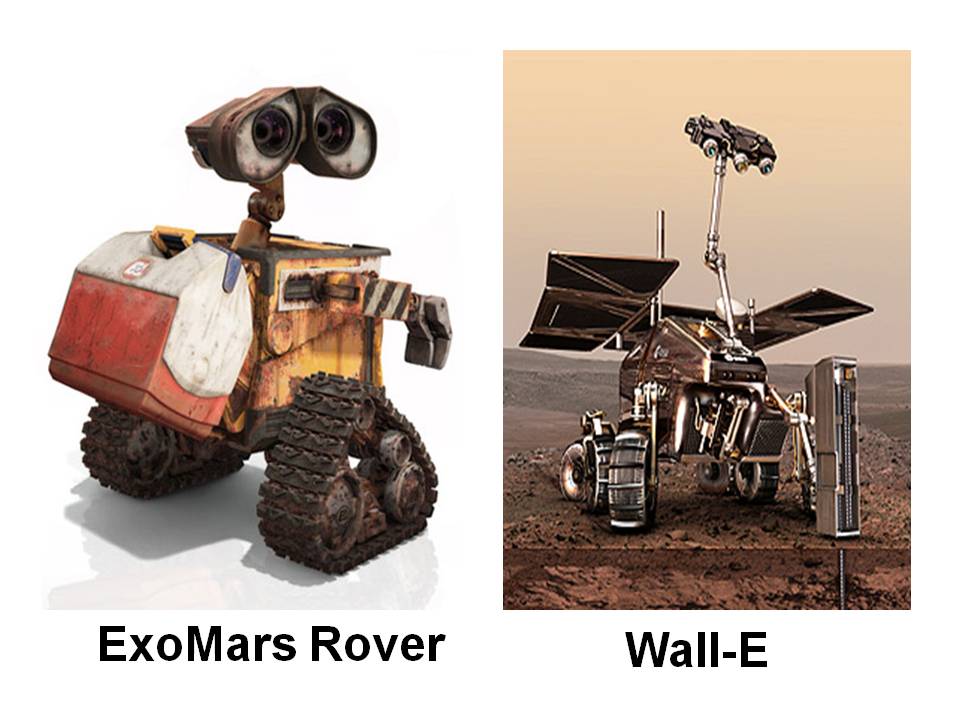
I’m struck by the remarkable similarity between the depiction below of WALL-E, an absurdly comical fantasy robot that exists only in the realm of  Science Fiction, and the European Space Agency’s Exomars Rover. I wonder if by any chance they might be related?

P.S. Thanks to Rigsby Matt Griffin for this one!

First Light from Planck!

Posted in The Universe and Stuff with tags , , , on September 17, 2009 by telescoper

Credit to Andrew Jaffe for alerting me to the fact that ESA’s first press release concerning Planck has now been, well, released…

I last blogged about Planck when it had reached its orbit around L2 and cooled down to its working temperature of 100 milliKelvin. Over the ensuing weeks it has been tested and calibrated, prodded and poked (electronically of course) and generally tuned up. More recently it has completed a “mini-survey” to check that it’s all working as planned.

The way Planck scans means that it takes about six months to cover the whole sky, which is much longer than the two-week period allowed for the mini-survey. This explains the fact that a relatively narrow slice of the celestial sphere has been mapped. However, you can see the foreground emission from the Galactic plane quite clearly. Here is the region shown in the box split into the nine separate frequency channels that Planck observes:

The High Frequency Instrument (HFI) is more sensitive to dust, while the Low Frequency Instrument (LFI) detects more radio emission. It all seems to be working as expected!

And finally here’s a blow up of the smaller square above the Galactic plane shown as seen by  LFI and HFI:

This region is much less prone to foreground emission. The fact that similar structures are seen in the two completely independent receivers shows that the structure is not just instrument noise. In other words, Planck is seeing the cosmic microwave background!

Now Planck will carry out its full survey, scanning the sky for another year or so. There will then be an intense period of data analysis for about another year after which the key science results will be published. Exciting times.