Archive for exoplanets

Weekly Update from the Open Journal of Astrophysics – 08/11/2025

Posted in OJAp Papers, Open Access, The Universe and Stuff with tags , , , , , , , , , , , , , , , , , , , , , , on November 8, 2025 by telescoper

It’s Saturday again, so it’s time for the usual update of the week’s new papers at the Open Journal of Astrophysics. Since the last update we have published another five papers, which brings the number in Volume 8 (2025) up to 168, and the total so far published by OJAp up to 403.

The first paper this week is “Maximizing Ariel’s Survey Leverage for Population-Level Studies of Exoplanets” by Nicolas B. Cowan and Ben Coull-Neveu (McGill University, Canada). This article was published in the folder Earth and Planetary Astrophysics on Tuesday 4th November 2025; it discusses various different schemes to select the mission reference sample for a notional three year transit spectroscopy survey with the European Space Agency’s Ariel mission

The overlay is here:


You can find the officially accepted version on arXiv here.

The Fediverse announcement is here:

Open Journal of Astrophysics

New Publication at the Open Journal of Astrophysics: "Maximizing Ariel’s Survey Leverage for Population-Level Studies of Exoplanets" by Nicolas B. Cowan and Ben Coull-Neveu (McGill University, Canada)

doi.org/10.33232/001c.146656

November 4, 2025, 5:08 pm 1 boosts 3 favorites


The second paper of the week is “A substellar flyby that shaped the orbits of the giant planets” by Garett Brown (U. Toronto at Scarborough, Canada), Renu Malhotra (U. Arizona, USA) and Hanno Rein (U. Toronto at Scarborough, Canada). This article was published on Wednesday 5th November 2025, also in the folder Earth and Planetary Astrophysics. It argues that an ancient close encounter with a substellar object offers a plausible explanation for the origin of the moderate eccentricities and inclinations of the giant planets.

The overlay is here:

You can find the official version of this one on arXiv here. The federated announcement on Mastodon is here:

Open Journal of Astrophysics

New Publication at the Open Journal of Astrophysics: "A substellar flyby that shaped the orbits of the giant planets" by Garett Brown (U. Toronto at Scarborough, Canada), Renu Malhotra (U. Arizona, USA) and Hanno Rein (U. Toronto at Scarborough, Canada)

doi.org/10.33232/001c.146688

November 5, 2025, 8:34 am 3 boosts 3 favorites

Next one up is “The Potential Impact of Primordial Black Holes on Exoplanet Systems” by Garett Brown (U. Toronto at Scarborough), Linda He (Harvard U., USA),  and James Unwin (U. Illinois Chicago, USA). This one was also published on Wednesday 5th November 2025, but in the folder Astrophysics of Galaxies. This one is an exploration of the possibility that primordial black holes (PBHs) in our Galaxy, might impact the orbits of exoplanets. The overlay is here:

You can find the official accepted version on arXiv here. The fediverse announcement is here:

Open Journal of Astrophysics

New Publication at the Open Journal of Astrophysics: "The Potential Impact of Primordial Black Holes on Exoplanet Systems" by Garett Brown (U. Toronto at Scarborough), Linda He (Harvard U., USA), James Unwin (U. Illinois Chicago, USA)

doi.org/10.33232/001c.146689

November 5, 2025, 8:49 am 3 boosts 1 favorites

The fourth paper to report is “The Unhurried Universe: A Continued Search for Long Term Variability in ASAS-SN” by Sydney Petz, C. S. Kochanek & K. Z. Stanek (Ohio State U., USA), Benjamin J. Shappee (U. Hawaii, USA), Subo Dong (Peking University, China), J. L. Prieto (Universidad Diego Portales, Chile) and Todd A. Thompson (Ohio State U., USA). This one was also published on Wednesday November 5th 2025, but in the folder Solar and Stellar Astrophysics.  It describes the discovery and investigation of slowly-varying sources in the All Sky Automated Survey for SuperNovae (ASAS-AN) leading to the identification of 200 new variable stars. The overlay is here:


You can find the official published version on arXiv here. The Fediverse announcement follows:

Open Journal of Astrophysics

New Publication at the Open Journal of Astrophysics: "The Unhurried Universe: A Continued Search for Long Term Variability in ASAS-SN" by Sydney Petz, C. S. Kochanek & K. Z. Stanek (Ohio State U., USA), Benjamin J. Shappee (U. Hawaii, USA), Subo Dong (Peking University, China), J. L. Prieto (Universidad Diego Portales, Chile) and Todd A. Thompson (Ohio State U., USA)

doi.org/10.33232/001c.146690

November 5, 2025, 9:08 am 1 boosts 0 favorites

The fifth and final paper for this week is “Measuring the splashback feature: Dependence on halo properties and history” by Qiaorong S. Yu (Oxford U., UK) and 9 others based in the UK and USA. This was published on Friday 7th November 2025 in the folder Cosmology and Nongalactic Astrophysics. It discusses how the properties of “splashback” features in halo profiles relate to the halo’s assembly history (e.g. mass accretion rate and most recent merger time). The overlay is here:

The officially accepted version can be found on arXiv here. The Fediverse announcement is here:

Open Journal of Astrophysics

New Publication at the Open Journal of Astrophysics: "Measuring the splashback feature: Dependence on halo properties and history" by Qiaorong S. Yu (Oxford U., UK) and 9 others based in the UK and USA.

doi.org/10.33232/001c.146824

November 7, 2025, 9:12 am 0 boosts 0 favorites

That’s all the papers for this week. I’ll do another report next Saturday.

Four New Publications at the Open Journal of Astrophysics

Posted in OJAp Papers, Open Access, The Universe and Stuff with tags , , , , , , , , , , , , , on December 14, 2024 by telescoper

It’s Saturday morning once again so here’s another quick update of activity at the Open Journal of Astrophysics. Since the last update a week ago we have published  four papers, which takes the count in Volume 7 (2024) up to 114 and the total published altogether by OJAp up to 229. If we publish just one more paper between now and the end of the year, we will have published as many papers in 2024 as we have in all previous years.

Anyway, in chronological order of publication, the four papers published this week, with their overlays, are as follows. You can click on the images of the overlays to make them larger should you wish to do so.

First one up is “Star formation beyond galaxies: widespread in-situ formation of intra-cluster stars” by Niusha Ahvazi & Laura V. Sales (UC Riverside, USA), Julio F. Navarro (U. Victoria, Canada), Andrew Benson (Carnegie Obs. USA), Alessandro Boselli (Aix Marseille U., France) and Richard D’Souza (Vatican Obs.). The paper, which is in the folder marked Astrophysics of Galaxies, The paper presents a simulation-based analysis of a diffuse star forming component in galaxy clusters extending for hundreds of kiloparsecs and tracing the distribution of neutral gas in the cluster host halo.

Here is a screen grab of the overlay, which includes the abstract:

You can find the officially accepted version of the paper on the arXiv here.

The second paper to announce, published on 10th December 2024 in the folder Cosmology and NonGalactic Astrophysics, is “Cosmological Constraints from Combining Photometric Galaxy Surveys and Gravitational Wave Observatories” by E.L. Gagnon, D. Anbajagane, J. Prat, C. Chang, and J. Frieman (all of U. Chicago, USA). This article quantifies the expected cosmological information gain from combining the forecast LSST 3x2pt analysis with the large-scale auto-correlation of GW sources from proposed next-generation GW experiments.

You can see the overlay here:

The accepted version of this paper can be found on the arXiv here.

The third paper, also published on 10th December 2024, but in the folder marked Earth and Planetary Astrophysics, has the title “A potential exomoon from the predicted planet obliquity of β Pictoris b” and is written by Michael Poon, Hanno Rein, and Dang Pham all of the University of Toronto, Canada. It presents discussion, based on the β Pictoris system, of the idea that the presence of exomoons can excite misalignment between the spin and orbit axis (obliquity) in exoplanet systems

Here is the overlay

The final version accepted on arXiv is here.

Last of this quartet, published on 11th December 2024, and in the folder Cosmology and NonGalactic Astrophysics is “Map-level baryonification: Efficient modelling of higher-order correlations in the weak lensing and thermal Sunyaev-Zeldovich fields” and is by Dhayaa Anbajagane & Shivam Pandey (U. Chicago) and Chihway Chang (Columbia U.), all based in the USA.

The paper proposes an extension of the semi-analytic formalism to weak lensing and thermal Sunyaev-Zeldovich (tSZ) fields directly on the full-sky, with an emphasis on higher-order correlations. The overlay is here:

You can find the official accepted version on the arXiv here.

That’s all for this week. I’ll do another update next Saturday, and that will probably be the last one of the year. If we publish just one more paper between now and 31st December, we will have published as many papers in 2024 as we have in all previous years put together!

Six New Publications at the Open Journal of Astrophysics

Posted in OJAp Papers, Open Access, The Universe and Stuff with tags , , , , , , , , , , , , , , , , , , , , , , , , , on October 12, 2024 by telescoper

Regular readers of this blog (both of them) will have noticed that I didn’t post an update of activity at the Open Journal of Astrophysics last weekend. Despite having accepted several papers for publication in the preceding week, no final versions had made it onto the arXiv. We can’t published a paper until the authors post the final version, so that meant a bit of a backlog developed. This week included one day with no arXiv update (owing to a US holiday on Tuesday 8th October) and a major glitch on Crossref on Thursday which delayed a couple, but even so we’ve published six papers which is the most we’ve ever managed in a week. This week saw the publication of our 200th article; the total as of today is 202.  The count in Volume 7 (2024) is now up to 87; we have four papers in the queue for publication so we should pass 90 next week if all goes well.

In chronological order, the six papers published this week, with their overlays, are as follows. You can click on the images of the overlays to make them larger should you wish to do so.

First one up, published on Monday 7th October 2024 is “z~2 dual AGN host galaxies are disky: stellar kinematics in the ASTRID Simulation” by Ekaterina Dadiani (CMU; Carnegie Mellon U.) Tiziana di Matteo (CMU), Nianyi Chen (CMU), Patrick Lachance (CMU), Yue Shen (U. Illinois at Urbana-Champaign), Yu-Ching Chen (Johns Hopkins U.), Rupert Croft (CMU), Yueying Ni (CfA Harvard) and Simeon Bird (U. California Riverside) – all based in the USA. The paper, which is in the folder marked Astrophysics of Galaxies describes a numerical study of the morphology of AGN host galaxies containing close pairs of black holes.

Here is a screen grab of the overlay, which includes the abstract:


You can find the officially accepted version of the paper on the arXiv here.

The second paper to announce, published on 8th October 2024, is “Origin of LAMOST J1010+2358 Revisited” by S.K. Jeena and Projjwal Banerjee of the Indian Institute of Technology Palakkad, Kerala, India. This paper discusses  the possible formation mechanisms for Very Metal Poor (VMP) stars and the implications for the origin of LAMOST J1010+2358 and is in the folder marked Solar and Stellar Astrophysics.

You can see the overlay here:

The accepted version of this paper can be found on the arXiv here.

The third paper is very different in both style and content: “Assessing your Observatory’s Impact: Best Practices in Establishing and Maintaining Observatory Bibliographies” by Raffaele D’Abrusco (Harvard CfA and 14 others; the Observatory Bibliographers Collaboration) and is in the folder marked Instrumentation and Methods for Astrophysics. It presents discussion of the methods used by astronomical observatories to construct and analyze bibliographic databases. The overlay is here:

(This one gave me a rare opportunity to use the library of stock images that comes with the Scholastica platform!) The officially accepted version can be found on arXiv here.

The fourth paper, also published on 8th October 2024, and our 200th publication, is in the folder marked Cosmology and NonGalactic Astrophysics, and is called “CombineHarvesterFlow: Joint Probe Analysis Made Easy with Normalizing Flows“. The authors are Peter L. Taylor, Andrei Cuceu, Chun-Hao To, and Erik A. Zaborowski of Ohio State University, USA. The article presents a new method that speeds up the sampling of joint posterior distributions in the context of inference using combinations of data sets. The overlay is here

You can find the officially accepted version of this paper here.

The fifth paper in this batch is “Estimating Exoplanet Mass using Machine Learning on Incomplete Datasets” by Florian Lalande (Okinawa Institute of Science and Technology), Elizabeth Tasker (Institute of Space and Astronautical Science, Kanagawa) and Kenji Doya (Okinawa); all based in Japan. This one was published on 10th October 2024 in the folder marked Earth and Planetary Astrophysics. It compares different methods for inferring exoplanet masses in catalogues with missing data


You can find the official accepted version on the arXiv here.

Finally for this week we have “Forecasting the accuracy of velocity-field reconstruction” by Chris Blake and Ryan Turner of Swinburne University of Technology, Melbourne, Australia. This was also published on 10th October 2024 and is in the folder marked Cosmology and NonGalactic Astrophysics. The paper describes a numerical study of the reliability and precision of different methods of velocity-density reconstruction. The overlay is here

You can find the officially-accepted version on arXiv here.

That’s it for now. We have published six papers, with a very wide geographical spread of authors, and in five of the six astro-ph categories we cover. I think it’s been a good week!

Four New Publications at the Open Journal of Astrophysics

Posted in OJAp Papers, Open Access, The Universe and Stuff with tags , , , , , , , , , , , , on May 11, 2024 by telescoper

It is time yet again for an update of recent activity at the Open Journal of Astrophysics.
This week we have published four papers, which I now present to you. These four take the count in Volume 7 (2024) up to 36 and the total published by OJAp up to 151. I speculated last week that we would probably pass the 150 mark this week, and so we did. We’re still on target to publish around 100 papers this year.
In chronological order, the four papers published this week, with their overlays, are as follows. You can click on the images of the overlays to make them larger should you wish to do so.
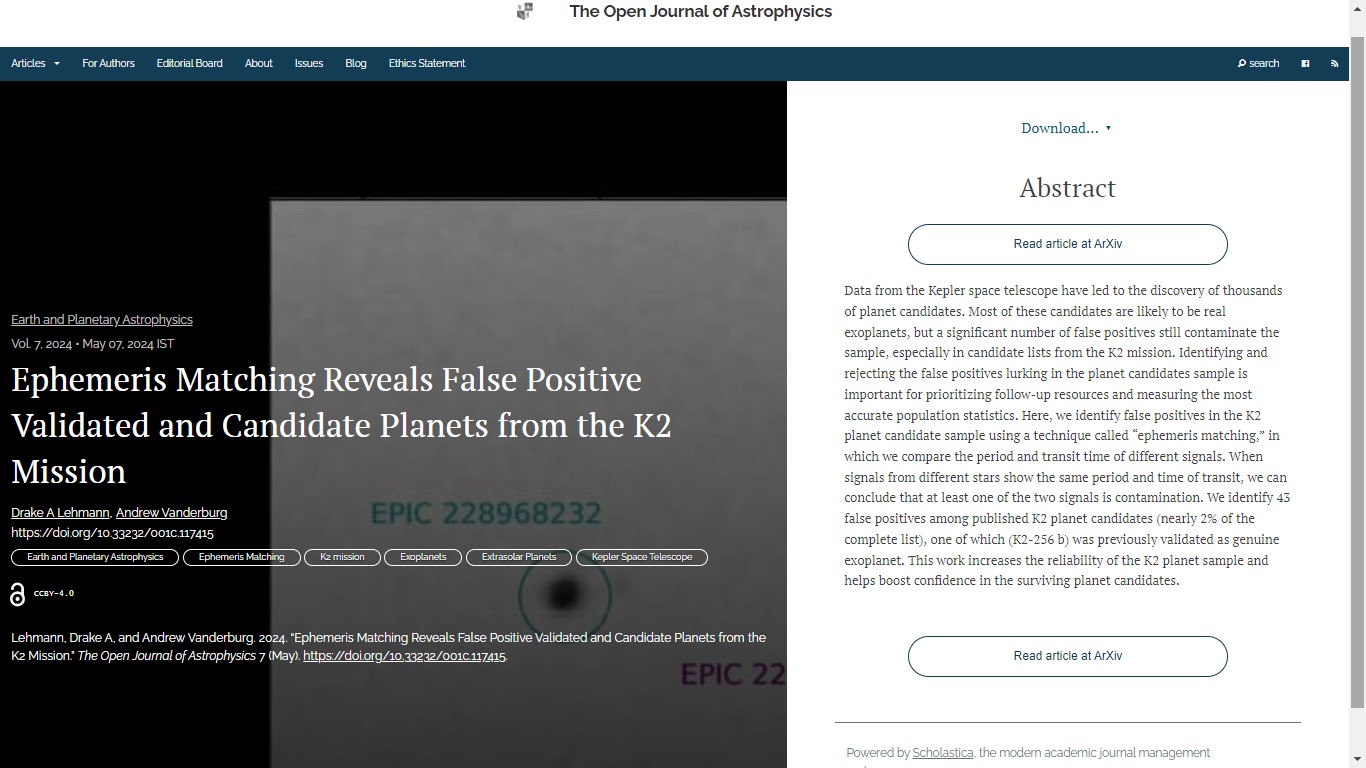
First one up is “Ephemeris Matching Reveals False Positive Validated and Candidate Planets from the K2 Mission” by Drake A. Lehmann (U. Wisconsin-Madison, USA) and Andrew Vanderburg (MIT, USA). It presents a description and application of a technique for identifying false positives among candidate exoplanets. The paper was published on 7th May 2024, is in the folder marked Earth and Planetary Astrophysics, and can be found here.
Here is a screen grab of the overlay, which includes the abstract:

You can find the officially accepted version of the paper on the arXiv here.
The second paper to announce is “Accuracy requirements on intrinsic alignments for Stage-IV cosmic shear” which is by by Anya Paopiamsap, Natalia Porqueres & David Alonso (Oxford, UK) and Joachim Harnois-Deraps & C. Danielle Leonard (Newcastle, UK). This paper sets about quantifying the permissible level of disagreement between the true intrinsic galaxy alignments and the theoretical models thereof that can be allowed for future Stage-IV cosmic shear surveys. This one is in the folder marked Cosmology and Nongalactic Astrophysics. The paper was published on May 9th 2024 and you can see the overlay here:

The accepted version of this paper can be found on the arXiv here.
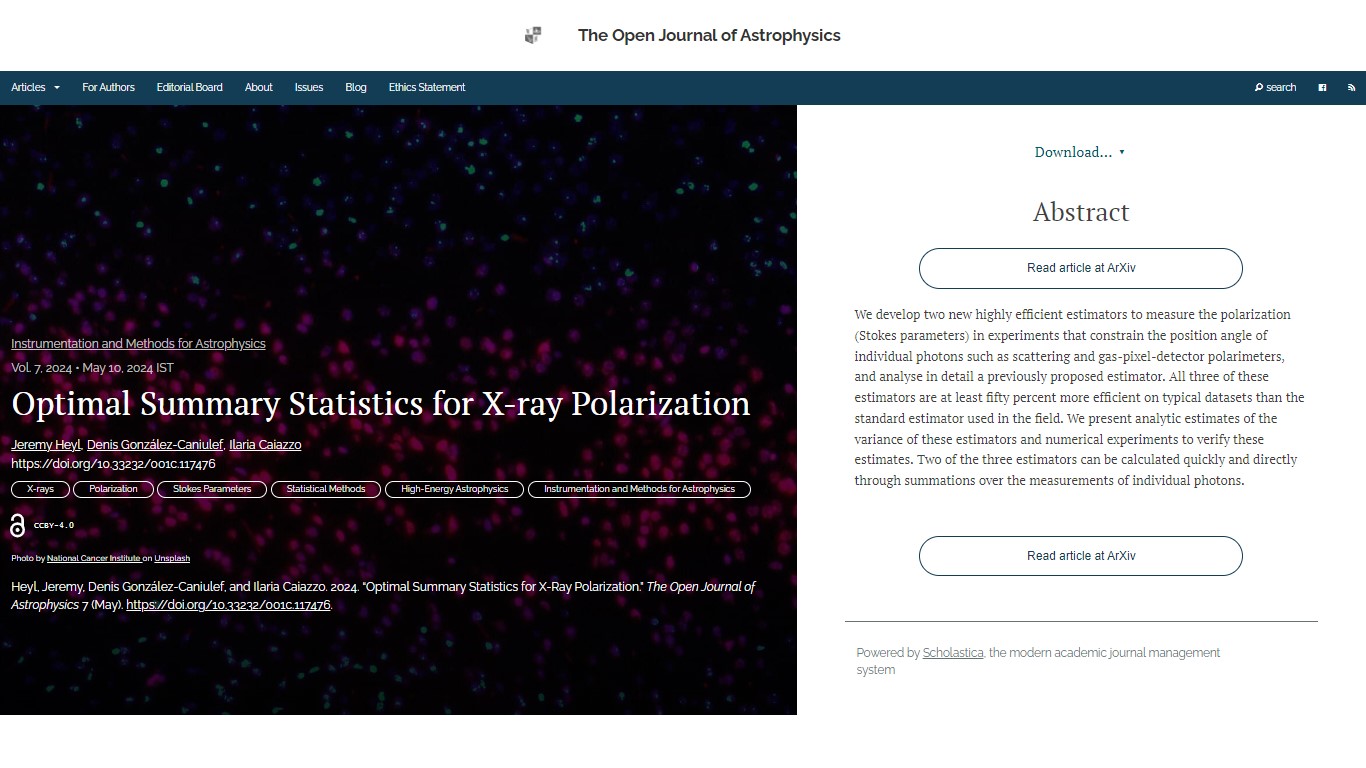
The next paper, is in the folder Instrumentation and Methods for Astrophysics and is entitled “Optimal Summary Statistics for X-ray Polarization”. The authors are Jeremy Heyl (Uni. British Columbia, Canada), Denis González-Caniulef (Uni. Toulouse, France) and Ilaria Caiazzo (Caltech, USA). This presents new statistical estimators for use in studies of X-ray polarization, with an analytic discussion of their efficiency. It can be found here and the accepted version can be read on arXiv here. Here is the overlay:

The last paper of this batch is called “B-modes from galaxy cluster alignments in future surveys” and is by Christos Georgiou, Thomas Bakx, Juliard van Donkersgoed and Nora Elisa Chisari, all from Utrecht University in The Netherlands. It presents a discussion of the possible detection of cosmic shear B-modes produced by intrinsic alignments in future galaxy surveys.
Here is the overlay:

You can find the full text for this one on the arXiv here. The primary classification for this one is Cosmology and Nongalactic Astrophysics.
And that ends this week’s update. More next week!

New Publication at the Open Journal of Astrophysics

Posted in OJAp Papers, Open Access, The Universe and Stuff with tags , , , , , , , on March 2, 2024 by telescoper

It’s a rainy Saturday afternoon here in Sydney, and here’s the last update from the Open Journal of Astrophysics before I change time zones. In fact there is only one paper to report this week, being  the 16th paper in Volume 7 (2024)  and the 131st altogether. It was published on February 29th 2024.

The title is “Bound circumplanetary orbits under the influence of radiation pressure: Application to dust in directly imaged exoplanet systems” and it  is in the folder marked Earth and Planetary Astrophysics. It presents an investigation into the effect of radiation pressure on bound orbits, with applications to the behaviour of dust in exoplanet systems in general and to the Fomalhaut system in particular. The authors are Bradley Hansen of UCLA and Kevin Hayakawa of California State University (both in the USA).

Here is the overlay of the paper containing the abstract:

You can click on the image of the overlay to make it larger should you wish to do so. You can also find the officially accepted version of the paper on the arXiv here.

There are quite a few papers in the pipeline which I expect to be published during the next week or soon after.

Life, the Universe and the Drake Equation

Posted in The Universe and Stuff with tags , , , , , , , on September 3, 2022 by telescoper
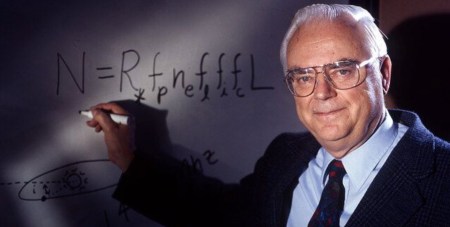
Picture of Frank Drake with his equation

Frank Drake and the Drake Equation (Picture credit: Space.com)

I heard last night of the death at the age of 92 of astronomer Frank Drake, one of the pioneers of the Search for Extraterrestrial Intelligence (SETI). He was best known to most people for formulating the Drake Equation, so since it’s a rainy Saturday morning I thought I’d commemorate him here by presenting a brief discussion of that equation and what it means.

Our Universe is contrived in such a way as to make life possible within it. After all, we’re here! But just because it is possible, that doesn’t mean that it is commonplace. Is life all around us, or did it only happen on Earth? It fascinates me that this topic comes up so often in the question sessions that follow the public lectures I give on astronomy and cosmology. Do you think there is life on other worlds? Are there alien civilisations more advanced than our own? Have extraterrestrials visited Earth? These are typical of the kind of things people ask me when I give talks on the Big Bang theory of the origin of the Universe. It often seems that people are more interested in finding out if there is life elsewhere than in making more serious efforts to sustain life in the fragile environment of our own planet. But there’s no doubting the effect that it would have on humanity to have proof that we are not alone in the cosmos. We could then accept that the Universe was not made for our own benefit. Such proof might also help release mankind from the shackles currently placed on it by certain fundamentalist religious cults. But whatever the motives for seeking out life on other worlds, this is undoubtedly a subject worthy of serious scientific study.

Our understanding of the origins of terrestrial life still has important gaps. There is still no compelling direct evidence that life has existed elsewhere in the Solar system. Conditions may, for example, have been conducive to life earlier in the history of Mars but whatever did manage to evolve there has not left any unambiguous clues that we have yet found. The burgeoning new field of astrobiology seeks to understand the possible development of life far from Earth, and perhaps in extreme conditions very different from those found on our planet. This is, however, a very new field and it will be a very long time before it becomes fully established as a rigorous scientific discipline with a solid experimental and observational foundation. What I want to do in this discussion is therefore not to answer the question “Are we alone?” but to give some idea of the methods used to determine if there might be life elsewhere, including the SETI (Search for ExtraTerrestrial Intelligence) industry which aims to detect evidence of advanced civilizations.

The first ever scientific conference on SETI was held in 1961, in Green Bank, West Virginia, the site of a famous radio telescope. A search had just been carried out there for evidence of radio signals from alien intelligences. This conference didn’t exactly change the world, which is not surprising because only about ten people showed up. It did, however, give rise to one of the most famous equations in modern science: the Drake Equation.

The astronomer Frank Drake was setting up the programme for the inaugural SETI conference and he wanted to summarize, for further discussion, the important factors affecting the chances of detecting radio transmissions from alien worlds. The resulting equation yields a rough guess of the number of civilizations existing in the Milky Way from which we might get a signal. Of course we can’t calculate the answer. The equation’s usefulness is that it breaks down the puzzle into steps, rather than providing the solution. The equation has been modified over the years so that there are various versions of it addressing different questions, but its original form in all its glory was


N=R× fp × ne × fl × fi × fc × L


The symbols in this equation have the following meanings. The left hand side N is the number of transmitting civilisations in our Galaxy, which is what we want to determine  The first term on the right hand side is R, which is the birth-rate of stars in our Galaxy per year. We know that the Milky Way is about 10 billion years old, and it contains about 100 billion stars. As a very rough stab we could guess that the required birth-rate is therefore about ten stars per year. It seems unlikely that all stars could even in principle be compatible with life existing in their neighbourhood. For example, very big stars burn out very quickly and explode, meaning that there is very little time for life to evolve there in the first place and very little chance of surviving once it has. Next in the equation is fp, the fraction of these stars having planets, followed by ne, the typical number of planets one might find.  This is followed by fl, the fraction of all planets on which life in some form does actually evolve. The next term is fi, the fraction of those planets with life on them that have intelligent life on them. Finally we have two factors pertaining to civilization: fc is the fraction of planets inhabited by intelligent beings on which civilizations arise that are capable of interstellar communication and L is the average lifetime of such civilizations.

The Drake equation probably looks a bit scary because it contains a large number of terms, but I hope you can see that it is basically a consequence of the rules for combining probabilities. The idea is that in order to have a transmitting civilisation, you must the simultaneous occurrence of various properties each of which whittles away at the original probability.

To distil things a little further we can simplify the original Drake equation so that it has only four terms

N=NH × fl × fc × fnow

The first three terms of the original equation have been absorbed into NH, the number of habitable planets and the last two have become fnow, the fraction of civilized planets that happen to be transmitting now, when we are trying to detect them. This is important because many civilizations could have been born, flourished and died out millions of years in the past so will never be able to communicate with them.

Whichever way you write it, the Drake equation depends on a number of unknown factors. Combining factors multiplicatively like this can rapidly lead to very large (or very small) numbers. In this case each factor is very uncertain, so the net result is very poorly determined.

Recent developments in astronomy mean that we at least have something to go on when it comes to NH, the number of habitable planets. Until relatively recently the only planets we knew about for sure were in our own Solar System orbiting our own star, the Sun. We didn’t know about planets around other stars because even if there were there we were not able to detect them. Many astronomers thought planets would turn out to be quite rare but absence of evidence is not evidence of absence.  Observations now seem to support the idea that planets are fairly common, and this also seems to be implied by our improved understanding of how stars form.

Planets around distant stars are difficult to detect directly because they only shine by light reflected from their parent star and are not themselves luminous. They can, however, be detected in a number of very convincing ways. Strictly speaking, planets do not orbit around stars. The star and the planet both orbit around their common centre of mass.  Planets are generally much smaller than stars so this centre of mass lies very close to the centre of the star. Nevertheless the presence of a planet can be inferred through the existence of a wobble in the stars’ path through the Galaxy. Dozens of extrasolar planets have been discovered using this basic idea. The more massive the planet, and the closer it is to the star the larger is the effect. Interestingly, many of the planets discovered so far are large and closer in than the large ones in our Solar System (Jupiter, Saturn, Uranus and Neptune). This could be just a selection effect – we can only detect planets with a big wobble so we can’t find any small planets a long way from their star – but if it isn’t simply explained away like that it could tell us a lot about the processes by which planets formed.

The birth of a star is thought to be accompanied by the formation of a flattened disk of debris in the form of tiny particles of dust, ice and other celestial rubbish. In time these bits of dirt coagulate and form larger and larger bodies, all the way up in scale to the great gas giants like Jupiter. The planets move in the same plane, as argued by Laplace way back in the 19th century, because they were born in a disk.

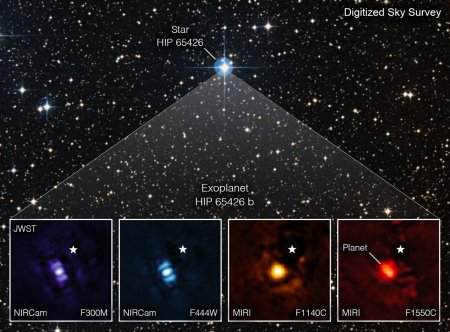
As an aside I’ll mention that when I started my PhD in 1985 there were no known extra-solar planets -exoplanets for short – so as a field exoplanet research hadn’t really started. Now it’s one of the biggest areas of astrophysics and is set to grow even more with the launch of JWST, which has just made its first direct image of an exoplanet:
 

Of course, while planets may be common we still do not know for sure whether habitable planets are also commonplace. We have no reason to think otherwise, however, so we could reasonably assume that there could be one habitable planet per system of planets. This would give a very large value for NH, perhaps 100 billion or so in our Galaxy.

The remaining terms in the Drake Equation pose a bit more of a problem. We certainly don’t have any rational or reliable way to estimate fl. We only know of one planet with life on it. Even Bayesians can’t do much in the way of meaningful statistical inference in this case because we do not have a sensible model framework within which to work. On the other hand, there is a plausibility argument that suggests fl may be larger rather than smaller. We think Earth formed as a solid object about 4.5 billion years ago. Carbon-isotope evidence suggests that life in a primitive form had evolved about 3.85 billion years ago, and the fossil record suggests it was abundant by 3.5 billion years. At least the early stages of evolution happened relatively quickly after the Earth was formed and it is a reasonable inference that life is not especially difficult to get going.

It might be possible therefore that fl=1, or close to it, which would mean that all habitable planets have life. On the other hand, suppose life has a one-in-a-million chance of arising then this reduces the number of potentially habitable planets with life actually on them to only a millionth of this value.

The factor fc represents the fraction of inhabited planets on which transmitting civilizations exist at some point. Here we really don’t have much to go on at all. But there may be some strength in the converse argument to that of the previous paragraph. The fact that life itself arose 3.85 billion years ago but humans only came on the scene within the last million years suggests that this step may be difficult, and fc should consequently take a small value.

The last term in the simplified Drake equation, fnow, is even more difficult because it involves a discussion of the survivability of civilizations. Part of the problem is that we lack examples on which to base a meaningful discussion. For present purposes, however, it is worth looking at the numbers for terrestrial life. The Milky Way is roughly 10 billion years old. We have only been capable of interstellar communication for about 80 years, initially accidentally through through stray radio broadcasts. This is only about one part in 200 million of the lifetime of our Galaxy. If we destroy ourselves in the very near future, either by accident or design, then this is our lifetime L as it appears in the original Drake equation. If this is typical of other civilizations then we would have roughly a one in 200 million chance of detecting them at any particular time. Even if our Galaxy had nurtured hundreds of millions of civilizations, there would only be a few that would be detectable by us now.

Incidentally, it is worth making the comment that Drake’s equation was definitely geared to the detection of civilizations by their radio transmissions. It is quite possible that radio-based telecommunication that results in leakage into space only dominates for a brief stage of technological evolution. Maybe some advanced form of cable transmission is set to take over. This would mean that accidental extraterrestrial communications might last only for a short time compared to the lifetime of a civilization. Many SETI advocates argue that in any case we should not rely on accidents, but embark on a programme of deliberate transmission.  Maybe advanced alien civilizations are doing this already…

In Drake’s original discussion of this question, he came to the conclusion that the first six factors on the right-hand-side of the equation, when multiplied together, give a number about one. This leads to the neat conclusion that N=L (when L is the lifetime of a technological civilization in years). I would guess that most astronomers probably doubt the answer is as large as this, but agree that the weakest link in this particular chain of argument is L. Reading the newspapers every day does not make me optimistic that L is large…

A Nobel Prize for Jim Peebles!

Posted in The Universe and Stuff with tags , , , , , , on October 8, 2019 by telescoper

I’ve just dashed back in excitement to the office from two hours of mandatory Financial Report Training to write a quick post before my 12 o’clock lecture on Astrophysics & Cosmology because of the news about the award of the 2019 Nobel Prize for Physics.

My recent post was half right in the sense that half this year’s prize goes to Michel Mayor and Didier Queloz for the discovery of an extrasolar planet. I don’t know either of them personally, but heartiest congratulations to both!

My heart lept with joy, however, to see the other half of the prize go to Jim Peebles (above) for his work on theoretical cosmology. Much of the reason for that is that I’ve had the great honour and pleasure to meet Jim many times over the years. He is not only a truly great scientist but also a extremely nice man whose kindness and generosity is universally recognized. He’s not known as `Gentleman Jim’ for nothing!

The other reason for the excitement is that I was completely taken by surprise by the announcement. I had feared that his chance of winning a Nobel Prize had passed – I argued at the time that Jim should have been awarded a share of the 2006 Nobel Prize because without his amazing pioneering theoretical work the importance of the cosmic microwave background for cosmology and the large-scale structure of the Universe would not have been established so rapidly. As an author of the first paper to provide a theoretical interpretation of the signal detected by Penzias and Wilson, Jim was there right at the start of the modern era of cosmology and his subsequent work constructed the foundations of the theory of structure formation through gravitational instability. I was sad that he didn’t get a share in 2006 for this work, but am absolutely delighted that this has been rectified now!

This was one of the first cosmology books I ever bought. It’s an amazing piece of work that has been essential reading for cosmologists for almost 40 years!

Congratulations to Jim!

Now let me think about what to say to my students about this!

Ariel to Fly

Posted in The Universe and Stuff with tags , , , , on March 23, 2018 by telescoper

All hail, great master! Grave sir, hail! I come
To answer thy best pleasure. Be ‘t to fly,
To swim, to dive into the fire, to ride
On the curled clouds, to thy strong bidding task
Ariel and all his quality.

The Tempest, Act I, Scene 2.

It’s nice to be able to pass on a bit of good news for the good folk of the Astronomy Instrumentation Group here in the School of Physics & Astronomy at Cardiff University.

The ARIEL mission has been given the green light by the European Space Agency and will launch sometime around 2028. It will produce the first ever large-scale survey of the atmospheric chemistry of planets outside our solar system. Ariel will extract the chemical fingerprints of the gases in the atmospheres of over 1000 exoplanets, as well as capturing information about the temperatures and pressures in their atmospheres and the presence of clouds.

Whenever I read of exciting news from the field of exoplanet research – which happens quite frequently nowadays – it reminds me that when I started my graduate studies (in 1985) the field didn’t really exist. Now it’s one of the biggest and most active areas of astronomy! Another thing that makes me feel a bit of a dinosaur is that when Ariel actually launches I’ll be 65…

As with all such missions, a large international collaboration will be involved in Ariel, and much of the detail of who will do what is yet to be worked out, but Cardiff scientists will be providing detailed computer simulations of the Ariel satellite and its instruments, ensuring that the scientific observations can be carefully planned and the resulting data can be analysed correctly. The team will also be involved in the ground segment after launch, interpreting the data from the observations to characterise the atmospheres of the exoplanets. The Principal Investigator of the whole mission is Professor Giovanna Tinetti of University College, London, who I see regularly at dinner with the RAS Club.

Head Irishman of the School, Matt Griffin, who will himself is quoted in the news item as saying

The decision to select the Ariel mission demonstrates the scientific vision and ambition of ESA, and it’s the start of a great adventure for everyone involved. This is a mission that will hugely advance our understanding of the nature of planets and of our place in the Universe, and at Cardiff we are very much looking forward to our participation in the project.

The launch date of 2028 is some way off but space missions are exceedingly complicated things and there’s a lot to do in the next decade or so until Ariel finally flies. Hopefully neither swimming, nor diving into fire nor riding on the curled clouds will be involved, but the scientific quality is something of which we can be very confident.

Congratulations to everyone involved in getting this mission selected and best wishes to all those involved in Cardiff and elsewhere!

It’s Official, it’s PLATO!

Posted in Science Politics, The Universe and Stuff with tags , , , , on February 19, 2014 by telescoper

Just a quick post to pass on the news that the European Space Agency has officially selected the third M-Class mission to form part of its Cosmic Vision Programme (which covers the period 2015-2025). The lucky winner is PLATO (PLAnetary Transits and  Oscillations of stars) and it will detect extra-solar planets by monitoring relatively nearby stars, searching for tiny, regular dips in brightness as planets transit in front of them. It will also study astroseismological activity, enabling a precise characterisation of the host star of each planet discovered, including its mass, radius and age.

plato_satelliteIt is expected that PLATO will find and analyse thousands of  such exoplanetary systems in this way, with an emphasis on discovering and characterizing Earth-sized planets and super-Earths in the habitable zone of their parent star. PLATO will be launched on a Soyuz rocket from Europe’s Spaceport in Kourou by 2024 for an initial six-year mission. It will operate from the Second Lagrange Point, or L2 for short. It’s an intriguing design consisting of 34 small telescopes (left).

PLATO joins Solar Orbiter and Euclid, which were chosen in 2011 as ESA’s first two M-class missions. Solar Orbiter will be launched in 2017 to study the Sun and solar wind from a distance of less than 50 million km, while Euclid, to be launched in 2020, will focus on dark energy, dark matter and the structure of the Universe.

The decision to select PLATO wasn’t exactly a surprise as it was singled out as the leading candidate by an expert panel last month, but there was nevertheless some nervousness among certain senior astronomers at the Royal Astronomical Society on Friday in advance of the formal decision. I suspect they’ll all be out celebrating tonight!