Archive for Fuzzy Dark Matter

New Publication at the Open Journal of Astrophysics

Posted in OJAp Papers, Open Access, The Universe and Stuff with tags , , , , on November 10, 2022 by telescoper

I’m delighted to be able to announce the 10000th paper this year, and 1000000th publication overall, at the Open Journal of Astrophysics!

That is counting in binary, of course. In base ten the  new paper at the 16th paper in Volume 5 (2022) as well as the 64th in all.

The latest publication is entitled “Evolution of Cosmic Voids in the Schrödinger-Poisson Formalism” and the authors are Aoibhinn Gallagher and Peter Coles (Who he? Ed) both of the Department of Theoretical Physics at Maynooth University. Obviously as author I played no role in the selection of referees or any other aspect of the editorial process.

Aoibhinn Gallagher – bonus marks for pronouncing both names correctly – is my first Maynooth PhD student and this is her first paper, of many I hope (and expect)! We’re already working on extensions of this approach to other aspects of large-scale structure. You can find some discussion of this general approach here.

Anyway, here is a screen grab of the overlay which includes the  abstract:
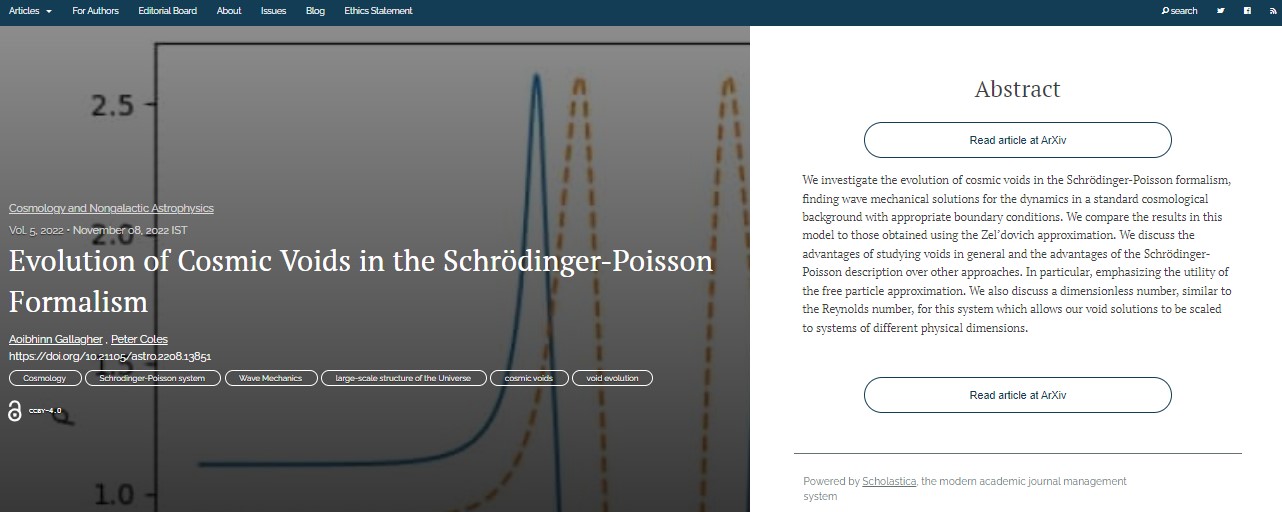
 

You can click on the image to make it larger should you wish to do so. You can find the officially accepted version of the paper on the arXiv here.

Here is a nice animated version of Figure 5 of the paper showing, for a 1D slice, the radial expansion of a spherically symmetric void (i.e. underdense region) using periodic boundary conditions:
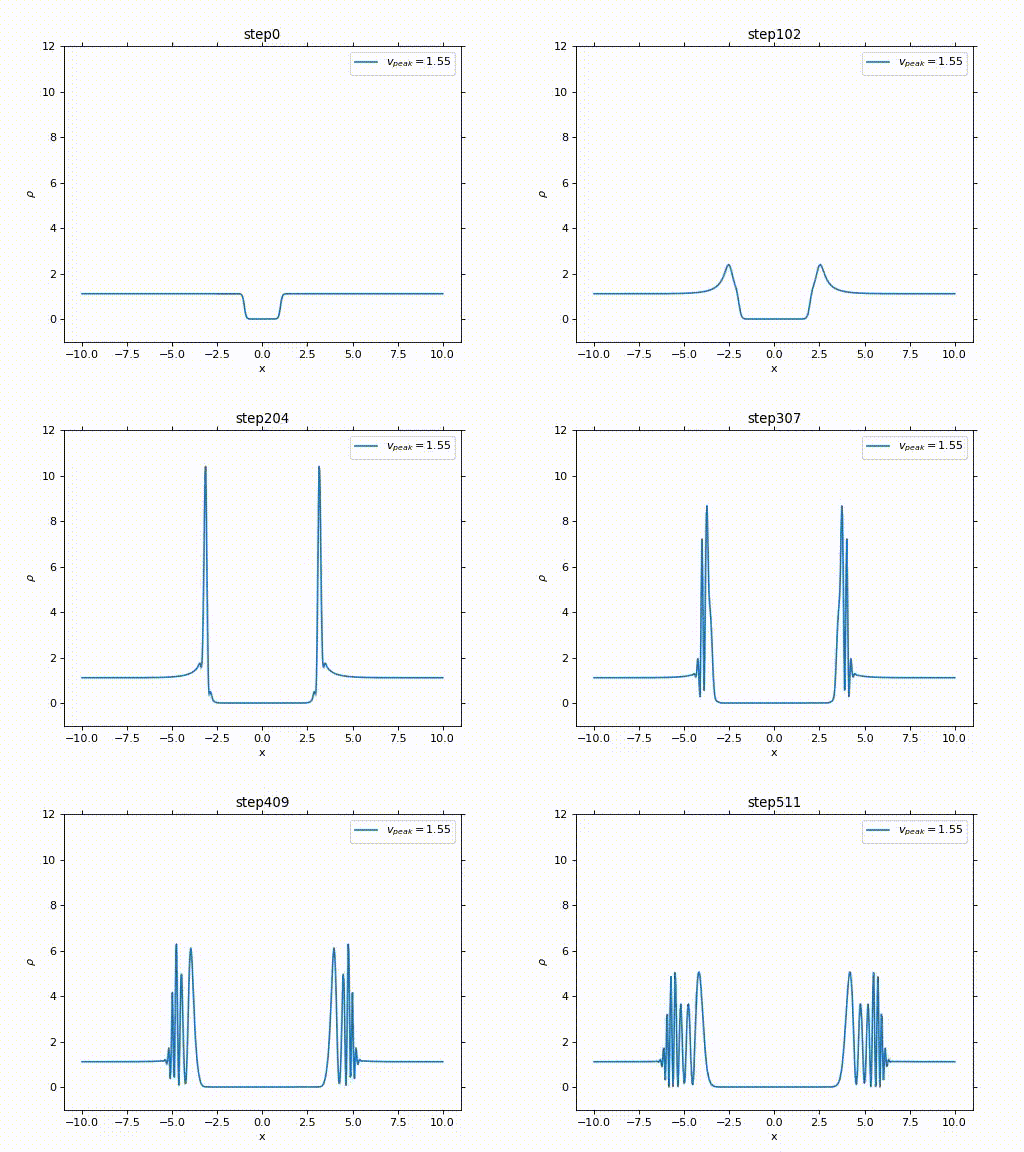
The x-axis is in (scaled) comoving coordinates, i.e. expanding with the cosmological background, so that the global expansion is removed.  You can see that the void expands in these coordinates, so is expanding more quickly than the background, initially pushing matter into a dense ring around the rim of the empty void. That part of the evolution is just the same as for “normal” matter but in this case the wave-mechanical behaviour of the matter prevents it from being confined to a strongly-localized structure as well as affecting the subsequent expansion rate.

Of course in the real Universe, voids are not isolated like this but instead tend to push into each other, but we felt it was worth studying the single void case to understand the dynamics!

Fuzzy Cosmology at ITP2022

Posted in Biographical, Talks and Reviews, The Universe and Stuff with tags , , , on May 26, 2022 by telescoper

As I usually do when I give a talk (which hasn’t been for a while) I’ve uploaded the slides for the presentation I gave at the Irish Theoretical Physics meeting at DIAS this morning. The title of the talk was Fuzzy Cosmology and the abstract reads:

I discuss some applications of the Schrodinger-Poisson wave-mechanical approach to
cosmological structure formation. The most obvious use of this formalism is to “fuzzy” dark matter,
i.e. dark matter consisting of extremely light particles whose effective de Broglie wavelength is
sufficiently large to be astrophysically relevant, but it can be used to model more general scenarios
and has a number of advantages over standard methods based on Eulerian perturbation theory. I
illustrate the formalism with some calculations for cosmic voids and discuss its application to the
cosmological reconstruction problem(s).

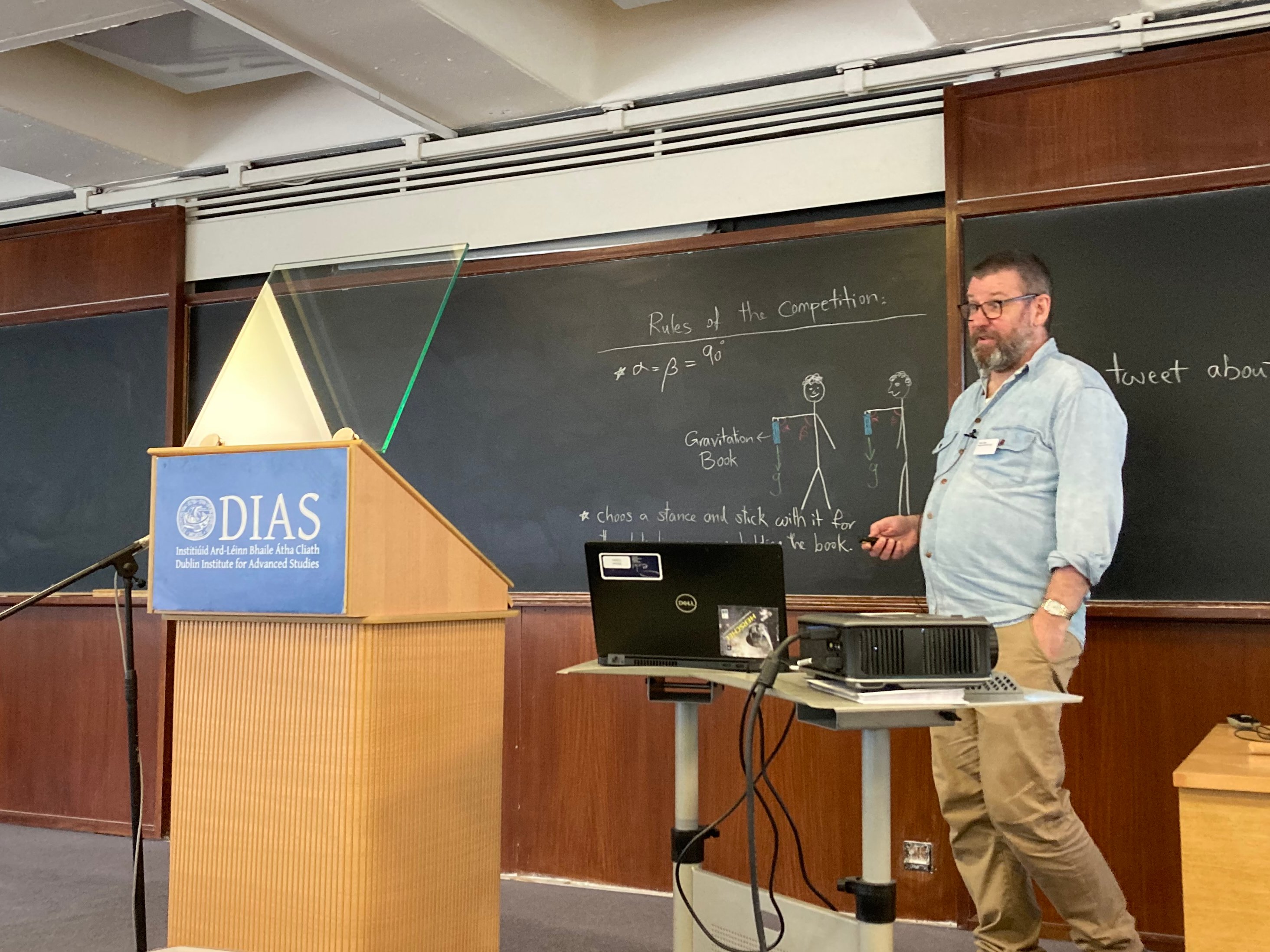
I think it went reasonably well despite there being a hitch at the start because the touchpad on my laptop stopped working. Fortunately I was able to produce an emergency mouse. Anyway, here is a picture of me taken during the talk to prove I was there..

Cosmology Talks: Alvaro Pozo on Potential Evidence for Wave Dark Matter

Posted in The Universe and Stuff with tags , , , , , , , , , on February 19, 2021 by telescoper

It’s time I shared another one of those interesting cosmology talks on the Youtube channel curated by Shaun Hotchkiss. This channel features technical talks rather than popular expositions so it won’t be everyone’s cup of tea but for those seriously interested in cosmology at a research level they should prove interesting. This is quite a recent one, from about a week ago.

In the talk, Alvaro Pozo tells us about a recent paper where he an collaborators detect the transition between a core (flat density profile) and halo (power law density profile) in dwarf galaxies. The full core + halo profile matches very closely what is expected in simulations of wave dark matter (sometimes called “fuzzy” dark matter), by which is meant dark matter consisting of a particle so light that its de Broglie wavelength is long enough to be astrophysically relevant. That is, there is a very flat core, which then drops off suddenly and then flattens off to a decaying power-law profile. The core matches the soliton expected in wave dark matter and the halo matches an outer NFW profile expected outside the soliton. They also detect evidence for tidal stripping of the matter in the galaxies. The galaxies closer to the centre of the Milky Way have their transition point between core and halo happen at smaller densities (despite the core density itself not being systematically smaller). The transition also appears to happen closer to the centre of the galaxy, which matches simulations. Of course the core+halo pattern they have clearly observed might be due to something else, but the match between wave dark matter simulations and observations is impressive. An important  caveat is that the mass for the dark matter that they use is very small and in significant tension with Lyman Alpha constraints for wave-like dark matter. This might indicate that the source of this universal core+halo pattern they’re observing comes from something else, or it might indicate that the wave dark matter is more complicated than represented in the simplest models.

P. S. The papers that accompany this talk can be found here.

P.P.S. If you’re interested in wave dark matter there is a nice recent review article by Lam Hui here.

Cosmology Talks: Mateja Gosença & Bodo Schwabe on Simulating Mixed Fuzzy and Cold Dark Matter

Posted in The Universe and Stuff with tags , , , , , , on November 11, 2020 by telescoper

It’s been too long since I shared one of those interesting cosmology talks on the Youtube channel curated by Shaun Hotchkiss. This channel features technical talks rather than popular expositions so it won’t be everyone’s cup of tea but for those seriously interested in cosmology at a research level they should prove interesting.

Anyway, although I’ve been too busy to check out the talks much recently I couldn’t resist sharing this one not only because it’s on a topic I find interesting (and have worked on) but also because one of the presenters (Mateja Gosença) is a former PhD student of mine from Sussex! So before I go fully into proud supervisor mode, I’ll just say that the talk is about AxioNyx, which is a new public code for simulating both ultralight (or “Fuzzy”, so called because its Compton de Broglie wavelength is large enough to be astrophysically relevant) dark matter (FDM) and Cold dark matter (CDM) simultaneously. The code simulates the FDM using adaptive mesh refinement and the CDM using N-body particles.

P. S. The paper that accompanies this talk can be found on the arXiv here.

Cosmology Talks: Jurek Bauer on ‘Fuzzy’ Dark Matter

Posted in The Universe and Stuff with tags , , , , , on April 26, 2020 by telescoper

If you are missing your regular seminar experience because of the Coronavirus lockdown, Shaun Hotchkiss has set up a YouTube channel just for you!

The channel features technical talks rather than popular expositions so it won’t be everyone’s cup of tea but for those seriously interested in cosmology at a research level they should prove interesting.

Here’s another example from that series in which Jurek Bauer talks about ‘Fuzzy’ Dark Matter (ie matter in the form of a very light particle such as the axion) and the prospects for constraining its existence using the Square Kilometre Array.

P. S. The paper that accompanies this talk can be found on the arXiv here.