I came across this video on youtube and was intrigued because the title seemed like a crossword clue (to which I couldn’t figure out the answer). It turns out that it goes with a piece in the Guardianwhich describes a computer simulation showing the formation of a galaxy during the first 2bn years of the Universe’s evolution. Those of us interested in cosmic structures on a larger scale than galaxies usually show such simulations in co-moving coordinates (i.e. in a box that expands at the same rate as the Universe), but this one is in physical coordinates showing the actual size of the objects therein; the galaxy is seen first to condense out of the expanding distribution of matter, but then grows by accreting matter in a complicated and rather beautiful way.
This calculation includes gravitational and hydrodynamical effects, allowing it to trace the separate behaviour of dark matter and gas (predominantly hydrogen). You can see that this particular object forms very early on; the current age of the Universe is estimated to be about 13 – 14 billion years. When we look far into space using very big telescopes we see objects from which light has taken billion of years to reach us. We can therefore actually see galaxies as they were forming and can therefore test observationally whether they form as theory (and simulation) suggest.
Future large-scale structure surveys of the Universe will aim to constrain the cosmological model and the true nature of dark energy with unprecedented accuracy. In order for these surveys to achieve their designed goals, they will require predictions for the nonlinear matter power spectrum to sub-percent accuracy. Through the use of a large ensemble of cosmological N-body simulations, we demonstrate that if we do not understand the uncertainties associated with simulating structure formation, i.e. knowledge of the `true’ simulation parameters, and simply seek to marginalize over them, then the constraining power of such future surveys can be significantly reduced. However, for the parameters {n_s, h, Om_b, Om_m}, this effect can be largely mitigated by adding the information from a CMB experiment, like Planck. In contrast, for the amplitude of fluctuations sigma8 and the time-evolving equation of state of dark energy {w_0, w_a}, the mitigation is mild. On marginalizing over the simulation parameters, we find that the dark-energy figure of merit can be degraded by ~2. This is likely an optimistic assessment, since we do not take into account other important simulation parameters. A caveat is our assumption that the Hessian of the likelihood function does not vary significantly when moving from our adopted to the ‘true’ simulation parameter set. This paper therefore provides strong motivation for rigorous convergence testing of N-body codes to meet the future challenges of precision cosmology.
This paper asks an important question which I could paraphrase as “Do we trust N-body simulations too much?”. The use of numerical codes in cosmology is widespread and there’s no question that they have driven the subject forward in many ways, not least because they can generate “mock” galaxy catalogues in order to help plan survey strategies. However, I’ve always worried that there is a tendency to trust these calculations too much. On the one hand there’s the question of small-scale resolution and on the other there’s the finite size of the computational volume. And there are other complications in between too. In other words, simulations are approximate. To some extent our ability to extract information from surveys will therefore be limited by the inaccuracy of our calculation of the theoretical predictions.
Anyway, the paper gives us quite a few things to think about and I think it might provoke a bit of discussion, which is why I mentioned it here – i.e. to encourage folk to read and give their opinions.
The use of the word “simulation” always makes me smile. Being a crossword nut I spend far too much time looking in dictionaries but one often finds quite amusing things there. This is how the Oxford English Dictionary defines SIMULATION:
1.
a. The action or practice of simulating, with intent to deceive; false pretence, deceitful profession.
b. Tendency to assume a form resembling that of something else; unconscious imitation.
2. A false assumption or display, a surface resemblance or imitation, of something.
3. The technique of imitating the behaviour of some situation or process (whether economic, military, mechanical, etc.) by means of a suitably analogous situation or apparatus, esp. for the purpose of study or personnel training.
So it’s only the third entry that gives the intended meaning. This is worth bearing in mind if you prefer old-fashioned analytical theory!
In football, of course, you can even get sent off for simulation…
While I’m incarcerated at home I thought I might as well make myself useful by passing on an interesting news item I found on the BBC website. This relates to a paper in the latest edition of Nature that reports the discovery of what appears to be a classic “Grand Design” spiral galaxy at a redshift of 2.18. According to the standard big bang cosmology this means that the light we are seeing set out from this object over 10 billion years ago, so the object formed about 3 billion years after the big bang.
I found this image of the object – known to its friends as BX442 – and was blown away by it..
..until I saw the dreaded words “artist’s rendering”. The actual image is somewhat less impressive.
But what’s really interesting about the study reported in Nature are the questions it asks about how this object first into our understanding of spiral galaxy formation. According to the prevailing paradigm, galaxies form hierarchically by progressively merging smaller clumps into bigger ones. The general expectation is that at high redshift – corresponding to earlier stages of the formation process – galaxies are rather clumpy and disturbed; the spiral structure we see in nearby galaxies is rather flimsy and easily disturbed, so it’s quite surprising to see this one. Does BX442 live in an especially quiet environment? Have we seen few high-redshift spirals because they are rare, or because they are hard to find? Answers to these and other questions will only be found by doing systematic surveys to establish the frequency and distribution of objects like this, as well as the details of their internal kinematics.
The paper, to appear in due course in Monthly Notices of the Royal Astronomical Society, describes a study of the positions and velocities of small satellite galaxies and other object around the Milky Way, which suggest the existence of a flattened structure orientated at right angles to the Galactic plane. They call this the “Vast Polar Structure”. There’s even a nifty video showing this arrangement:
They argue that this is is evidence that these structures have a tidal origin, having been thrown out in the collision between two smaller galaxies during the formation of the Milky Way. One would naively expect a much more isotropic distribution of material around our Galaxy if matter had fallen into it in the relatively quiescent way envisaged by more standard theoretical models.
Definitely Quite Interesting.
However, I was rather taken aback by this quotation by one of the authors, Pavel Kroupa, which ends the press release.
Our model appears to rule out the presence of dark matter in the universe, threatening a central pillar of current cosmological theory. We see this as the beginning of a paradigm shift, one that will ultimately lead us to a new understanding of the universe we inhabit.
Hang on a minute!
One would infer from this rather bold statement that the paper concerned contained a systematic comparison between the observations – allowing for selection effects, such as incomplete sky coverage – and detailed theoretical calculations of what is predicted in the standard theory of galaxy formation involving dark matter.
But it doesn’t.
What it does contain is a simple statistical calculation of the probability that the observed distribution of satellite galaxies would have arisen in an exactly isotropic distribution function, which they conclude to be around 0.2 per cent.
However, we already know that galaxies like the Milky Way are not exactly isotropic, so this isn’t really a test of the dark matter hypothesis. It’s a test of an idealised unrealistic model. And even if it were a more general test of the dark matter hypothesis, the probability of this hypothesis being correct is not what has been calculated. The probability of a model given the data is not the same as the probability of the data given the model. To get that you need Bayes’ theorem.
What needs to be done is to calculate the degree of anisotropy expected in the dark matter theory and in the tidal theory and then do a proper (i.e. Bayesian) comparison with the observations to see which model gives the better account of the data. This is not any easy thing to do because it necessitates doing detailed dynamical calculations at very high resolution of what galaxy like the Milky Way should look like according to both theories.
Until that’s done, these observations by no means “rule out” the dark matter theory.
I hope you’ve all been tuning in to the BBC’s astronomy jamboree Stargazing Live. There have been two episodes so far, with one last one to follow tonight, plus a huge range of activities across the country (including Wales) giving members of the public the chance to look at the sky through telescopes. The programmes and other activities have been getting an excellent response, especially from the younger generation, which is excellent news for the future of astronomy.
Working in a School of Physics & Astronomy makes one realise just how much public interest there is in astronomy, not just among schoolkids but in the numerous amateur astronomical societies, the members of which actually know the night sky better than many professionals! Most of us astronomers and astrophysicists are regularly asked to give public lectures and Cardiff in particular runs a host of other outreach activities related to our astronomy research. Our colleagues in mainstream physics subjects such as condensed matter physics don’t get the same level of direct public interest – I don’t think there are any amateur semiconductor physics clubs in the UK! – but many students attracted into universities by astronomy do turn to other branches of physics when they get here, because something else catches their imagination.
But important though that role is, let’s not forget that astronomy isn’t just about outreach. It’s actually real science, making real discoveries about the way our universe works. It’s worth doing in its own right as well as being good for other branches of physics.
Anyway, being a theoretical astrophysicist I usually feel a bit left out of these stargazing actitivies because I don’t really know one end of a telescope from the other. The other day I jokingly asked whether Stargazing Live was ever going to include a theory component…
Last night’s episode actually did, in the form of a discussion of a numerical simulation of galaxy formation between the presenters and young Dr Andrew Pontzen from Oxford University. He even made a little video about the simulation, sort of virtual reality rendition of the formation of the Milky Way, as shown on the telly:
Apparently, making this required 300,000 CPU hours on 300 processors and it is based on 16 Terabytes of raw data. Phew!
It’s a very impressive simulation, but the use of the word simulation in this context always makes me smile. Being a crossword nut I spend far too much time looking in dictionaries but one often finds quite amusing things there. This is how the Oxford English Dictionary defines SIMULATION:
1.
a. The action or practice of simulating, with intent to deceive; false pretence, deceitful profession.
b. Tendency to assume a form resembling that of something else; unconscious imitation.
2. A false assumption or display, a surface resemblance or imitation, of something.
3. The technique of imitating the behaviour of some situation or process (whether economic, military, mechanical, etc.) by means of a suitably analogous situation or apparatus, esp. for the purpose of study or personnel training.
It’s only the third entry that gives the intended meaning. This is worth bearing in mind if you prefer old-fashioned analytical theory!
In football, of course, you can get sent off for simulation…
Not long ago I posted an item about the exciting discovery of a quasar at redshift 7.085. I thought I’d return briefly to that topic in order (a) to draw your attention to a nice guest post by Daniel Mortlock on Andrew Jaffe’s blog giving more background to the discovery, and (b) to say something about the theoretical interpretation of the results.
The reason for turning the second theme is to explain a little bit about what difficulties this observation might pose for the standard “Big Bang” cosmological model. Our general understanding of galaxies form is that gravity gathers cold non-baryonic matter into clumps into which “ordinary” baryonic material subsequently falls, eventually forming a luminous galaxy forms surrounded by a “halo” of (invisible) dark matter. Quasars are galaxies in which enough baryonic matter has collected in the centre of the halo to build a supermassive black hole, which powers a short-lived phase of extremely high luminosity.
The key idea behind this picture is that the haloes form by hierarchical clustering: the first to form are small but merge rapidly into objects of increasing mass as time goes on. We have a fairly well-established theory of what happens with these haloes – called the Press-Schechter formalism – which allows us to calculate the number-density of objects of a given mass as a function of redshift . As an aside, it’s interesting to remark that the paper largely responsible for establishing the efficacy of this theory was written by George Efstathiou and Martin Rees in 1988, on the topic of high redshift quasars.
Anyway, courtesy of my estimable PhD student Jo Short, this is how the mass function of haloes is predicted to evolve in the standard cosmological model (the different lines show the distribution as a function of redshift for redshifts from 0 to 9):
It might be easier to see what’s going on looking instead at this figure which shows instead of .
You can see that the typical size of a halo increases with decreasing redshift, but it’s only at really high masses where you see a really dramatic effect.
The mass of the black hole responsible for the recently-detected high-redshift quasar is estimated to be about . But how does that relate to the mass of the halo within which it resides? Clearly the dark matter halo has to be more massive than the baryonic material it collects, and therefore more massive than the central black hole, but by how much?
This question is very difficult to answer, as it depends on how luminous the quasar is, how long it lives, what fraction of the baryons in the halo fall into the centre, what efficiency is involved in generating the quasar luminosity, etc. Efstathiou and Rees argued that to power a quasar with luminosity of order for a time order years requires a parent halo of mass about .
The abundance of such haloes is down by quite a factor at redshift 7 compared to redshift 0 (the present epoch), but the fall-off is even more precipitous for haloes of larger mass than this. We really need to know how abundant such objects are before drawing definitive conclusions, and one object isn’t enough to put a reliable estimate on the general abundance, but with the discovery of this object it’s certainly getting interesting. Haloes the size of a galaxy cluster, i.e. , are rarer by many orders of magnitude at redshift 7 than at redshift 0 so if anyone ever finds one at this redshift that would really be a shock to many a cosmologist’s system, as would be the discovery of quasars at redshifts significantly higher than seven.
Another thing worth mentioning is that, although there might be a sufficient number of potential haloes to serve as hosts for a quasar, there remains the difficult issue of understanding how precisely the black hole forms and especially how long that takes. This aspect of the process of quasar formation is much more complicated than the halo distribution, so it’s probably on detailed models of black-hole growth that this discovery will have the greatest impact in the short term.
The views presented here are personal and not necessarily those of my employer (or anyone else for that matter).
Feel free to comment on any of the posts on this blog but comments may be moderated; anonymous comments and any considered by me to be vexatious and/or abusive and/or defamatory will not be accepted. I do not necessarily endorse, support, sanction, encourage, verify or agree with the opinions or statements of any information or other content in the comments on this site and do not in any way guarantee their accuracy or reliability.


 of objects of a given mass
  as a function of redshift
  . As an aside, it’s interesting to remark that the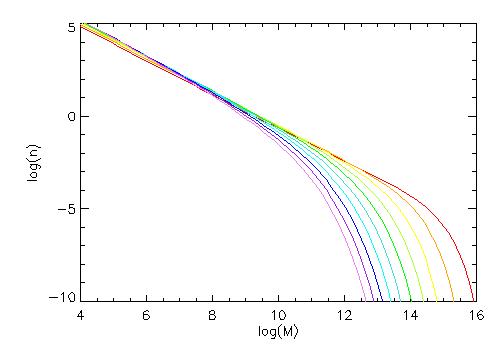
 instead of
  .
.
 . But how does that relate to the mass of the halo within which it resides? Clearly the dark matter halo has to be more massive than the baryonic material it collects, and therefore more massive than the central black hole, but by how much?
 for a time order
  years requires a parent halo of mass about
  .
. , are rarer by many orders of magnitude at redshift 7 than at redshift 0 so if anyone ever finds one at this redshift that would really be a shock to many a cosmologist’s system, as would be the discovery of quasars at redshifts significantly higher than seven.
 In the Dark