Archive for galaxy formation

Yet more high-z galaxies from JWST…

Posted in The Universe and Stuff with tags , , , , , , , on December 19, 2023 by telescoper

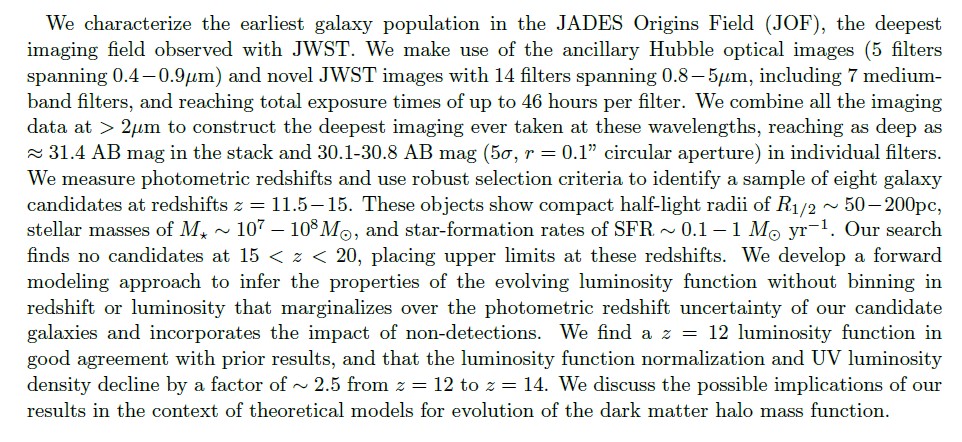
I noticed a paper on arXiv yesterday, by Robertson et al., with the abstract:

You can click on this to make it larger if you find it difficult to read.

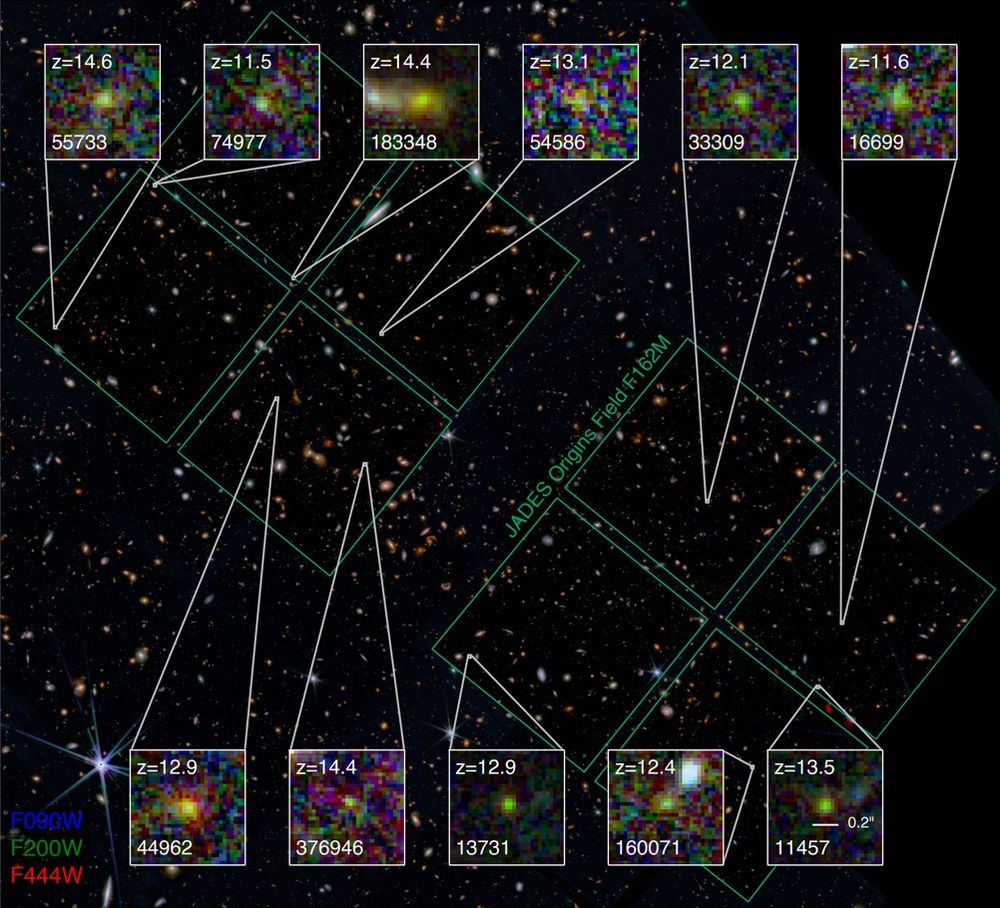
This is the latest in a number of studies by the JWST Advanced Deep Extragalactic Survey (JADES), which is aiming to detect galaxies that formed in the very early Universe; for a previous example see here. The latest batch can be seen in this figure:

There is an important caveat here, which is that these are photometric redshifts, based on the overall shape of the spectrum of the galaxy rather than on spectral lines which give a more accurate result. Follow-up spectroscopy is needed to firmly identify the redshift of the sources. Past experience suggests that some of these candidates may not actually be at as high a redshift as is claimed. If confirmed, however, the existence of large galaxies at redshifts of order 15 will put greater pressure on models of galaxy formation. A recent OJAp publication has shown that galaxies at redshift 10 are consistent with current theoretical ideas, but much larger will increase the tension on theorists. I can imagine quite a few people around the world replotting their graphs right now!

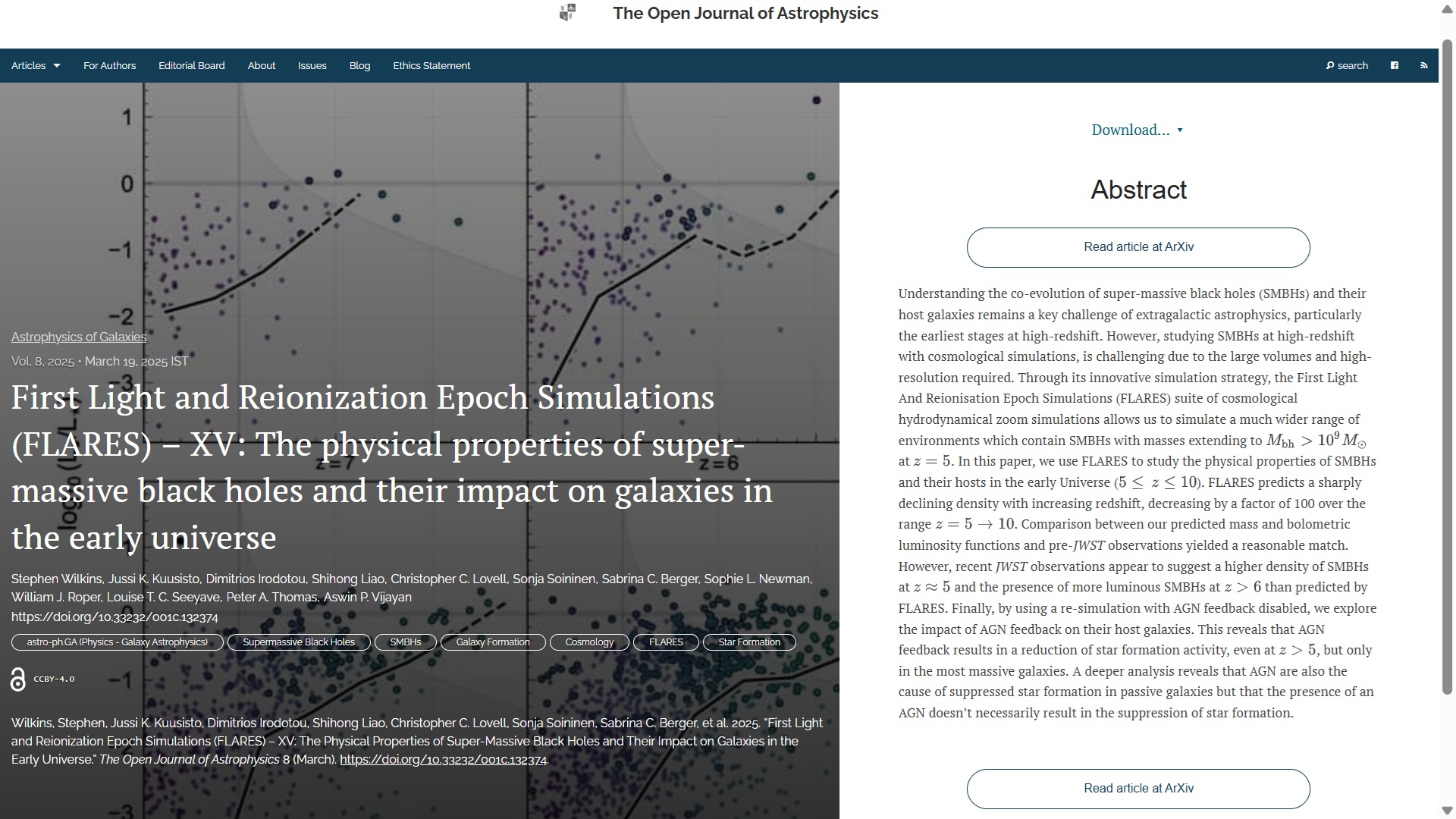
New Publication at the Open Journal of Astrophysics

Posted in OJAp Papers, Open Access, The Universe and Stuff with tags , , , on September 28, 2023 by telescoper

Time to announce yet another new paper at the Open Journal of Astrophysics. This one was published yesterday (27th September 2023).

The latest paper is the 37th  so far in Volume 6 (2023) and the 102nd in all. The authors are Joe McCaffrey (Maynooth, Ireland), Samantha Hardin (Georgia Tech, USA), John Wise (Georgia Tech) and John Regan (Maynooth). As this one involved two authors from my own Department, I recused myself from the editorial process, although it is work I am very interested in.

The primary classification for this paper is Astrophysics of Galaxies and its title is “No Tension: JWST Galaxies at z>10 Consistent with Cosmological Simulations”.  I’ve blogged about this paper before, a few months ago, when it appeared on the arXiv. The editorial process on this one has been very thorough and  it has been a few rounds with the reviewers before being accepted for publication. The authors may have found this a bit irksome, but I think the process improved them paper considerably, which is what it is meant to do.

As many of you will be aware, there’s been a considerable to-do not to mention a hoo-hah about the detections by JWST of some galaxies at high redshift. Some of these have been shown not to be galaxies at high redshift after all, but some around z=10 seem to be genuine. This paper is a response to claims that these somehow rule out the standard cosmological framework.

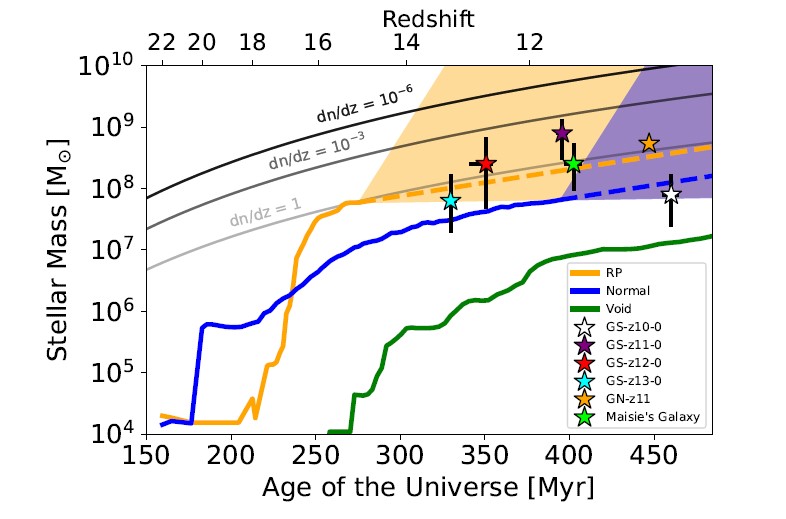
The key figure in the current paper is this:

The solid curves show the number of galaxies of a given mass one would expect to see as a function of redshift in fields comparable to those observed with estimated values from observations (star-shaped symbols). As you can see the observed points are consistent with the predictions. There’s no tension, so you can all relax.

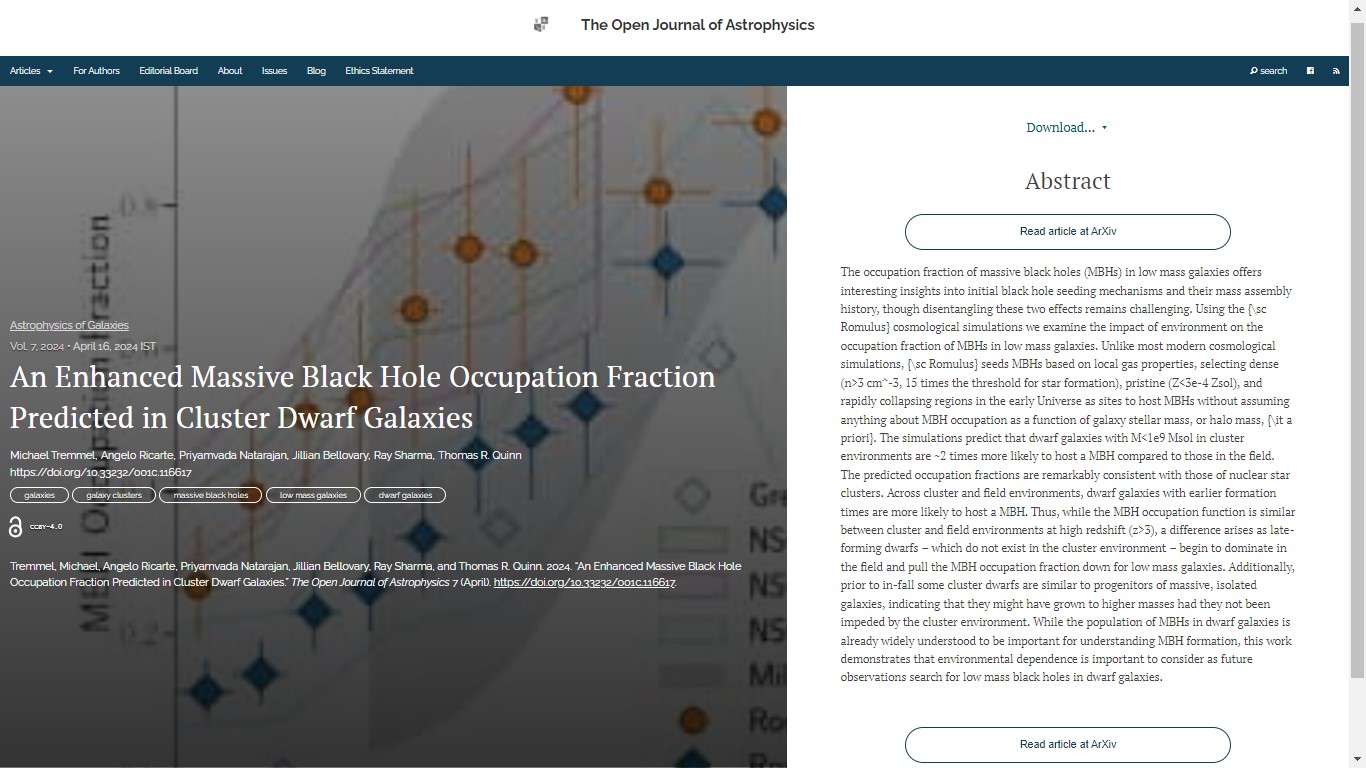
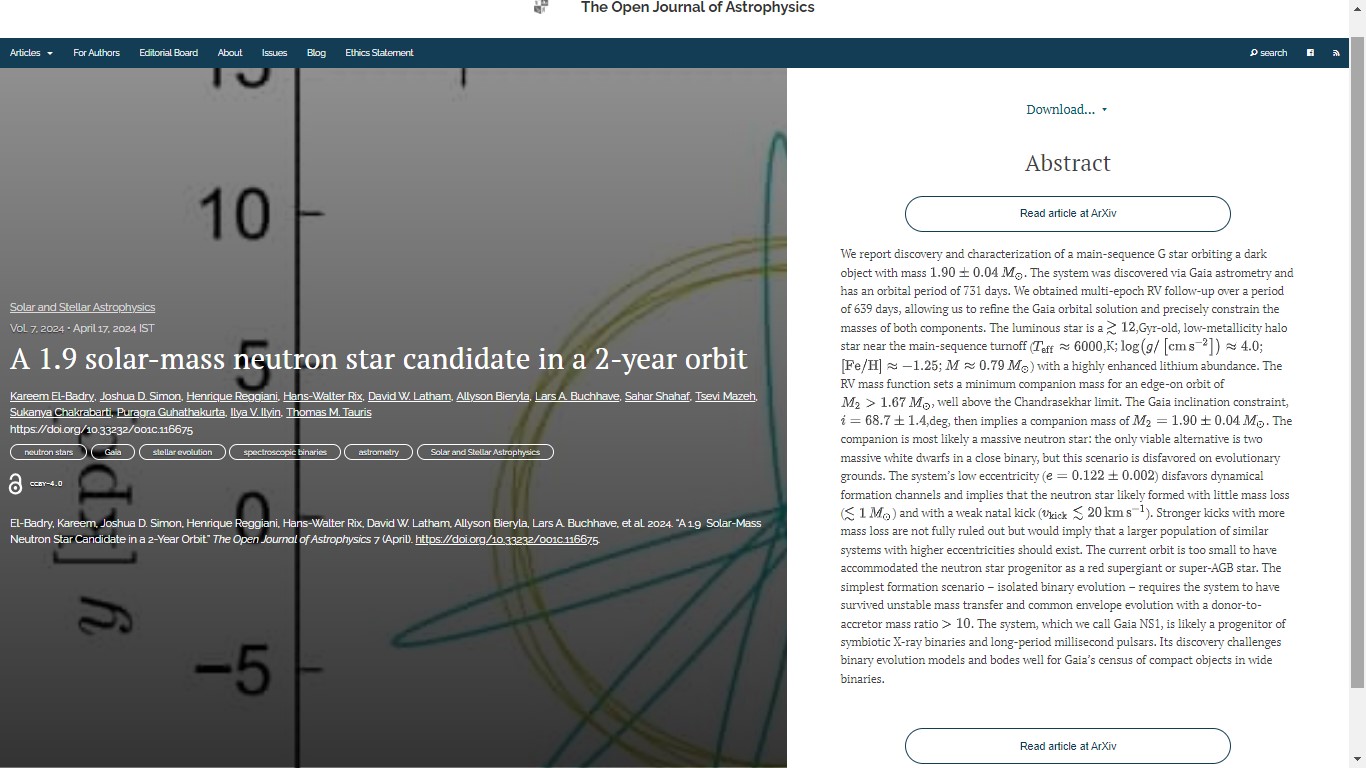
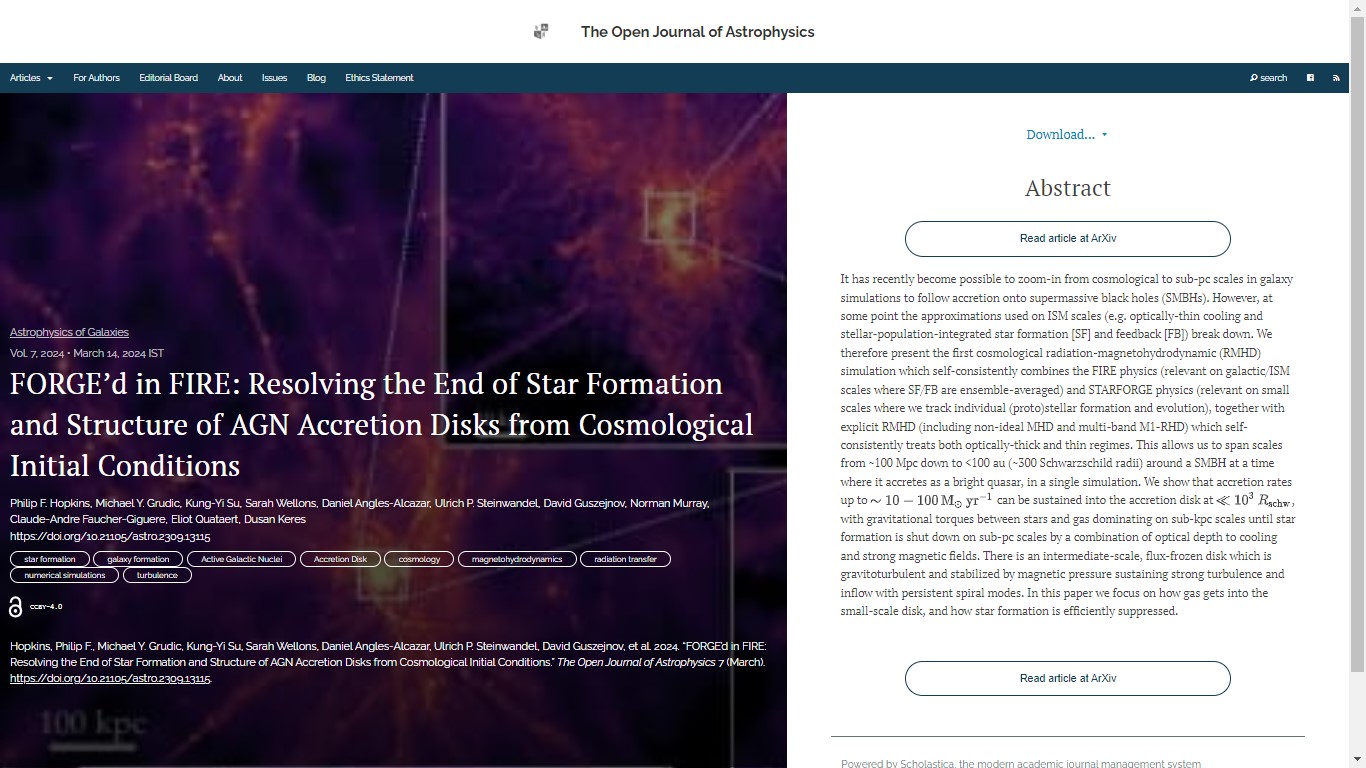
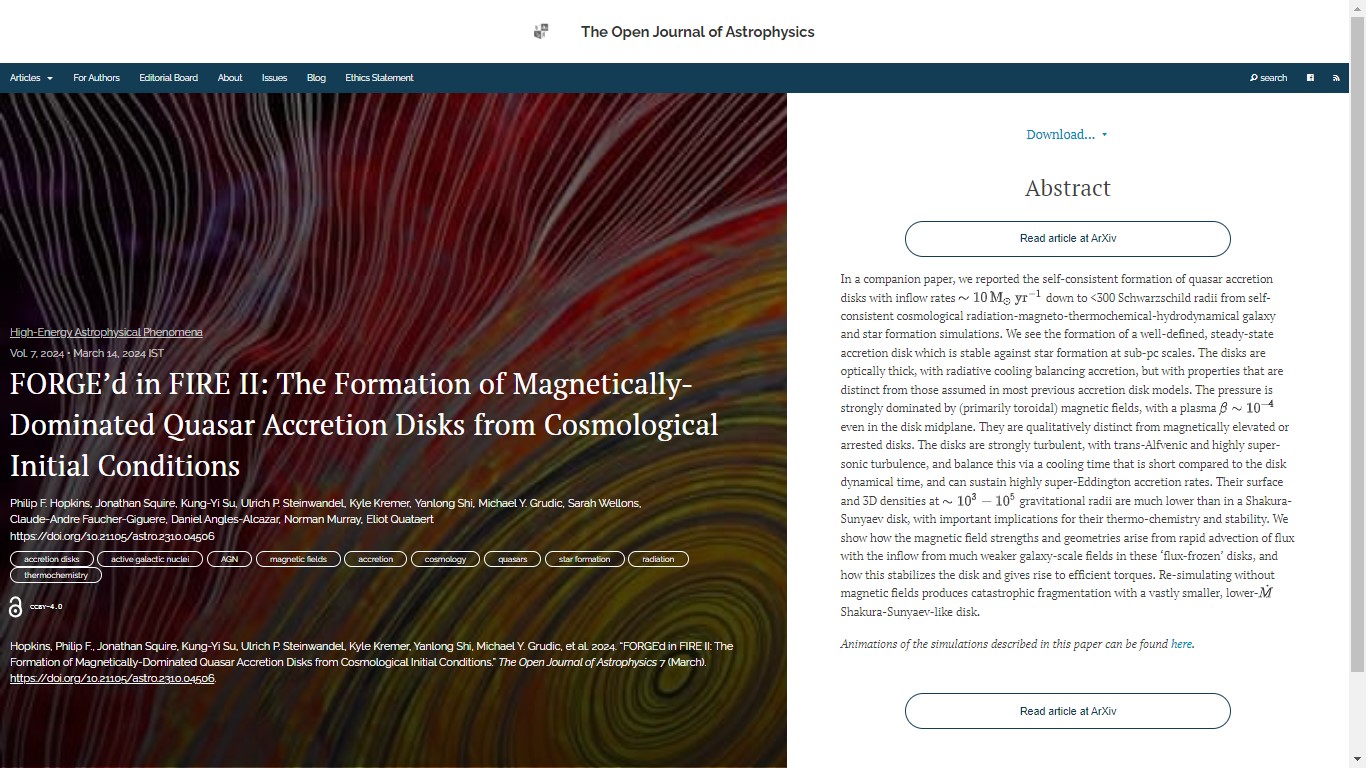
Anyway, here is a screen grab of the overlay of the published version which includes the  abstract:


You can click on the image of the overlay to make it larger should you wish to do so. You can find the officially accepted version of the paper on the arXiv here.

Spectroscopy of High Redshift Galaxies

Posted in The Universe and Stuff with tags , , , , , on March 28, 2023 by telescoper

The tentative identifications of a number of galaxies at high redshift using JWST on the basis of photometric measurements (see, e.g., here and here) have initiated a huge amount of activity in the extragalactic community trying to establish spectroscopic redshifts for these galaxies. Results of this endeavour have started to appear on the arXiv here with this abstract:

During the first 500 million years of cosmic history, the first stars and galaxies formed and seeded the cosmos with heavy elements. These early galaxies illuminated the transition from the cosmic “dark ages” to the reionization of the intergalactic medium. This transitional period has been largely inaccessible to direct observation until the recent commissioning of JWST, which has extended our observational reach into that epoch. Excitingly, the first JWST science observations uncovered a surprisingly high abundance of early star-forming galaxies. However, the distances (redshifts) of these galaxies were, by necessity, estimated from multi-band photometry. Photometric redshifts, while generally robust, can suffer from uncertainties and/or degeneracies. Spectroscopic measurements of the precise redshifts are required to validate these sources and to reliably quantify their space densities, stellar masses, and star formation rates, which provide powerful constraints on galaxy formation models and cosmology. Here we present the results of JWST follow-up spectroscopy of a small sample of galaxies suspected to be amongst the most distant yet observed. We confirm redshifts z > 10 for two galaxies, including one of the first bright JWST-discovered candidates with z = 11.4, and show that another galaxy with suggested z ~ 16 instead has z = 4.9, with strong emission lines that mimic the expected colors of more distant objects. These results reinforce the evidence for the rapid production of luminous galaxies in the very young Universe, while also highlighting the necessity of spectroscopic verification for remarkable candidates.

arXiv:2303.15431

As the abstract explains, the spectroscopic measurements confirm some – but not all – of the galaxies studied to be at high redshift. One galaxy – the one discussed here (known to its friends as 93316) which appeared to have a redshift of 16.6 ± 0.1 now seems to have a much lower redshift of 4.91. Here’s an image of this object:

The redshift 16.6 object was of some interest to cosmologists because an object of large stellar mass at such a large distance is difficult to reconcile with the standard theory of galaxy formation. That is now apparently out of the way, and the remaining high-z galaxies are not as extreme as this one and pose less of a problem.

While this result may disappoint some, and indeed delight others, it is also interesting to note that there are three similar objects at much the same redshift, which may indicate the presence of some sort of group or cluster:

Fascinating!

P.S. It struck me, after writing this, that waiting for spectroscopic confirmation of photometric redshifts is a lot like waiting for VAR to check whether or not to rule out a goal for offside…

How big were the biggest galaxies in the early Universe?

Posted in Biographical, Cardiff, The Universe and Stuff with tags , , , , , , , on August 23, 2022 by telescoper

Once upon a time (over a decade ago when I was still in Cardiff), I wrote a paper with PhD student Ian Harrison on the biggest (most massive) galaxy clusters. I even wrote a blog post about it. It was based on an interesting branch of statistical theory called extreme value statistics which I posted about in general terms here.

Well now the recent spate of observations of high-redshift galaxies by the James Webb Space Telescope has inspired Chris Lovell (who was a student at Cardiff back in the day then moved to Sussex to do his PhD and is now at the University of Hertfordshire) and Ian Harrison (who is back in Cardiff as a postdoc after a spell in the Midlands), and others at Cambridge and Sussex, to apply the extreme value statistics idea not to clusters but to galaxies. Here is the abstract:

The basic idea of galaxy formation in the standard ΛCDM cosmological model is that galaxies form in dark matter haloes that grow hierarchically so that the typical size of galaxies increases with time. The most massive haloes at high redshift should therefore be less massive than the most massive haloes at low redshift, as neatly illustrated by this figure, which shows the theoretical halo mass function (solid lines) and the predicted distribution of the most massive halo (dashed lines) at a number of redshifts, for a fixed volume of 100 Mpc3.

The colour-coding is with redshift as per the legend, with light blue the highest (z=16).

Of course we don’t observe the halo mass directly and the connection between this mass and the luminosity of a galaxy sitting in it is likely to be complicated because the formation of the stars that produce the light is a rather messy process; the ratio of mass to light is consequently hard to predict. Moreover we don’t even have overwhelmingly convincing measurements of the redshifts yet. A brief summary of the conclusions of this paper, however, is that is some of the big early galaxies recently observed by JWST seem to be a big too big for comfort if we take their observed properties at face value. A lot more observational work will be needed, however, before we can draw definite conclusions about whether the standard model is consistent with these new observations.

Sins of Omission

Posted in The Universe and Stuff with tags , , , , , on February 20, 2022 by telescoper

There’s a paper recently published in Nature Astronomy by Moreno et al, which you can find on the arXiv here. The title is Galaxies lacking dark matter produced by close encounters in a cosmological simulation and the abstract is here:

The standard cold dark matter plus cosmological constant model predicts that galaxies form within dark-matter haloes, and that low-mass galaxies are more dark-matter dominated than massive ones. The unexpected discovery of two low-mass galaxies lacking dark matter immediately provoked concerns about the standard cosmology and ignited explorations of alternatives, including self-interacting dark matter and modified gravity. Apprehension grew after several cosmological simulations using the conventional model failed to form adequate numerical analogues with comparable internal characteristics (stellar masses, sizes, velocity dispersions and morphologies). Here we show that the standard paradigm naturally produces galaxies lacking dark matter with internal characteristics in agreement with observations. Using a state-of-the-art cosmological simulation and a meticulous galaxy-identification technique, we find that extreme close encounters with massive neighbours can be responsible for this. We predict that approximately 30 percent of massive central galaxies (with at least 1011 solar masses in stars) harbour at least one dark-matter-deficient satellite (with 108 – 109 solar masses in stars). This distinctive class of galaxies provides an additional layer in our understanding of the role of interactions in shaping galactic properties. Future observations surveying galaxies in the aforementioned regime will provide a crucial test of this scenario.

It’s quite an interesting result.

I’m reminded of this very well known paper from way back in 1998, available on arXiv here, by Priya Natarajan, Steinn Sigurdsson and Joe Silk, with the abstract:

We propose a scenario for the formation of a population of baryon-rich, dark matter-deficient dwarf galaxies at high redshift that form from the mass swept out in the Intergalactic Medium (IGM) by energetic outflows from luminous quasars. We predict the intrinsic properties of these galaxies, and examine the prospects for their observational detection in the optical, X-ray and radio wavebands. Detectable thermal Sunyaev-Zeldovich decrements (cold spots) on arc-minute scales in the cosmic microwave background radiation maps are expected during the shock-heated expanding phase from these hot bubbles. We conclude that the optimal detection strategy for these dwarfs is via narrow-band Lyman-α imaging of regions around high redshift quasars. An energetically scaled-down version of the same model is speculated upon as a possible mechanism for forming pre-galactic globular clusters.

It’s true that the detailed mechanism for forming dwarf galaxies with low dark matter densities is different in the two papers, but it does show that the issue being addressed by Moreno et al. had been addressed before. It seems to me therefore that the Natarajan et al. paper is clearly relevant background to the Moreno et al. one. I always tell junior colleagues to cite all relevant literature. I wonder why Moreno et al. decided not to do that with this paper?

Had Moreno et al. preprinted their paper before acceptance by Nature Astronomy I’m sure someone would have told them of this omission. This is yet another reason for submitting your papers to arXiv at the same time as you submit them to a journal rather than waiting for them to be published.

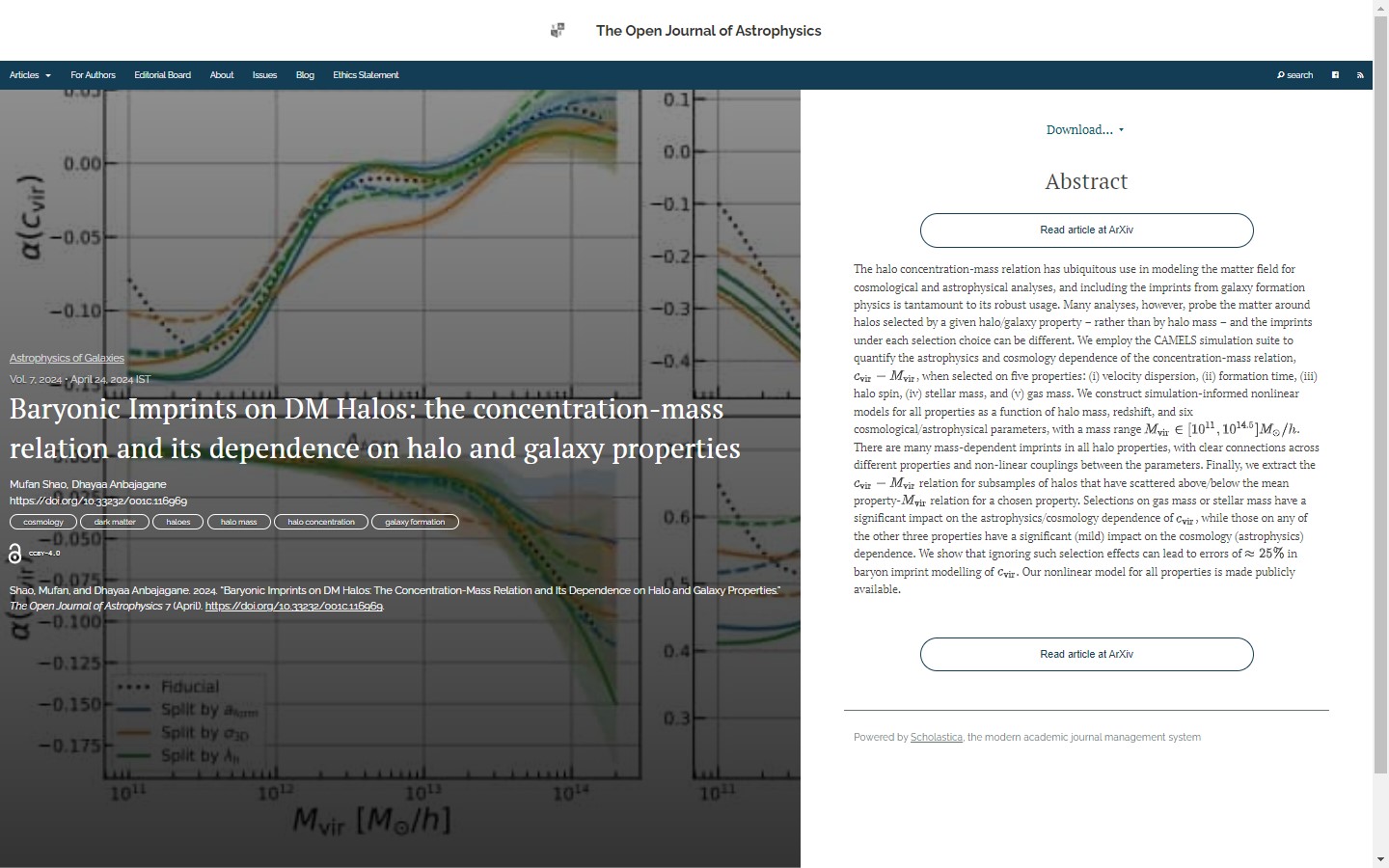
New Publication at the Open Journal of Astrophysics

Posted in OJAp Papers, Open Access, The Universe and Stuff with tags , , , on August 13, 2021 by telescoper

Back from my short trip, I now have time to announce another publication in the Open Journal of Astrophysics. This one was published at the end of last month, but owing to the holiday season there was a delay in activating the DOI and registering the metadata  so I have delayed posting about it until just now. It is the seventh paper in Volume 4 (2021) and the 38th in all.

The latest publication is entitled A Differentiable Model of the Assembly of Individual and Populations of Dark Matter Halos. The authors are Andrew P. Hearin,  Jonás Chaves-Montero, Matthew R. Becker and Alex Alarcon, all of the Argonne National Laboratory.

Here is a screen grab of the overlay which includes the abstract:

You can click on the image to make it larger should you wish to do so. You can find the arXiv version of the paper here. This one is also in the folder marked Cosmology and Nongalactic Astrophysics.

We’ve had a bit of a surge in submissions over the last few weeks – no doubt due to authors using their “vacation” to finish off papers. August is not the best month for finding referees, but we’ll do our best to process them quickly!

Catching up on Cosmic Dawn

Posted in The Universe and Stuff with tags , , , , , on June 25, 2021 by telescoper

Trying to catch up on cosmological news after a busy week I came across a number of pieces in the media about “Cosmic Dawn” (e.g. here in The Grauniad). I’ve never actually met Cosmic Dawn but she seems like an interesting lady.

But seriously folks, Cosmic Dawn refers to the epoch during which the first stars formed in the expanding Universe lighting up the Universe after a few hundred million years of post-recombination darkness.

According to the Guardian article mentioned above the new results being discussed are published in Monthly Notices of the Royal Astronomical Society but they’re actually not. Yet. Nevertheless the paper (by Laporte et al.) is available on the arXiv which is where people will actually read it…

Anyway, here is the abstract:

Here is a composite of HST and ALMA images for one of the objects discussed in the paper (MACS0416-JD):

I know it looks a bit blobby but it’s not easy to resolve things at such huge distances! Also, it’s quite small because it’s far away. In any case the spectroscopy is really the important thing, not the images, as that is what determines the redshift. The Universe has expanded by a factor 10 since light set out towards us from an object at redshift 9. I’m old enough to remember when “high redshift” meant z~0.1!

At the end of my talk on Wednesday Floyd Stecker asked me about what the James Webb Space Telescope (due for launch later this year) would do for cosmology and I replied that it would probably do a lot more for galaxy formation and evolution than cosmology per se. I think this is a good illustration of what I meant. Because of its infrared capability JWST will allow astronomers to push back even further and learn even more about how the first stars formed, but it won’t tell us much directly about dark matter and dark energy.

Cosmology Talks: Volker Springel on GADGET-4

Posted in The Universe and Stuff with tags , , , , , , , on May 18, 2021 by telescoper

It’s time I shared another one of those interesting cosmology talks on the Youtube channel curated by Shaun Hotchkiss. This channel features technical talks rather than popular expositions so it won’t be everyone’s cup of tea but for those seriously interested in cosmology at a research level they should prove interesting.

In this talk from a couple of months ago  Volker Springel discusses Gadget-4 which is a parallel computational code that combines cosmological N-body and SPH code and is intended for simulations of cosmic structure formation and calculations relevant for galaxy evolution and galactic dynamics.

The predecessor of GADGET-2 is probably the most used computational code in cosmology; this talk discusses what new ideas are implemented in GADGET-4 to improve on the earlier version and what new features it has.  Volker also explains what happened to GADGET-3!

The paper describing Gadget-4 can be found here.


New Publication at the Open Journal of Astrophysics!

Posted in Maynooth, OJAp Papers, Open Access, The Universe and Stuff with tags , , , , , , on August 24, 2020 by telescoper

So another new paper has been published in the Open Journal of Astrophysics! This one is in the folder marked Astrophysics of Galaxies and is entitled Massive Star Formation in Metal-Enriched Haloes at High Redshift. I should explain that “Metal” here is the astrophysicist’s definition which basically means anything heavier than hydrogen or helium: chemists may look away now.

The authors of this paper are John Regan (of the Department of Theoretical Physics at Maynooth University), Zoltán Haiman (Columbia), John Wise (Georgia Tech), Brian O’Shea (Michigan State) and Michael Norman (UCSD). And before anyone asks, no I don’t force members of staff in my Department to submit papers to the Open Journal of Astrophysics and yes I did stand aside from the Editorial process because of the institutional conflict.

Here is a screen grab of the overlay:

You can click on the image to make it larger should you wish to do so.

You can find the arXiv version of the paper here.

Chaos and Variance in (Simulations of) Galaxy Formation

Posted in The Universe and Stuff with tags , , , on September 11, 2019 by telescoper

During yesterday’s viva voce examination a paper came up that I missed when it came out last year. It’s by Keller et al. called Chaos and Variance in Galaxy Formation. The abstract reads:

The evolution of galaxies is governed by equations with chaotic solutions: gravity and compressible hydrodynamics. While this micro-scale chaos and stochasticity has been well studied, it is poorly understood how it couples to macro-scale properties examined in simulations of galaxy formation. In this paper, we show how perturbations introduced by floating-point roundoff, random number generators, and seemingly trivial differences in algorithmic behaviour can produce non-trivial differences in star formation histories, circumgalactic medium (CGM) properties, and the distribution of stellar mass. We examine the importance of stochasticity due to discreteness noise, variations in merger timings and how self-regulation moderates the effects of this stochasticity. We show that chaotic variations in stellar mass can grow until halted by feedback-driven self-regulation or gas exhaustion. We also find that galaxy mergers are critical points from which large (as much as a factor of 2) variations in quantities such as the galaxy stellar mass can grow. These variations can grow and persist for more than a Gyr before regressing towards the mean. These results show that detailed comparisons of simulations require serious consideration of the magnitude of effects compared to run-to-run chaotic variation, and may significantly complicate interpreting the impact of different physical models. Understanding the results of simulations requires us to understand that the process of simulation is not a mapping of an infinitesimal point in configuration space to another, final infinitesimal point. Instead, simulations map a point in a space of possible initial conditions points to a volume of possible final states.

(The highlighting is mine.) I find this analysis pretty scary, actually, as it shows that numerical effects (including just running the code on different processors) can have an enormous impact on the outputs of these simulations. Here’s Figure 14 for example:

This shows the predicted stellar surface mass density in a number of simulations: the outputs vary by more than an order of magnitude!

This paper underlines an important question which I have worried about before, and could paraphrase as “Do we trust N-body simulations too much?”. The use of numerical codes in cosmology is widespread and there’s no question that they have driven the subject forward in many ways, not least because they can generate “mock” galaxy catalogues in order to help plan survey strategies. However, I’ve always been concerned that there is a tendency to trust these calculations too much. On the one hand there’s the question of small-scale resolution and on the other there’s the finite size of the computational volume. And there are other complications in between too. In other words, simulations are approximate. To some extent our ability to extract information from surveys will therefore be limited by the inaccuracy of our calculation of the theoretical predictions.

Anyway, the paper gives us quite a few things to think about and I think it might provoke a bit of discussion, which is why I mentioned it here – i.e. to encourage folk to read and give their opinions.

The use of the word “simulation” always makes me smile. Being a crossword nut I spend far too much time looking in dictionaries but one often finds quite amusing things there. This is how the Oxford English Dictionary defines SIMULATION:

1.

a. The action or practice of simulating, with intent to deceive; false pretence, deceitful profession.

b. Tendency to assume a form resembling that of something else; unconscious imitation.

2. A false assumption or display, a surface resemblance or imitation, of something.

3. The technique of imitating the behaviour of some situation or process (whether economic, military, mechanical, etc.) by means of a suitably analogous situation or apparatus, esp. for the purpose of study or personnel training.

So it’s only the third entry that gives the intended meaning. This is worth bearing in mind if you prefer old-fashioned analytical theory!

In football, of course, you can even get sent off for simulation…