Archive for Gravitational Lensing

The Universe through a lens, darkly…

Posted in The Universe and Stuff with tags , , on March 27, 2013 by telescoper

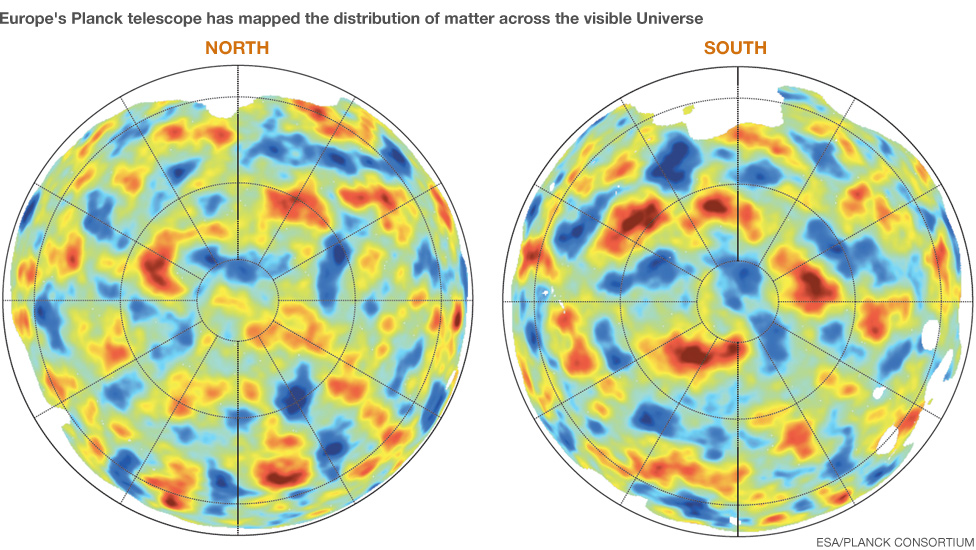
Just time to post this neat picture I found on the BBC Website this morning:

lens

Although these images were obtained using measurements of the cosmic microwave background made by Planck, they are not themselves maps of the radiation field itself. As photons produced in the early Universe travel through the Universe towards the observer, they are deflected by the gravitational field of intervening clumps of matter; this is called gravitational lensing. With a bit of effort this effect can be “inverted” to reveal the distribution of matter traversed by CMB photons, or at least a projection of that distribution along the line of sight. The good thing about this is that the maps show all the matter (through its gravitational effects) not just the luminous part that might be seen in a galaxy surveys, so they might provide more direct ways of testing cosmological theories.

A Little Bit of Gravitational Lensing

Posted in The Universe and Stuff with tags , , , , , on December 30, 2012 by telescoper

I thought I’d take a short break from doing absolutely nothing to post a quick little item about gravitational lensing. It’s been in my mind to say something about this since I mentioned it in one of the lectures I gave just before Christmas, but I’ve been too busy (actually too disorganized) to do it until now. It’s all based on a paper posted to the arXiv in December which was led by Jo Woodward (née Short) who did her PhD with me in Cardiff and is now in a postdoctoral research position in Durham (which is in the Midlands). The following pictures were take from her paper.

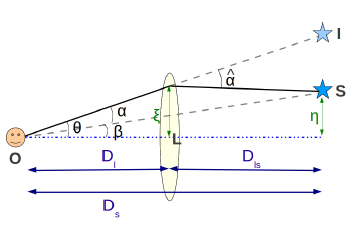
This figure shows the geometry of a gravitational lens system: light from the source S is deflected by the gravitational potential of the lens L so that an image I appears at a position on the sky which is different from the actual position when viewed by the observer O:
lensing_1
There’s a critical radius (which depends on the mass and density profile of the lens) at which this can lead to the formation of multiple images of the source. Even if multiple images are not resolved, lensing results in an increase in the apparent brightness of the source.

A great deal of cosmological information can be gleaned statistically from lensing  with even limited knowledge of the properties of the source and lens populations and with incomplete information about e.g. the actual angular deflection produced by the lens or the lens mass. To illustrate this, just consider the expression for the differential optical depth to lensing (related to the probability that a source at redshift z_s is lensed by an object at redshift z_l
lensing_2

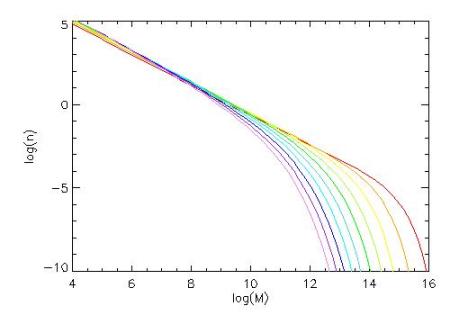
The first two terms are cosmological, accounting geometrical and expansion effects. Roughly speaking, the larger the volume out to a given redshift the higher the probability is that a given source will be lensed. The third term involves the mass function of lens systems. In the framework of the standard cosmological model this can be computed using Press-Schechter theory or one of the variations thereof. According to current understanding, cosmological structures (i.e. galaxies and clusters of galaxies) form hierarchically so this mass function changes with redshift, with fewer high mass objects present at high redshift than at low redshift, as represented in this picture, in which masses are given in units of solar masses, the colour-coding representing different redshifts:
lensing_3

The last term represents the lensing cross-section of an object with a given mass. This depends on the internal structure of the lens – an object in which the mass is highly concentrated produces  lensing effects radically different from one that isn’t. Two simple models for the mass distribution are the singular isothermal sphere (SIS) and the Navarro-Frenk-White profile (NFW). The latter is thought (by some) to represent the distribution of cold dark matter in haloes around galaxies and clusters which is more diffuse than that of the baryonic material because it can’t dissipate energy which it needs to do to fall into the centre of the object. The real potential of a galaxy in its central regions could be more like the SIS profile would predict, however, because baryons outweigh dark matter there.

Now time for a bit of historical reminiscence. In 1997 I published a book with George Ellis in which we analysed the evidence available at the time relating to the density of matter in the Universe. It was a little bit controversial at the time, but it turns out we were correct in concluding that the density of matter was well below the level favoured by most theorists i.e. only about 20-30% of the critical density. However we did not find any compelling evidence at that time for a cosmological constant (or, if you prefer, dark energy). Indeed one of the strongest upper limits on the cosmological constant came from gravitational lensing measurements, or rather the dearth of them.

The reason for this negative conclusion was that, for a fixed value of the Hubble constant,  in the presence of a cosmological constant the volume out to a given redshift is much larger than if there is no cosmological constant. That means the above integral predicts a high probability for lensing. Surveys however failed to turn up large numbers of strongly-lensed objects, hence the inference that the universe could not be dominated by a cosmological constant. This is, of course, assuming that the other terms in the integral are well understood and that the reason significant numbers of lensed systems weren’t found wasn’t just they are tricky to identify…

Meanwhile, huge advances were made in other aspects of observational cosmology that established a standard cosmological model in which the cosmological constant makes up almost 75% of the energy budget of the Universe.

Now, 15 years later on, enter the Herschel Space Observatory, which turns out to be superb at identifying gravitational lenses.  I posted about this here, in fact. Working in the far-infrared makes it impossible to resolve multiple images with Herschel – even with a 3.5m mirror in space, λ/D isn’t great for wavelengths of 500 microns! However, the vast majority of sources found during the Herschel ATLAS survey with large fluxes at this wavelengths can be identified as lenses simply because their brightness tells us they’ve probably been magnified by a lens. Candidates can then be followed up with other telescopes on the ground.  A quick look during the Science Demonstration Phase of Herschel produced the first crop of firmly identified gravitational lens systems published in Science by Negrello et al..  When the full data set has been analysed there should be hundreds of such systems, which will revolutionize this field.

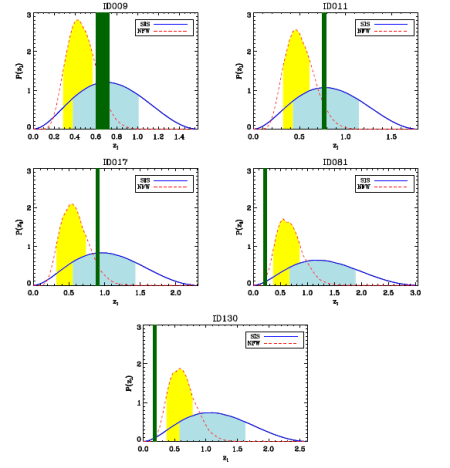
To see the potential (no pun intended) of this kind of measurement, take a look at these five systems from the SDP set:
lensing_4

These systems have measured (or estimated) source and lens redshifts. What is plotted is the conditional probability of a lens at some particular lens redshift, given the source redshift and the fact that strong lensing has occurred. Curves are given for SIS and NFW lens profiles and everything else is calculated according to the standard cosmological model. The green bars represent the measured lens redshifts.  It’s early days, so there are only five systems, but you can already see that they are pointing towards low lens redshifts, favouring NFW over SIS;  the yellow and light blue shading represents regions in which 68% of the likelihood lies.  These data don’t strongly prefer one model over the other, but with hundreds more, and extra information about at least some of the lens systems (such as detailed determinations of the lens mass from deflections etc) we should be able  to form more definite conclusions.

Unfortunately the proposal I submitted to STFC to develop a more detailed theoretical model and statistical analysis pipeline (Bayesian, of course) wasn’t funded. C’est la vie. That probably just means that someone smarter and quicker than me will do the necessary…
Clusters, Splines and Peer Review

Posted in Bad Statistics, Open Access, The Universe and Stuff with tags , , , , , on June 26, 2012 by telescoper

Time for a grumpy early morning post while I drink my tea.

There’s an interesting post on the New Scientist blog site by that young chap Andrew Pontzen who works at Oxford University (in the Midlands). It’s on a topic that’s very pertinent to the ongoing debate about Open Access. One of the points the academic publishing lobby always makes is that Peer Review is essential to assure the quality of research. The publishers also often try to claim that they actually do Peer Review, which they don’t. That’s usual done, for free, by academics.

But the point Andrew makes is that we should also think about whether the form of Peer Review that journals undertake is any good anyway.  Currently we submit our paper to a journal, the editors of which select one (or perhaps two or three) referees to decide whether it merits publication. We then wait – often many months – for a report and a decision by the Editorial Board.

But there’s also a free online repository called the arXiv which all astrophysics papers eventually appear on. Some researchers like to wait for the paper to be refereed and accepted before putting it on the arXiv, while others, myself included, just put it on the arXiv straight away when we submit it to the journal. In most cases one gets prompter and more helpful comments by email from people who read the paper on arXiv than from the referee(s).

Andrew questions why we trust the reviewing of a paper to one or two individuals chosen by the journal when the whole community could do the job quicker and better. I made essentially the same point in a post a few years ago:

I’m not saying the arXiv is perfect but, unlike traditional journals, it is, in my field anyway, indispensable. A little more investment, adding a comment facilities or a rating system along the lines of, e.g. reddit, and it would be better than anything we get academic publishers at a fraction of the cost. Reddit, in case you don’t know the site, allows readers to vote articles up or down according to their reaction to it. Restrict voting to registered users only and you have the core of a peer review system that involves en entire community rather than relying on the whim of one or two referees. Citations provide another measure in the longer term. Nowadays astronomical papers attract citations on the arXiv even before they appear in journals, but it still takes time for new research to incorporate older ideas.

In any case I don’t think the current system of Peer Review provides the Gold Standard that publishers claim it does. It’s probably a bit harsh to single out one example, but then I said I was feeling grumpy, so here’s something from a paper that we’ve been discussing recently in the cosmology group at Cardiff. The paper is by Gonzalez et al. and is called IDCS J1426.5+3508: Cosmological implications of a massive, strong lensing cluster at Z = 1.75. The abstract reads

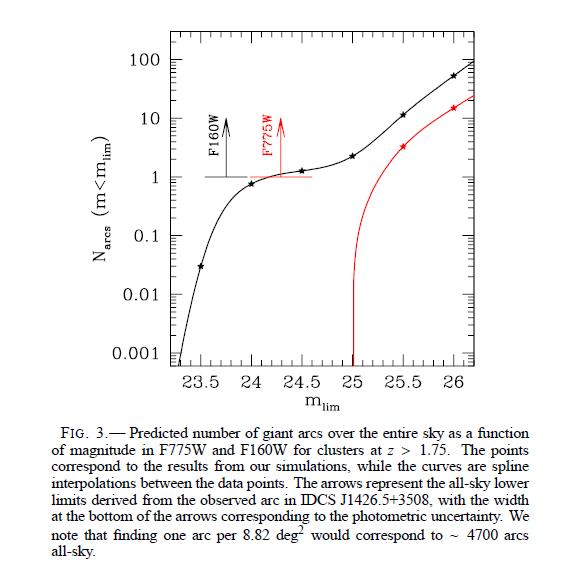
The galaxy cluster IDCS J1426.5+3508 at z = 1.75 is the most massive galaxy cluster yet discovered at z > 1.4 and the first cluster at this epoch for which the Sunyaev-Zel’Dovich effect has been observed. In this paper we report on the discovery with HST imaging of a giant arc associated with this cluster. The curvature of the arc suggests that the lensing mass is nearly coincident with the brightest cluster galaxy, and the color is consistent with the arc being a star-forming galaxy. We compare the constraint on M200 based upon strong lensing with Sunyaev-Zel’Dovich results, finding that the two are consistent if the redshift of the arc is  z > 3. Finally, we explore the cosmological implications of this system, considering the likelihood of the existence of a strongly lensing galaxy cluster at this epoch in an LCDM universe. While the existence of the cluster itself can potentially be accomodated if one considers the entire volume covered at this redshift by all current high-redshift cluster surveys, the existence of this strongly lensed galaxy greatly exacerbates the long-standing giant arc problem. For standard LCDM structure formation and observed background field galaxy counts this lens system should not exist. Specifically, there should be no giant arcs in the entire sky as bright in F814W as the observed arc for clusters at  z \geq 1.75, and only \sim 0.3 as bright in F160W as the observed arc. If we relax the redshift constraint to consider all clusters at z \geq 1.5, the expected number of giant arcs rises to \sim 15 in F160W, but the number of giant arcs of this brightness in F814W remains zero. These arc statistic results are independent of the mass of IDCS J1426.5+3508. We consider possible explanations for this discrepancy.

Interesting stuff indeed. The paper has been accepted for publication by the Astrophysical Journal too.

Now look at the key result, Figure 3:

I’ll leave aside the fact that there aren’t any error bars on the points, and instead draw your attention to the phrase “The curves are spline interpolations between the data points”. For the red curve only two “data points” are shown; actually the points are from simulations, so aren’t strictly data, but that’s not the point. I would have expected an alert referee to ask for all the points needed to form the curve to be shown, and it takes more than two points to make a spline.  Without the other point(s) – hopefully there is at least one more! – the reader can’t reproduce the analysis, which is what the scientific method requires, especially when a paper makes such a strong claim as this.

I’m guessing that the third point is at zero (which is at – ∞ on the log scale shown in the graph), but surely that must have an error bar on it, deriving from the limited simulation size?

If this paper had been put on a system like the one I discussed above, I think this would have been raised…

Heart of Darkness

Posted in Astrohype, The Universe and Stuff with tags , , , , , on March 6, 2012 by telescoper

Now here’s a funny thing. I’ve been struggling to keep up with matters astronomical recently owing to pressure of other things, but I could resist a quick post today about an interesting object, a galaxy cluster called Abell 520. New observations of this complex system – which appears to involve a collision between two smaller clusters, hence its nickname “The Train Wreck Cluster” – have led to a flurry of interest all over the internet, because the dark matter in the cluster isn’t behaving entirely as expected. Here is the abstract of the paper (by Jee et al., now published in the Astrophysical Journal):

We present a Hubble Space Telescope/Wide Field Planetary Camera 2 weak-lensing study of A520, where a previous analysis of ground-based data suggested the presence of a dark mass concentration. We map the complex mass structure in much greater detail leveraging more than a factor of three increase in the number density of source galaxies available for lensing analysis. The “dark core” that is coincident with the X-ray gas peak, but not with any stellar luminosity peak is now detected with more than 10 sigma significance. The ~1.5 Mpc filamentary structure elongated in the NE-SW direction is also clearly visible. Taken at face value, the comparison among the centroids of dark matter, intracluster medium, and galaxy luminosity is at odds with what has been observed in other merging clusters with a similar geometric configuration. To date, the most remarkable counter-example might be the Bullet Cluster, which shows a distinct bow-shock feature as in A520, but no significant weak-lensing mass concentration around the X-ray gas. With the most up-to-date data, we consider several possible explanations that might lead to the detection of this peculiar feature in A520. However, we conclude that none of these scenarios can be singled out yet as the definite explanation for this puzzle.

Here’s a pretty picture in which the dark matter distribution (inferred from gravitational lensing measurements) is depicted by the bluey-green colours and which seems to be more concentrated in the middle of the picture than the galaxies, although the whole thing is clearly in a rather disturbed state:

Credit: NASA, ESA, CFHT, CXO, M.J. Jee (University of California, Davis), and A. Mahdavi (San Francisco State University)

The three main components of a galaxy cluster are: (i) its member galaxies; (ii) an extended distribution of hot X-ray emitting gas and (iii) a dark matter halo. In a nutshell, the main finding of this study is that the dark matter seems to be stuck in the middle of the cluster with the X-ray gas, while the  visible galaxies seem to be sloshing about all over the place.

No doubt there will be people jumping to the conclusion that this cluster proves that the theory of dark matter is all wrong, but I think that it simply demonstrates that this is a complicated object and we don’t really understand what’s going on. The paper gives a long list of possible explanations, but there’s no way of knowing at the moment which (if any) is correct.

The Universe is like that. Most of it is a complete mess.

Seeing Dark Matter..

Posted in The Universe and Stuff with tags , , , , on November 13, 2010 by telescoper

I found this intruiging and impressive image over at Cosmic Variance (there’s also a press release at the Hubble Space Telescope website with higher resolution images). It shows the giant cluster of galaxies Abell 1689 with, superimposed on it, a map of the matter distribution as reconstructed from the pattern of distortions of background galaxy images caused by gravitational lensing.

This picture confirms the existence of large amounts of dark matter in the cluster – the mass distribution causing lensing quite different from what you can see in the luminous matter – but it also poses a problem, in that the matter is much more concentrated in the centre of the cluster than current theoretical ideas seem to suggest it should be…

You can find the full paper here.


Share/Bookmark

New light through a gravitational lens

Posted in The Universe and Stuff with tags , , , , on July 1, 2010 by telescoper

New data from the European Space Agency’s Herschel Space Observatory have just been released that shed new light on a well-known gravitational lens system involving the cluster Abell 2218. You can get more details and higher-resolution pictures from the STFC press release or from the dedicated Herschel Outreach Website, but I couldn’t resist putting this nice picture up.

Image Credit: ESA/SPIRE and HERMES Consortia

This triptych shows the region of sky around the massive galaxy cluster Abell 2218, as seen by the SPIRE instrument on Herschel and by the Hubble Space Telescope. On the far left, we have images at the three SPIRE wavelength bands (in the far-infrared part of the spectrum), while the centre image is a false-colour composite. The centre of the galaxy cluster is shown as a white cross-hair, while the large orange-yellow blob just below it is a much more distant galaxy.

On the far right you can see an optical image of the same cluster taken using the Hubble Space Telescope. Working at much shorter, optical wavelengths, the resolution here is much higher. This makes it possible to see the complicated pattern of  arcs caused by the distortion of light as it travels through the gravitational field of the cluster from background sources to the observer. The cluster acts as a gigantic optical system that produces magnified but warped images of very distant galaxies that lie behind it. It’s not designed to act as proper lens, of course, so the images it produces are deformed versions of the original, but they yield sufficient clues to work out the optical properties of the gravitational lens.

Clusters like this tend to contain lots of elliptical galaxies which are not bright in the SPIRE wavebands, so what we see with Herschel is very different from the Hubble view. What Herschel has  done in this particular case is  to reveal that this  gravitational lens produces at least one bright image in the far-infrared part of the spectrum. This is produced by a very distant galaxy which we probably would not have been able to see at all, even with Herschel, had it not been located fortuitously close to a perfect alignment with the optical axis of the Abell 2218 system. Although the image we see is distorted we can still learn a lot about the source that produced using the new data.
