Archive for History

Tacitus on Agricola in Scotland about Ireland

Posted in History with tags , , , , , , , , on August 19, 2025 by telescoper

Some years ago I came across a blog post relating to the discovery of a fortified settlement at Drumanagh (near Dublin) where Roman coins and goods have been found. It might have been a Roman military site, but in my mind it could equally well have been a Celtic settlement and the finds might have been loot from elsewhere.

I do find it a bit hard to believe that no Romans ever set foot in Ireland, though, and Drumanagh may well have been some sort of trading post or temporary fort for a reconnaissance mission. If that site is Roman, and that was all there was, then it didn’t amount to a full invasion and there’s certainly nothing like the roads or other infrastructure that’s so common in England and Wales.

I thought about this when at the weekend I was “reorganising” my bookshelves (by which I mean changing from one form of disorganization to another), when I came across some old Latin textbooks that included excerpts from the book De vita et moribus Iulii Agricolae which was written by Publius Cornelius Tacitus (Tacitus to you). The Agricola of the title was Gnaeus Julius Agricola, Roman Governor of Britain from around AD 77 until 85. He also happened to be the father-in-law of Tacitus, which probably accounts for the sycophantic tone of some of the writing.

The availability of this book is interesting in itself because only a solitary codicil survived the Roman Era. It eventually became a very popular source in old-fashioned British grammar schools at which Latin was compulsory, as it was at the one I went to, partly because it related to Britain and partly because of the author’s very concise and direct prose which makes much of it quite easy to translate. We didn’t read the whole book at school, but excerpts cropped up regularly to illustrate various grammatical constructions and introduce new vocabulary.

You can find the full Latin text here and an English translation here. I tried Google translate on some passages and it was terrible.

Anyway, as an exercise to my erudite readers I here include sections 23 to 26 which describe part of Agricola’s adventures in Scotland, followed by some comments. Before doing so it is worth mentioning a bit of the context. Agricola’s military campaigns at this time were often carried out in the first instance by water. Scotland was very much bandit country and slogging through the terrain on foot would have led to multiple ambushes and pitched battles.

[23] Quarta aestas obtinendis quae percucurrerat insumpta; ac si virtus exercituum et Romani nominis gloria pateretur, inventus in ipsa Britannia terminus. Namque Clota et Bodotria diversi maris aestibus per inmensum revectae, angusto terrarum spatio dirimuntur: quod tum praesidiis firmabatur atque omnis propior sinus tenebatur, summotis velut in aliam insulam hostibus.

[24] Quinto expeditionum anno nave prima transgressus ignotas ad id tempus gentis crebris simul ac prosperis proeliis domuit; eamque partem Britanniae quae Hiberniam aspicit copiis instruxit, in spem magis quam ob formidinem, si quidem Hibernia medio inter Britanniam atque Hispaniam sita et Gallico quoque mari opportuna valentissimam imperii partem magnis in vicem usibus miscuerit. Spatium eius, si Britanniae comparetur, angustius nostri maris insulas superat. Solum caelumque et ingenia cultusque hominum haud multum a Britannia differunt; [in] melius aditus portusque per commercia et negotiatores cogniti. Agricola expulsum seditione domestica unum ex regulis gentis exceperat ac specie amicitiae in occasionem retinebat. Saepe ex eo audivi legione una et modicis auxiliis debellari obtinerique Hiberniam posse; idque etiam adversus Britanniam profuturum, si Romana ubique arma et velut e conspectu libertas tolleretur.

[25] Ceterum aestate, qua sextum officii annum incohabat, amplexus civitates trans Bodotriam sitas, quia motus universarum ultra gentium et infesta hostilis exercitus itinera timebantur, portus classe exploravit; quae ab Agricola primum adsumpta in partem virium sequebatur egregia specie, cum simul terra, simul mari bellum impelleretur, ac saepe isdem castris pedes equesque et nauticus miles mixti copiis et laetitia sua quisque facta, suos casus attollerent, ac modo silvarum ac montium profunda, modo tempestatum ac fluctuum adversa, hinc terra et hostis, hinc victus Oceanus militari iactantia compararentur. Britannos quoque, ut ex captivis audiebatur, visa classis obstupefaciebat, tamquam aperto maris sui secreto ultimum victis perfugium clauderetur. Ad manus et arma conversi Caledoniam incolentes populi magno paratu, maiore fama, uti mos est de ignotis, oppugnare ultro castellum adorti, metum ut provocantes addiderant; regrediendumque citra Bodotriam et cedendum potius quam pellerentur ignavi specie prudentium admonebant, cum interim cognoscit hostis pluribus agminibus inrupturos. Ac ne superante numero et peritia locorum circumiretur, diviso et ipso in tris partes exercitu incessit.

[26] Quod ubi cognitum hosti, mutato repente consilio universi nonam legionem ut maxime invalidam nocte adgressi, inter somnum ac trepidationem caesis vigilibus inrupere. Iamque in ipsis castris pugnabatur, cum Agricola iter hostium ab exploratoribus edoctus et vestigiis insecutus, velocissimos equitum peditumque adsultare tergis pugnantium iubet, mox ab universis adici clamorem; et propinqua luce fulsere signa. Ita ancipiti malo territi Britanni; et nonanis rediit animus, ac securi pro salute de gloria certabant. Ultro quin etiam erupere, et fuit atrox in ipsis portarum angustiis proelium, donec pulsi hostes, utroque exercitu certante, his, ut tulisse opem, illis, ne eguisse auxilio viderentur. Quod nisi paludes et silvae fugientis texissent, debellatum illa victoria foret.

In [23], around 80 AD, we find that Agricola saw advantage in conquering Scotland as far as the Firth of Clyde (Clota) and Firth of Forth (Bodotria) because the tide would bring his ships a long way inland and they were separated by only a narrow stretch of land. He claims he would have gone further had he had the resources needed to do so.
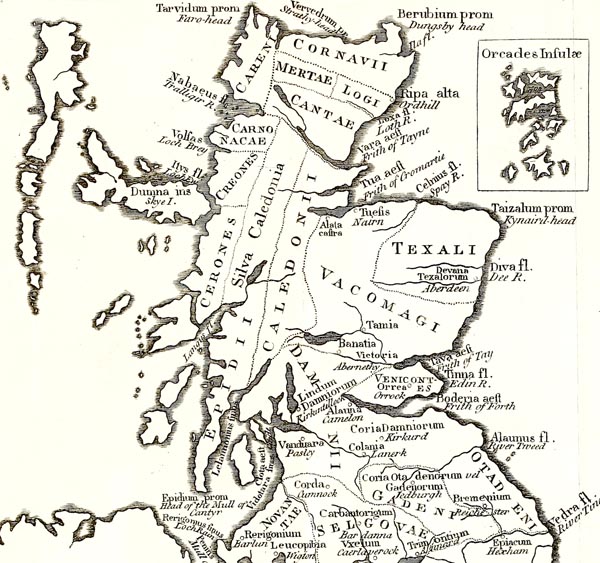
[24] is the interesting one in light of the introduction to this piece . The fifth year of campaigning would have been 81 AD, long before the construction of Hadrian’s Wall. It says that Agricola crossed in his flagship (literally in the first ship, nave prima). It then goes to say that he garrisoned that part of Britain which faces Hibernia (i.e. Ireland) not out of fear but in hopes of further action. This is because he felt that Ireland offered a strategic connection between the provinces of Britain and Spain.

Some people think that the garrison Agricola formed for his putative future action, ostensibly an invasion of Ireland, was at Ravenglass in modern-day Cumbria, rather than Scotland, but it might have been further North; nobody really knows. My reading of the text is that he crossed the Firth of Clyde to the Mull of Kintyre. I remember as a kid seeing Ireland from the Mull of Kintyre and was told that on a clear day you could see as far as the mountains in Donegal from there.

Tacitus goes on to say that (my emphasis):

Ireland is smaller in size when compared to Britain, but larger than the islands of the Mediterranean. The soil, the climate and the character and manners of its inhabitants differ little from those of Britain, while its approaches and harbours are better known through trade and commerce. We also learn that Agricola has a friendly Irish chieftain in tow, who has been turfed out of his own land.

Agricola had given sanctuary to a minor chieftain driven from home by faction, and held him, under the cloak of friendship, until occasion demanded. My father-in-law often said that with one legion and a contingent of auxiliaries Ireland could be conquered and held; and that it would be useful as regards Britain also, since Roman troops would be everywhere, and the prospect of independence would fade from view.

So Agricola felt that people of Hibernia and Britain were similar and the effect of conquering the former would be to snuff out any hopes of independence in the latter. Either the planned invasion never happened, or Agricola tried it, got his fingers burnt and Tacitus chose to omit it from his account. This seems unlikely because Agricola had enough on his plate dealing with the Scottish campaign without diverting a legion to Ireland.

Anyway, the second emphasized section explains that Ireland’s ports were well known through trade and commerce, so one can infer that Romans were familiar enough to have landed there to trade, etc. I think Drumanagh was probably just one of many such stations.

In [25], a year later. Agricola is already campaigning beyond the Firth of Forth using a combination of naval and land-based forces. The Britons were wrong-footed by the Romans’ use of the sea, but mounted attacks against Roman forts. At the end of this section, Agricola, hearing that his force is about to be attacked, divides his army into three divisions and advances.

I included [26] because it mentions the Ninth Legion (in the accusative case, nonam legionem) because they are being attacked. The Ninth Legion has been the source of much speculation as the “Lost Legion”, as it disappears entirely from the historical record after about 120 AD. This unit was in the thick of the action, many times and was almost wiped out in 61 AD during the rebellion of Boudica and in other rebellions. According to Tacitus it was one of the three parts of Agricola’s army in 83 AD, though it was described as “especially weak” (maxime invalidem), and was in trouble there too, but was eventually rescued by the other two divisions. It doesn’t explain why the Ninth was the most weakened. Had it suffered more casualties than the rest of Agricola’s army or was it just not as well trained? Was part of it left as the garrison described in [24]? Could it have participated in an abortive invasion of Ireland the year before, got badly mauled in the process, and hadn’t recovered to full strength?

Bearing in mind that Tacitus wanted to portrary Agricola in a positive light, perhaps the complete rescue of the Ninth described in the text was exaggerated and its already weakened state was worsened still further by this battle? It wasn’t here that the Lost Legion was lost, however, as it cropped up elsewhere in Britain until at least 108 AD, twenty-five years later, and perhaps as late as 120 AD elsewhere on the continent. I’m not a historian but it seems to me that a plausible explanation of the fate of the Ninth Legion is that it was broken up into detachments and gradually dispersed, rather than being wiped out in one calamitous battle.
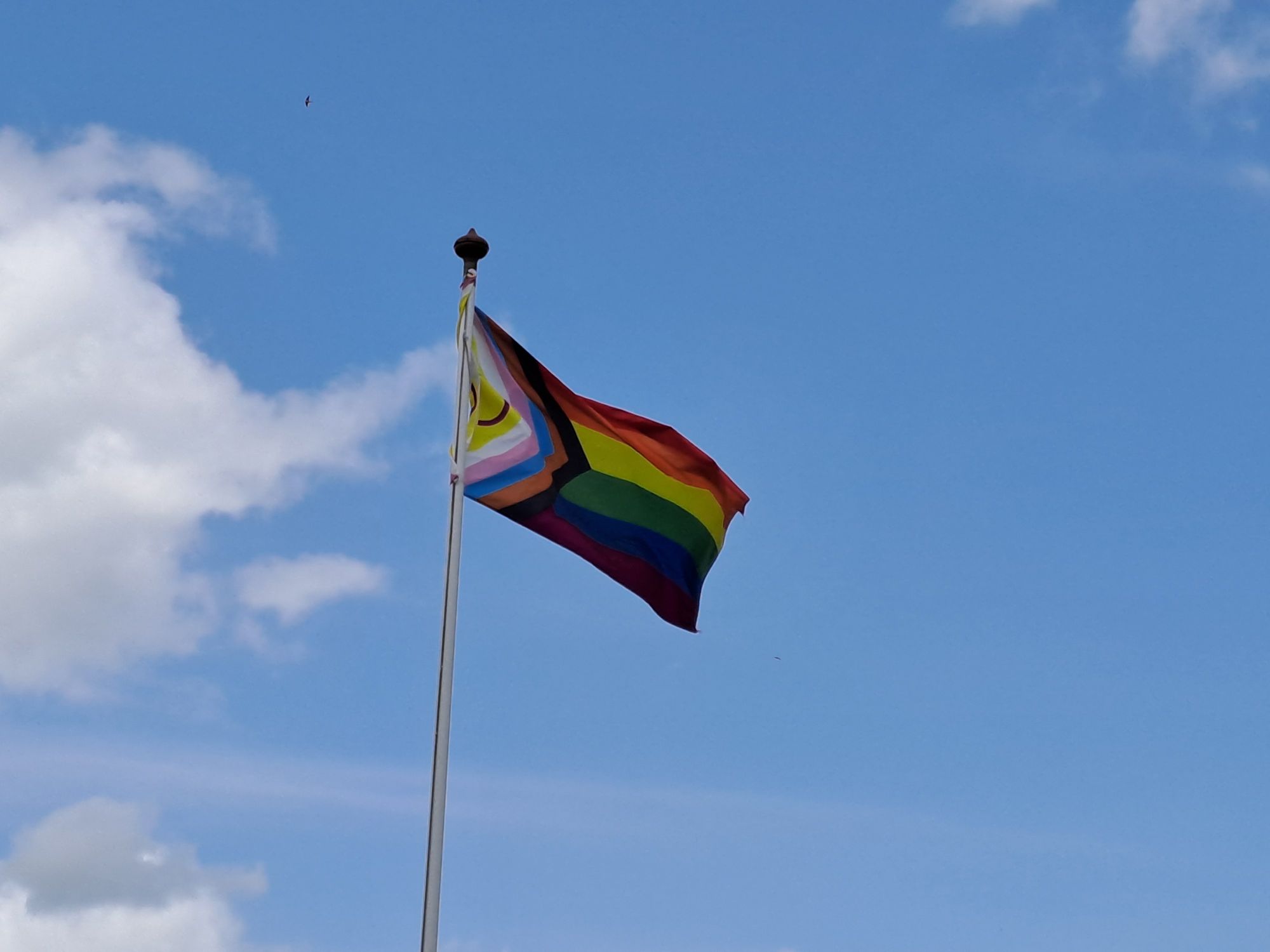
Pride 2025

Posted in History, LGBTQ+, Maynooth with tags , , , , , , , , on June 13, 2025 by telescoper

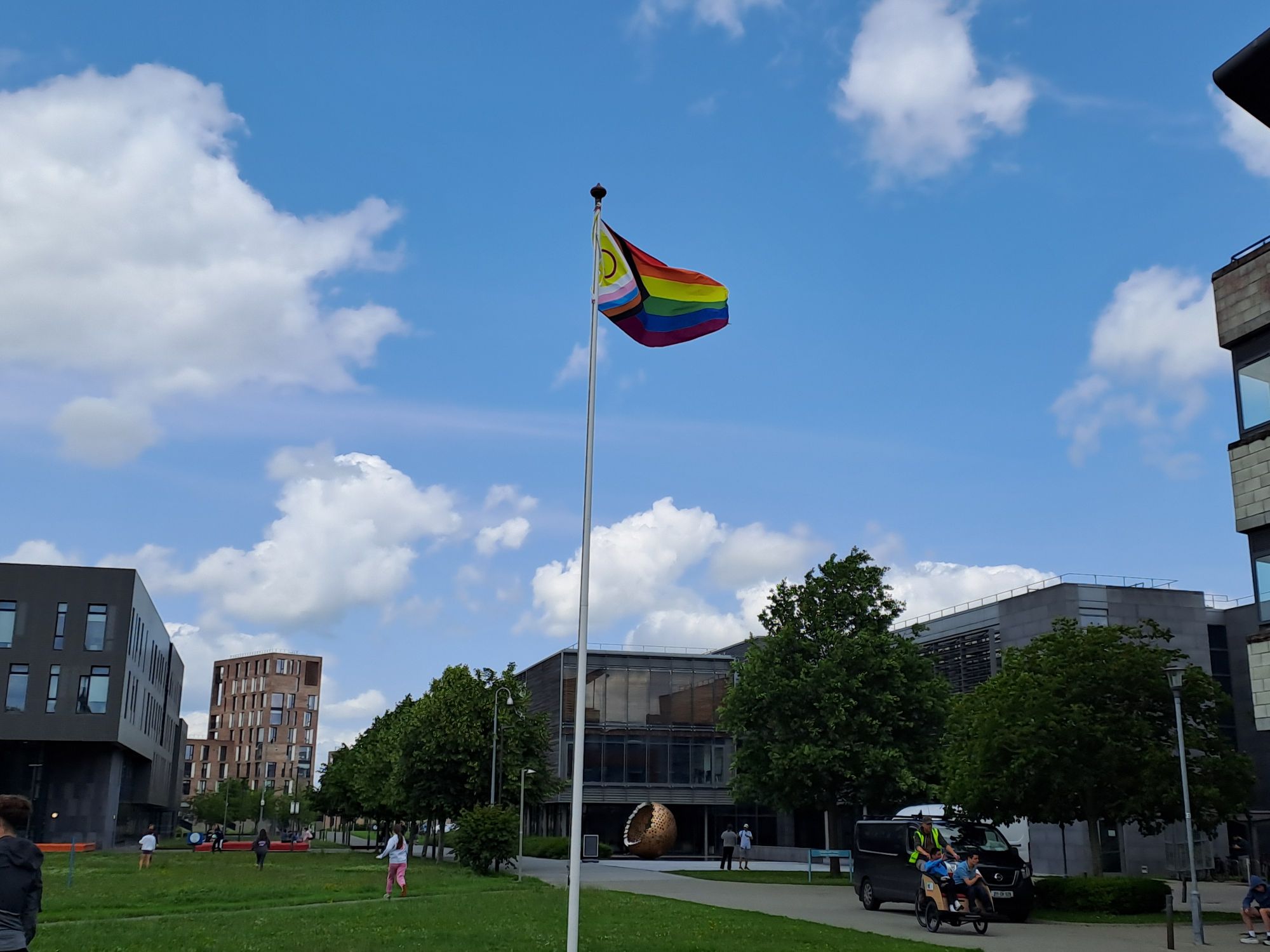
It’s 13th June, which means it’s almost halfway through this year’s Pride Month. I’ve been so busy that I am very late in posting about Pride 2025. I usually post something to mark Pride Month on 1st June (e.g. here). In fact I hadn’t even noticed the Pride Progress Flag flying on Maynooth Campus (between the Arts Block and John Hume Building) until today. I didn’t see anything on Maynooth’s social media about Pride either. I didn’t see the flag yesterday when I left the Science Building and assumed it wasn’t there. It was however raining heavily so my view may have been obscured by the rain on my spectacles, so I went back today to check. I am relieved it is there, as we need such symbols now more than ever.

With its origins as a commemoration of the Stonewall Riots of 1969, Pride remains both a celebration and protest. It’s more necessary than ever now because of the sustained abuse being aimed at trans people from all quarters, including those in political power and those sad losers who have nothing better to do that spend all day tweeting their bigotry on social media. Bigots will always be bigots, but the lowest of the low are those that masquerade as some sort of progressive while spouting their hate and prejudice.

Someone asked me the other day whether we still needed Pride. I replied that I think Pride will be necessary for as long as there are people who are annoyed by its existence. As well as a celebration and a protest, Pride is an opportunity for us all to show solidarity against those who seek to divide us. Though many LGBTQIA+ people in many countries – even those that claim to be more liberal – still face discrimination, hostility and violence, Pride Month always reminds me of how far we’ve come in the past 50 years but also serves as a reminder that the rights we have won could so easily be taken away. As I get older, I find I have become more and more protective towards younger LGBTQ+ people. I don’t want them to have to put up with the crap that I did when I was their age.

To mark this year’s Pride I decided to become a patron of Gay Community News, a free magazine that is, I hope, a vital resource to for the Irish LGBTQ+ community. I hope to take part in the Dublin Pride March on 28th June too. More generally, I would like to wish all LGBTQIA+ people around the world, but especially staff and students at Maynooth University, a very enjoyable and inspiring Pride 2025!

International Day Against Homophobia, Biphobia and Transphobia

Posted in History, LGBTQ+ with tags , , , on May 17, 2025 by telescoper

Today is May 17th, which means that it is International Day Against Homophobia, Transphobia and Biphobia. If you’re wondering why May 17th was chosen, it’s to commemorate May 17th 1990, which is when the World Health Organisation removed homosexuality from its list of “mental illnesses”.


Attitudes in many places are more enlightened than they were decades ago. Next week, for example, sees the 10th anniversary of the equal marriage referendum in Ireland.  But the rights we have won  could easily be  (and indeed are being ) lost if we do not defend them.


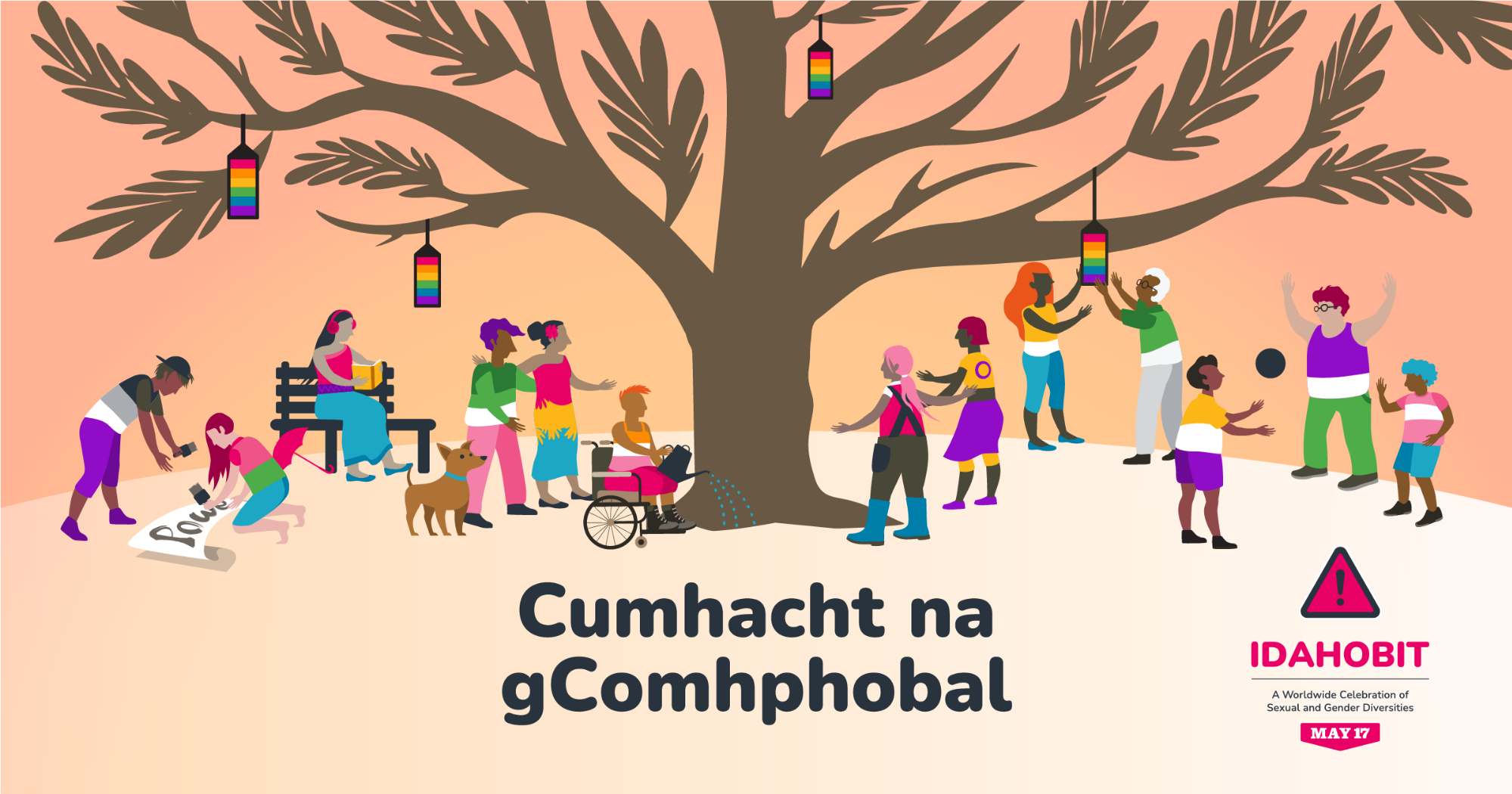
The theme for IDAHOBIT2025  is “The Power of Communities”, shown above in Irish. Even if you are not a member of our community we still need your support. Here is a useful guide I posted a few years ago about how to be a good ally.

Revolução dos Cravos

Posted in History, Music, Politics with tags , , , , , , on April 25, 2024 by telescoper

My office mate in Barcelona is Portuguese and he very proudly reminded me this morning that today, 25th April 2024, is the 50th anniversary of the Carnation Revolution that ultimately overthrew a fascist dictatorship and led Portugal towards becoming a progressive democracy. Just over a year later, General Franco died and Spain began its transition to democracy too. Both countries joined the European Community in 1986 and are now members of the European Union. It’s hard to believe, only 50 years on, that fascism is on the rise once more in Europe (and elsewhere). That makes it all the more important to remember the struggles of the not-so-distant past.

The signal for the Revolução dos Cravos in Portugal to begin was a song played on the radio. The result was remarkable. Although led by military officers dissatisfied with the ruling regime, it garnered a huge level of popular support and morphed into a coordinated campaign of mass civil resistance. When regime change was achieved, it was largely peaceful. The name “Carnation Revolution” refers to the flowers given to soldiers by people celebrating their liberation from authoritarianism.

Fascismo nunca mais! Vinte e cinco de abril sempre!

I couldn’t help sharing the song that triggered that huge historical moment. It is Grândola, Vila Morena by Zeca Afonso. Few people can lay claim to have written a song that brought down a dictatorship.

An Unmarked Anniversary

Posted in History with tags , , , on April 19, 2024 by telescoper

I didn’t have time to mention yesterday, 18th April 2024, that it was the 75th anniversary of the day that that the Republic of Ireland came into existence. The  Republic of Ireland Act, which provided the legal basis for the establishment of a new Republic, was passed in 1948 but only came into force on 18th April 1949. From that point the Republic no longer had the British monarch as Head of State and was no longer part of the Commonwealth.

That day was marked with parades and celebrations but “Republic Day” never became the public holiday that might have been expected given how many other countries mark such events in their history and indeed is hardly marked at all, not even on its 75th anniversary. I have quite a few Irish friends who were unaware of the significance of yesterday’s date.

The reason is probably explained by the statement made by Éamon De Valera when he declined an invitation extended to him by Taoiseach John A. Costello to attend the official ceremonies on 18th April 1949:

Celebrations such as those now proposed ought to be reserved until the national task which we have set ourselves is accomplished…We still believe that public demonstrations and rejoicings are out of place and are likely to be misunderstood so long as that task remains uncompleted and our country partitioned.

The Last Mughal by William Dalrymple

Posted in History, Literature with tags , , , , , , , on April 15, 2024 by telescoper

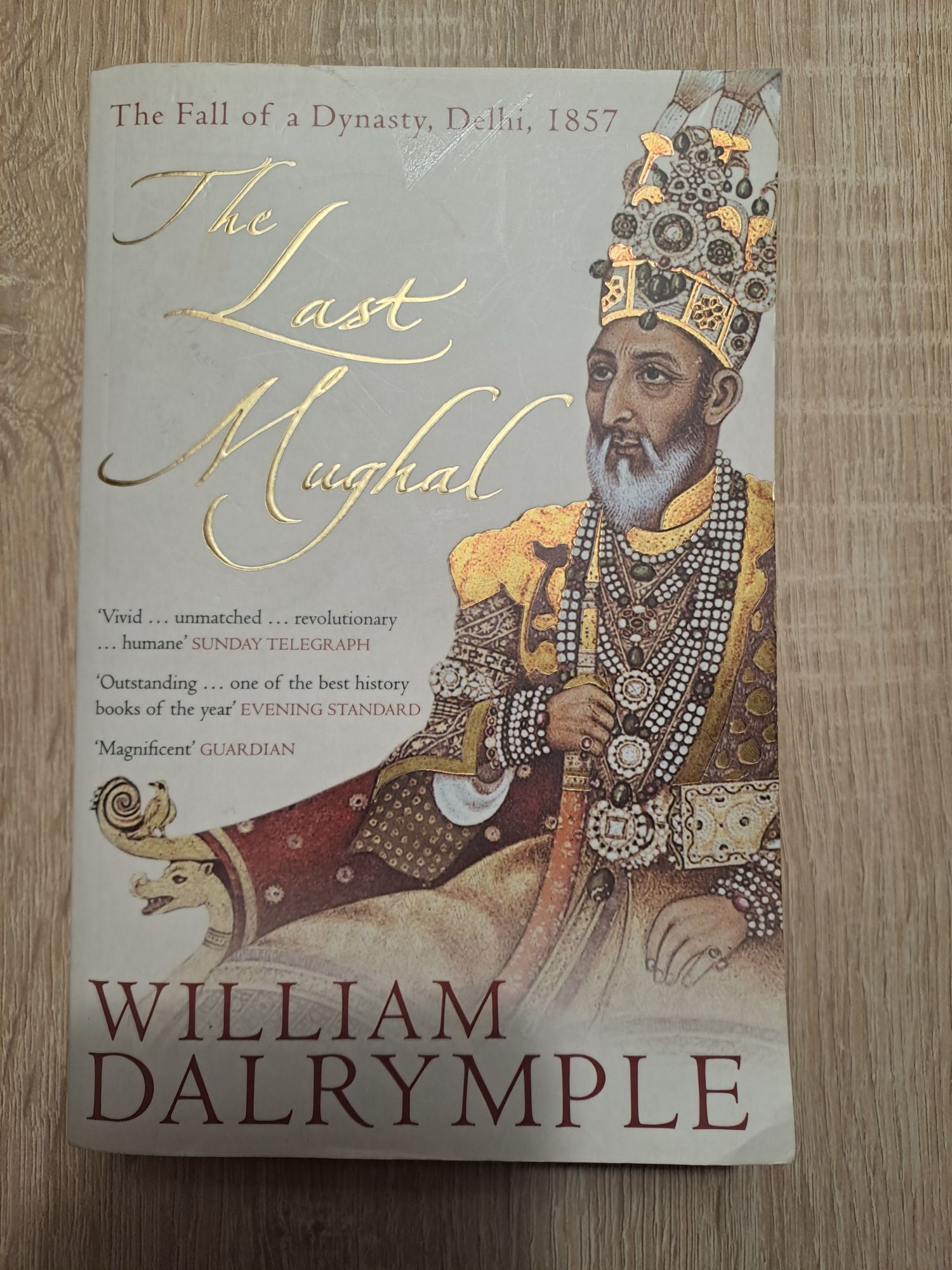
The latest item on my sabbatical reading list is The Last Mughal by William Dalrymple. This is about Bahadur Shah Zafur, the last King of the Mughal Dynasty that ruled Hindustan from its capital Delhi for 350 years, but it’s really about the last years of his life, focusing on the Indian Rebellion (Uprising) of 1857, when Mughal rule was already in a state of decline, to his death in exile in Rangoon five years afterwards. His narrative makes much use of the Mutiny Papers, an enormous collection of correspondence from the time of the rebellion collected in India’s National Archive, and there is extensive use of quoted material. There is also an extensive glossary and some excellent illustrations.

I remember learning about the “Indian Mutiny” (as it was called then) when I was doing my O-level History (in 1979) but that was more-or-less entirely from a British perspective. The immediate trigger for the rebellion of the sepoys in the British Army, we were told with some amusement by our teacher, was that a rumour had spread that the grease used to lubricate cartridges for the newly-issued Enfield rifles contained a mixture of beef fat and lard, offensive to both Hindus and Muslims. The implication was that this was a silly and trivial matter. There was, of course, a lot more to it than that…

Dalrymple explains how the British, Hindus and Muslims in Delhi co-existed reasonably peacefully until the middle of the 19th Century; there were many mixed marriages and it was by no means unknown for British representatives of the East India Company to wear Indian dress. This began to change with the arrival of a new British colonial class who disrespected any religion other than their own form of Christianity; the same attitudes were held by this class towards Irish Catholics. Resentment had been building up among both Hindus and Muslims, who felt their beliefs were under threat. The Enfield rifles were just the spark that lit the fire.

Let me quote from the book:

But while Zafar was certainly never cut out to be a heroic or revolutionary leader, he remains, like his ancestor the Emperor Akbar, an attractive symbol of Islamic civilisation at its most tolerant and pluralistic. he himself was a notable poet and calligrapher; his court contained some of the talented and artistic and literary figures in modern South Asian history; and the Delhi he presided over was undergoing one of its great periods of learning, communal amity and prosperity. He is certainly a strikingly liberal and sensitive figure when compared to the Victorian Evangelicals whose insensitivity, arrogance and blindness did so much to bring the Uprising of 1857 down upon their own heads, and those of the people and court of Delhi, engulfing all of northern India in a religious war of terrible violence

The Last Mughal, pp. 483-4

The Indian Rebellion (which took place between May and September 1857) was on a huge scale and involved terrible atrocities: women and children were not spared, many of the executed in sadistic fashion. The rebels (“mutineers” to the British) flocked to Delhi drawn to the idea that the Mughal King would lead them to victory. Unfortunately Zafar was already an old man of 82 and he was in no fit state, either mentally or physically, to be a military leader. By then he had very little power as King anyway; he certainly had only modest financial resources. He was really more of a mascot than anything else.

The lack of military leadership at Delhi was a serious problem for the rebels. In the British army a sepoy was unable to rise to a rank that involved commanding more than about 100 men. There was no-one at Delhi capable of organizing and coordinating the huge rebel army, with the result that they were unable to dislodge a much smaller British force that had assembled on a ridge outside the city. Eventually a much larger British column arrived and Delhi’s fate was sealed. Not without themselves suffering heavy casualties, the British eventually stormed the Kashmiri Gate, entered the city, looted what they could find and massacred the remnants of the rebel army in revenge for the atrocities committed by the sepoys. The famous Red Fort was largely destroyed. A plan to flatten Delhi completely was seriously considered, but eventually rejected. What remained however was a City of the Dead – that’s the title of Chapter 11.

Zafar was eventually captured but in contrast to most of the rest of his family and members of his court, was not summarily executed but exiled to Rangoon where he died in obscurity just five years later.

This book is vividly written with a extraordinary eye for detail as well as a sense of the grand sweep of the history. It must be difficult to combine the large and small scale like that. Although it’s well written it’s not always easy to read. The graphic descriptions of indiscriminate slaughter by both sides made me very uncomfortable, as did the obvious racism of many British officials and army officers revealed by the Mutiny Papers. But these are part of history, and we have to be made aware of them.

Zafar was of course Muslim, but a significant majority – almost two-thirds – of the sepoys who took part in the rebellion were Hindus. It’s interesting that both factions seem to have been content to rally around the Mughal banner. At his “trial” the British authorities in the form of prosecutor Major Harriott tried to argue that Zafar was the leader of a global Muslim conspiracy.

Here’s another quote:

The Uprising in fact showed every sign of being initiated by upper-caste Hindu sepoys reacting against specifically grievances perceived as a threat to their faith and dharma.; it then spread rapidly through the country, attracting a fractured and diffuse collection of other groups alienated by aggressively insensitive and brutal British policies. Among these were the Mughal court and the many Muslim individuals who made their way to Delhi and fought as civilian jihadis united against the kafir enemy. Yet Harriott’s bigoted and Islamophobic argument oversimplified this complex picture down to an easily comprehensible, if quite fictional, global Muslim conspiracy with an appealingly visible and captive hate figure at its centre, towards whom righteous vengeance could now be directed.

The Last Mughal, pp. 439-40

I won’t dwell on the obvious and important lesson about how bigotry and intolerance feed extremism, as the one lesson one can learn from studying history is that nobody ever learns the most obvious and important lesson.

Thomas Cromwell and his Prayer-Book

Posted in Art, History with tags , , , , , , on April 1, 2024 by telescoper
(1532-1533, Oil on Panel, 78.1 cm × 64.1 cm) by Hans Holbein the Younger – The Frick Collection, Public Domain, https://commons.wikimedia.org/w/index.php?curid=207764

The famous portrait of Thomas Cromwell by Hans Holbein the Younger shown above is in fact a copy; the original is lost. There is another copy in the National Portrait Gallery in London, but it’s not as good. The original was painted around 1533, during the period covered by the novel Wolf Hall (which I reviewed yesterday) and is mentioned in the book. Holbein is known for having sometimes painted excessively flattering portraits – most notably of Anne of Cleves – but he doesn’t seem to have done that here. Cromwell is portrayed as dour, stern-faced and more than a little scary. He probably wanted people to fear him, so wouldn’t have minded this.

As well as the nature of the likeness, the composition is interesting. The subject seems to be squashed into the frame, and hemmed in by the table that juts out towards the viewer. He is also looking out towards the viewer’s left, though not simply staring into space; his eyes are definitely focussed on something. I’m not sure what all this is intended to convey, except that the table carries an ornate prayer-book (the Book of Hours) as if to say “look, here’s a symbol of how devout this man is”.

Interesting, just last year scholars published research that argues that the copy of the Hardouyn Hours which can be found in the Library at Trinity College, Cambridge, is precisely the book depicted on the table. If so, it’s a rare and perhaps unique example of an artefact seen in a Tudor painting that survives to this day.

Modern Ireland 1600-1972 by R. F. Foster

Posted in History, Literature with tags , , , , on October 30, 2023 by telescoper

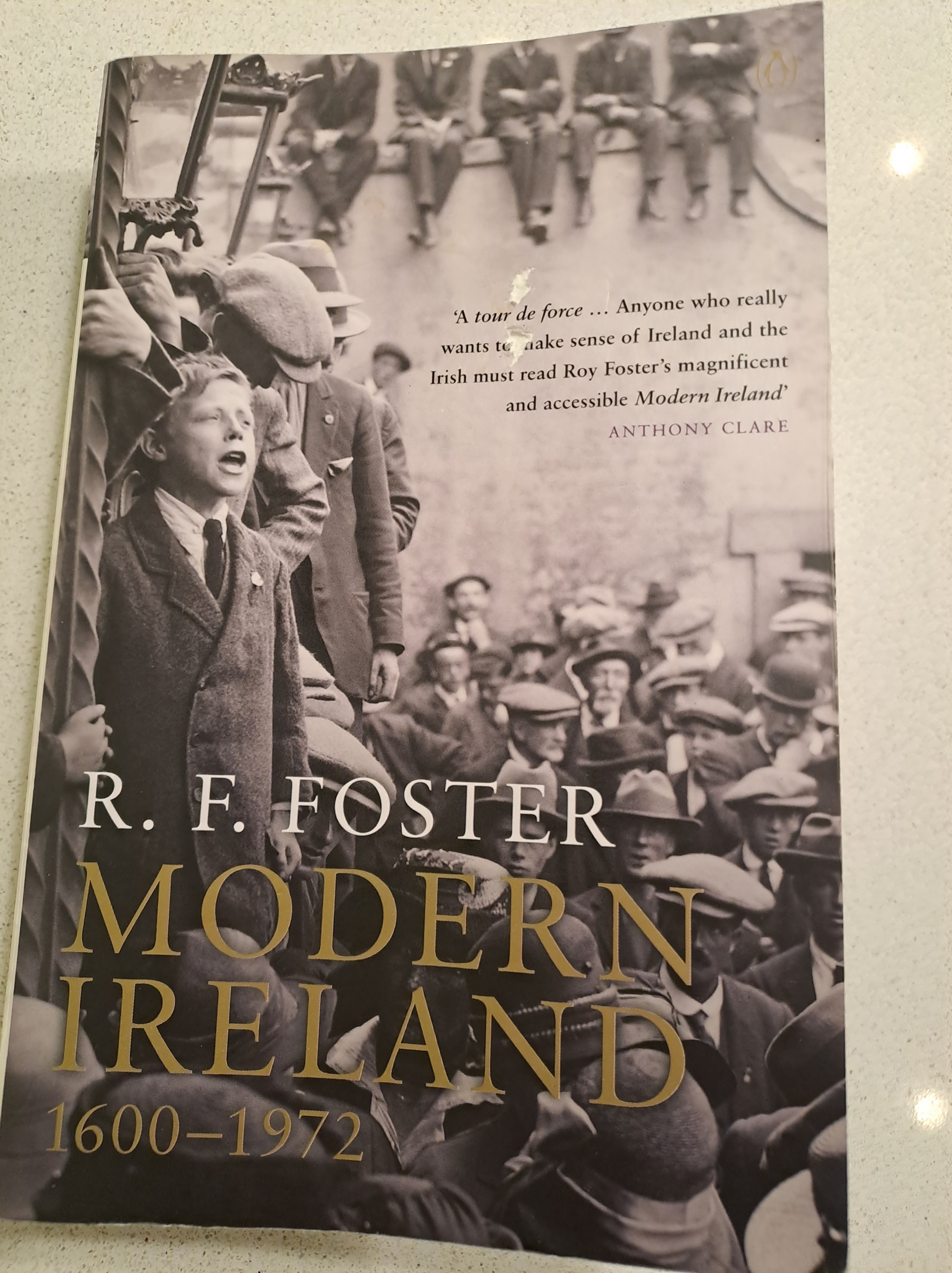
My attempt to catch up with a backlog of reading while on sabbatical has now brought me to Modern Ireland, by R.F. Foster, the paperback version of which, shown above, I bought way back in 2018 but have only just finished reading. In the following I’ll describe the scope of the book and make a few observations.

The book was first published in 1988 so it obviously can’t deal with more recent events such as the Good Friday Agreement. The narrative stops almost 50 years ago in 1972, the year of Bloody Sunday and just before Ireland joined the European Economic Community in 1973, but since it starts way back in 1600 one can forgive Roy Foster for not covering such recent events. The start is in what is usually termed the early modern period, but if truth be told much of Irish society at that point was still organized on mediaeval lines.

To set the scene, Foster starts with a description of the three main sections of the population of Ireland in 1600. These were the (Gaelic and Catholic) Irish, the “Old English”, descendants of the 12th Century conquest of part of the country, who were also Catholic, and the Protestant “New English” who arrived with the Tudor plantations. There were tensions between all three of these groups.

The rest of the book is divided into four parts, roughly one per century: Part I covers the continued Elizabethan plantation of Ireland, rebellions against it, the devastation caused by Cromwell’s so-called “pacification”, and the Penal Laws that basically outlawed the Catholic faith. In Part II Foster discusses a period often called The Ascendancy which showed the consolidation of power in the hands of a Protestant – specifically Anglican – ruling class, though there was a sizeable community of non-conformist Protestants, chiefly Presbyterians, who were regarded by Anglicans with almost as much suspicion as the Catholics. This Part ends with yet another failed rebellion, involving Wolfe Tone and the United Irishmen, against the backdrop of the French revolution. Up until the Act of Union of 1800, Ireland had its own Parliament; after that Irish MPs were sent to the House of Commons in Westminster. The century covered by Part III includes the Irish Famine, rising levels of rural violence, and issues of land reform, and various attempts to deliver some form of Home Rule; it ends with Charles Stewart Parnell. Part IV covers the Easter Rising, War of Independence, Civil War, Partition, the creation of the Irish Free State, and the eventual formation of the Irish Republic. A running theme through all four Parts is a recognition of how historical forces – and not only religion – shaped Ulster in a different way from the rest of Ireland.

As I’ve said before on this blog, it disturbs me quite how little of this history I was taught at school in England so I found it valuable to read a detailed scholarly work whose main message is that everything is much more complex than simple narratives – those peddled by politicians, for example – would have you believe. This is primarily a revisionist history, calling much of received wisdom into question. That said, it’s probably not the best book for a newcomer to Irish history. Foster does assume knowledge of quite a few of the major events and, while reading it, I did have to look quite a few things up. Much is said in the jacket reviews of the author’s writing style. To be honest, I found it sometimes rather mannered and self-conscious, though with some enjoyably arch humour thrown in for good measure. It’s thoroughly researched, as far as that is possible when primary sources are sketchy and contemporary records usually written by someone with an axe to grind. It does seem to rely mainly on documents written in English, however, so one might argue that introduces quite a bias. I gather that there is much greater emphasis among contemporary Irish historians on records written in Irish (Gaelic).

The book is rather heavy on footnotes, too. Usually I dislike these, but in this case they are mostly little biographical sketches of important figures which would have disrupted the flow if included in the main text, and I found many of them valuable. Just to be perverse, I have to say I liked his liberal use of semicolons. Though dense, the books is as accessible as I think a scholarly work can be and although I am not so much a scholar of history as an interested bystander, I learnt a lot. It also made me want to learn more, especially about the period between the death of Parnell in 1891 and the Easter Rising of 1916.

It seems apt to finish with an excerpt that illustrates a theme that crops up repeatedly during the 23 chapters of the book:

Irish history in the long period since the completion of the Elizabethan conquest concerned a great deal more than the definition of Irishness against Britishness; this survey has attempted to indicate as much. But that sense of difference comes strongly through, though its expression was conditioned by altering circumstances, and adapted for different interest-groups, as the years passed. If the claims of cultural maturity and a new European identity advanced by the 1970s can be substantiated, it may be by the hope of a more relaxed and inclusive definition of Irishness, and a less constricted view of Irish history.

Modern Ireland, R. F. Foster, p596

I hope that too. It may even be happening.

The Death of Michael Collins

Posted in History with tags , , , , on August 22, 2022 by telescoper
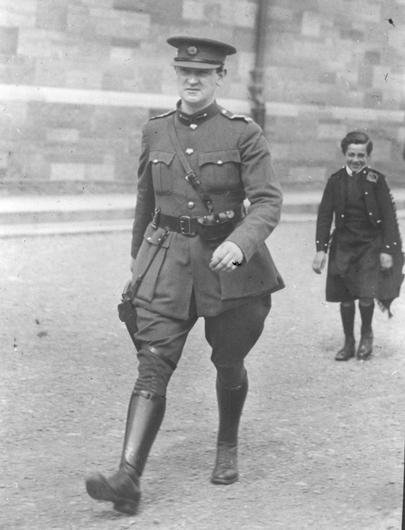
Michael Collins in full dress uniform, pictured a few days before his death.

Today marks the centenary of the death of Michael Collins during the Irish Civil War. The event was marked by a ceremony yesterday at Béal na Bláth, where Collins was shot in the head and killed by a sniper on 22nd August 1922. He was 31 years old.

The Civil War had erupted over the the Anglo-Irish Treaty with the pro-Treaty National Army (of which Collins was Commander-in-Chief) fighting against anti-Treaty forces. Opponents of the Treaty felt that the Irish Free State it created fell far short of the Republic they had fought for during the War of Independence. In particular the Treaty required an Oath of Allegiance to the British Crown, which many Republicans found totally unacceptable.

On 22nd August, with Free State forces gaining the upper hand, Collins was travelling through County Cork with a convoy including an armoured car, when it was ambushed by soldiers of the anti-Treaty IRA. Instead of trying to escape, the convoy stopped and a gunfight developed during which Collins was shot dead. He was the only fatality. There was no official inquiry into the events at Béal na Bláth and nobody knows for sure who fired the fatal shot. The death of Michael Collins, following the death a few days earlier of Arthur Griffith, was a big setback for the leadership of the Free State and the already bitter Civil War descended into cycle of atrocities and reprisals. The fighting was to grind on until May 1923.

The Hundred

Posted in History with tags , on June 18, 2021 by telescoper

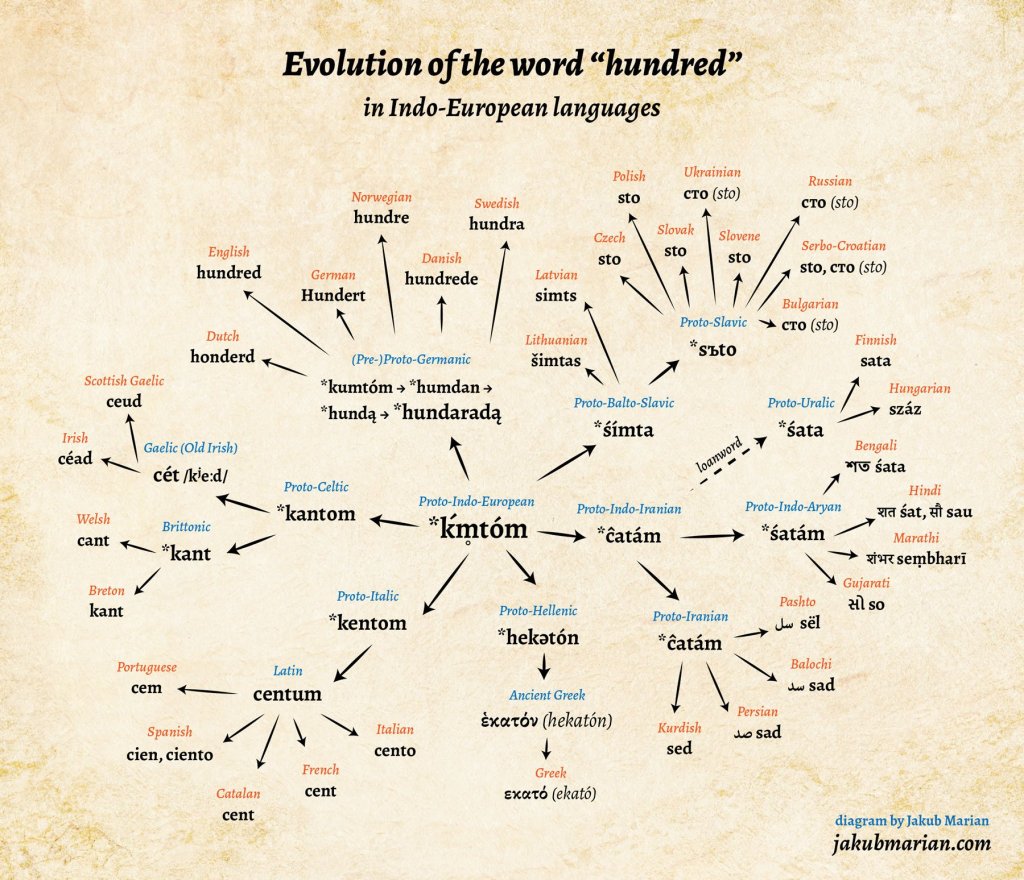
I saw this on Twitter recently and thought I’d share it because I found it fascinating. Taken from here and it shows the evolution of the word “hundred” across Indo-European languages:

Apologies if you thought I was going to go off on one about the silly new English cricket format. I think it’s best I don’t discuss that.