There’s a nice short review article on arXiv today by Mike Turner. I wasn’t going to share it because it hasn’t got any pictures in it, but changed my mind.
Here is the abstract
The current cosmological paradigm, ΛCDM, is characterized (b) its expansive description of the history of the Universe, its deep connections to particle physics and the large amounts of data that support it. Nonetheless, ΛCDM’s critics argue that it has been falsified or must be discarded for various reasons. Critics and boosters alike do agree on one thing: it is the not the final cosmological theory and they are anxious to see it replaced by something better! I review the status of ΛCDM, provide my views of the path forward, and discuss the role that the “Hubble tension” might play.
arXiv:2510.05483
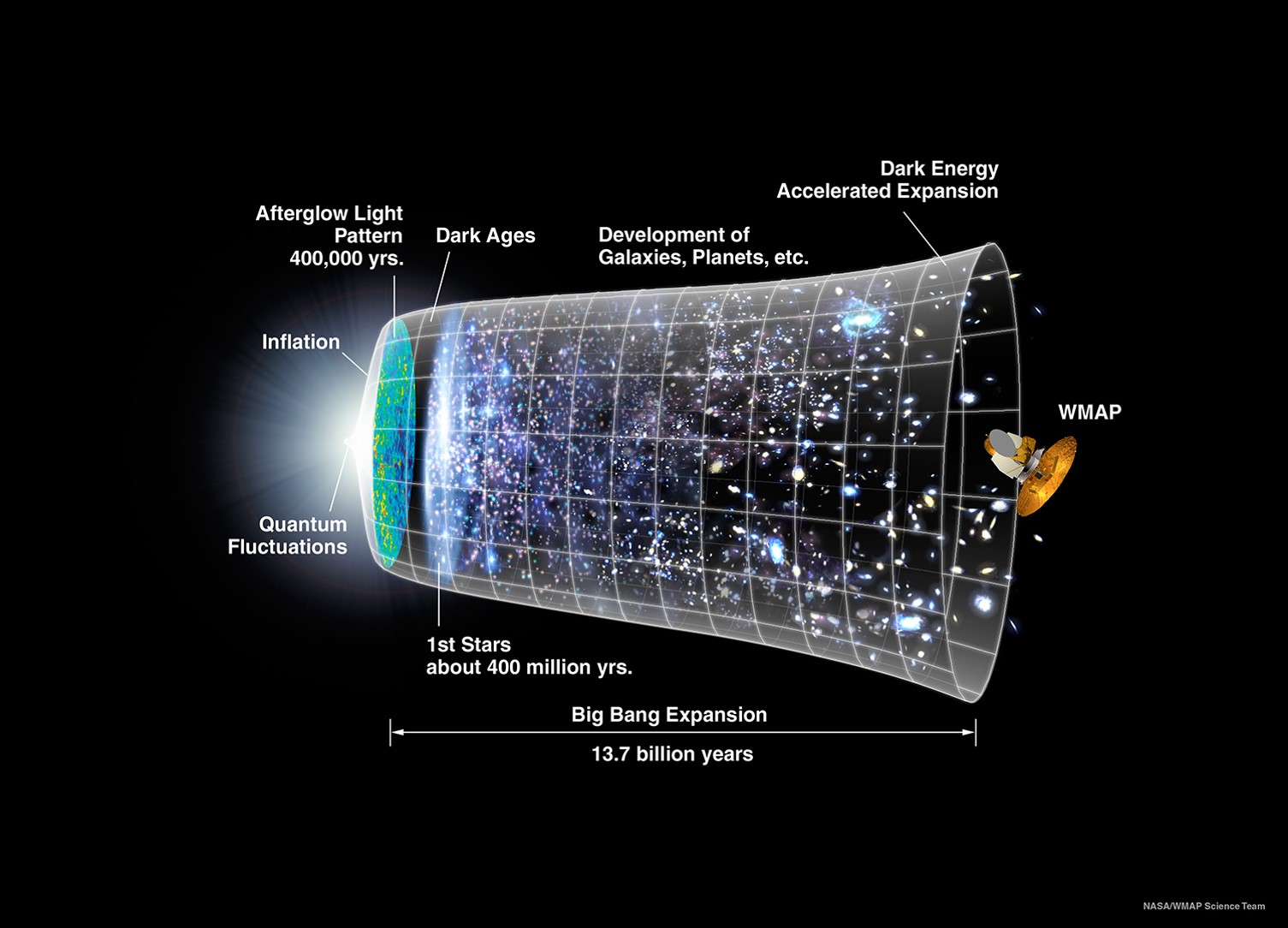
To make up for the lack of pictures in the article, here’s the first image that came up when I did a search for “ΛCDM”:
Newly announced on arXiv there is a review article with the title The CosmoVerse White Paper: Addressing observational tensions in cosmology with systematics and fundamental physics. The abridged form of the abstract reads:
The standard model of cosmology has provided a good phenomenological description of a wide range of observations both at astrophysical and cosmological scales for several decades. This concordance model is constructed by a universal cosmological constant and supported by a matter sector described by the standard model of particle physics and a cold dark matter contribution, as well as very early-time inflationary physics, and underpinned by gravitation through general relativity. There have always been open questions about the soundness of the foundations of the standard model. However, recent years have shown that there may also be questions from the observational sector with the emergence of differences between certain cosmological probes. In this White Paper, we identify the key objectives that need to be addressed over the coming decade together with the core science projects that aim to meet these challenges. These discordances primarily rest on the divergence in the measurement of core cosmological parameters with varying levels of statistical confidence. These possible statistical tensions may be partially accounted for by systematics in various measurements or cosmological probes but there is also a growing indication of potential new physics beyond the standard model. After reviewing the principal probes used in the measurement of cosmological parameters, as well as potential systematics, we discuss the most promising array of potential new physics that may be observable in upcoming surveys. We also discuss the growing set of novel data analysis approaches that go beyond traditional methods to test physical models.
arXiv:2504.01669v2
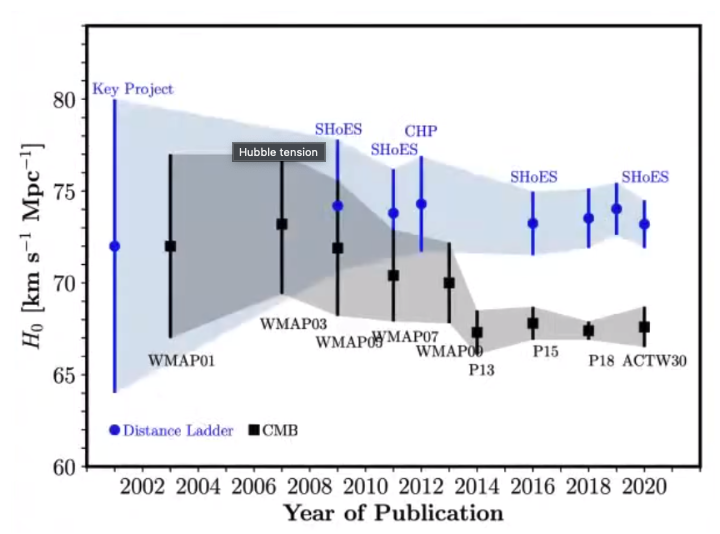
Here’s a plot demonstrating one of the tensions discussed in this paper, and widely on this blog, the Hubble Tension:
This is a very comprehensive review article consisting of over 400 pages and having over 400 authors. I expect all of you to read it over the weekend. There will be a test on Monday.
Today is going to be a very busy day on the cosmology front – with the Euclid Q1 Data Release coming out at 11am GMT – but I’ll start off by sharing news of final data release (DR6) by the Atacama Cosmology Telescope. This was announced yesterday and includes former colleagues at Cardiff University, so congratulations to them and all concerned. Here is a pretty picture showing one of the beautiful cosmic microwave background polarization and intensity maps:
Intensity and Polarization maps from ACT: arXiv:2503.14451
There are three related preprints on the arXiv today:
There’s a lot to digest in these papers but a quick skim of the abstracts gives two pertinent points. First, from the second paper:
We find that the ACT angular power spectra estimated over 10,000 deg2, and measured to arcminute scales in TT, TE and EE, are well fit by the sum of CMB and foregrounds, where the CMB spectra are described by the ΛCDM model. Combining ACT with larger-scale Planck data, the joint P-ACT dataset provides tight limits on the ingredients, expansion rate, and initial conditions of the universe.
They also find that, when combined with CMB lensing from ACT and Planck, and baryon acoustic oscillation data from the Dark Energy Spectroscopic Instrument (DESI Y1), the ACT data give a “low” value for the Hubble constant: H0=68.22 ± 0.36 km s-1 Mpc-1.
The third paper also says
In general, models introduced to increase the Hubble constant or to decrease the amplitude of density fluctuations inferred from the primary CMB are not favored by our data.
Back in April I posted about a meeting at the Royal Society in London called Challenging the Standard Cosmological Model, some of which I attended virtually. In that post I mentioned that Wendy Freedman gave a talk related to the ongoing issue of the Hubble Tension, i.e. the discrepancy between different types of measurement of the Hubble Constant, usually characterized as local measurements (using stellar distance indicators) and larger-scale measurements (chiefly Planck). There are quite a few posts about this issue on this blog. Anyway, Wendy Freedman mention in her talk that her latest work on stellar distances suggested a value of 69.1 ± km s-1 Mpc-1, which reduces the tension with Planck significantly. At the time, however, there was no paper explaining how this number was derived.
Yesterday there appeared on arXiv a preprint by Freedman et al. which summarizes the recent results. The abstract is here:
We present the latest results from the Chicago Carnegie Hubble Program ( CCHP) to measure the Hubble constant using data from the James Webb Space Telescope (JWST). This program is based upon three independent methods: (1) Tip of the Red Giant Branch (TRGB) stars, (2) JAGB (J-Region Asymptotic Giant Branch) stars, and (3) Cepheids. Our program includes 10 nearby galaxies, each hosting Type Ia supernovae (SNe Ia), suitable for measuring the Hubble constant (H0). It also includes NGC 4258, which has a geometric distance, setting the zero point for all three methods. The JWST observations have significantly higher signal-to-noise and finer angular resolution than previous observations with the Hubble Space Telescope (HST). We find three independent values of H0 = 69.85 ± 1.75 (stat) ± 1.54 (sys) for the TRGB, H0 = 67.96 ± 1.85 (stat) ± 1.90 (sys) km s-1 Mpc-1 for the JAGB, and H0 = 72.05 ± 1.86 (stat) ± 3.10 (sys) for Cepheids. Tying into SNe Ia, and combining these methods adopting a flat prior, yields our current estimate of H0 = 69.96 ± 1.05 (stat) ± 1.12 (sys) km s-1 Mpc-1. The distances measured using the TRGB and the JAGB method agree at the 1% level, but differ from the Cepheid distances at the 2.5-4% level. The value of H0 based on these two methods with JWST data alone is H0 = 69.03 ± 1.75 (total error) km s-1 Mpc-1. These numbers are consistent with the current standard ΛCDM model, without the need for the inclusion of additional new physics. Future JWST data will be required to increase the precision and accuracy of the local distance scale.
You can read the full paper on arXiv here. A summary of the summary is that of the three methods they use, two give lower values of the Hubble constant and one (Cepheids) gives a higher value but with larger errors. The number quoted in the Royal Society talk was presumably preliminary as it doesn’t match any of the numbers in the abstract, but the point remains.
You can see the reduction in scatter in the new JWST measurements in this Figure (old on the left and new on the right).
On the face of it, these results suggest that the Hubble tension is greatly reduced. I am sure, however, that advocates of a higher value will have been preparing their ripostes and it’s just a matter of time before they arrive on the arXiv too!
It’s Saturday morning in Barcelona, and time to post another update relating to the Open Journal of Astrophysics. Since the last update we have published two more papers, taking the count in Volume 7 (2024) up to 32 and the total published by OJAp up to 147. There’s every chance we will reach 150 next week.
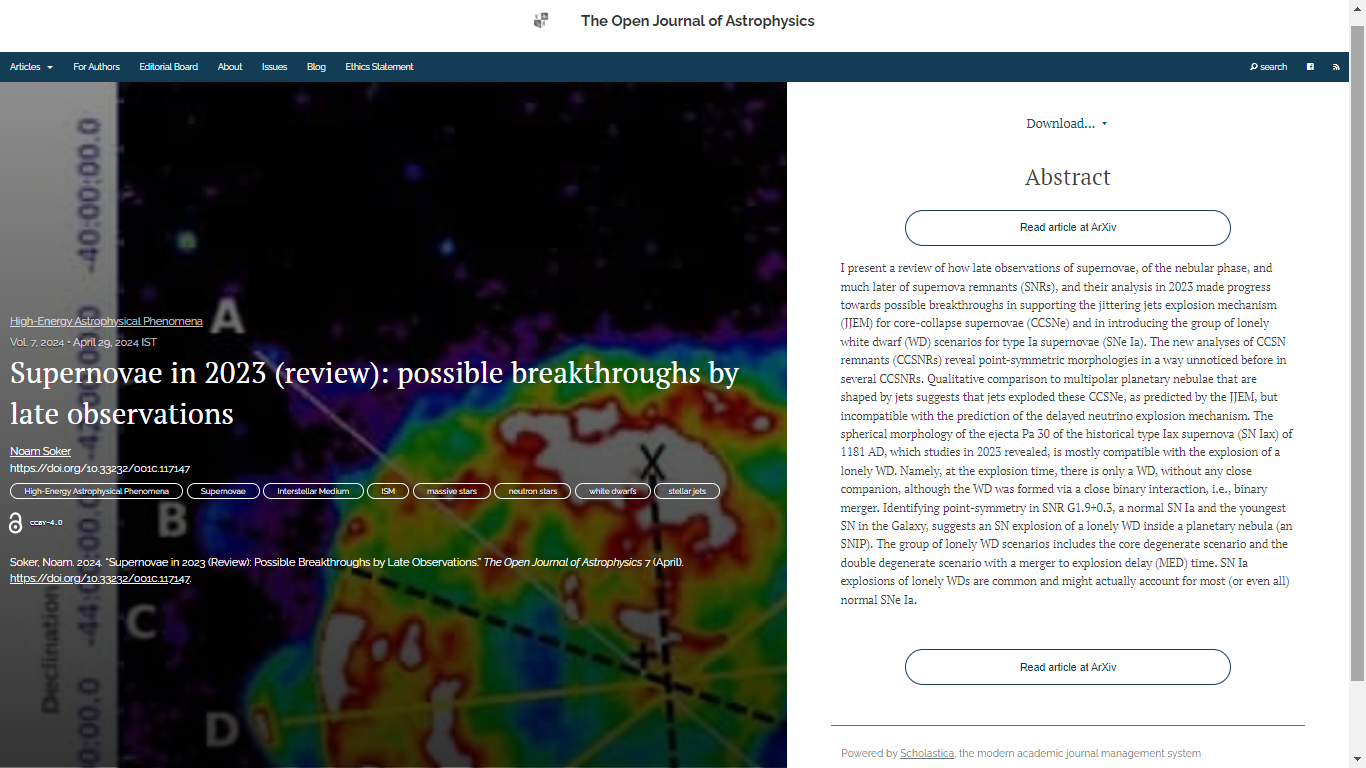
The first paper of the most recent pair – published on Monday 29th April- is “Supernovae in 2023 (review): possible breakthroughs by late observations” by Noam Soker of Technion in Haifa, Israel. It presents a discussion of observations of the aftermath of supernovae explosions, such as supernova remnants, and how these may shed light on the explosion mechanism. This one is in the folder marked High-Energy Astrophysical Phenomena.
Here is a screen grab of the overlay which includes the abstract:
You can click on the image of the overlay to make it larger should you wish to do so. You can find the officially accepted version of the paper on the arXiv here.
The second paper was published on Thursday 2nd May and has the title “ΛCDM is alive and well” The authors are: Alain Blanchard (Université de Toulouse, France), Jean-Yves Héloret (Université de Toulouse, France), Stéphane Ilíc (Université Paris-Saclay, France), Brahim Lamine (Université de Toulouse, France) and Isaac Tutusaus (Université de Genève, Switzerland). This one, which is in the folder marked Cosmology and NonGalactic Astrophysics, presents a review of review of the alleged tensions between observations and the standard cosmological model.
Here is a screen grab of the overlay which includes the abstract:
You can click on the image of the overlay to make it larger should you wish to do so. You can find the officially accepted version of the paper on the arXiv here.
And that concludes this week’s update. More next week!
Is the universe simple enough to be adequately described by the standard ΛCDM cosmological model which assumes the isotropic and homogeneous Friedmann-Lemaître-Robertson-Walker metric? Tensions have emerged between the values of cosmological parameters estimated in different ways. Do these tensions signal that our model is too simple? Could a more sophisticated model account for the data without invoking a Cosmological Constant?
That conference is actually taking place this week (on 15th and 16th April, i.e. yesterday and today). I can’t be there, of course, because I’m here, but I can share the recording of the talks. Here is the first day’s worth. The recording is about 8 hours long so you probably won’t want to watch it all in one sitting. Let me point out the talk by Wendy Freedman, which starts at around 2:13.30 talking about the Hubble Tension largely from the point of view of stellar distance indicators and suggesting an answer of 69.1 ± km s-1 Mpc-1, which reduces the tension with Planck significantly.
And here is Day 2:
You can find more information about the meeting, including a full list of the talks here.
There has been a lot of excitement around the ICCUB today – the press have been here and everything – ahead of the release of the Year 1 results from the Dark Energy Spectroscopic Instrument (DESI). The press release from the Lawrence Berkeley Laboratory in California can be found here.
The papers were just released at 5pm CEST and can be found here. The key results pertain to Baryon Acoustic Oscillations (BAOs) which can be used to track the expansion rate and geometry of the Universe. This is one of the techniques that will be used by Euclid.
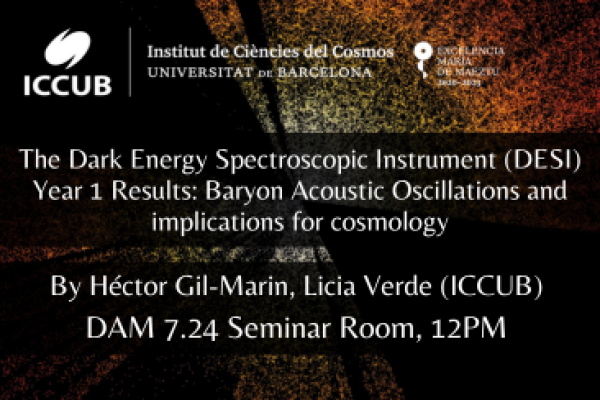
There’s a lot of technical information to go through and I have to leave fairly soon. Fortunately we have seminar tomorrow that will explain everything at a level I can understand:
I will update this post with a bit more after the talk, but for the time being I direct you to the high-level cosmological implications are discussed in this paper (which is Paper VI from DESI).
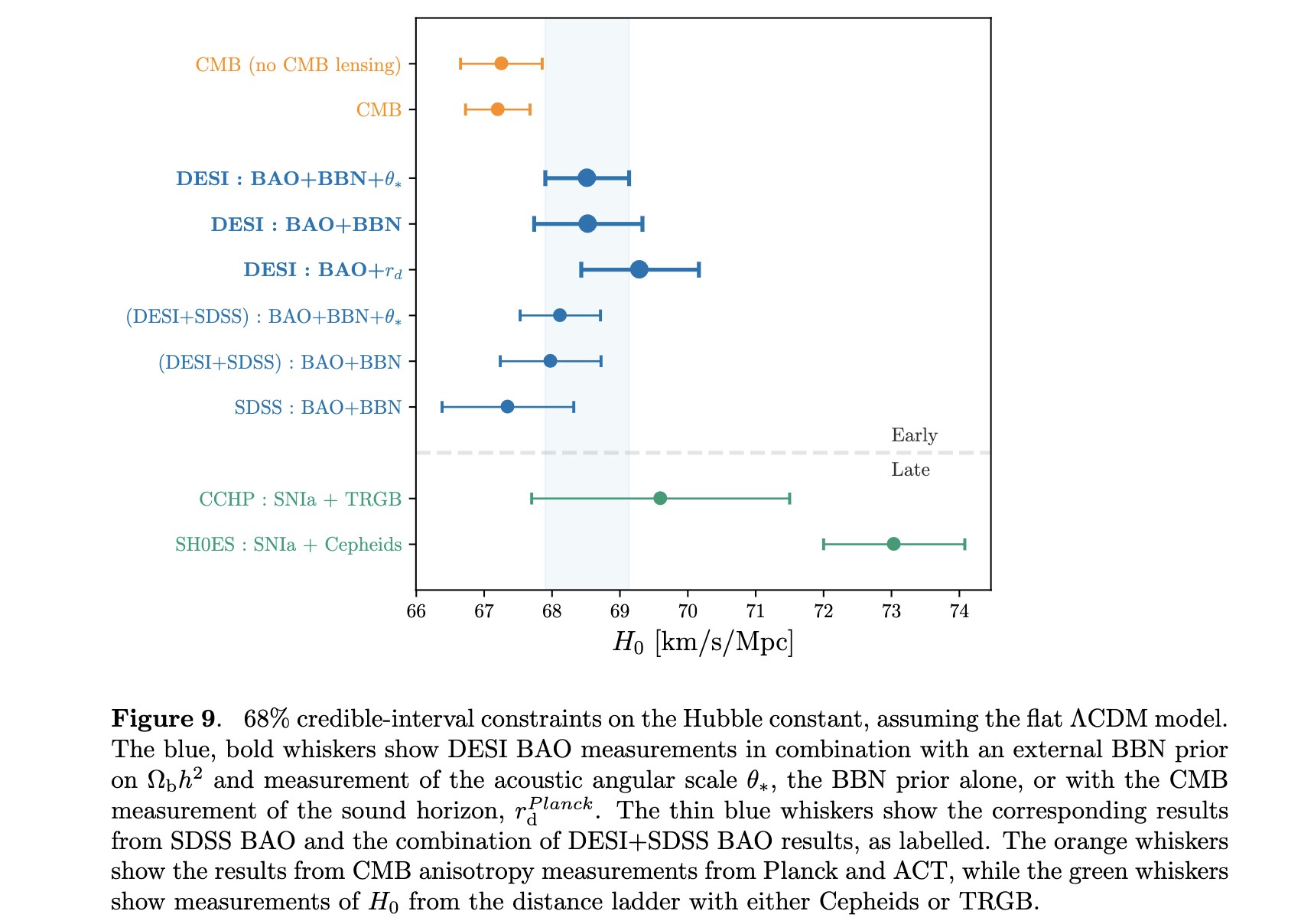
If your main interest is in the Hubble Tension then I direct you to this Figure:
Depending on the other data sets included, the value obtained is around 68.5 ± 0.7 in the usual units, closer to the (lower) Planck CMB value than the (higher) Supernovae values but not exactly in agreement; the error bars are quite small too.
You might want to read my thoughts about distances estimated from angular diameters compared with distances measured using luminosity distances here.
If you’re wondering whether there is any evidence for departures from the standard cosmology, another pertinent comment is:
In summary, DESI data, both alone and in combination with other cosmological probes, do not show any evidence for a constant equation of state parameter different from −1 when a flat wCDM model is assumed.
DESI 2024 VI: Cosmological Constraints from the Measurements of Baryon Acoustic Oscillations
More complicated models of time-varying dark energy might work, but there’s no strong evidence from the current data.
That’s all from me for now, but feel free to comment through the box below with any hot takes!
UPDATE: As expected there has been quite a lot of press coverage about this – see the examples below – mostly concentrating on the alleged evidence for “new physics”. Personally I think the old physics is fine!
It’s my last morning in Phoenix and since I was too busy at the weekend to post the usual update from the Open Journal of Astrophysics I will do so now, before I go to the Airport for my flight home.
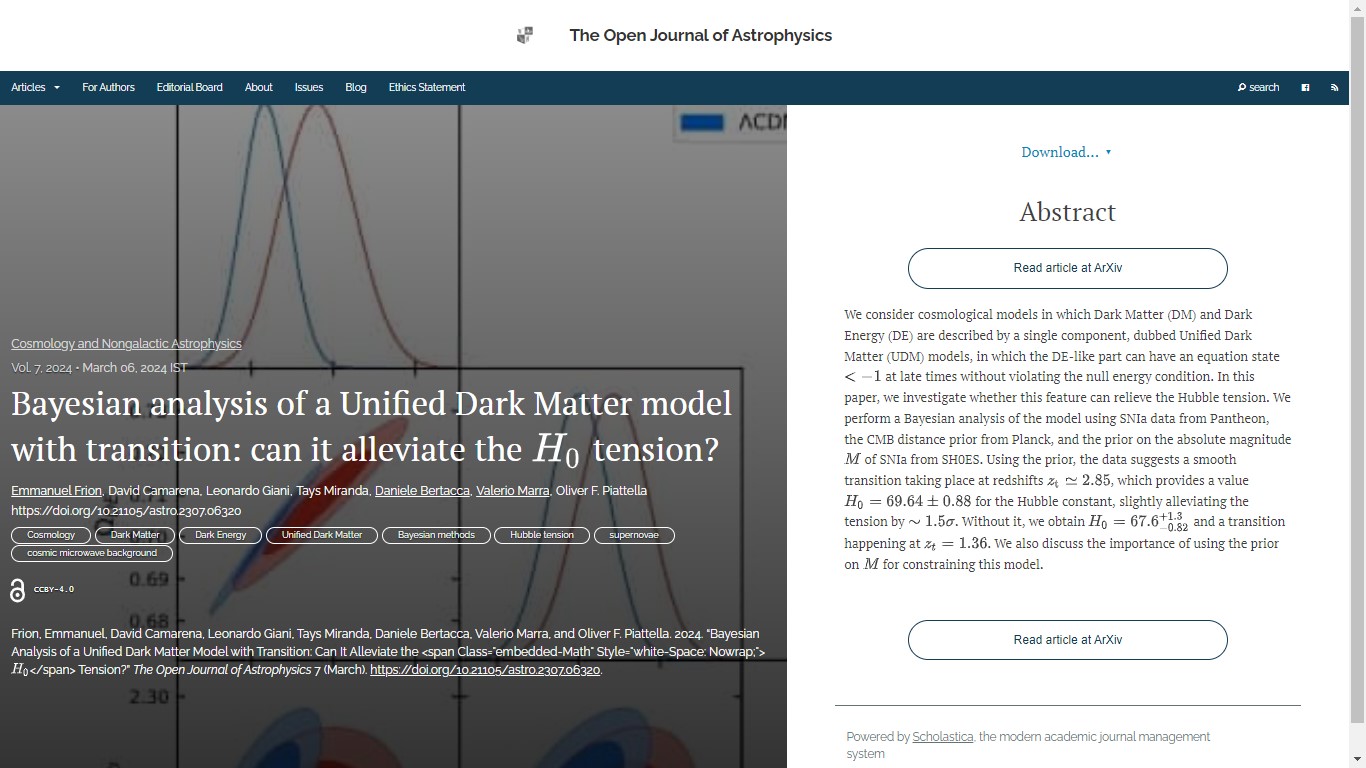
Looking at the workflow I see that there is a considerable backlog of papers that have been accepted but are waiting for the authors to put the final version on arXiv. As a result there is only one paper to report for last week, being the 17th paper in Volume 7 (2024) and the 132nd altogether; it was published on March 6 2024. I expect more soon!
The authors are seven in number: Emmanuel Frion (University of Helsinki, Finland, and Western University, Canada); David Camarena (University of New Mexico, USA); Leonardo Giani (University of Queensland, Australia); Tays Miranda (University of Helsinki and University of Jyväskylä, both in Finland); Daniele Bertacca (Università degli Studi di Padova, Italy); Valerio Marra (Universidade Federal do Espírito Santo, Brazil and Osservatorio Astronomico di Trieste, Italy);
and Oliver F. Piattella (Università degli Studi dell’Insubria, Como, Italy).
Here is the overlay of the paper containing the abstract:
You can click on the image of the overlay to make it larger should you wish to do so. You can also find the officially accepted version of the paper on the arXiv here.
Just a quick post to pass on a reference to a paper on arXiv (to appear in Annual Reviews of Astronomy and Astrophysics) about the ongoing saga of the Hubble Tension. The authors are Licia Verde, Nils Schöneberg, and Héctor Gil-Marín, three members of the ICCUB which is hosting me during my sabbatical. I saw an earlier draft of this paper but didn’t want to blog about it before the final version appeared. The abstract (which I’ve slightly reformatted) reads:
The Hubble parameter H0, is not a univocally-defined quantity: it relates redshifts to distances in the near Universe, but is also a key parameter of the ΛCDM standard cosmological model. As such, H0 affects several physical processes at different cosmic epochs, and multiple observables. We have counted more than a dozen H0‘s which are expected to agree if a) there are no significant systematics in the data and their interpretation and b) the adopted cosmological model is correct. With few exceptions (proverbially confirming the rule) these determinations do not agree at high statistical significance; their values cluster around two camps: the low (68 km/s/Mpc) and high (73 km/s/Mpc) camp. It appears to be a matter of anchors: the shape of the Universe expansion history agrees with the model, it is the normalizations that disagree. Beyond systematics in the data/analysis, if the model is incorrect there are only two viable ways to “fix” it: by changing the early time (z≳1100) physics and thus the early time normalization, or by a global modification, possibly touching the model’s fundamental assumptions (e.g., homogeneity, isotropy, gravity). None of these three options has the consensus of the community. The research community has been actively looking for deviations from ΛCDM for two decades; the one we might have found makes us wish we could put the genie back in the bottle.
arXiv:2311.13305
You can read the full paper here to learn about the scientific arguments, but I’d like to draw attention to this excerpt which is of more general relevance and with which I agree wholeheartedly:
It is also fair to say that the developments of the last decade have changed the expectations and modus operandi of a big part of the community. The community now expects results to be reproducible, hence the data and key software to be publicly available in such a way that a practitioner not involved in the original analysis could still retrace and reproduce all important steps and findings. While research areas such as the CMB and large-scale structure made this transition to “open science” about two decades ago, this was not the case for other areas of extra-galactic astronomy, but this is now changing.
I bookmarked this paper on arXiv a week or so ago with the intention of sharing it here, but evidently forgot about it. Anyway, as its name suggests, it’s a review by Brent Tully from a historical perspective of measurements of the Hubble Constant. I’m not sure whether it is intended for publication in a book – as it opens with the heading “Chapter 1” – but it’s well worth reading whatever its purpose. Here is the abstract:
For 100 years since galaxies were found to be flying apart from each other, astronomers have been trying to determine how fast. The expansion, characterized by the Hubble constant, H0, is confused locally by peculiar velocities caused by gravitational interactions, so observers must obtain accurate distances at significant redshifts. Very nearby in our Galaxy, accurate distances can be determined through stellar parallaxes. There is no good method for obtaining galaxy distances that is applicable from the near domain of stellar parallaxes to the far domain free from velocity anomalies. The recourse is the distance ladder involving multiple methods with overlapping domains. Good progress is being made on this project, with satisfactory procedures and linkages identified and tested across the necessary distance range. Best values of H0 from the distance ladder lie in the range 73 – 75 km/s/Mpc. On the other hand, from detailed information available from the power spectrum of fluctuations in the cosmic microwave background, coupled with constraints favoring the existence of dark energy from distant supernova measurements, there is the precise prediction that H0 = 67.4 to 1%. If it is conclusively determined that the Hubble constant is well above 70 km/s/Mpc as indicated by distance ladder results then the current preferred LambdaCDM cosmological model based on the Standard Model of particle physics may be incomplete. There is reason for optimism that the value of the Hubble constant from distance ladder observations will be rigorously defined with 1% accuracy in the near future.
Brent Tully, arXiv:2305.11950
Here is the concluding paragraph:
As the 20th century came to an end, ladder measurements of the Hubble constant were at odds with the favored cosmological model of the time of cold dark matter with Λ =0. The new favorite became the ΛCDM model with dark energy giving rise to acceleration of space in a topologically flat universe. Yet ladder measurements, continuously improving, create doubts that this currently favorite model is complete. Yes, there is a Hubble tension.
The views presented here are personal and not necessarily those of my employer (or anyone else for that matter).
Feel free to comment on any of the posts on this blog but comments may be moderated; anonymous comments and any considered by me to be vexatious and/or abusive and/or defamatory will not be accepted. I do not necessarily endorse, support, sanction, encourage, verify or agree with the opinions or statements of any information or other content in the comments on this site and do not in any way guarantee their accuracy or reliability.




 In the Dark