It’s time once again for the regular Saturday update of papers published during the past week at the Open Journal of Astrophysics. Since the last update we have published three new papers, which brings the number in Volume 8 (2025) up to 62 and the total so far published by OJAp up to 297.
In chronological order of publication, the three papers published this week, with their overlays, are as follows. You can click on the images of the overlays to make them larger should you wish to do so.
The first paper to report is: “Jet-shaped filamentary ejecta in common envelope evolution” by Ron Schreier, Shlomi Hillel and Noam Soker (Technion, Haifa, Israel). This paper, which was published on Monday May 19th 2025 in the folder High-Energy Astrophysical Processes, presents three-dimensional hydrodynamical simulations of common envelope evolution of a neutron star inside the envelope of a rotating red supergiant with Rayleigh-Taylor instabilities forming filamentary ejecta.
The overlay is here:

You can find the officially accepted version on arXiv here.
Second one up is “Weighing The Options: The Unseen Companion in LAMOST J2354 is Likely a Massive White Dwarf” by M. A. Tucker, A. J. Wheeler & D. M. Rowan (Ohio State University, USA) and M. E. Huber (U. Hawaii, USA). This paper was published on Tuesday 20th May 2025 in the folder for Solar and Stellar Astrophysics. It discusses a spectroscopic study of the binary system LAMOST J235456.73+335625 (J2354) with a discussion of the implications for the nature of the dark component.
The overlay is here:
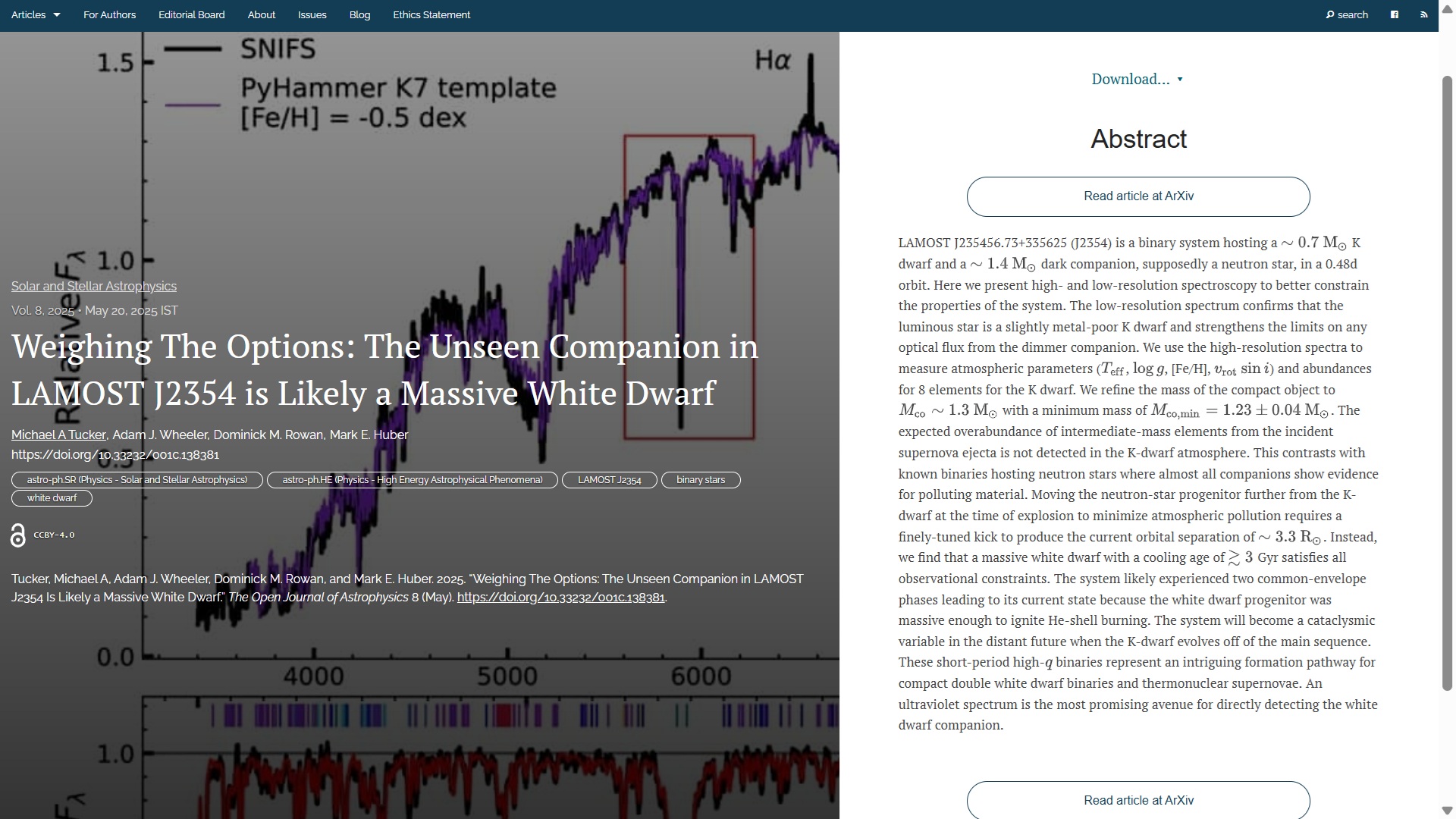
You can find the officially-accepted version of the paper on arXiv here.
The third and last paper of the week, published on Thursday May 22nd 2025, also in the folder Solar and Stellar Astrophysics, is “How to use Gaia parallaxes for stars with poor astrometric fits” by Kareem El-Badry (Caltech, USA). This paper presents a method for extracting reasonable estimates of stellar parallaxes from Gaia data when the overall astrometric solution is unreliable due to errors and noise
Here is the overlay:
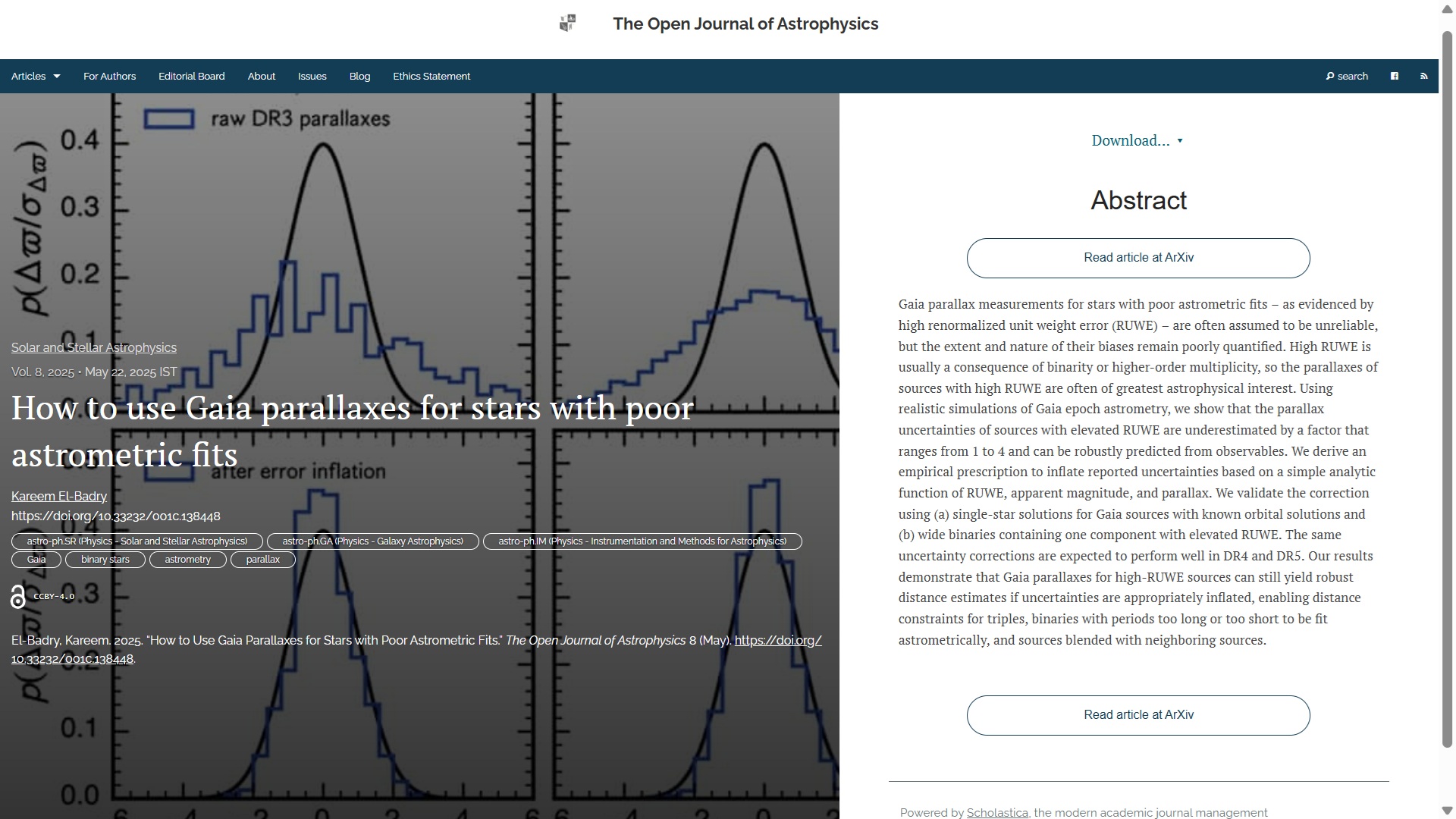
You can find the officially accepted version of this paper on arXiv here.
That’s all the papers for this week. Looking at the publishing workflow, I expect we will pass the 300 mark next week. We’ll see when I post the next update next Saturday.

 In the Dark