Archive for Institute of Physics

Autumn Repeats

Posted in Education, History, Maynooth with tags , , , , , on August 5, 2025 by telescoper

As I mentioned yesterday, it is almost time for the repeat examination period to begin once again. In fact the first papers are due tomorrow (6th August). A couple of years ago, Maynooth University produced this nice good luck message for those resitting so I’ll repeat it here:

I was a bit surprised when I first arrived here in Ireland that the August repeat examinations are called the Autumn Repeats. After all, they happen in August which is generally regarded as summer rather than Autumn. The term is, I think, a relic of the old Celtic calendar in which the start of Autumn coincides with the start of harvesting, the old festival of Lúnasa being when people celebrated the Celtic deity Lugh, who would bring a good harvest or who, if not satisfied, could bring his wrath to bear in storms that would mess everything up. Lúnasa is the name for August in modern Irish; Lá Lúnasa is 1st August, and the first Monday in August (Lá Saoire i mí Lúnasa) (yesterday) is a Bank Holiday.

Anyway, the repeat examinations start tomorrow and go on for ten days or so, I will have four different papers to grade, though I’m expecting only one candidate each for three of them.

Every year at this time I mention the difference between the system of repeats in Maynooth compared to other institutions with which I am familiar, especially in the UK. Elsewhere, students generally take resits when, because they have failed one or more examinations the previous May, they have not accumulated sufficient credits to proceed to the next year of their course. Passing the resit allows them to retrieve lost credit, but their mark is generally capped at a bare pass (usually 40%). That means the student gets the credit they need for their degree but their average (which determines whether they get 1st, 2nd or 3rd class Honours) is affected. This is the case unless a student has extenuating circumstances affecting the earlier examination, such as bad health or family emergency, in which case they take the resit as a `sit’, i.e. for the first time with an uncapped mark.

Here in Maynooth, however, the mark obtained in a repeat examination is usually not capped. Indeed, some students – though not many – elect to take the repeat examination even if they passed earlier in the summer, in order to increase their average mark.

Some people don’t like the idea of uncapped repeats because they feel that it would lead to many students playing games, i.e. deliberately not taking exams in May with the intention of spreading some of their examination  load into August. The Institute of Physics has decided to impose capped resits as part of its accreditation requirements. Some people here seem to think IOP accreditation is worth having so we’re being pushed into that requirement. I find it heavy-handed and unhelpful. It is also unimportant unless you want to do postgraduate study in physics in the UK. It doesn’t matter at all anywhere else.

If you think students have an unfair advantage if they don’t take a full diet of examinations in May, then the logical conclusion is that part-time students have an unfair advantage as do students taking micro-credentials consisting of just one or two modules. It’s the essence of the modular system that each module result should be considered on its own merit, not in relation to other modules a student may or may not have taken at the same time. One can of course argue whether the modular system is good or not, but if you have it then you should act consistently in accordance with it. You wouldn’t penalize students who have to work to support their study relative to those who don’t, would you?

And there’s no real evidence of students actually playing the system in the way the IOP thinks they do anyway. For one thing the results from the repeat examination period are not confirmed until early September so that students that deploy this strategy do not know whether they are going to be able to start their course until just a couple of weeks before term. That could cause lots of problems securing accommodation, etc, so it doesn’t seem to me to be a good ploy. Finallists adopting this strategy will not be able to graduate with the rest of their cohort and may miss several months of potential employment. I think most of our students are smart enough to realize that it’s a risky strategy.

Anyway, I’d welcome comments for or against whether resits/repeats should be capped/uncapped and on what practice is adopted in your institution.

Open Access Updates & Announcements

Posted in Open Access with tags , , , on August 3, 2024 by telescoper

When I wrote last week’s update on papers published at the Open Journal of Astrophysics, I was a little surprised that our publishing activity had not tailed off because of the summer vacations. Well, it has now because we haven’t publish any papers this week! Rather than not post an update at all, however, I thought I’d point out a few interesting things that have happened in the world of open access.

First. I draw your attention to an article in C&EN (Chemical & Engineering News) reflecting on the fact that the Gates Foundation (one of the largest research charities in the world) announced in March 2024 that, starting from Jan. 1, 2025, it would no longer cover publishing costs. I actually wrote about this decision here. The article is largely about the threat this poses to the Gold Open Access model, which in my opinion thoroughly deserves to be threatened. It does, however, talk briefly about Diamond Open Access which commercial publishers don’t like as it removes – or should do – their source of profits:

Another alternative model is diamond OA, in which all research papers and their associated peer-reviewed reports are published without fees for the author or the reader and are also freely available to read and reuse. 

It goes on to say:

Under diamond OA, publishers are no longer gatekeepers of research. Instead, they become service providers that handle manuscript submissions, typesetting, and copyediting. This is in contrast to the current publishing system, in which the publisher controls everything from the copyright to the production process.

I don’t really agree with even the limited role of “service providers” mentioned here, as much of what that role entails just involves a decent reviewing platform. Elsewhere the article says that moving to Diamond OA would entail a significant cost. That may be but, as I’ve said over and over again, the actual cost of online publishing is low compared to the level of profit extracted by commercial publishers. The cost to academia of moving to Diamond OA would be much less than not moving to Diamond OA.

The second item I’d like to draw your attention is called Choosing a publisher? It’s not all about the impact factor and is by Antigoni Messaritaki, a senior publisher at IOP Publishing,  When I saw the title I thought that it might be about the uselessness of Journal Impact Factors and a commitment by IOP Publishing to stop using them. Sadly it’s nothing of the sort. It tries to entice authors to look beyond journal impact factors when choosing a publisher, pushing Open Access as an important factor to consider. It admits that APCs are expensive, but never even mentions Diamond OA. It’s an entirely self-serving piece. I find the IOP’s stance on publishing, and the disingenuous way they try to excuse their own profiteering, unethical and unacceptable. That’s why I resigned my fellowship of the IOP.

Last, and by all means least, I should draw your attention that the 32nd General Assembly of the International Astronomical Union takes place next week in Cape Town. I’m not attending in person – I’ve done enough travelling this year! – but I have accepted an invitation to give a remote talk at a side event called Open Access Encounters on Wednesday 7th August:

Don’t call me FRAS

Posted in Biographical, Open Access with tags , , , , on March 22, 2024 by telescoper

Some time ago I mentioned on this blog that I was resigning my Fellowship of the Institute of Physics as a consequence of the IOP’s blatant dishonesty over its publication policy. In a subsequent post giving further details of my fundamental disagreements with IOP Publishing’s profiteering, I stated that

I will decide in the next few days whether or not to resign also from the Royal Astronomical Society for the same reason.

After giving the matter a lot of thought, I have indeed now decided to resign my Fellowship of the Royal Astronomical Society, of which I have been a Fellow since 1990. The main reason for this decision is that I feel it would be inconsistent to remain FRAS after resigning as FInstP when I have the same problem with both institutions, i.e. the way they fund themselves through exploitative publishing practices.

Here is the email I sent to the Royal Astronomical Society earlier today.

Dear Membership Officer,

After much deliberation about the new policy of the Royal Astronomical Society to charge exorbitant fees for publishing in its journals (especially Monthly Notices of the Royal Astronomical Society), I have decided that I cannot in good conscience remain a member of a society that funds itself this way. I therefore resign my Fellowship of the Royal Astronomical Society with immediate effect. Kindly remove me from your membership list. I have cancelled the Direct Debit relating to my subscription.

Regards,

Peter Coles

Other, subsidiary, reasons for resignation include the expense, and the fact that Astronomy & Geophysics, the house magazine of the RAS, one of the few direct benefits of membership, even if it doesn’t have a crossword, only ever arrives in Ireland 6-8 weeks late (if it arrives at all). In any case, since I now live in Ireland, it is much more appropriate for me to participate in the activities of the Astronomical Society of Ireland than the Royal Astronomical Society, which is a UK institution.

As I am no longer a Fellow of the Royal Astronomical Society, I am no longer eligible to remain a member of the RAS Dining Club, of which I have been a member for 15 years, so I have resigned from that too. It has been in any case difficult and expensive for me to attend the dinners since I moved to Ireland. No more dinners at the Athenaeum for me!

Publishing Revenue and the Learned Societies

Posted in Open Access with tags , , , , , on March 8, 2024 by telescoper

A couple of days ago I posted a reaction to a shockingly dishonest article I saw in Physics World which has led me to resign my Fellowship of the Institute of Physics (IoP). I thought I would spend a bit of time now to raising some wider points (which I’ve raised before) about the extent that such organizations (including, in my field,  the Royal Astronomical Society and the Institute of Physics) rely for their financial security upon the revenues generated by publishing traditional journals and why this is not in the best interests of their disciplines.

Take IOP Publishing. This is a wholly-owned subsidiary of the Institute of Physics that has an annual turnover of around £60M generated from books and journals. This revenue is the largest contribution to the income that the IoP needs to run its numerous activities relating to the promotion of physics.  A similar situation pertains to the Royal Astronomical Society, although on a smaller scale, as it relies for much of its income from Monthly Notices of the Royal Astronomical Society, in which I have published quite a few papers in the past.

Not surprisingly, these and other learned societies are keen to protect their main source of cash and have lobbied very hard for the “Gold” Open Access some authorities are attempting to foist on the research community, rather than the far more sensible and sustainable approaches to Open Access employed, for example, by the Open Journal of Astrophysics.

There are two major reasons why I object to this approach, one practical and one ethical.

First, I consider it to be inevitable that the traditional journal industry will very soon be completely bypassed in favour of  other forms of publishing. The internet has changed the entire landscape of scientific publication. It’s now so cheap and so easy to disseminate knowledge that traditional journals are already virtually redundant, especially in my field of astrophysics where we have been using the arXiv for so long that many of us hardly ever look at journals.

The comfortable income stream that has been used by the IoP to “promote Physics”, as well as to furnish its  building in King’s Cross and office in Dublin, will dry up unless these organizations find a way of defending it. The “Gold” OA favoured by such organizations their attempt to stem the tide. I think this move into Gold `Open Access’, paid for by ruinously expensive Article Processing Charges paid by authors (or their organizations) is unsustainable because the research community will see through it and refuse to pay. I can already see signs of this happening.

The other problematic aspect of the approach of these learned societies is that I think it is fundamentally dishonest. University and other institutional libraries are provided with funds to provide access to published research, not to provide a backdoor subsidy for a range of extraneous activities that have nothing to do with that purpose. The learned societies do many good things – and some are indeed outstandingly good – but that does not give them the right to siphon off funds from their constituents by a sort of stealth levy.  Voluntary institutional affiliation, paid for by a fee, would be a much fairer way of funding these activities.

A couple of days ago I decided to cease paying the annual subscription to, and resign my Fellowship of, the Institute of Physics. I was reasonably comfortable spending some of my own money supporting physics, but don’t agree with  researchers having to fork out huge amounts of money in involuntary payment of APCs to the IOP. I will decide in the next few days whether or not to resign also from the Royal Astronomical Society for the same reason.

Some time ago I had occasion to visit the London offices of a well-known charitable organization which shall remain nameless. The property they occupied was glitzy, palatial, and obviously very expensive. I couldn’t help wondering how they could square the opulence of their headquarters with the quoted desire to spend as much as possible on their good works. Being old and cynical, I came to the conclusion that, although charities might start out with the noblest intentions, there is a grave danger that they simply become self-serving, viewing their own existence in itself as more important than what they do for others.

The commercial academic publishing industry has definitely gone that way. It arose because of the need to review, edit, collate, publish and disseminate the fruits of academic labour. Then the ease with which profits could be made led it astray. It now fulfills little or no useful purpose, but simply consumes financial resources that could be put to much better effect actually doing science. I think the scientific community knows this very well, and hopefully the parasite will die a natural death.

The question for learned societies is whether they can find a sustainable funding model that isn’t reliant upon effectively purloining funds from research budgets. If their revenue from publishing does fall, can they replace it? And, if not, in what form can they survive?

On “Purpose-Led Publishing”

Posted in Open Access with tags , , , , , , , , , , on March 6, 2024 by telescoper

I was flabbergasted by the cheek of an article that recently appeared in Physics World by Michael Brooks announcing that:

I can’t speak about the American Institute of Physics or the American Physical Society but in the context of the Institute of Physics – of which I am a Fellow and in whose house magazine the article appears – I draw your attention to the last sentence of the above excerpt which contains a commitment to “invest funds generated from publishing back into research” (my emphasis).

Really? The IOP invests in research? That’s news to me. How do I apply for a grant? Will they fund my next PhD student?

The IOP invests its funds in many things – many of them worthy – but it does not spend a significant part of the vast income it generates from its publishing house on research. The claim that it does is just dishonest. There’s point in mincing words.

This is an important distinction, particularly so that publishing in most IOP journals now requires the payment of a hefty Article Processing Charge (APC; Artificial Profit Charge would be more apt) which often has to be paid for out of research grants. Previously the revenue of IOP Publishing was appropriated from library budgets through subscriptions, so physicists were less aware of just how much the IOP was raking in. Now that researchers are having to find the funds themselves from research grants it has become more obvious that the IOP is actually a drain on research funds, not a source of them. The APC is a levy on research, designed to generate funds for other things. I think this model is indefensible. What gives the IOP the right to impose charges that far exceed the cost of disseminating scientific results in order to appropriate funds for its other activities?

Moreover, even if the IOP did fund research, what benefit would that be to a researcher in Spain, South Korea or Singapore or indeed anywhere outside the UK and Ireland?

The slogan for the initiative described in the article is “Purpose-led Publishing”. That reminds me of an old saying from systems theory: the Purpose Of a System Is What it Does (POSIWID). What the system does in this case is to raise funds for the IOP. That’s its purpose. Everything else is just marketing spiel.

The claim that IOP Publishing does not make a profit is disingenuous too. It does make a substantial profit. The only difference between it and the likes of Elsevier is where the profits go. A true not-for-profit publisher would charge only at the level to cover the costs of publication. The Purpose that should be leading Publishing in physics is the dissemination of scientific results, not the generation of revenue for sundry other things.

I have avoided publishing in IOP journals for many years because I think the approach of IOP Publishing is unethical. Now I have decided that I no longer wish to be associated with the IOP in any way. I have paid the subscription for 2024 but when that lapses I won’t renew it. Enough is enough.

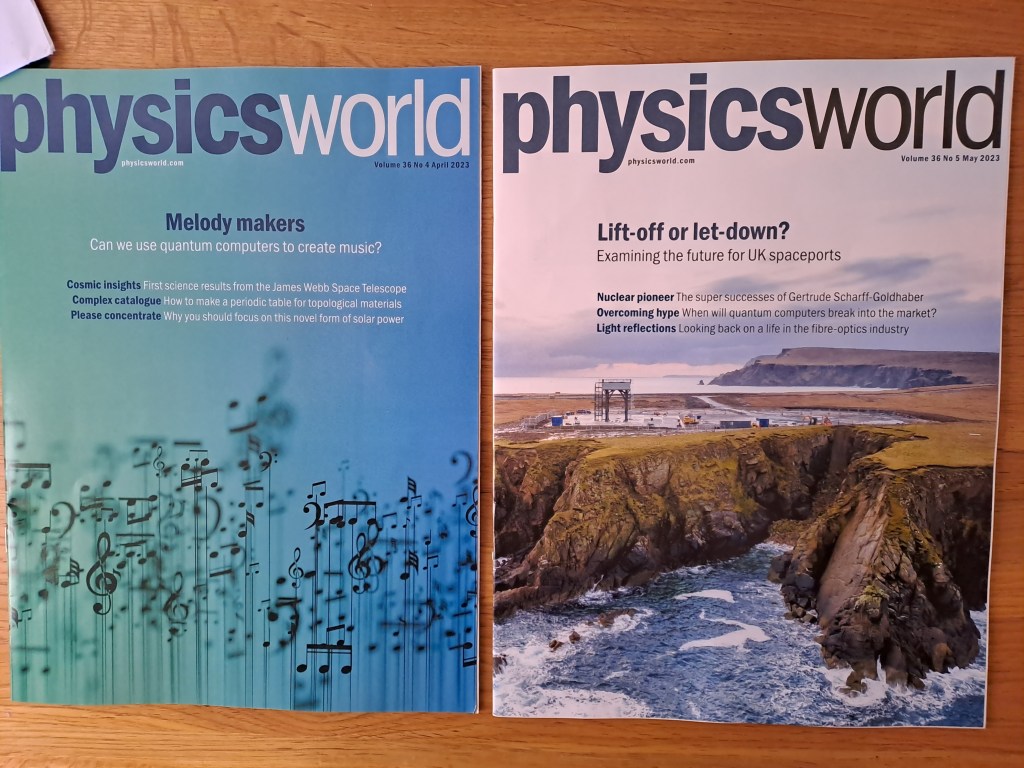
The Physics World Mystery

Posted in Maynooth, The Universe and Stuff with tags , on May 19, 2023 by telescoper

Now here’s a funny thing. The April and May 2023 editions of Physics World, shown above, published a month apart in the UK, arrived in the same day earlier this week in the post at my house in Maynooth. Both were correctly addressed. One took just over two weeks to cross the Irish Sea; the other took a whole month longer.

Can anyone provide a physical explanation for this phenomenon?

Faking Proceedings

Posted in Open Access with tags , , , , , , on October 2, 2022 by telescoper

Almost every day I get an invitation to a fake conference somewhere, usually somewhere nice (to make the event more attractive). Usually these are caught by my spam filter, but when one isn’t the conference often turns out to be in a field I don’t work in. A small fraction are in cosmology or astrophysics but fortunately those fields are relatively small and it’s quite easy to identify whether or not they are bona fide. I’ve often wondered what happens if you turn up at one of these fake meetings, but not enough to waste money on trying to find out. Perhaps one of my readers knows? One day someone should turn up at one of them with a film crew…

It seems that along with these fake conferences there are fake conference proceedings, not just proceedings of fake conferences but proceedings of conferences that didn’t actually happen.

Publishers make a killing from publishing books of conference proceedings, which generally have a very short shelf-life. I stopped contributing to conference proceedings some time ago as I don’t think they’re worth the effort any more. It’s far better in my view for contributors just to put a copy of their slides on the conference website. I fully accept however that conference proceedings or similar publications may be important in other fields and it does seem that there is still a considerable traffic in them, with some publishers – including Institute of Physics Publishing – setting up special journals to exploit the traffic.

My attention was drawn today to an article in The Times (behind a paywall). The Times piece appears to be based on this one by the excellent Retraction Watch. It seems the IOP publishing system has been comprehensively hacked by (mostly Chinese) publishing mills. As a result the publisher has retracted 494 papers:

The vast majority – 463 articles – are from the Journal of Physics: Conference Series, while 21 are from IOP Conference Series: Materials Science & Engineering, and 10 are from IOP Conference Series: Earth & Environmental Science.

A statement from the IOP explains

These articles are being retracted following an allegation that raised concerns regarding several manuscripts. IOP Publishing has conducted a comprehensive investigation, which indicated that some papers may have been created, manipulated, and/or sold by a commercial entity.

I’m told that to be named as an author of a paper costs anything from about $500 to $US5000, depending on the calibre of the journal and how prominently you want your name to appear. It’s easy to find companies willing to provide such a service, e.g. on Facebook.

Of course this episode raises serious questions about the quality of the peer review applied to these papers, but the more serious issue is how science let itself get into a mindset that fetishizes publications in the first place. The publishing industry must share some of the blame for this. As long as this absurd situation exists there will be unscrupulous people willing and able to exploit it.

Accreditation, Validation and Recognition of Physics Degrees

Posted in Biographical, Maynooth with tags , , , , , on September 19, 2022 by telescoper

Last week I gave a couple of talks to new undergraduate students about courses in Theoretical and Mathematical Physics here at Maynooth. As happens from time to time, a student asked me if our programmes are accredited by the Institute of Physics. The short answer to this is ‘no’.

Before going further into this, I should probably explain what accreditation actually means. An accredited degree is one that counts as a professional qualification that enables the holder to pursue a career in a given discipline, usually as a practitioner of some sort. Obvious examples are medical degrees (which Maynooth does not offer), Engineering, Architecture, Law, Accounting and Psychology (for its clinical aspects). Most degree progammes at Maynooth and elsewhere are not accredited

As the Complete University Guide says:

You shouldn’t be concerned about the quality of a course just because it isn’t accredited  not all degree courses are. Accredited courses are only really necessary if there is a professional qualification in the industry you plan to work in  where they can help you to get ahead in your chosen career.

I’ll add for those who weren’t aware that the Institute of Physics covers the UK and Ireland.

Having a physics degree accredited by the IOP is not a professional requirement as it is in, say, Law or Engineering. Indeed, there is no job or career path in physics that requires a degree with IOP accreditation. If there were then nobody with a physics degree from outside the UK or Ireland would be eligible for it. IOP accreditation is also irrelevant for doing a Masters or PhD. Ask any one of a number of our graduates!

We have discussed IOP accreditation a number of times with the unanimous result that we should steer clear of this process. There are two main reasons why.

The first is that the IOP insists on there being a practical laboratory component of any courses it accredits, so it will not accredit a purely theoretical degree programme. There is, for example, a Theoretical Physics degree programme which is accredited, but students on this programme had to do laboratories in the first year. Here in Maynooth the Department of Experimental Physics has accreditation for programmes, including a Double Major in Experimental Physics and Another Subject. Consequently, if you do Experimental Physics and Mathematical Physics that combination is accredited. But if you do Mathematical Physics on its own or with another subject that will not be an accredited programme. So the first reason is that if we applied for IOP accreditation (which we have never done and have no intention of doing), we would not get it unless we required students to take Experimental Physics too, which would reduce the choice available to students.

As an aside I should mention that there is an alternative degree status offered by the IOP, namely recognised rather than accredited. A list of current recognised courses is here (PDF). This includes interdisciplinary programmes involving mathematics and physics. We could apply for this, I suppose, were it not for the second point.

The second point is that we think it would be a huge waste of effort, especially for a very small department like ours. While the accreditation process does provide some external oversight of course content and quality, one has to weigh up the small benefit against the extremely onerous bureaucratic burden it places on departments as well as imposing restrictions on progression rules and forcing an unjustifiable conformity on courses.

We in the Department of Theoretical Physics at Maynooth University feel these negatives strongly outweigh any positives of accreditation, which we feel are in fact very hard to identify. There is no job or career path in physics that requires a degree with IOP accreditation. If there were then nobody with a physics degree from outside the UK or Ireland would be eligible. IOP accreditation is also irrelevant for doing a Masters or PhD.  I repeat that we have never to my knowledge had any problem with lack of IOP accreditation being a barrier for any of our graduates.

That doesn’t mean there are no quality controls on our programmes. We go through regular institutional quality reviews that undertake a rigorous assessment of our courses, including interviewing students and staff. The panel on our last review included distinguished physicists from institutions outside Ireland and the UK. We obtained very high commendations for our courses through this process as well as some suggestions of things we might consider to improve things still further. I think such processes that validate our programmes are at least as rigorous as IOP accreditation and are significantly less Anglocentric.

As a Fellow of the Institute of Physics who has taught in Physics Departments for over 20 years I have never understood why people think IOP accreditation is at all important. I know many physicists feel otherwise, however, and indeed most physics courses in the UK and Ireland do appear on the list. I would argue that this is largely for fear of appearing to be out of line rather than for any positive reason.

Anyway, feel free to air your own views through the box below!

Making a Statement about Ukraine

Posted in Maynooth, Politics with tags , , , , , , on March 2, 2022 by telescoper

A Ukrainian student here in Maynooth gave out some ribbons for staff and students to show support by making a visible statement of solidarity. I’m proud to be wearing one:

Public statements made by institutions such as universities and research organizations aren’t going to end the war in Ukraine, but they can at least offer solidarity with the victims of war and sometimes even offer practical support.

I was very pleased to see on Friday, dust a day after the Russian invasion of Ukraine, that my own University, Maynooth, issued a statement on the conflict:

Maynooth University condemns the invasion of Ukraine and we extend our deepest sympathy at this dark hour to all our Ukrainian colleagues, students and graduates as they anxiously await word from friends and family fleeing their homes.

Also in our thoughts are members of the MU community from the entire region, whose families, lives and livelihoods are affected by the escalating tension and violence.

Maynooth University stands in solidarity with those who cherish democracy and peace, and we will undertake a process of engagement with colleagues from this region to discuss and explore ways to activate our support.  

It doesn’t say much, but it was at least timely and thoughtful. Far better than remaining silent.

The Royal Irish Academy issued a statement on Monday:

The Royal Irish Academy, as Ireland’s national academy for science, the humanities, and social sciences, is shocked and deeply concerned at the military invasion by Russia of Ukraine. The Academy notes with grave concern the damage this represents to educational and scientific institutions, academics, and international research collaboration, and to the social, economic and cultural foundations of Ukraine. The Academy expresses support and solidarity with the National Academy of Sciences of Ukraine. The Academy also wishes to salute the courageous position taken by many members of the Russian Academy of Sciences, who associated their signature with that of several hundred researchers and scientific journalists from their country in an open letter denouncing the aggression against Ukraine by the Russian Federation and calling for its immediate end.

In my own field, I saw a statement issued by various learned societies and organizations in the field of astronomy. It’s not as strong but at least does offer some practical supports for Ukrainian academics fleeing the war:

The European Astronomical Society (EAS), the International Astronomical Union (IAU), the American Astronomical Society (AAS), and African Astronomical Society (AfAS), the Astronomical Society of Australia (ASA), and the Korean Astronomical Society (KAS) have been observing with great concern the events unfolding in Ukraine and fear the adverse consequences for the scientific community, our colleagues, and their families. We have been receiving reports of the dire circumstances they are experiencing: their freedom, safety and even their lives are under threat.

The mission of our societies is to promote and safeguard the science of astronomy in all its aspects, including research, communication, education and development through international cooperation. We believe in free expression and free exchange of scientific ideas and in peaceful collaboration at a global level. The current events jeopardise the scientific cooperation within our European community and with the rest of the world.

We are deeply concerned for the Ukrainian community as well as for the entire region. Triggered by the life-threatening situation in which our Ukrainian colleagues find themselves, we wish to encourage members to help wherever possible in this difficult time for Ukraine. Ukrainian astronomers seeking support should contact the Institute of International Education (IIE) scholar rescue fund, which supports refugee scholars and is activating an Ukraine-specific student emergency fund.

Notice that the Royal Astronomical Society is absent from the list of signatories. Indeed it has not made any public statement whatsoever about the invasion of Ukraine. Their silence is deafening. From where I sit, as a Fellow, their policy of ignoring the conflict just looks spineless and contemptible.

UPDATE: The Royal Astronomical Society has now posted a statement (dated 2nd March):

The Royal Astronomical Society deeply regrets the illegal military invasion of Ukraine, a sovereign democratic nation, by Russia. Our thoughts and hopes go out to our fellow scientists and all the citizens of Ukraine for their safety and well-being. We will be exploring avenues for supporting our fellow scientists who are fleeing the war zone with government agencies and our sister societies.

There are a number of non-governmental organisations working to provide humanitarian relief in Ukraine itself and in neighbouring countries, including the following, who welcome donations:

British Red Cross

United Help Ukraine

Sunflower of Peace

Voices of Children

As far I know the Institute of Physics has so far refused to address the Ukraine crisis.

The Institute of Physics has also now issued a (brief) statement (dated 3rd March):

The Institute of Physics condemns Russia’s actions against Ukraine which are a violation of one of the most fundamental norms of international law that prohibits the use or threat of force by one state against another. As a member of the European Physical Society we support the statement of the Executive Committee.

Physics is a global endeavour, and we continue to support academic freedom of scientists everywhere.

We hope for a quick resolution of the crisis to bring an end to its devastating impacts on the people of Ukraine.

My regard for both these organizations has fallen considerably in the last week, to the point that I now seriously doubt whether I wish to remain a Fellow of either. If there are good reason why I should change my mind, or if either organization has made public statements that I’ve missed, I’d love to hear them, either through the comments box or privately.

P.S. The Royal Society of London is also yet to make a statement on Ukraine. I find this regrettable. Obviously, though, I am not a Fellow of that organization so am not able to resign.

UPDATE: The Royal Society has now joined with the National Academies of all the G7 Nations in making a strong statement against the Russian invasion of Ukraine:

I don’t know why it took a full week to get there, but I am pleased at last that the RAS, IOP and Royal Society have now at least said something. Every little helps.

Learned Societies, Equity, and Open Access

Posted in Open Access with tags , , , , , on November 8, 2021 by telescoper

I’m not getting much time these days to think about new ideas for blog posts so yet again I’m going to rehash an old one, but at least it is somewhat topical because of an interesting blog post I saw recently about the American Sociological Association. Referring to the inequity of the way this particular society is funded the author says

The greatest source of income for the association is publications, which is mostly subscriptions to journals paid by academic libraries, which are being bled dry by profit-making publishers that ASA organizes academic labor to subsidize with free content and editorial services. This is a wealth transfer from poorer, teaching-intensive libraries to richer, research-intensive libraries.

I tthink it’s relevant to raise some points about the extent that such organizations (including, in my field,  the Royal Astronomical Society and the Institute of Physics) rely for their financial security upon the revenues generated by publishing traditional journals and why this is not in the best interests of their disciplines.

Take IOP Publishing, for example. This is a wholly-owned subsidiary of the Institute of Physics that has an annual turnover of around £60M generated from books and journals. This revenue is the largest contribution to the income that the IoP needs to run its numerous activities relating to the promotion of physics.  A similar situation pertains to the Royal Astronomical Society, although on a smaller scale, as it relies for much of its income from Monthly Notices of the Royal Astronomical Society, in which as a matter of fact I have published quite a few papers.

Not surprisingly, these and other learned societies are keen to protect their main source of cash. When I criticized the exploitative behaviour of IoP Publishing some time ago in a recent blog post, I drew a stern response from the Chief Executive of the Institute of Physics, Paul Hardaker. That comment seems to admit that the high prices charged by IOP Publishing for access to  its journals is nothing to do with the real cost of disseminating scientific knowledge but is instead a means of generating income to allow the IoP to pursue its noble aim of  “promoting Physics”.

This is the case for other learned societies too, and it explains why such organizations have lobbied very hard for the “Gold” Open Access some authorities are attempting to foist on the research community, rather than the far more sensible and sustainable approaches to Open Access employed, for example, by the Open Journal of Astrophysics.

Some time ago I came across another blog post, pointing out that other learned societies around the world are also opposing anything other than the most expensive forms of Open Access:

There is also great incentive for the people who manage and run these organisations to defend their cartel. For example, the American Chemical Society, a huge opponent to open access, pays many of its employees, as reported in their 990 tax return, over six figures. These salaries ranged from $304,528 to $1,084,417 in 2010.

The problem with the learned societies behaving this way is twofold.

First, I consider it to be inevitable that the traditional journal industry will very soon be completely bypassed in favour of  other forms of Open Access publishing. The internet has changed the entire landscape of scientific publication. It’s now so cheap and so easy to disseminate knowledge that traditional journals are already virtually redundant, especially in my field of astrophysics where we have been using the arXiv for so long that many of us hardly ever look at journals.

The comfortable income stream that has been used by the IoP to “promote Physics”, as well as to furnish its brand new building in King’s Cross, will dry up unless these organizations find a way of defending it. The “Gold” OA favoured by such organizations their attempt to stem the tide. I think this move into Gold `Open Access’, paid for by ruinously expensive Article Processing Charges paid by authors (or their organizations) is unsustainable because the research community will see through it and refuse to pay.

The other problematic aspect of the approach of these learned societies is that I think it is fundamentally dishonest. University and other institutional libraries are provided with funds to provide access to published research, not to provide a backdoor subsidy for a range of extraneous activities that have nothing to do with that purpose. The learned societies do many good things – and some are indeed outstandingly good – but that does not give them the right to siphon off funds from their constituents in this way.  Institutional affiliation, paid for by fee, would be a much fairer way of funding these activities.

I should point out that, as a FRAS and a FInstP, I pay annual subscriptions to both the RAS and the IoP. I am happy to do so, as I feel reasonably comfortable spending some of my own money supporting astronomy and physics. What I don’t agree with is my department having to fork out huge amounts of money from an ever-dwindling budget for access to scientific research that should be in the public domain because it has already been funded by the taxpayer.

Some time ago I had occasion to visit the London offices of a well-known charitable organization which shall remain nameless. The property they occupied was glitzy, palatial, and obviously very expensive. I couldn’t help wondering how they could square the opulence of their headquarters with the quoted desire to spend as much as possible on their good works. Being old and cynical, I came to the conclusion that, although charities might start out with the noblest intentions, there is a grave danger that they simply become self-serving, viewing their own existence in itself as more important than what they do for others.

The commercial academic publishing industry has definitely gone that way. It arose because of the need to review, edit, collate, publish and disseminate the fruits of academic labour. Then the ease with which profits could be made led it astray. It now fulfills little or no useful purpose, but simply consumes financial resources that could be put to much better effect actually doing science. Fortunately, I think the scientific community knows this and the parasite will die a natural death.

The question for learned societies is whether they can find a sustainable funding model that isn’t reliant upon effectively purloining funds from university library budgets. If their revenue from publishing does fall, can they replace it? And, if not, in what form can they survive?