Archive for ireland

The Days of the Double Bind

Posted in Biographical, Literature, Politics with tags , , , , , , , on December 5, 2017 by telescoper

The last few days I’ve been trying to deal with the sort of apparently insoluble problem usually called a double bind, similar to the logical paradox which provided the central plot device of Joseph Heller’s classic novel Catch-22. I’ve seen this particular double bind happen to so many colleagues from abroad wanting to work in the United Kingdom that in a sense it’s quite reassuring that the same thing happens in much the same way in other countries too, specifically Ireland.

The problem facing me is that I need to find somewhere to rent temporarily in Maynooth until I can find longer-term accommodation (i.e. by buying a house). As convenient as St Patrick’s College is as a short-term residence, it’s not somewhere I would want to live for weeks and months. The trouble is that in order to secure private rented accommodation you need to prove that you are able to pay the rent, which generally means having a bank account. On the other hand, in order to open a bank account you need to have proof of an address. No address, no bank account and no bank account, no address.

This is not exactly the same as Heller’s Catch-22 (which is basically that an airman can’t be discharged from military service on grounds of being insane because his wanting to be discharged from military service means that he can’t actually be insane), but it belongs to the same broad class of logical quandaries where there appears to be no solution.

Although it’s quite intimidating to be put in a seemingly impossible position, Robert M. Persig’s Zen and the Art of Motorcycle Maintenance offers a way out: you just need to `unask the question’, and proceed in a way that denies the (binary) premises on which the conundrum is based. Engaging in a bit of lateral thinking, calling on the assistance of influential bodies, and employing a bit of gentle persuasion you often find that what look initially like hard rules turn out to have a surprising degree of flexibility.  Anyway, to cut a long story short, and with fingers crossed, I should have my bank account and place of residence both sorted out before I return to Cardiff on Thursday.

For me of course this isn’t anything like a life-or-death situation. I have been around long enough not to let bureaucracy get to me. Things like this seem very serious at the time, but there’s always a way to resolve the, usually because there are still some reasonable people in the world. And I am lucky. I can cope with the uncertainty and frustration of being in a double bind as I have resources to fall back on if there are problems. It would no doubt have been more difficult had I just arrived in the country as a recent graduate with no savings. I’ve seen many others at all kinds of stages in their career go through a similar impasse and, though it’s troublesome, such things invariably sort themselves out in time. Still, it’s nice to get such things settled sooner rather than later.

Thinking about this as I listened to the radio this morning, I was struck by another, much larger, more important, and slightly more complex, paradox. That is the inability of the UK government to find a solution to the Irish border problem in the Brexit negotiations. In essence, the nature of this pickle is that the EU insists (as it always said it would) that there should be no hard border between Northern Ireland and the Republic of Ireland. That is possible if the UK leaves the EU but seems to require that Northern Ireland  remains in  the Single Market and Customs Union in some form. However, the PM has insisted that the United Kingdom must leave the Single Market and Customs Union. Moreover, the Democratic Unionist Party, which is propping up the Conservative government, insists (as it always said it would) that Northern Ireland should not be treated differently from the rest of the UK. If cast in these terms, there seems to be no solution to the problem.

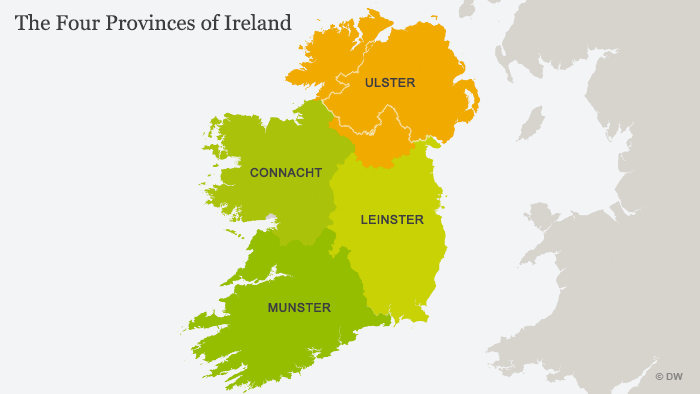
Incidentally, and I now digress, here is a map showing the Four Provinces of Ireland, together with the current border:

These are historical divisions and nowadays have no political or administrative role, but I think the map is interesting because it shows, if you didn’t know it before, that: (a) the current Irish border does not coincide with the boundary of Ulster; and (b) the most northerly point of the island of Ireland (Malin Head  on the Inishowen Peninsula, in County Donegal)  is in the Irish Republic, not in Northern Ireland. Maynooth, incidentally, is in Leinster.

Anyway, I think the current stalemate over the Irish Border is the inevitable outcome of one of Theresa May’s `red lines’ which seem to me to make a negotiated settlement impossible a priori. The only option for the Prime Minister seems to me to be to frame the problem another way. One way of making progress would be to abandon the red line on SM and CU membership. I don’t think that will happen as it would look too much like an admission of failure. Another way to do it would be to use gentle persuasion to get the DUP to shift its position. That is more likely, but will prove costly in both political and financial terms.  The best way to unask this particular question is, of course, to abandon the Brexit project altogether. I’m not going to quote odds, but the possibility of the United Kingdom remaining in the European Union is increasing by the day. That won’t affect me directly very much, as I’ll be remaining in the EU come what may.

Switching Allegiances

Posted in Biographical, Education, Football, Rugby with tags , , , , , on February 3, 2013 by telescoper

So here I am, then, in the office on a Sunday afternoon,which I suspect is going to be a pretty regular occurrence for the foreseeable future. I mainly came in to sort out papers for tomorrow’s Senior Management Group meeting, which will be the first such meeting I’ll be attending in my new capacity. I have managed to prepare for it in fine style by losing my diary, which isn’t a very good start to my career as any kind of manager.

Yesterday was taken up with flat-hunting which, if all turns out well this time, was successful. I also had time to watch a bit of the opening match of the Six Nations Rugby between Wales and Ireland. For the last five years or so I’ve always been in Cardiff for Wales’ first home game of the competition, although I’ve never actually managed to get a ticket for the match. It felt a bit strange not being there anyway. It has to be said that Wales were pretty chronic in the first half, going into the break at 30-3 down, but they recovered in the second half and it was quite an absorbing match all considered. Ireland’s excellent defence held off a spirited Welsh comeback and Ireland won 30-22.

Although I’ve lived in Wales for a while, and have enjoyed the match-day atmosphere in Cardiff, I’ve never switched allegiance from England as far as rugby is concerned. Later on yesterday England beat Scotland in their opening match of the Six Nations, showing quite a bit of flair in doing so but also making quite a lot of mistakes. The 38-18 scoreline flattered England, I felt, and they’ll have to up their game a lot if they’re going to match Wales’ Grand Slam last season.

Football is another matter in which allegiances are difficult to change. Many’s the time I’ve thought of giving up being a Newcastle United supporter but I’ve never managed it. I disapprove of people who think they have an option concerning which team to support, actually. I was born in Newcastle therefore I support Newcastle United. That’s the end of it. We all have our cross to bear. Anyway, yesterday brought an unexpected ray of sunshine into a gloomy season for the Toon with a 3-2 victory over Chelsea. Following a first away win of the season against Aston Villa last week it may even be possible that they’ll avoid relegation. Perhaps.

Switching allegiances between universities is almost as difficult. In today’s academic world we’re supposed to think of higher education as a marketplace in which different institutions compete for funding for both teaching and research. I’ve never felt comfortable with the idea that opening up higher education to “market forces” is in anyone’s interests. Certainly on the research side, there are so many collaborations between groups in different universities that cooperation is more the rule than competition although, as with any rule, there are exceptions. Friendly rivalry is as good a thing in higher education as it is in football, but anything more serious than that can only be justified in the case of Sunderland.