Just stumbled across this excellent documentary about the great Sidney Bechet and couldn’t resist posting it alongside the poem by Philip Larkin that follows it, which is called For Sidney Bechet. Watching great jazz musicians play, including the rare clips of Bechet shown in the video, the thought always comes into my mind that if you took the instrument away from them, it would just carry on playing by itself…
That note you hold, narrowing and rising, shakes Like New Orleans reflected on the water, And in all ears appropriate falsehood wakes,
Building for some a legendary Quarter Of balconies, flower-baskets and quadrilles, Everyone making love and going shares
Oh, play that thing! Mute glorious Storyvilles Others may license, grouping around their chairs Sporting-house girls like circus tigers (priced
Far above rubies) to pretend their fads, While scholars manqués nod around unnoticed Wrapped up in personnels like old plaids.
On me your voice falls as they say love should, Like an enormous yes. My Crescent City Is where your speech alone is understood,
And greeted as the natural noise of good, Scattering long-haired grief and scored pity.
Not much time to post today: I’ve got a full morning’s work finishing the drafts of two papers before flying home this afternoon….so here’s an appropriate piece of music from the late great Lionel Hampton.
Well, it’s 1pm and my third-year students are just sitting down for two hours of fun with their Nuclear and Particle Physics examination. For my part I’m obliged to sit by the phone for the next two hours in case there’s a problem with the examination paper. Ideal excuse for a quick blog post while I eat my sandwich.
I also notice from my trusty wordpress dashboard that this is my 1000th post since I started blogging, way back in late 2008. Time to indulge myself, then. I haven’t posted much jazz recently so I thought I’d share this classic recording with you. It’s from my favourite era of jazz – the late 1950s – and my favourite kind of jazz, bebop, which by then had matured, ripened and hardened considerably since its birth in the 1940s.
This gives me the excuse to mention a nice article in Saturday’s Grauniad about the poet Philip Larkin, his love for “trad” and his hatred for the “modern” jazz exemplified by bebop. It’s entirely a matter of personal taste, of course, but speaking for myself I can say that I’ve never had any problem loving jazz of all ages. For me, though, it reached a peak in the late 50s with musicians of the calibre of Miles Davis, John Coltrane, and Ornette Coleman.
This particular track features alto-saxophonist Lou Donaldson whom many jazz critics regarded as a pale imitation of the pioneering be-bop icon Charlie Parker but whose playing I’ve always admired. In my book, anyone brave enough to follow Charlie Parker deserves the highest esteem. In any case when Lou Donaldson walked into the Van Gelder studio in Hackensack, New Jersey on July 28th 2008 he clearly had fire in his belly.
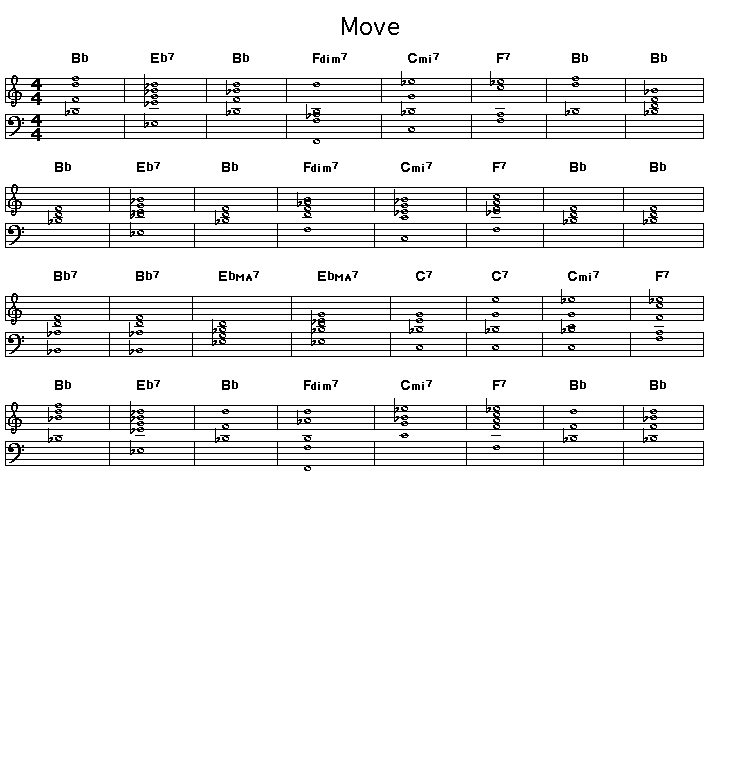
The tune is entitled Move and it was written by drummer Denzil Best. It’s quite unusual for a drummer also to be a composer, but Best wrote a number of classic jazz tunes. I even managed to find the chords that make up this one’s 32 bar AABA structure…
Many bebop compositions are based on the chord progressions of standard tunes, such as How High the Moon or I Got Rhythm, but with the melody replaced by something much more intricate than the original tune. I don’t recognize the chords above from anywhere else so it may be an entirely original composition by Denzil Best. I’m sure there’s a jazz buff out there who will correct me if I’m wrong. In any case the jagged melody is archetypal bebop stuff – complex and angular, very difficult to play but intensely exciting to listen to.
I came across this just now and it completely blew me away so I thought I’d share it here. It’s a solo version of the John Coltrane tune Mr PC by the amazing (British-born) bassist Dave Holland. Words totally unnecessary. Wow will do.
At the end of a very busy week (during which I haven’t had much time to post), I decided to relax a bit this morning by listening to some old favourite Jazz CDs. When I got to this one, Portrait in Jazz, by the Bill Evans Trio I couldn’t understand why I hadn’t played it for so long. Surely I can’t have forgotten such a masterpiece? Anyway, I decided to write a post about this wonderful album. If it helps just one person discover this timeless music then it will have been worth it.
Bill Evans was one of the greatest, if not the greatest, Jazz pianists of all time. Among other things he practically created the modern piano trio, converting it from what it had been before – a pianist with bass and drum backing – to an equal partnership of these three very diverse instruments. To make the format work required partners of equal brilliance and compatibility and it was a while before Bill Evans found the right musicians to join him. Eventually he formed his first regular trio with the superb Scott La Faro on bass and Paul Motian on drums.
Innovations based on collective endeavour rarely succeed immediately, however. It took Evans and La Faro a long time, and two or three albums, before the latter was able to work out how his bass lines might comment on and blend with the piano improvisations instead of merely underpinning them. As their relationship changed and matured, Evans’ contributions actually became a bit more fragmented, so as to leave room for the bass to burst through, and increasingly their performances became like dialogues for piano and bass. Not that we should ignore the contribution of the drummer Paul Motian either; he does far more than just keep time in the way old-fashioned drummers when playing in a trio format.
But on Portrait in Jazz, their first album together, the accent was still predominantly on Evans the soloist and because his playing here is so entrancing one has to acknowledge that the eventual change of emphasis, however justified from an artistic point of view, was in some ways a mixed blessing.
What characterises this album is Evans’ lyricism and lightness of touch. He doesn’t try to overwhelm with virtuosic flourishes. Each phrase and indeed each note is finely shaded. Confidence in his timing enables him to make subtle use of the space between phrases and bring off the most dazzling rhythmic displacements, almost casually.
I’ve picked one track to give as an example. It wasn’t an easy choice but I think this – the standard Autumn Leaves – is the best track on the album. After the opening statement there’s a fine example of the interplay between the three members of the trio that was to become more prominent on later albums, but eventually (about two minutes) they kick into tempo and Evans launches into a stunningly beautiful solo improvisation in which every note sings with a sustained emotional intensity few, if any, pianists have ever achieved in any idiom. As Miles Davis once said of Bill Evans “He plays the piano the way it should be played.” Amen.
So a long and difficult week ends, with quite a few beers in the Poet’s Corner and me about to collapse into bed. I think this is a good time to wheel out something you hopefully find quite amusing, i.e. a Harlem Stride piano version, by Don Lambert, of the Pilgrims’ Chorus from the Opera Tannhauser by Richard Wagner. I think I can safely say that if Wagner was alive today he’d be turning in his grave to hear such a frontal assault on his music, but I think it’s a blast…
Pianist Jaki Byard was one of the most consistently original musicians of his jazz generation, but he was also consistently underrated. His eclectic style embraced the avant garde free jazz of the 60s and 70s as well as traditional gospel and folk music. Whatever he played, though, it definitely sounded exactly like Jaki Byard. Anyway, in 1968 he teamed up with the extraordinarily talented multi-instrumentalist Roland Kirk to record a typically varied selection of music, including this one which has been a favourite of mine since I first heard it on the radio about 30 years ago. It’s one of the most played tracks on my iPod, and it never fails to bring a smile to my face even when I’m stuck on stationary train feeling miserable.
Shine on me is attributed to that most prolific of all composers, Trad. It’s a theme that turns up in a few very early jazz recordings, but I think it began life as a gospel song way back in the mists of time. In this version, though, it’s given a foot-tapping beat which is just so very nineteen-sixties. Roland Kirk’s decision to start the piece on clarinet was truly inspired, and you can tell that all four musicians had a blast playing this. I suppose it’s a sort of parody, but it’s an affectionate one.
Finally, let me mention the drummer Alan Dawson, whose playing is based around a sort of half-funk half-boogie, but with all kinds of polyrythmic stuff on on top; he drives this along like the clappers and makes it such a joy to listen to.
As regular readers of this blog (both of them) will know, I listen to quite a lot of jazz. In the course of doing that it has often struck me that there can hardly be a tune that’s ever been written – however unpromising – that some jazz musician somewhere hasn’t taken a fancy to and done their own version. Louis Armstrong turned any amount of base metal into gold during his long career, but here’s an example from a more modern legend, Sonny Rollins, who is still going strong at the age of 80. It’s a tune called How are thing in Glocca Morra? and it was written for the 1947 musical Finian’s Rainbow (which I hate). This version, though, recorded in the mid 50s by a band led by Sonny Rollins on tenor sax, is absolutely gorgeous. It doesn’t take much to inspire a genius…
It’s cold and rainy outside so I thought I’d indulge myself by posting a bit of music. When I was in Oxford last week I was treated to a glass or two of wine after my seminar and during the conversation I was mildy castigated by Pedro Ferreira for not posting enough “modern jazz”, and especially not enough Ornette Coleman. I explained that I always feel like I’m cheating when I just put up a bit of music without actually writing something about it at the same time, and I especially feel that way about pieces that some people might find a bit challenging.
Anyway, I went through my collection just now and found the pioneering album Change of the Century which is well represented on Youtube (and not cursed by the copyright mafia), so here we go…
Coleman’s music must have sounded strange and dissonant for listeners in the late 1950s but it was soon assimilated and became part of the language of jazz from the 1960s onwards. This album dates from 1959, right at the start of his acceptance as a major artist. This album is actually also one of his most listenable LPs and contains a number of tunes which are catchy and even singable. There are obvious overtones of Charlie Parker throughout, but Ornette is already introducing some novel features, especially the use of suspended rhythmic figures which Miles Davis was to call the “stopping and swinging” approach to improvisation.
The album also features Don Cherry on trumpet, Billy Higgins on drums and the superb Charlie Haden on bass so it’s by no means a solo vehicle for Ornette Coleman’s alto saxophone. Indeed, some of the most exciting moments in the album belong to the intricate alto-trumpet unison passages, which are so complicated but played with unbelievable accuracy by the musicians. The following track, simply called Free, provides good examples.
Ornette Coleman’s playing, though, is truly remarkable: agile, constantly moving and full of nervous energy, but also bursting away from the constraints of the bar lines and sometimes taking ideas over the boundary between one chorus and the next. In this respect he was fortunate to have Haden and Higgins playing behind him because they seem to be able to sense the direction of these spontaneous departures, giving the music a close-knit unity which sets it apart from so many other groups recorded at the same time.
If you’re interested in modern jazz you really should get this album. It’s consistently brilliant. As a taster, here’s the track called Free, which is my favourite.
Don Cherry and Billy Higgins are sadly no longer with us, but Ornette Coleman is still going strong. I hope to post some reflections on his later work in due course.
By way of a little Thanksgiving gift to my friends and colleagues over in the US of Stateside, and also to warm the cockles of everyone shuddering here in the cold snap that’s fallen over Blighty, here’s a rare taste of hot jazz from a very young Benny Goodman.
This track was recorded in 1928, long before the start of the Swing Era of which Benny Goodman’s Orchestra was in the vanguard, leading Mr BG to be called “The King of Swing”. His clarinet sound is a bit rougher around the edges than he achieved in the slick performances of his later years, but then he was only 19 at the time and he certainly plays with a huge amount of drive.
This was recorded with a trio of himself on clarinet, a piano (Mel Stitzel) and a drummer (Bob Conselman). After he formed his big band in the thirties he continued to make records with a band of the same format, but featuring Teddy Wilson on piano and Gene Krupa on drums. I never quite worked out why he preferred not to have a bass player in the small group recordings (although he often included Lionel Hampton on vibes), but this older track at least demonstrates that he was consistent in that respect!
And another thing. I’m not an expert, but to my ears there’s more than a hint of the sound of Klezmer music in this recording. Waddayathink?
The views presented here are personal and not necessarily those of my employer (or anyone else for that matter).
Feel free to comment on any of the posts on this blog but comments may be moderated; anonymous comments and any considered by me to be vexatious and/or abusive and/or defamatory will not be accepted. I do not necessarily endorse, support, sanction, encourage, verify or agree with the opinions or statements of any information or other content in the comments on this site and do not in any way guarantee their accuracy or reliability.