This evening I happened across a reminder that today is the centenary of the birth of saxophonist and composer Paul Desmond, who was born on November 25th 1924. Paul Desmond is best known for his work with Dave Brubeck’s quartet from 1951 to 1967, and particularly as composer of their smash hit Take Five. He didn’t only work with Brubeck, though. He made fine recordings with Chet Baker and Gerry Mulligan amongst others. His gentle tone and lyrical phrasing on alto saxophone were instantly recognizeable and very typical of the West Coast style of cool jazz, and on alto saxophone was instantly recognizeable. Never a speed merchant in the Charlie Parker tradition, Desmond fell out with Brubeck’s drummer Joe Morello who would often set the tempo, especially on Take Five, too fast in live performances, so I thought I’d pay my little tribute by playing a less familiar number, the Japanese-influenced Koto Song on which Paul Desmond plays very beautifully.
Archive for Jazz
100 Years of Paul Desmond
Posted in Jazz with tags alto saxophone, Dave Brubeck, Jazz, Koto Song, music, Paul Desmond on November 25, 2024 by telescoperA Century of See See Rider
Posted in Jazz with tags Blues, Fletcher Henderson, Gertrude "Ma" Rainey, Jazz, Louis Armstrong, Ma Rainey, music, See See Rider on October 16, 2024 by telescoperBack in 2023 I posted an item marking the first appearance of Louis Armstrong on record with King Oliver’s Creole Jazz Band back in 1923. Now it’s time to mark another jazz centenary which also involves Satchmo but in a different setting. King Oliver’s band split up at the end of 1923 over a disagreement about a planned nationwide tour and in 1924 Louis Armstrong moved to New York. He was soon snapped up by Fletcher Henderson and spent a glorious year as star trumpet soloist with Henderson’s big band. During that time he also made records with various small bands, including a number with the great vocalist and “Mother of the Blues” Gertrude “Ma” Rainey.
One of the tracks recorded by Ma Rainey in the Paramount studio in New York was called See See Rider. Although not released until 1925, the very first recording of this number was made exactly one hundred years ago today, on 16th October 1924, by “Ma Rainey and her Georgia Jazz Band”, the supporting musicians being Charlie Dixon (Banjo), Buster Bailey (Clarinet), Charlie Green (Trombone), Fletcher Henderson (Piano) and Louis Armstrong (Cornet). The origins of this blues song are lost in the mists of time but it has been recorded a huge number of times, not only by jazz and blues musicians but also by the likes of Elvis Presley; I posted a great version by Peggy Lee here.
Unusually for the time, two takes were made of which the following was the first. Notice that there is an introduction in the form of a verse, which is quite unusual: most blues performances involve only a chorus. Despite the limitations of recording technology at the time you can hear what a tremendously soulful voice Ma Rainey had, and the muted cornet work by Louis Armstrong is unmistakable.
The sound quality may not be great, but it’s a priceless piece of music history.
Quasar – The Jimmy Giuffre 4
Posted in Jazz with tags Four Brothers, Jazz, Jimmy Giuffre, quasar, The Train and the River on August 19, 2024 by telescoperJimmy Giuffre (1921-2008) was an immensely gifted saxophonist and clarinet player who was also an accomplished arranger and composer who worked for many big bands. His most famous piece as an arranger was Four Brothers which he wrote for Woody Herman’s fantastic saxophone section of Stan Getz, Zoot Sims, Serge Chaloff and Herb Steward. My first encounter with Giuffre as an instrumentalist was in the opening track of the 1958 film Jazz on a Summer’s Day playing a tune called The Train and the River which has been a favourite of mine for many years. Back then he had a quite accessible style that blended jazz with folk elements, but he later developed a freer and more “modern” approach, including the use of electronic instruments and elements of jazz/rock fusion. I recently read a biographical article about him and – for obvious reasons – was intrigued that in 1985 he made an album called Quasar so I thought I’d share the title track here. Giuffre is on soprano sax on this one.
All Things You Are – Joe Pass
Posted in Jazz with tags All the things you are, Brecon Jazz Festival 1991, Jazz, Joe Pass on June 23, 2024 by telescoperAll The Things You Might Be
Posted in Jazz with tags All the things you are, chords, Jazz, Jerome Kern on April 29, 2024 by telescoperApparently the great American songwriter Jerome Kern didn’t like Jazz at all. It’s ironic therefore that his tune All The Things You Are is such a favourite among Jazz musicians, sometimes played as it is and sometimes forming the underlying chord progression for some other tune. Here it is, sung by the sublime Ella Fitzgerald:
The first things you learn if you try to teach yourself something about how jazz works is that there are two basic forms: the Twelve-bar Blues and the Thirty-two-bar form built from an A section and a B section (the bridge) arranged AABA. It’s true that this gets you quite a long way but it doesn’t take you long to realize that many famous Blues are not based on 8 or 16 -bar cycle and many of those that are 12-bar blues don’t have the standard progression. Then you find out that some of the most well-known Jazz standards aren’t AABA either.
All The Things You Are is an example. The chorus of this tune actually consists of 36 bars in a A1A2BA3 form with two twists on the usual 32-bar AABA song-form: A2 transposes the initial A section down a fourth, while the final A3 section adds an extra four bars. The result is much easier to lose your way when you try to improvise but, on the other hand, provides a very rich framework within which to experiment. That’s obviously why Jazz musicians like it so much.
Here is a backing track for this tune that shows you the chords without the melody. Although I’m a fairly incompetent musician I love trying to play along to this sort of thing, playing the melody for one chorus to find your feet and then just letting the chords suggest possibilities. It’s tremendous fun and very rewarding if you do manage to play something original, even if it makes Jerome Kern turn in his grave.
Mad about the Boy – Blossom Dearie
Posted in Jazz with tags Blossom Dearie, Jazz, Mad About the Boy, music, Noel Coward, Piano, Ronnie Scott's Club on April 17, 2024 by telescoperThe song Mad about the Boy was written by Noel Coward and published in 1932. It’s a song about an infatuation with a movie star and has generally been performed by female singers, although it was apparently inspired by Coward’s own crush on Douglas Fairbanks Jnr (which wasn’t reciprocated). The song became popular again in 1992 when a version recorded by Dinah Washington was used in a famous Levi commercial. . I never liked Noel Coward’s own recording – with him singing in a curious falsetto – very much at all, although I suppose it is authentic to what Coward was writing about. For a long time my favourite version was Dinah Washington’s but recently I came across this version, which has now, for me, eclipsed that one.
Blossom Dearie was a very underrated singer and pianist. Her voice – very high and girlish – was well suited to the whimsical songs she seemed to like to sing, but it meant that she wasn’t taken as seriously as a singer as she might have been. The lack of appreciation of her singing also extended to her piano playing, which was consistently excellent and innovative. No less a pianist than the great Bill Evans was a huge admirer of her musicianship, and he even attributed his use of stacked fourths in the left hand as inspired by Blossom Dearie. Other reasons to like this recording are that it was made live at Ronnie Scott’s Club in London and she goes straight into a verse that’s missed in many versions, probably because it uses the word “gay”. I love the way the accompaniment changes the mood each time she repeats the verses.
R.I.P. Ahmad Jamal (1930-2023)
Posted in Jazz, R.I.P. with tags Ahmad Jamal, Jazz, Live at the Pershing: But Not For Me, Poinciana on April 17, 2023 by telescoperWith the passing, on Sunday, of Ahmad Jamal, at the age of 92, another legendary Jazz musician has left us. He was a consistently inventive pianist, of great elegance, and a wonderful knack of deconstructing a tune into its component parts before reassembling it into something fresh. His formative years were a time when many keyboard players emphasized virtuosic brilliance, but Jamal’s approach was relaxed and spare. He was great letting his story develop gradually but very enjoyably through a series of riffs over a compelling rhythmic foundation. A perfect example is this track, Poinciana, from a hugely popular album Live at the Pershing: But Not For Me, recorded in 1958 with Israel Crosby on bass and Vernel Fournier on drums. Ahmad Jamal is no longer with us, but this groove will last forever!
R.I.P. Ahmad Jamal (born Frederick Russell Jones, 1930-2023).
A Jazz Centenary
Posted in History, Jazz with tags 1923, Gennett Studios, Jazz, King Oliver, King Oliver's Creole Jazz Band, Louis Armstrong on April 5, 2023 by telescoper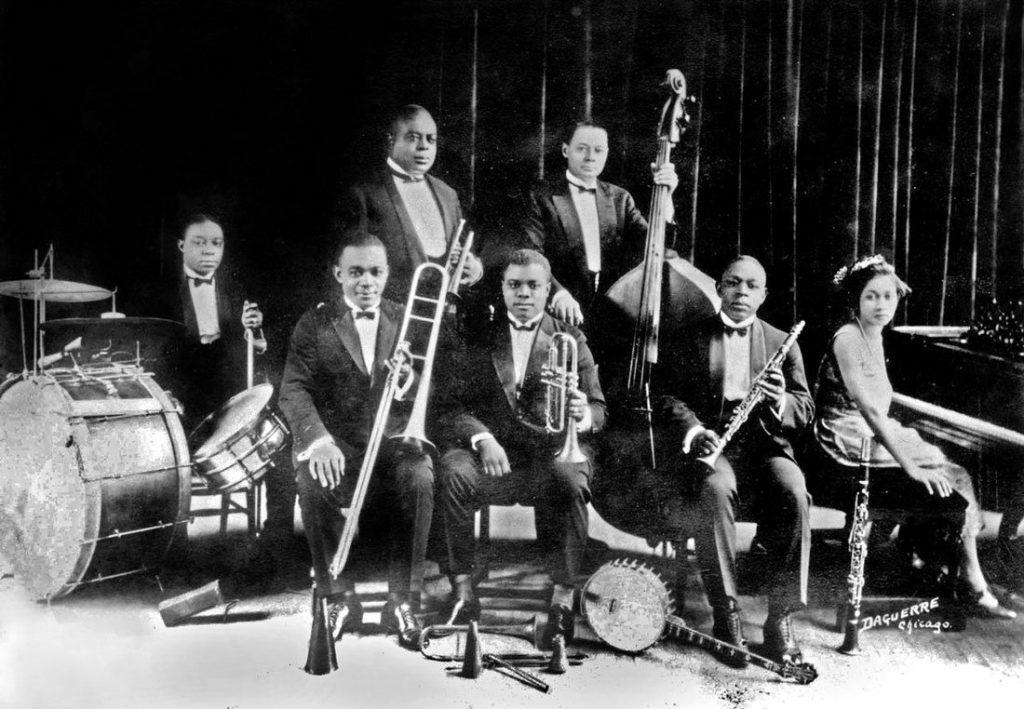
I’ve been looking forward to this day because it marks an important jazz centenary. Or at least I think it does. There’s some contradictory evidence about whether it was April 5th 1923 or April 6th, or maybe both, when King Oliver‘s Creole Jazz Band did its first ever recording session at the Gennett studios in Richmond, Virginia. They recorded 20 sides in that session, which may well have involved two days with a break in between or working through the night.
These dates represent a remarkable occasion not only because King Oliver’s band was really the first jazz Supergroup, but also because it had been joined just a few months earlier by a young cornet player by the name of Louis Armstrong. This session therefore represent the first examples of Louis Armstrong ever heard on record.
It is somewhat surprising that this historic session happened at the Gennett studios. The band was based on Chicago, Illinois, and the studios were in Richmond, Virginia, so it required a long road trip to get there. Moreover the studio building wasn’t exactly in a prime location, as it was right next to a railroad line:

Musicians had to time their recordings so as to avoid the noise from passing trains. Still, records only lasted about 3 minutes in those days so presumably weren’t so frequent as to make it difficult to fit in a take between two of them! Recording techniques were rather primitive in those days though, and the sound quality that emerged isn’t great.
The lineup for the band is shown in the picture at the top of this page. It’s interesting to note that four of these musicians (Armstrong, Hardin, and the Dodds brothers) were to feature regularly from 1925 onwards in the classic Hot Fives and Hot Sevens. King Oliver’s band, however, had style that was very different from these later records, with a much greater emphasis on polyphony, much more complex arrangements, and much less emphasis on solos. Also, King Oliver’s band played to live audiences on a regular basis, but the Hot Fives and Hot Seven only ever performed as such in recording studios.
As far as I understand how this band worked, King Oliver made the arrangements. I don’t think they used full written scores, but tended to play from wonderfully intricate “head arrangements” worked out beforehand, with ensemble passages, gaps for breaks and solos, and King Oliver introducing the (usually very catchy themes). Armstrong and Johnny Dodds improvised a decorative counterpoint, and Honore Dutrey added harmonic breadth to the ensemble. This must have been a great learning experience for the young Louis Armstrong, has he had to develop a great ear for what was going on around him to play like this. I gather that Louis Armstrong often tended to play very loud so he was kept well in the background in these early Gennett sessions, but such a prodigious talent was never going to play second fiddle for long and in later sessions he effectively duets with King Oliver and swapped leads with him freely and completely intuitively, producing a sound that was entirely unique. I am always astonished by how much is going on in these old records, even if you can’t hear it all very well!
I’ve mentioned before that, over time, this classic type of polyphonic Jazz – derived from its New Orleans roots – gradually morphed into musical form dominated by much simpler arrangements and a succession of virtuoso solos. This change was also reflected in the differing fortunes of Louis Armstrong and King Oliver. The former went on to become an international celebrity, while the latter lost all his savings when his bank went bust during the Wall Street Crash and ended his life working as a janitor.
As well as Gennett, this band recorded with other labels in 1923 including Okeh and Columbia. Sadly however they split up at the end of 1923 over disagreements about a possible tour in 1924. Only about 40 sides were ever recorded King Oliver’s Creole Jazz Band. Many of them are absolutely marvelous.
This is the first track recorded by the band in April 1923. It’s called Just Gone. It’s a scratchy old record, with a rather compressed acoustic, so it’s like putting your next to one end of a tunnel leading back a hundred years, but it’s a good example of the Creole Jazz Band’s style. Joe Oliver’s lead cornet clearly influenced Louis Armstrong’s later style. You have to listen hard to hear Satchmo in the background on this track, but it’s worth the effort. You’re listening to a piece of music history, and a wonderful piece at that.
R.I.P. Wally Fawkes (1924-2023)
Posted in Art, Jazz, R.I.P. with tags Humphrey Lyttelton, Jazz, Trog, Trog's Blues, Wally Fawkes on March 16, 2023 by telescoperI just heard today – via the latest Private Eye – of the passing of Wally Fawkes on 1st March at the age of 98. His name won’t be familiar to many of the readers of this blog, but it is a name that I grew up with in a jazz-loving family. Wally Fawkes played clarinet with Humphrey Lyttelton’s band in its heyday in the late 40s and early 50s and was the last surviving member of that group. That band may have had a rhythm section that always sounded like its members were wearing diving boots, but the front line of Humphrey Lyttelton (trumpet), Wally Fawkes (clarinet) and Keith Christie (trombone) was truly outstanding.
Wally Fawkes wasn’t just a musician, though. He was also the acclaimed cartoonist known by the pseudonym Trog, and contributed a variety of cartoons to a variety of magazines and newspapers, including the long-running comic strip Flook. He was also an occasional contributor to Private Eye. He had to give up drawing in 2005 because of failing eyesight, after 62 years in the business.
I’ve already drawn attention to Wally Fawke’s excellence as a clarinet soloist with the Lyttelton band on The Onions at the famous 1954 Festival Hall Concert so it seems apt to pay tribute to his skills as both a cartoonist and a musician by returning to that concert for him playing his own composition Trog’s Blues. Wally Fawkes was a huge admirer of Sidney Bechet, and this tune clearly pays homage to Bechet’s monumental Blue Horizon (which I think is the finest instrumental blues ever recorded) but while Bechet’s blues performances were hewn from granite, Wally’s were wrought from finest porcelain.
R.I.P. Wally Fawkes (1924-2023)


