Archive for John Regan

Astrophysics & Cosmology Masterclass at Maynooth

Posted in Maynooth, The Universe and Stuff with tags , , , on November 13, 2023 by telescoper

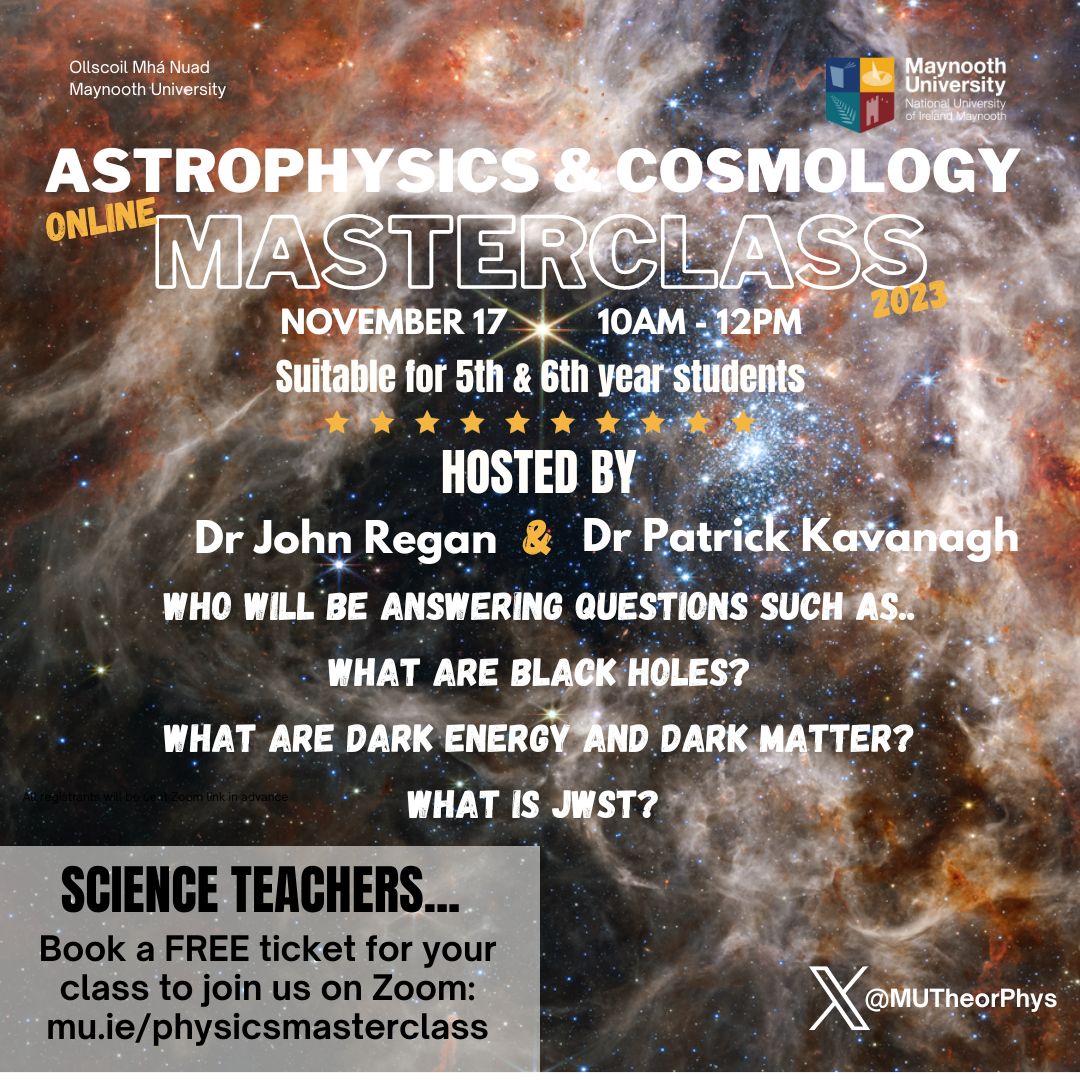
Both my regular readers may remember that for the last couple of years at this time of year there has been an Astrophysics & Cosmology Masterclass at Maynooth; see here and here for the previous incarnations. Not being in Maynooth I almost forgot about this year’s Masterclass, which has a different line-up with Dr Paddy Kavanagh adding some observational content alongside Dr John Regan.

This event is online only from 10am to 12pm on Friday 17th November 2023 and you can find out more details and register here.

No Tension at Redshift Ten

Posted in Maynooth, The Universe and Stuff with tags , , , , , on April 29, 2023 by telescoper

I know it’s the Bank Holiday weekend but I could resist a quick post about a new paper that hit the arXiv yesterday (where all new astrophysics papers worth reading can be found). It is led by Joe McCaffrey who is a PhD student in the Department of Theoretical Physics at Maynooth University. The paper has been submitted to the Open Journal of Astrophysics, but obviously I am conflicted so have assigned it to another editor.

UPDATE: the paper is now published here.

As many of you will be aware, there’s been a considerable to-do not to mention a hoo-hah about the detections by JWST of some galaxies at high redshift. Some of these have been shown not to be galaxies at high redshift after all, but some around z=10 seem to be genuine.

Anyway, the abstract of Joe’s paper is this:

Recent observations by JWST have uncovered galaxies in the very early universe via the JADES and CEERS surveys. These galaxies have been measured to have very high stellar masses with substantial star formation rates. There are concerns that these observations are in tension with the ΛCDM model of the universe, as the stellar masses of the galaxies are relatively high for their respective redshifts. Recent studies have compared the JWST observations with large-scale cosmological simulations. While they were successful in reproducing the galaxies seen in JADES and CEERS, the mass and spatial resolution of these simulations were insufficient to fully capture the early assembly history of the simulated galaxies. In this study, we use results from the Renaissance simulations, which are a suite of high resolution simulations designed to model galaxy formation in the early universe. We find that the most massive galaxies in Renaissance have stellar masses and star formation rates that are entirely consistent with the observations from the JADES and CEERS surveys. The exquisite resolution afforded by Renaissance allows us to model the build-up of early galaxies from stellar masses as low as 104 M⊙ up to a maximum stellar mass of a few times 107 M⊙. Within this galaxy formation paradigm, we find excellent agreement with JADES and CEERS. We find no tension between the ΛCDM model and current JWST measurements. As JWST continues to explore the high redshift universe, high resolution simulations, such as Renaissance, will continue to be crucial in understanding the formation history of early embryonic galaxies.

arXiv:2304.13755

The key figure is this one:

The solid curves show the number of galaxies of a given mass one would expect to see as a function of redshift in fields comparable to those observed with estimated values from observations (star-shaped symbols). As you can see the observed points are consistent with the predictions. There’s no tension, so you can all relax.

PhD Opportunity in Theoretical Astrophysics at Maynooth!

Posted in Maynooth, The Universe and Stuff with tags , , , on January 18, 2023 by telescoper

Posting this again because the deadline (31st January) is coming up fast….

The Department of Theoretical Physics at Maynooth University invites applications for a PhD in Theoretical Astrophysics starting in September 2023. The successful applicant will work in the group led by Dr. John Regan on a project examining the formation processes of massive black holes in the early Universe. Massive black holes populate the centres of all massive galaxies and are now also observed in both the centres and in off-centre locations in less massive dwarf galaxies.

For more details and instructions on how to apply, see here.

PhD Opportunity in Theoretical Astrophysics at Maynooth!

Posted in Maynooth, The Universe and Stuff with tags , , , on December 8, 2022 by telescoper

The Department of Theoretical Physics at Maynooth University invites applications for a PhD in Theoretical Astrophysics starting in September 2023. The successful applicant will work in the group led by Dr. John Regan on a project examining the formation processes of massive black holes in the early Universe. Massive black holes populate the centres of all massive galaxies and are now also observed in both the centres and in off-centre locations in less massive dwarf galaxies.

For more details and instructions on how to apply, see here.

Job Opportunity in Computational Astrophysics at Maynooth!

Posted in Maynooth, The Universe and Stuff with tags , , on December 2, 2022 by telescoper

Just a quick post to advertise the fact that the Department of Theoretical Physics at Maynooth University is inviting applications for a Postdoctoral Fellowship Position in Computational and Theoretical Astrophysics. The successful applicant will join the Research Group led by Dr John Regan and is expected to develop their own independent research program within the confines of a research project investigating the formation, growth, and demographics of Black Holes in the early Universe. The group, currently consisting of four PhD students and one additional postdoctoral researcher, is currently engaged in numerous research topics with the goal of understanding early black hole formation. In line with this we are currently implementing an ambitious research project using the EnzoE exascale class code to run large volume, high resolution simulations focused on the first billion years of black hole formation. The successful candidate will be expected to contribute significantly to this research effort but are free to pursue their own research lines under this remit.

For more information, including deadlines and the applications procedure, please see the AAS Jobs register advertisement here.

New Publication at the Open Journal of Astrophysics

Posted in OJAp Papers, Open Access, The Universe and Stuff with tags , , , , , , , , , , , , on December 24, 2020 by telescoper

Just time before Christmas to announce another paper in the Open Journal of Astrophysics. This one was actually published a few days ago but because of holiday delays it took some time to get the metadata and DOI registered so I held off announcing it until that was done.

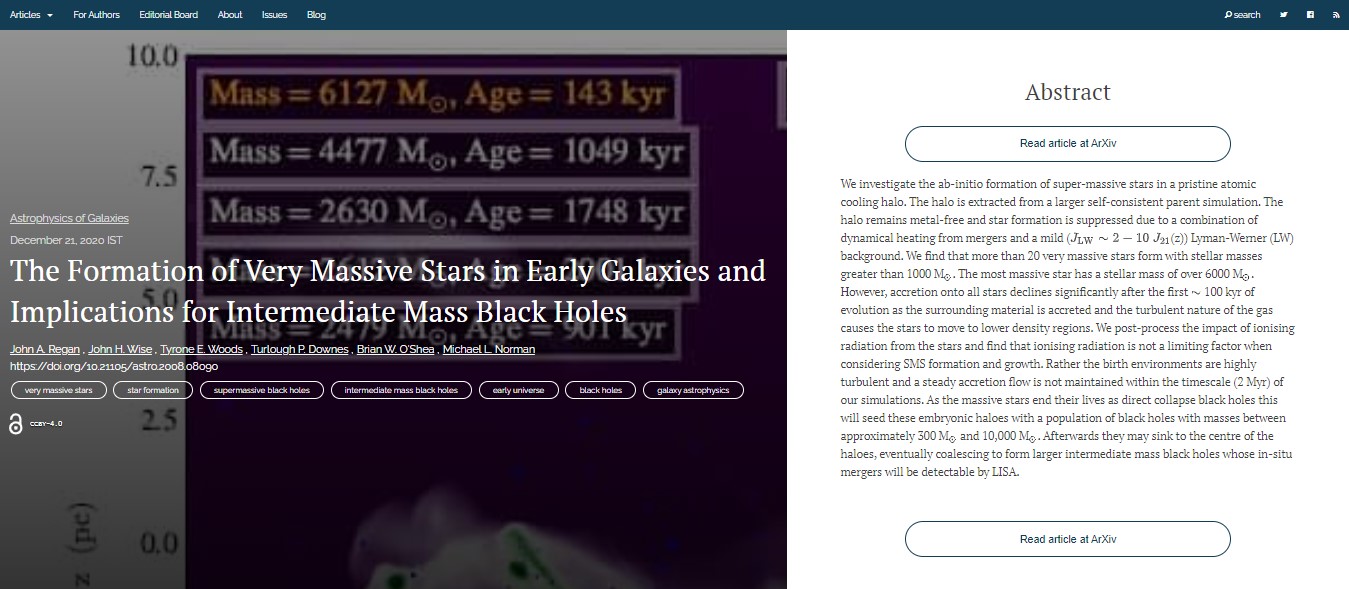
The latest publication is by my colleague* John Regan (of the Department of Theoretical Physics at Maynooth), John Wise (Georgia Tech), Tyrone Woods (NRC Canada), Turlough Downes (DCU), Brian O’Shea (Michigan State) and Michael Norman (UCSD). It is entitled The Formation of Very Massive Stars in Early Galaxies and Implications for Intermediate Mass Black Holes and appears in the Astrophysics of Galaxies section of the arXiv.

Here is a screen grab of the overlay:

You can click on the image to make it larger should you wish to do so. You can find the arXiv version of the paper here.

I think that will be that for for 2020 at the Open Journal of Astrophysics. We have published 15 papers this year, up 25% on last year. Growth is obviously modest, but there’s obviously a lot of inertia in the academic community. After the end of this year we will have two full consecutive years of publishing.

I’d like to take this opportunity to thank all our authors, readers, referees, and editors for supporting the Open Journal of Astrophysics and wish you all the very best for 2021!

*Obviously, owing to the institutional conflict I recused myself from the editorial process on this paper.

Another Cosmologist for Maynooth!

Posted in Maynooth, The Universe and Stuff with tags , , on January 13, 2020 by telescoper

A few people have contacted me to ask what happened with the research position in cosmology at Maynooth University advertised a few months ago. Well, I am now in a position to provide the answer.

I’m very happy to announce that as of January 2nd 2020, Dr John Regan has joined the staff of the Department of Theoretical Physics, bringing with him an SFI – Royal Society University Research Fellowship (URF) which will fund his research for five years.

Dr John Regan

John’s primary area of research is in trying to understand the formation of black holes in the early Universe and their subsequent growth and evolution. He is interested in trying to determine how the first massive black holes in the Universe formed and the conditions required to form them. The problem is well posed since at early times the Universe was a comparatively simple place compared to the Universe today. Recent observations have indicated that Supermassive Black Holes existed less than 1 billion years after the big bang (the Universe is approximately 14 billion years old). A current open problem in Cosmology is how did black holes form and grow quickly enough in order to become super-massive so early in the Universe?

In answering this question John uses high resolution numerical simulations to study the environments in which the first massive black hole seeds may have formed and then grown to become the super-massive ones we can still observe today.

I’m delighted that John has joined the Department and look forward to many years of fruitful collaborations and discussions. He will be joined by a PDRA and a research student in due course.

You can follow John on Twitter here: