It will be well known to the regular readers of the blog (Sid and Doris Bonkers) that I am not the sort of chap who’s likely to get involved in the PC versus Mac controversy. Except occasionally. And with great reluctance. It doesn’t do any good to take sides in such conflicts. I couldn’t resist passing on this little picture I found in internetland, however, which I know will not upset any Mac users….
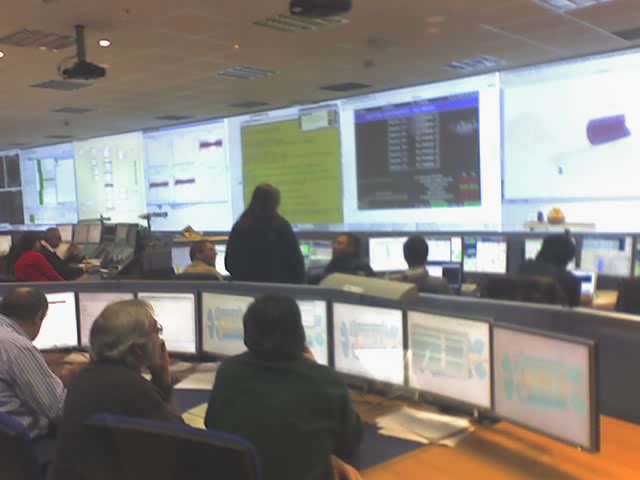
P.S. I still think the LHC control room looks like the inside of a betting shop.
As the media frenzy abates after the latest experimental results from the Large Hadron Collider show tantalising but inconclusive evidence for the existence of the Higgs boson, it’s perhaps now time to focus on the hard facts surrounding this elusive particle. At yesterday’s Christmas lunch I stumbled upon one piece of information of which I was previously unaware and which is clearly of national importance. The eponymous creator of the Higgs particle, Professor Peter Higgs, was in fact born in the fine city of Newcastle upon Tyne, which really is in The North. This fact identifies him as a Geordie, although having just heard him on the radio I think there’s not much sign of it in his accent.
Anyway, in honour of this important discovery I respectfully submit that The Large Hadron Collider should be given a more appropriate name, i.e. The Geet Big Hadron Basher. And I’m sure God won’t mind if the Higg’s boson is henceforth known as the Geordie Particle.
I’m very pressed for time this week so I thought I’d cheat by resurrecting and updating an old post from way back when I had just started blogging, about three years ago. I thought of doing this because I just came across a Youtube clip of the late great Alfred Hitchcock, which you’ll now find in the post. I’ve also made a couple of minor editorial changes, but basically it’s a recycled piece and you should therefore read it for environmental reasons.
–0–
Unpick the plot of any thriller or suspense movie and the chances are that somewhere within it you will find lurking at least one MacGuffin. This might be a tangible thing, such the eponymous sculpture of a Falcon in the archetypal noir classic The Maltese Falcon or it may be rather nebulous, like the “top secret plans” in Hitchcock’s The Thirty Nine Steps. Its true character may be never fully revealed, such as in the case of the glowing contents of the briefcase in Pulp Fiction, which is a classic example of the “undisclosed object” type of MacGuffin. Or it may be scarily obvious, like a doomsday machine or some other “Big Dumb Object” you might find in a science fiction thriller. It may even not be a real thing at all. It could be an event or an idea or even something that doesn’t exist in any real sense at all, such the fictitious decoy character George Kaplan in North by Northwest.
Whatever it is or is not, the MacGuffin is responsible for kick-starting the plot. It makes the characters embark upon the course of action they take as the tale begins to unfold. This plot device was particularly beloved by Alfred Hitchcock (who was responsible for introducing the word to the film industry). Hitchcock was however always at pains to ensure that the MacGuffin never played as an important a role in the mind of the audience as it did for the protagonists. As the plot twists and turns – as it usually does in such films – and its own momentum carries the story forward, the importance of the MacGuffin tends to fade, and by the end we have often forgotten all about it. Hitchcock’s movies rarely bother to explain their MacGuffin(s) in much detail and they often confuse the issue even further by mixing genuine MacGuffins with mere red herrings.
Here is the man himself explaining the concept at the beginning of this clip. (The rest of the interview is also enjoyable, convering such diverse topics as laxatives, ravens and nudity..)
North by North West is a fine example of a multi-MacGuffin movie. The centre of its convoluted plot involves espionage and the smuggling of what is only cursorily described as “government secrets”. But although this is behind the whole story, it is the emerging romance, accidental betrayal and frantic rescue involving the lead characters played by Cary Grant and Eve Marie Saint that really engages the characters and the audience as the film gathers pace. The MacGuffin is a trigger, but it soon fades into the background as other factors take over.
There’s nothing particular new about the idea of a MacGuffin. I suppose the ultimate example is the Holy Grail in the tales of King Arthur and the Knights of the Round Table and, much more recently, the Da Vinci Code. The original Grail itself is basically a peg on which to hang a series of otherwise disconnected stories. It is barely mentioned once each individual story has started and, of course, is never found.
Physicists are fond of describing things as “The Holy Grail” of their subject, such as the Higgs Boson or gravitational waves. This always seemed to me to be an unfortunate description, as the Grail quest consumed a huge amount of resources in a predictably fruitless hunt for something whose significance could be seen to be dubious at the outset.The MacGuffin Effect nevertheless continues to reveal itself in science, although in different forms to those found in Hollywood.
The Large Hadron Collider (LHC), switched on to the accompaniment of great fanfares a few years ago, provides a nice example of how the MacGuffin actually works pretty much backwards in the world of Big Science. To the public, the LHC was built to detect the Higgs Boson, a hypothetical beastie introduced to account for the masses of other particles. If it exists the high-energy collisions engineered by LHC should reveal its presence. The Higgs Boson is thus the LHC’s own MacGuffin. Or at least it would be if it were really the reason why LHC has been built. In fact there are dozens of experiments at CERN and many of them have very different motivations from the quest for the Higgs, such as evidence for supersymmetry.
Particle physicists are not daft, however, and they have realised that the public and, perhaps more importantly, government funding agencies need to have a really big hook to hang such a big bag of money on. Hence the emergence of the Higgs as a sort of master MacGuffin, concocted specifically for public consumption, which is much more effective politically than the plethora of mini-MacGuffins which, to be honest, would be a fairer description of the real state of affairs.
Even this MacGuffin has its problems, though. The Higgs mechanism is notoriously difficult to explain to the public, so some have resorted to a less specific but more misleading version: “The Big Bang”. As I’ve already griped, the LHC will never generate energies anything like the Big Bang did, so I don’t have any time for the language of the “Big Bang Machine”, even as a MacGuffin.
While particle physicists might pretend to be doing cosmology, we astrophysicists have to contend with MacGuffins of our own. One of the most important discoveries we have made about the Universe in the last decade is that its expansion seems to be accelerating. Since gravity usually tugs on things and makes them slow down, the only explanation that we’ve thought of for this perverse situation is that there is something out there in empty space that pushes rather than pulls. This has various possible names, but Dark Energy is probably the most popular, adding an appropriately noirish edge to this particular MacGuffin. It has even taken over in prominence from its much older relative, Dark Matter, although that one is still very much around.
We have very little idea what Dark Energy is, where it comes from, or how it relates to other forms of energy we are more familiar with, so observational astronomers have jumped in with various grandiose strategies to find out more about it. This has spawned a booming industry in surveys of the distant Universe (such as the Dark Energy Survey) all aimed ostensibly at unravelling the mystery of the Dark Energy. It seems that to get any funding at all for cosmology these days you have to sprinkle the phrase “Dark Energy” liberally throughout your grant applications.
The old-fashioned “observational” way of doing astronomy – by looking at things hard enough until something exciting appears (which it does with surprising regularity) – has been replaced by a more “experimental” approach, more like that of the LHC. We can no longer do deep surveys of galaxies to find out what’s out there. We have to do it “to constrain models of Dark Energy”. This is just one example of the not necessarily positive influence that particle physics has had on astronomy in recent times and it has been criticised very forcefully by Simon White.
Whatever the motivation for doing these projects now, they will undoubtedly lead to new discoveries. But my own view is that there will never be a solution of the Dark Energy problem until it is understood much better at a conceptual level, and that will probably mean major revisions of our theories of both gravity and matter. I venture to speculate that in twenty years or so people will look back on the obsession with Dark Energy with some amusement, as our theoretical language will have moved on sufficiently to make it seem irrelevant.
But that’s how it goes with MacGuffins. Even the Maltese Falcon turned out to be a fake in the end.
My (probably ill-informed) earlier post about particle physics seems to have generated quite a lot of traffic, so I thought I’d reblog this short article (by a real particle physicist) for the benefit of those people who want to find out about the latest results from someone who actually knows what they’re talking about.
You would be forgiven for seeing the headlines from EPS-HEP 2011 and thinking the LHC is less interesting than maybe you were led to believe. A year or so ago you might have expected hints of supersymmetry, black holes, extra dimensions or even something more exotic to have been found in the ever increasing LHC datasets. But the current story is that the Standard Model is still describing all data analysed so far pretty damn well. There may or ma … Read More
There’s been a big conference on High Energy Physics going on in Grenoble since last Thursday, which I’ve been following a little bit via Tweets from various participants and links to blog articles contained therein. The media seem to be almost exclusively focussed on the Higgs boson but, as is made clear in a Guardian blog article by John Butterworth, the situation is that the latest data from the Large Hadron Collider do not provide clear evidence for it yet. Strangely, though, the Guardian ran another piece at the weekend claiming that “CERN scientists suspect a glimpse of the Higgs”, which appears to have been based on a blog article which offers various possible interpretations of a set of measurements which lie at the margin of statistical significance. It must be very frustrating not having a clear detection, but this strikes me as clutching at straws. Far better to wait for more data before speculating in public. Nobody really expected to see the Higgs so soon, so it’s surely better to wait for more data rather than over-interpreting what’s there. Let’s put it down to overenthusiasm.
However the real point of the latest news is not in my view the lack of, or marginal nature of, evidence for the Higgs Boson. It’s the extremely strong limits that have been placed on supersymmetry. This is of particular (geddit?) interest to me as a cosmologist because supersymmetric theories provide us with plausible candidates for the non-baryonic dark matter we think pervades the Universe. The possibilities include fermionic counterparts of the bosons that mediate the standard model interactions. The photon, for example, which is a boson, mediates the electromagnetic interaction between charged particles; in SUSY theories it would have a fermionic partner called a photino. There would also be the Higgsino (assuming there is a Higgs!), gluino, gravitino and so on. Supersymmetry is a beautiful idea and many theorists love it to bits, but there isn’t a shred of evidence that has anything to do with the way nature is.
The search for supersymmetry is thus more directly relevant to my work than the Higgs, in fact, but the Large Hadron Collider was largely “sold” to politicians and the public in terms of the quest for the Higgs. That’s the MacGuffin, as Alfred Hitchcock would have said. Actually the LHC will do many other things, but I guess it’s easier to make the case for funding to government if you have one Big Idea rather than lots of smaller ones.
Anyway, a piece from New Scientist today hits the nail on the head. While the Higgs search may or may not be producing tantalising clues, the searches for supersymmetry has drawn a complete blank. Zilch. Nada. Not the merest smidgeon of a scintilla. The class of supersymmetric theories is broad and no doubt many possibilities remain viable; the current measurements only rule out the “minimal” variety. But I think this is a timely reminder not to take nature for granted. Perhaps an ugly fact is about to slay a beautiful hypothesis…
UPDATE: Bookmaker Paddy Power has shortened the odds on a Higgs discovery this year from 12-1 against to 3-1 on.
Some of you might think this is just ridiculous hype, but I couldn’t possibly comment…
I don’t think there has ever been a moment quite like this in physics before. Within the next few months, weeks or even days we will learn something new about the universe that will change our thinking forever. I don’t mean something like a little CP asymmetry or a new observation of neutrino physics. These things are great but they just pose questions that we can’t answer yet. What we are about to learn is going to generate so many new ideas in … Read More
I thought I’d reblog this as it relates to the pronouncements about the LHC by Otto Rössler I mentioned yesterday.
As I predicted nearly two-and-a-half years ago, it looks like the Earth will survive the most powerful accelerator ever built. A recent article validates my prediction. On September 8, 2008, I recorded a Science News Flash podcast addressing concerns that the Large Hadron Collider (LHC) would produce a shower of black holes that would, in turn, consume Earth from the inside out. I predicted that Earth would not only survive the experiments perfor … Read More
You might also want to read this older blog post about the kerfuffle when the LHC was switched on. I quote:
Rössler turns out to be quite a strange fellow. He is an MD who stayed in academia, moved into biochemistry, and then made a name in the relatively new field of chaos theory. He seems to think of himself as a visionary, having founded a new field of physics called “endophysics,” which is supposed to take into account the observer’s inner state. Or something like that. Have you heard of it? Neither had I.
Recently, at the age of sixty-eight, Rössler, despite having no particle physics or blackhole physics credentials, announced that he had found important new results, alarmingly relevant to the destructive potential of microscopic black holes in LHC proton-proton collisions. Rössler variously estimates the likelihood of such blackhole production by LHC as being from 10% to 50% though he appears to have pulled these numbers out of a hat.
And there’s also this most excellent video that John Butterworth told me about because he’s in it…
I’d never heard of Cardiff Business Club until Friday afternoon, when I received a message that they were hosting a lecture by Dr Lyndon Evans, the Director of the Large Hadron Collider experiment at CERN in Geneva, followed by a dinner, and had sent a bunch of invitations to the School of Physics & Astronomy at Cardiff University, where I work.
Given the short notice it was a bit of a scramble to get a group together, but in the end eight of us – 3 staff and 5 students – headed off in taxis yesterday to the swish St David’s Hotel in Cardiff Bay for the welcoming reception.
Earlier in the day I’d been in contact with Alun Davies, the Secretary of Cardiff Business Club, who had asked me if I would deliver the vote of thanks at the end of Dr Evans’ lecture. Naturally, I agreed to do the honours. I’m not actually a particle physicist, of course, but I was the closest thing available. This all meant that, instead of joining my colleagues at the reception, I went off to meet the speaker and various officers of the club in a private lounge where we were plied with drinks and canapés. As well as meeting Lyn Evans, I also got the chance to chat with the Club Chairman, legendary former rugby international Gerald Davies who is an extremely friendly and charming bloke.
Thence it was downstairs to the lecture, during which I sat on the platform, facing the audience, from where it was extremely difficult to see the speaker’s slides. It was a 30-minute overview of the science, technology, and even politics behind the LHC, which went down extremely well. I remember this quote in particular
The greatest economic benefits of scientific research have always resulted from advances in fundamental knowledge rather than the search for specific applications.
It’s particularly interesting, in the light of government suggestions that we should focus science funding more on applied sciences and technology, to note that this remark was made by Margaret Thatcher.
At the end I did my best to keep my vote of thanks as brief as possible – brevity has never been my strong suit, I’m afraid – and we then went off to dinner, with me rejoining the physics crowd at their table in a far-flung corner of the room.
Not surprisingly, the dinner turned out to be quite a formal affair – preceded by grace and followed by the loyal toast – which I think made some of our party feel a little bit uncomfortable, but at least it was all free! The room was dominated by men in suits who all looked like they were used to going everywhere Business Class. We academics usually travel by Economy Class only.
Proceedings drew to a close quite early, at 10pm. Unfortunately, the temptation to adjourn to the pub for a “quick drink” proved too strong to resist.
I’ve wanted to post this little clip for some time, just because it’s so marvellous.
I wonder what you felt as you watched it? What went through your mind? Amusement? Fascination? I’ll tell you how it was for me when I first saw it. I marvelled.
Seeing the extraordinary behaviour of this incredible creature filled me with a sense of wonder. But I also began to wonder in another sense too. How did the Lyre Bird evolve its bizarre strategy? How does it learn to be such an accurate mimic? How does it produce such a fascinating variety of sounds? How can there be an evolutionary advantage in luring a potential mate to the sound of foresters and a chainsaw?
The Lyre Bird deploys its resources in such an elaborate and expensive way that you might be inclined to mock it, if all it does is draw females to “look at its plumes”. I can think of quite a few blokes who adopt not-too-dissimilar strategies, if truth be told. But if you could ask a Lyre Bird it would probably answer that it does this because that’s what it does. The song defines the bird. That’s its nature.
I was moved to post the clip in response to a characteristically snide and ill-informed piece by Simon Jenkins in yesterday’s Guardian. Jenkins indulges in an anti-science rant every now and again. Sometimes he has a point, in fact. But yesterday’s article was just puerile. Perhaps he had a bad experience of science at school and never got over it.
I suppose I can understand why some people are cynical about scientists stepping into the public eye to proselytise about science. After all, it’s also quite easy to come up with examples of scientists who have made mistakes. Sadly, there are also cases of outright dishonesty. Science is no good because scientists are fallible. But scientists are people, no better and no worse than the rest. To err is human and all that. We shouldn’t expect scientists to be superhuman any more than we should believe the occasional megalomaniac who says they are.
To many people fundamental physics is a just a load of incomprehensible gibberish, the Large Hadron Collider a monstrous waste of money, and astronomy of no greater value to the world than astrology. Any scientist trying to communicate science to the public must be trying to hoodwink them, to rob them of the schools and hospitals that their taxes should be building and sacrifice their hard-earned income on the altar of yet another phoney religion.
And now the BBC is participating in this con-trick by actually broadcasting popular programmes about science that have generated huge and appreciative audiences. Simon Jenkins obviously feels threatened by it. He’s probably not alone.
I don’t have anything like the public profile of the target of Jenkins’ vitriol, Lord Rees, but I try to do my share of science communication. I give public lectures from time to time and write popular articles, whenever I’m asked. I also answer science questions by email from the general public, and some of the pieces I post on here receive a reasonably wide distribution too.
Why do I (and most of my colleagues) do all this sort of stuff? Is it because we’re after your money? Actually, no it isn’t. Not directly, anyway.
I do all this stuff because, after 25 years as a scientist, I still have a sense of wonder about the universe. I want to share that as much as I can with others. Moreover, I’ve been lucky enough to find a career that allows me to get paid for indulging my scientific curiosity and I’m fully aware that it’s Joe Public that pays for me to do it. I’m happy they do so, and happier still that people will turn up on a rainy night to hear me talk about cosmology or astrophysics. I do this because I love doing science, and want other people to love it too.
Scientists are wont to play the utilitarian card when asked about why the public should fund fundamental research. Lord Rees did this in his Reith Lectures, in fact. Physics has given us countless spin-offs – TV sets, digital computers, the internet, you name it – that have created wealth for UK plc out of all proportion to the modest investment it has received. If you think the British government spends too much on science, then perhaps you could try to find the excessive sum on this picture.
Yes, the LHC is expensive but the cost was shared by a large number of countries and was spread over a long time. The financial burden to the UK now amounts to the cost of a cup of coffee per year for each taxpayer in the country. I’d compare this wonderful exercise in friendly international cooperation with the billions we’re about to waste on the Trident nuclear weapons programme which is being built on the assumption that international relations must involve mutual hatred.
This is the sort of argument that gets politicians interested, but scientists must be wary of it. If particle physics is good because it has spin-offs that can be applied in, e.g. medicine, then why not just give the money to medical research?
I’m not often put in situations where I have to answer questions like why we should spend money on astronomy or particle physics but, when I am, I always feel uncomfortable wheeling out the economic impact argument. Not because I don’t believe it’s true, but because I don’t think it’s the real reason for doing science. I know the following argument won’t cut any ice in the Treasury, but it’s what I really think as a scientist (and a human being).
What makes humans different from other animals? What defines us? I don’t know what the full answer to that is, or even if it has a single answer, but I’d say one of the things that we do is ask questions and try to answer them. Science isn’t the only way we do this. There are many complementary modes of enquiry of which the scientific method is just one. Generally speaking, though, we’re curious creatures.
I think the state should support science but I also think it should support the fine arts, literature, humanities and the rest, for their own sake. Because they’re things we do. They make us human. Without them we’re just like any other animal that consumes and reproduces.
So the real reason why the government should support science is the song of the Lyre Bird. No, I don’t mean as an elaborate mating ritual. I don’t think physics will help you pull the birds. What I mean is that even in this materialistic, money-obsessed world we still haven’t lost the need to wonder, for the joy it brings and for the way it stimulates our minds; science doesn’t inhibit wonder, as Jenkins argues, it sparks it.
I just remembered that while I was at CERNlast week I took a few crummy pics with my phone, so I thought I’d stick them on here.
This first one is actually of the control room of the ATLAS experiment, but it looked to me rather like the inside of a betting shop.
These two were taken in the facility where they test the magnets for the Large Hadron Collider. Each section of superconducting thingummyjig is about 10 metres long; the whole thing is 27km long so that’s a lot of sections! Although the magnets carry a huge current – 10,000 Amps – since they’re superconducting they have no resistance and therefore dissipate no power. However, they have to be kept at liquid helium temperatures, which does require quite a lot of power.
I like the sign on the second one: RISK OF LIQUID AIR.
Finally, here’s the most important one. While I am away Columbo is looked after by a lady called Helen who sends me daily updates. Here is Columbo in a characteristic pose.
The views presented here are personal and not necessarily those of my employer (or anyone else for that matter).
Feel free to comment on any of the posts on this blog but comments may be moderated; anonymous comments and any considered by me to be vexatious and/or abusive and/or defamatory will not be accepted. I do not necessarily endorse, support, sanction, encourage, verify or agree with the opinions or statements of any information or other content in the comments on this site and do not in any way guarantee their accuracy or reliability.

 As the






 In the Dark