So now after a half-term mid-semester study break, including one day of actual holiday, that was both pleasant and eventful it will soon be time to return to the fray, at least for 9 working days. A full week of lectures, labs and tutorials starts tomorrow but the following week end a day early, on Thursday 2nd April, because 3rd April is Good Friday. Campus is closed then, as it is on Easter Monday and there are no lectures for the rest of that week. I’ll miss a lecture on Good Friday. I’m sure the students will be distraught, but that’s the way of things.
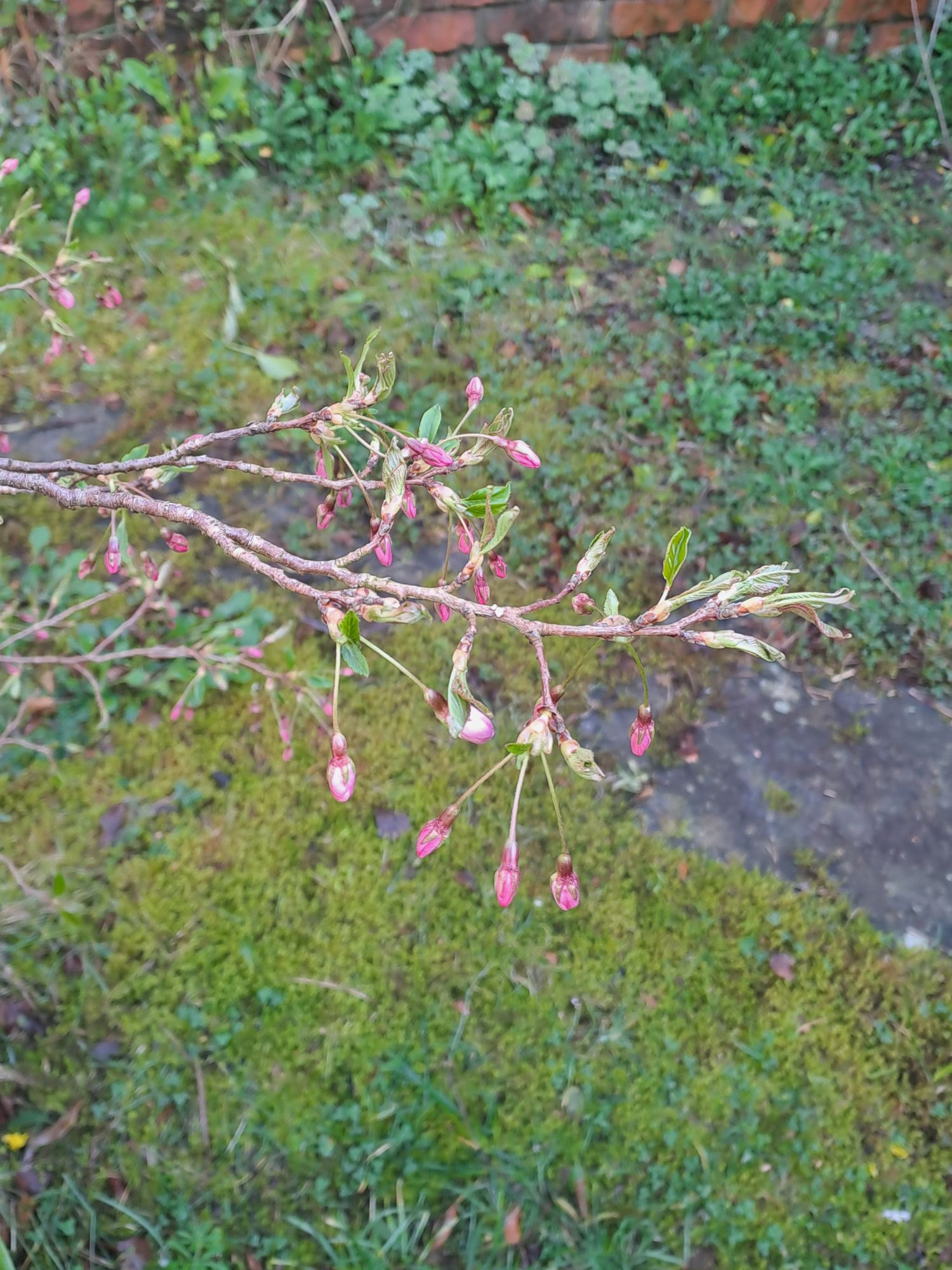
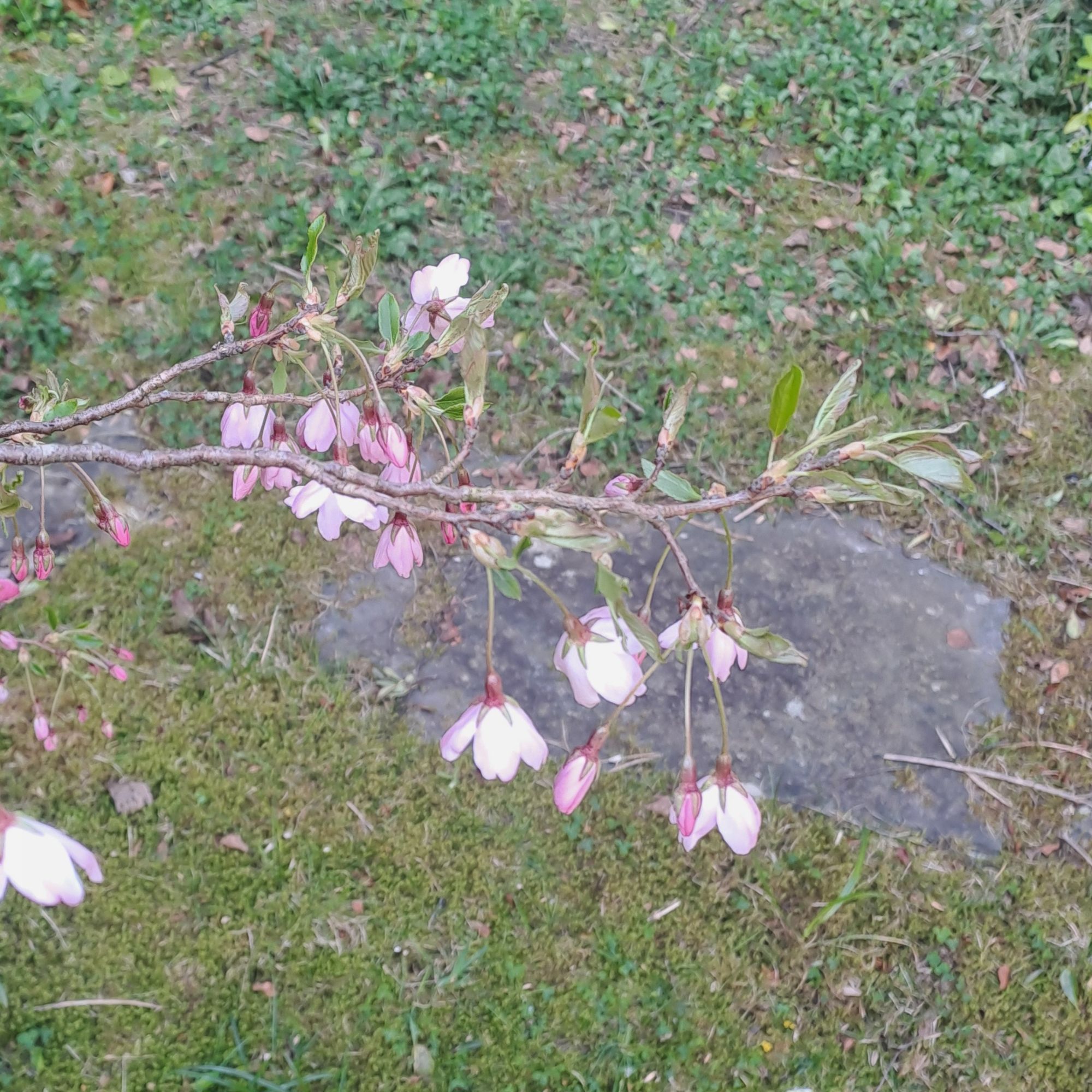
Anyway, with the Eastertide coming in and yesterday being World Poetry Day I thought I’d share a couple of pictures (taken two days apart) of the Japanese cherry trree in my back garden along with this haiku on a theme by A.E. Housman:
Loveliest of trees?
Not yet, but soon there will be
Bloom along the bough...
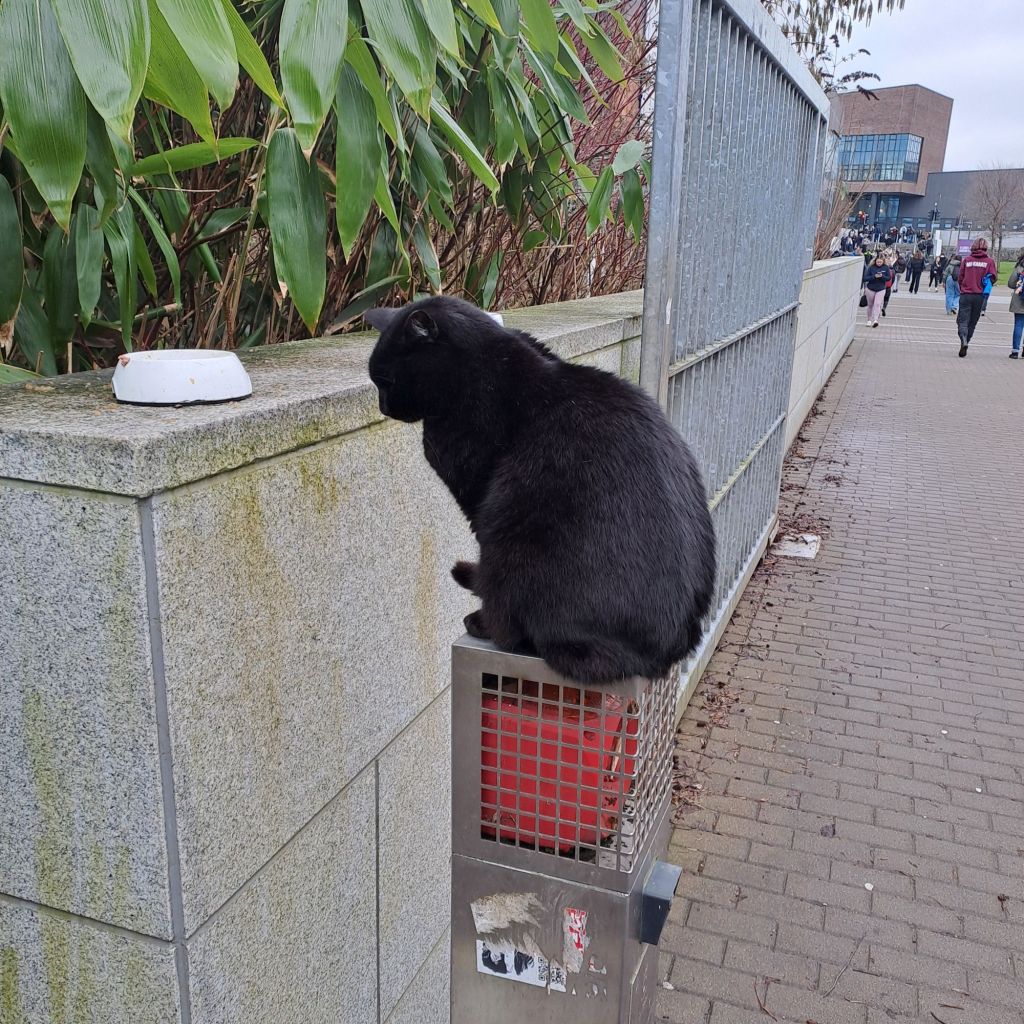
I hadn’t seen Maynooth University Library Cat for a while, so it was nice to see him today, on post, as large as life. Approaching him I saw him receive a number of back scratches. It seems he enjoyed them and continued to present his back to passers-by in the hope of getting more.
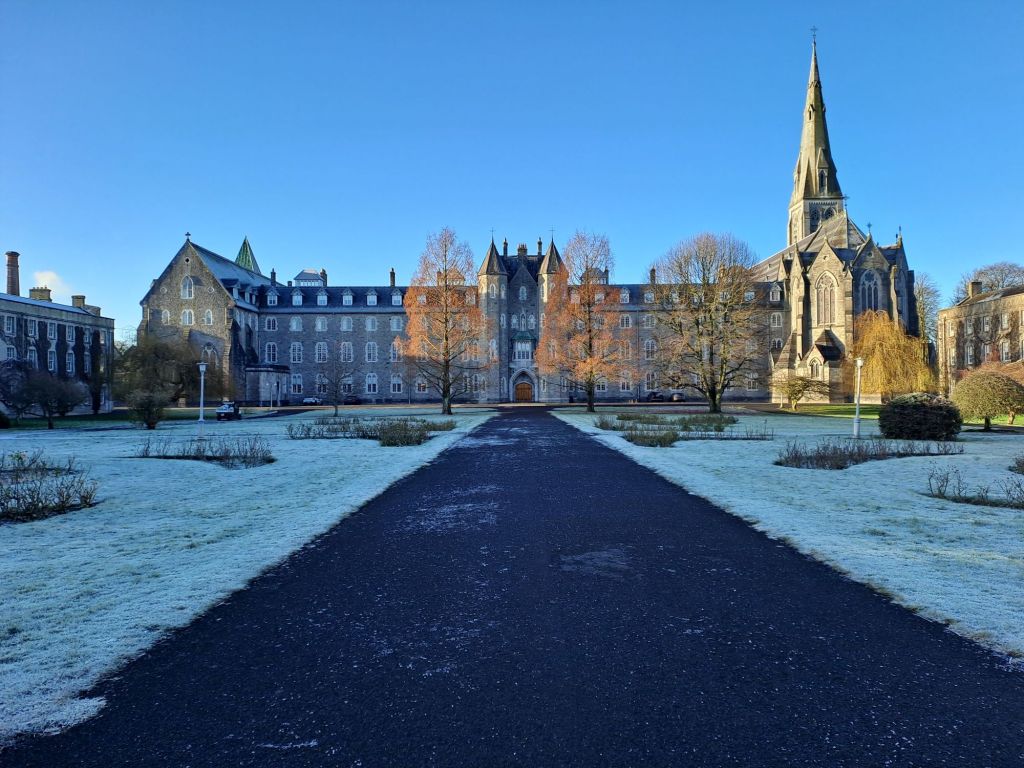
So here I am, back on campus at Maynooth University, for the first time in 2026. I took a longer route than usual to my office this morning as I thought the South Campus would look pretty with all the frost around, as indeed it was:
The temperature was well below freezing last night. Today was refuse collection day and I happened to see the crew empty my bins first thing. They struggled to do so as the lids were frozen down. I think there might be a bit of a thaw during the day, but the forecast is that the temperature will barely make it above zero and there’ll be more frost tonight. No snow is forecast for Maynooth.
I topped up the bird feeders in my garden before I left for work. On Saturday I bought a new feeder designed for smaller and nimbler birds; since then there have been several blue tits and various finches using it. I’ve got nothing against the larger birds, but they do tend to hog the other feeders. I suppose it won’t be long until crows try to wreck the new one, but for the time being it’s intact.
Anyway, I have to prepare a revision lecture for this afternoon so ahead of that I need to do a bit of revision myself…
For last year’s words belong to last year’s language
And next year’s words await another voice.
And to make an end is to make a beginning.
From Four Quartets, ‘Little Gidding’ by T. S. Eliot.
So it’s New Year’s Day. Athbhliain faoi mhaise dhaoibh!
For me this brings the festive season to an end. I’ve been eating and drinking too much for the last week as one is supposed to. Last night I brought in the new year with a dish of roast duck and the last of the Christmas vegetables. I think I’ll be buying any sprouts and parsnips for a while. When the iron tongue of midnight told twelve, I had a glass of excellent Irish Whiskey in the form of Clonakilty Single Pot Still (46%). It has been a most enjoyable week, but heightened level of self-indulgence has been rather exhausting, and I’ll be taking things a bit easier for a few days before I go back to work on Monday. It’s hard work being a glutton.
Anyway, I thought I’d mention a few things looking forward to the New Year.
January will, as usual, be dominated by examinations, and especially the marking thereof. The first examination for which I am responsible is on January 12th. The examination, incidentally, will be held in the Glenroyal Hotel in Maynooth as the Sports Hall on campus – usually a major exam venue – is out of commission due to building work.
I have a couple of writing deadlines, in addition to having to correct the examinations, so it will be a busy January.
Then February sees the start of a new semester. I’ll be teaching Particle Physics again. I was a bit surprised to be asked to teach this again, as I was filling last year in for our resident particle physicist who was on sabbatical. I’m glad to be able to continue with it given the work I put in to do it last time. My other module is Computational Physics which I have taught at Maynooth every year since 2018, apart from 2024 when I was on sabbatical. This time, however, I will have to think hard about how to deal with the use of generative AI in the coursework.
Will I get to teach any astrophysics or cosmology at Maynooth before I retire? That’s looking very unlikely. I think it’s probable that the new academic year, starting in September, will find me teaching the same modules as last year.
The year ahead will also see the first data release (DR1) from the European Space Agency’s Euclid Mission. The date for that will be October 21st 2026. This is a hard deadline. There’s a huge amount of work going on within the Euclid Consortium to extract as much science as possible from the observations so far before the data becomes public, but you’ll have to wait until October to find out more!
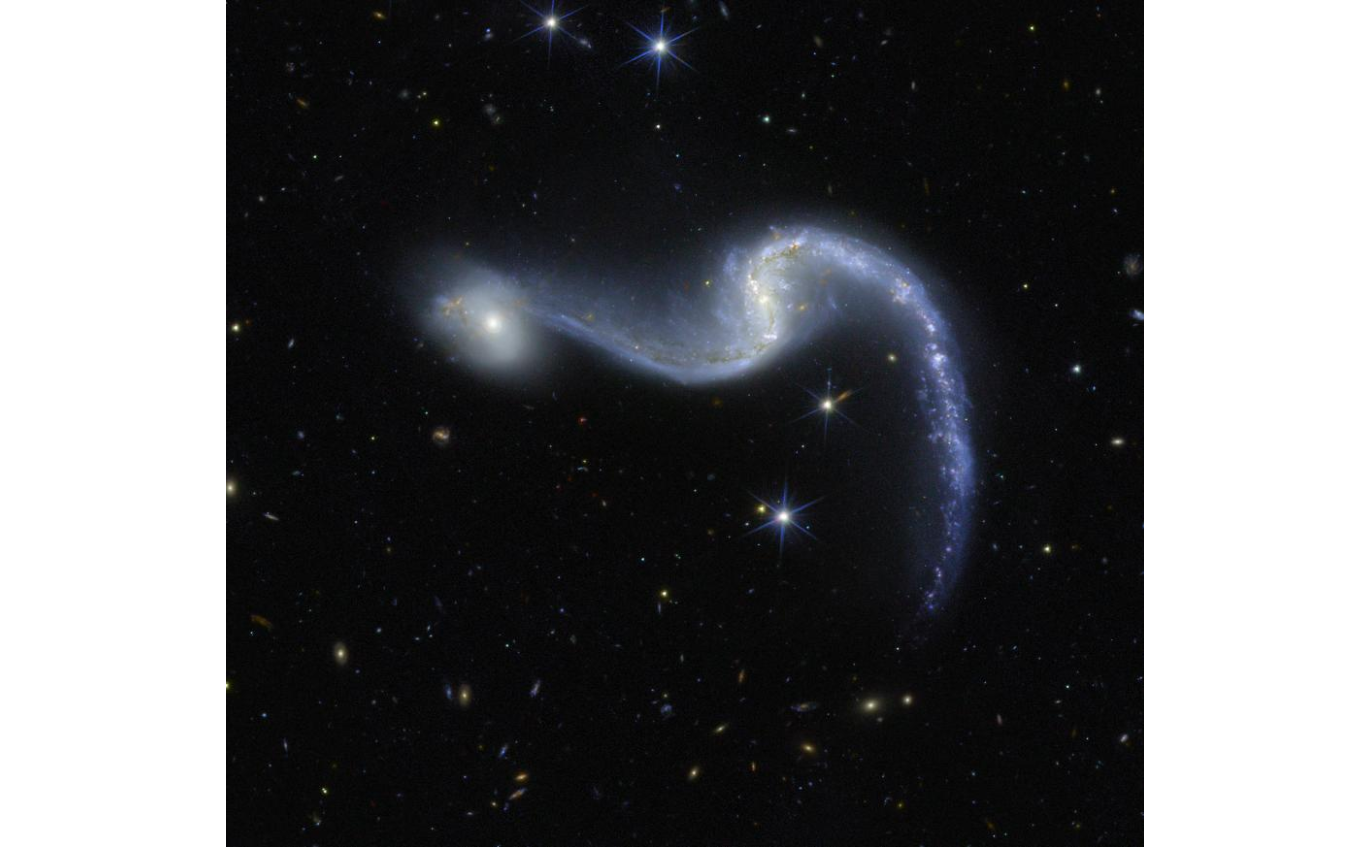
This reminds me that I forgot to share this nice image from Euclid that was released just before Christmas.
Galaxy NGC 646 looking like a cosmic holiday garland in this image from the European Space Agency’s Euclid space telescope.
Once upon a time, WordPress used to send an email about the year’s blog statistics, etc, but it stopped doing that some time ago. I checked this morning, however, and learned that traffice on the blog in 2025 was up by 2.6% since 2024. I’m not sure how meaningful this is, because there is so much scraping going on these days. That figure doesn’t include the people who get posts via email or RSS or via other platforms such as the Fediverse.
While I’m on about social media I’ll mention a stat about my Bluesky account. I joined Bluesky in 2023 when I abandoned Xitter. As of today I have 8,078 BlueSky followers, which is more than I ever had on X, and with far higher levels of engagement and much friendlier interactions.
I’m also on Mastodon, although with a much smaller following (1.4k). This blog also has a separate existence on Mastodon here. I very much like the federated structure of Mastodon (which, incidentally, accords with my view of how academic publishing should be configured) and am a bit disappointed that it doesn’t seem to have caught on as much as it should.
That disappointment pales into insignificance, however, with the outrage I feel that my employer – along with most other universities – persists in using Xitter. Touting for trade in a far-right propaganda channel is no way for a institution of higher education to behave. You can read my views on this matter here.
And finally there’s the Open Journal of Astrophysics. The year ahead will see the 10th anniversary of our first ever publication – on an experimental prototype platform, long before we moved to Scholastica. It will be next Monday before we resume publishing, starting Volume 9. Which author(s) will be the first to get their final versions on arXiv in 2026? Stay tuned to find out!
Walking home through Maynooth this evening, the streets filled with partying students, I was reminded of this:
It’s the central part of the triptych Das letzte Gericht (The Last Judgment) by Hieronymus Bosch. The medium is oil on oak panel and it measures 164 x 127 cm. The original work is in the Academy of Fine Arts in Vienna.
The figures at the top, looking down on the chaos, are clearly identifiable as members of academic staff, while those below are students. I’m sure that if Christmas jumpers had been invented in 1486, when the work is thought to have been completed, Bosch would have painted a few in…
This week is the penultimate week of teaching term at Maynooth and, as usual at this stage of the Semester, we’re getting busier and busier. The examinations for January have been sent off for printing and are (presumably) ready to go, and I’m up to date with all my coursework gradin so I am, miraculously, on schedule as far as teaching is concerned. I should finish covering the respective syllabuses by Tuesday 16th, with the remaining teaching sessions devoted to revision. I don’t have any lectures on Fridays this term, so my teaching ends, a day before the end of term, on Thursday 18th December. To celebrate the end of term I’ll be presenting the students in the last session of my Engineering Mathematics module the gift of a final Class Test. I’m not sure when I’ll get to correct it. Oh, and our Department Christmas Dinner is on Wednesday 17th.
I’ll soon have to decide when to pause the publication of new papers at the Open Journal of Astrophysics and prepared for next year’s Volume 9. A certain person is insisting that I take a complete break for at least a week, so I think we’ll probably stop on Christmas Eve and begin again in the New Year.
In the meantime, term goes on. I have three lectures to get ready for tomorrow. Incidentally, my mid-Semester feedback suggested that I start each lecture with an introduction to say what I’m going to be covering. Here are some examples of what I’ve been doing in response:
Yesterday afternoon I acted as Chair of the viva voce examination for a PhD degree in the Department of Mathematics & Statistics at Maynooth University. I have done this once before at Maynooth, in the Department of Biology, but had to look back through my archive of blog posts to find out when that was: it was in June 2023.
For those of you not familiar with how this works, a PhD involves doing research into a particular topic and then writing up what you’ve done in a thesis. The thesis is a substantial piece of work, often in the region of 100,000 words (200 pages or so), which is then assessed by two examiners (one internal to the university at which the research was done, and one external). They read copies of the thesis and write preliminary reports on it. Then the candidate has to defend it in an oral examination, which was what happened yesterday, after which they make a recommendation to the university about whether the degree should be awarded.
There aren’t many rules for how a viva voce examination should be conducted or how long it should last, but the can be as short as, say, 90 minutes and can be as long as 5 hours or more. The examiners usually ask a mixture of questions, some about the details of the work presented and some about the general background. Sometimes, especially in Mathematics, the candidate might be asked to use the chalkboard to explain something, as was the case yesterday.
The unpredictable content of a viva voce examination makes it very difficult to prepare for, and it can be difficult and stressful for the candidate (as well as just tiring, as it can drag on for a long time). However, call me old-fashioned but I think if you’re going to get to call youself Doctor of Philosophy you should expect to have to work for it.
I found it interesting when I first arrived here that viva voce examinations at Maynooth follow a similar practice to those at my previous institution, Cardiff University my previous institution, in that each viva has a Chair as well as the usual internal and external examiners. The Chair is really only present to ensure fair play, that proper procedure is followed, and that all the paperwork is done in timely fashion. The Chair is rarely (if ever) called upon to intervene in the viva itself, though I have on some previous occasions done so, mainly to ask if the candidate and/or examiners would like to take a comfort break. Other than that it’s just a matter of sitting quietly and getting on with something else while the viva proceeds.
I have done quite a lot of examinations as internal or external examiner over the years and most institutions don’t have a Chair – only the two examiners and the candidate are present. Cardiff University is an exception: I chaired a quite a few vivas when I was there. The difference there was that the Chair was from the same School (Physics & Astronomy) as the candidate, whereas in Maynooth the Chair must be from a different Department (which is why I was asked to Chair examinations in Biology and, more recently, Mathematics).
I think having an independent Chair is a good idea, but I do understand that it involves finding a person willing to do it which, it seems, sometimes slows down the organization of a viva, as the process does not start until a Chair is appointed.
Anyway, in this case it all went well. The candidate passed, the forms were filled in and sent to the relevant people. Now there are just minor corrections to be done, everything approved at the relevant Faculty meeting, and then the PhD degree can be conferred.
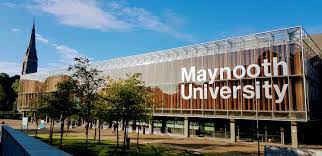
Maynooth University Library, home of the famous cat
Today is 1st December 2025, which means that it’s eight years to the day since I started work at Maynooth University. Despite the frustrations, I’m still very happy I made the move all that time ago.
We’ve now had more than a year since the merger of the former Departments of Theoretical and Experimental Physics. This has gone pretty well, actually, with significant improvements in terms of some steps forward in rationalising teaching. It does, however, feel less like a merger and more like an acquisition, with the theoretical activity effectively subsumed into the old Experimental Physics department. I suppose that was inevitable given the relative sizes of the two former Departments, but it has led to a loss of identity and the loss of the group spirit we use to have in Theoretical Physics. To add to this a number of familiar faces have left – two of my own PhD students, Aonghus Hunter-McCabe and Aoibhinn Gallagher have graduated and left, as have others with different supervisors. I am delighted for their success, of course, but will miss having them around.
I continue to enjoy teaching, and was pleasantly surprised to continue doing the same modules this academic year as last. The big change in that regard has been the adoption of different assessment methods to deal with the possibility of students using AI to do their coursework. That seems to be going reasonably well, though I’ll have to wait until the January examinations to see the outcomes.
The thing I’m probably most proud of over the past eight years is, with the huge help of staff at Maynooth University Library, getting the Open Journal of Astrophysics off the ground and attracting some excellent papers. This year has seen yet more significant growth, publications this year set to reach 200, after 120 in 2024 and just 50 the year before that (2024). We’re still smaller than many of the mainstream astrophysics journals, but we’re still growing…
Anyway, eight years of service mean that only two remain until I can claim the full state pension. I’ll be retiring as soon as I can afford to. There were Open Days at Maynooth on Friday and Saturday (28th and 29th November, respectively). These were for prospective students to enter in September 2026. Since I don’t teach any first or second year Physics modules now, and that is likely to continue, it looks like I’ll never see any of that intake in class.
As it was foretold, I conducted my first set of my new-style in-class tests this week. These tests, as I mentioned a while ago, were introduced because of concerns about the integrity of the coursework element of my modules in the light of improvements in Generative AI.
The main events – one for each of my modules – were both yesterday, but one student couldn’t make it at the scheduled time (for good reasons) so I set a special test this morning, which is now over. Because access to the internet is not allowed these tests are invigilated.
It’s been quite a while since I was last required to invigilate a full examination. I think it was back in Nottingham days, actually. I never enjoyed this task even though I took work to do it wasn’t really possible to do much as one had to keep one’s eyes on the students. Crosswords could be done; these are good in this situation because you can solve a few clues at a time. It was disappointing if I happened to take one that was easy enough to do quickly, as there was little to stave off the boredom after completing it. Other things I used to do included counting the number of right-handed and left-handed students, though I never did any detailed statistical analysis of the results.
Anyway, my recent class tests were a bit different. Designed to fit in a lecture slot of 50 minutes duration, they were much shorter than traditional end-of-year exams. They were also “open-book” style, so students could bring anything on paper that they wanted. Phones and laptops were, however, forbidden. During these tests I just sat quietly with my laptop getting some work done, with an occasional glance at the students. It was actually nice to be locked away like this with no disturbance. Time passed very quickly, actually, though perhaps not as quickly as it did for the students taking the tests.
When I first told the students that the tests would be “open-book”, I think they all assumed that would make them easy. I don’t think that was the case, however, as the questions are designed so that the answers can’t be obtained immediately by looking them up in a textbook. Also, having things on paper rather than in your head does slow you down. I’ve never seen much point in examinations as speed tests. I designed this week’s tests so that the questions could be done in about 30 minutes, but the formal duration was 50 minutes. I encouraged students who finished early to use the remaining time to check their work, but some did leave early.
This new regime also meant I had number of teaching sessions without the exertion of having to do any actual teaching, which was nice. The downside is, of course, that I now have stacks of class tests to correct. That will be payback time.
I won’t know how well the students have coped until I have got their grades, but informal feedback was that they seemed reasonably content with the new method of assessment. I’ll be doing the next ones in about three weeks.
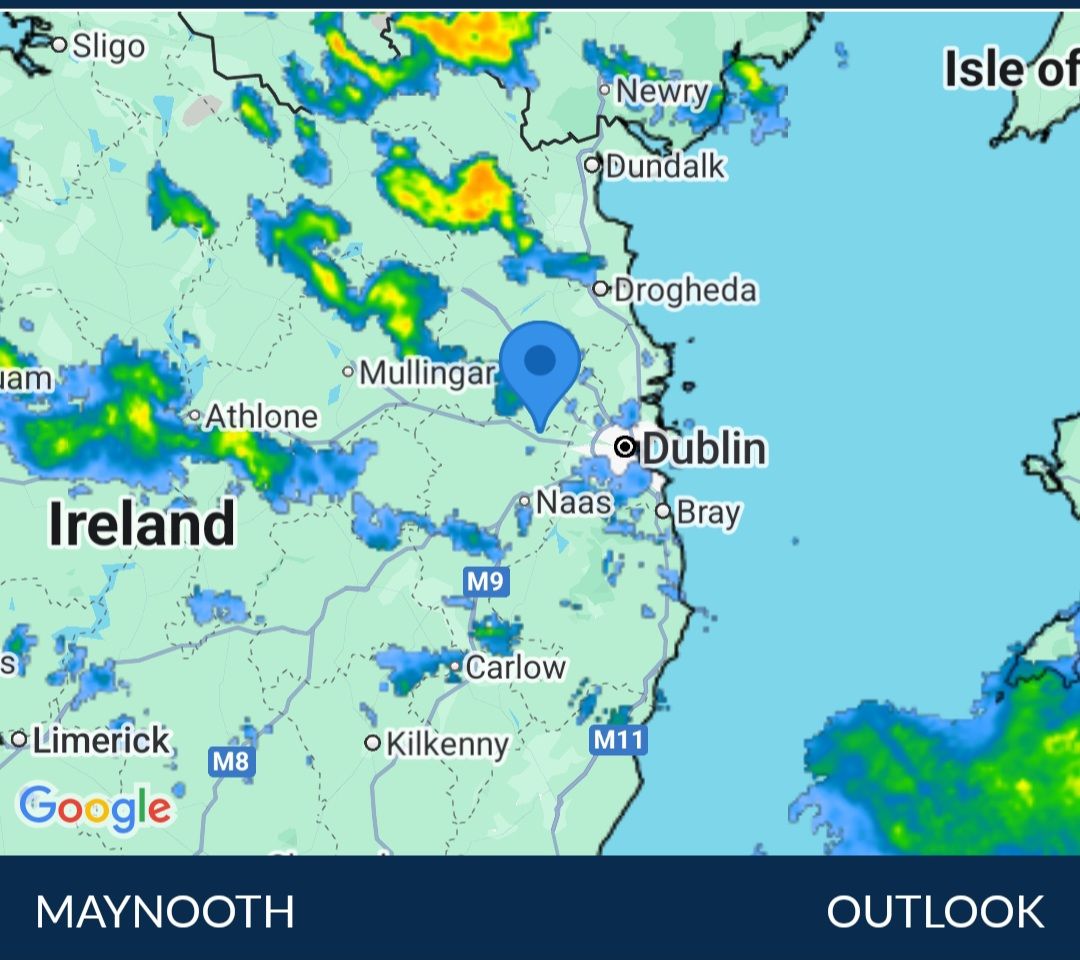
It’s been an interesting couple of days while Storm Amy worked its way over the island of Ireland and on to Scotland. The worst hit County in the Republic was Donegal but even here in the shelter of County Kidlare there were gusts over 100 hm/h on Friday, and quite a lot of rain as you can see from the first two radar* plots above. Quite a few people, quite reasonably if they were heading towards the weather, went home a bit early on Friday.
Initially the wind was southerly, and it felt surprisingly warm, despite the rain, but by this morning it had veered westerly, the rain had turned to showers, and the wind has now moderated substantially.
I spent some time this afternoon clearing up leaves and small branches that had fallen during the storm, as well as looking for signs of damage. But all’s well. No power cuts either. My big worry however is this tree just outside my house:
It is far too tall for its location, and has been leaning alarmingly for some time. If it topples in the direction it is leaning it will hit my house. I’ve been on to Kildare County Council a few times about it, actually. I don’t want them to chop it down, but I do think they should cut back the upper branches so that if it falls it won’t hit either mine or my neighbour’s house. Unfortunately, they’ve refused to do anything at all. Time for another go at them, I think. It will cost them a lot less to deal with it now than the sum they will have to pay me if serious damage is caused by their negligence.
*In case you’re interested, Met Éireann’s weather radars are located at Dublin and Shannon, and operate at 5.64 GHz (C-band).
The views presented here are personal and not necessarily those of my employer (or anyone else for that matter).
Feel free to comment on any of the posts on this blog but comments may be moderated; anonymous comments and any considered by me to be vexatious and/or abusive and/or defamatory will not be accepted. I do not necessarily endorse, support, sanction, encourage, verify or agree with the opinions or statements of any information or other content in the comments on this site and do not in any way guarantee their accuracy or reliability.







 In the Dark