Archive for Maynooth University

Maynooth in the News

Posted in Biographical, Euclid, Maynooth, The Universe and Stuff with tags , , on July 12, 2023 by telescoper

I was in a meeting this morning at which it was mentioned that the recent launch of the Euclid satellite has generated quite a lot of publicity in the news media for Maynooth University. There’s a piece in the Sunday Times (Ireland Edition), another in Silicon Republic, and an online feature for RTÉ Brainstorm as well as a radio segment on Morning Ireland and another on NewsTalk.

Maynooth University plugged these items in on the “Maynooth in the News” feed on its main webpage, along with many other items that show the University in a good light.

Conspicuous by its absence from that feed, however, is the biggest story surrounding Maynooth University in recent days, namely the appalling decision by the President to scrap elections to the Governing Authority of the University in favour of having representatives chosen only by the President. This is just one example of the increasingly intransigent and authoritarian management of the University. Can anyone justify the complete disenfranchisement of the staff of the University from the Governance of the university? Or that an Executive body should select the Board to which it is supposed to be accountable?

I know I’m not the only person employed by this University who thinks this decision is a terrible one – my Union, IFUT is strongly opposed- but it has been already been imposed and now we have no say. At least you can read about, e.g. here in the Times Higher.

One story you can’t read about however concerns the outcomes of Maynooth University’s “Staff Climate and Culture Survey” which was carried out in 2022 with the promise made to participants that results would be published in early 2023. No such results were ever communicated to staff and all mention of this survey has been wiped off the University’s web pages. I don’t know why this happened, but I venture to suggest that if the results had been good the Maynooth publicity team would not have hesitated to publish them.

Since the Management of Maynooth University has chosen to close off any internal channels by which academic and other staff can communicate their views, it seems that the only means of communication open to us is via the external media. Perhaps the Times Higher will run a story on the Curious Case of the Missing Staff Survey?

Last Call for the Maynooth MSc in Theoretical Physics & Mathematics!

Posted in Education, Maynooth with tags , , on June 26, 2023 by telescoper

While I remember, here’s another plug for our new MSc course in Theoretical Physics & Mathematics, further details of which may be found here. Maynooth University offers Taught Masters Scholarships for high-flying applicants but you need to apply by 30th June to get one, which is why I’m advertising this one more time.

The new postgraduate course will be run jointly between the Departments of Theoretical Physics and Mathematics & Statistics, with each contributing about half the material. The duration is one calendar year (full-time) or two years (part-time) and consists of 90 credits in the European Credit Transfer System (ECTS). This will be split into 60 credits of taught material (split roughly 50-50 between Theoretical Physics and Mathematics) and a research project of 30 credits, supervised by a member of staff in a relevant area from either Department.

This new course is a kind of follow-up to the existing undergraduate BSc Theoretical Physics & Mathematics at Maynooth, also run jointly. We think the postgraduate course will appeal to many of the students on that programme who wish to continue their education to postgraduate level, though applications are very welcome from suitably qualified candidates who did their first degree elsewhere.

Postgraduate admissions in Ireland operate differently from the UK, in that there is a central system in Ireland (called PAC) that is similar to the undergraduate admissions system; in the UK PG courses are dealt with by individual institutions. You will need to apply online via PAC after the following the instructions here. The requisite PAC code for the full-time version of the course is MHQ56.

Examinations, Past and Future

Posted in Biographical, Education, mathematics, Maynooth with tags , , , , , on June 7, 2023 by telescoper

No sooner is yesterday’s departmental Examination Board done and dusted (after just two and a half hours) when attention switches to school examinations. The Junior Certificate and Leaving Certificate examinations both start today, so the first thing I need to do is wish everyone taking examinations the very best of luck!

Among other things, the results of the leaving certificate examinations are important for next year’s University admissions. As we gradually dispense with the restrictions imposed during the pandemic, it seems this year we just might have the results before the start of teaching at the end of September. That will make a nice change!

In the system operating in England and Wales the standard qualification for entry is the GCE A-level. Most students take A-levels in three subjects, which gives them a relatively narrow focus although the range of subjects to choose from is rather large. In Ireland the standard qualification is the Leaving Certificate, which comprises a minimum of six subjects, giving students a broader range of knowledge at the sacrifice (perhaps) of a certain amount of depth; it has been decreed for entry into this system that an Irish Leaving Certificate subject counts as about 2/3 of an A-level subject for admissions purposes, so Irish students do the equivalent of at least four A-levels, and many do more than this. It’s also worth noting that all students have to take Mathematics at Leaving Certificate level.

Overall I prefer the Leaving Certificate over the UK system of A-levels, as the former gives the students a broader range of subjects than the latter (as does the International Baccalaureate). I would have liked to have been allowed to take at least one arts subject past O-level, for example.

For University admissions points are awarded for each paper according to the marks obtained and then aggregated into a total CAO points, CAO being the Central Applications Office, the equivalent of the UK’s UCAS. This means, for example, that our main Science pathway at Maynooth allows students to study Physics without having done it at Leaving Certificate level. This obviously means that the first year has to be taught at a fairly elementary level, but it has the enormous benefit of allowing us to recruit students whose schools do not offer Physics.

As much as I like the Leaving Certificate, I have concerns about using a simple CAO points count for determining entry into third-level courses. My main concern about is with Mathematics. Since the pandemic struck, students have been able to choose to questions from just six out of ten sections. That means that students can get very high grades despite knowing nothing about 40% of the syllabus. That matters most for subjects that require students to have certain skills and knowledge for entry into University, such as Physics.

I’ve been teaching the first year Mathematical Physics course in Maynooth for about 5 years. At the start of the module I put up a questionnaire asking the students about various mathematical concepts and asking them how comfortable they feel with them. It’s been noticeable how the fraction that are comfortable with basic differentiation and integration has been falling. That’s not a reflection on the ability of the students, just on the way they have been taught. As well as making adjustments during the pandemic for online teaching, etc, I have changed various things about the teaching, in particular adjusting the way I have introduced calculus into the module. Another problem is that we have been forced to start teaching first-years a week late because of delays to the CAO process caused by the pandemic.

I’ll be on sabbatical next academic year so I won’t be teaching the first-years (or anyone else) in September. It’s time to hand these challenges on to someone else!

Terms Ending

Posted in Biographical, Education, Maynooth with tags , , , on May 26, 2023 by telescoper

So here I am, on a fine early summer evening, waiting for the train into Dublin for the last performance of the season by the National Symphony Orchestra at the National Concert Hall. I’m looking forward to it very much, as the second half is a piece I’ve never heard before. I’ll write more about it tomorrow.

There’s an end of term feeling in other ways, too. The examination period ended earlier this week, and most students have now vanished for the summer. Quite a few staff members will be marking scripts at home too. Campus has been very quiet for the last few days. The train I’m now on, the 17.10 from Maynooth to Connolly, usually very busy on a Friday, is almost empty today.

The one exception to the general lack of activity on campus happened on Wednesday when a mysterious ferret appeared on Campus. It even tried to get into the Science Building, but failed (I suppose) because it didn’t have a swipe card. It seems this critter was a family pet that had got out and went on an adventure. It was spotted at various locations around the town before being collected by its owner and returned safely home.

Artist’s impression of the ferret.

Despite that flurry of excitement, I managed to finish marking my examinations and other assessments, but the grades still need to be checked. They then have to be approved by the Departmental Exam Board in early June. They then get a final dose of scrutiny at the University Examination Board. Students will have to wait almost another month to get their results. It’s quite a slow process, but it’s right to be careful.

MSc in Theoretical Physics & Mathematics at Maynooth

Posted in Education, Maynooth, The Universe and Stuff with tags , , on May 25, 2023 by telescoper

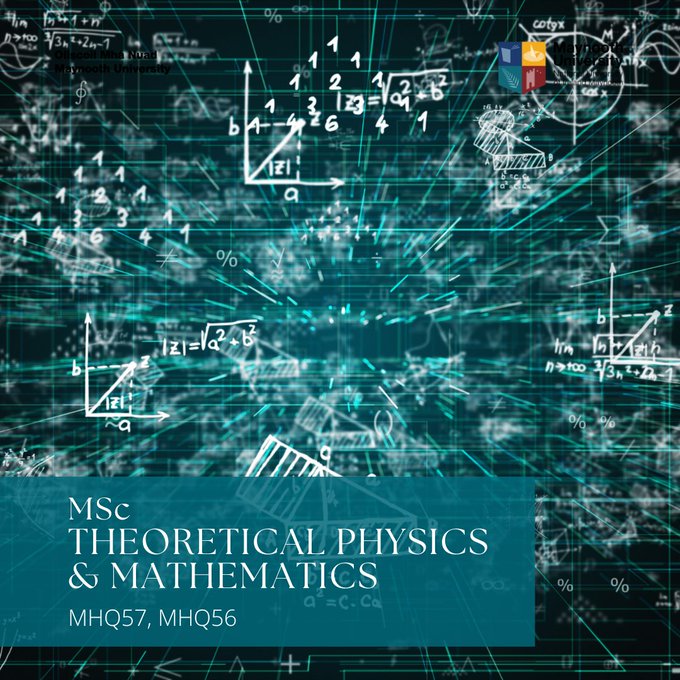
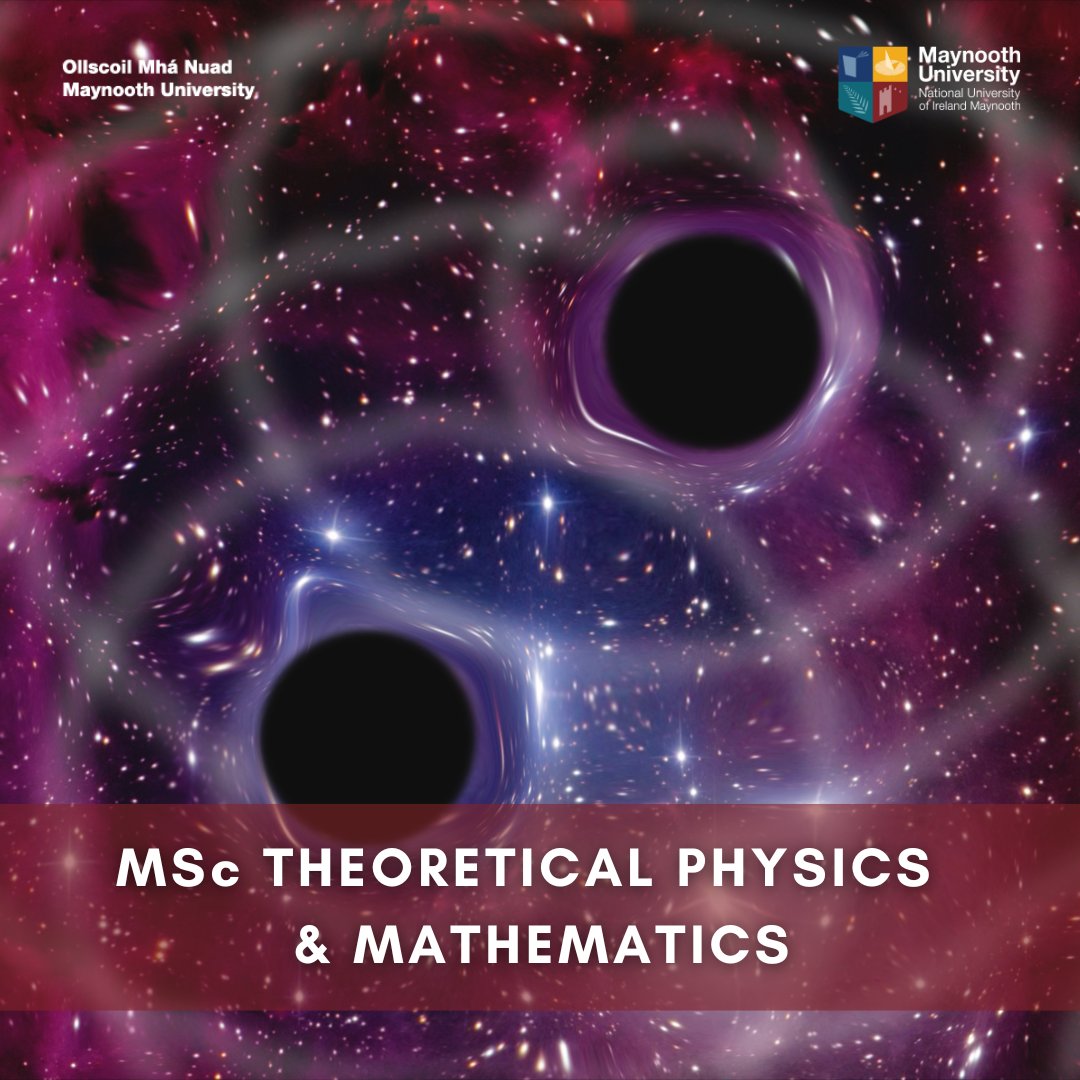
Now that the exams are over I thought I’d take the opportunity to promote our new MSc in Theoretical Physics & Mathematics. The existence of this was only announced in April and it was fully opened to applications just a couple of weeks ago. The University’s social media people have been pushing it very hard recently with, so I’m told, some success! Here are a few examples of the images that have been used in the ads:

Anyway, this (new) postgraduate course will be run jointly between the Departments of Theoretical Physics and Mathematics & Statistics, with each contributing about half the material. The duration is one calendar year (full-time) or two years (part-time) and consists of 90 credits in the European Credit Transfer System (ECTS). This will be split into 60 credits of taught material (split roughly 50-50 between Theoretical Physics and Mathematics) and a research project of 30 credits, supervised by a member of staff in a relevant area from either Department.

This new course is a kind of follow-up to the existing undergraduate BSc Theoretical Physics & Mathematics at Maynooth, also run jointly. We think the postgraduate course will appeal to many of the students on that programme who wish to continue their education to postgraduate level, though applications are very welcome from suitably qualified candidates who did their first degree elsewhere.

Postgraduate admissions in Ireland operate differently from the UK, in that there is a central system in Ireland (called PAC) that is similar to the undergraduate admissions system; in the UK PG courses are dealt with by individual institutions. You will need to apply online via PAC after the following the instructions here. The requisite PAC code for the full-time version of the course is MHQ56.

If you apply by 30th June you may be eligible for one of the University’s Taught Masters Scholarships!

After the Lectures, before the Examinations

Posted in Education, Maynooth, The Universe and Stuff with tags , , on May 11, 2023 by telescoper

This morning I did my last teaching session of the Academic Year 2022-3, a revision lecture/tutorial on Computational Physics. It was optional, as this is officially a study break, and was at 9am, but I had about 40% attendance which wasn’t bad in the circumstances. As is often the case with optional sessions, I think the students who came were the keenest and probably therefore those who least needed last-minute tips for the examination, but that’s always the way.

The Examination Period starts tomorrow, but most of the students who turned up this morning have their first examination on Monday. My paper is on Saturday next, 20th May.

Anyway, now that my teaching is over I thought I’d take the opportunity to wish all students the best for their examinations:

You shouldn’t really be relying on luck of course, so here are some tips (especially for physics students, but applicable elsewhere).

  1. Try to get a good night’s sleep before the examination and arrive in plenty of time before the start. Spending all night cramming is unlikely to help you do well.
  2. Prepare well in advance so you’re relaxed when the time comes.
  3. Read the entire paper before starting to answer any questions. In particular, make sure you are aware of any supplementary information, formulae, etc, given in the rubric or at the end.
  4. Start off by tackling the question you are most confident about answering, even if it’s not Question 1. This will help settle any nerves. You’re under no obligation to answer the questions in the order they are asked.
  5. Don’t rush! Students often lose marks by making careless errors. In particular, check all your numerical results on your calculator at least twice
  6. Please remember the units!
  7. Don’t panic! You’re not expected to answer everything perfectly. A first-class mark is anything over 70%, so don’t worry if there are bits you can’t do. If you get stuck on a part of a question, don’t waste too much time on it (especially if it’s just a few marks). Just leave it and move on. You can always come back to it later.

A Midweek Lecture

Posted in Biographical, Education with tags , , , , on May 3, 2023 by telescoper

It’s halfway through the last week of teaching term, and it’s been a busy day. Earlier on, I gave my final “proper” lecture of the Semester in Advanced Electromagnetism, about the reflection and transmission of electromagnetic waves at interfaces. That’s basically optics, but done in terms of the electric and magnetic fields. I have two more classes this week, on Friday, but these will be revision tutorials devoted to going through past examination questions etc. I’ve had special requests for problems involving conformal transformations and the method of images, so that should be fun!

Meanwhile, my Computational Physics class are working hard on their projects, due in on Friday. My office is opposite the lab so I’ve had a few students coming to ask for help, but mostly they are just beavering away. I hope most of them are writing up by now. I just did a quick check and nobody has submitted anything yet. I suppose that, as usual, they will all wait until the last minute!

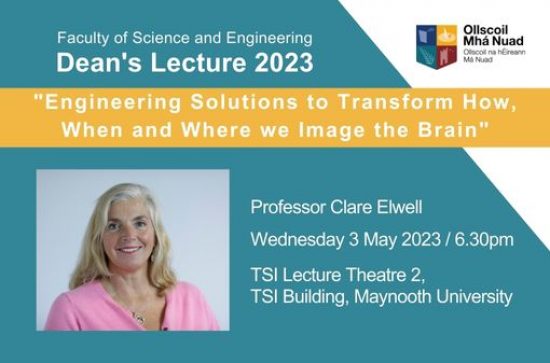
I have a telecon coming up in a few minutes, but after that I’ll be attending this public lecture:

The speaker, Professor Clare Elwell is a physicist at University College London, where she is the Director of the Near Infrared Spectroscopy (NIRS) Group. Specifically, Prof Elwell develops non-invasive techniques to study brain function, paving the way for defining early markers of autism, developing more targeted care following brain injury, and for better understanding brain development in global health settings. Prof Elwell described her pioneering work in using invisible near infrared light to probe the human brain. Near Infrared Spectroscopy (NIRS) is a portable, wearable, low-cost brain imaging technology which can be used to study the brain in newborn babies, toddlers and adults in a range of different scenarios.

I’ll post an update when I get home after the lecture. Actually, there’s no need because the lecture was streamed and a recording is now available. The lecture starts a fairly long way in and the sound didn’t start until part-way through the introductions so I’ve cued the link to the start of the lecture itself.

It was a very interesting lecture by a very engaging speaker. The audience was smaller than I’d expected, though, with less than a hundred in the theatre. This might be because it was scheduled in the middle of the last week of teaching term, which is a very busy time of year for academic staff.

No Tension at Redshift Ten

Posted in Maynooth, The Universe and Stuff with tags , , , , , on April 29, 2023 by telescoper

I know it’s the Bank Holiday weekend but I could resist a quick post about a new paper that hit the arXiv yesterday (where all new astrophysics papers worth reading can be found). It is led by Joe McCaffrey who is a PhD student in the Department of Theoretical Physics at Maynooth University. The paper has been submitted to the Open Journal of Astrophysics, but obviously I am conflicted so have assigned it to another editor.

UPDATE: the paper is now published here.

As many of you will be aware, there’s been a considerable to-do not to mention a hoo-hah about the detections by JWST of some galaxies at high redshift. Some of these have been shown not to be galaxies at high redshift after all, but some around z=10 seem to be genuine.

Anyway, the abstract of Joe’s paper is this:

Recent observations by JWST have uncovered galaxies in the very early universe via the JADES and CEERS surveys. These galaxies have been measured to have very high stellar masses with substantial star formation rates. There are concerns that these observations are in tension with the ΛCDM model of the universe, as the stellar masses of the galaxies are relatively high for their respective redshifts. Recent studies have compared the JWST observations with large-scale cosmological simulations. While they were successful in reproducing the galaxies seen in JADES and CEERS, the mass and spatial resolution of these simulations were insufficient to fully capture the early assembly history of the simulated galaxies. In this study, we use results from the Renaissance simulations, which are a suite of high resolution simulations designed to model galaxy formation in the early universe. We find that the most massive galaxies in Renaissance have stellar masses and star formation rates that are entirely consistent with the observations from the JADES and CEERS surveys. The exquisite resolution afforded by Renaissance allows us to model the build-up of early galaxies from stellar masses as low as 104 M⊙ up to a maximum stellar mass of a few times 107 M⊙. Within this galaxy formation paradigm, we find excellent agreement with JADES and CEERS. We find no tension between the ΛCDM model and current JWST measurements. As JWST continues to explore the high redshift universe, high resolution simulations, such as Renaissance, will continue to be crucial in understanding the formation history of early embryonic galaxies.

arXiv:2304.13755

The key figure is this one:

The solid curves show the number of galaxies of a given mass one would expect to see as a function of redshift in fields comparable to those observed with estimated values from observations (star-shaped symbols). As you can see the observed points are consistent with the predictions. There’s no tension, so you can all relax.

A Draft Strategic Plan for Maynooth (via ChatGPT)

Posted in Education, Maynooth with tags , , on April 23, 2023 by telescoper

Senior managers at Maynooth University are currently engaged in the expensive and time-consuming process of compiling a new “Strategic Plan“. All universities seem to feel the need to have one of these, although I’ve never understood what purpose is served by such a document. They are all remarkably similar to one another in any case. Anyway, this is what ChatGPT produced for free in a matter of seconds in response to the query “please write a first draft strategic plan for Maynooth University”:

Introduction:

Maynooth University is a leading university in Ireland founded in 1795. The University aims to provide high-quality education to its students and prepare them for successful careers and to contribute positively to society as a whole. As a forward-thinking institution, Maynooth University recognizes the need for strategic planning to continue its legacy of excellence and ensure that it remains at the forefront of education and research.to conduct innovative research that address the challenges of the 21st century. In order to achieve its goals, the university needs to develop a strategic plan that outlines its priorities and the steps it needs to take to achieve them.

Vision:

The vision for Maynooth University is to become a world-class institution of higher education that promotes excellence in teaching, research and community engagement. The university will strive to provide a stimulating and inclusive environment that inspires its students, faculty and staff to achieve their full potential.

Mission:

The mission of Maynooth University is to provide a transformative student experience that prepares graduates to be leaders in their fields. The university will contribute to the creation and dissemination of new knowledge through its research and scholarship. It will engage with local, national and international communities to promote social and economic development.

Goals:

The following are the key goals of Maynooth University:

1. To enhance the quality of teaching and learning:

Maynooth University will provide its students with a challenging and engaging learning experience that equips them with the knowledge and skills required to succeed in their chosen fields. The university will invest in innovative teaching methods, modern teaching equipment, and professional development opportunities for its faculty to enhance their teaching skills and delivery.

2. To advance research and scholarship:

Maynooth University aims to become a leading research institution known for its excellence in research, innovation, and scholarship. The university will prioritize research funding and support for its faculty, students, and research teams. It will also invest in research infrastructure, facilities and equipment to support cutting-edge research across a range of disciplines.

3. To foster community engagement:

Maynooth University will strive to promote social and economic development through community engagement, public service, and outreach. The university will work with communities, government, and other stakeholders to address societal challenges and create positive social impact. Maynooth University will also prioritize outreach and engagement with schools, businesses, and cultural organizations in the region.

Strategies:

The following are the strategies that Maynooth University will use to achieve its goals:

  1. Develop innovative and relevant degree programs that meet the needs of employers and society.
  2. Support faculty development, recruitment, and retention to ensure that Maynooth University maintains its position as a leading research institution.
  3. Expand research partnerships, collaborations and funding through strategic alliances with other universities, government and industry.
  4. Foster a culture of interdisciplinary research, linking research with teaching and learning, and research with community engagement.
  5. Promote a sense of community and belonging among the Maynooth University community through effective communication and engagement strategies.

Conclusion:

Maynooth University is committed to providing a world-class education, conducting innovative research, and contributing to the social and economic development of communities. The strategic plan outlines the goals and strategies that the university will undertake to achieve its vision and mission. The university will continually review and update its strategies to ensure they are aligned with changes in the higher education landscape to maintain its standing as a leading institution of higher learning.

Maynooth Open Day Admissions

Posted in Education, Maynooth with tags , , on April 22, 2023 by telescoper
The Day Before The Open Day

Well, it’s Saturday 22nd April and it’s another Open Day at Maynooth University. I was there for the similar event at this time last year, and many others before that, but others are doing it this year so I’m sitting at home drinking coffee and writing this blog. I hope it’s going well (though it is raining quite heavily as I write this).

This year’s event is in the new TSI building on the North Campus, a change of venue since last year when it was in the Iontas building. I went in there last night on my way home to have a look at the setup. Our stand was pretty bare then but it will be a bit more exciting now (I hope).

In previous years I taught the first-year module in Mathematical Physics taken by new students, some of whom recognized me from an Open Day. I won’t be teaching the first-years this September, though. I won’t be teaching anyone else this September, either, as I’ll be away on sabbatical for the whole academic year.

The real problem facing first-years, however, is that it seems that yet again this year’s Leaving Certificate results will be late. Last year, new students started a week later than returning students, meaning their teaching term was truncated. The shift from August release to September was excusable during the Covid-19 pandemic, but its continuation is a farcical and is causing huge stress for new students, arising from difficulties in finding accommodation and no time for proper induction events on top of the delayed start to lectures. Well have to wait until June to see how much all this has affected progression rates.

There was an opinion piece about this in the Irish Times last week, from an academic at Trinity, which I agree with and I think is well worth reading. Here’s a quote:

This may all have once felt like an inevitable consequence of the pandemic, but the novelty has long since worn off. Students and universities alike have been left frustrated and hugely discommoded.

The word “discommoded” is a considerable understatement. Let’s just hope that the start of next year is less chaotic than the last three. The academic year at Maynooth starts and ends a bit later than other Irish third-level institutions, so our students have only lost a week at the beginning. Elsewhere more time has been lost: two weeks at Trinity, for example. I wonder if this particular selling-point will be mentioned to prospective students at the Open Day?