Archive for Modified Newtonian Dynamics

Weekly Update from the Open Journal of Astrophysics – 02/08/2025

Posted in OJAp Papers, Open Access, The Universe and Stuff with tags , , , , , , , , , , , , , , , , , , , , , , , , , , , , on August 2, 2025 by telescoper

It’s Saturday morning again, and it’s the start of a new month, so it’s time for an update of papers published at the Open Journal of Astrophysics. Since the last update we have published five new papers, which brings the number in Volume 8 (2025) up to 110, and the total so far published by OJAp up to 345. I expect we’ll the total number we published last year (120) sometime this month. I predict that by the end of this year we will have published around 180 papers in Volume 8 and around 400 altogether.

The papers published this week, with their overlays, are as follows. You can click on the images of the overlays to make them larger should you wish to do so.

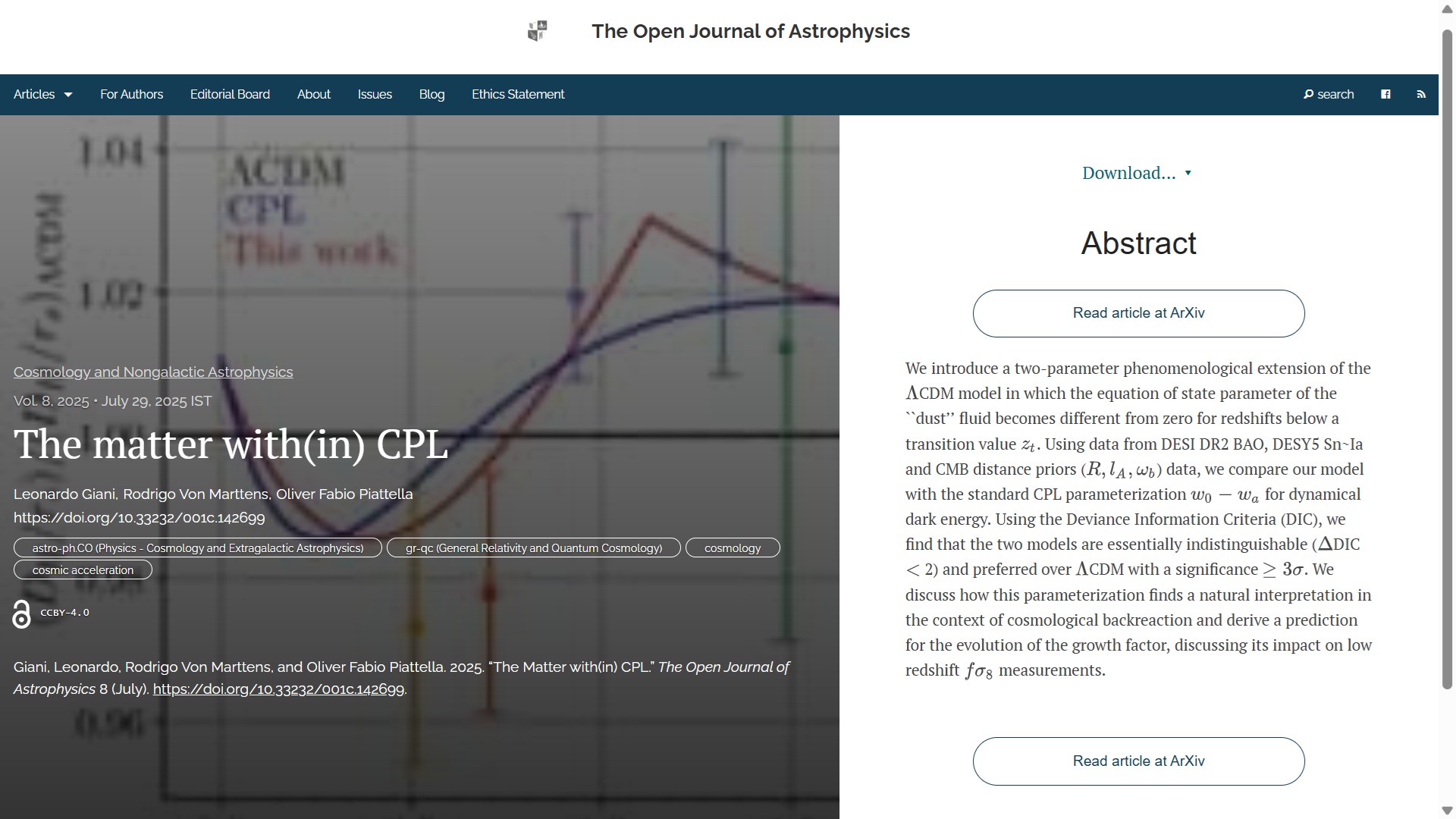
The first paper to report is “The matter with(in) CPL” by Leonardo Giani (U. Queensland, Australia), Rodrigo Von Marttens (Universidade Federal da Bahia, Brazil) and Oliver Fabio Piattella (Universita degli Studi dell’Insubria, Italy). This was published on Monday 29th July 2025 in the folder Cosmology and Nongalactic Astrophysics. This article presents a new parameterization of the standard model and its implications for the interpretation of cosmological observations.

The overlay is here:
 

The officially-accepted version can be found on arXiv here.

The second paper of the week, published on Tuesday 30th July in the folder Instrumentation and Methods for Astrophysics, is “An automated method for finding the most distant quasars” by Lena Lenz, Daniel Mortlock, Boris Leistedt & Rhys Barnett (Imperial College London, UK) and Paul C. Hewett (U. Cambridge, UK)”.  This paper presents an automated, reproduceable and objective high-redshift quasar selection pipeline, tested on simulations and real data from the Sloan Digital Sky Survey (SDSS) and UKIRT Infrared Deep Sky Survey (UKIDSS). The overlay is here:


You can find the officially accepted version of the paper on arXiv here.

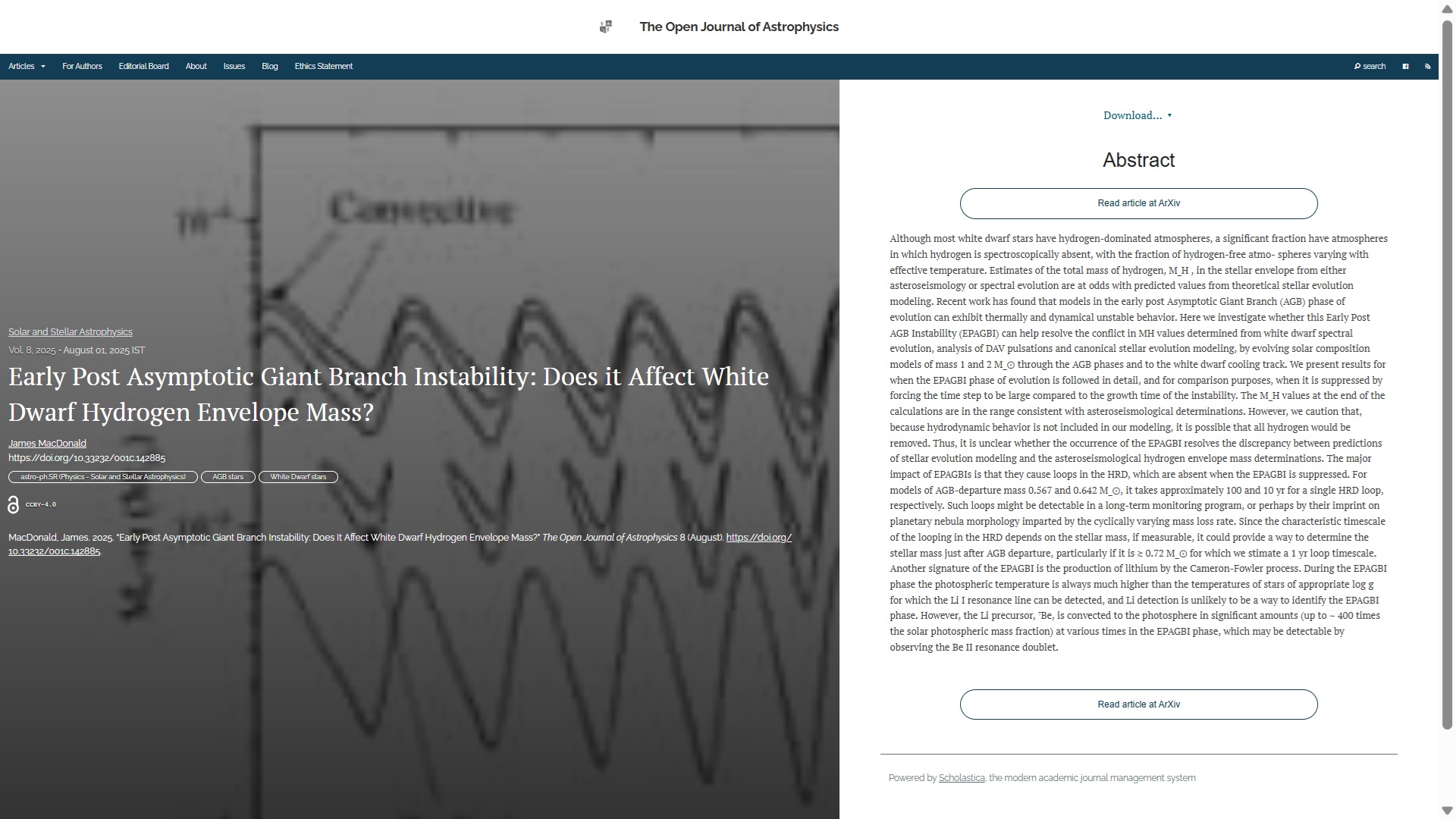
The third paper of the week is “Early Post Asymptotic Giant Branch Instability: Does it Affect White Dwarf Hydrogen Envelope Mass?” by James MacDonald (University of Delaware, USA). This one was published on Friday 1st Auguest (i.e. yesterday) in the folder Solar and Stellar Astrophysics. It is an investigation into whether Early Post AGB Instability (EPAGBI) can affect determinations of the total abundance of hydrogen in white dwarf stars.

The overlay is here:
The final version is on arXiv here.


The fourth paper of the week, also published on Friday 1st August, is “Light Echoes of Time-resolved Flares and Application to Kepler Data” by Austin King and Benjamin C. Bromley (University of Utah, USA).  This describes a new model for circumstellar disks that incorporates echoes produced by extended, time-resolved flares. It is published in the folder Solar and Stellar Astrophysics. Here is the overlay:
You can find the officially-accepted version on arXiv here.


The fifth and final article published this week, also published on Friday 1st August,  is “Wide Binaries from Gaia DR3 : testing GR vs MOND with realistic triple modelling” by Charalambos Pittordis, Will Sutherland and Paul Shepherd (Queen Mary, University of London, UK). This presents a test for modified gravity from a sample of wide-binary stars from Gaia DR3, finding that (unmodified) Newtonian gravity provides a better fit to the data. It is in the folder Astrophysics of Galaxies.

The overlay is here:


You can find the officially-accepted version on arXiv here.

And that’s all the papers for this week. I’ll do another update next Saturday.

MOND: Open to Debate

Posted in OJAp Papers, The Universe and Stuff with tags , , on June 8, 2023 by telescoper

I didn’t know until today that there is a meeting going on this week at the University of St Andrews with the title 40 Years of MOND (Modified Newtonian Dynamics). Here’s a description of the conference.

The source of the gravitational field in objects ranging from individual galaxies to the largest scales in the universe is one of the biggest unanswered questions of modern physics. It is generally assumed that the gravitational field in extragalactic systems is dominated by dark matter particles occupying a dark sector that represents new physics beyond the stubbornly successful Standard Model of particle physics. So far, candidates for these particles have evaded detection in remarkably sensitive laboratory experiments: the evidence for missing mass remains entirely astrophysical in nature.

Forty years ago, Weizmann-Institute professor Mordehai Milgrom published a series of three articles in The Astrophysical Journal in which he proposed that the dark matter phenomenon is not due to unknown particles, but to a departure from the known laws of dynamics when the acceleration is about eleven orders of magnitude smaller than that on Earth’s surface (Milgrom 1983). Only one year later, in 1984, Jacob Bekenstein and Mordehai Milgrom developed this Modified Newtonian Dynamics (or Milgromian Dynamics, MOND) into a non-relativistic Lagrangian theory (Bekenstein & Milgrom 1984). During the ensuing decades, MOND has developed into a multifaceted paradigm that includes several non-relativistic and relativistic theory proposals, as well as possible connections with quantum gravity theories. Most remarkably, MOND has successfully made many striking and unique a priori predictions.

This conference will commemorate the last 40 years of this modern gravitational paradigm, of its predictive successes as well as its outstanding challenges, and will look to the road ahead.

It looks like an interesting meeting but what caught my eye in particular about it was this pic I found on Twitter today taken at the start of one of the talks:

The work presented apparently has been the focus of quite a lot of debate and several follow-up studies. I just thought I’d mention that it was published earlier this year in the Open Journal of Astrophysics:

It’s good to see work appearing in one of our publications attracting attention at an international conference!

New Publication at the Open Journal of Astrophysics

Posted in OJAp Papers, Open Access, The Universe and Stuff with tags , , , , , , on February 3, 2023 by telescoper

The articles are coming in thick and fast at the Open Journal of Astrophysics. and why trying to get them refereed and published as quickly as we can. It’s time to announce yet another paper. This one was published officially yesterday (2nd February 2023) but I just found time to post about it here today before I go to my 9am tutorial.

The latest paper is the 4th paper in Volume 6 (2023) as well as the 69th in all. This one is in the Astrophysics of Galaxies folder.

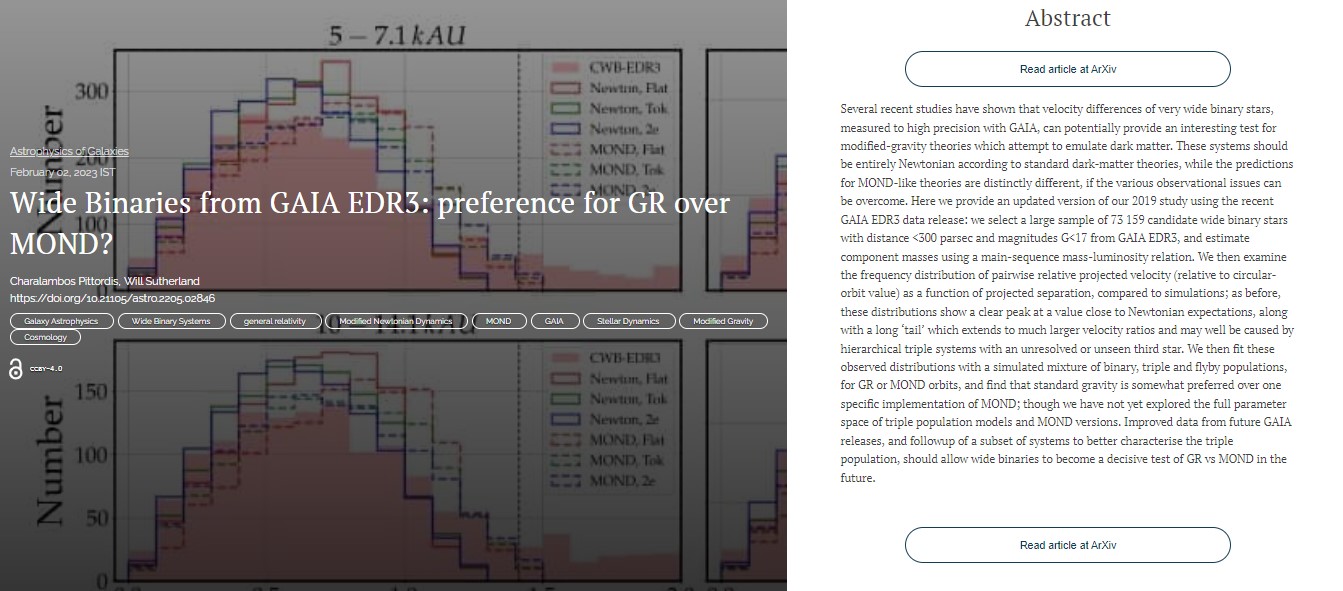
The latest publication is entitled “Wide Binaries from GAIA EDR3: preference for GR over MOND?”.  The authors of this paper,  Charalambos Pittordis and Will Sutherland, are both based at Queen Mary, University of London. We published a related paper last month.

Here is a screen grab of the overlay which includes the  abstract:


You can click on the image to make it larger should you wish to do so. You can find the officially accepted version of the paper on the arXiv here.

Modified Gravity: Evidence from Cavendish Experiments?

Posted in The Universe and Stuff with tags , , , , , on January 15, 2019 by telescoper

A paper by Norbert Klein caught my eye as I tried to catch up on my arXiv reading after a couple of days away last week. It’s called Evidence for Modified Newtonian Dynamics from Cavendish-type gravitational constant experiments and the abstract reads:

Recent experimental results for the gravitational constant G from Cavendish-type experiments were analysed in the framework of MOND (Modified Newtonian Dynamics). The basic assumption for the analysis is that MOND corrections apply only to the component of the gravitational field which leads to an accelerated motion of the pendulum body according to Newtons second law. The analysis is based on numerical solutions of the MOND corrected differential equation for a linear pendulum at small acceleration magnitudes of the order of Milgroms fundamental acceleration parameter a0 = 10-10m s-2 for the case of a mixed gravitational and electromagnetic pendulum restoring force. The results from the pendulum simulations were employed to fit experimental data from recent Cavendish-type experiments with reported discrepancies between G values determined by different measurement methods for a similar experimental setup, namely time of swing, angular acceleration feedback, electrostatic servo and static deflection methods. The analysis revealed that the reported discrepancies can be explained by MOND corrections with one single fit parameter. The MOND corrected results were found to be consistent with a value of G = 6.6742 x 10⁻¹¹ m3 kg-1 s-2 within a standard deviation of 14 ppm.

I have edited the abstract slightly for formatting and added the link to an explanation of MOND. You can find a PDF of the paper here.

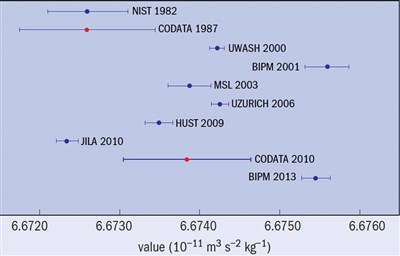
I blogged about the discrepancies between different determinations of Newton’s Gravitational Constant G a few years ago here, where you can find this figure:

The claim that Modified Newtonian Dynamics can resolve these `discrepancies’  is very bold and I’m very skeptical of the arguments presented in this paper. It seems to me far more likely that the divergence in experimental measurements is due to systematics.  If anyone else has different views, however,  please feel free to share them through the comments box.