The song Mad about the Boy was written by Noel Coward and published in 1932. It’s a song about an infatuation with a movie star and has generally been performed by female singers, although it was apparently inspired by Coward’s own crush on Douglas Fairbanks Jnr (which wasn’t reciprocated). The song became popular again in 1992 when a version recorded by Dinah Washington was used in a famous Levi commercial. . I never liked Noel Coward’s own recording – with him singing in a curious falsetto – very much at all, although I suppose it is authentic to what Coward was writing about. For a long time my favourite version was Dinah Washington’s but recently I came across this version, which has now, for me, eclipsed that one.
Blossom Dearie was a very underrated singer and pianist. Her voice – very high and girlish – was well suited to the whimsical songs she seemed to like to sing, but it meant that she wasn’t taken as seriously as a singer as she might have been. The lack of appreciation of her singing also extended to her piano playing, which was consistently excellent and innovative. No less a pianist than the great Bill Evans was a huge admirer of her musicianship, and he even attributed his use of stacked fourths in the left hand as inspired by Blossom Dearie. Other reasons to like this recording are that it was made live at Ronnie Scott’s Club in London and she goes straight into a verse that’s missed in many versions, probably because it uses the word “gay”. I love the way the accompaniment changes the mood each time she repeats the verses.
I’ve been meaning to post this track for some time but for some reason haven’t got around to it until now. It was recorded in Germany in 1951 and is a solo performance by legendary guitarist, blues singer and guitarist Big Bill Broonzy. The song, often called the Ballad of John Henry, tells the story of the folk hero John Henry, a man whose job was to use a 12lb hammer drive a steel drill into a rock to make holes for explosives to blast the rock in constructing a railroad tunnel. In the legend, John Henry is pitted against a steam-powered drill. He beats the machine, but is exhausted by his efforts and dies with his hammer in his hand.
By the way, you will hear reference in the song to a “shaker”. This was a man whose job it was to hold the drill – an object like a chisel – against the rock while it was struck by the hammer, and move it about to loosen the rock around it. I dread to think what happened if the hammerman missed the drill.
The historical facts around the location of the story of John Henry and indeed the identity of the hero are open to debate, but it’s a wonderful song and this is a brilliant and very characteristic performance of the song by Big Bill Broonzy whose singing, playing, and announcement to the song, will bring it all back to anyone lucky enough to hear him in the flesh. Bill Broonzy was on a European tour at the time this record was made, and I have back at home a very old LP of him singing and playing at the Dancing Slipper in West Bridgford, in Nottingham. I also have a copy of the album from which this performance is taken, the other side of which is by Graham Bell and his Australian Jazz Band. The full introduction to John Henry begins with Bill Broonzy saying rather sardonically “Thank you. Thank you. Thank you. I’m glad to be here too, don’t think I ain’t” before the rest of it that you hear.
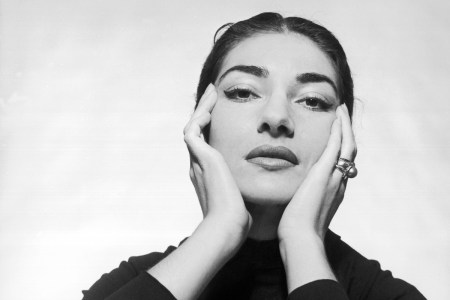
Today, 2nd December 2023, is the centenary of the birth of the most renowned opera singer of her time, Maria Callas. I couldn’t let this occasion pass without posting a tribute, Tonight I’ll be sipping wine and listening to some historic recordings of her. I think every classical radio station in the world will tonight be paying tribute to this remarkable artist.
Maria Callas was born on December 2nd 1923 in New York city, of Greek parents who had moved there the previous year, and christened Maria Anna Sofia Cecilia Kalogeropoulou. Her mother, disenchanted with her deteriorating marriage, abandoned her husband (Maria’s father) and took Maria and her sister back to Athens in 1937. Maria enrolled at the National Conservatoire of Greece the same year after winning a scholarship with the quality of her voice, which
was warm, lyrical, intense; it swirled and flared like a flame and filled the air with melodious reverberations.
At this age, Maria was a rather plump young lady with a rather deep singing voice. Initially, she aspired to be a contralto but at the Conservatoire she was encouraged instead to become a dramatic soprano. Accordingly, she underwent special training to raise her natural pitch (or tessitura) and learned how to control her remarkable voice more accurately so she could sing in a sufficiently disciplined fashion that she could take on the dazzling coloratura passages that she would perform in later years with such success. She also worked on her chest tones to broaden the scope of her voice in the mezzo region. Although she became more technically refined as a singer during this period, there were some things that didn’t change. One was the sheer power of her voice, which is something that we tend to notice less in these days of microphones and studio recordings. People who heard her sing live confess to being shocked at the sheer scale of sound she could deliver without amplification. Perhaps more tellingly, she eschewed many of the devices sopranos tended to use to control the highest notes (usually involving some alteration of the throat to produce accuracy at the expense of a thinner and more constricted tone). When Callas went for a high note, she always did so in a full-throated manner. This often produced a piercing sound that could be intensely dramatic, even to the extent of almost knocking you out of your seat, but it was a very risky approach for a live performance. Audiences simply weren’t used to hearing a coloratura sing with such volume and in such a whole-hearted way. It wasn’t always pretty, but it was certainly remarkable and often very moving. It was this aspect of her voice that led her friend Tito Gobbi (who sang with her in Tosca) to call it una grande vociaccia, which I translate in my schoolboy Italian as meaning something like “a big ugly voice”. That isn’t meant to be as disparaging as it sounds (Gobbi was a great admirer of Callas’ singing).
Having listened to lots of recordings of Maria Callas I have to admit that they are certainly not all good. Sometimes the voice didn’t come off at all. Unkindly, one colleague said that she “sang with her ovaries”. When she talked about her own voice, Callas herself often referred to it as if it were some independent creature over which she had very little control. Anyway, whatever the reason, when she was bad she was definitely bad. But I adopt the philosophy that one should judge artists (and scientists, for that matter) by their best work rather than their worst, and when Callas was good she was simply phenomenal, like a sublime and irresistible force of nature. Nobody else could bring characters to life in the same way. That’s why they called her La Divina.
Although her talent was very raw in the beginning there was no question that she always had a voice of exceptional power and dramatic intensity. When she started singing professionally she immediately attracted lavish praise from the critics not just for her voice but also for her acting. As a young soprano she sang in an astonishing variety of operas, including Wagner‘s Tristan und Isoldeand Die Walküre, neither of which one would now associate with Callas.
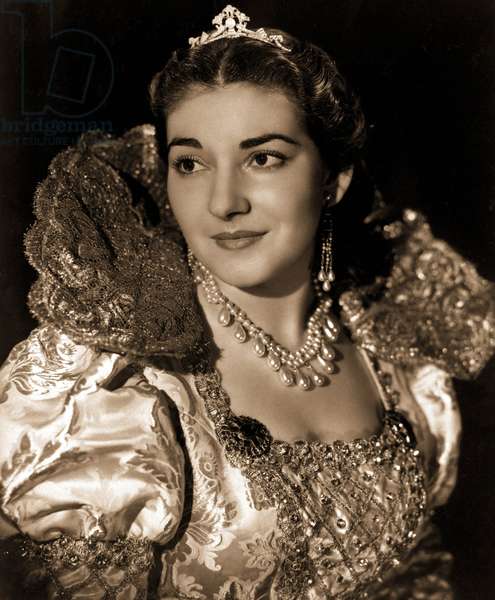
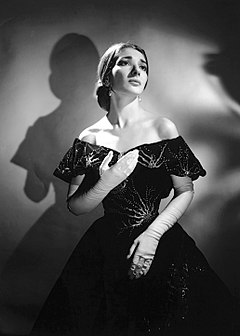
Maria Callas as Elvira in ‘I Puritani’, Teatro la Fenice, Venice, 1949Maria Callas as Violetta in `La Traviata’, Covent Garden, London, 1958
It was in the late 1940s that Callas began to take an interest in the type of opera that would really make her name. Bel canto opera was rather unfashionable at that time, probably because audiences preferred the grittier and more realistic verismo style. Virtually single-handed, Callas resurrected the bel canto canon by injecting a true sense of drama into works which had previously just been seen as vehicles for the singers to demonstrate their art. Callas brought an entirely new dimension to the great operas by Bellini (Norma, I Puritani, La Somnambula…) and Donizetti (Lucia di Lammermoor, Anna Bolena), although she was sufficiently versatile to also perform brilliantly in the verismo syle of Verdi and Puccini as well as lesser known composers such as Giordano (Andrea Chenier). Recordings of many of these performances are available, but it is sad that this glorious period of her singing career happened just a bit before high quality equipment was available so the true glory of her voice isn’t always evident.
In 1953, Callas decided that she wanted to change her appearance, perhaps so she would look more appropriate for the parts she was playing on stage. At the time she weighed almost 200lbs. In order to lose weight as quickly as possible, she followed the barbarous but highly effective expedient of swallowing a tapeworm. She lost 80lbs in a matter of months. The dramatic loss of weight changed her body and her face, emphasizing her high angular cheekbones and giving her a striking look very well suited to the opera stage. But it also affected her voice somewhat, especially at the upper end where she seems to have found it more difficult to avoid the dreaded “wobble” which was one of the alleged imperfections that critics tended to dwell upon.
Callas also had very poor eyesight which required her to wear very thick spectacles in order to see at all, a thing she refused to do onstage with the result that she was virtually blind during performances. In fact, during a performance of Tosca at Covent Garden she leant too far over a candle and her hair caught fire. Improvising magnificently, Tito Gobbi, as the loathsome Scarpia, extinguished the fire by throwing water at her before the audience had noticed. Although they weren’t much use for seeing with, her eyes were a great asset for her acting, in turns flashing like a demon then shining like an angel.
After her weight loss, Callas was suddenly no longer just a wonderful singer but also a strikingly beautiful woman. Her career took a back seat as she started to revel in the glamorous lifestyle that opened up in front of her. Her voice deteriorated and she performed rather less frequently. Eventually she embarked on a love affair with Aristotle Onassis, a notorious serial collector of trophy women. She hoped to marry him but he abandoned her to marry Jackie Kennedy, widow of John F. Kennedy.
She never really recovered from the failure of this affair, retired from singing and lived out the last years of her life as a virtual recluse in her apartment in Paris. She died in 1977.
I had heard a lot about Maria Callas when I was younger, but the recordings that I listened to (generally from the 1960s) were really not very good, as her voice was undoubtedly much diminished by then. I just assumed that, as is the case with many artists, the legend of Callas was all mere hype. Then, about 20 years ago, I was listening to BBC Radio 3 and they played the final scenes of the great 1954 recording of Norma with Callas in the title role, conducted by Tullio Serafin. I was completely overwhelmed by the emotion of it and tears flowed freely from my eyes. I’ve always had a tendency to blub when I hear really beautiful music, but as I’ve got older I’ve learned not to be embarrassed by it.
In England, Callas is probably best remembered for her performances in Tosca in Covent Garden. I have recordings of her in that role and they are really wonderful. But there are many fine recordings of Tosca by other singers, some of which are almost as good. In the case of Norma, though, there isn’t any other performance that comes within a mile of the Callas version. Or if there is, I’ve yet to hear it.
Now I know that there are some people, even opera lovers, who just don’t get Callas at all (just look at the comment boards on Youtube, etc). I grant that she wasn’t always the most accurate singer, and I don’t think you could say her voice had a purely classical beauty. But even if you don’t like her voice you have to admit that she revitalized the opera stage and brought a new public into the theatres. I can’t imagine what the state of opera would be now, if there hadn’t been a Callas, and you can’t argue that she is now an iconic figure. What I admire most about her is that, like it or loath it, her voice is instantly recognizable. In this sense, she always puts me in mind of a kind of operatic version of Billie Holliday. She’s a far cry from the many bland mediocrities that pass themselves off as opera singers nowadays.
I’m going to end with the obligatory clips from Youtube. There’s a lot of Callas on there, not all of it good. I’ve chosen a couple of items, although neither of them has a proper video. The first was performed live in 1955 in front of the notoriously difficult audience at La Scala in Milan and recorded from a radio broadcast so that the sound quality is very poor. A studio recording of this aria, from Andrea Chenier, features most movingly in the film Philadelphia. This live version, however, is notable for a number of reasons. One is that you get some idea of the power of the Callas voice in the way she pushes aside the entire orchestra and is even able to cut through the distortions introduced by the rather primitive recording technology. The second thing is that she sings it so beautifully, with such feeling, lovely phrasing, and so much colour and vitality. Listen to the way the texture of her voice matches perfectly her changing emotions as she tells her story. The shattering, climactic high C that occurs near the end is a perfect example of what I was saying above. She stabs this note out like her life depended on it. It sends shivers down my spine and clearly had the same effect on the audience. The thunderous applause that follows the end of this aria is quite frightening in its intensity, but gives a good idea how much her public adored her. If you can put up with the lo-fi recording, this is certainly a better performance than the studio version.
The final piece has to be from Norma. I think Bellini is a wonderful composer of opera, but he doesn’t make life easy for the singers. There’s never any doubling of the vocal line by the orchestra so the singer is very exposed. This doesn’t bother Maria Callas. This is the famous aria Casta Diva, which has become a kind of signature tune for her and it’s one of the pieces that she always seemed to perform beautifully. It might be a bit hackneyed but I love it and, after all, it’s my blog. There’s also a nice compilation of pictures.
I wonder how many times and in how many places, Casta Diva is being played today?
I posted about this fascinating piece by Charles Ives ten years ago today, when I was still in Cardiff, but the link on that post to the actual music has died so I’m posting it again today.
If you like you can read my first ever Hallowe’en post from 2008 here.
Not a lot of people know that I acquired a second-hand piano when I bought my house in Maynooth. I’ve been having a go on it from time since then. Fortunately it’s a detached house so that doesn’t cause the neighbours to suffer too much. I wish I’d got it tuned before the lockdown though. It’s a little bit flat in the middle range and gets worse as the notes get lower. Still, I’m such a terrible player that doesn’t make too much difference!
I can read music but am used to single note instruments and find piano parts difficult to read especially if there are complicated chords – or even simple ones, for that matter. I find having the notes squashed together like in the bass part here makes it difficult to disentangle them.
Fortunately I have a basic knowledge of harmony and can cope with chord symbols so I generally don’t try to read the bass parts but instead fill in chords according to the symbols. If the chords aren’t written on the music like the above example I add them myself.
Even for an oldie like me it’s quite easy to get used to playing basic chordal accompaninents. Most standard progressions involve only three or four chords. You can start playing block triads like in the example above just to get the idea. Adding, for example, the odd 7th here and there helps to explore the sound produced by different harmonic ingredients. After that you can play left-hand figures based on the chords to make it more interesting.
I know you’re all thinking that I’m way too old to be trying to teach myself how to play the piano. One of these days I think I’ll put up a YouTube video to prove that you are right.
It’s the Twelfth of September so it’s now precisely six months to the day since schools and colleges in Ireland were closed because of the Covid-19 pandemic. The initial announcement on 12th March was that the closure would be until 29th March. Little did we know then that six months later campus would still be closed to students.
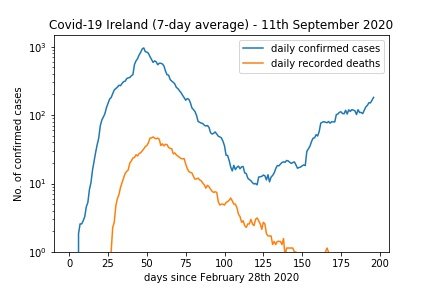
Here is how the pandemic has progressed in Ireland since March:
On 12th March, 70 new cases of Covid-19 were announced in Ireland; yesterday there were 211. The current 7-day average in Ireland is over 180 new cases per day and is climbing steadily. Things are similar, if not worse, elsewhere in Europe. as countries struggle to contain the pandemic while simultaneously attempting to reopen their economies. We are heading towards a very difficult autumn, with a large second peak of infection definitely on the cards. Who knows how this will turn out?
The word ‘semester’ is derived from the Latin for ‘six months’ but the term now applies almost exclusively to half a university teaching year, usually more like four months.
I’m looking ahead to the next teaching semester at Maynooth University, which starts in two weeks. The last time I gave a face-to-face lecture was on the morning of March 12th (a Thursday). Going home that evening I was engulfed by morbid thoughts and wondered if I would ever see the students again. Now we’re making plans for their return to (limited) on-campus teaching. Outline teaching plans have now been published, so returning students will have an idea how things will go. These will be refined as we get a better idea of student numbers. Given the continued increase in Covid-19 cases there is a significant chance of another campus closure at some point which will necessitate going online again but, at least to begin with, our students in Theoretical Physics will be getting 50% or more of the in-person teaching they would have got in a normal year.
Yesterday third-level institutions made their first round of CAO offers. Maynooth’s can be found here. Our offer for MH206 Theoretical Physics & Mathematics is, like many courses around the country, up a bit at 510 points reflecting the increase in high grades in this year’s Leaving Certificate.
We won’t know the final numbers for at another week or more but based on the traffic on Twitter yesterday Maynooth in general seems to be very popular:
Outline teaching plans are available for new students but these will not be finalised until Orientation Week is over and students have registered for their modules, which will not be until Thursday 24th September, just a few days before teaching starts. The weekend of 26th/27th looks like being a very busy one!
Returning to the original theme of the post I have to admit that I haven’t set foot outside Maynooth once in the last six months. I haven’t minded that too much, actually, but one thing I have missed is my weekly trip to the National Concert Hall in Dublin. Last night saw the start of a new season of concerts by the RTE National Symphony Orchestra at the NCH. There is no live audience for these so it’s not the same as being there in person, but watching and listening on the live stream is the next best thing.
Last night’s programme was a very nice one, of music by Mendelssohn Mozart and Beethoven, that not only provided a welcome tonic to the end of a busy week but also provided a great example of how to adapt. I’m glad they’re back and am looking forward to the rest of the season.
I was listening to the radio last night – specifically to Bernard Clarke’s Blueof the Night on RTÉ Lyric FM – as a result of which I heard a fascinating piece of music by a composer who is new to me, John McClachlan. The composition I heard was a miniature with an astrophysical theme called Sagittarius A* (the name of the supermassive black hole at the centre of the Milky Way Galaxy) . It turns out that this piece is the first of 12 such miniatures composed during the ‘cultural wave’ of the current Covid-19 lockdown. I gather one is going to played every evening on Blue of the Night for the next few weeks.
All these miniatures are on astrophysical themes, which gives me another excuse for posting them in a playlist here!
I didn’t remember until late last night that yesterday was the 60th anniversary of the release, on 17th August 1959, of the classic jazz album Kind of Blue by a band led by trumpeter Miles Davis featuring John Coltrane (ts), Cannonball Adderley (as), Bill Evans (p, replaced by Wynton Kelly on one track), Paul Chambers (b) and Jimmy Cobb on drums. I bought the album on vinyl way back in the 1970s when I was still at school and have listened to it probably thousands of times since then. It still sounds fresh and exciting sixty years after its first release. But you don’t have to listen to me, you can listen to the whole album here:
When it first appeared, Kind of Blue seemed to represent all that Miles Davis stood for from a musical point of view, with its modal and scalar themes and such passages as the fourth section of Flamenco Sketches which hints at a Spanish influence. Whether the actual performances were typical of the way this band sounded live is less clear, but there’s no question that the album has worn so well as to be now universally regarded as a timeless masterpiece.
So why is it such an important album?
I can only speak for myself, of course, but I’d say a big part of this was that the music is on the cusp of the evolution of modern jazz. It’s music from a time of transition, pointing the way forward to exciting developments while also acknowledging past traditions. You only have to look at the various directions Miles Davis, John Coltrane and Bill Evans explored after this album to see what I mean.
A few words about each of the tracks:
The opening number So What? established the practice of constructing themes based on scales instead of chords. After an introduction that keeps you guessing for a while, it turns out to be a straightforward 32-bar melody with a simple modulation serving as the bridge. At a medium tempo, the pure-toned and rather spare solo by Miles Davis provides a delicious contracts with the flurry of notes produced by Coltrane, who also plays between the beats. It might be just my imagination but the rhythm section seems to tighten up behind him, only to relax again with Cannonball Adderley’s more laid-back, bluesy approach.
The next track is All Blues, which is in a gentle 6/8 time. I discovered by accident a while ago this composition found its way onto the GCSE Music syllabus. In fact there’s a recording of the track, produced and distributed as “set work” for that purpose:
As an aside, I should mention that I never took any qualifications in music at School – although I did get music lessons, I didn’t find them at all inspiring and it took me years to develop a taste for anything other than Jazz, which I knew about mainly from home, because my father was a (part-time) Jazz drummer. There wasn’t much mention of Jazz at School from teachers, and none of my friends were into it, so it became a very private passion, although I’m glad to say it never faded.
Anyway, what little I know about music I picked up by studying on my own, and trying to figure out what was going on by listening to records. All Blues is a really interesting composition to unpick in this way, as it tells you a lot about how Jazz was evolving in the late 1950s (it was released in 1959). Musicians like Miles Davis were experimenting with ways of breaking away from the standard approach to Jazz improvisation based on chord progressions, and one of the routes that developed was modal Jazz. All Blues is particularly interesting because it teeters on the edge between the old approach and the new; it’s clearly based on the traditional 12-bar blues progression but diverges from it in several respects.
A standard blues progression in G might go like this (although there are many variations):
|G|G|G|G|
|C|C|G|G|
|D|C|G|G|
It’s based on just three chords: the tonic (in this case G): the sub-dominant IV (C) and the dominant V (D); the V-IV-I progression in the last four bars is usually called the turnaround.
While the addition of a major 7th note to the basic triad G isn’t unusual, the two G minor 7th chords are more interesting, because they involve adding a blue note (a flattened third) to the basic chord . But it’s in the last four bars that the harmonies move dramatically away from the standard turnaround. Chromatic chords are included and the usual resolution back to G is subtly changed by the addition of a 6th note (E) to the basic G chord (GBD) at the end; that trick became a bit of a trademark for Jazz of this period.
However, it’s the two F chords that represent the strongest connection with modal harmony. The scale of G major involves F-sharp, so the F is a flattened note (a flattened VIIth). In fact, all the Fs in the piece are natural rather than sharp. For this reason you could argue that this is a piece not played in the key of G major but in the corresponding Mixolydian mode (the white notes on the piano from G to G).
So it’s a blues that’s not quite a blues, but is (appropriately enough) Kind of Blue. There’s so much going on harmonically that the fact that it’s played in 6/8 rhythm (rather than the more usual 4/4 for the Blues) seems almost irrelevant.
Those are just the bare bones, but the improvisations of Miles Davis, Bill Evans, Cannonball Adderley and John Coltrane et al breathe life into them and create a living Jazz masterpiece. Although it seems like a complicated tune, apparently what happened at the recording session was that Miles Davis talked the band through the piece, they played it once to get a feel for it, and then recorded the entire track that was released on the album in one go.
On Freddie Freeloader , Bill Evans was replaced with Wynton Kelly. I suppose that Miles Davis thought that Kelly would be more convincing on this relatively straight-ahead blues, and his crisp, direct opening solo suggests that Miles was probably right. Miles Davis’s solo that follows is superbly structured in terms of timing and dynamics. Coltrane plays more-or-less entirely in double-time and then Adderley enjoys himself hugely in a good-humoured final solo.
Blue in Green, which was mainly written by Bill Evans, is based on a ten-bar melody featuring an eloquent solo Miles on muted trumpet and some sensitive playing by Coltrane and Evans. The same mood prevails in the following track.
Flamenco Sketches involves a series of solos each improvised on a set of five scales; it’s the fourth section that hints at the Spanish influence alluded to in the title. The tempo is very slow, which contributes the air of solemnity as does the absolute perfection of the solos. In that respect it has clear parallels with some of Duke Ellington’s work. Miles Davis, who opens and closes the track on muted trumpet, and Bill Evans on piano are absolutely faultless but I particularly enjoy John Coltrane’s playing on tenor saxophone: his tone is as bleak and austere as an Arctic sunrise, and just as wonderful and he conjures up an absolutely beautiful improvised melody.
Kind of Blue isn’t merely an artistic highlight for Miles Davis, it’s an album that towers above its peers, a record generally considered as the definitive jazz album, a universally acknowledged standard of excellence. Why does Kind of Blue posses such a mystique? Perhaps because this music never flaunts its genius… It’s the pinnacle of modal jazz — tonality and solos build from the overall key, not chord changes, giving the music a subtly shifting quality… It may be a stretch to say that if you don’t like Kind of Blue, you don’t like jazz — but it’s hard to imagine it as anything other than a cornerstone of any jazz collection.
People sometimes ask me why I post about music on here. The answer has two parts and they’re both simple. One is that I enjoy writing about music because it gives me the opportunity to explore my own thoughts about why I like it so much. The other reason is to share something I love very much, in the hope that other people might find as much joy from the music I love. For example, if just one person listens to Kind of Blue for the first time as a result of reading this piece, then it will definitely be worth the 40 minutes it took me to write!
Mention the name Elkie Brooks to people of my generation or older and most will think of her popular hits from the late 1970s, especially Pearl’s A Singer which made the UK Top Ten in 1977. Elkie Brooks has however had a long and very distinguished career as a Jazz and Blues singer, including regular performances over the years with trumpeter Humphrey Lyttelton and his band. This particular track was recorded in 2002, when Humph was already in his eighties, but I think it’s a lovely performance so I thought I’d share it here.
Trouble in Mind is a very familiar tune that has been recorded countless times by jazz musicians. In fact an earlier manifestation of Humph’s Band made a very nice instrumental version way back in 1950 which I have on an old Parlophone 78. The tune is usually credited to Richard M. Jones, but it has its roots in much older spirituals and folk songs. There are a couple of things worth mentioning about it despite it being so well known.. Although Trouble in Mind is a blues, it is a slightly unusual one because it’s an eight-bar blues rather than the more usual twelve-bar variety. The other thing is that there’s something about this tune that suits a rhythm accompaniment in sixth notes, as exemplified by drummer Adrian Macintosh on this track when the vocal starts.
There’s also some fine trombone on this (by Pete Strange) and a nice bit of banter from Humph at the beginning. Enjoy!
The views presented here are personal and not necessarily those of my employer (or anyone else for that matter).
Feel free to comment on any of the posts on this blog but comments may be moderated; anonymous comments and any considered by me to be vexatious and/or abusive and/or defamatory will not be accepted. I do not necessarily endorse, support, sanction, encourage, verify or agree with the opinions or statements of any information or other content in the comments on this site and do not in any way guarantee their accuracy or reliability.





 In the Dark