Archive for neutrinos

Weekly Update from the Open Journal of Astrophysics – 15/11/2025

Posted in OJAp Papers, Open Access, The Universe and Stuff with tags , , , , , , , , , , , , , , , , , , , , , , , , , , , , , on November 15, 2025 by telescoper

It’s Saturday again, so it’s time for the usual update of the week’s new papers at the Open Journal of Astrophysics. It has been quite a busy week. Since the last update we have published another seven papers, which brings the number in Volume 8 (2025) up to 175, and the total so far published by OJAp up to 410.

First on the menu for this week is “Dynamical friction and measurements of the splashback radius in galaxy clusters” by Talia M. O’Shea (U. Wisconsin-Madison, USA), Josh Borrow & Stephanie O’Neil (U. Pennsylvania, USA) and Mark Vogelsberger (MIT, USA). Published on Tuesday 11th November in the folder Cosmology and NonGalactic Astrophysics, this one presents a study suggesting that dynamical friction does not play a major role in reducing the radius of the splashback feature in real data compared to numerical simulations.

The overlay is here:
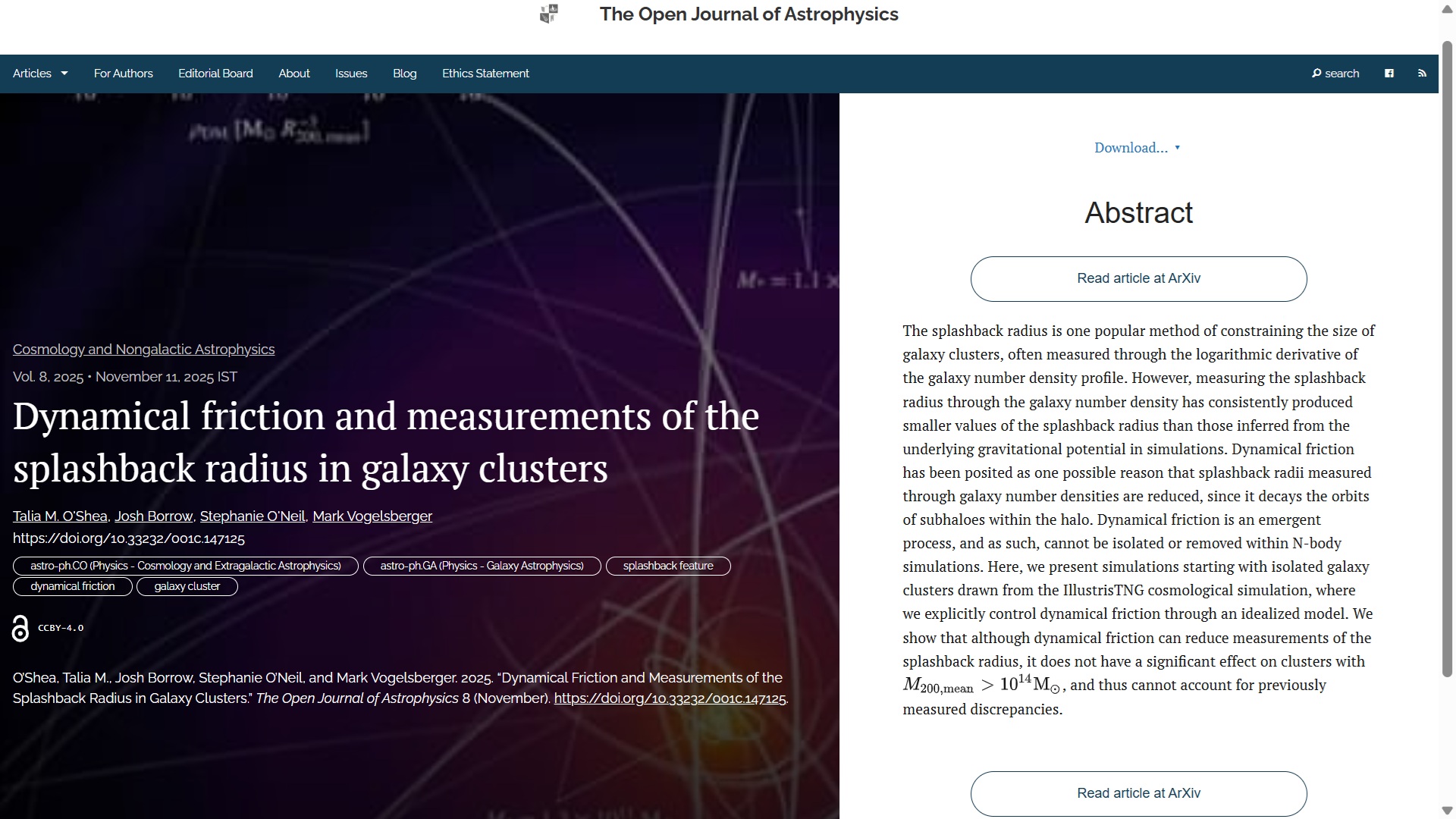
You can find the officially accepted version on arXiv here.

The Fediverse announcement is here:

Open Journal of Astrophysics

New Publication at the Open Journal of Astrophysics: "Dynamical friction and measurements of the splashback radius in galaxy clusters" by Talia M. O'Shea (U. Wisconsin-Madison, USA), Josh Borrow & Stephanie O'Neil (U. Pennsylvania, USA) and Mark Vogelsberger (MIT, USA)

doi.org/10.33232/001c.147125

November 11, 2025, 8:36 am 3 boosts 1 favorites


The second paper of the week is “Microlensing of lensed supernovae Zwicky & iPTF16geu: constraints on the lens galaxy mass slope and dark compact object fraction” by Nikki Arendse (Stockholm University, Sweden) and and international cast of 11 others based in Sweden, UK and France. This one was published on 11th November 2025 in the folder Astrophysics of Galaxies. It is about combining observations of two supernovae, iPTF16geu and SN Zwicky, with microlensing magnification maps to probe the properties of the lens galaxy.

The overlay is here:
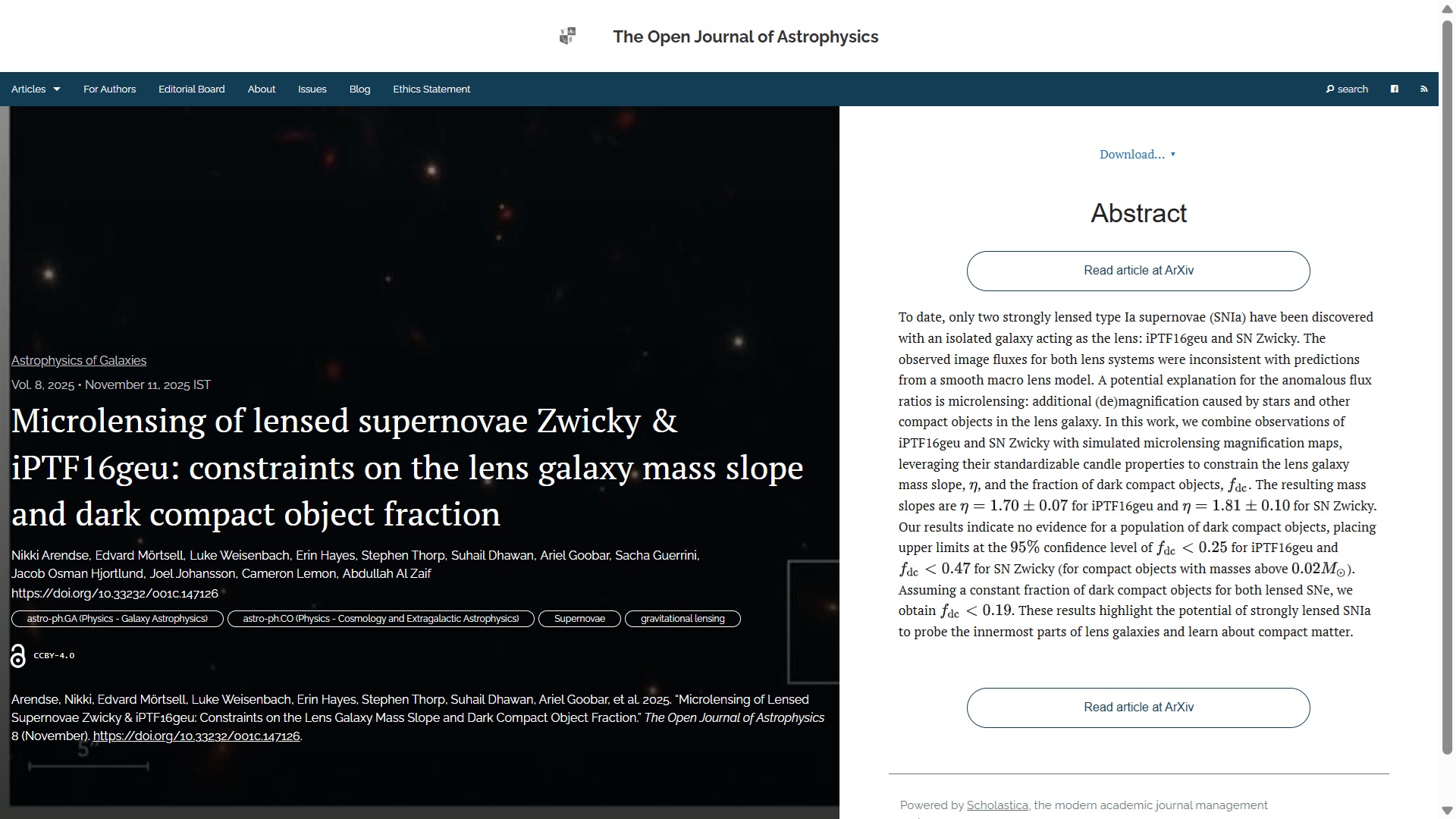
 

You can find the official version of this one on arXiv here. The federated announcement on Mastodon is here:

Open Journal of Astrophysics

New Publication at the Open Journal of Astrophysics: "Microlensing of lensed supernovae Zwicky & iPTF16geu: constraints on the lens galaxy mass slope and dark compact object fraction" by Nikki Arendse (Stockholm University, Sweden) and 11 others based in Sweden, UK and France

doi.org/10.33232/001c.147126

November 11, 2025, 8:53 am 1 boosts 1 favorites


Next one up is “Neutrino Constraints on Black Hole Formation in M31” by Yudai Sawa (U. Tokyo, Japan) and 11 others all based in Japan. This was published on Tuesday 11th November in the folder High-Energy Astrophysical Phenomena. It presents a calculation of the neutrino emission expected from the collapse of massive stars and its use in constraining black hole formation using neutrino detectors.


The overlay is here:
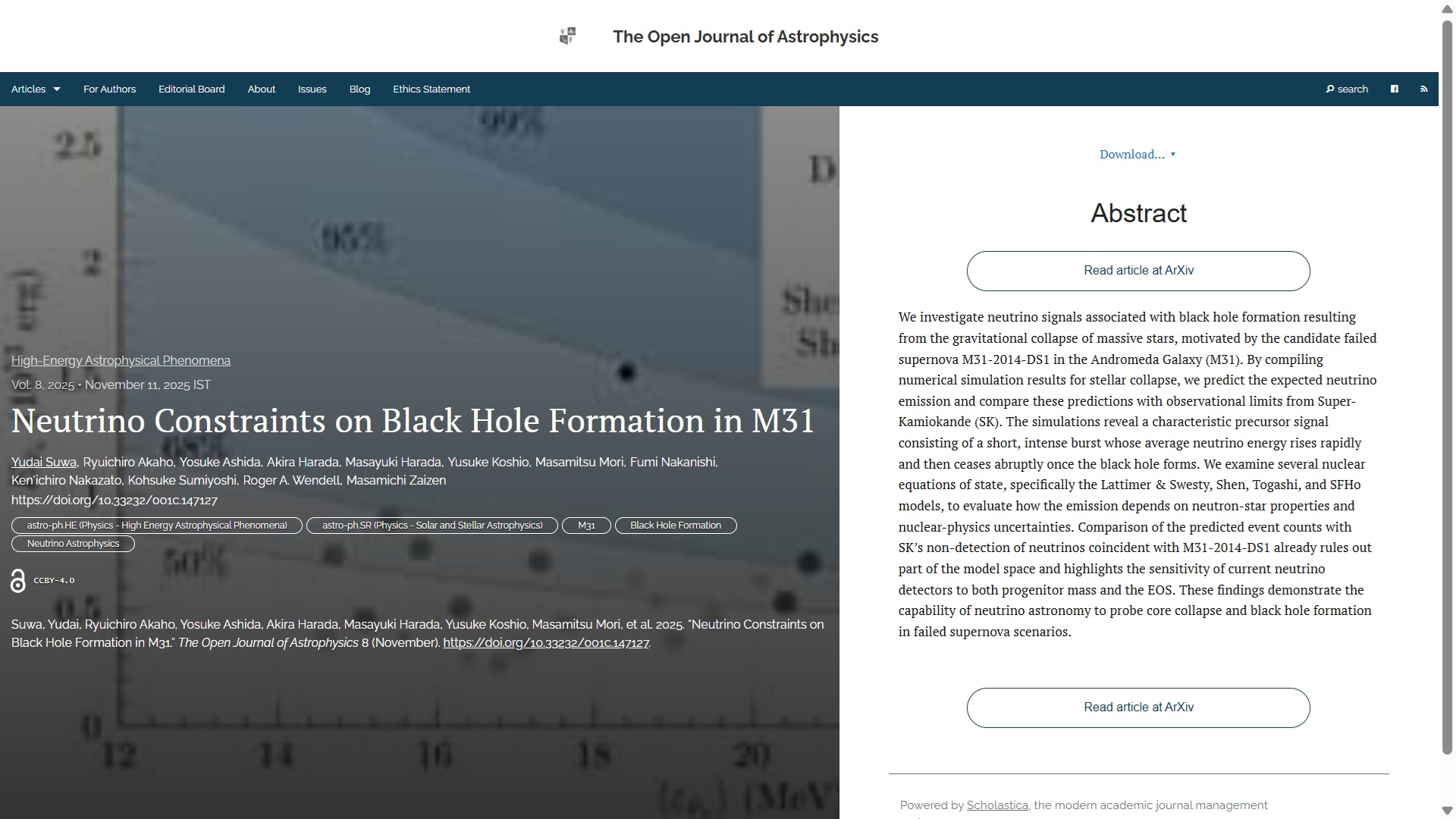
You can find the official accepted version on arXiv here. The fediverse announcement is here:

Open Journal of Astrophysics

New Publication at the Open Journal of Astrophysics: "Neutrino Constraints on Black Hole Formation in M31" by Yudai Sawa (U. Tokyo, Japan) and 11 others all based in Japan

doi.org/10.33232/001c.147127

November 11, 2025, 9:04 am 0 boosts 1 favorites

The fourth paper this week is “Redshift Drift in Relativistic N-Body Simulations” by Alexander Oestreicher (U. Southern Denmark, DK), Chris Clarkson (QMUL, UK), Julian Adamek (U. Zürich, CH) and Sofie Marie Koksbang (U. Southern Denmark, DK). This one was published on Wednesday 12th November in the folder marked Cosmology and NonGalactic Astrophysics. It presents numerical calculations of the cosmological redshift drift effect for comparison with future surveys.

The overlay is here:
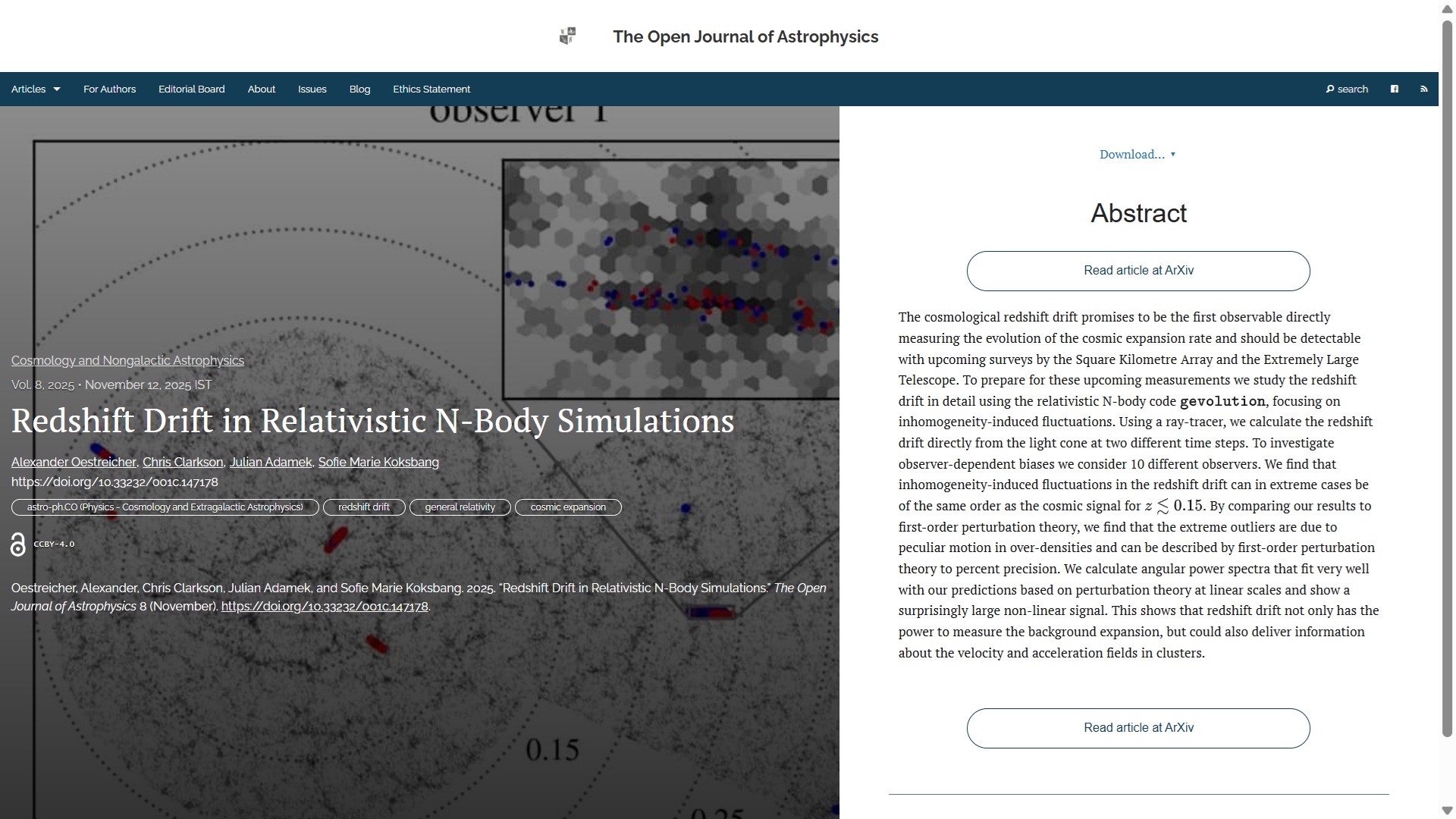


You can find the official published version on arXiv here. The Fediverse announcement follows:

Open Journal of Astrophysics

New Publication at the Open Journal of Astrophysics: "Redshift Drift in Relativistic N-Body Simulations" by Alexander Oestreicher (U. Southern Denmark, DK), Chris Clarkson (QMUL, UK), Julian Adamek (U. Zürich, CH) and Sofie Marie Koksbang (U. Southern Denmark, DK)

doi.org/10.33232/001c.147178

November 12, 2025, 8:35 am 1 boosts 0 favorites


The fifth paper for this week is “Attributing the point symmetric structure of core-collapse supernova remnant N132D to the jittering jets explosion mechanism” by Noam Soker (Technion, Haifa, Israel). This one, published on Wednesday November 12th in the folder High-Energy Astrophysical Phenomena, presents a discussion of the morphology of a supernova remnant and possible explanation for it in terms of the explosion mechanism.

The overlay is here:
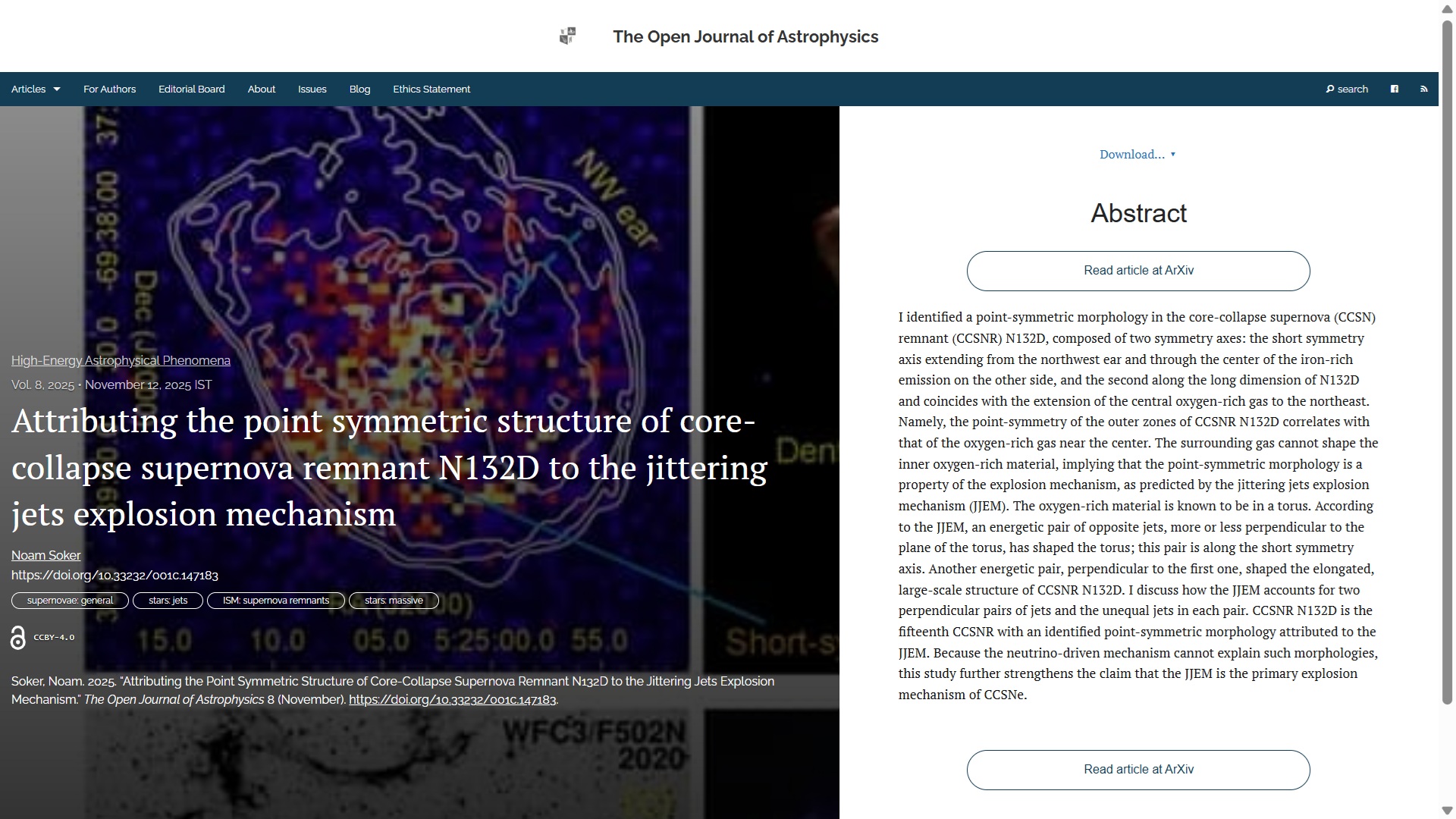
 

The officially accepted version can be found on arXiv here. The Fediverse announcement is here:

Open Journal of Astrophysics

New Publication at the Open Journal of Astrophysics: "Attributing the point symmetric structure of core-collapse supernova remnant N132D to the jittering jets explosion mechanism" by Noam Soker (Technion, Haifa, Israel)

doi.org/10.33232/001c.147183

November 12, 2025, 8:46 am 1 boosts 0 favorites

The sixth paper to report this week is “Witnessing downsizing in the making: quiescent and breathing galaxies at the dawn of the Universe” by Emiliano Merlin (Osservatorio Astronomico di Roma, Italy) and an international cast of 20 others based in Italy, Germany, UK, USA, Switzerland, Spain and China. This one was published on Friday November 14th in the folder Astrophysics of Galaxies.
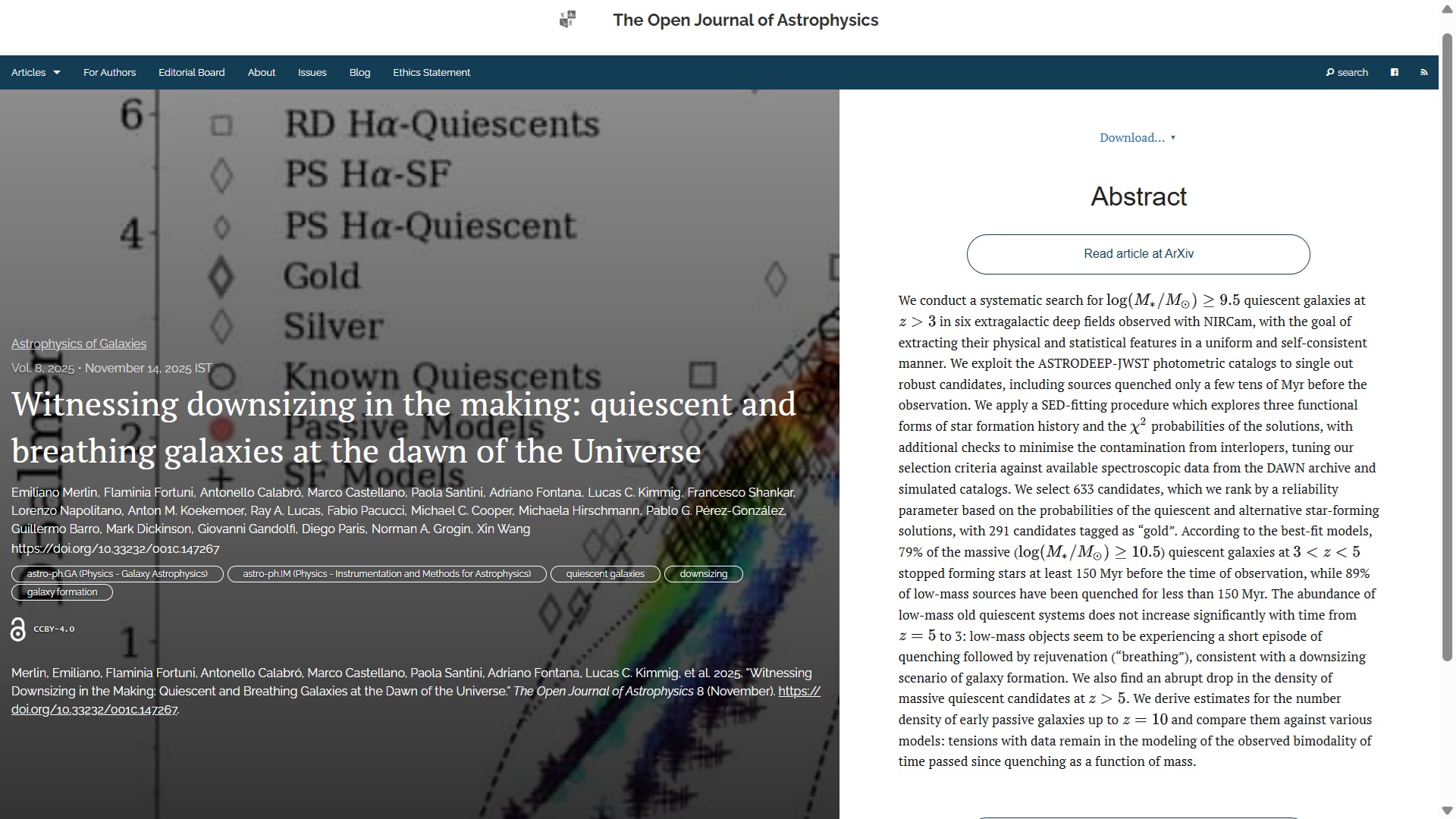
You can find the officially-accepted version on arXiv here. The fediverse announcement is here:

Open Journal of Astrophysics

New Publication at the Open Journal of Astrophysics: "Witnessing downsizing in the making: quiescent and breathing galaxies at the dawn of the Universe" by Emiliano Merlin (Osservatorio Astronomico di Roma, Italy) and 20 others based in Italy, Germany, UK, USA, Switzerland, Spain and China

doi.org/10.33232/001c.147267

November 14, 2025, 8:38 am 1 boosts 1 favorites

And finally (for this week) we have “Beyond No No Tension: JWST z > 10 Galaxies Push Simulations to the Limit” by Joe McCaffrey (NUI Maynooth, Ireland), Samantha Hardin & John Wise (Georgia Institute of Technology, USA) and John Regan (Maynooth). This one was also published on Friday 14th November, in the folder marked Astrophysics of Galaxies. It asks the question whether newly-discovered high redshift galaxies are consistent with simulations of galaxy formation. The overlay is here:
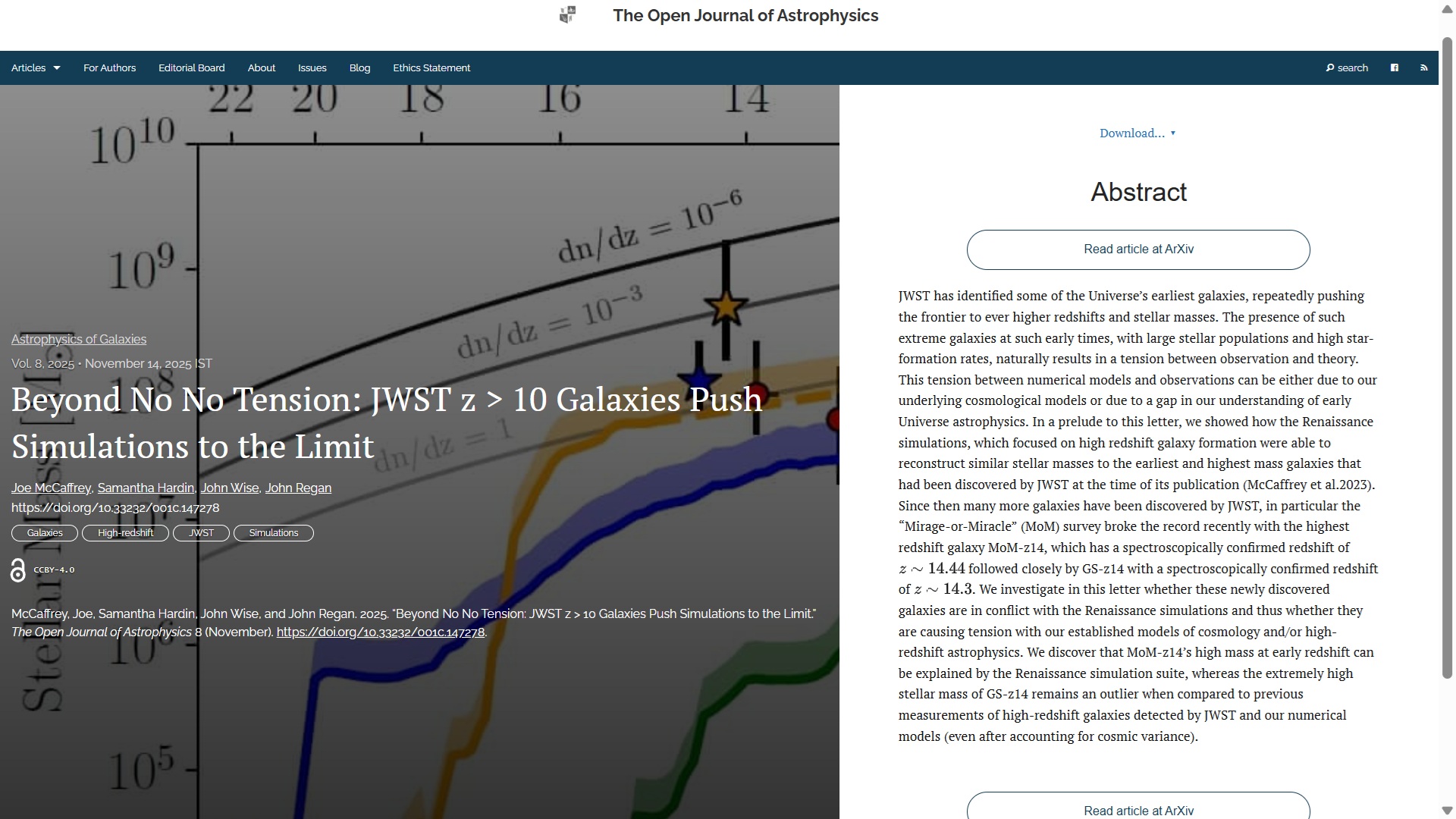
You can find the officially acceopted version on arXiv here. The fediverse announcement is here:

Open Journal of Astrophysics

New Publication at the Open Journal of Astrophysics: "Beyond No No Tension: JWST z > 10 Galaxies Push Simulations to the Limit" by Joe McCaffrey (NUI Maynooth, Ireland), Samantha Hardin & John Wise (Georgia Institute of Technology, USA) and John Regan (Maynooth)

doi.org/10.33232/001c.147278

November 14, 2025, 9:02 am 2 boosts 0 favorites

And that concludes the update for this week. There will be another next Saturday.
Three New Publications at the Open Journal of Astrophysics

Posted in OJAp Papers, The Universe and Stuff with tags , , , , , , , , , on November 12, 2023 by telescoper

It’s been a busy week generally, and specifically at the  Open Journal of Astrophysics. In fact, this week we have published three papers, which I didn’t have time to post here at the time we published them but now present to you. These take the count in Volume 6 (2023) up to 44 and the total published by OJAp up to 109. With many more in the pipeline we’re still on for 50 by the end of the year.

In chronological order, the three papers published this week, with their overlays, are as follows. You can click on the images of the overlays to make them larger should you wish to do so. All three of these papers are in the folder Cosmology and Nongalactic Astrophysics.

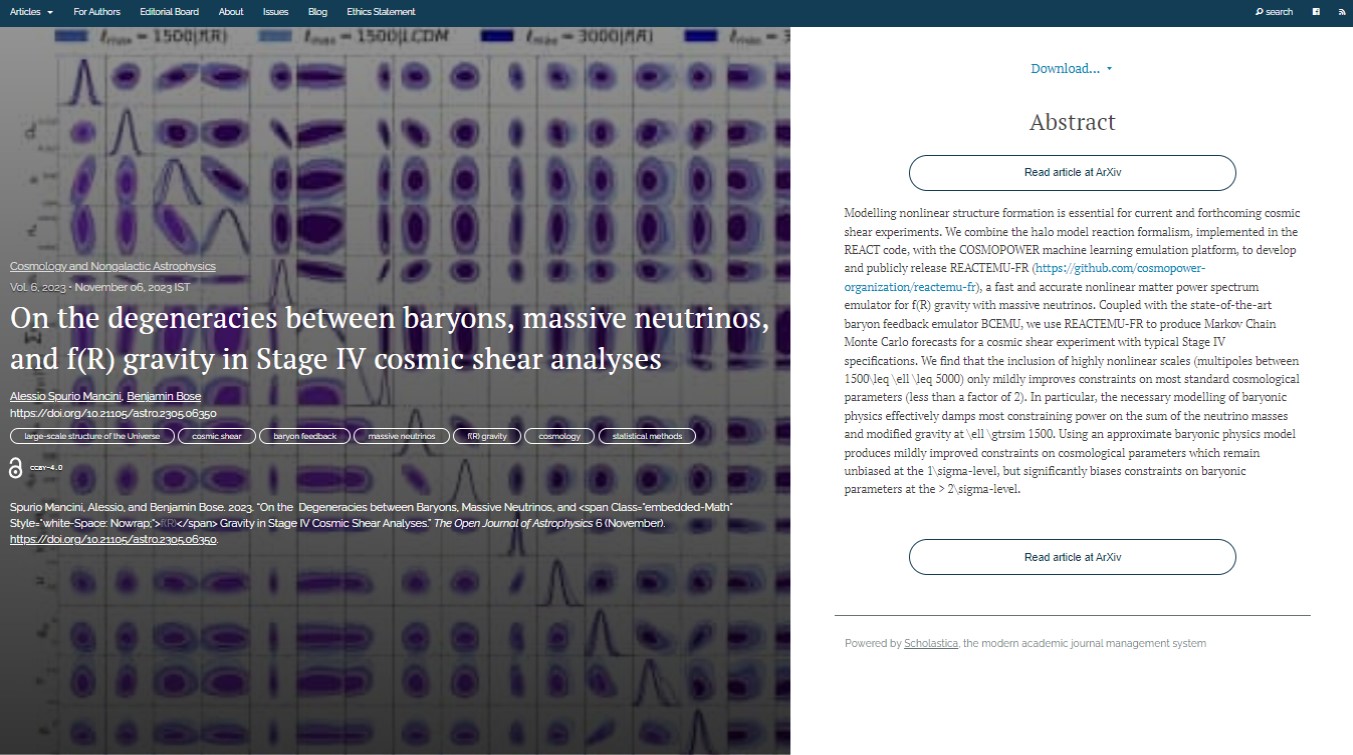
First one up is “On the degeneracies between baryons, massive neutrinos and f(R) gravity in Stage IV cosmic shear analyses” by Alessio Spurio Mancini (Mullard Space Sciences Laboratory, University College London, UK) and Benjamin Bose (Royal Observatory Edinburgh, UK). This presents a fast nonlinear matter power spectrum emulator for f(R) gravity with massive neutrinos, coupled with a baryon feedback emulator forecasts for a cosmic shear experiment with typical Stage IV specifications. This paper was published on 6th November 2023.

Here is a screen grab of the overlay, which includes the abstract:

You can find the officially accepted version of the paper on the arXiv here.

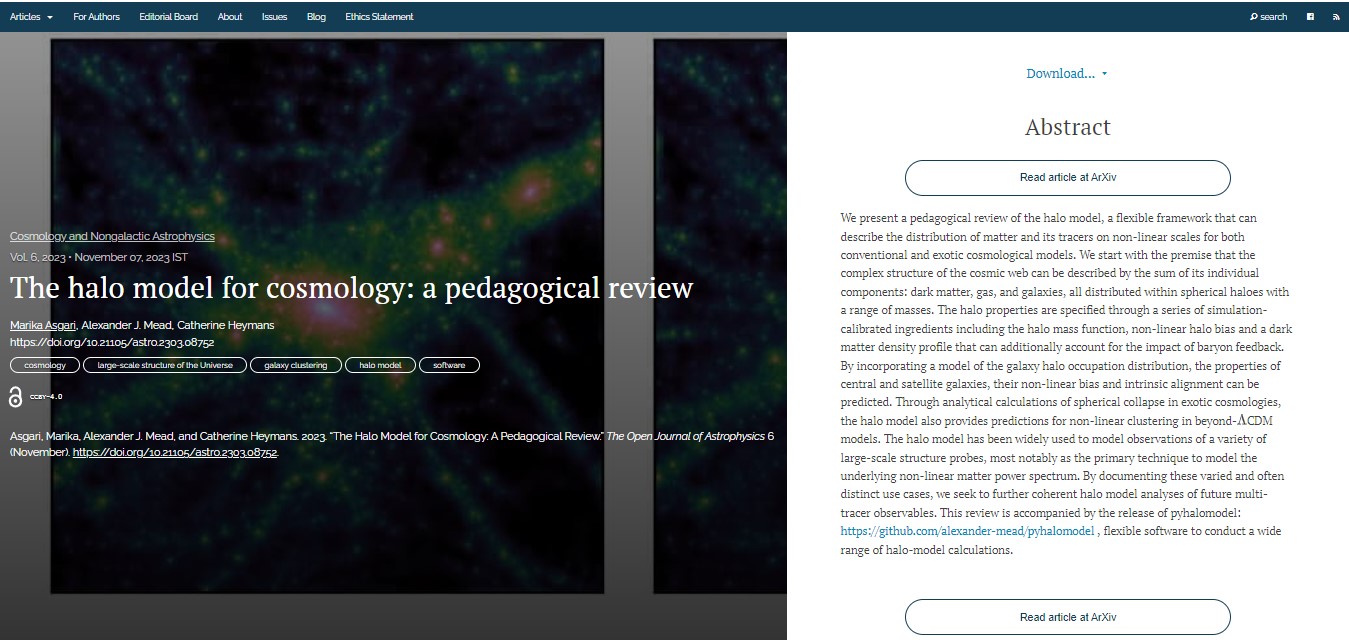
The second paper to announce is “” by Marika Asgari (Hull, UK), Alexander Mead (Bochum, Germany) and Catherine Heymans (Edinburgh, UK).  This presents a thorough discussion of the popular halo model for cosmological structure with applications, accompanied by the release of a software suite called pyhalomodel (which you can download here). The paper was also published on 7th November 2023 and you can see the overlay here:


The accepted version of this paper can be found on the arXiv here.

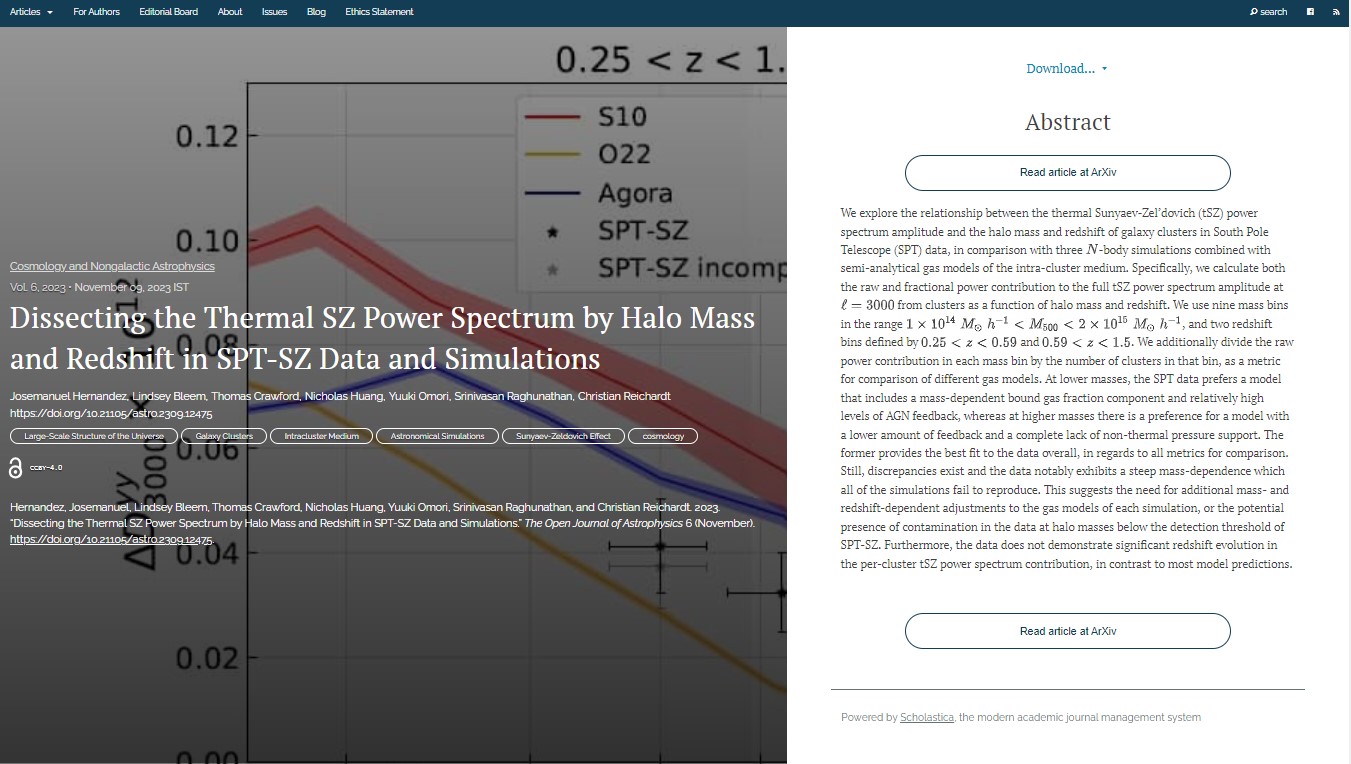
The last paper of this batch is  entitled “Dissecting the Thermal SZ Power Spectrum by Halo Mass and Redshift in SPT-SZ Data and Simulations” and the authors are: by Josemanuel Hernandez (Chicago), Lindsey Bleem (Chicago) , Thomas Crawford (Chicago), Nicholas Huang (Berkeley), Yuuki Omori (Chicago), Srinivasan Raghunathan (NCSA, Urbana) & Christian Reichardt (Melbourne). This paper, a study of the mass and redshift dependence of the thermal Sunyaev-Zeldovich effect in South Pole Telescope data and a comparison thereof with theoretical calculations, was published on 9th November 2023.

Here is the overlay:


You can find the full text for this one on the arXiv here.

Neutrinos from NGC 1068

Posted in The Universe and Stuff with tags , , , , , on November 7, 2022 by telescoper

I’m a bit late onto this as I was rather busy last week, but I couldn’t resist passing on the news that the IceCube Neutrino Observatory has detected high-energy neutrinos (Tev) from the active galaxy NGC1068 (also known as Messier 77). The result is published in Science whence I stole this figure showing the concentration neutrinos correlated with the position of NGC1068, along with a couple of other sources.

The hotspot associated with NGC 1068 is the most intense feature observed on the whole sky. I won’t write any more because there are two videos about this discovery, the first a quick summary for general viewers:

/

And the second is the full hour-long presentation as given last week.

A source of high-energy neutrinos!

Posted in The Universe and Stuff with tags , , , , on July 12, 2018 by telescoper

Before I go for a lie down here is a video that goes with the discovery of the first astrophysical source of high-energy neutrinos!

You can find the two Science papers relating to the discovery here and here. The first abstract reads:

Previous detections of individual astrophysical sources of neutrinos are limited to the Sun and the supernova 1987A, whereas the origins of the diffuse flux of high-energy cosmic neutrinos remain unidentified. On 22 September 2017, we detected a high-energy neutrino, IceCube-170922A, with an energy of ~290 TeV. Its arrival direction was consistent with the location of a known γ-ray blazar, TXS 0506+056, observed to be in a flaring state. An extensive multi-wavelength campaign followed, ranging from radio frequencies to γ-rays. These observations characterize the variability and energetics of the blazar and include the detection of TXS 0506+056 in very-high-energy γ-rays. This observation of a neutrino in spatial coincidence with a γ-ray–emitting blazar during an active phase suggests that blazars may be a source of high-energy neutrino.

The other abstract is:

A high-energy neutrino event detected by IceCube on 22 September 2017 was coincident in direction and time with a gamma-ray flare from the blazar TXS 0506+056. Prompted by this association, we investigated 9.5 years of IceCube neutrino observations to search for excess emission at the position of the blazar. We found an excess of high-energy neutrino events, with respect to atmospheric backgrounds, at that position between September 2014 and March 2015. Allowing for time-variable flux, this constitutes 3.5σ evidence for neutrino emission from the direction of TXS 0506+056, independent of and prior to the 2017 flaring episode. This suggests that blazars are identifiable sources of the high-energy astrophysical neutrino flux.

It’s all very cool!

Newsflash: New Chair at STFC

Posted in Science Politics, The Universe and Stuff with tags , , , on January 22, 2018 by telescoper

As a quick piece of community service I thought I’d pass on the news of the appointment of a new Executive Chair for the Science and Technology Facilities Council (STFC), namely Professor Mark Thomson of the University of Cambridge. Developments at STFC will cease to be relevant to me after this summer as I’m moving to Ireland but this is potentially very important news for many readers of this blog.

Professor Thomson is an Experimental Particle Physicist whose home page at Cambridge describes his research in thuswise manner:

My main research interests are neutrino physics, the physics of the electroweak interactions, and the design of detectors at a future colliders. I am co-spokesperson of the DUNE collaboration, which consists of over 1000 scientiests and engineers from over 170 institutions in 31 nations across the globe. The Cambridge neutrino group splits its acivities between MicroBooNE and DUNE and is using advanced particle flow calorimetry techniques to interpret the images from large liquid argon TPC neutrino detector.

I’ve added a link to the DUNE collaboration for those of you who don’t know about it – it’s a very large neutrino physics experiment to be based in the USA.

On the announcement, Prof. Thomson stated:

I am passionate about STFC science, which spans the smallest scales of particle physics to the vast scales of astrophysics and cosmology, and it is a great honour be appointed to lead STFC as its new Executive Chair. The formation of UKRI presents exciting opportunities for STFC to further develop the UK’s world-leading science programme and to maximise the impact of the world-class facilities supported by STFC.

This appointment needs to be officially confirmed after a pre-appointment hearing by the House of Commons Science and Technology Committee but, barring a surprise offer of the position to Toby Young, he’s likely to take over the reins at STFC in April this year. He’ll have his work cut out trying to make the case for continued investment in fundamental science in the United Kingdom, in the face of numerous challenges, so I’d like to take this opportunity to wish him the very best of luck in his new role!

The Nobel Prize for Neutrino Oscillations

Posted in The Universe and Stuff with tags , , , , , , , , on October 6, 2015 by telescoper

Well the Nobel Prize for Physics in 2015 has been announced. It has been awarded jointly to Takaaki Kajita and Arthur B. McDonald for..

the discovery of neutrino oscillations, which prove that neutrinos have mass.

You can read the full citation here. Congratulations to them both. Some physicists around here were caught by surprise because the 2002 Nobel Prize was also awarded for neutrino physics, but it is fair because this award goes for a direct measurement of neutrino oscillations, which is an important breakthrough in its own right; the earlier award was for measurements of solar neutrinos. For a nice description of the background you could do worse than the Grauniad blog post by Jon Butterworth about neutrino physics.

In brief the a process in which neutrinos (which have three distinct flavour states, associated with the electron, mu and tau leptons) can change flavour as they propagate. It’s quite a weird thing to spring on students who previously thought that lepton number (which denotes the flavour) was always conserved. I remember years ago having to explain this phenomenon to third-year students taking my particle physics course.  I decided to start with an analogy based on more familiar physics, but it didn’t go to plan.

A charged fermion such as an electron (or in fact anything that has a magnetic moment, which would include, e.g. the neutron)  has spin and, according to standard quantum mechanics, the component of this in any direction can  can be described in terms of two basis states, say |\uparrow> and |\downarrow> for spin in the z direction. In general, however, the spin state will be a superposition of these, e.g.

\frac{1}{\sqrt{2}} \left( |\uparrow> + |\downarrow>\right)

In this example, as long as the particle is travelling through empty space, the probability of finding it with spin “up” is  50%, as is the probability of finding it in the spin “down” state. Once a measurement is made, the state collapses into a definite “up” or “down” wherein it remains until something else is done to it.

If, on the other hand, the particle  is travelling through a region where there is a  magnetic field the “spin-up” and “spin-down” states can acquire different energies owing to the interaction between the spin and the magnetic field. This is important because it means the bits of the wave function describing the up and down states evolve at different rates, and this  has measurable consequences: measurements made at different positions yield different probabilities of finding the spin pointing in different directions. In effect, the spin vector of the  particle performs  a sort of oscillation, similar to the classical phenomenon called  precession.

The mathematical description of neutrino oscillations is very similar to this, except it’s not the spin part of the wavefunction being affected by an external field that breaks the symmetry between “up” and “down”. Instead the flavour part of the wavefunction is “precessing” because the flavour states don’t coincide with the eigenstates of the Hamiltonian that describes the neutrinos’ evolution. However, it does require that different neutrino types have intrinsically different energies  in quite  a similar way similar to the spin-precession example. In the context of neutrinos however the difference in energy means a difference in mass, and if there’s a difference in mass then not all flavours of neutrino can be massless.

Although the analogy I used isn’t a perfect, I thought  it was a good way of getting across the basic idea. Unfortunately, however, when I subsequently asked an examination question about neutrino oscillations I got a significant number of answers that said “neutrino oscillations happen when a neutrino travels through a magnetic field….”. Sigh. Neutrinos don’t interact with  magnetic fields, you see…

Anyway, today’s announcment also prompts me to mention that neutrino physics is one of the main research interests in our Experimental Particle Physics group here at Sussex. You can read a recent post here about an important milestone in the development of the NOvA Experiment which involves several members of the Department of Physics and Astronomy in the School of Mathematical and Physical Sciences here at the University of Sussex. Here’s the University of Sussex’s press release on the subject. In fact Art McDonald is a current collaborator of our neutrino physicists, who have been celebrating his award today!

Neutrino physics is a fascinating subject even to someone like me, who isn’t really a particle physicist. My impression of the field is that was fairly moribund until about the turn of the millennium  when the first measurement of atmospheric neutrino oscillations was announced. All of a sudden there was evidence that neutrinos can’t all be massless (as many of us had long assumed, at least as far as lecturing was concerned).  Now the humble neutrino is the subject of intense experimental activity, not only in the USA and UK but all around the world in a way that would have been difficult to predict twenty years ago.

But then, as the physicist Niels Bohr famously observed, “Prediction is very difficult. Especially about the future.”

NOvA and Neutrinos

Posted in The Universe and Stuff with tags , , , , on March 11, 2014 by telescoper

Yesterday’s Grauniad blog post by Jon Butterworth about neutrino physics reminded me that I forgot to post about an important milestone in the development of the NOvA Experiment which involves several members of the Department of Physics and Astronomy in the School of Mathematical and Physical Sciences here at the University of Sussex. Here’s the University of Sussex’s press release on the subject, which came out a couple of weeks ago.

The NOvA experiment consists of two enormous  particle detectors, one at the Fermi National Accelerator Laboratory “Fermilab” near Chicago and the other in Minnesota. The neutrinos are actually generated  at Fermilab; the particle beam is then aimed  at the detectors the, one near the source at Fermilab, and the other in Ash River, Minnesota, near the Canadian border. The particles, sent in their billions every couple of seconds, complete the 500-mile trip in less than three milliseconds.

The point is that the experiment has managed for the first time to actually detect neutrinos through the 500 miles of rock separating the two ends of the experiment. This is obviously just a first step, but it’s equally obviously a crucial one.

Colleagues from Sussex University are strongly involved in  calibrating and fine-tuning the detector, which produces light when particles pass through it. Dr Abbey Waldron and PhD student Luke Vinton have developed a calibration procedure that uses known properties of  muons to calibrate precise measurements of the neutrinos, which are less well understood.  The detector sees 200,000 particle interactions a second, produced by cosmic rays bombarding the atmosphere, and scientists can’t record every single one. Sussex’s Dr Matthew Tamsett has developed a trigger algorithm that searches for events that look like neutrinos among the billions of other particle interactions.

Neutrino physics is an interesting subject to someone like me, who isn’t really a particle physicist. My impression of the field is that was fairly moribund until 1998 when the first measurement of atmospheric neutrino oscillations was announced. All of a sudden there was evidence that neutrinos can’t all be massless (as many of us had long assumed, at least as far as lecturing was concerned).  Now the humble neutrino is the subject of intense experimental activity, not only in the USA and UK but all around the world in a way that would have been difficult to predict twenty years ago.

But then, as the physicist Niels Bohr famously observed, “Prediction is very difficult. Especially about the future.”

Hot News! Supernova in M82

Posted in The Universe and Stuff with tags , , , , , on January 22, 2014 by telescoper

Very exciting news today – a supernova has gone off in Messier 82. In fact, according to this sequence of images from Japan it actually started to brighten about a week ago:

psn-m82

Being arranged in Japanese fashion, you have to read these from top to bottom but starting at the right, so the supernova can be seen to be steadily brightening, i.e. decreasing in magnitude from 17.0 to 11.9. That means it’s now visible with binoculars and will have been seen already by many amateur astronomers. The exciting question this time is whether we’ll get any neutrinos from it!

UPDATE: I’m told that, close as it is, M82 is probably too far to detect neutrinos. Boo.

This is the nearest supernova since 1987a which was observed in, er, 1987. This is the nearest Type Ia supernova for a very long time (possibly 1937), so it’s of considerable interest for the use of such objects in cosmology. There have been other close ones since the nearest one I can remember, 1987a, which was observed in, er, 1987 but all have been Type II.

UPDATE: Thanks for the people who pointed out my error which I’ve left in to show that I don’t know much about supernovae so you shouldn’t phone me up to ask.

Neutrino Physics in a Small Universe

Posted in Biographical, The Universe and Stuff with tags , , , , , , , on April 23, 2013 by telescoper

I’ve only just got time for a quick lunchtime post before I head off to attend an afternoon of Mathematics presentations, but it’s a one of those nice bits of news that I like to mention on here from time to time.

It is my pleasure to pass on the wonderful news that one of my colleagues in the School of Mathematical and Physical Sciences here at the University of Sussex,  Dr Jeff Hartnell,. has been awarded  the High Energy Particle Physics prize of the Institute of Physics, which means that his name has now been added to the illustrious list of previous winners. The prize is awarded annually by the HEPP Group, a subject group in the Nuclear and Particle Physics Division of the IOP, to a researcher in the UK who has made an outstanding contribution to their field of study early in their career (within 12 years of being awarded their first degree).

There’s a very nice piece about this award here which reveals, amongst other things, that many moons ago at Nottingham I was Jeff’s undergraduate tutor! In fact Jeff also attended a third-year course on Theoretical Elementary Particle Physics I taught in those days. That he survived those experience and went on to be a world-leading physicist speaks volumes! Not only that, it’s also evidence that the world of physics is smaller than we sometimes suppose. I’ve crossed paths with a number of my new colleagues at various times in the past, but it’s particularly rewarding to see someone you taught as an undergraduate go on to a highly successful career as a scientist. Jeff was awarded a prestigious ERC grant this year too!

Jeff is currently in the USA helping to set up the largest-ever experiment in neutrinos to be built there, called NOvA. You can click on the preceding links for more technical details, and I also found this interesting video showing the NOvA detector being assembled. Particle physics experiments are never small, are they?

p.s. Why do they insist on writing “metric ton” instead of “tonne”?

Neutrino Timing Glitch?

Posted in The Universe and Stuff with tags , , , , on February 23, 2012 by telescoper

You may recall the kerfuffle last September when physicists connected with the OPERA experiment at the Gran Sasso National Laboratory in Italy produced a paper suggesting that neutrinos might travel at speeds greater than that of light. I posted on that story myself and even composed a poem specially for the occasion at no extra charge:

Do neutrinos go faster than light?
Some physicists think that they might.
In the cold light of day,
I am sorry to say,
The story is probably shite

Well news began to break last night that OPERA scientists had identified an error. The first story I read was a bit shaky on the question of attribution, so I decided to sleep on it and see whether anything emerged that seemed sounder before posting on here. Later on last night an item in Nature News appeared which looks a bit better grounded:

But according to a statement OPERA began circulating today, two possible problems have now been found with its set-up. As many physicists had speculated might be the case, both are related to the experiment’s pioneering use of Global Positioning System (GPS) signals to synchronize atomic clocks at each end of its neutrino beam. First, the passage of time on the clocks between the arrival of the synchronizing signal has to be interpolated and OPERA now says this may not have been done correctly. Second, there was a possible faulty connection between the GPS signal and the OPERA master clock.

We should wait for a more definitive announcement from OPERA about these possible errors, but if it does turn out that technical glitches are responsible for the neutrino speed result then it won’t be entirely unexpected. A faulty cable connection does sound a bit lame, however. I hope they weren’t relying on a USB connection….

Anyway, as I mentioned in a comment elsewhere the arXiv paper from OPERA has now received about 230 citations, although it has not appeared in a refereed journal.  If it turns out to have been a completely wrong result, what does that tell you about the use of citations to measure “quality”?

UPDATE: There is now an official press release from CERN, confirming the unofficial reports mentioned above:

The OPERA collaboration has informed its funding agencies and host laboratories that it has identified two possible effects that could have an influence on its neutrino timing measurement. These both require further tests with a short pulsed beam. If confirmed, one would increase the size of the measured effect, the other would diminish it. The first possible effect concerns an oscillator used to provide the time stamps for GPS synchronizations. It could have led to an overestimate of the neutrino’s time of flight. The second concerns the optical fibre connector that brings the external GPS signal to the OPERA master clock, which may not have been functioning correctly when the measurements were taken. If this is the case, it could have led to an underestimate of the time of flight of the neutrinos. The potential extent of these two effects is being studied by the OPERA collaboration. New measurements with short pulsed beams are scheduled for May.