Archive for Open Access

Open Access Week 2023

Posted in Open Access with tags , , on October 23, 2023 by telescoper

I’m reminded by multiple sources that this week is International Open Access Week 2023, with a theme of “Community over Commercialization”.

Of course, round my way, every week is Open Access Week.

The ongoing OA revolution should involve a radical reinvention/disruption of commercialized academic publishing instead of letting exploitative profit-making private publishing firms keep on fleecing the scholarly community. There is much still to do, and we’ll only succeed if more people turn words into actions.

P.S. You could always start by making a donation to arXiv.

Two New Publications at the Open Journal of Astrophysics

Posted in OJAp Papers, Open Access, The Universe and Stuff with tags , , , , , , , , on October 20, 2023 by telescoper

It’s Friday so it’s a good time to catch up with the week’s action at the Open Journal of Astrophysics, where there have been two new publications so far this week. These papers take us up to a total of 40  in Volume 6 (2023) and 105 in total since we started publishing.

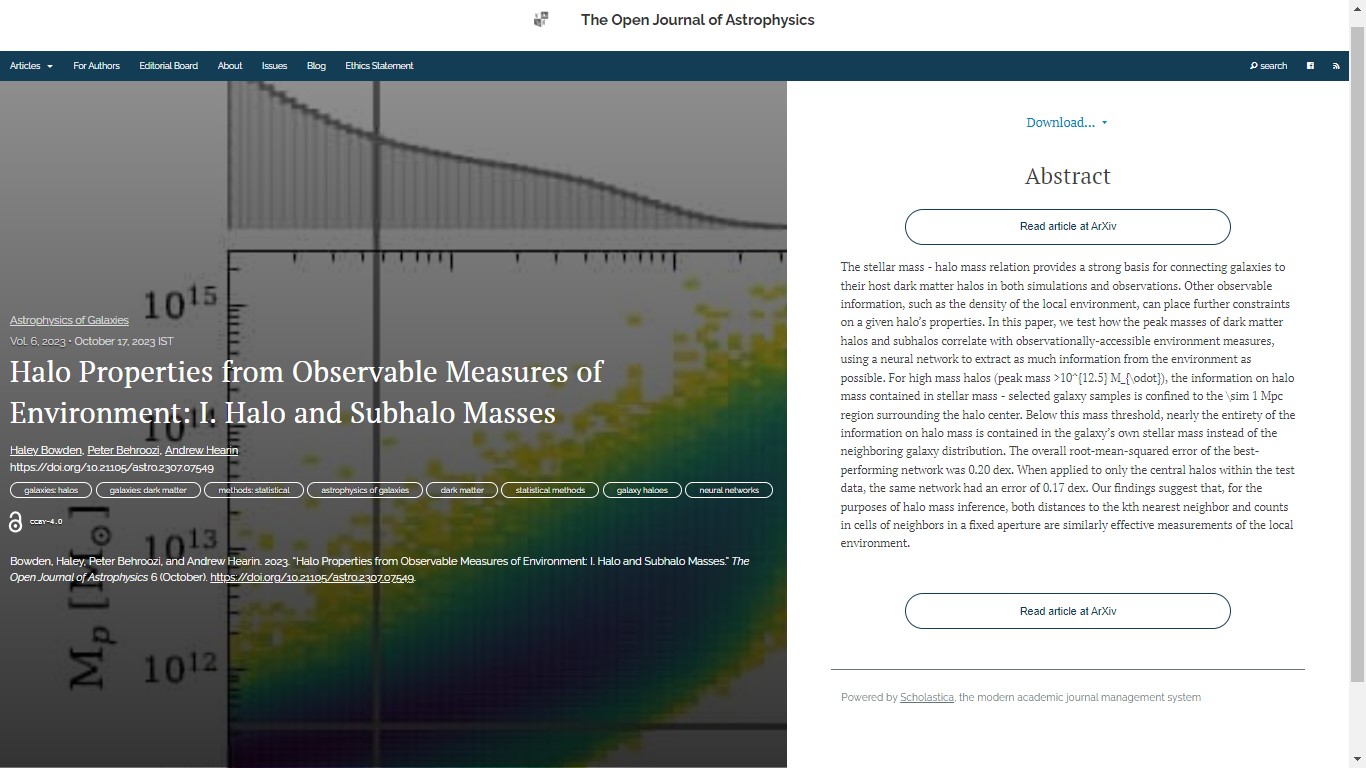
The title of the first paper is “Halo Properties from Observable Measures of Environment: I. Halo and Subhalo Masses” and its primary classification is Astrophysics of Galaxies. it is an exploration using neural networks of how the peak masses of dark matter halos and subhaloes correlate with observationally-accessible measures of their dependence on environment.

The authors based in the United States of America: Haley Bowden and Peter Behroozi of the University of Arizona, and Andrew Hearin of the Argonne National Laboratory

Here is a screen grab of the overlay which includes the abstract:


You can click on the image of the overlay to make it larger should you wish to do so. You can find the officially accepted version of the paper on the arXiv here.

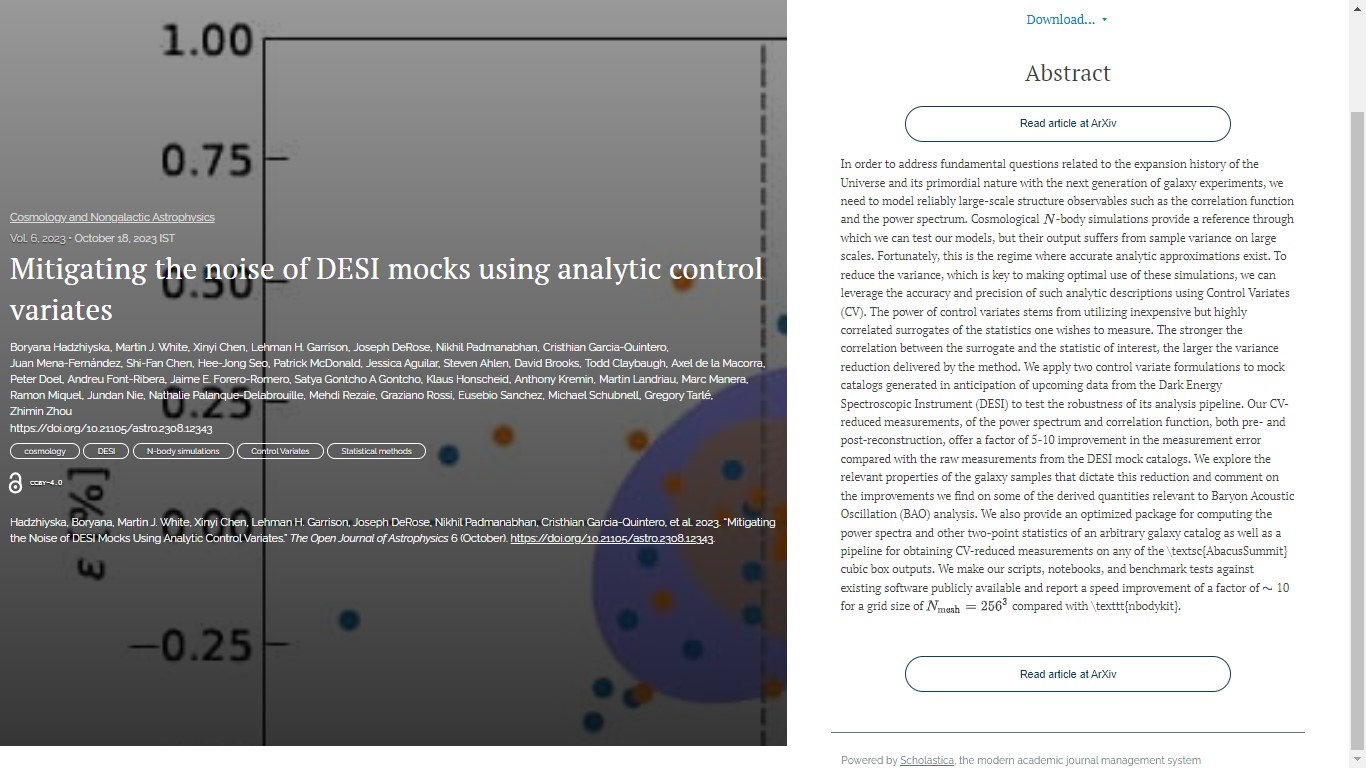
The second paper was published on 18th October 2023.  The primary classification for this one is Cosmology and Nongalactic Astrophysics and is “Mitigating the noise of DESI mocks using analytic control variates”. For those of you not up with the lingo, DESI stands for the Dark Energy Spectroscopic Instrument and you can read more about it here.

The lead author for this one is Boryana Hadzhiyska of the Lawrence Berkeley Laboratory and the University of California, Berkeley (USA) and there are 32 other authors. This paper presents a method for reducing the effects of sample variance on cosmological simulations using analytical approximations and tests it using DESI data.

Here is a screen grab of the overlay which includes the abstract:


You can click on the image of the overlay to make it larger should you wish to do so. You can find the officially accepted version of the paper on the arXiv here.

New Publication at the Open Journal of Astrophysics

Posted in OJAp Papers, Open Access, The Universe and Stuff with tags , , , , on June 13, 2023 by telescoper

It’s time to announce yet another new paper at the Open Journal of Astrophysics. This one was published on Friday 9th June.

The latest paper is the 19th paper so far in Volume 6 (2023) and the 84th in all,  so with more than half of 2023 remaining and many papers still in the pipeline we’re on track to reach a total of 100 papers by the end of 2023!

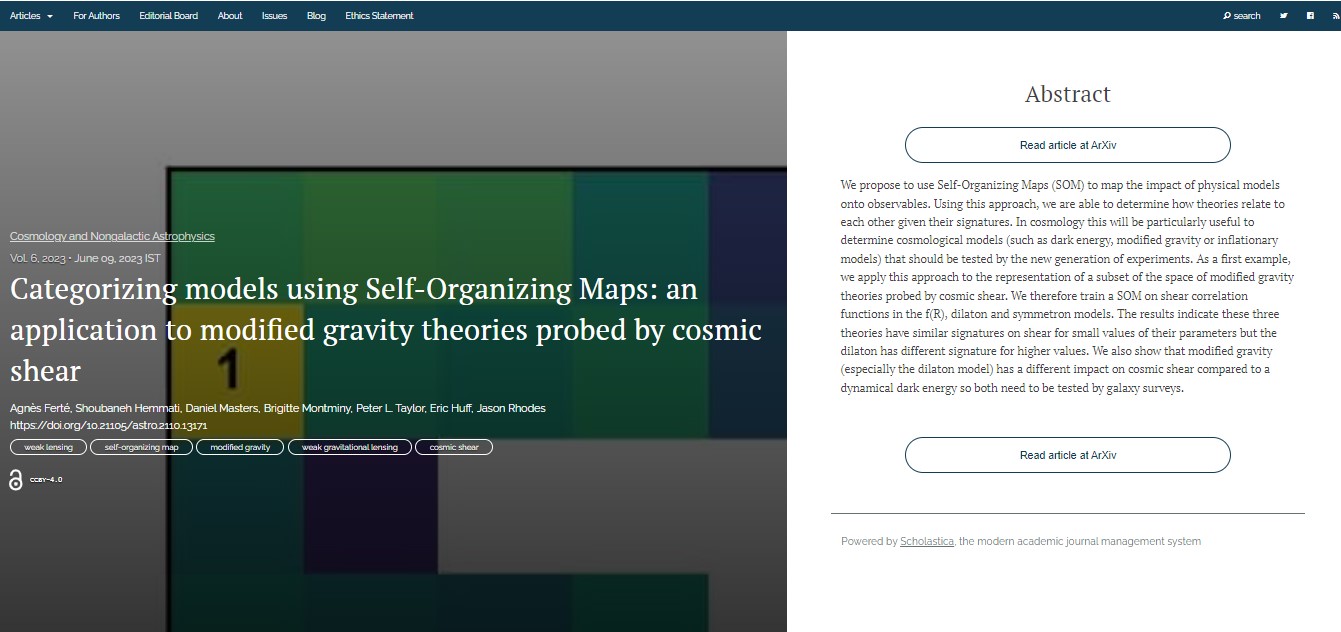
The primary classification for this paper is Cosmology and Nongalactic Astrophysics and its title is “Categorizing models using Self-Organizing Maps: an application to modified gravity theories probed by cosmic shear”. For the uninitiated, a Self-Organizing Map is a machine-learning technique that makes large-dimensional data sets easier to analyze. This paper is yet another one about weak gravitational lensing (cosmic shear), which is obviously what the cool kids do these days.

The authors are: Agnès Ferté (JPL); Shoubaneh Hemmati (IPAC); Daniel Masters (IPAC); Brigitte Montminy (JPL); Peter L. Taylor (JPL); Eric Huff (JPL);  and Jason Rhodes (JPL).

(JPL=Jet Propulsion Laboratory, IPAC= Infrared Processing & Analysis Center, both associated with California Institute of Technology, Pasadena, USA)

Here is a screen grab of the overlay which includes the  abstract:


You can click on the image of the overlay to make it larger should you wish to do so. You can find the officially accepted version of the paper on the arXiv here.

P.S. The first author tweeted about this paper:


Open Access: the Future is Diamond

Posted in Open Access with tags , , , on May 24, 2023 by telescoper

As it was foretold the Council of Europe has now released a document (PDF) that calls for “transparent, equitable, and open access to scholarly publications”.  In its conclusions, the Council calls on the Commission and the member states to support policies towards a scholarly publishing model that is not-for-profit, open access and multi-format, with no costs for authors or readers. In other words, it calls for Diamond Open Access. The covering press release includes:

If we really believe in open science, we need to make sure that researchers can make their findings available and re-usable and that high-quality scientific articles are openly accessible to anyone that needs to read them. This should be particularly the case for research that benefits from public funding: what has been paid by all should be accessible to all.

Mats Persson, Swedish Minister for Education, Ministry of Education and Research

This is clearly how Open Access should be, though I am still worried that the sizeable publishing lobby will still try to persuade research agencies and institutions to pay the existing fees on behalf of authors, which does not solve the problem but merely hides it.

I know I’m not alone in thinking that the current publishing ecosystem is doomed and will die a natural death soon enough. The replacement should be a worldwide network of institutional and/or subject-based repositories that share research literature freely for the common good. Universities and research centres should simply bypass the grotesque parasite that is the publishing industry. Indeed, I would be in favour of hastening the demise of the Academic Journal Racket by having institutions make it a disciplinary offence for any researcher to pay an APC to any journal.

We are lucky in physics and astronomy because arXiv has already done the hard work for us. With the existence of arXiv, old-style journals are no longer necessary. It is great that arXiv is being joined by similar ventures in other fields, such as BiorXiv and EarthArxiv. A list of existing repositories can be found here. I’m sure many more will follow. The future is Diamond.

What is needed is a global effort to link these repositories to each other and to peer review mechanisms. One way is through overlays as demonstrated by the Open Journal of Astrophysics, there being no reason why the idea can’t be extended beyond arXiv. Other routes are possible, of course, and I would love to see different models developed. I hope the European Council call will result in more support for Diamond Open Access. But whether this happens or not, I think the next few years are going to be very exciting.

Progress on Open Access?

Posted in Open Access with tags , , , , , , , on April 27, 2023 by telescoper

The current state of play with regard to Open Access publishing is very disappointing. The academic publishing industry seems to have persuaded the powers that be to allow them to charge exorbitant article processing charges (APCs) to replace revenues lost from subscriptions when they publish a paper free to readers. This simply transfers the cost from reader to author, and excludes those authors who can’t afford to pay.

This current system of ‘Gold’ Open Access is a scam, and it’s a terrible shame we have ended up having it foisted upon us. Fortunately, being forced to pay APCs of many thousands of euros to publish their papers, researchers are at last starting to realize that they are being ripped off. Recently, the entire Editorial Board of Neuroimage and its sister journal Neuroimage: Reports resigned in protest at the `extreme’ APC levels imposed by the publisher, Elsevier. I’m sure other academics will follow this example, as it becomes more and more obvious that the current arrangements are unsustainable. Previously the profits of the big publishers were hidden in library budgets. Now they are hitting researchers and their grants directly, as authors now have to pay, and people who previously hadn’t thought much about the absurdity of it all are now realizing what a racket academic publishing really is.

The people at the top have been slow to grasp this reality, but there are signs that this is at last happening, In the USA there has been the Nelson Memorandum (see discussion here). Now there is movement in the European Union, with member states apparently set on agreeing a  text to be published next month (May 2023) that calls for immediate open access the default, with no author fees. This is clearly how Open Access should be, though I am still worried that the sizeable publishing lobby will try to persuade research agencies and institutions to pay the existing fees on behalf of authors, which does not solve the problem but merely hides it.

I know I’m not alone in thinking that the current publishing ecosystem is doomed and will die a natural death soon enough. The replacement should be a worldwide network of institutional and/or subject-based repositories that share research literature freely for the common good. Universities and research centres should simply bypass the grotesque parasite that is the publishing industry. Indeed, I would be in favour of hastening the demise of the Academic Journal Racket by having institutions make it a disciplinary offence for any researcher to pay an APC.

We are lucky in physics and astronomy because arXiv has already done the hard work for us. Indeed, it is now a truth universally acknowledged* that every new research paper worth reading in these disciplines can be found on arXiv. Old-style journals are no longer necessary. It is great that arXiv is being joined by similar ventures in other fields, such as BiorXiv and EarthArxiv. A list of existing repositories can be found here. I’m sure many more will follow. What is needed is a global effort to link these repositories to each other and to peer review mechanisms. One way is through overlays as demonstrated by the Open Journal of Astrophysics, there being no reason why the idea can’t be extended beyond arXiv. Other routes are possible, of course, and I would love to see different models developed. I think the next few years are going to be very exciting.

*It is also a truth universally acknowledged that anyone who doesn’t understand the reference to “a truth university acknowledged” has not read Pride and Prejudice by Jane Austen…

Response to the Nelson Memorandum from arXiv

Posted in Open Access with tags , , on April 11, 2023 by telescoper

I just noticed on the arXiv blog that arXiv, along with bioRxiv and medRxiv, has released its response in the form of an open letter to the US Office of Science and Technology Policy (OSTP) “Nelson Memorandum” which recommends that US government agencies update their public access policies to make publications and data from research funded by US taxpayers publicly accessible immediately without embargo or cost. I thought I’d take the liberty of reproducing the letter in full here because what it says should apply beyond the United States. I agree particularly strongly with the last paragraph. I haven’t edited the letter except to replace footnotes with links.

—o—

April 11, 2023

The recent Office of Science and Technology Policy “Nelson Memorandum” on “Ensuring Free, Immediate, and Equitable Access to Federally Funded Research” is a welcome affirmation of the public right to access government funded research results, including publication of articles describing the research, and the data behind the research. The policy is likely to increase access to new and ongoing research, enable equitable access to the outcome of publicly funded research efforts, and enable and accelerate more research. Improved immediate access to research results may provide significant general social and economic benefits to the public.

Funding Agencies can expedite public access to research results through the distribution of electronic preprints of results in open repositories, in particular existing preprint distribution servers such as arXivbioRxiv, and medRxiv. Distribution of preprints of research results enables rapid and free accessibility of the findings worldwide, circumventing publication delays of months, or, in some cases, years. Rapid circulation of research results expedites scientific discourse, shortens the cycle of discovery and accelerates the pace of discovery.

Distribution of research findings by preprints, combined with curation of the archive of submissions, provides universal access for both authors and readers in perpetuity. Authors can provide updated versions of the research, including “as accepted,” with the repositories openly tracking the progress of the revision of results through the scientific process. Public access to the corpus of machine readable research manuscripts provides innovative channels for discovery and additional knowledge generation, including links to the data behind the research, open software tools, and supplemental information provided by authors.

Preprint repositories support a growing and innovative ecosystem for discovery and evaluation of research results, including tools for improved accessibility and research summaries. Experiments in open review and crowdsourced commenting can be layered over preprint repositories, providing constructive feedback and alternative models to the increasingly archaic process of anonymous peer review.

Distribution of research results by preprints provides a well tested path for immediate, free, and equitable access to research results. Preprint archives can support and sustain an open and innovative ecosystem of tools for research discovery and verification, providing a long term and sustainable approach for open access to publicly funded research.

New Publication at the Open Journal of Astrophysics

Posted in OJAp Papers, Open Access, The Universe and Stuff with tags , , , , , , on February 3, 2023 by telescoper

The articles are coming in thick and fast at the Open Journal of Astrophysics. and why trying to get them refereed and published as quickly as we can. It’s time to announce yet another paper. This one was published officially yesterday (2nd February 2023) but I just found time to post about it here today before I go to my 9am tutorial.

The latest paper is the 4th paper in Volume 6 (2023) as well as the 69th in all. This one is in the Astrophysics of Galaxies folder.

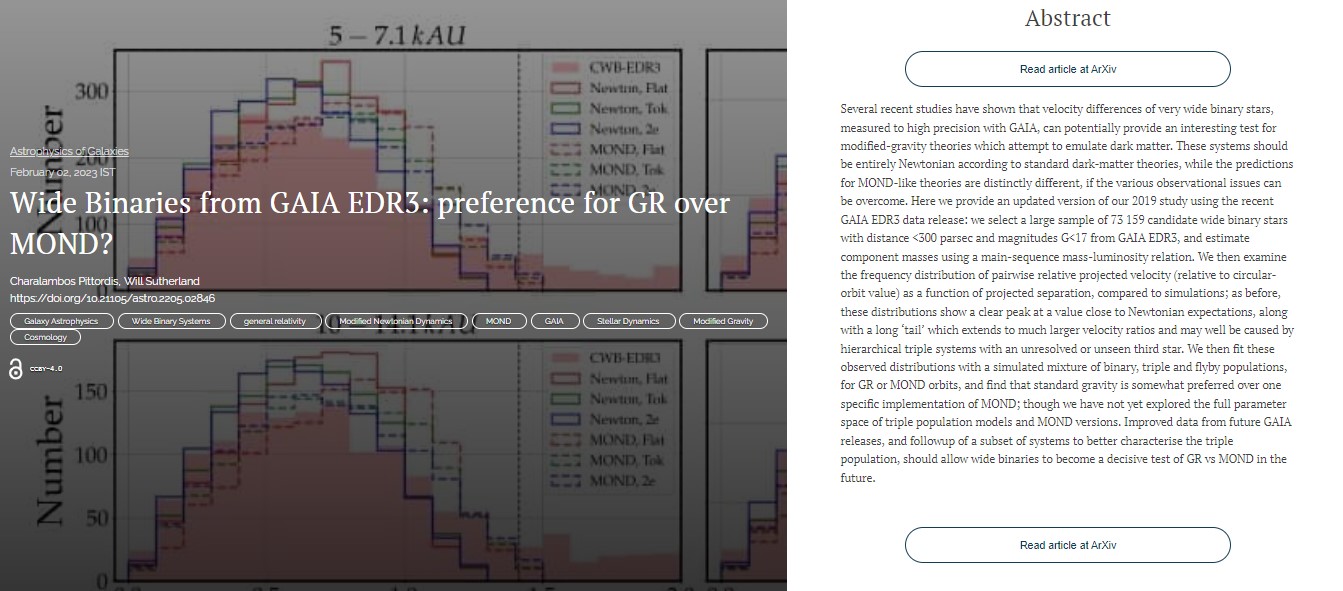
The latest publication is entitled “Wide Binaries from GAIA EDR3: preference for GR over MOND?”.  The authors of this paper,  Charalambos Pittordis and Will Sutherland, are both based at Queen Mary, University of London. We published a related paper last month.

Here is a screen grab of the overlay which includes the  abstract:


You can click on the image to make it larger should you wish to do so. You can find the officially accepted version of the paper on the arXiv here.

New Publication at the Open Journal of Astrophysics

Posted in OJAp Papers, Open Access, The Universe and Stuff with tags , , , , , on November 4, 2022 by telescoper

It’s time once again for me to announce new paper at the Open Journal of Astrophysics. The new paper, published last week, is the 15th paper in Volume 5 (2022) and the 63rd in all. The latest publication is entitled “Two-photon amplitude interferometry for precision astrometry” and the authors are Paul Stankus, Andrei Nomerotski and Anže Slosar of Brookhaven National Laboratory (USA) and Stephen Vintskevich (Moscow Institute of Physics & Technology, Russia).

The paper presents a new method for doing interferometry with quantum-mechanically entangled photons and is thus is in the folder marked Instrumentation and Methods for Astrophysics. I don’t know much about this area – and there are many whose baseline opinion is that interferometry is a bit of a fringe topic that is rather complex perhaps needs more visibility in the current phase of its development  (geddit?) – but the physics looks fascinating to me. Amplitude interferometry should be contrasted with the intensity interferometry method of Hanbury Brown and Twiss which I remember learning about as an undergraduate.

Anyway, here is a screen grab of the overlay which includes the  abstract:

You can click on the image to make it larger should you wish to do so. The full image used in the overlay is this:


You can find the officially accepted version of the paper on the arXiv here.

Open Access Week and the arXiv

Posted in Open Access with tags , , on October 17, 2022 by telescoper

Just time for a quick post to advertise the fact that next week (commencing October 24th 2022) is International Open Access Week.

I’ll be participating in one of the events – a panel discussion – organized by arXiv as part of Open Access Week. This event is entitled Trends in Peer Review of Open Access Preprints and the description is:

Speed of research is a major feature of open access preprint platforms like arXiv – formal peer review can follow later after rapid distribution of results. However, as submissions to arXiv and other preprint servers have grown, many researchers are seeking new avenues for community feedback and peer review. At this panel discussion, leaders in preprints and peer review will discuss current trends in virtual overlay journals, open peer reviews, and more. (Video recording will be available to registrants after the event)

Panelists:

  • Peter Coles, PhD, Theoretical Cosmologist at Maynooth University in Ireland and Managing Editor of The Open Journal of Astrophysics
  • Jessica Polka, PhD, Executive Director of ASAPbio
  • Antti Mikael Rousi, PhD, Senior Advisor, Research Services at Aalto University, Finland
  • Steinn Sigurdsson, PhD, Professor of Astronomy at Penn State University and arXiv Scientific Director

The event is at on Wednesday, October 26, 2022 at 15:00 UTC /11:00 EDT; that’s 16:00 Irish Time. It’s on Zoom (unless you are at Cornell and can attend in person). You need to register here.

Open Access USA

Posted in Open Access with tags , , on August 26, 2022 by telescoper

There was an important announcement yesterday about Open Access from the Office of Science & Technology Policy at the White House which I picked up from Twitter. Here is a summary:

More detailed documents can be found here and here.

The principle that research that is funded by the public should be available to the public is one of the foundations of Open Access publishing and it is laudable to see this enforced more strictly. Previously journals were able to keep articles behind a paywall for an embargo period, just withholding access for up to a year. The deadline for ending this practice is December 31st 2025. I would have made it sooner, but at least it has not been kicked into the very long grass.

The problem that I can see with the policy is that it will probably involve researchers having to pay thousands of dollars in article processing fees associated with the “Gold” Open Access of the form offered by commercial publishers. When the summary says “without cost” it means “without cost to the reader”. The way it will work is that these costs are transferred to the authors. The publishers will still gather their profits.

It will take stronger policies than this to break the stranglehold of the academic publishing cartels. It is more likely in my view that radical change will emerge from the grass roots, as researchers find novel ways of publishing their work without handing huge dollops of cash to profiteers.