Archive for Open Access

Academic Publishing is a Lucrative Scam

Posted in OJAp Papers, Open Access with tags , , , , , , , , on July 17, 2024 by telescoper

I saw an article in the Guardian yesterday with the title Academic journals are a lucrative scam – and we’re determined to change that. It’s written by Arash Abizadeh who is Professor of Political Science at McGill University in Canada. I urge you to read the piece if you’re interested in Open Access and the issues surrounding it.

I agree with virtually everything in the article. Indeed I’ve been saying much the same thing for about 15 years! I’m also determined to change things too, which is why we set up the Open Journal of Astrophysics, a “Diamond” Open Access Journal. Talking about the system of Gold Open Access, Prof. Abizadeh writes:

There is an obvious alternative: universities, libraries, and academic funding agencies can cut out the intermediary and directly fund journals themselves, at a far lower cost. This would remove commercial pressures from the editorial process, preserve editorial integrity and make research accessible to all. The term for this is “diamond” open access, which means the publishers charge neither authors, editors, nor readers (this is how our new journal will operate). Librarians have been urging this for years. So why haven’t academics already migrated to diamond journals?

I think the reason more academics haven’t already migrated to Diamond Open Access journals is that there are relatively few such journals. The reason for that is that although there are lots of people talking about Diamond Open Access there are many fewer actually taking steps to implement it. The initiative mentioned in the Guardian article is therefore very welcome. Although I think in the long run this transition is inevitable, it won’t happen by itself. It certainly won’t be helped by the Academic Publishing Industry either. We academics have to provide the push.

Here’s another excerpt:

Career advancement depends heavily on publishing in journals with established name recognition and prestige, and these journals are often owned by commercial publishers. Many academics – particularly early-career researchers trying to secure long-term employment in an extremely difficult job market – cannot afford to take a chance on new, untested journals on their own.

This is true, up to a point.

First of all any institution that has signed up to the San Francisco Declaration On Research Assessment (DORA) should not be relying on (often bogus) indicators of prestige such as the Journal Impact Factor or the journal’s presence in the Scopus index. If Diamond Open Access is to gain further traction it has to be accompanied to a wholesale change towards fairer research assessment practices.

Second, although it is true that it has taken some years to reach the volume it has now, I have been pleasantly surprised how many early career researchers in astrophysics have been keen to try out the Open Journal of Astrophysics. I think that’s because (a) early career researchers have not been indoctrinated into the absurdities of existing publishing practices and (b) they can see that the citation rates on OJAp are no worse than other allegedly more “prestigious” journals.

Counting the Cost of Gold Open Access

Posted in Open Access with tags , , , , , , , , , on July 10, 2024 by telescoper

If you’re interested in how Article Processing Charges (APCs) have changed over the past five years, the data from six major publishers are now available accompanied by a paper on the arXiv with the abstract:

This paper introduces a dataset of article processing charges (APCs) produced from the price lists of six large scholarly publishers – Elsevier, Frontiers, PLOS, MDPI, Springer Nature and Wiley – between 2019 and 2023. APC price lists were downloaded from publisher websites each year as well as via Wayback Machine snapshots to retrieve fees per journal per year. The dataset includes journal metadata, APC collection method, and annual APC price list information in several currencies (USD, EUR, GBP, CHF, JPY, CAD) for 8,712 unique journals and 36,618 journal-year combinations. The dataset was generated to allow for more precise analysis of APCs and can support library collection development and scientometric analysis estimating APCs paid in gold and hybrid OA journals.

There’s even an interactive data explorer here, at which link you can also find this very informative summary graphic:

Surprise, surprise: the vast majority have gone up!

These figures apply to Gold and Hybrid Open Access publications, but not to Diamond Open Access journals which are free to both authors and readers and avoid these rip-off charges. In my opinion research institutions would be much better off investing in Diamond Open Access publishing than sending their hard-earned cash to profiteering outfits such as Elsevier.

An All-Ireland Diamond Open Access Publishing Platform?

Posted in Maynooth, Open Access with tags , , , , , , on June 24, 2024 by telescoper

Here’s a report on an interesting development about Open Access in Ireland. The article belongs to the Special Issue 10th Anniversary Special Issue “PUBMET2023 Conference on Scholarly Communication in the Context of Open Science” and has the following abstract:

The Government of Ireland has set a target of achieving 100% open access to publicly funded scholarly publications by 2030. As a key element of achieving this objective, the PublishOA.ie project was established to evaluate the feasibility of establishing an all-island [Republic of Ireland and Northern Ireland] digital publishing platform for Diamond Open Access journals and monographs designed to advance best practice and meet the needs of authors, readers, publishers, and research funding organisations in Irish scholarly publishing. It should be noted in this context that there is substantial ‘north–south’ cooperation between public bodies in the Republic of Ireland and Northern Ireland in the United Kingdom, some of whom operate on what is commonly termed an ‘all-island’ basis. The project commenced in November 2022 and will run until November 2024, with the submission of a Final Report. This article originated as an interim project report presented in September 2023 at the PubMet2023 conference in Zadar, Croatia. The project is unique in its mandate to report on the feasibility of a shared platform that will encompass scholarly publishing across the two jurisdictions on the island of Ireland, which are now, post-Brexit, inside and outside the European Union (EU): the Republic of Ireland and Northern Ireland in the United Kingdom. The project is co-led by the Royal Irish Academy (RIA), Ireland’s leading body of experts in the Sciences and Humanities, and the Trinity Long Room Hub Arts & Humanities Research Institute of Trinity College Dublin. There are sixteen partners and affiliates from universities and organisations from the island of Ireland. The feasibility study will be based on a review of the publishing practices in the island of Ireland, with gap analysis on standards, technology, processes, copyright practices, and funding models for Diamond OA, benchmarking against other national platforms, and specifications of the requirements, leading to the delivery of a pilot national publishing platform. A set of demonstrator journals and monographs will be published using the platform, which will be actively trialled by the partner publishers and authors. PublishOA.ie aims to deliver an evidence-based understanding of Irish scholarly publishing and of the requirements of publishers to transition in whole or in part to Diamond OA. This paper provides an interim report on progress on the project as of September 2023, ten months after its commencement.

I think the idea of having a national Diamond Open Access publishing platform is a very interesting one. In principle it could facilitate the federated system of repositories linked by refereeing overlays which I think is the future of academic publishing. I think a national peer review platform would be more to the point than a publishing platform.

I have two comments:

  1. I am surprised that Maynooth University – publisher, among other things, of the Open Journal of Astrophysics (a Diamond Open Access journal) – is not among the partners in this project and does not even receive a mention as a publisher. I wonder how far this project will get if it excludes organizations that are already running Diamond Open Access Journals.
  2. Less of a comment, more of a question: why on Earth is the report published in a journal run by MDPI, a publisher that is controversial (to say the least)? It would be deeply ironic if they had to pay an APC to publish an article on Diamond Open Access!

Research Inventy Journal

Posted in Open Access with tags , on May 28, 2024 by telescoper

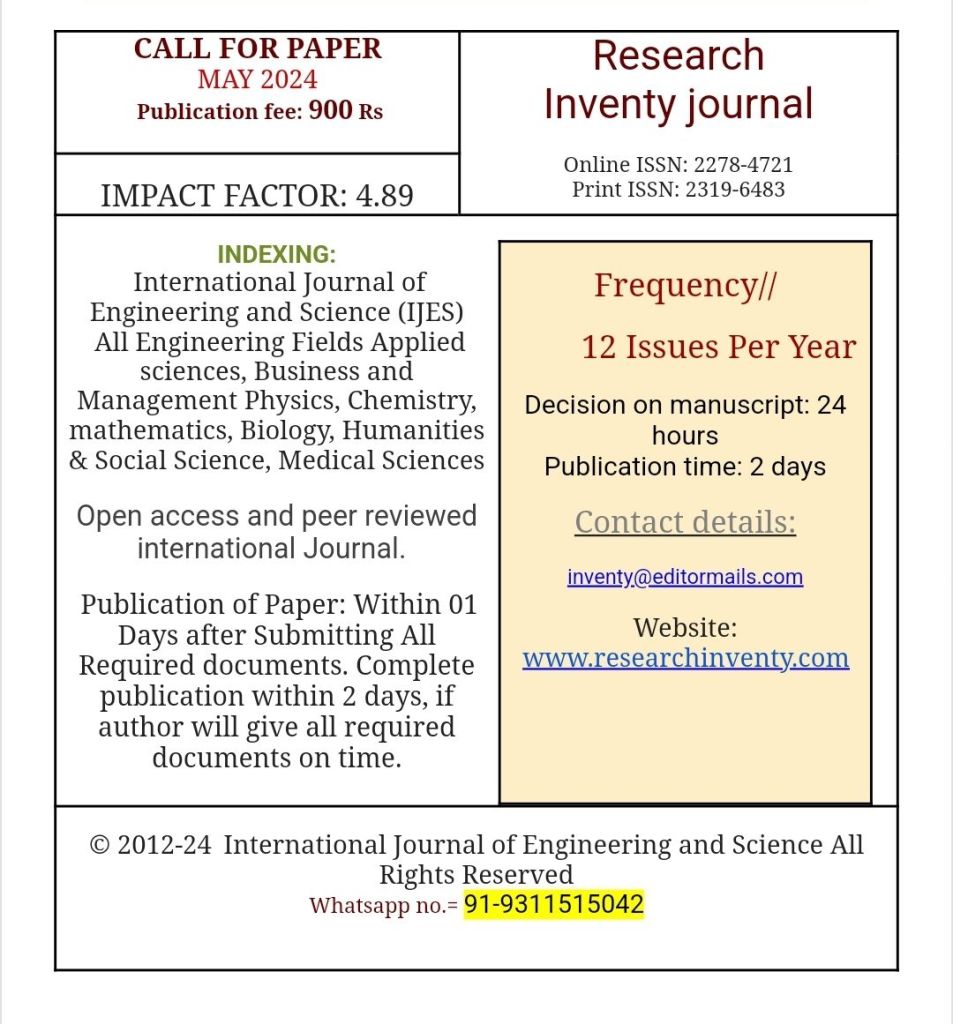
It is great to see the number of open access scientific journals increasing. Just yesterday I was contacted by another one that was previously unknown to me. The style of the advertisement leaves no doubt about the quality of this publication nor of the papers therein; from submission to publication within 24 hours, and all for 900 Rupees (about $10)! Amazing! There’s no question that this journal fills a much needed gap.

An analysis of the effects of sharing research data, code, and preprints on citations

Posted in OJAp Papers, Open Access with tags , , , , , on May 27, 2024 by telescoper

Whenever researchers ask me why I am an advocate of open science the response that first occurs to me is somewhat altruistic: sharing results and data is good for the whole community, as it enables the proper progress of research through independent scrutiny. There is however a selfish reason for open science, demonstrates rather well by a recent preprint on arXiv. The abstract is here:

Calls to make scientific research more open have gained traction with a range of societal stakeholders. Open Science practices include but are not limited to the early sharing of results via preprints and openly sharing outputs such as data and code to make research more reproducible and extensible. Existing evidence shows that adopting Open Science practices has effects in several domains. In this study, we investigate whether adopting one or more Open Science practices leads to significantly higher citations for an associated publication, which is one form of academic impact. We use a novel dataset known as Open Science Indicators, produced by PLOS and DataSeer, which includes all PLOS publications from 2018 to 2023 as well as a comparison group sampled from the PMC Open Access Subset. In total, we analyze circa 122’000 publications. We calculate publication and author-level citation indicators and use a broad set of control variables to isolate the effect of Open Science Indicators on received citations. We show that Open Science practices are adopted to different degrees across scientific disciplines. We find that the early release of a publication as a preprint correlates with a significant positive citation advantage of about 20.2% on average. We also find that sharing data in an online repository correlates with a smaller yet still positive citation advantage of 4.3% on average. However, we do not find a significant citation advantage for sharing code. Further research is needed on additional or alternative measures of impact beyond citations. Our results are likely to be of interest to researchers, as well as publishers, research funders, and policymakers.

Colavizza et al., arXiv:2404.16171

This analysis isn’t based on astrophysics, but I think the relatively high citation rates of papers in the Open Journal of Astrophysics are at least in part due to the fact that virtually all our papers are all available as preprints arXiv prior to publication. Citations aren’t everything, of course, but the positive effect of preprinting is an important factor in communicating the science you are doing.

Two New Publications at the Open Journal of Astrophysics

Posted in OJAp Papers, Open Access, The Universe and Stuff with tags , , , , , , , , , , on April 20, 2024 by telescoper

It’s Saturday, and it’s time to post another update relating to the  Open Journal of Astrophysics.  Since the last update we have published two more papers, taking  the count in Volume 7 (2024) up to 27 and the total published by OJAp up to 142.

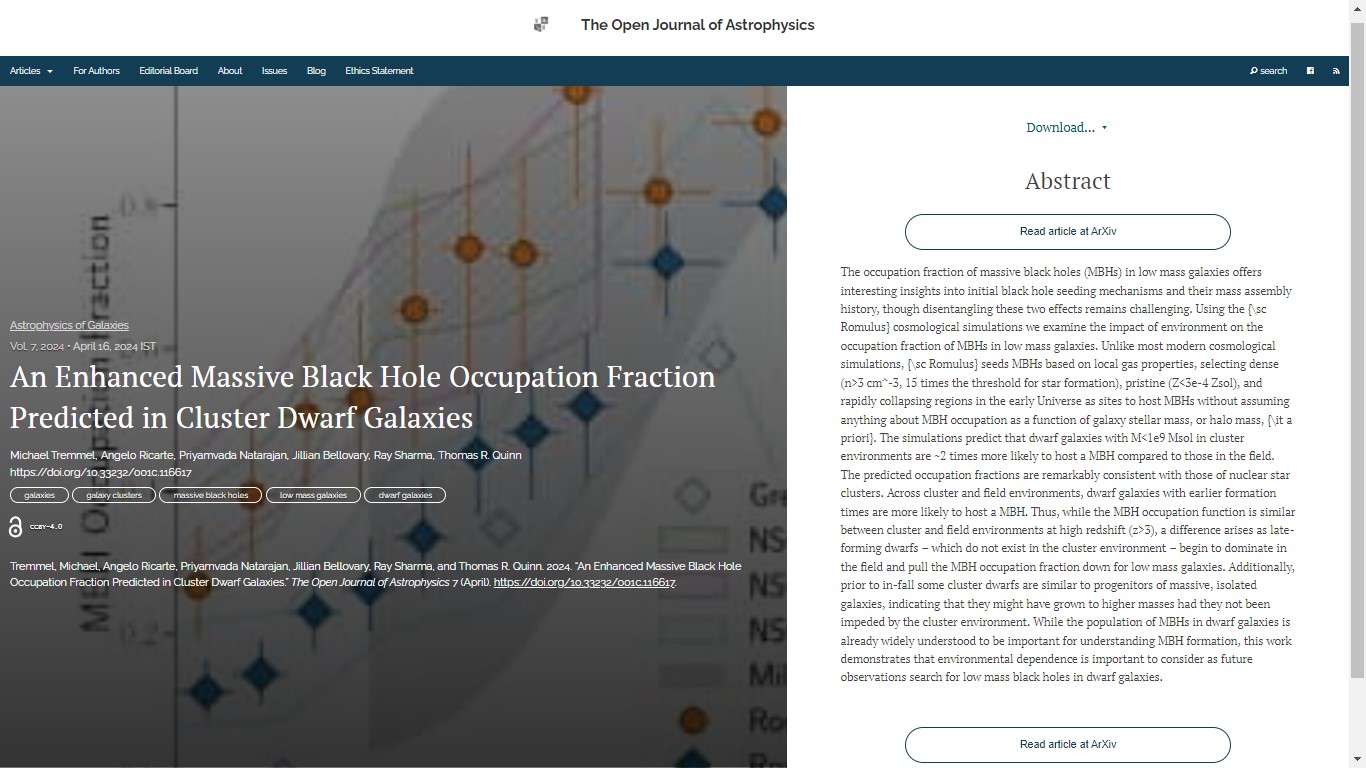
The first paper of the most recent pair – published on  Tuesday April 16th – is “An Enhanced Massive Black Hole Occupation Fraction Predicted in Cluster Dwarf Galaxies” by Michael Tremmel (UCC, Ireland), Angelo Ricarte (Harvard, USA), Priyamvada Natarajan (Yale, USA), Jillian Bellovar (American Museum of Natural History, New York, USA), Ray Sharma (Rutgers, USA), Thomas R. Quinn (University of Washington, USA). It presents a  study, based on the Romulus cosmological simulations, of the impact of environment on the occupation fraction of massive black holes in low mass galaxies. This one is in the folder marked “Astrophysics of Galaxies“.

Here is a screen grab of the overlay which includes the abstract:


You can click on the image of the overlay to make it larger should you wish to do so. You can find the officially accepted version of the paper on the arXiv here.

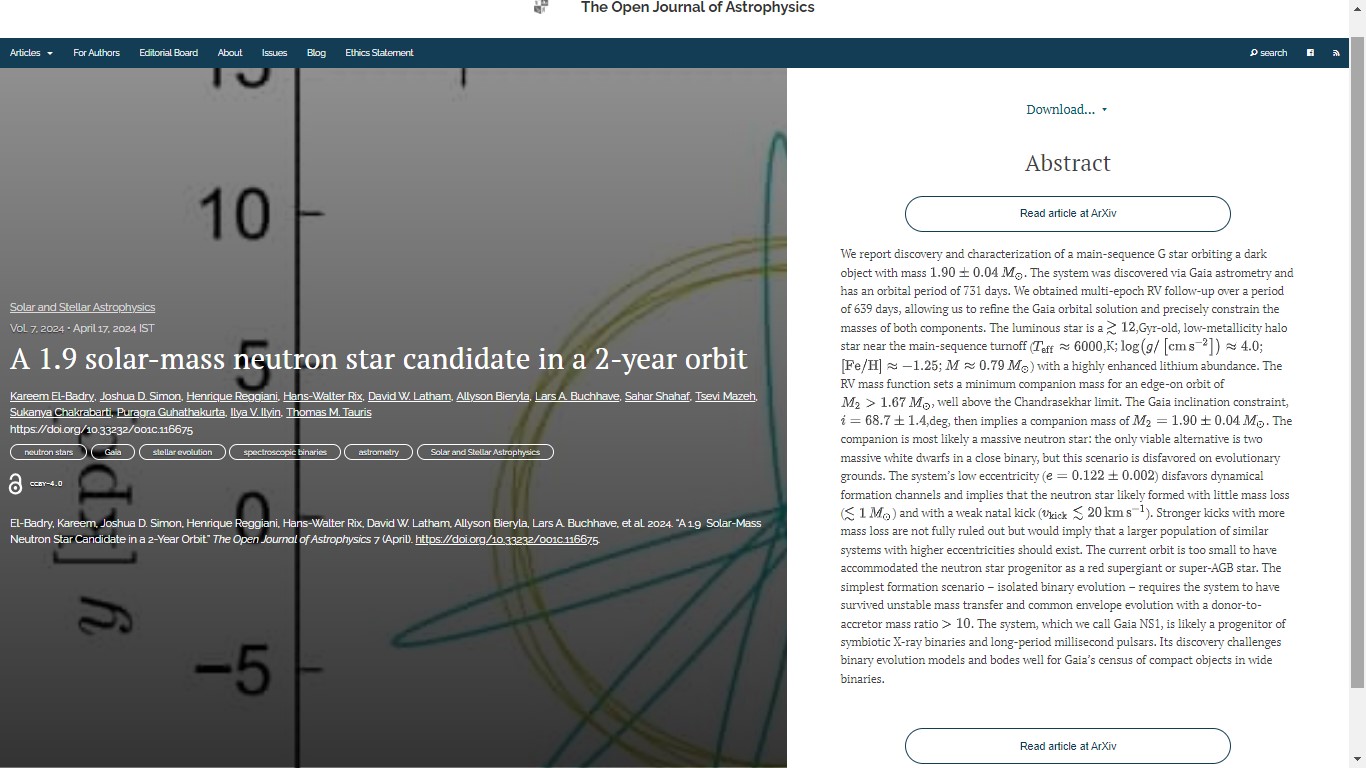
The second paper was published on Wednesday 17th April and has the title “A 1.9 solar-mass neutron star candidate in a 2-year orbit” and the authors are: Kareem El-Badry (Caltech, USA), Joshua D. Simon (Carnegie Observatories, USA), Henrique Reggiani (Gemini Observatory, Chile), Hans-Walter Rix (Heidelberg, Germany),  David W. Latham (Harvard, USA),  Allyson Bieryla (Harvard, USA),  Lars A. Buchhave (Technical University of Denmark, Denmark),  Sahar Shahaf (Weizmann Institute of Science, Israel),  Tsevi Mazeh (Tel Aviv University, Israel), Sukanya Chakrabarti (University of Alabama, USA), Puragra Guhathakurta (University of California Santa Cruz, USA), Ilya V. Ilyin (Potsdam, Germany), and Thomas M. Tauris (Aalborg University, Denmark)

This one, which is in the folder marked Solar and Stellar Astrophysics, presents a discussion of the discovery of a 1.9 solar mass neutron star candidate using Gaia astrometric data, together with the implications of its orbital parameters for the formation mechanism.

Here is a screen grab of the overlay which includes the abstract:


You can click on the image of the overlay to make it larger should you wish to do so. You can find the officially accepted version of the paper on the arXiv here.

That concludes this week’s update!

The Gates Foundation and Open Access

Posted in Open Access with tags , , , , , on April 9, 2024 by telescoper

There has been quite a lot of reaction (e.g. here) to the recent announcement of a new Open Access Policy by the Bill & Melinda Gates Foundation, which is one of the one of the world’s top funders of biomedical research. This mandates the distribution of research it funds as preprints and also states that it will not pay Article Processing Charges (APCs). The essentials of the policy, which comes into effect on 1st January 2025, are these:

  1. Funded Manuscripts Will Be Available. As soon as possible and to the extent feasible, Funded Manuscripts shall be published as a preprint in a preprint server recognized by the foundation or preapproved preprint server which applies a sufficient level of scrutiny to submissions. Accepted articles shall be deposited immediately upon publication in PubMed Central (PMC), or in another openly accessible repository, with proper metadata tagging identifying Gates funding. In addition, grantees shall disseminate Funded Manuscripts as described in their funding agreements with the foundation, including as described in any proposal or Global Access commitments.
  2. Dissemination of Funded Manuscripts Will Be On “Open Access” Terms. All Funded Manuscripts, including any subsequent updates to key conclusions, shall be available immediately, without any embargo, under the Creative Commons Attribution 4.0 International License (CC BY 4.0) or an equivalent license. This will permit all users to copy, redistribute, transform, and build on the material in any medium or format for any purpose (including commercial) without further permission or fees being required.
  3. Gates Grantees Will Retain Copyright. Grantees shall retain sufficient copyright in Funded Manuscripts to ensure such Funded Manuscripts are deposited into an open-access repository and published under the CC-BY 4.0 or equivalent license.
  4. Underlying Data Will Be Accessible Immediately. The Foundation requires that underlying data supporting the Funded Manuscripts shall be made accessible immediately and as open as possible upon availability of the Funded Manuscripts, subject to any applicable ethical, legal, or regulatory requirements or restrictions. All Funded Manuscripts must be accompanied by an Underlying Data Availability Statement that describes where any primary data, associated metadata, original software, and any additional relevant materials or information necessary to understand, assess, and replicate the Funded Manuscripts findings in totality can be found. Grantees are encouraged to adhere to the FAIR principles to improve the findability, accessibility, interoperability, and reuse of digital assets.
  5. The Foundation Will Not Pay Article Processing Charges (APC). Any publication fees are the responsibility of the grantees and their co-authors.
  6. Compliance Is A Requirement of Funding. This Open Access policy applies to all Funded Manuscripts, whether the funding is in whole or in part. Compliance will be continuously reviewed, and grantees and authors will be contacted when they are non-compliant.
    • As appropriate, Grantees should include the following acknowledgment and notice in Funded Manuscripts:
    • “This work was supported, in whole or in part, by the Bill & Melinda Gates Foundation [Grant number]. The conclusions and opinions expressed in this work are those of the author(s) alone and shall not be attributed to the Foundation. Under the grant conditions of the Foundation, a Creative Commons Attribution 4.0 License has already been assigned to the Author Accepted Manuscript version that might arise from this submission. Please note works submitted as a preprint have not undergone a peer review process.”

Reactions to this new policy are generally positive, except (unsurprisingly) for the academic publishing industry.

For what it’s worth, my view is that it is a good policy, and I wish more funders went along this route, but it falls short of being truly excellent. As it stands, the policy seems to encourage authors to put the “final” version of their articles in traditional journals, without these articles being freely available through Open Access. That falls short of goal establishing a global worldwide network of institutional and/or subject-based repositories, linked to peer review mechanisms such as overlays, that share research literature freely for the common good. To help achieve that aim, the Gates’ Foundation should to encourage overlays rather than traditional journals as the way to carry out peer review. Perhaps this will be the next step?

Open Journal of Astrophysics Update

Posted in OJAp Papers, Open Access with tags , , , , , on April 4, 2024 by telescoper

I’ve just noticed that my post earlier in the week about changes to the publication system at the Open Journal of Astrophysics is dated April 1st. I can assure you it wasn’t meant as a joke! Anyway, the integration with Crossref is now complete and I’ve started clearing the backlog of papers waiting to be published. I would say normal service has been resumed, but the idea is to make the process faster and more reliable than before so it’s hopefully a return but to better-than-normal service.

I want first of all to thank the people at Maynooth University Library, Crossref, and Scholastica for helping us figure out the issue and solve it. We would no doubt have got there faster were it not for the intervention of the Easter break, but in any case it has only required a pause of publication for a couple of weeks.

I’ll resume the regular weekly updates at the weekend. However, one paper got snarled up when we ran into a problem. Although published on 20th March, it was never properly registered with Crossref. The only way I could think of to sort out the issue with this one was to start it again, which I did this morning, and it is now published though I kept the publication date as 20th March.

This paper, by Yingtian Chen and Oleg Gnedin of the University of Michigan, is the 21st paper to be published in Volume 7 and the 136th altogether. It is a study of kinematic, chemical and age data of globular clusters from Gaia yielding clues to how the Milky Way Galaxy assembled. You can read the article on arXiv directly here.

You will note the new format of DOI on the overlay. Nothing else has changed that’s visible to the reader.

Academic Publishing: Never Mind the Quality…

Posted in Open Access with tags , , , , , , , , on March 16, 2024 by telescoper

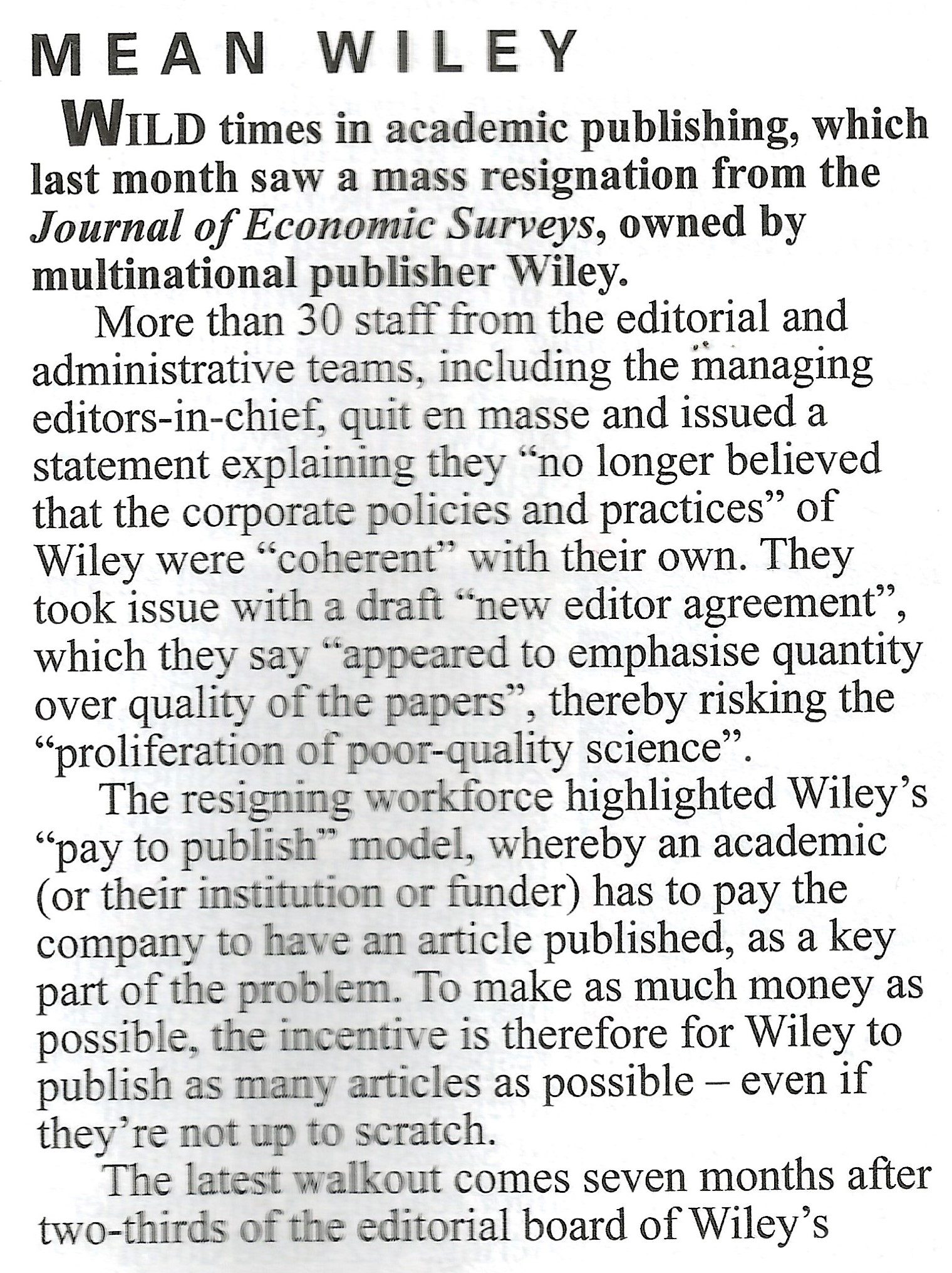
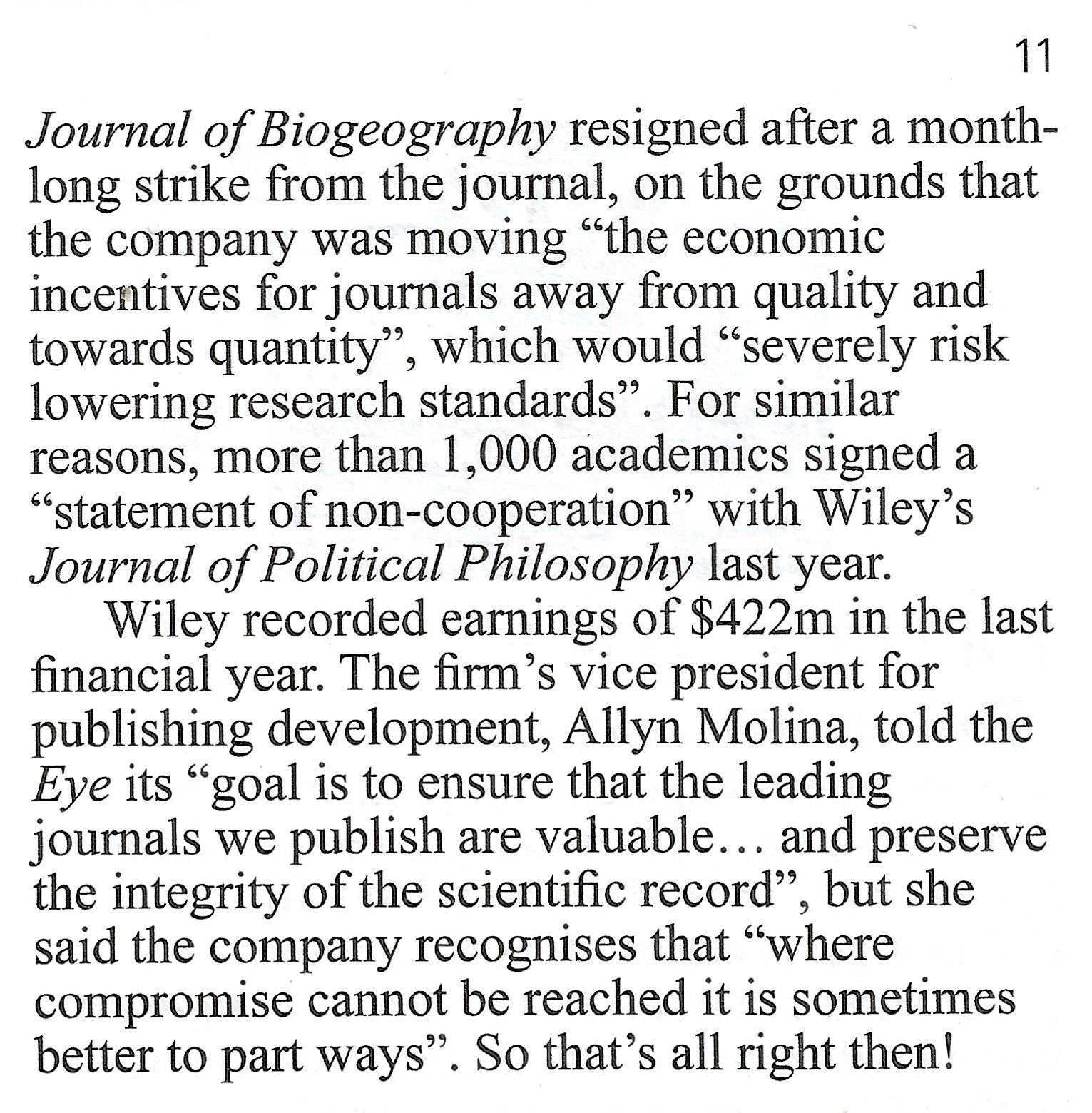
I was interested to see that the latest issue of Private Eye contains a short item about academic publishing:

I’ve heard many stories of this type, with publishers putting pressure on their Editorial Boards to allow more papers to be published. This is undoubtedly motivated by the Gold Open Access model in which authors or their institutions are forced to pay thousands of dollars upfront to publish papers. Since the publisher makes an eye-watering profit on every article, why not publish as many as possible? The recent decision by the Royal Astronomical Society adopt this model is highly likely to have a similar effect there, as its journals will be able to increase revenue at the expense of quality. Under the older subscription-based system, publishers could sell their product to libraries on the basis of quality but they no longer need to do that to make a profit.

The academic publishing industry is perverse enough without adding this obvious incentive to lower editorial standards. There are far too many low quality papers being published already, a situation driven not only by the profiteering of the publishing industry but also by the absurd policies of academia itself which require researchers to churn out huge numbers of papers to get promotion, win research grants, etc.

This part of the academic system is definitely broken. To fix it, academic publishing must be taken out of the hands of commercial publishers and put into the care of research institutions whose libraries are perfectly capable of publishing and curating articles on a non-profit basis. But that won’t be enough: we need also to overhaul how we do research assessment. The principles outlined in the San Francisco Declaration on Research Assessment would be a start.

Publishing Revenue and the Learned Societies

Posted in Open Access with tags , , , , , on March 8, 2024 by telescoper

A couple of days ago I posted a reaction to a shockingly dishonest article I saw in Physics World which has led me to resign my Fellowship of the Institute of Physics (IoP). I thought I would spend a bit of time now to raising some wider points (which I’ve raised before) about the extent that such organizations (including, in my field,  the Royal Astronomical Society and the Institute of Physics) rely for their financial security upon the revenues generated by publishing traditional journals and why this is not in the best interests of their disciplines.

Take IOP Publishing. This is a wholly-owned subsidiary of the Institute of Physics that has an annual turnover of around £60M generated from books and journals. This revenue is the largest contribution to the income that the IoP needs to run its numerous activities relating to the promotion of physics.  A similar situation pertains to the Royal Astronomical Society, although on a smaller scale, as it relies for much of its income from Monthly Notices of the Royal Astronomical Society, in which I have published quite a few papers in the past.

Not surprisingly, these and other learned societies are keen to protect their main source of cash and have lobbied very hard for the “Gold” Open Access some authorities are attempting to foist on the research community, rather than the far more sensible and sustainable approaches to Open Access employed, for example, by the Open Journal of Astrophysics.

There are two major reasons why I object to this approach, one practical and one ethical.

First, I consider it to be inevitable that the traditional journal industry will very soon be completely bypassed in favour of  other forms of publishing. The internet has changed the entire landscape of scientific publication. It’s now so cheap and so easy to disseminate knowledge that traditional journals are already virtually redundant, especially in my field of astrophysics where we have been using the arXiv for so long that many of us hardly ever look at journals.

The comfortable income stream that has been used by the IoP to “promote Physics”, as well as to furnish its  building in King’s Cross and office in Dublin, will dry up unless these organizations find a way of defending it. The “Gold” OA favoured by such organizations their attempt to stem the tide. I think this move into Gold `Open Access’, paid for by ruinously expensive Article Processing Charges paid by authors (or their organizations) is unsustainable because the research community will see through it and refuse to pay. I can already see signs of this happening.

The other problematic aspect of the approach of these learned societies is that I think it is fundamentally dishonest. University and other institutional libraries are provided with funds to provide access to published research, not to provide a backdoor subsidy for a range of extraneous activities that have nothing to do with that purpose. The learned societies do many good things – and some are indeed outstandingly good – but that does not give them the right to siphon off funds from their constituents by a sort of stealth levy.  Voluntary institutional affiliation, paid for by a fee, would be a much fairer way of funding these activities.

A couple of days ago I decided to cease paying the annual subscription to, and resign my Fellowship of, the Institute of Physics. I was reasonably comfortable spending some of my own money supporting physics, but don’t agree with  researchers having to fork out huge amounts of money in involuntary payment of APCs to the IOP. I will decide in the next few days whether or not to resign also from the Royal Astronomical Society for the same reason.

Some time ago I had occasion to visit the London offices of a well-known charitable organization which shall remain nameless. The property they occupied was glitzy, palatial, and obviously very expensive. I couldn’t help wondering how they could square the opulence of their headquarters with the quoted desire to spend as much as possible on their good works. Being old and cynical, I came to the conclusion that, although charities might start out with the noblest intentions, there is a grave danger that they simply become self-serving, viewing their own existence in itself as more important than what they do for others.

The commercial academic publishing industry has definitely gone that way. It arose because of the need to review, edit, collate, publish and disseminate the fruits of academic labour. Then the ease with which profits could be made led it astray. It now fulfills little or no useful purpose, but simply consumes financial resources that could be put to much better effect actually doing science. I think the scientific community knows this very well, and hopefully the parasite will die a natural death.

The question for learned societies is whether they can find a sustainable funding model that isn’t reliant upon effectively purloining funds from research budgets. If their revenue from publishing does fall, can they replace it? And, if not, in what form can they survive?