Archive for Open Journal of Astrophysics

Plan S – Get your feedback in!

Posted in Open Access with tags , , on February 4, 2019 by telescoper

It’s been a rather busy first day back at teaching, and I’m a bit tired after my first Engineering Mathematics lecture, so I’ll just post a couple of quick items on the topic of Open Access Publishing.

The most important thing is a reminder that the deadline for submission of feedback on the Plan S proposals is February 8th 2019, which is this Friday so please get your finger out and submit feedback.

I haven’t written my feedback yet, but when I do I will post it here.

The nice people at the arXiv have already sent in their feedback, and have released it publicly here. There’s a lot of good sense in their comments, which I encourage you to read.

In particular I agree with their comment that the reference XML should be removed. I agree very much with the principle underlying the decision by CoalitionS to include this, I don’t think mandating XML is a sensible way forward. For one thing, it is not a useful format when a paper contains lots of figures and mathematical equations. It’s not that it is particularly difficult to do, just that it’s a waste of time for mathematical disciplines. We could implement a fix to make XML versions of papers available on the Open Journal of Astrophysics, but I’m not going to do it unless and until it’s made obligatory (which I hope it isn’t).

Finally, let me just point out that Scholastica have chosen the latest publication in the Open Journal of Astrophysics as an article highlight!

The Cost of the Open Journal of Astrophysics

Posted in Open Access with tags , , , on February 1, 2019 by telescoper

Our recent publication of a paper in the Open Journal of Astrophysics caused a flurry of interest in social media and a number of people have independently asked me for information about the cost of this kind of publication.

I see no reason not to be fully `open’ about the running costs of the Open Journal, but it’s not quite as simple as a cost per paper.

The Scholastica platform we use (which is very nice, simple and easy to use) costs $99 per month. That includes professional website hosting with a custom domain, a built-in website editor (so the site itself can be easily customized), integrated PDF viewer, indexing through e.g. Google scholar, fully searchable metadata, and readership analytics. That amounts to $1188 per annum, regardless of how many submissions we receive or how many articles get published.

On top of that we pay for the Peer Review service, which amounts to $10 for each submission (subject to an annual minimum of $250). We pay that whether or not a submission is published. So far we have rejected significantly more than we have accepted. This system provides automated emails, deadline reminders, an interface for searching sorting and assigning submissions to editors, file versioning & blindness control, a reviewer database, metrics to track performance, etc.

The final charge is only for papers that are accepted: we pay a fee to Crossref to register the Digital Object Identifier (DOI). That costs a princely $1.

There are no* other charges, as editors and referees give their services for free. Since all papers are typset by authors we do not use the Scholastica typesetting service (which is $5 per 500 words). If you’re thinking of setting up a non-overlay journal you might want to pay for that.

The actual cost per paper therefore depends on how many papers we publish. If we had 25 papers submitted in a year and published 10 the net cost per published paper would be ($250+$1188+$10)/10= $144.80, but that reduces as the number of published papers increases. For 50 submissions with 20 published it would be ($500+$1188+$20)/20=$85.40, and so on.

Some publishers argue that Open Access publication justifies an Article Processing Charge of several thousands of dollars. I think I’ve demonstrated that it doesn’t. Any charge over a hundred dollars or so is pure profiteering, bearing in mind the huge economies of scale inherent in large organizations.

In reality we have a combination of sources of funding that will be able to pay the annual fee for the foreseeable future. Ignoring this element, the marginal cost per published paper is just $11…

I hope this clarifies the situation.

*As has been pointed out in the comments, there is of course the cost of running the arXiv. The current funding model for that involves a membership program according to which institutes pay a fee depending on how heavily they use the arXiv. The top fee is $4400 per annum, for an entire institution. Some OA journals charge that much as an APC for a single paper!

New Publication at the Open Journal of Astrophysics!

Posted in OJAp Papers, Open Access, The Universe and Stuff with tags , , , , , on January 29, 2019 by telescoper

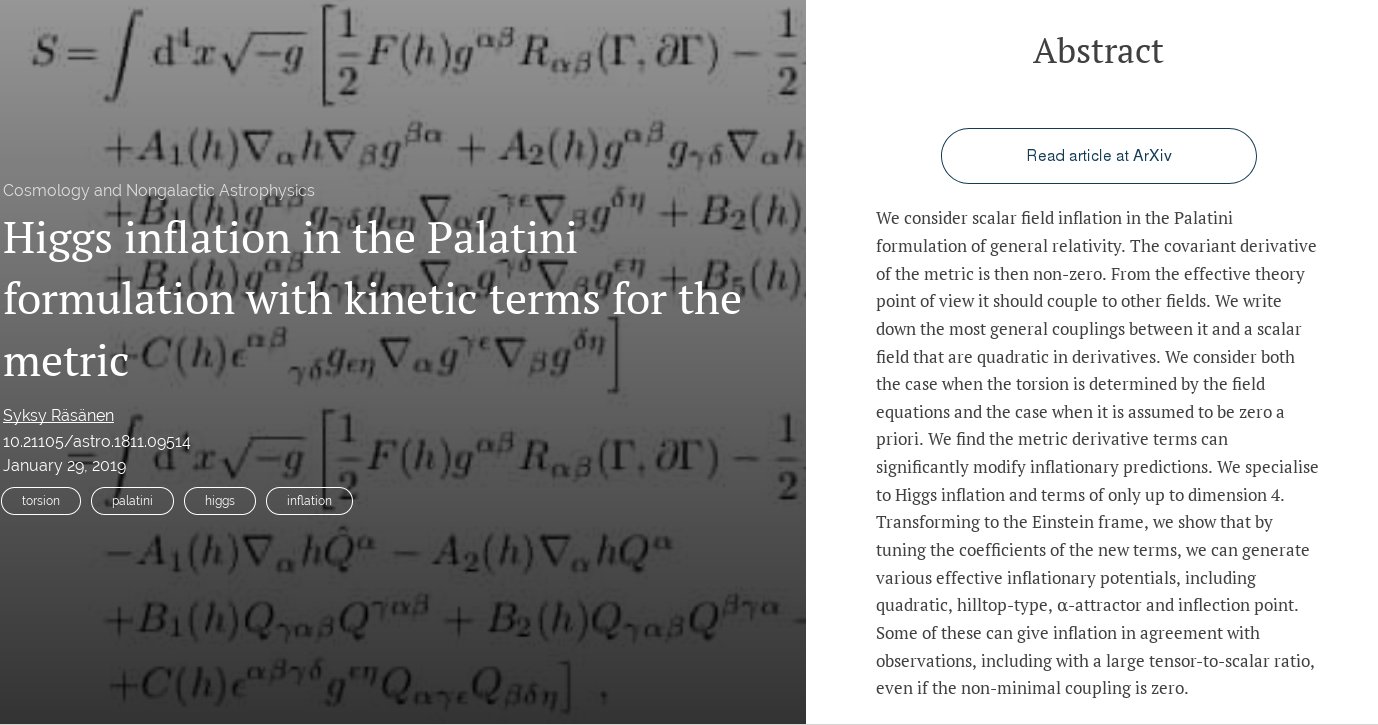
Well, it’s time at last to announce the first paper to be published by the new incarnation of the Open Journal of Astrophysics, which we just published this morning. Here it is!

It’s by Syksy Räsänen of the University of Helsinki. You can find the full article on the arXiv here.

This is the first published paper to have been submitted to the Open Journal of Astrophysics since its re-launch last October; the others on the OJA site were published on the old platform and imported into the new site after publication. This new paper has gone all the way through submission, refereeing, revision and publication on the new platform.

It’s been quite exciting for the last couple of months, as various papers have been working their way through the Editorial pipeline, to see which would win the race and get published first. Some submissions have been slowed down by folk reluctant to accept reviewing requests, presumably because the journal is not so well known and some are suspicious that it might not be bona fide. Hopefully that will pass with time. Moreover, after internal discussions, the Editorial Board have decided to ask for two referees for each paper by default and that has probably also slowed us down a bit.

We have a few other papers coming up for publication soon, and some have been sent back to authors for revise and resubmit. I think I know which one will be published next, but I’ll keep that to myself for now!

Plan S Open Access Briefing

Posted in Maynooth, The Universe and Stuff with tags , , , , , , on January 22, 2019 by telescoper

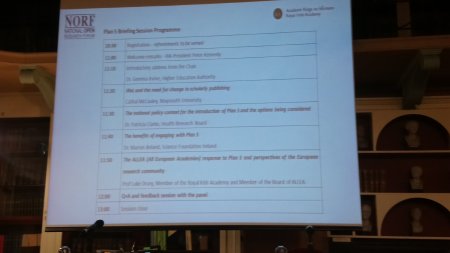
This morning I found myself in the centre of Dublin to attend an event at the Royal Irish Academy, in Dawson Street. Coincidentally this is just a few yards from the Mansion House, scene of the meeting of the First Dáil on 21st January 1919 (which I blogged about here) and also scene of the commemorations of its centenary yesterday. I’m guessing that the removals van was taking away some of the paraphernalia used for yesterday’s event.

Anyway, the event at the Royal Irish Academy organized by the National Open Research Forum (NORF) was intended to disseminate information about Plan S – a European initiative for Open Access publishing.

I have blogged about Plan S and some of the reactions to it before (e.g. here and here).

The main point is that comprehensive technical guidance on how to comply with Plan S and you can also submit feedback on the guidance here until the deadline of February 8th 2019. Full implementation is expected by January 2020. Things are moving relatively quickly, which is a very good thing. Some people thing this deadline is unrealistic, but I think it was a smart move to make it close so as to galvanize researchers into action.

I learnt a particularly interesting fact during the talk by Maynooth’s own Cathal McCauley, namely that the global revenues of the academic publishing industry amount to about, €22 billion per annum. This exceeds the global revenues of the recorded music industry. Profit margins for these publishers are much larger (up to 45%) than Apple, Google and BMW. The research community is being fleeced, and the worst offenders are the `Big Four’: Elsevier, Springer, Wiley and Taylor & Francis.

One of the main concerns expressed in the discussion session was the extent that move away from traditional journals might have a negative effect on early career researchers, as those responsible for hiring postdocs and new faculty members often concentrate on the journal in which their work is published rather than the work itself. The obvious way to address this problem to use article-level information rather than journal-level metrics, which is entirely feasible to do, but it is true that we need a change of culture across the board to make this work for the benefit of science as whole. I am optimistic about this, largely because I recall very well how rapidly the culture in astrophysics adapted to the existence of the arXiv. With regard to open access publishing the way forward is to disrupt the existing Academic Journal Racket by developing alternative modes publication which demonstrate benefits in cost, reach and simplicity, combined with pressure from funding agencies imposing mandates on publications arising from their grants.

There is no question in my mind that in just a few years, when Open Access is the overwhelmingly dominant mode of publication, researchers will look back and wonder why we ever put up with the absurd system we have at present.

As a final comment I’ll mention that the Open Journal of Astrophysics got a few mentions during the session. I’m hoping to make some exciting announcements about this journal very soon indeed. Before that, however, I have to go to Belfast to give a talk…

Plan S for Open Access: Guidance and Feedback

Posted in Open Access with tags , , , , , on November 27, 2018 by telescoper

Those of you interested in the topic of Open Access Publishing, and Open Science generally, will no doubt already have heard of `Plan S’. For those that haven’t it is a proposal by 11 European Nations to give the public free access to publicly funded science. The 11 countries involved in this initiative are: France, Italy, Austria, Ireland, Luxembourg, the Netherlands, Norway, Poland, Slovenia, Sweden, and the UK. Together, these nations compise `cOAlition S’ – the `OA’ is for `Open Access’ – to carry out the plan, which can be found here.

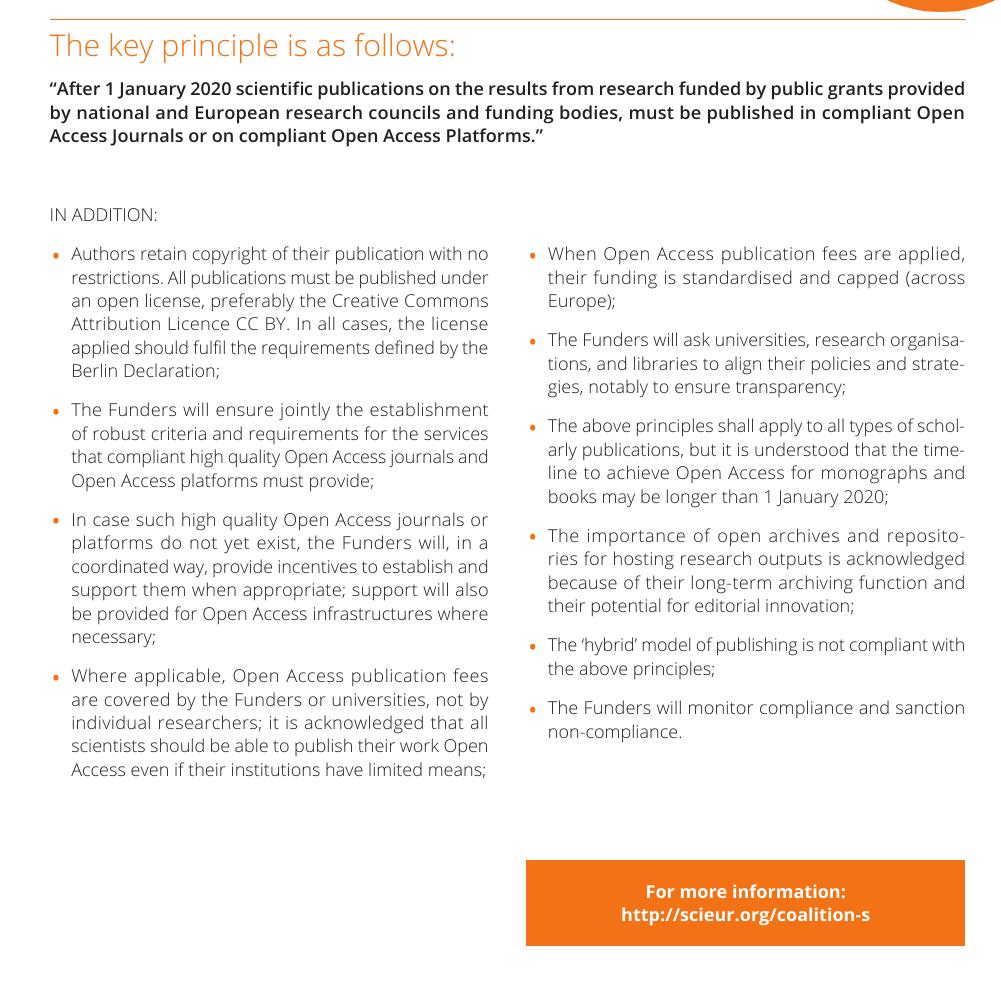
Here is a summary:

I have blogged about this and some of the reactions to it before (e.g. here and here).

I’m writing today, however, to pass on an important piece of news, which is that comprehensive technical guidance on how to comply with Plan S has now been issued by Coalition S, where. you can also submit feedback on the guidance.

I’ve got quite a busy day teaching today and have so far only just skimmed the guidance. At first sight it looks a lot more flexible than some people feared. Comments are welcome belo.

My main preoccupation will, however, be to ensure that the Open Journal of Astrophysics can be made compliant (if it isn’t already)..


The Open Journal is Open for Submissions Again!

Posted in Open Access, The Universe and Stuff with tags , , on October 8, 2018 by telescoper

I have now finished moving the Open Journal of Astrophysics onto the new Scholastica platform, and it is now open again for submissions! It has taken a lot longer to get to this point than I thought it would when I first proposed the Open Journal of Astrophysics way back in 2012 but better late than never!

Full instructions for authors can be found here. It is there that you will find the `submit’ button shown above, which will take you to a form through which you can upload your paper. All you need to do is upload a few details and the arXiv ID of your paper and we’ll take it from there.

The membership of the Editorial Board is listed here.

The papers published so far can be found here.

Oh, and there’s a blog that will include topical posts about matters astrophysical here.

In a nutshell, any paper that’s suitable for the astro-ph section of the arXiv can be submitted to the Open Journal of Astrophysics. We will consider any `traditional’ papers as well as others which may find it difficult to publish in other journals, such as papers on astrophysics education and outreach, or technical papers relating to instrumentation, mission proposals, and other documents.

Well, that’s about it. I just remains for me to thank all the people without whom this project would never have got off the ground, chiefly Chris Lintott, Arfon Smith and Adam Becker, developers Stuart Lynn and Marc Rohloff, Fiona Morley and the team at Maynooth University Library, and of course the good folk of the wonderful arXiv!

The Open Journal of Astrophysics Blog

Posted in Open Access with tags , , , on October 5, 2018 by telescoper

Since I’ve recently been boring all my readers with a stream of stuff about the Open Journal of Astrophysics, I thought I might as well continue by pointing out that this journal also has a blog feature, on which we will include commentaries on some of the papers published and on wider issues in astrophysics. To illustrate this feature I’ve written a short post about the background to the Open Journal project, which you can find here. The text is as below.

I first proposed this idea several years ago and it has taken a while to make it happen, but here we are at last.

Astrophysics has taken the lead for many years in opening up access to scientific publications – all publications of any merit are available for free on the internet via the arXiv and, in my opinion, the traditional journals are already more-or-less redundant even without considering their “astronomical” cost. The one thing that seems a consistent objection to dispensing with journals altogether is the element of peer review.

My suggestion was that we set up a quick-and-easy system to circumvent the traditional (ruinously expensive) publishing route. The basic idea is that authors who submit papers to the arXiv can have their papers refereed by the community, outside the usual system of traditional journals. I was intially thinking of a website on which authors would simply have to post their arXiv ID and a request for peer review. Once accepted, the author would be allowed to mark the arXiv posting as “refereed” and an electronic version would be made available for free on the website. What we have now is a little more involved than that, but the basic idea remains the same.

Whether or not this idea is a success really depends partly on the willingness of the community to submit high-quality papers here, and partly on the performance of those of us involved on the Editorial Board at providing the community with what I hope will prove to be an effective resource.


The Open Journal of Astrophysics – Update

Posted in Maynooth, Open Access, The Universe and Stuff with tags , , , on October 4, 2018 by telescoper

Well, it was a bit fiddly importing the legacy papers from the earlier version of the Open Journal of Astrophysics website to the new platform, but I managed to do it this afternoon as planned. The result looks rather nice, I think,

The only things left to do now are (a) to train the members of the Editorial Board on how to handle the workflow through the journal site and (b) to open up for submission of new papers. Both these steps should be trivial so we’re definitely entering the final stages of this project. There is  an event at Maynooth University Library next Tuesday afternoon at which I am doing a talk about Open Science. This will represent the official launch of the Open Journal of Astrophysics.

All we will need then is for people to submit some papers!


The Open Journal of Astrophysics and NASA/ADS

Posted in Uncategorized with tags , , , , on September 18, 2018 by telescoper

As I’m working on the Open Journal of Astrophysics project quite a lot these days I’m probably going to be boring a lot of people with updates, but there you go.

First astro.theog.org is now transferred to the new platform here. It doesn’t look like much now but there is a lot sitting behind the front page and we will get the new site up and running when we’ve got various administrative things approved.

Another thing I forgot to mention in yesterday’s post concerns the SAO/NASA Astrophysics Data System which (for the uninitiated) is a Digital Library portal for researchers in astronomy and physics, operated by the Smithsonian Astrophysical Observatory (SAO) under a NASA grant. The ADS maintains three bibliographic databases containing more than 14.0 million records covering publications in Astronomy and Astrophysics, Physics, and (of course) the arXiv e-prints. In addition to maintaining its bibliographic corpus, the ADS tracks citations and other information, which means that it is an important tool for evaluating publication impact.

One of the issues that we’ve had with the handful of papers published so far by the Open Journal of Astrophysics is that, because it is an overlay journal, the primary location of the papers published is on the arXiv, alongside other content that has not been refereed. Up until recently searching ADS for `All bibliographic sources’ would return OJA papers, but `All refereed articles’ would not. I’m glad to say that with the help of the ADS team, this issue has now been resolved and OJA papers now show up as refereed articles, as demonstrated by this example:

I know that this was a particular worry for early career researchers who might have been deterred from submitting to the Open Journal of Astrophysics by the fear that their publications would not look like refereed publications. They need worry no longer!

Incidentally, that image also shows that citations are tracked through the CROSSREF system, in which OJA papers are registered when published and issued with a DOI. All this happens behind the scenes from the point of view of an author, but it involves a lot of interesting machinery! A discussion on facebook the other day led to an academic publisher stating that one of the greatest costs of running a journal was registering publications for citation tracking. In fact it costs a maximum of $1 per article (see here). The industry is relying on academics not understanding how cheap things actually are.


The Open Journal of Astrophysics – Call for Editors

Posted in Maynooth, Open Access with tags , , , on September 17, 2018 by telescoper

It’s nice to see that my recent post on the Open Journal of Astrophysics has been attracting some interest. The project is developing rather swiftly right now and it seems the main problems we have to deal with are administrative rather than technical. Fingers crossed anyway.

I thought I’d do a follow-up re-iterating a request in that recent post. As you will be aware, the Open Journal of Astrophysics is an arXiv overlay journal. We apply a simple criterion to decide whether a paper is on a suitable topic for publication, namely that if it it is suitable for the astro-ph section of the arXiv then it is suitable for the Open Journal of Astrophysics. This section of the arXiv, which is rather broad,is divided thuswise:

  1. astro-ph.GA – Astrophysics of Galaxies.
    Phenomena pertaining to galaxies or the Milky Way. Star clusters, HII regions and planetary nebulae, the interstellar medium, atomic and molecular clouds, dust. Stellar populations. Galactic structure, formation, dynamics. Galactic nuclei, bulges, disks, halo. Active Galactic Nuclei, supermassive black holes, quasars. Gravitational lens systems. The Milky Way and its contents
  2. astro-ph.CO – Cosmology and Nongalactic Astrophysics.
    Phenomenology of early universe, cosmic microwave background, cosmological parameters, primordial element abundances, extragalactic distance scale, large-scale structure of the universe. Groups, superclusters, voids, intergalactic medium. Particle astrophysics: dark energy, dark matter, baryogenesis, leptogenesis, inflationary models, reheating, monopoles, WIMPs, cosmic strings, primordial black holes, cosmological gravitational radiation
  3. astro-ph.EP – Earth and Planetary Astrophysics.
    Interplanetary medium, planetary physics, planetary astrobiology, extrasolar planets, comets, asteroids, meteorites. Structure and formation of the solar system
  4. astro-ph.HE – High Energy Astrophysical Phenomena.
    Cosmic ray production, acceleration, propagation, detection. Gamma ray astronomy and bursts, X-rays, charged particles, supernovae and other explosive phenomena, stellar remnants and accretion systems, jets, microquasars, neutron stars, pulsars, black holes
  5. astro-ph.IM – Instrumentation and Methods for Astrophysics.
    Detector and telescope design, experiment proposals. Laboratory Astrophysics. Methods for data analysis, statistical methods. Software, database design
  6. astro-ph.SR – Solar and Stellar Astrophysics.
    White dwarfs, brown dwarfs, cataclysmic variables. Star formation and protostellar systems, stellar astrobiology, binary and multiple systems of stars, stellar evolution and structure, coronas. Central stars of planetary nebulae. Helioseismology, solar neutrinos, production and detection of gravitational radiation from stellar systems.

The expertise of the current Editorial Board is concentrated in the area of (2), and a bit of (5), but we would really like to add some editors from different areas (i.e. 1, 3, 4 and 6).  We  would therefore really appreciate volunteers from other areas of astrophysics (especially stars/exoplanets, etc). If you’re interested please let me know. Please also circulate this call as widely as possible among your colleagues so we can recruit the necessary expertise. The journal is entirely free (both to publish in and to read) and we can’t afford to pay a fee, but there is of course the prestige of being in at the start of a publishing revolution of cosmic proportions!

If you join the Editorial Board we will invite you to an online training session to show you how the platform works.

Thank you in advance for your interest in this project, and I look forward to hearing from you.