Archive for Open Journal of Astrophysics

New Publication at the Open Journal of Astrophysics

Posted in OJAp Papers, Open Access, The Universe and Stuff with tags , , , , on November 10, 2022 by telescoper

I’m delighted to be able to announce the 10000th paper this year, and 1000000th publication overall, at the Open Journal of Astrophysics!

That is counting in binary, of course. In base ten the  new paper at the 16th paper in Volume 5 (2022) as well as the 64th in all.

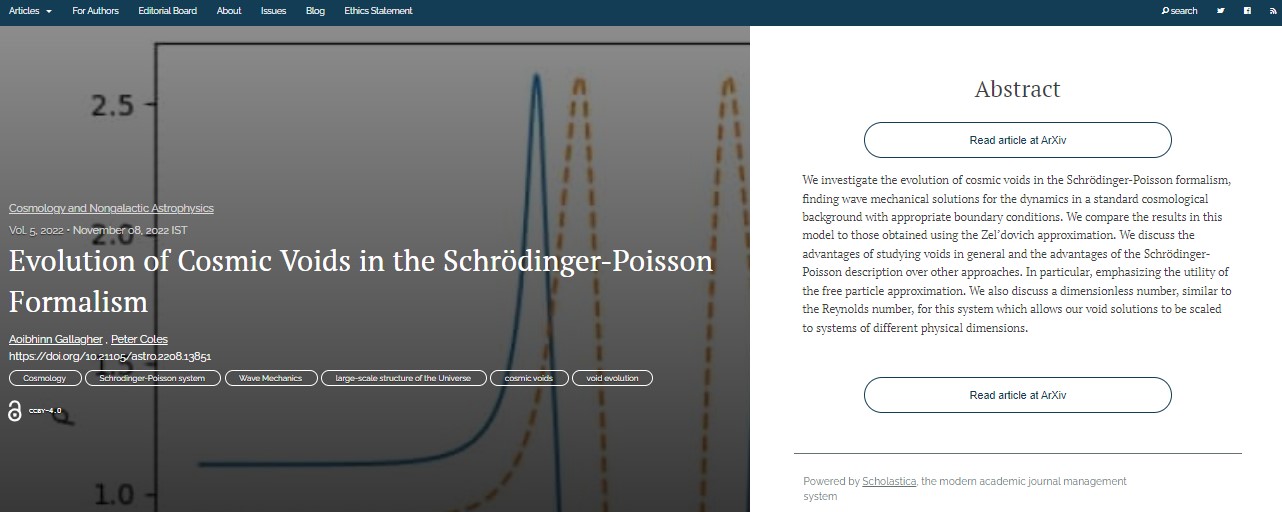
The latest publication is entitled “Evolution of Cosmic Voids in the Schrödinger-Poisson Formalism” and the authors are Aoibhinn Gallagher and Peter Coles (Who he? Ed) both of the Department of Theoretical Physics at Maynooth University. Obviously as author I played no role in the selection of referees or any other aspect of the editorial process.

Aoibhinn Gallagher – bonus marks for pronouncing both names correctly – is my first Maynooth PhD student and this is her first paper, of many I hope (and expect)! We’re already working on extensions of this approach to other aspects of large-scale structure. You can find some discussion of this general approach here.

Anyway, here is a screen grab of the overlay which includes the  abstract:


You can click on the image to make it larger should you wish to do so. You can find the officially accepted version of the paper on the arXiv here.

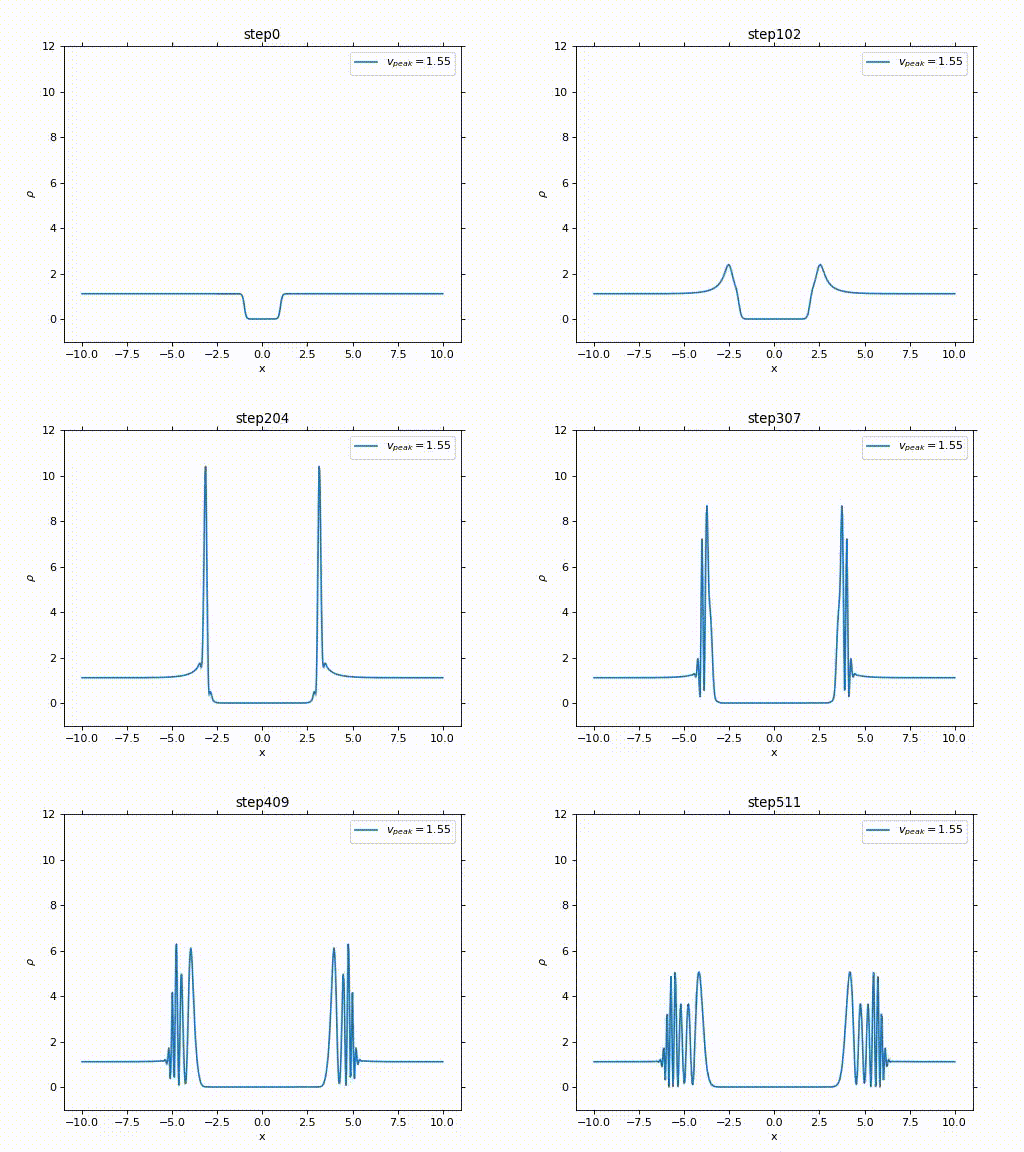
Here is a nice animated version of Figure 5 of the paper showing, for a 1D slice, the radial expansion of a spherically symmetric void (i.e. underdense region) using periodic boundary conditions:

The x-axis is in (scaled) comoving coordinates, i.e. expanding with the cosmological background, so that the global expansion is removed.  You can see that the void expands in these coordinates, so is expanding more quickly than the background, initially pushing matter into a dense ring around the rim of the empty void. That part of the evolution is just the same as for “normal” matter but in this case the wave-mechanical behaviour of the matter prevents it from being confined to a strongly-localized structure as well as affecting the subsequent expansion rate.

Of course in the real Universe, voids are not isolated like this but instead tend to push into each other, but we felt it was worth studying the single void case to understand the dynamics!

New Publication at the Open Journal of Astrophysics

Posted in OJAp Papers, Open Access, The Universe and Stuff with tags , , , , , on November 4, 2022 by telescoper

It’s time once again for me to announce new paper at the Open Journal of Astrophysics. The new paper, published last week, is the 15th paper in Volume 5 (2022) and the 63rd in all. The latest publication is entitled “Two-photon amplitude interferometry for precision astrometry” and the authors are Paul Stankus, Andrei Nomerotski and Anže Slosar of Brookhaven National Laboratory (USA) and Stephen Vintskevich (Moscow Institute of Physics & Technology, Russia).

The paper presents a new method for doing interferometry with quantum-mechanically entangled photons and is thus is in the folder marked Instrumentation and Methods for Astrophysics. I don’t know much about this area – and there are many whose baseline opinion is that interferometry is a bit of a fringe topic that is rather complex perhaps needs more visibility in the current phase of its development  (geddit?) – but the physics looks fascinating to me. Amplitude interferometry should be contrasted with the intensity interferometry method of Hanbury Brown and Twiss which I remember learning about as an undergraduate.

Anyway, here is a screen grab of the overlay which includes the  abstract:

You can click on the image to make it larger should you wish to do so. The full image used in the overlay is this:


You can find the officially accepted version of the paper on the arXiv here.

Open Access Week and the arXiv

Posted in Open Access with tags , , on October 17, 2022 by telescoper

Just time for a quick post to advertise the fact that next week (commencing October 24th 2022) is International Open Access Week.

I’ll be participating in one of the events – a panel discussion – organized by arXiv as part of Open Access Week. This event is entitled Trends in Peer Review of Open Access Preprints and the description is:

Speed of research is a major feature of open access preprint platforms like arXiv – formal peer review can follow later after rapid distribution of results. However, as submissions to arXiv and other preprint servers have grown, many researchers are seeking new avenues for community feedback and peer review. At this panel discussion, leaders in preprints and peer review will discuss current trends in virtual overlay journals, open peer reviews, and more. (Video recording will be available to registrants after the event)

Panelists:

  • Peter Coles, PhD, Theoretical Cosmologist at Maynooth University in Ireland and Managing Editor of The Open Journal of Astrophysics
  • Jessica Polka, PhD, Executive Director of ASAPbio
  • Antti Mikael Rousi, PhD, Senior Advisor, Research Services at Aalto University, Finland
  • Steinn Sigurdsson, PhD, Professor of Astronomy at Penn State University and arXiv Scientific Director

The event is at on Wednesday, October 26, 2022 at 15:00 UTC /11:00 EDT; that’s 16:00 Irish Time. It’s on Zoom (unless you are at Cornell and can attend in person). You need to register here.

Ethics Statement for the Open Journal of Astrophysics

Posted in Open Access with tags , , , on August 3, 2022 by telescoper

For various reasons I spent yesterday evening, the last evening of my “break”, concocting an Ethics Statement for the Open Journal of Astrophysics. I don’t know much about this sort of thing so some of the text is based on similar statements elsewhere, e.g. at the AAS Journals site. So far we haven’t had many instances of misconduct but I have had to ban a couple of authors for violations.

Anyway, you can find the statement on the OJAp website but I’ve copied it below in case anyone has suggestions of things we might wish to add. If you have any such comments please use the box below:

–o–

  1. Ethics and Professionalism
    Authors of papers published in the Open Journal of Astrophysics (OJAp) are expected to adhere to basic standards of professional ethics and conduct that are common across all areas of scholarly publishing. Because we are an arXiv overlay journal we also require adherence to the specific standards stipulated in the arXiv code of conduct of conduct. By submitting a paper authors affirm that their work is theirs, is original and has not been published elsewhere. All parties are also expected to conform to common standards of professional respect and civility. This page summarizes the expected standards of professional and ethical conduct required for OJAp.
  2. Plagiarism (including Self-Plagarism)
    Plagiarism (understood as the act of reproducing text or other materials from other papers without properly crediting the source) represents a serious ethical breach, and may constitute legal breach of copyright if the reproduced material has been previously published. This includes repeating text from previously published papers by the author or authors (i.e., “self-plagiarism”). The arXiv submission process does an initial screen for plagiarism, and we will look very carefully at submissions that have triggered the arXiv filter.
  3. Citations and References
    Articles published in OJAp should include citations to previously published articles which are directly relevant to the results being presented. This requirement is especially important when new ideas or results are being presented. Deliberate refusal to credit or cite prior or corroborating results represents a breach of professional ethics, and can result in summary rejection of a manuscript but an unintentional failure to cite a relevant article does not necessarily imply misconduct. Responsibility for updating references after acceptance (but before publication) of an article rests fully with the authors, but the same principles should apply.
  4. Conflicts of Interest
    The referees selected by the editor assume responsibility for evaluating the scientific veracity, clarity, and significance of the results presented. For such a system to function effectively it is essential that the referee be free of any conflicts of interest that might influence the content or the promptness of the review. Authors may identify individuals who they believe are conflicted and should not serve as referees. Referees also have a responsibility to recuse themselves if they feel a conflict may arise. Editors are required to disqualify themselves whenever a real or perceived conflict is present.
  5. Confidentiality
    The Editorial Board of OJAp will not reveal the identities of referees nor the contents of peer-review-related materials to individuals outside of the respective peer-review process. Referees are also bound by strict confidentiality; neither the manuscripts nor the contents of referee correspondence may be shared with other parties without written permission from the editor. Authors are not bound by similar confidentiality requirements (for example, they may choose to consult with co-authors and colleagues when revising a manuscript in response to a referee report), but public dissemination of the contents of referee reports and editorial correspondence is highly inappropriate.
  6. Professional Conduct
    All participants in the publication process, including Editors, Authors and Referees, are expected to conform to basic standards of professional courtesy, and respect the basic rules and guidelines that govern the peer-review and publication process. Authors should also recognize that all our Editors and Referees are volunteers who give their time freely; that’s part of the reason why the journal is free. Personal attacks or verbal abuse are unacceptable and OJAp reserves the right to refuse submissions from individuals who repeatedly violate these guidelines or refuse to cooperate with editors and referees in the normal peer review and publication processes.
  7. Allegations of Misconduct
    The integrity of OJAp rests on the professionalism of its authors, referees, and editors. Alleged cases of unethical conduct within the editorial process will be investigated vigorously by the Editor-in-Chief or an appropriately delegated individual or individuals and with respect for confidentiality. Accusations of misconduct falling outside of the peer review or publication process may be more properly directed elsewhere. OJAp also recognizes its obligation to protect their authors and referees against malicious, frivolous, vexatious or unfounded allegations of misconduct. Repeated complaints of this type by individuals may be summarily dismissed.

New Publication at the Open Journal of Astrophysics

Posted in Open Access, The Universe and Stuff with tags , , , on July 17, 2022 by telescoper

Today is ten years to the day that I wrote the blog post that first proposed setting up the Open Journal of Astrophysics. It took a bit longer than I’d expected to get it going. The prototype site opened at the end of 2015 but owing to personal issues the project didn’t get going in full until after I moved to Maynooth in 2017.

It couldn’t have happened without enormous help from Arfon Smith, Chris Lintott, Adam Becker, Robert Simpson, Stuart Lynn and Mark Rohloff so many thanks to them for assistance in getting it off the ground. I also thank the staff at Maynooth University Library, especially Fiona Morley-Clarke, for their support and assistance. I also acknowledge financial support from the Gordon and Betty Moore Foundation.

I’d also like to thank the Editorial Team at OJAp, all unpaid volunteers, for their efforts and of course to all the authors who have trusted their research findings what was, at least at the start, an experimental venture.

Now seems an appropriate time to announce yet another new publication in the Open Journal of Astrophysics! This one, published last week, is the 10th paper in Volume 5 (2022) and the 58th in all.

The latest publication is entitled “V889 Her: abrupt changes in the magnetic field or differential rotation?” and is written by Teemu Willamo (Helsinki), Thomas Hackman (Helsinki), Jyri J. Lehtinen (Turku), Maarit Korpi-Lagg (Aalto) and Oleg Kochukhov (Uppsala). The first four of these are based in Finland and the last in Sweden.

This is another paper in the Solar and Stellar Astrophysics folder; the subject of the paper V889 Herculis is a young and very active dwarf star with some intriguing properties.

Here is a screen grab of the overlay which includes the (very short) abstract:

You can click on the image to make it larger should you wish to do so. You can find the arXiv version of the paper here.

The AAS goes for Gold

Posted in Open Access, The Universe and Stuff with tags , , , , , , on September 2, 2021 by telescoper

Yesterday there was a big announcement from the American Astronomical Society (AAS) , namely that all its journals will switch to Open Access from 1st January 2022. This transition will affect the Astronomical Journal (AJ), the Astrophysical Journal (ApJ), Astrophysical Journal Letters (ApJL), and the Astrophysical Journal Supplement Series (ApJS). Previously authors were able to opt for Open Access but from next year it will apply to all papers.

The positive aspect to this change is that it makes articles published by the AAS freely available to the public and other scientists without requiring the payment of a subscription.

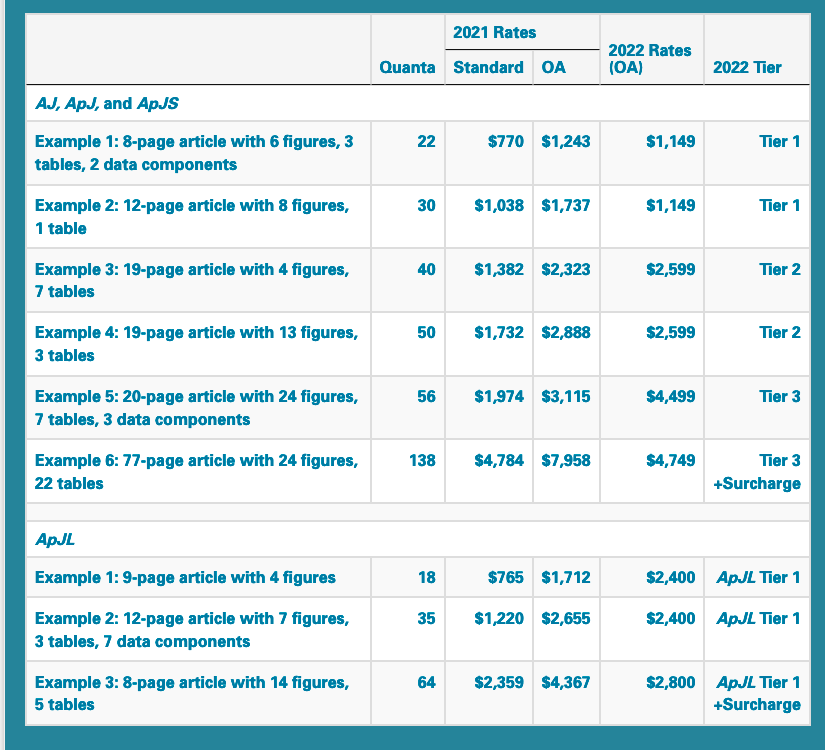
On the other hand, these journals will require authors to pay a hefty sum, equivalent to an Article Processing Charge (APC), that increases with the length and complexity of a paper. AAS journals have in the past levied “page charges” from authors for standard (non-OA) publications. In the new regime these are merged into a unified scheme. Here is a summary of the rates.

What’s on offer is therefore a form of Gold Open Access that switches the cost of publication from subscribers to authors. In my view this level of APC is excessive, which is why I call this Fool’s Gold Open Access. Although the AAS is a not-for-profit organization, its journals are published by the Institute of Physics Publishing which is a definitely-for-profit organization.

The Open Journal of Astrophysics charges neither subscribers nor authors; this form of Open Access is usually called Diamond or Platinum Open Access.

The terminology surrounding Open Access is confusing not least because its usage is evolving. In the current jargon, “Gold” Open Access refers to publication that is free to access at the journal. The principal alternative is “Green” Open Access, which means that free access is offered through depositing the paper in some form of repository separate from the journal. Some astronomical journals allow authors to deposit their articles on arXiv, for example, which is probably the main way in which astrophysicists achieve Green Open Access.

Nowadays “Gold” Open Access refers to anything that is made available freely by a journal regardless of whether an APC is charged or not. The Diamond Open Access provided by the Open Journal of Astrophysics is thus a special case of Gold Open Access. A classification in which Diamond and Platinum are subdivisions of Gold must confuse the heck out of chemists, but that’s where we are at the moment. At least it’s not as bad as in astrophysics where the only terms used to describe chemical elements are hydrogen, helium and “metals”…

While I am glad to see the AAS move its journals into Open Access configurations, I can’t agree with the level of APC. The Open Journal of Astrophysics may be relatively small but it has plenty of capacity for growth while remaining entirely free. The more people realize that it costs tens of dollars rather than thousands to publish a paper the more likely it is that they’ll see the moral case for Diamond Open Access.

New Publication at the Open Journal of Astrophysics!

Posted in OJAp Papers, Open Access, The Universe and Stuff with tags , , , on April 28, 2020 by telescoper

Well Maynooth University may have been closed by the Coronavirus but the The Open Journal of Astrophysics certainly has not!

In fact we have just published another paper! This one is called Discrete Chi-square Method for Detecting Many Signals and the author is Lauri Jetsu of the University of Helsinki in Finland.

Here is a grab of the overlay as it appears on my phone:

You can find the arXiv version of the paper here.

I’d like to take this opportunity to thank the Editorial team and various referees for their efforts in keeping the Open Journal of Astrophysics going in these difficult times.

The Open Journal of Astrophysics and the Free Journals Network

Posted in Uncategorized with tags , , , on March 30, 2020 by telescoper


I am pleased to announce that The Open Journal of Astrophysics is now a member of the Free Journal Network.

We are in fact the 51st member of the network, which exists

…to promote scholarly journals run according to the Fair Open Access model (roughly, journals that are controlled by the scholarly community, and have no financial barriers to readers and authors.

A full list of the illustrious journals belonging to this network can be found here.


Not the Open Journal of Astrophysics Impact Factor – Update

Posted in Open Access, The Universe and Stuff with tags , , , , on February 11, 2020 by telescoper

 I thought I would give an update with some bibliometric information about the 12 papers published by the Open Journal of Astrophysics in 2019. The NASA/ADS system has been struggling to tally the citations to a couple of our papers but this issue has now been resolved.  According to this source the total number of citations for these papers is 532 (as of today). This number is dominated by one particular paper which has 443 citations according to NASA/ADS. Excluding this paper gives an average number of citations for the remaining 11 of 7.4.

I’ll take this opportunity to re-iterate some comments about the Journal Impact Factor. When asked about this my usual response is (a) to repeat the arguments why the impact factor is daft and (b) point out that we have to have been running continuously for at least two years to have an official impact factor anyway.

For those of you who can’t be bothered to look up the definition of an impact factor , for a given year it is basically the sum of the citations for all papers published in the journal over the previous two-year period divided by the total number of papers published in that journal over the same period. It’s therefore the average citations per paper published in a two-year window. The impact factor for 2019 would be defined using data from 2017 and 2018, etc.

The impact factor is prone to the same issue as the simple average I quoted above in that citation statistics are generally heavily skewed  and the average can therefore be dragged upwards by a small number of papers with lots of citations (in our case just one).

I stress again we don’t have an Impact Factor as such for the Open Journal. However, for reference (but obviously not comparison) the latest actual impact factors (2018, i.e. based on 2016 and 2017 numbers) for some leading astronomy journals are: Monthly Notices of the Royal Astronomical Society 5.23; Astrophysical Journal 5.58; and Astronomy and Astrophysics 6.21.

My main point, though, is that with so much bibliometric information available at the article level there is no reason whatsoever to pay any attention to crudely aggregated statistics at the journal level. Judge the contents, not the packaging.

This post is based on an article at the OJA blog.


Not the Open Journal of Astrophysics Impact Factor – Update

Posted in Open Access, The Universe and Stuff with tags , , , , on January 20, 2020 by telescoper

Now that we have started a new year, and a new volume of the Open Journal of Astrophysics , I thought I would give an update with some bibliometric information about the 12 papers we published in 2019.

It is still early days for aggregating citations for 2019 but, using a combination of the NASA/ADS system and the Inspire-HEP, I have been able to place a firm lower limit on the total number of citations so far for those papers of 408, giving an average citation rate per paper of 34.

These numbers are dominated by one particular paper which has 327 citations according to Inspire (see above). Excluding this paper gives an average number of citations for the remaining 11 of 7.4.

I’ll take this opportunity to re-iterate some comments about the Journal Impact Factor. When asked about this my usual response is (a) to repeat the arguments why the impact factor is daft and (b) point out that we have to have been running continuously for at least two years to have an official impact factor anyway.

For those of you who can’t be bothered to look up the definition of an impact factor , for a given year it is basically the sum of the citations for all papers published in the journal over the previous two-year period divided by the total number of papers published in that journal over the same period. It’s therefore the average citations per paper published in a two-year window. The impact factor for 2019 would be defined using data from 2017 and 2018, etc.

The impact factor is prone to the same issue as the simple average I quoted above in that citation statistics are generally heavily skewed and the average can therefore be dragged upwards by a small number of papers with lots of citations (in our case just one).

I stress again we don’t have an Impact Factor for the Open Journal. However, for reference (but obviously not direct comparison) the latest actual impact factors (2018, i.e. based on 2016 and 2017 numbers) for some leading astronomy journals are: Monthly Notices of the Royal Astronomical Society 5.23; Astrophysical Journal 5.58; and Astronomy and Astrophysics 6.21.

My main point, though, is that with so much bibliometric information available at the article level there is no reason whatsoever to pay any attention to crudely aggregated statistics at the journal level. Judge the contents, not the packaging.