Archive for Open Journal of Astrophysics

Plan S Open Access Briefing

Posted in Maynooth, The Universe and Stuff with tags , , , , , , on January 22, 2019 by telescoper

This morning I found myself in the centre of Dublin to attend an event at the Royal Irish Academy, in Dawson Street. Coincidentally this is just a few yards from the Mansion House, scene of the meeting of the First Dáil on 21st January 1919 (which I blogged about here) and also scene of the commemorations of its centenary yesterday. I’m guessing that the removals van was taking away some of the paraphernalia used for yesterday’s event.

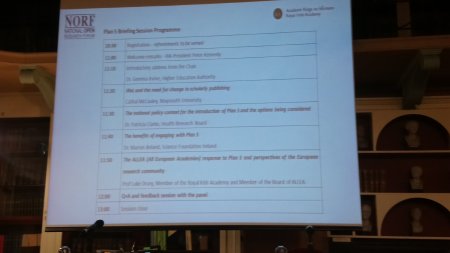
Anyway, the event at the Royal Irish Academy organized by the National Open Research Forum (NORF) was intended to disseminate information about Plan S – a European initiative for Open Access publishing.
I have blogged about Plan S and some of the reactions to it before (e.g. here and here).

The main point is that comprehensive technical guidance on how to comply with Plan S and you can also submit feedback on the guidance here until the deadline of February 8th 2019. Full implementation is expected by January 2020. Things are moving relatively quickly, which is a very good thing. Some people thing this deadline is unrealistic, but I think it was a smart move to make it close so as to galvanize researchers into action.

I learnt a particularly interesting fact during the talk by Maynooth’s own Cathal McCauley, namely that the global revenues of the academic publishing industry amount to about, €22 billion per annum. This exceeds the global revenues of the recorded music industry. Profit margins for these publishers are much larger (up to 45%) than Apple, Google and BMW. The research community is being fleeced, and the worst offenders are the `Big Four’: Elsevier, Springer, Wiley and Taylor & Francis.

One of the main concerns expressed in the discussion session was the extent that move away from traditional journals might have a negative effect on early career researchers, as those responsible for hiring postdocs and new faculty members often concentrate on the journal in which their work is published rather than the work itself. The obvious way to address this problem to use article-level information rather than journal-level metrics, which is entirely feasible to do, but it is true that we need a change of culture across the board to make this work for the benefit of science as whole. I am optimistic about this, largely because I recall very well how rapidly the culture in astrophysics adapted to the existence of the arXiv. With regard to open access publishing the way forward is to disrupt the existing Academic Journal Racket by developing alternative modes publication which demonstrate benefits in cost, reach and simplicity, combined with pressure from funding agencies imposing mandates on publications arising from their grants.

There is no question in my mind that in just a few years, when Open Access is the overwhelmingly dominant mode of publication, researchers will look back and wonder why we ever put up with the absurd system we have at present.

As a final comment I’ll mention that the Open Journal of Astrophysics got a few mentions during the session. I’m hoping to make some exciting announcements about this journal very soon indeed. Before that, however, I have to go to Belfast to give a talk…

Plan S for Open Access: Guidance and Feedback

Posted in Open Access with tags , , , , , on November 27, 2018 by telescoper

Those of you interested in the topic of Open Access Publishing, and Open Science generally, will no doubt already have heard of `Plan S’. For those that haven’t it is a proposal by 11 European Nations to give the public free access to publicly funded science. The 11 countries involved in this initiative are: France, Italy, Austria, Ireland, Luxembourg, the Netherlands, Norway, Poland, Slovenia, Sweden, and the UK. Together, these nations compise `cOAlition S’ – the `OA’ is for `Open Access’ – to carry out the plan, which can be found here.

Here is a summary:

I have blogged about this and some of the reactions to it before (e.g. here and here).

I’m writing today, however, to pass on an important piece of news, which is that comprehensive technical guidance on how to comply with Plan S has now been issued by Coalition S, where. you can also submit feedback on the guidance.

I’ve got quite a busy day teaching today and have so far only just skimmed the guidance. At first sight it looks a lot more flexible than some people feared. Comments are welcome belo.

My main preoccupation will, however, be to ensure that the Open Journal of Astrophysics can be made compliant (if it isn’t already)..


The Open Journal is Open for Submissions Again!

Posted in Open Access, The Universe and Stuff with tags , , on October 8, 2018 by telescoper

I have now finished moving the Open Journal of Astrophysics onto the new Scholastica platform, and it is now open again for submissions! It has taken a lot longer to get to this point than I thought it would when I first proposed the Open Journal of Astrophysics way back in 2012 but better late than never!

Full instructions for authors can be found here. It is there that you will find the `submit’ button shown above, which will take you to a form through which you can upload your paper. All you need to do is upload a few details and the arXiv ID of your paper and we’ll take it from there.

The membership of the Editorial Board is listed here.

The papers published so far can be found here.

Oh, and there’s a blog that will include topical posts about matters astrophysical here.

In a nutshell, any paper that’s suitable for the astro-ph section of the arXiv can be submitted to the Open Journal of Astrophysics. We will consider any `traditional’ papers as well as others which may find it difficult to publish in other journals, such as papers on astrophysics education and outreach, or technical papers relating to instrumentation, mission proposals, and other documents.

Well, that’s about it. I just remains for me to thank all the people without whom this project would never have got off the ground, chiefly Chris Lintott, Arfon Smith and Adam Becker, developers Stuart Lynn and Marc Rohloff, Fiona Morley and the team at Maynooth University Library, and of course the good folk of the wonderful arXiv!

The Open Journal of Astrophysics Blog

Posted in Open Access with tags , , , on October 5, 2018 by telescoper

Since I’ve recently been boring all my readers with a stream of stuff about the Open Journal of Astrophysics, I thought I might as well continue by pointing out that this journal also has a blog feature, on which we will include commentaries on some of the papers published and on wider issues in astrophysics. To illustrate this feature I’ve written a short post about the background to the Open Journal project, which you can find here. The text is as below.

I first proposed this idea several years ago and it has taken a while to make it happen, but here we are at last.

Astrophysics has taken the lead for many years in opening up access to scientific publications – all publications of any merit are available for free on the internet via the arXiv and, in my opinion, the traditional journals are already more-or-less redundant even without considering their “astronomical” cost. The one thing that seems a consistent objection to dispensing with journals altogether is the element of peer review.

My suggestion was that we set up a quick-and-easy system to circumvent the traditional (ruinously expensive) publishing route. The basic idea is that authors who submit papers to the arXiv can have their papers refereed by the community, outside the usual system of traditional journals. I was intially thinking of a website on which authors would simply have to post their arXiv ID and a request for peer review. Once accepted, the author would be allowed to mark the arXiv posting as “refereed” and an electronic version would be made available for free on the website. What we have now is a little more involved than that, but the basic idea remains the same.

Whether or not this idea is a success really depends partly on the willingness of the community to submit high-quality papers here, and partly on the performance of those of us involved on the Editorial Board at providing the community with what I hope will prove to be an effective resource.


The Open Journal of Astrophysics – Update

Posted in Maynooth, Open Access, The Universe and Stuff with tags , , , on October 4, 2018 by telescoper

Well, it was a bit fiddly importing the legacy papers from the earlier version of the Open Journal of Astrophysics website to the new platform, but I managed to do it this afternoon as planned. The result looks rather nice, I think,

The only things left to do now are (a) to train the members of the Editorial Board on how to handle the workflow through the journal site and (b) to open up for submission of new papers. Both these steps should be trivial so we’re definitely entering the final stages of this project. There is  an event at Maynooth University Library next Tuesday afternoon at which I am doing a talk about Open Science. This will represent the official launch of the Open Journal of Astrophysics.

All we will need then is for people to submit some papers!


The Open Journal of Astrophysics and NASA/ADS

Posted in Uncategorized with tags , , , , on September 18, 2018 by telescoper

As I’m working on the Open Journal of Astrophysics project quite a lot these days I’m probably going to be boring a lot of people with updates, but there you go.

First astro.theog.org is now transferred to the new platform here. It doesn’t look like much now but there is a lot sitting behind the front page and we will get the new site up and running when we’ve got various administrative things approved.

Another thing I forgot to mention in yesterday’s post concerns the SAO/NASA Astrophysics Data System which (for the uninitiated) is a Digital Library portal for researchers in astronomy and physics, operated by the Smithsonian Astrophysical Observatory (SAO) under a NASA grant. The ADS maintains three bibliographic databases containing more than 14.0 million records covering publications in Astronomy and Astrophysics, Physics, and (of course) the arXiv e-prints. In addition to maintaining its bibliographic corpus, the ADS tracks citations and other information, which means that it is an important tool for evaluating publication impact.

One of the issues that we’ve had with the handful of papers published so far by the Open Journal of Astrophysics is that, because it is an overlay journal, the primary location of the papers published is on the arXiv, alongside other content that has not been refereed. Up until recently searching ADS for `All bibliographic sources’ would return OJA papers, but `All refereed articles’ would not. I’m glad to say that with the help of the ADS team, this issue has now been resolved and OJA papers now show up as refereed articles, as demonstrated by this example:

I know that this was a particular worry for early career researchers who might have been deterred from submitting to the Open Journal of Astrophysics by the fear that their publications would not look like refereed publications. They need worry no longer!

Incidentally, that image also shows that citations are tracked through the CROSSREF system, in which OJA papers are registered when published and issued with a DOI. All this happens behind the scenes from the point of view of an author, but it involves a lot of interesting machinery! A discussion on facebook the other day led to an academic publisher stating that one of the greatest costs of running a journal was registering publications for citation tracking. In fact it costs a maximum of $1 per article (see here). The industry is relying on academics not understanding how cheap things actually are.


The Open Journal of Astrophysics – Call for Editors

Posted in Maynooth, Open Access with tags , , , on September 17, 2018 by telescoper

It’s nice to see that my recent post on the Open Journal of Astrophysics has been attracting some interest. The project is developing rather swiftly right now and it seems the main problems we have to deal with are administrative rather than technical. Fingers crossed anyway.

I thought I’d do a follow-up re-iterating a request in that recent post. As you will be aware, the Open Journal of Astrophysics is an arXiv overlay journal. We apply a simple criterion to decide whether a paper is on a suitable topic for publication, namely that if it it is suitable for the astro-ph section of the arXiv then it is suitable for the Open Journal of Astrophysics. This section of the arXiv, which is rather broad,is divided thuswise:

  1. astro-ph.GA – Astrophysics of Galaxies.
    Phenomena pertaining to galaxies or the Milky Way. Star clusters, HII regions and planetary nebulae, the interstellar medium, atomic and molecular clouds, dust. Stellar populations. Galactic structure, formation, dynamics. Galactic nuclei, bulges, disks, halo. Active Galactic Nuclei, supermassive black holes, quasars. Gravitational lens systems. The Milky Way and its contents
  2. astro-ph.CO – Cosmology and Nongalactic Astrophysics.
    Phenomenology of early universe, cosmic microwave background, cosmological parameters, primordial element abundances, extragalactic distance scale, large-scale structure of the universe. Groups, superclusters, voids, intergalactic medium. Particle astrophysics: dark energy, dark matter, baryogenesis, leptogenesis, inflationary models, reheating, monopoles, WIMPs, cosmic strings, primordial black holes, cosmological gravitational radiation
  3. astro-ph.EP – Earth and Planetary Astrophysics.
    Interplanetary medium, planetary physics, planetary astrobiology, extrasolar planets, comets, asteroids, meteorites. Structure and formation of the solar system
  4. astro-ph.HE – High Energy Astrophysical Phenomena.
    Cosmic ray production, acceleration, propagation, detection. Gamma ray astronomy and bursts, X-rays, charged particles, supernovae and other explosive phenomena, stellar remnants and accretion systems, jets, microquasars, neutron stars, pulsars, black holes
  5. astro-ph.IM – Instrumentation and Methods for Astrophysics.
    Detector and telescope design, experiment proposals. Laboratory Astrophysics. Methods for data analysis, statistical methods. Software, database design
  6. astro-ph.SR – Solar and Stellar Astrophysics.
    White dwarfs, brown dwarfs, cataclysmic variables. Star formation and protostellar systems, stellar astrobiology, binary and multiple systems of stars, stellar evolution and structure, coronas. Central stars of planetary nebulae. Helioseismology, solar neutrinos, production and detection of gravitational radiation from stellar systems.

The expertise of the current Editorial Board is concentrated in the area of (2), and a bit of (5), but we would really like to add some editors from different areas (i.e. 1, 3, 4 and 6).  We  would therefore really appreciate volunteers from other areas of astrophysics (especially stars/exoplanets, etc). If you’re interested please let me know. Please also circulate this call as widely as possible among your colleagues so we can recruit the necessary expertise. The journal is entirely free (both to publish in and to read) and we can’t afford to pay a fee, but there is of course the prestige of being in at the start of a publishing revolution of cosmic proportions!

If you join the Editorial Board we will invite you to an online training session to show you how the platform works.

Thank you in advance for your interest in this project, and I look forward to hearing from you.


The Open Journal of Astrophysics – Update

Posted in Maynooth, Open Access with tags , , , on September 13, 2018 by telescoper

The observant among you will have noticed that the website for the Open Journal of Astrophysics is currently offline. This emphatically does not mean that this project is dead so

In fact we’re in the process of moving the journal to a new platform (at the same web address) and the new site will be up and running as soon as we have completed the transfer, have tested the new configuration and done a few administrative things. All papers already published on the old site will be transferred to the new one and their DOI will remain unchanged. In fact the old site is still available, but at a secret location.

I’ll be blogging in a bit more detail about the new-look Open Journal of Astrophysics in due course, but in the mean time I’ll just make a few points.

First and foremost, if you don’t know what this project is about it is an idea I first floated over five years ago, shortly before I moved to Sussex. Although we got a website together and published a few papers, for one reason or another I didn’t have time to iron out some remaining bugs and the project stalled. However, after my move to Maynooth University I’ve been delighted to receive the support of the Maynooth University Library team and we’re now moving ahead. I know there have been a few false dawns on this project – for which I apologize – so I won’t announce the full re-opening until I’m absolutely sure everything works.

Second, and actually most importantly, the Editorial Board for the Open Journal of Astrophysics is looking for new members. We already have several distinguished editors, but the expertise we currently have is concentrated (not surprisingly) in cosmology, and we would really appreciate volunteers from other areas of astrophysics (especially stars/exoplanets, etc). If you’re interested please let me know.

Third, although the platform will look a little different (i.e. better) the overall philosophy of the Open Journal will remain as it always was, a fully `Green’ Open Access Journal, as defined by the following points:

  • There will be no charge for accessing or downloading OJA papers (i.e. no subscription fee).
  • There will be no charge for submitting, reviewing or publishing OJA papers (i.e. no `article processing charge’).
  • The OJA is a peer-reviewed journal; all papers accepted for publication will be assigned a DOI and registered with Crossref for citation tracking purposes.
  • The OJA is an arXiv overlay journal, so paper submitted to it must first be submitted to the arXiv.

Finally, I will mention that I was motivated to post this update by a piece by George Monbiot in todays’s Guardian. I don’t agree with everything Monbiot says, but he is dead right about this:

In the great majority of cases, the research reported has been funded by taxpayers. Most of the work involved in writing the papers, reviewing and editing them is carried out at public expense by people at universities. Yet this public asset has been captured, packaged and sold back to us for phenomenal fees. Those who pay most are publicly funded libraries. Taxpayers must shell out twice: first for the research, then to see the work they have sponsored. There might be legal justifications for this practice. There are no ethical justifications.

I’ve said as much myself on this blog. My point is that the academic publishing industry is not going to change of its own volition. If the Academic Journal Racket is to be rumbled, it is we (by which I mean academics and our institutions) who have to take control. Sitting on our hands while we get systematically fleeced is not an option. One way to do this is for institutions and organizations to themselves become Open Access publishers, which is precisely what my current institution is doing: Maynooth University will be the official publisher of the Open Journal of Astrophysics (and hopefully many more similar journals in the future).

The Open Journal of Astrophysics: Update

Posted in Open Access with tags on February 25, 2016 by telescoper

Just a quick post to update you all on the Open Journal of Astrophysics project. The journal was opened to submissions just before Christmas 2015 and we’ve been putting papers through our editorial processes since then. We did plan to go live in January, but we have not yet done so because we haven’t had enough publishable articles. It has taken a bit longer than we expected partly because of the relatively low numbers of papers submitted – presumably because authors are understandably nervous about submitting to a new journal – but also because editors and referees are still learning how to use the system, which has slowed us down a bit. However the submissions we have had have allowed us to test the platform and do a bit of tinkering behind the scenes. We also fixed a bug that caused a problem when the site was viewed using Safari (rather than a proper browser).

I’m always delighted when I see something like this on the daily arXiv listing:

OJ_planet

That and several other papers are already in the system but we could do with a few more to join the first batch of half-a-dozen or so we intend to publish soon. For that reason I’m appending below some information I’ve already circulated about the philosophy of the project and the practicalities of how to submit a paper.

–0–

We no longer need traditional academics journals to disseminate research in astrophysics and cosmology. We all post our research to the arXiv and read other papers there too. It’s been years since I last accessed a paper in a journal.  The only useful function that journals provide is peer review, and we in the research community do that (usually for free) anyway.  We only need journals for peer review, although we also like the prestige that is associated with them. But traditional journals have an unnecessarily slow and expensive editorial process, along with a nasty habit of placing the articles they publish behind a paywall.

The Open Journal does things differently, because we are not a publisher in the traditional sense. Instead, we are a peer-review platform, piggybacking on the arXiv for all the “publishing.” The Open Journal provides peer review for arXiv articles, making the process as fast and easy as we can. Once peer review for a particular article is successfully completed, we mark that article as accepted and send that information to the arXiv. Accepted articles will receive a DOI, and citations to them will get picked up through the CrossRef system just as they would in any other journal — but in a fraction of the time, and at a fraction of the cost. In fact, the service is provided free of charge both for authors and readers. There is no Article Processing Charge, no submission fee and no subscription is payable. The Open Journal is a service to the academic community, not a profit-making venture.

Moreover, articles published by the Open Journal are open, in that all articles  are released under a Creative Commons Attribution license. The infrastructure is open too – the code running the Open Journal is available under an MIT license. The reviewer comments can be made open too, with the agreement of both the authors and reviewer(s).  In the long run I hope  that the community will embrace the spirit of open reviewing so anonymous confidential reviews will become the exception rather than the rule, but we’ll see how that goes just for now.

Any paper that’s suitable for the astro-ph section of the arXiv can be subvmitted to the Open Journal of Astrophysics. We will consider any “traditional” papers as well as others which may find it difficult to get into other journals, such as papers on astrophysics education or outreach or technical papers relating to instrumentation, mission proposals, and other documents.

Now, to business. The best way to get an idea of how the Open Journal works is by watching the following video (which was made using a beta version of the site, but nothing much has changed except for a few layout issues being changed):

Note that the site is currently just called the Open Journal, which is so that it can be used with minimal modification to create similar journals in other fields.

If you don’t want to watch the whole thing here’s a quick summary of the steps you have to take to submit to the Open Journal.

  1.  If you don’t have one already, get an ORCID ID!
  2. Write your paper. There is latex style file you can use here, although it is not compulsory to use this and we will allow anything that produces a PDF that can be viewed easily using our mark-up tool. Single-column is strongly preferred.
  3. Submit your paper to the arXiv. You have to be registered in order to do this. Note also that you have to be prepared to submit your paper to the arXiv before it is reviewed. There is an enormous advantage in doing this, actually, as you may get more comments and suggestions than our refereeing system will generate.
  4. Log on to the Open Journal website
  5. Go to the submit tab on the left hand side of the screen.
  6. Type in the arXiv reference of your paper (you can do this in various ways)
  7. Our software will assign the paper to an editor, who will then select referee(s). Each referee makes comments by marking “issues” on the PDF, each of which needs a reply from the author. When all issues are resolved the paper is accepted. If revision is required a new version can be submitted to the arXiv which will be picked up by the software.
  8. When it us ready our software will automatically assign a DOI and write it to the appropriate field in the arXiv.
  9. That’s it! The paper is published and can be accessed either directly on the arXiv or through the Open Journal website.
  10. Go and have a beer.

One other thing is worth mentioning. Because this service is provided free we do not have the effort required to undertake extensive copy-editing or rewriting of papers that are very poorly written. If the editor or referee deems a paper to be unfit for review then we will refer the author to a professional writing and editing service who will charge a fee depending on the length and complexity of the task.

As well as submissions we are also looking for new editors. At the moment our Editorial Board is dominated by cosmologists but as word gets round we will probably need expertise in other areas of astrophysics. If you’d like to volunteer please send me an email or use the comment box below.

Well, that’s about it. I just remains for me to thank all the people without whom this project would never have got off the ground, chiefly Chris Lintott, Arfon Smith and Adam Becker, developers Stuart Lynn and Marc Rohloff, and of course the good folk of the wonderful arXiv!


Nature and the Open Journal of Astrophysics

Posted in Uncategorized with tags , on January 4, 2016 by telescoper

As I prepare to return to Sussex for the new term, I find that Nature News & Comment has published a piece on a pet project I’ve blogged about on a number of occasions, The Open Journal of Astrophysics.

There are a couple of sceptical comments quoted in the piece, which is fair enough. Such views are not at all unexpected. This is a new venture and there are bound to be people who prefer to stick to the established publishing channels. I and the others involved in the Open Journal think traditional journals have long since had their day. We’ll just have to see how many others agree!