Archive for open science

An analysis of the effects of sharing research data, code, and preprints on citations

Posted in OJAp Papers, Open Access with tags , , , , , on May 27, 2024 by telescoper

Whenever researchers ask me why I am an advocate of open science the response that first occurs to me is somewhat altruistic: sharing results and data is good for the whole community, as it enables the proper progress of research through independent scrutiny. There is however a selfish reason for open science, demonstrates rather well by a recent preprint on arXiv. The abstract is here:

Calls to make scientific research more open have gained traction with a range of societal stakeholders. Open Science practices include but are not limited to the early sharing of results via preprints and openly sharing outputs such as data and code to make research more reproducible and extensible. Existing evidence shows that adopting Open Science practices has effects in several domains. In this study, we investigate whether adopting one or more Open Science practices leads to significantly higher citations for an associated publication, which is one form of academic impact. We use a novel dataset known as Open Science Indicators, produced by PLOS and DataSeer, which includes all PLOS publications from 2018 to 2023 as well as a comparison group sampled from the PMC Open Access Subset. In total, we analyze circa 122’000 publications. We calculate publication and author-level citation indicators and use a broad set of control variables to isolate the effect of Open Science Indicators on received citations. We show that Open Science practices are adopted to different degrees across scientific disciplines. We find that the early release of a publication as a preprint correlates with a significant positive citation advantage of about 20.2% on average. We also find that sharing data in an online repository correlates with a smaller yet still positive citation advantage of 4.3% on average. However, we do not find a significant citation advantage for sharing code. Further research is needed on additional or alternative measures of impact beyond citations. Our results are likely to be of interest to researchers, as well as publishers, research funders, and policymakers.

Colavizza et al., arXiv:2404.16171

This analysis isn’t based on astrophysics, but I think the relatively high citation rates of papers in the Open Journal of Astrophysics are at least in part due to the fact that virtually all our papers are all available as preprints arXiv prior to publication. Citations aren’t everything, of course, but the positive effect of preprinting is an important factor in communicating the science you are doing.

Bravo, Sorbonne University!

Posted in Education, Open Access with tags , , , on December 10, 2023 by telescoper

Here’s some good news for advocates of open research. Sorbonne University (Paris) has made an important announcement. I quote:

Sorbonne University has been deeply committed to the promotion and the development of  open science for many years. According to its commitment to open research information, it has decided to discontinue its subscription to the Web of Science publication database and Clarivate bibliometric tools in 2024. By resolutely abandoning the use of proprietary bibliometric products, it is opening the way for open, free and participative tools.

That’s the way to do it! Such a decision requires real intellectual leadership, so I’m not sure how many other universities will follow suit. Those paralyzed by managerialism probably won’t.

The Sorbonne statement goes on to explain:

This decision is in line with the University’s overall policy of openness, and it is now working to consolidate a sustainable, international alternative, in particular by using OpenAlex.

Both Web of Science and Clarivate are, of course, fronts for the academic publishing industry and are just as pointless, as they sell to subscribers a biased subset of information which is already in the public domain through services such as CrossRef.

While I’m congratulating Sorbonne for its leadership, I should do likewise (though in a different context) for Utrecht University, which refused to participate in this year’s Times Higher World Rankings. Among their reasons are

  • Rankings put too much stress on scoring and competition, while we want to focus on collaboration and open science.
  • The makers of the rankings use data and methods that are highly questionable, research shows. 

I hope more institutions join the fight back against the box-tickers in this regard too, although I’m not particularly hopeful here either.

Two New Publications at the Open Journal of Astrophysics

Posted in OJAp Papers, The Universe and Stuff with tags , , , , , , , , on March 26, 2023 by telescoper

I just realized that I forgot to advertise on here a couple of recent publications at the Open Journal of Astrophysics – the papers are coming in at quite a rate now – so I’ll catch up with them both in one post.

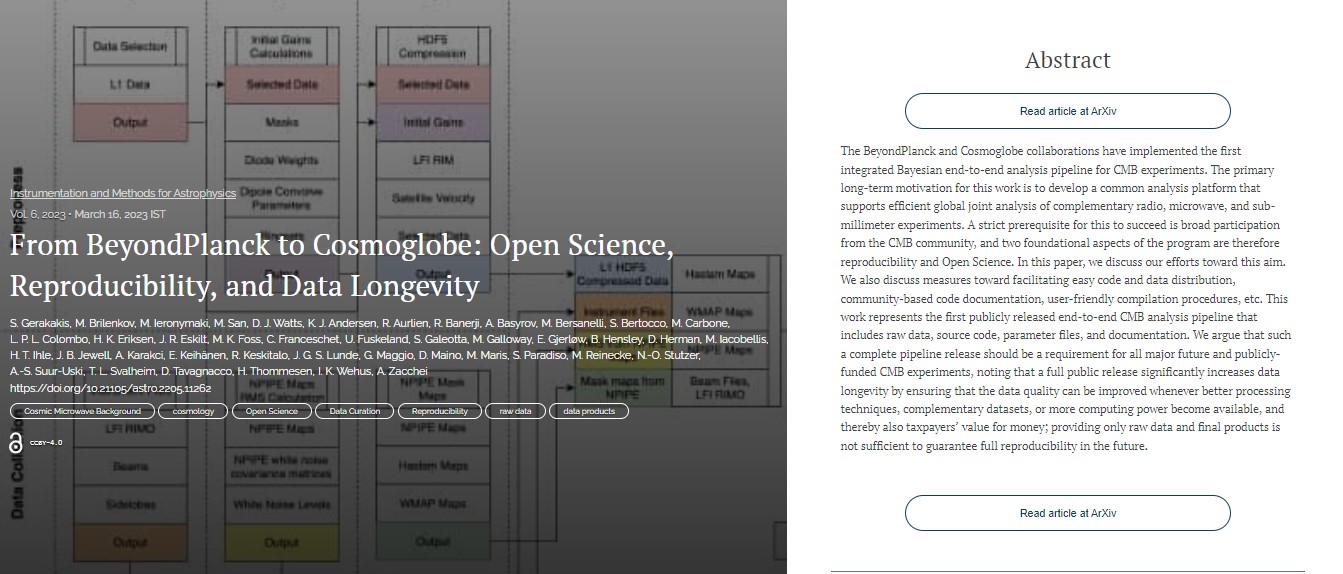
The first paper of the two is the 10th paper in Volume 6 (2023) and the 75th in all; it was published on 16th March 2023. This one is  in the folder marked Instrumentation and Methods for Astrophysics. The title is “From BeyondPlanck to Cosmoglobe: Open Science, Reproducibility, and Data Longevity” and it is a discussion of the importance of reproducibility and Open Science in CMB science including measures toward facilitating easy code and data distribution, community-based code documentation, user-friendly compilation procedures, etc.  You can find out more about the BeyondPlanck collaboration here and about Cosmoglobe here.

The first author is S. Gerakakis and there are 42 authors in all. This is too many to list individually here but they come from Greece, Norway, Finland, Germany, Italy, and the USA.

Here is a screen grab of the overlay which includes the  abstract:

You can click on the image of the overlay to make it larger should you wish to do so. You can find the officially accepted version of the paper on the arXiv here.

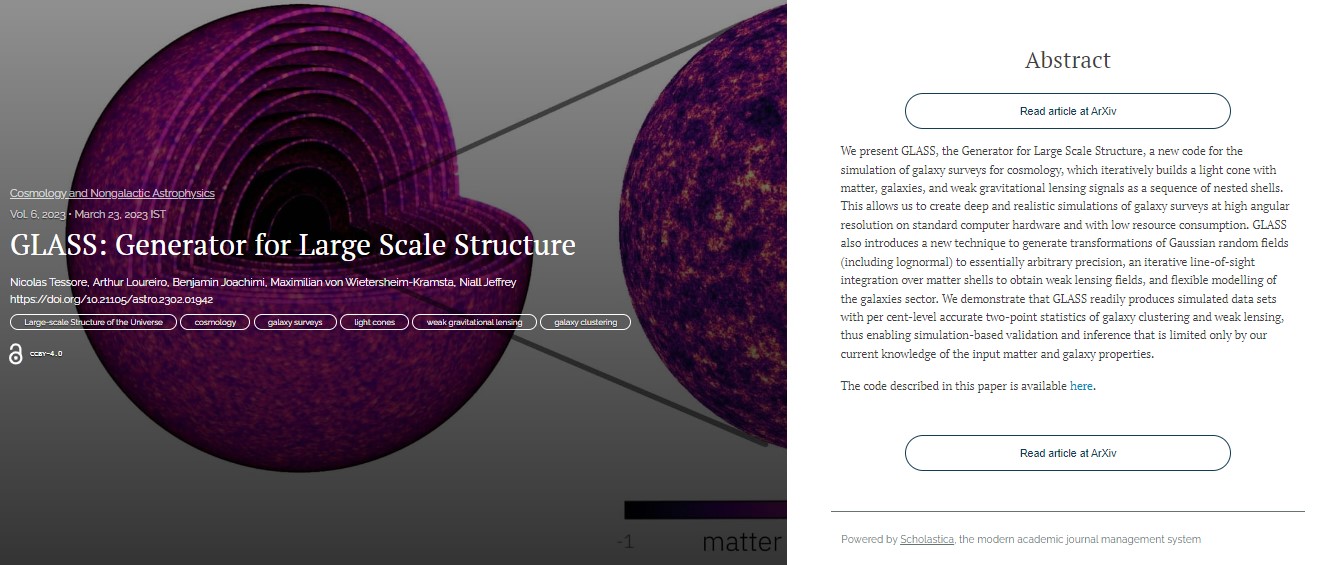
The second paper is the 11th paper in Volume 6 (2023) as well as the 76th in all; this one was published last Thursday (23rd March). This is another for the folder marked Cosmology and Nongalactic Astrophysics. The title is “GLASS: Generator for Large Scale Structure” and the paper is about a new code for the simulation of cosmological observables obtainable from galaxy surveys in a realistic yet computationally inexpensive manner. The code can be downloaded here. This is an interesting approach that contrasts with the “brute force” of full numerical simulations like those I discussed a few days ago.

The authors are Nicolas Tessore (University College London), Arthur Loureiro (UCL, Edinburgh and Imperial College), Benjamin Joachimi (UCL), Maximilian von Wiestersheim-Kramsta (UCL) and Niall Jeffrey (UCL).

Here is a screen grab of the overlay which includes the  abstract:


You can click on the image of the overlay to make it larger should you wish to do so. You can find the officially accepted version of the paper on the arXiv here.

UNESCO and Open Science

Posted in Open Access, Politics with tags , , , , , on January 12, 2022 by telescoper

Time to pass on news of an interesting development from the United Nations Educational, Scientific and Cultural Organization (UNESCO) concerning Open Science. Here’s a little video to explain what it’s about:

A press release announcing the new recommendations begins thus:

The first international framework on open science was adopted by 193 countries attending UNESCO’s General Conference. By making science more transparent and more accessible, the UNESCO Recommendation on Open Science will make science more equitable and inclusive. 

Through open science, scientists and engineers use open licenses to share their publications and data, software and even hardware more widely. Open science should, thus, enhance international scientific cooperation. 

Some 70% of scientific publications are locked behind paywalls. Over the past two years, however, this proportion has dropped to about 30% for publications on COVID-19 specifically. This shows that science can be more open. 

The framework document itself is here (21 pages). It’s a very general document, the strongest aspect of which is that it takes a broad view of open science. When I’ve talked and written about open access publishing I’ve always stressed that represents only one aspect of open science: there is a need to share data and analysis software too.

You can find an upbeat commentary on the new agreement by James Wilsdon here. Here’s a snippet:

At a time when ideologies opposed to universalism, multilateralism, and collaboration are gaining ground in many parts of the world—exacerbated by greed, corruption, and exploitation of common assets and resources—the scientific system is as vulnerable as it has always been to reflecting both the best and the worst of society’s wider tendencies.

Moves towards open research have gained significant ground over the past twenty years, but this progress remains fragile, under-resourced, and at times willfully or unintentionally blind to the fresh inequalities and pressures it can create—particularly for researchers and institutions in the global south.

For me, the greatest strengths of the UNESCO statement are its breadth and holism—unlike some declarations in this field, it speaks with an authentically international chorus of voices. It reasserts the need for cultural, linguistic, and disciplinary pluralism, and reminds us that openness is ultimately a means to more fundamental ends. The recommendation returns repeatedly to the importance of infrastructures and incentives, which need to be financed, sustained, and better aligned.

I couldn’t agree more!

Open Access and the Open Journal of Astrophysics

Posted in Open Access, YouTube with tags , , on September 18, 2021 by telescoper

Here is the video recording of the Invited Colloquium at the International School Daniel Chalonge – Hector de Vega I gave via Zoom on15th September 2021, introduced by Prof. Norma Sanchez.

In the talk I give a review about the absurdity of the current system of academic publishing, about what Open Access publishing means, and give a short introduction to the Open Journal of Astrophysics, an arXiv overlay journal.

I’m sorry if the recording is a bit choppy but that’s an occupational hazard with Zoom recordings and rather limited broadband!

The talk itself lasts about an hour, but was followed by an interesting discussion session so although the full video is rather long (2 1/2 hours) I’ve put it all there on Youtube.

You can download the video here. A PDF of the slides may be found here. You can also view the slides on slideshare:

Gruber Prize 2020: Volker Springel & Lars Hernquist

Posted in Open Access, The Universe and Stuff with tags , , , , , on May 8, 2020 by telescoper

I’m delighted to be able to pass on the news released yesterday that the 2020 Gruber Prize for Cosmology has been awarded to Lars Hernquist (left) and Volker Springel (right) for their work on numerical simulations.

The citation reads:

The Gruber Foundation is pleased to present the 2020 Cosmology Prize to Lars Hernquist and Volker Springel for their transformative work on structure formation in the universe, and development of numerical algorithms and community codes further used by many other researchers to significantly advance the field. The contributions of Hernquist and Springel have led to profound insights spanning billions of years of cosmic evolution, including simulations of the growth of early density fluctuations through to present-day galaxies, the influence of galaxy mergers on star formation, and the close coevolution of supermassive black holes with their host galaxies.

I’ll just add that as well as being enormously influential in purely scientific terms both these scientists have contributed to the culture of open science through making codes (such as GADGET) freely available to the community.

Heartiest congratulations to Volker Springel and Lars Hernquist on their very well deserved award.

Public Health and Open Science – Updated

Posted in Covid-19 with tags , , , on March 16, 2020 by telescoper

Preface: I wrote this on Monday 16th March, before the release of a report from Imperial College admitting that the previous modelling was based on incorrect assumptions. Most of what I argued still stands but I have updated a few points.

–o–

The current Coronavirus outbreak is posing a great many questions not only about how governments should act but also about how they should communicate with the public. One aspect of this issue that came up last week was an open letter (now closed) asking the UK Government to release the data and models underpinning its COVID-19 strategy. In the interest of full disclosure, I didn’t sign it but only because I’m no longer based in the UK.

Although this letter received many signatures, I was very surprised by the negativity with which it was greeted from some corners of the scientific community. Those of us who work in astrophysics are of course used to open sharing of data and models being the norm. Some of us even see it as an essential component of the scientific method, so I was a bit shocked to see hostility from some other scientists. I think the reason was largely that it wouldn’t help to people without expert knowledge playing around with the data, getting hold of the wrong end of the stick, and jumping to erroneous conclusions. There is of course a danger of that, but in the absence of openness people are jumping to conclusions anyway and conspiracy theories are rife.

For what it’s worth, my view is that if governments can’t get those with scientific training on board then it has no chance with the general population. Astrophysicists, for example, at least understand what an exponential curve really means. Those of us who have a scientific background will not stop asking questions – nor, I think, should we. That’s how we view the world and for many equations and numbers are how we make sense of things.

So, undaunted by the calls that I should shut up because I’m not an expert, but prefaced by a clear admission that I am not an expert, I’m going to comment on a question that a lot of people are asking: why is the UK Government’s Coronavirus strategy so different from that adopted in other countries?

I didn’t watch the press conference last week that ignited this question, but I have listed to clips. The controversial issue is that of so-called herd immunity. Here is a quote by Sir Patrick Vallance, the UK’s chief scientific advisor:

Our aim is to try to reduce the peak, broaden the peak, not suppress it completely; also, because the vast majority of people get a mild illness, to build up some kind of herd immunity.

Now in the absence of a vaccine there isn’t going to be herd immunity in the sense that I understand it, but (as I have already said) I am not an expert. I think the key words are `some kind of’ in the above quote. What is envisaged is a large number of people getting infected, hopefully only contracting mild symptoms, but in any case subsequently acquiring immunity. It would be bad news for this line of thought if it turns out that people can be reinfected, as indeed seems to be the case.

After listening to the press briefings, however, it seems to me that this idea isn’t a key driver of the science policy and that Vallance simply used the phrase `herd immunity’ inadvisedly.

So if that’s not the reason why would the UK’s approach be so different from other countries? Again I preface this by admitting that I’m not an expert.

At the core of a public health strategy to combat a pandemic will be mathematical models of the spread of infection. I only know a little bit about these but I’d guess that most government agencies will have similar models (though there might be different choices of parameters reflecting different populations). But that’s not all the strategy will be based on. Among the other factors are:

  1. the resources available for treating infected persons; and
  2. the likely behaviour of the population (and hence the infection rate) as a result of any measures taken.
  3. A decision about what it means for a strategy to be ‘optimal’.

In the first of these the UK is clearly in a very different situation from most of the rest of the world: the National Health Service has (per capita) far fewer hospital beds and, most importantly, far fewer intensive care unit facilities than other developed nations. The latter, in any case, run at close to capacity even at normal times so the resource available is severely limited. The need to `flatten the curve’ would therefore seem to be even more pressing for the United Kingdom than in many other nations.

Update: the Imperial College report explains that previous models made unrealistically optimistic assumptions about the number of infected persons requiring critical treatment. The old strategy would have led to upwards of 250,000 deaths as the NHS would have been swamped. This was exactly what was being pointed out by ‘inexpert’ commenters on social media.

Here is a dramatic confirmation of this:

The red line represents UK current critical care capacity. No amount of ‘flattening’ will be enough to avoid the NHS being overwhelmed.

That is a difference in input, but it doesn’t explain why the UK is not taking more stringent measures on social distancing. Quite the opposite, in fact. Apparently the Government has already accepted that hospitals are going to be overrun and that things are going to be very grim indeed for a long time.

By way of support for this interpretation, Boris Johnson recently announced that the elections scheduled for May 2020 will be postponed for a whole year, rather than the six months recommended by the Electoral Commission. It is a reasonably inference that the Government does not believe that this will be anywhere near over by the end of 2020. That signals that it won’t be able to put extra resources in place on the timescale needed to deal effectively with COVID-19 as China and South Korea seem to have done.

It seems, then, that the reason for not enforcing stricter policies now is item 2 above, and it is a judgment based on behavioural psychology: that severe social distancing measures would not be effective because people would get bored or there would be widespread social unrest if folk were asked to endure them for many months. That very pessimistic view of the likely behaviour of the UK population may well be realistic but assuming it has serious implications for mortality.

My interpretation of this is that the Government thinks people won’t really pay enough attention to social distancing instructions until the body count starts to become very scary indeed which, with exponential growth leading to a doubling of cases, every 2-3 days, won’t take very long.

So that brings me the reason why I think there is no way the UK Government is going to release its modelling calculations, namely that they contain numbers for how many people are going to die over the next few months. It won’t do that because it thinks the numbers would just cause people to panic. That may be a correct call too. Those of us who work in subjects like astrophysics don’t have to worry that releasing our data and models will terrify people.

There’s also point (3) about what defines an optimal strategy, as constrained by (1) & (2). The criterion could be overall mortality, but one can imagine that a government might decide to include economic cost as well or instead. One can certainly imagine the UK Government making such a choice.

I’ll add one final comment.

Here in Ireland the HSE has increased the level of testing in recognition of the evidence that community transmission seems to be more probable than previously thought. A surge in the number of confirmed cases of COVID-19 is expected.

Meanwhile, in the United Kingdom, the National Health Service is no longer carrying out any community testing:

I suspect the reason for this is a combination of (1) and (2). Counting deaths rather than infections is arguably a more reliable indicator of the growth of the epidemic and it is certainly cheaper. Moreover, one way of keeping the numbers down to avoid frightening people is to stop counting them…

Update: As of yesterday Germany had 5813 COVID cases and had 13 deaths; Norway had 1356 cases and only 3 deaths. The UK claimed 1391 cases but 35 deaths. These numbers provide drastic evidence of undercounting cases in the UK.
New Publication at the Open Journal of Astrophysics!

Posted in OJAp Papers, Open Access, The Universe and Stuff with tags , , , , , , on December 11, 2019 by telescoper

We seem to be having an end-of-year rush and have published yet another new paper at The Open Journal of Astrophysics!

Here is a grab of the overlay:

The authors are Aditi Krishak (IISER Bhopal) and Shantanu Desai (IIT Hyderabad), both in India.

You can find the accepted version on the arXiv here. This is another one for the `Cosmology and Nongalactic Astrophysics’ section with a cross-listing in `Instrumentation and Methods for Astrophysics’, both of which are proving rather popular.

We would be very happy to get more submissions from other areas, especially Stellar and Planetary astrophysics. Hint! Hint!

P.S. Just a reminder that we now have an Open Journal of Astrophysics Facebook page where you can follow updates from the Journal should you so wish..

New Publication at the Open Journal of Astrophysics!

Posted in OJAp Papers, Open Access, The Universe and Stuff with tags , , , , , , on December 9, 2019 by telescoper

We have published yet another new paper at The Open Journal of Astrophysics!

Here is a grab of the overlay:

The authors are Emilio Bellini (Oxford, UK), Ludovic van Waerbeke (University of British Columbia, Canada), Shahab Joudaki (Oxford) and David Alonso (Cardiff)

You can find the accepted version on the arXiv here. This is another one for the `Cosmology and Nongalactic Astrophysics’ section, which is proving rather popular.

We would be very happy to get more submissions from other areas, especially Stellar and Planetary astrophysics. Hint! Hint!

P.S. Just a reminder that we now have an Open Journal of Astrophysics Facebook page where you can follow updates from the Journal should you so wish..

New Publication at the Open Journal of Astrophysics!

Posted in OJAp Papers, Open Access, The Universe and Stuff with tags , , , , , , , , on December 2, 2019 by telescoper

We have published another new paper at The Open Journal of Astrophysics. We actually published this one last week but (presumably because of the Thanksgiving holiday) it has taken longer than usual to register the DOI with Crossref and I held off mentioning this paper here until everything was sorted.

Here is a grab of the overlay:

The authors are Farhad Feroz and Mike Hobson of the Cavendish Laboratory at the University of Cambridge (UK), Ewan Cameron (now at Oxford, UK) and Anthony N. Pettitt of Queensland University of Technology in Australia.

You can find the accepted version on the arXiv here. This version was accepted after modifications requested by the referee and editor. Because this is an overlay journal the authors have to submit the accepted version to the arXiv (which we then check against the copy submitted to us) before publishing; version 3 on the arXiv is the accepted version (which contains a link to updated software).

It is worth mentioning a couple of points about this paper.

The first is that it is mainly a statistical methods paper rather than astrophysics per se but it does contain applications to astrophysics and cosmology and, more relevantly, was posted on the `Instrumentation and Methods for Astrophysics’ section on the arXiv. The Editorial Board felt that we should consider it for publication because our rule for whether a paper can be considered for publication in the Open Journal of Astrophysics is stated clearly on our instructions for authors:

We apply a simple criterion to decide whether a paper is on a suitable topic for this journal, namely that if it it is suitable for the astro-ph section of the arXiv then it is suitable for The Open Journal of Astrophysics.

So far our publication list is dominated by papers in `Cosmology and Nongalactic Astrophysics’ and `Instrumentation and Methods for Astrophysics’ (which is not surprising given its origin) but we would be very happy to get more submissions from other areas, especially Stellar and Planetary astrophysics. Hint! Hint!

The other point to make is that this paper actually appeared on the arXiv over six years ago and has been widely cited as a preprint but it has never previously been published by a journal. The Editorial Board felt that we should consider it for publication in order to ensure that it is properly curated and citations properly assigned, but we treated it as a new submission and sent it out for review just like any other paper. The review led to some changes and, most importantly, a few updates to the software which you can find here. The editorial process has been quite lengthy for this paper but I think we have done a valuable service to the community in reviewing and publishing this paper.

P.S. Just a reminder that we now have an Open Journal of Astrophysics Facebook page where you can follow updates from the Journal should you so wish..