It’s Saturday once more, so it’s time for another update of activity at the Open Journal of Astrophysics. Since the last update we have published a further eight papers, bringing the number in Volume 9 (2026) to 59 and the total so far published by OJAp up to 507. We passed the 500 mark on Monday, and the week was also notable because we once again published at least one paper each working day.
I will continue to include the posts made on our Mastodon account (on Fediscience) to encourage you to visit it. Mastodon is a really excellent service, and a more than adequate replacement for X/Twitter (which nobody should be using); these announcements also show the DOI for each paper.
The first paper to report this week is our 500th publication. The title is “The causal structure of galactic astrophysics” and the authors are Harry Desmond (U. Portsmouth, UK) and Joseph Ramsey (Carnegie Mellon U., USA). This paper was published on Monday March 16th 2026 in the folder Astrophysics of Galaxies. It proposes using causal discovery, a method for inferring data structure, to better utilize information in astrophysical data, demonstrated through an algorithm applied to a large galaxy dataset.
The overlay is here:
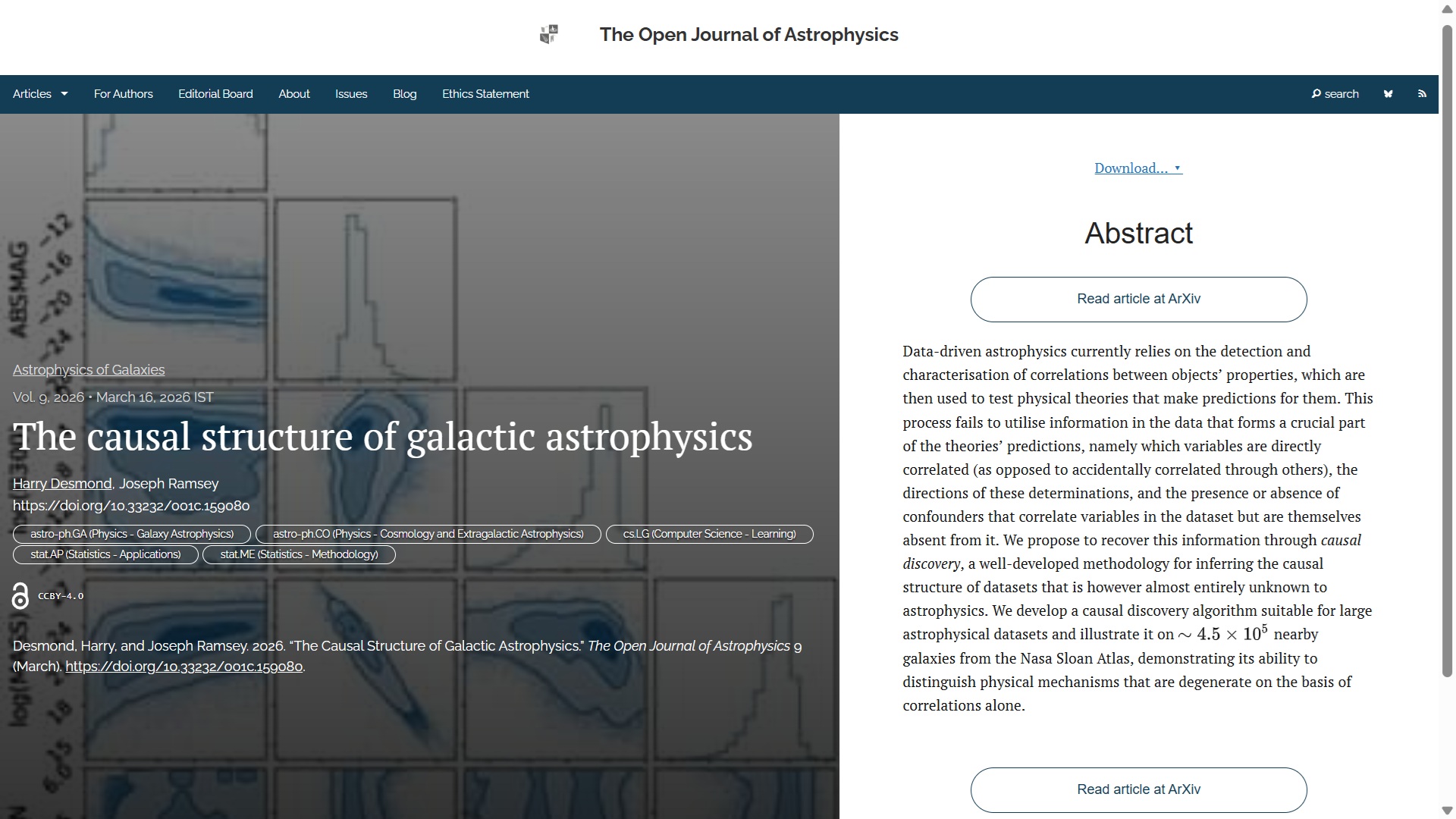
You can find the officially accepted version on arXiv here and the announcement on Fediverse here:

The second paper for this week, also published on March 16th in the folder Astrophysics of Galaxies, is “Finding the boundary: Using galaxy membership to inform galaxy cluster extent through machine learning” by Christine Hao, Stephanie O’Neil, Mark Vogelsberger, & Vinh Tran (MIT, USA), Lamiya Mowla (Wellesley College, USA) and Joshua S. Speagle (U. Toronto, Canada). This study uses neural networks and simulations to identify and map the transitional region between cluster and field galaxies, revealing it as a scattered area rather than a sharp boundary.
The overlay for this one is here:
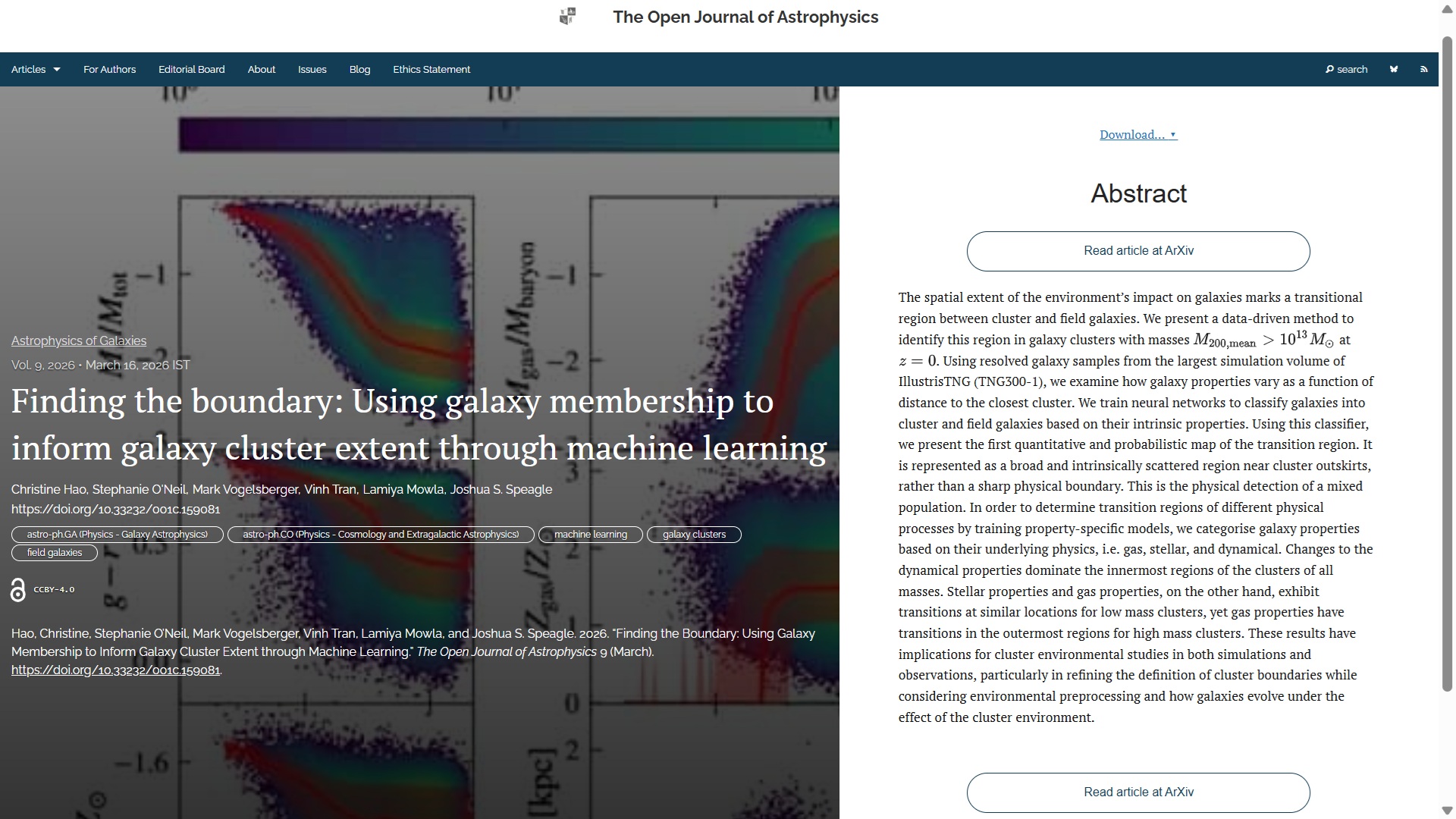
The official version of the paper can be found on arXiv here and the Fediverse announcement here:
Next one up is “The Manticore-Local Cluster Catalogue: A Posterior Map of Massive Structures in the Nearby Universe” by Stuart McAlpine (Oskar Klein Centre, Stockholm U., Sweden). This was published on Tuesday March 17th in the folder Cosmology and Nongalactic Astrophysics; it presents a catalogue of massive structures in the universe, inferred from 2M++ galaxies. The catalogue, validated through Planck thermal measurements, provides a consistent map of these structures for further studies.
The overlay for this one is here:
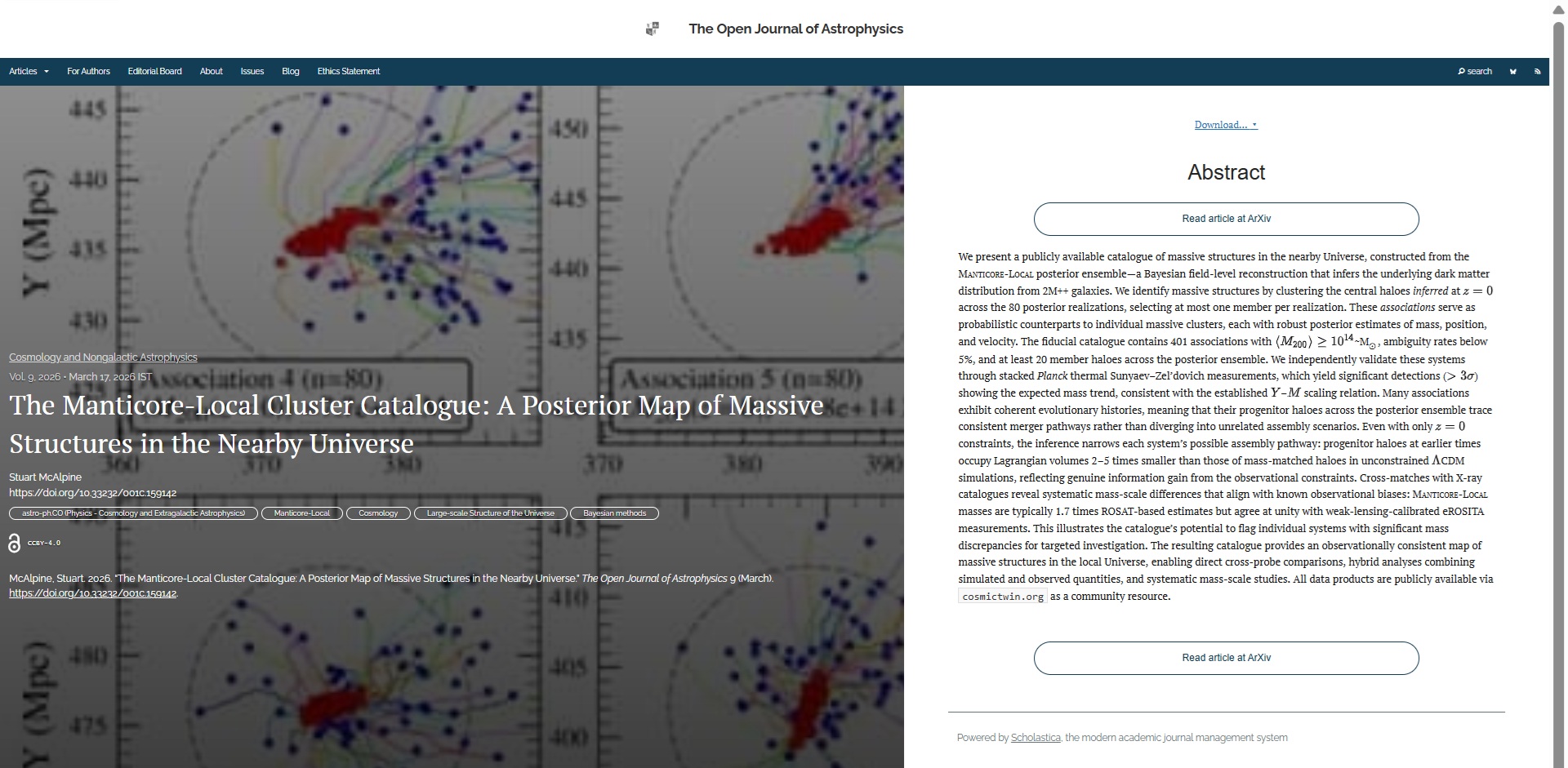
The final, accepted version can be found on arXiv here and the Mastodon announcement is here:
The fourth paper this week, published on 18th March 2026 in the folder Solar and Stellar Astrophysics is “Vision-Based CNN Prediction of Sunspot Numbers from SDO/HMI Images” by Fabian C. Quintero-Pareja, Diederik A. Montano-Burbano, Santiago Quintero-Pareja & David Sierra Porta (Universidad Tecnológica de Bolívar, Colombia). This article describes a deep learning framework that uses convolutional neural networks to estimate daily sunspot numbers from solar images, offering a scalable and accurate method for solar monitoring.
The overlay is here:
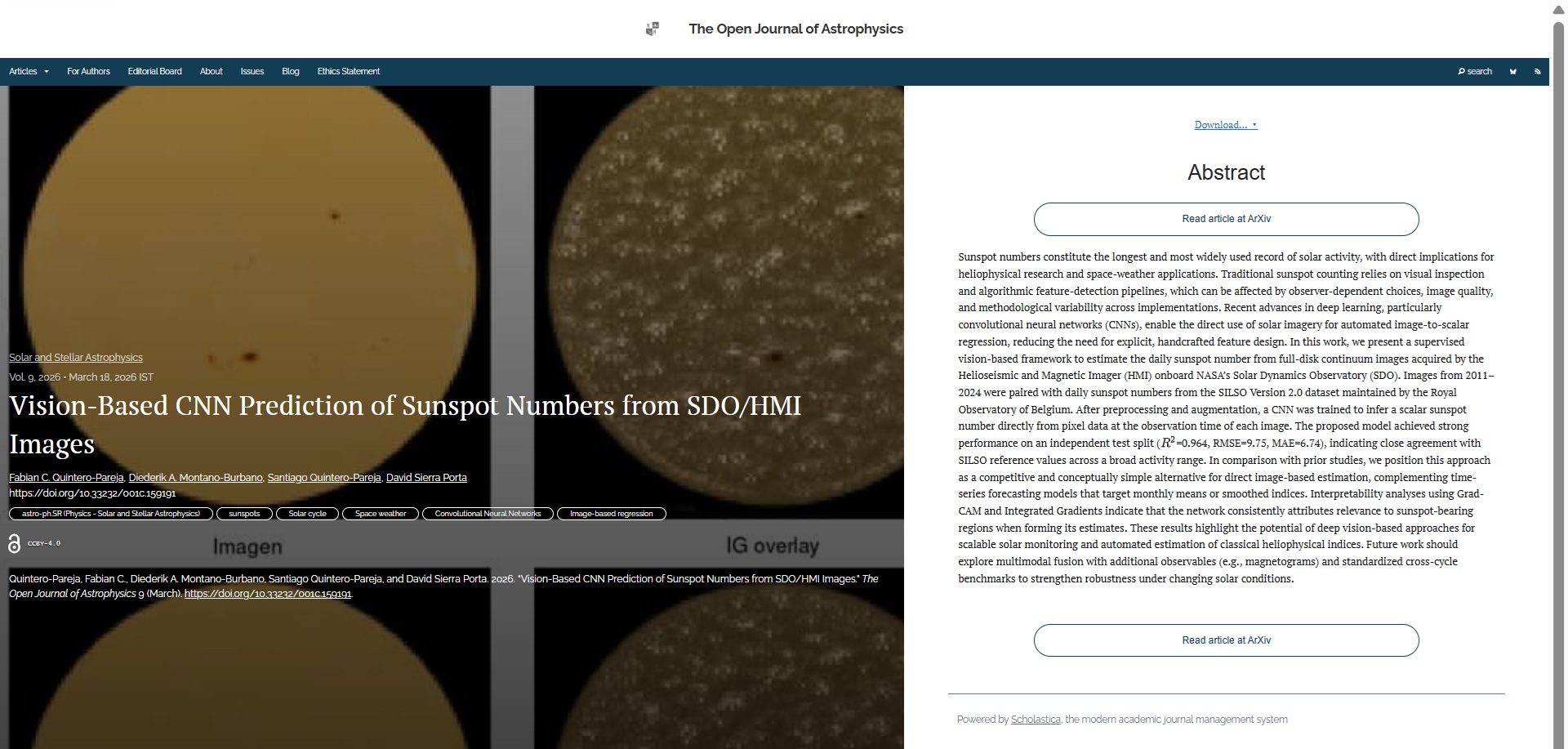
The finally accepted version of this paper can be found here and the Mastodon announcement is here:
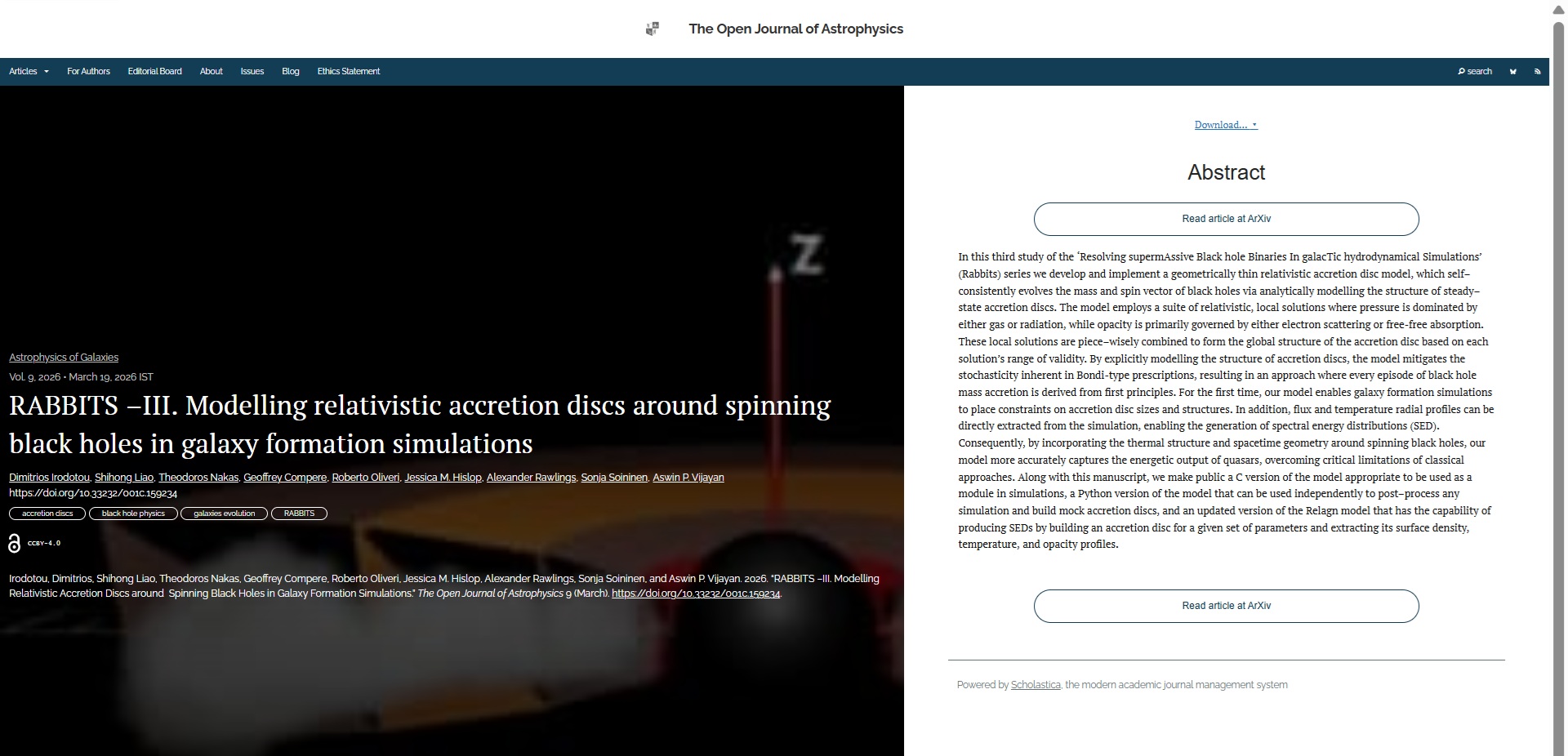
Next one up, published on Thursday 19th March 2026, is “RABBITS –III. Modelling relativistic accretion discs around spinning black holes in galaxy formation simulations” by Dimitrios Irodotou (ICR, London) and 8 others based in China, Korea, Belgium, France, Finland and the UK. This paper, which is in the folder Astrophysics of Galaxies, presents a new model for simulating supermassive black hole binaries, which more accurately predicts accretion disc structures and sizes, and the energetic output of quasars. The code is publicly available.
This is the overlay:
The officially accepted version can be found on arXiv here and the Mastodon announcement follows:
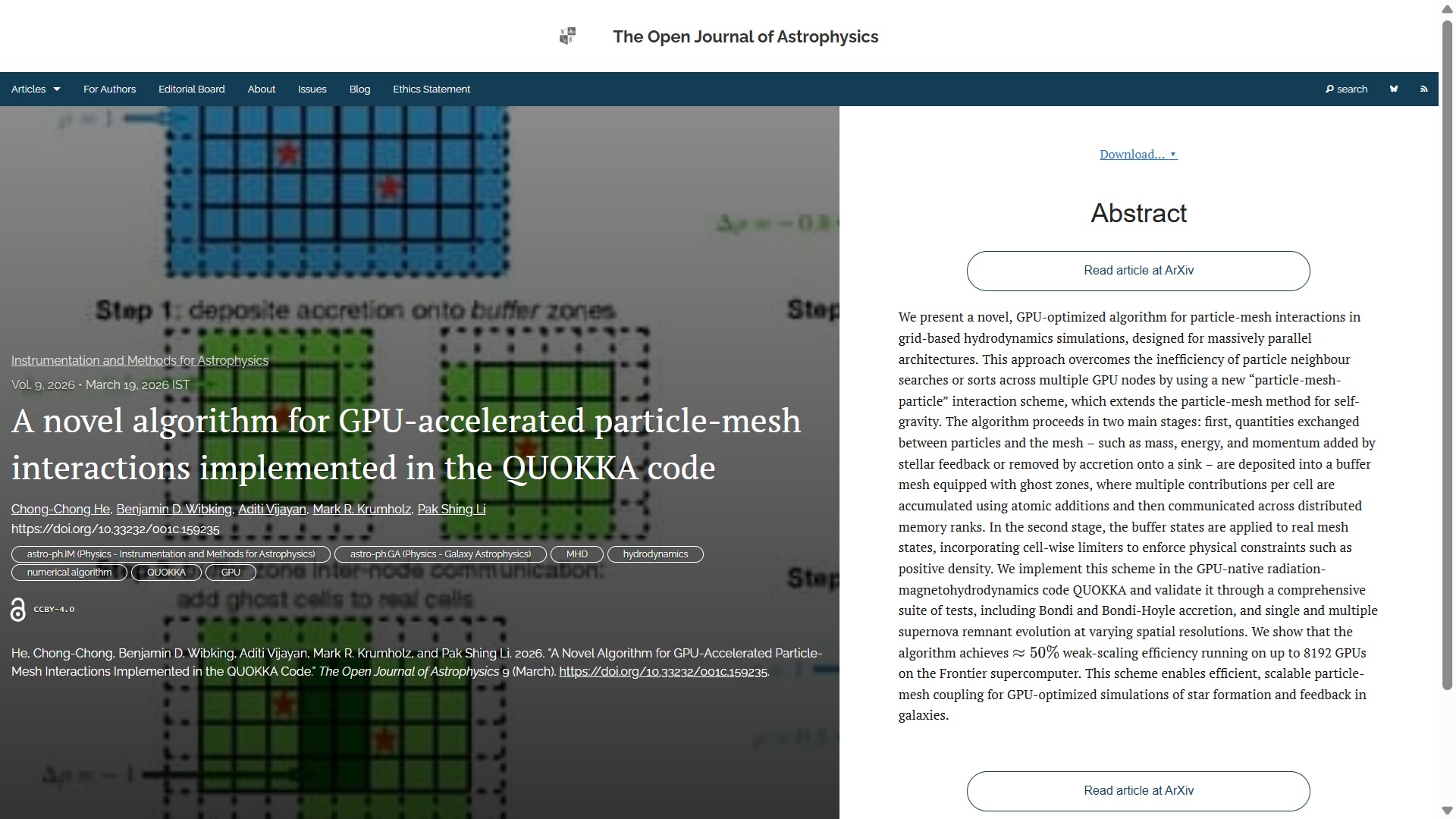
The sixth paper this week is “A novel algorithm for GPU-accelerated particle-mesh interactions implemented in the QUOKKA code” by Chong-Chong He (Australia National University), Benjamin D. Wibking (Michigan State U., USA), Aditi Vijayan (ANU), Mark R. Krumholz (ANU) and Pak Shing Li (Shanghai Astronomical Observatory, China). This was published on Thursday 19th March in the folder Instrumentation and Methods for Astrophysics. The article introduces a GPU-optimized algorithm for particle-mesh interactions in hydrodynamics simulations, improving efficiency and scalability in simulations of star formation and feedback in galaxies.
The overlay is here:
The officially accepted version of this paper can be found on arXiv here, and the Mastodon announcement is here:
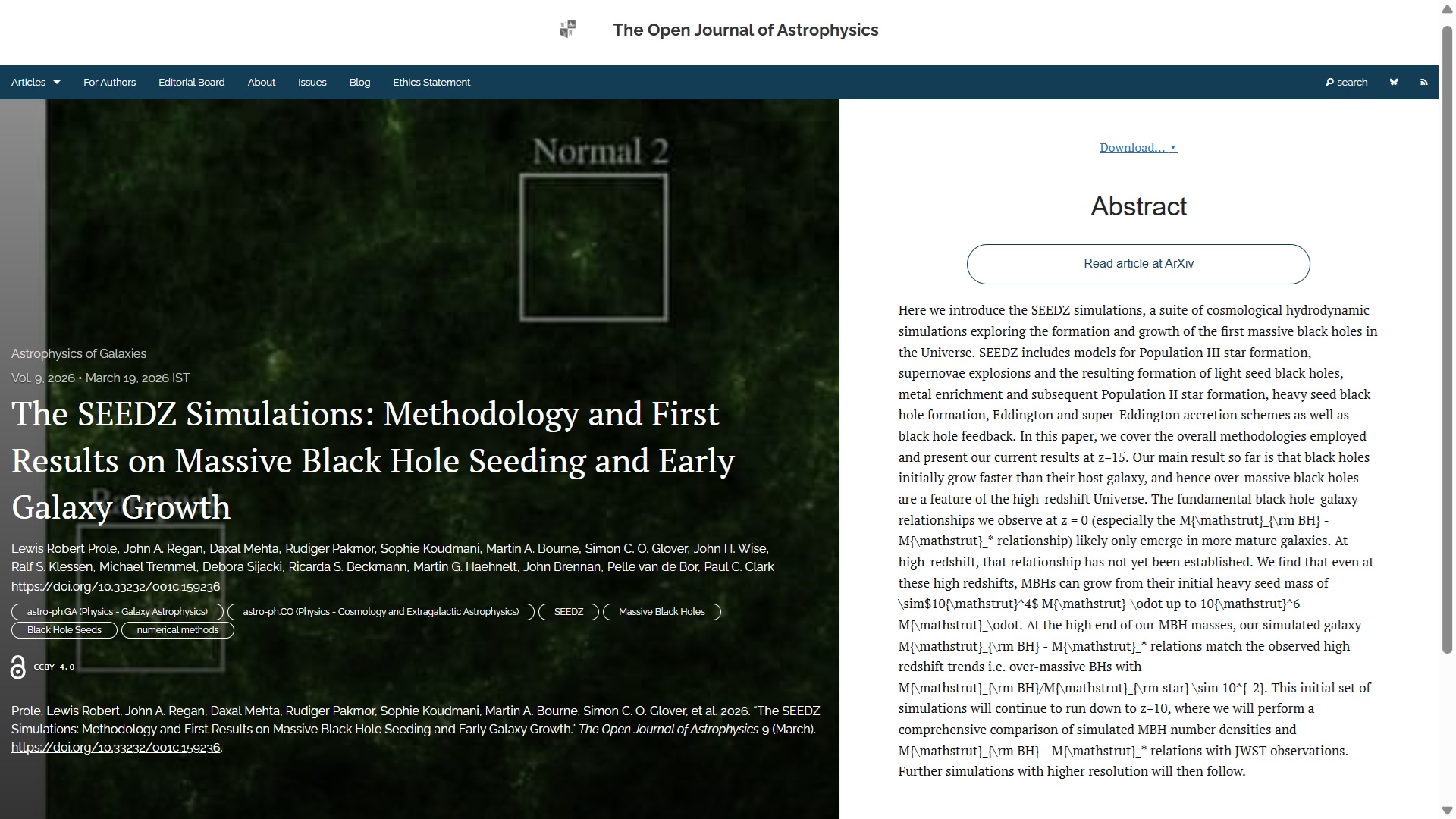
The penultimate, seventh, paper for this week is “The SEEDZ Simulations: Methodology and First Results on Massive Black Hole Seeding and Early Galaxy Growth” by Lewis Prole (NUI Maynooth, Ireland) and 15 others based in Ireland, Germany and the UK. This paper was also published on Thursday March 19th 2026 in the folder Astrophysics of Galaxies. Ir presents the SEEDZ simulations, studying the formation and growth of the universe’s first massive black holes, finding that these black holes initially grow faster than their host galaxies.
The overlay for this one is here:
The official version of this paper can be found here. This is the Mastodon announcement:
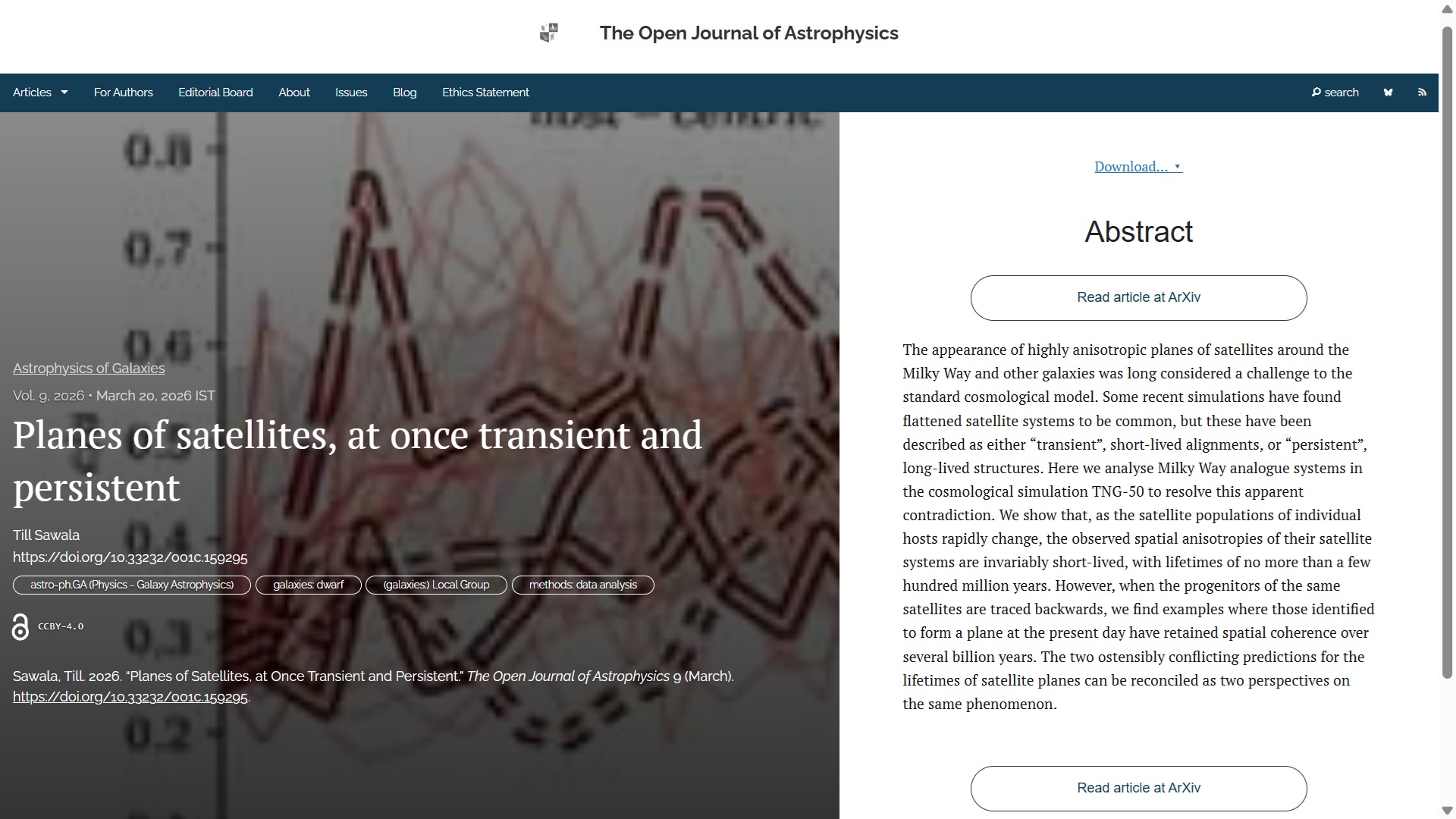
And finally for this week, published yesterday (Friday 20th March 2026) in the folder Astrophysics of Galaxies, we have “Planes of satellites, at once transient and persistent” by Till Sawala (University of Helsinki, Finland). This study resolves the contradiction in the lifespan of satellite systems around galaxies, showing they are short-lived but maintain spatial coherence over billions of years.
Here is the overlay for this one:
The officially accepted version can be found on arXiv here and the Mastodon announcement is here:
And that concludes the update for this week. Will we keep the rate up next week? Tune in next Saturday to find out!
P.S. Thank you once again to the many people who have responded to the latest call for editors. The Editorial Board has grown substantially over the last few weeks – an up-to-date version can be found here – and there are still some people waiting to get onboard, so please bear with me!

 In the Dark