Archive for Particle Physics

R.I.P. Tsung-Dao Lee (1926-2024)

Posted in R.I.P., The Universe and Stuff with tags , , , on August 5, 2024 by telescoper

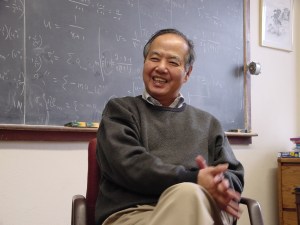
T.D.1.jpg_copyI’ve just heard the sad news of the death at the age of 97 of TD Lee (shown left) who, together with CN Yang, won the Nobel Prize for Physics in 1957 for his work on parity violation in particle physics. I always find it difficult on occasions like this to find ways of describing the work of people of such eminence in fields other than my own, but in this case it turns out I have a personal connection of a sort. Way back in 2006 when I was at Nottingham, the University decided to award Prof. Lee an honorary degree and I was chosen to deliver the oration at the graduation ceremony before spending some time chatting to him with some students. I remember that it was a very hot day and I was wilting under the graduation robes, but he took it all in his stride despite being 80 years old. Anyway, here is the text that I prepared for that occasion, which I hope will serve as a fitting obituary.


PROFESSOR TSUNG-DAO LEE

ORATION DELIVERED BY PROFESSOR PETER COLES

ON MONDAY 17 JULY 2006

Chancellor, Vice-Chancellor, Ladies and Gentlemen, it is both a pleasure and a privilege to present Professor Tsung-Dao Lee for the award of an honorary degree.  Professor Lee is a distinguished theoretical physicist whose work over many years has been characterized, in the words of Dr J Robert Oppenheimer, by “a remarkable freshness, versatility and style.”

Tsung-Dao Lee was born in Shanghai and educated at Suzhou University Middle School in Shanghai.  Fleeing the Japanese invasion, he left Shanghai in 1941.  His education was interrupted by war.  In 1945 he entered the National Southwest University in Kunming as a sophomore.  He was soon recognized as an outstanding young scientist and in 1946 was awarded a Chinese Government Scholarship enabling him to start a PhD in Physics under Professor Enrico Fermi at the University of Chicago.  He gained his doctorate in physics in 1950 with a thesis on the Hydrogen Content of White Dwarf Stars, and subsequently served as a research associate at the Yerkes Astronomical Observatory of the University of Chicago in Williams Bay, Wisconsin.

Astronomy is a science that concerns the very large, but it was in the physics of the very small that Professor Lee was to do his most famous work.  After one year as a research associate and lecturer at the University of California in Berkeley, he became a fellow of the Institute of Advanced Study in Princeton and, in 1953, he accepted an assistant professorship position at Columbia University in New York.  Two and a half years later, he became the youngest full professor in the history of Columbia University.  During this time he often collaborated with Chen Ning Yang whom he had known as a fellow student in Chicago.  In 1956 they co-authored a paper whose impact was both immediate and profound.  Only a year later, Lee and Yang were jointly awarded the Nobel Prize in Physics.  Professor Lee was thirty-one at the time and was the second youngest scientist ever to receive this distinction.  (The youngest was Sir Lawrence Bragg who shared the Physics Prize with his father in 1915, at the age of twenty-five; Werner Heisenberg was 31 when his Nobel Prize was announced, in 1932, but he did not receive the prize until the following year.)

It is usually difficult to explain the ideas of theoretical physics to non-experts.  The mathematical language is inaccessible to those without specialist training.  But some of the greatest achievements in this field are so bold and so original that they appear, at least with hindsight, to be astonishingly simple.  The work of Lee and Yang on parity violation in elementary particle interactions is an outstanding example.

Subatomic particles interact with each other in very complicated ways.  In high energy collisions, particles can be scattered, destroyed or transformed into other particles.  But governing these changes are universal rules involving things that never change.  The existence of these conservation laws is a manifestation of the symmetries possessed by the mathematical theory of particle interactions.

Lee and Yang focussed on a particular attribute called parity, which relates to the “handedness” of a particle and symmetry with respect to mirror reflections.  Physicists had previously assumed that the laws of nature do not distinguish between left- and right-handed states: a left-handed object when seen in a mirror should be indistinguishable from a right-handed one.  This symmetry suggests that parity should be conserved in particle interactions, as it is in many other physical processes.  Unfortunately this chain of thought led to a puzzling deadlock in our understanding of the so-called weak nuclear interaction.  Lee and Yang made the revolutionary suggestion that parity is not conserved in weak interactions and consequently that the laws of nature must have a built-in handedness.  A year later their theory was tested experimentally and found to be correct.  Their penetrating insight led to a radical overhaul of the theory of weak interactions and to many further discoveries.  Physicists around the world said “Of course!  Why didn’t I think of that?”

This classic “Eureka moment” happened half a century ago, but Professor Lee has since made a host of equally distinguished contributions to fields as diverse as astrophysics, statistical mechanics, field theory and turbulence.  He was made Enrico Fermi Professor at Columbia in 1964 and University Professor there in 1984.  With typical energy and enthusiasm he took up the post of director of the RIKEN Research Center at Brookhaven National Laboratories in 1998.  He has played a prominent role in the advancement of science in China, including roles as director of physics institutes in Beijing and Zhejiang.

Professor Lee has received numerous awards and honours from around the world, including the Albert Einstein Award in Science, the Bude Medal, the Galileo Galilei Medal, the Order of Merit, Grande Ufficiale of Italy, the Science for Peace Prize, the China National-International Cooperation Award, the New York City Science Award, the Pope Joannes Paulis Medal, Il Ministero dell’Interno Medal of the Government of Italy and the New York Academy of Sciences Award.  His recognition even extends beyond this world, for in 1997 Small Planet 3443 was named in his honour.

Chancellor, Vice-Chancellor, to you and to the whole congregation I present Professor Tsung-Dao Lee as eminently worthy to receive the degree of Doctor of Science, honoris causa.

R.I.P. Peter Higgs (1929-2024)

Posted in Barcelona, Maynooth, R.I.P., The Universe and Stuff with tags , , , , , on April 9, 2024 by telescoper

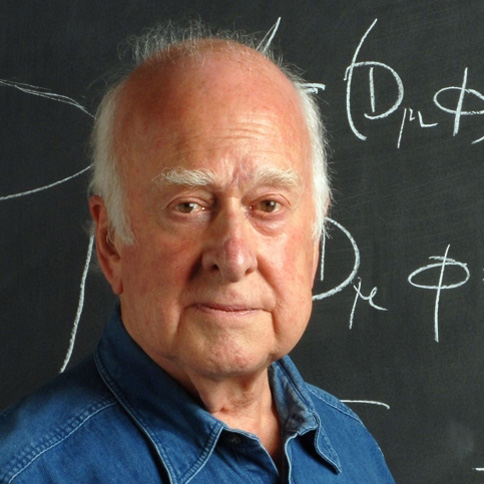
I was very sad this afternoon to hear of the death of theoretical physicist Peter Higgs, on Monday 8th April 2024, at the age of 94. I never met Peter Higgs but I know how greatly liked and respected he was (see, e.g. here) and that he leaves an important legacy as a physicist, particularly the work that led to the award of the 2013 Nobel Prize for Physics (jointly with François Englert) . Condolences to his family, friends and colleagues.

You can read the very nice Guardian obituary here; there are many others published in media from elsewhere in the world (including Ireland and Barcelona).

I’ll add two extremely slight connections. One is that Peter Higgs visited Maynooth University in 2012, not long before his Nobel Prize was announced. The other is that he was born in the Elswick area of Newcastle upon Tyne, not far from Benwell, where I grew up.

R. I. P. Steven Weinberg (1933-2021)

Posted in Biographical, The Universe and Stuff with tags , , , on July 24, 2021 by telescoper

I just heard this morning via Twitter of the death at the age of 88 of the physicist Steven Weinberg. The news media don’t seem to have caught on yet but I’ll add links to appropriate tributes when they do.

UPDATE: You will find an appreciation from UT Austin here and an Associated Press article here.

Steven Weinberg is probably most famous in physics circles for his work on electroweak unification, together with Seldon Glashow and Abdus Salam, for which he jointly won the Nobel Prize for Physics in 1979. He did many other things besides, of course, and his influence is felt across huge swathes of particle physics, quantum field theory and cosmology. As well as a researcher he was a prolific writer, both of technical books – his Gravitational and Cosmology is a classic text on the principles and applications of the general theory of relativity – but also of works for the general public. He was an author of rare elegance and lucidity with some wonderful turns of phrase and a beautifully articulated secular view of the human condition. For example

If there is no point in the universe that we discover by the methods of science, there is a point that we can give the universe by the way we live, by loving each other, by discovering things about nature, by creating works of art. And that—in a way, although we are not the stars in a cosmic drama, if the only drama we’re starring in is one that we are making up as we go along, it is not entirely ignoble that faced with this unloving, impersonal universe we make a little island of warmth and love and science and art for ourselves. That’s not an entirely despicable role for us to play.

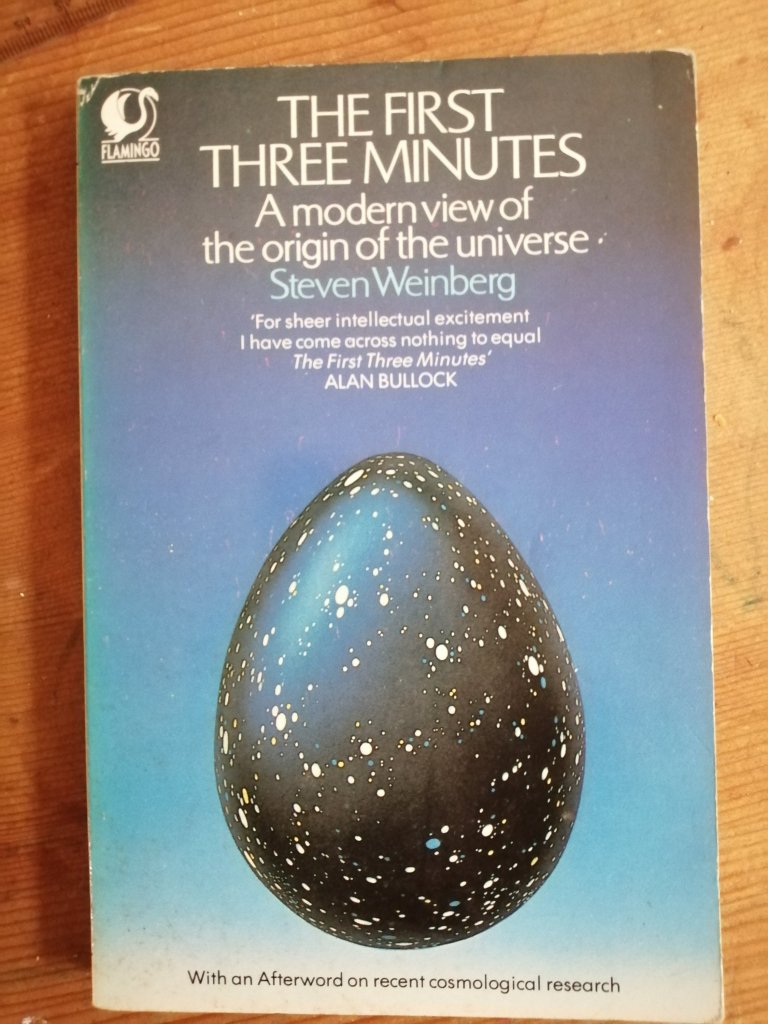
I bought Weinberg’s popular book The First Three Minutes about 40 years ago, and I still have a copy today. It’s no exaggeration to say that this book played a major part in my decision to continue a career in theoretical physics. I know I’m not the only physicist of my generation (or others) for whom this is the case. Although I never met Steven Weinberg in person, he was definitely an inspiration and he will be greatly missed.

Rest in peace, Steven Weinberg (1933-2021).

Particle Physics Masterclass at Maynooth

Posted in Education, Maynooth, The Universe and Stuff with tags , , on February 26, 2021 by telescoper

I have already informed you of a Masterclass in Astrophysics & Cosmology at Maynooth that will take place on March 25th 2021. For more information on that event including instructions on how to book see here.

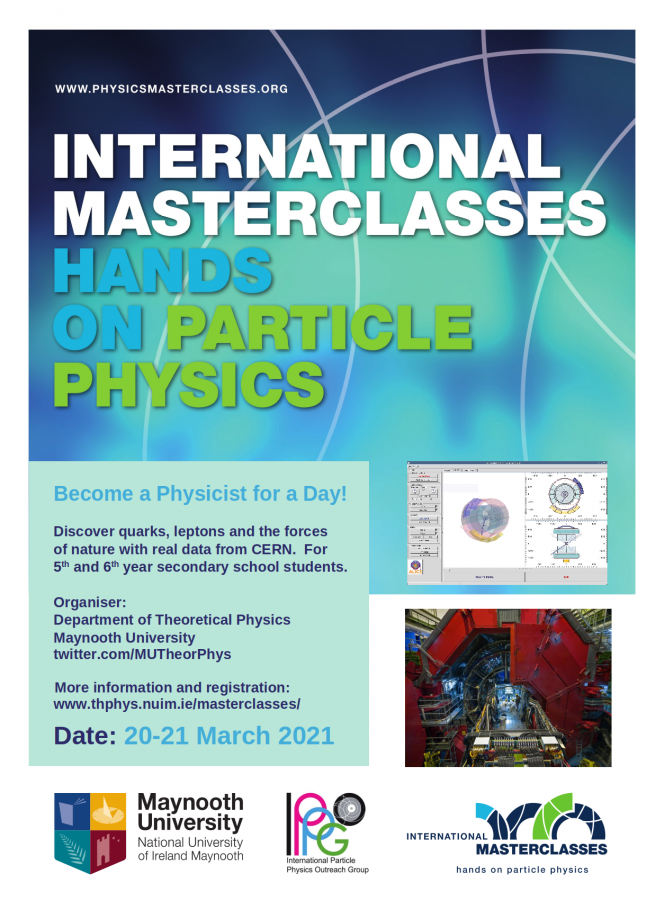
Now it’s time to announce the International Masterclass on Particle Physics. The  Department of Theoretical Physics has hosted such event for secondary school students each Spring, apart from last year when it was cancelled because of Covid-19.  The next event will take place online on 21 and 22 March 2021. You can find more information, including instructions on how to book a place, here.

These Masterclasses give secondary school students the opportunity to discover the world of quarks and leptons for themselves, by performing measurements on real data from CERN, meeting active particle physics researchers and linking up with like-minded students from other countries.  We will join thousands of other secondary school students at more than 100 universities and laboratories around Europe and worldwide in a programme stretching over four weeks.

Physics at the most fundamental level – the smallest and most basic building blocks of matter – is an exotic world.  But a few introductory talks and working with data from CERN will give the students insight into the fundamental particles of matter and the forces between them, as well as what went on during the Big Bang.

On Sunday afternoon, the students are introduced to particle physics, experiments and detectors in lectures given by active particle physics researchers.  On Monday, after a virtual visit to the ALICE detector at CERN, they work on their own with data from ALICE Afterwards they participate in a video conference with students from other countries and moderators at CERN, where they discuss and compare their results.

For more information on the Particle Physics Masterclasses, see the International Masterclasses web site.

I don’t know. You wait ages for a Masterclass in Physics at Maynooth University, and then along come two in quick succession!

The Open Journal of Astrophysics & INSPIRE

Posted in Open Access, The Universe and Stuff with tags , , , , on July 1, 2020 by telescoper

After a busy morning I’ve got time for an update or two about the Open Journal of Astrophysics.

As well as the NASA Astrophysics Data System (ADS) many papers in astrophysics are also indexed by INSPIRE HEP the analogous information management system for high energy physics. Here is the logo for the latter:

Being indexed in INSPIRE  is particularly relevant for authors of papers in astroparticle physics and cosmology, but papers in other areas of astrophysics are also listed on INSPIRE HEP. I am given to understand that, e.g., postdoc selection committees often look at INSPIRE for bibliometric information about applications so this is potentially important for early career researchers.

I am very grateful to staff at Inspire for ensuring that all our papers are now fully indexed in INSPIRE HEP as refereed articles with metadata fully consistent with NASA/ADS. The back catalogue having been dealt with manually we can now set up a feed to ensure that future papers are indexed automatically by NASA/ADS and Inspire HEP.

It is worth noting that because our papers are only published online we do not use the standard referencing style of volumes and pages. We have volumes: Volume 3 is 2020, Volume 2 is 2019, and everything before that is Volume 1. Each paper published in a given year is allocated an numerical id which is just an integer.

For an example of this style, see here.

The main thing for proper cross-referencing and citation is the Digital Object Identifier, which is displayed on the overlay for each paper.

The final thing I wanted to say is that I’m now reliably informed that the correct name to be use for the form of Open Access Publishing offered by the Open Journal of Astrophysics is not Green (which has come to mean author self-archiving of papers) but Diamond Open Access, which means that neither authors nor readers are charged.

R.I.P. Murray Gell-Mann (1929-2019)

Posted in The Universe and Stuff with tags , , , on May 25, 2019 by telescoper

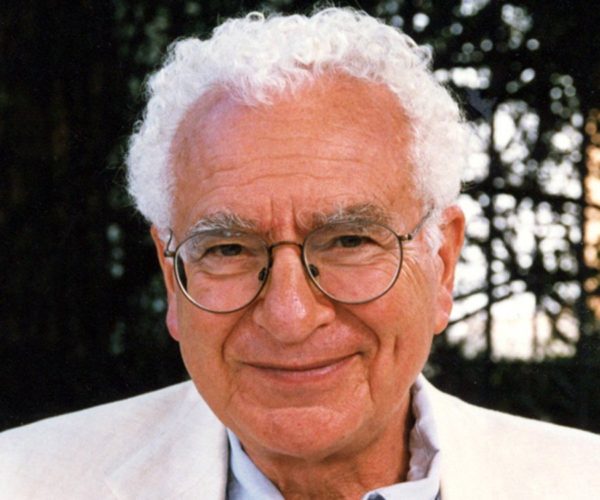
I heard this morning of the death of Murray Gell-Mann who passed away yesterday at the age of 89. Professor Gell-Mann was awarded the Nobel Prize for Physics in 1969 for his work on elementary particle physics, specifically for the development of the quark model. It was Gell-Mann who appropriated the phrase from James Joyce’s Finnegans Wake (‘Three quarks for Muster Mark’) from which the word `quark’ passed into the scientific lexicon.

There will be proper tributes from people who knew the man and his science far better than I do, so I’ll just say here that he was a man who made enormous contributions to physics and who will be greatly missed.

Rest in peace Murray Gell-Mann (1919-2019).

The Future Circular Collider: what’s the MacGuffin?

Posted in Science Politics, The Universe and Stuff with tags , , , , , , , on February 7, 2019 by telescoper

I’ve been reading a few items here and there about proposals for a Future Circular Collider, even larger than the Large Hadron Collider (and consequently even more expensive). No doubt particle physicists interested in accelerator experiments will be convinced this is the right move, but of course there are other projects competing for funds and it’s by no means certain that the FCC will actually happen.

One of the important things about `Big Science’ when it gets this big is that it has to capture the imagination of people with political influence if it is to be granted funding. Based on past experience that means that there has to be a Big Discovery to be made or a Big Idea to be tested. This Big Thing has to be simple enough for politicians to understand and exciting enough to capture their imagination (and that of the public). In the case of the Large Hadron Collider (LHC), for example, this was the Higgs Boson. In the case of the Euclid space mission, the motivation is Dark Energy.

The Big Thing that sells a project to politicians is not necessarily the thing that most scientists are interested in. The LHC has done a lot of things other than discover the Higgs, and Euclid will do many things other than probe Dark Energy, but there has to be one thing to set it all in motion. It seems to me that the Big Question about the FCC is whether there is something specific that can motivate this project in the way the Higgs did for the LHC? If so, what is it?

Answers on a postcard or, better, through the comments box below.


Humphrey Bogart with the eponymous Maltese Falcon

Anyway, these thoughts reminded me of the concept of a  MacGuffin. Unpick the plot of any thriller or suspense movie and the chances are that somewhere within it you will find lurking at least one MacGuffin. This might be a tangible thing, such the eponymous sculpture of a Falcon in the archetypal noir classic The Maltese Falcon or it may be rather nebulous, like the “top secret plans” in Hitchcock’s The Thirty Nine Steps. Its true character may be never fully revealed, such as in the case of the glowing contents of the briefcase in Pulp Fiction , which is a classic example of the “undisclosed object” type of MacGuffin, or it may be scarily obvious, like a doomsday machine or some other “Big Dumb Object” you might find in a science fiction thriller.

Or the MacGuffin may not be a real thing at all. It could be an event or an idea or even something that doesn’t actually exist in any sense, such the fictitious decoy character George Kaplan in North by Northwest. In fact North by North West is an example of a movie with more than one MacGuffin. Its convoluted plot involves espionage and the smuggling of what is only cursorily described as “government secrets”. These are the main MacGuffin; George Kaplan is a sort of sub-MacGuffin. But although this is behind the whole story, it is the emerging romance, accidental betrayal and frantic rescue involving the lead characters played by Cary Grant and Eve Marie Saint that really engages the characters and the audience as the film gathers pace. The MacGuffin is a trigger, but it soon fades into the background as other factors take over.

Whatever it is or is not, the MacGuffin is responsible for kick-starting the plot. It makes the characters embark upon the course of action they take as the tale begins to unfold. This plot device was particularly beloved by Alfred Hitchcock (who was responsible for introducing the word to the film industry). Hitchcock was however always at pains to ensure that the MacGuffin never played as an important a role in the mind of the audience as it did for the protagonists. As the plot twists and turns – as it usually does in such films – and its own momentum carries the story forward, the importance of the MacGuffin tends to fade, and by the end we have usually often forgotten all about it. Hitchcock’s movies rarely bother to explain their MacGuffin(s) in much detail and they often confuse the issue even further by mixing genuine MacGuffins with mere red herrings.

Here is the man himself explaining the concept at the beginning of this clip. (The rest of the interview is also enjoyable, convering such diverse topics as laxatives, ravens and nudity..)

There’s nothing particular new about the idea of a MacGuffin. I suppose the ultimate example is the Holy Grail in the tales of King Arthur and the Knights of the Round Table in which the Grail itself is basically a peg on which to hang a series of otherwise disconnected stories. It is barely mentioned once each individual story has started and, of course, is never found. That’s often how it goes with MacGuffins -even the Maltese Falcon turned out in the end to be a fake – they’re only really needed to start things off.

So let me rephrase the question I posed earlier on. In the case of the Future Circular Collider, what’s the MacGuffin?

R.I.P. James Stirling (1953-2018)

Posted in The Universe and Stuff with tags , , , on November 12, 2018 by telescoper

I’m sorry that this blog is once again the bearer of bad news, but it is my sad duty to pass on the news that distinguished particle physicist James Stirling (pictured above) passed away yesterday at the age of 65.

Professor James Stirling was one of the leading lights of the Institute for Particle Physics Phenomenology in Durham (of which he was the first Director) and subsequently became Jacksonian Professor of Natural Philosophy and Head of the Cavendish Laboratory at the University of Cambridge. More recently he was Provost of Imperial College, a post from which he stepped down earlier this year. He was elected to a Fellowship of the Royal Society in 1999, and awarded a CBE in the New Years Honours List in 2006.

As well as being an eminent physicist, with over 300 publications to his name including fundamental contributions to the field of hadronic interactions and perturbative QCD, Professor Stirling also gave great service to the research community, by serving on numerous important committees, including the Science Board of the Science & Technology Facilities Council (STFC).

Not being a particle physicist myself I didn’t know James as a close colleague, but I met him on several occasions during visits to Durham. Most recently, he was the external member of the appointment panel when I was interviewed for the post of Head of School of Mathematical and Physical Sciences at the University of Sussex. It says a lot for his personality that what I expected to be a fierce grilling when he led the questions on my research, turned out to he a friendly (yet challenging) discussion of some of my publications which he had clearly read extremely carefully.

James Stirling was held in extremely high regard by the scientific community and he’ll be greatly missed.I send my deepest condolences to his family, friends and colleagues.

R.I.P. Professor James Stirling (1953-2018)

Day and Night and CP Violation

Posted in Art, The Universe and Stuff with tags , , , on July 4, 2018 by telescoper

I’ve had these pictures for quite a while and can’t remember where I got them from, but I used them in my lectures on Theoretical Particle Physics when I was in Nottingham to illustrate CP-violation.

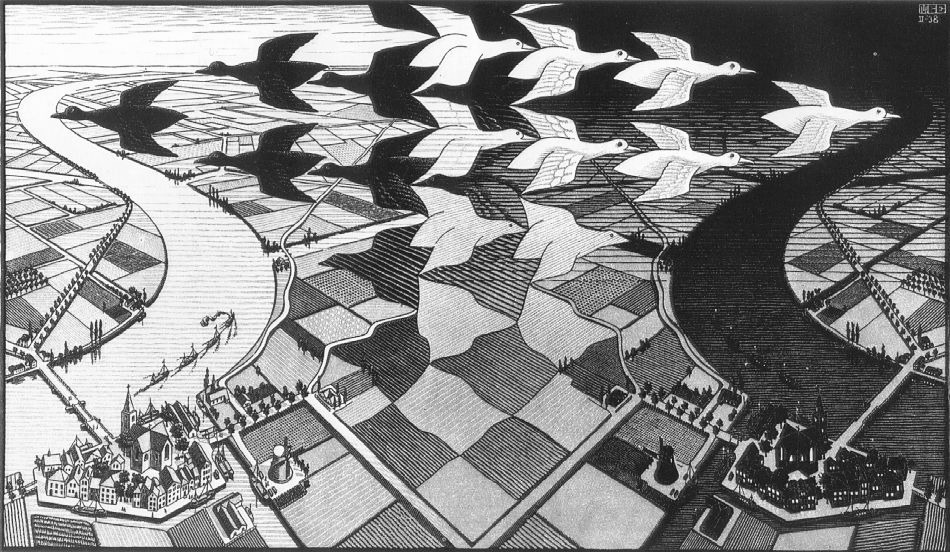
The following picture by M.C. Escher is called Day and Night:

If you look at it you can see two kinds of symmetry emerging. One is a kind of reflection symmetry about a vertical axis drawn through the centre of the picture that applies to shapes but not to colour. The other is between black and white. But it is obvious that the picture doesn’t display these symmetries separately: to get a picture unchanged from the original you would have to do the mirror reflection and change black to white (and vice-versa).

The mirror reflection in the image can be taken to represent parity (P). Strictly speaking parity refers to a reflection through the origin in 3D rather than a mirror reflection, but it’s just for illustration. We know that a parity symmetry is violated in weak interactions just as it is in the picture.

The other possible symmetry, between black and white can be taken to represent charge-conjugation (C), the operation that converts particles into anti-particles and vice-versa.

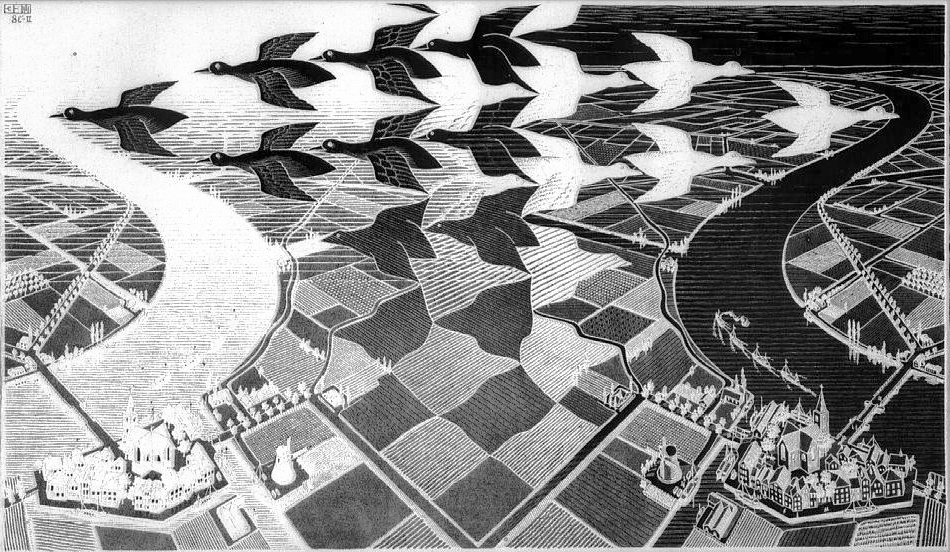
While P is not an exact symmetry of weak interactions, it was long thought that the combination of C and P (CP) would be. Actually it isn’t. The story of the discovery of CP-violation is fascinating but I don’t have time to go into it here. It suffices to say that the Escher print also displays CP violation.

First lets do `C’, i.e. convert black to white and vice-versa. The result is:

Now reflect about the vertical mid-line to illustrate `P’:

If `CP’ were an exact symmetry then that image would be identical to the original, which I reproduce here:

You can see, however, that while some elements of the picture do look the same after this combined operation (e.g. the birds), others (e.g. the buildings at the bottom) do not.


Public House Outreach

Posted in Education, The Universe and Stuff with tags , , , , on April 10, 2018 by telescoper

I’m told that there are pubs in which people don’t sit around discussing antimatter and time reversal by sketching Feynman diagrams on seasickness bags, but who would want to drink in one those?