Interesting comments about Bayes’ theorem and the prospects for detecting supersymmetry at the Large Hadron Collider. This piece explains how a non-detection isn’t always “absence of evidence” but can indeed by “evidence of absence”. It’s also worth reading the comments if you’re wondering whether what people say about Lubos Motl is actually true…
Here’s a puzzle. There are three cups upside down on a table. You friend tells you that a pea is hidden under one of them. Based on past experience you estimate that there is a 90% probability that this is true. You turn over two cups and don’t find the pea. What is the probability now that there is a pea underneath? You may want to think about this before reading on.
Naively you might think that two-thirds of the parameter space has been eliminated, so the probability has gone from 90% to 30%, but this is quite wrong. You can use Bayes Theorem to get the correct answer but let me give you a more intuitive frequentist answer. The situation can be models by imagining that there are thirty initial possibilities with equal probability. Nine of them have a pea under the first cup, nine more under the second and nine more under the third…
I just chanced upon the news that a new particle has been discovered at the Large Hadron Collider. This is probably old hat for people who work at CERN, but for those of us following along in their wake it definitely belongs to the category of things marked Quite Interesting.
The new particle is a baryon, which means that it consists of three quarks. These quarks are held together by the colour force (which I refuse to spell the American way); baryonic states exist by virtue of the colours of constituent quarks being a red-green-blue mixture that is colourless.
Quarks are fermions with spin 1/2. The new particle has spin 3/2 which contrasts with the most familiar baryons, the proton and the neutron, which also consist of three quarks but which have spin 1/2. The difference can be understood from basic quantum mechanics: spins have to be added like vectors, so the three individual quark spins can be added to produce total spin 3/2 or 1/2.
The most familiar spin 3/2 baryons are made from the lightest quarks (the up, down and strange) as shown in the diagram below:
The top row contains no strange quarks, only up and down. In fact the Δ0 and Δ+ contain exactly the same quark compositions as the proton and the neutron (udd and uud respectively), but differ in spin. The next row down contains one strange quark (e.g. uds) , the one below two (e.g uss), and the particle at the bottom is a very famous one called the Ω– which is entirely strange (sss). For reasons I’ve never really understood, a strange quark carries a strangeness quantum number S=-1 (why not +1?) and the electrical charge is labelled by q in the diagram.
There are six quark flavours altogether so one can construct further baryonic states by substituting various combinations of heavier quarks (c,b and t) in the basic configurations shown above. There are also excited states with greater orbital energy; all the particles shown above have quarks in the lowest state of orbital angular momentum (L=O). There is then a potential plethora of baryonic particles, but because all are unstable you need higher and higher energies to bring them into existence. Bring on the LHC.
The new particle is called the Ξb*, and it consists of a combination of up, strange and bottom quarks that required collision energies of 7 TeV to make it. The nomenclature reflects the fact that this chap looks a bit like the particles in the third row of the figure, but with one strange quark replaced by a much more massive bottom quark; this one has zero electrical charge because the charges on the u, s and b are +2/3, -1/3 and -1/3 respectively.
Anyway, here’s the graph that represents the detection of the new baryon on the block:
Only 21 events, mind you, but still pretty convincing. For technical details, see the arXiv preprint here.
Whether you really think of this as a new particle depends on how fundamental you think a particle should be. All six quark species have been experimentally detected and in a sense those are the real particles. Things like the Ξb* are merely combinations of these states. You probably wouldn’t say that an excited state of the hydrogen atom (say with the electron in the 2s energy level) is actually a different particle from the ground state so why do different permutations of the same quarks warrant distinct names?
The answer to this I guess is the fact that the mass of an excited hydrogen atom differs from the ground state by only a tiny amount; electronic energy levels correspond to electron-volt scales compared to the 1000 MeV or so that is the rest-mass energy of the nucleus. It’s all very different when you’re talking about energy levels of quarks in baryonic particles. In such situations the binding energies of the quarks are comparable to, or even larger than, their rest masses because the colour force is very strong and the quarks are whirling around inside baryons with correspondingly enormous energies. When two creatures have enormously different masses, it’s difficult to force yourself to think of them as different manifestations of the same beast!
Anyway, the naming of this particle isn’t really the important thing. A rose by any other name would smell as sweet. What matters is that existence of this new quark state provides another example of a test of our understanding of quark-quark interactions based on the theory of quantum chromodynamics. You might say that it passed with flying colours…
I started teaching Nuclear and Particle Physics to the 3rd year Physics students today. I decided to warm up with a few basics about elementary particles and their properties – all pretty standard stuff and no hairy mathematics. Cue pretty picture:
This doesn’t show the whole picture, of course, because for every particle there is an antiparticle, so there are antiquarks and antileptons. The existence of these was first suggested by Paul Dirac in 1928 based on his investigations into relativistic quantum theory, basically because invariance of special relativity is compatible with the existence of both positive and negative energy states, i.e.
has two sets of solutions, one with and the other with . Instead of simply assuming the latter set were physically unrealistic, Dirac postulated that they might be real, but completely filled in “empty” space; these filled negative-energy states are usually called the “Dirac Sea”. Injection of an appropriate amount of energy can promote something from a negative state into a positive one, leaving behind a kind of hole (very similar to what happens in the case of semiconductor). This process creates a pair consisting of a (positive energy) particle and a (negative energy) antiparticle (i.e. a hole in the Dirac Sea). In the case of electrons, the hole is called a positron.
The alternative, and even wackier, explanation of antimatter I usually mention in these lectures derives, I think, from Feynam who noted that in quantum (wave) mechanics the time evolution of particles involves things like
which have the property that changing into has the same effect as changing into . This is, in essence, the reason why, in Feynman diagrams, antiparticles are usually represented as particles travelling backwards in time…
This is a useful convention from the point-of-view of using such diagrams in calculations, but it allows one also to raise the wacky bar to a higher level still, to a suggestion that, coincidentally, was doing the rounds very recently – namely whether it is possible that there may really be only one electron in the entire Universe:
….I received a telephone call one day at the graduate college at Princeton from Professor Wheeler, in which he said, “Feynman, I know why all electrons have the same charge and the same mass” “Why?” “Because, they are all the same electron!” And, then he explained on the telephone, “suppose that the world lines which we were ordinarily considering before in time and space—instead of only going up in time were a tremendous knot, and then, when we cut through the knot, by the plane corresponding to a fixed time, we would see many, many world lines and that would represent many electrons, except for one thing. If in one section this is an ordinary electron world line, in the section in which it reversed itself and is coming back from the future we have the wrong sign to the proper time—to the proper four velocities—and that’s equivalent to changing the sign of the charge, and, therefore, that part of a path would act like a positron.”
In other words, a single electron can appear in many different places simultaneously if it is allowed to travel backwards and forwards in time…
I think this is a brilliant idea, especially if you like science fiction stories, but there’s a tiny problem with it in terms of science fact. In order for it to work there should be as many positrons in the Universe as there are electrons. Where are they?
Just time for a quick post this evening, primarily to make a note of an enjoyable event that took place this afternoon. I long since gave up keeping a proper journal so the old blog will have to play that role.
Today a small group of cosmologists from the School of Physics & Astronomy at Cardiff University made the short trip to Swansea to meet with members of the Physics department there. The idea of the meeting was to explore the possibilites of future research collaboration. For historical reasons there is a pretty strong separation in Wales between research in Particle Physics and Astronomy/Astrophysics; Swansea does the former and Cardiff does the latter. However, cosmology is an area in which there are possible overlaps between some of the – primarily theoretical – research going on at Swansea into, e.g., Quantum Gravity and what we do in Cardiff, e.g. inflationary cosmology.
Anyway we decided to get together for an afternoon of talks by members of both departments to see if anything emerged as potential research topics. In fact, a couple of interesting ideas were discussed and although the main focus of research differs substantially in the two institutions we’re definitely going to get together again to follow up these ideas.
Although I’ve been in Cardiff since 2007, I’d never visited Swansea University before which, considering that it’s only an hour away by train, is admittedly a bit pathetic. In fact I think it’s quite weird the two departments don’t collaborate more in other areas too. I’m certainly very keen to see more joint activities than we have now, so hopefully this is a move in that direction.
Anyway, I’d like to thank Graham Shore at Swansea for hosting us this afternoon and I very much look forward to the planned return leg which will be held in Cardiff in a couple of months.
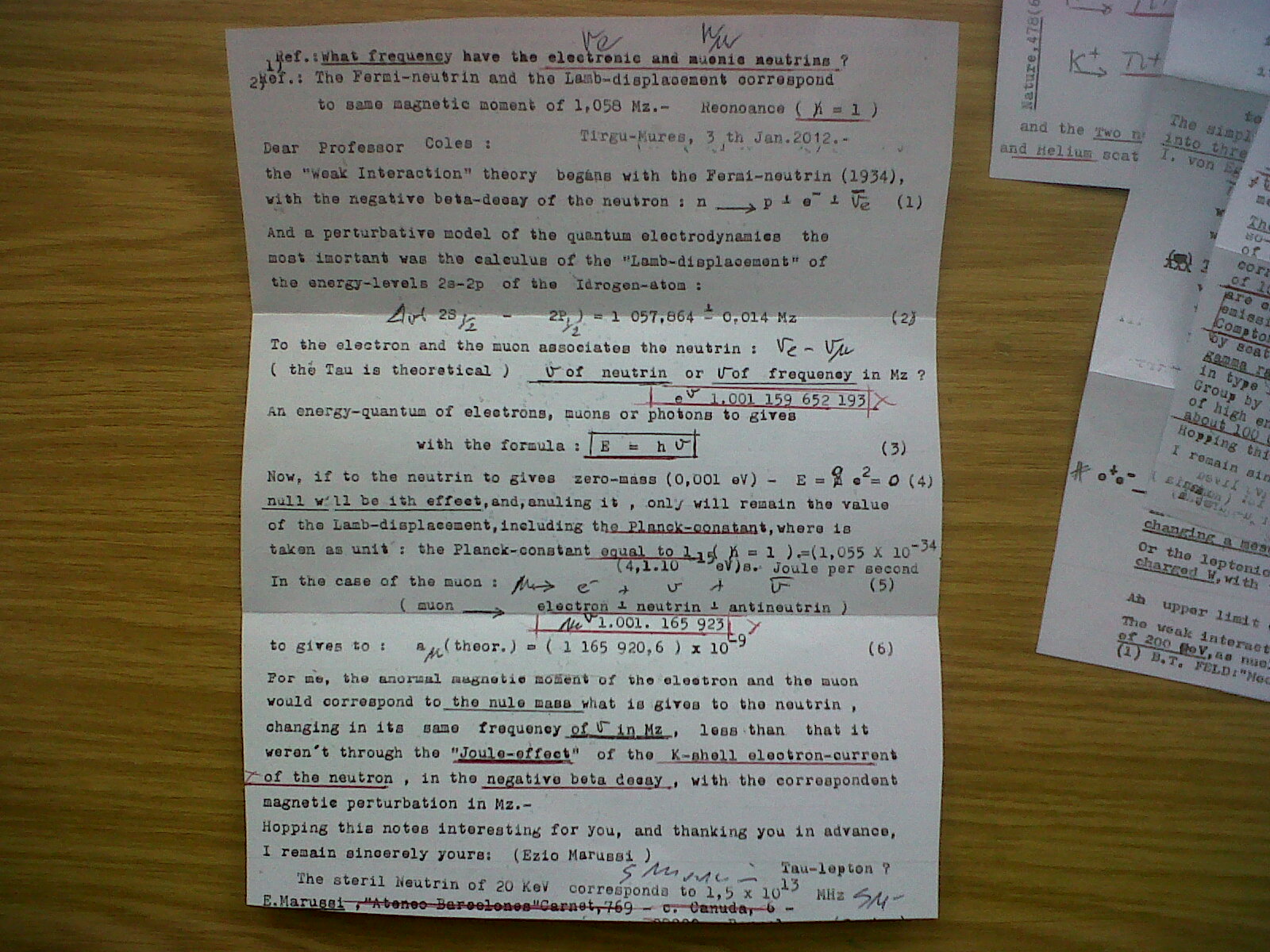
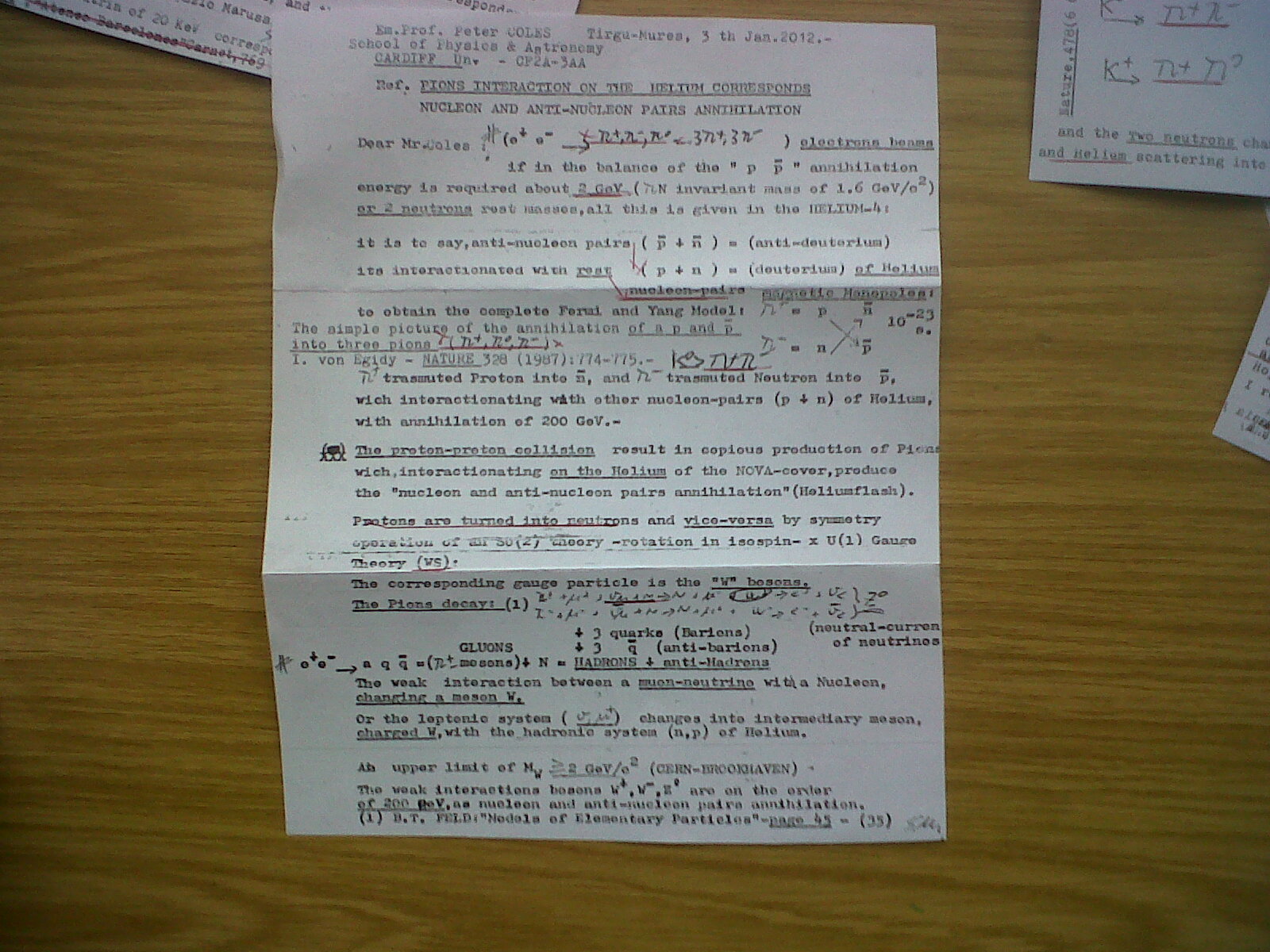
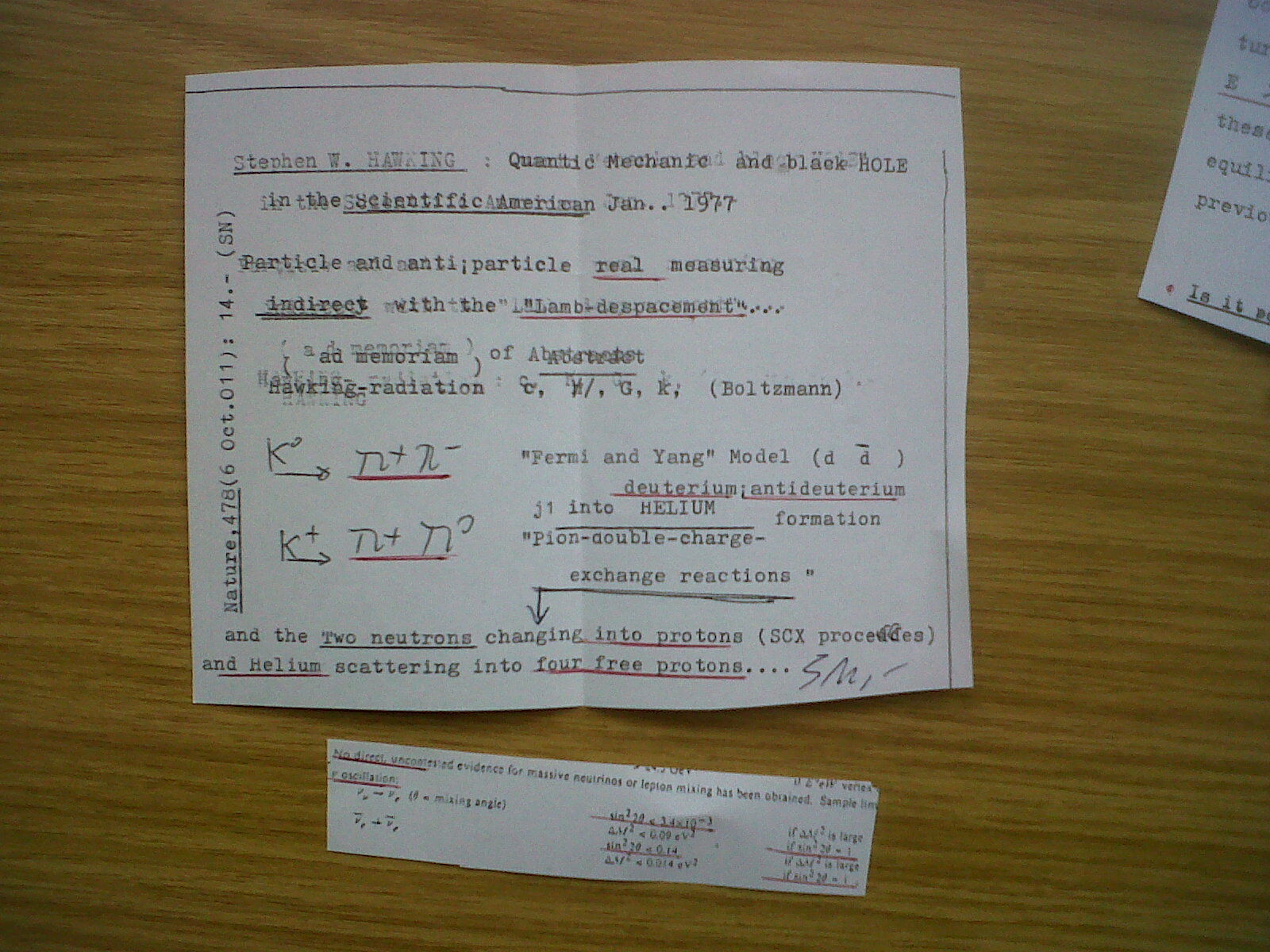
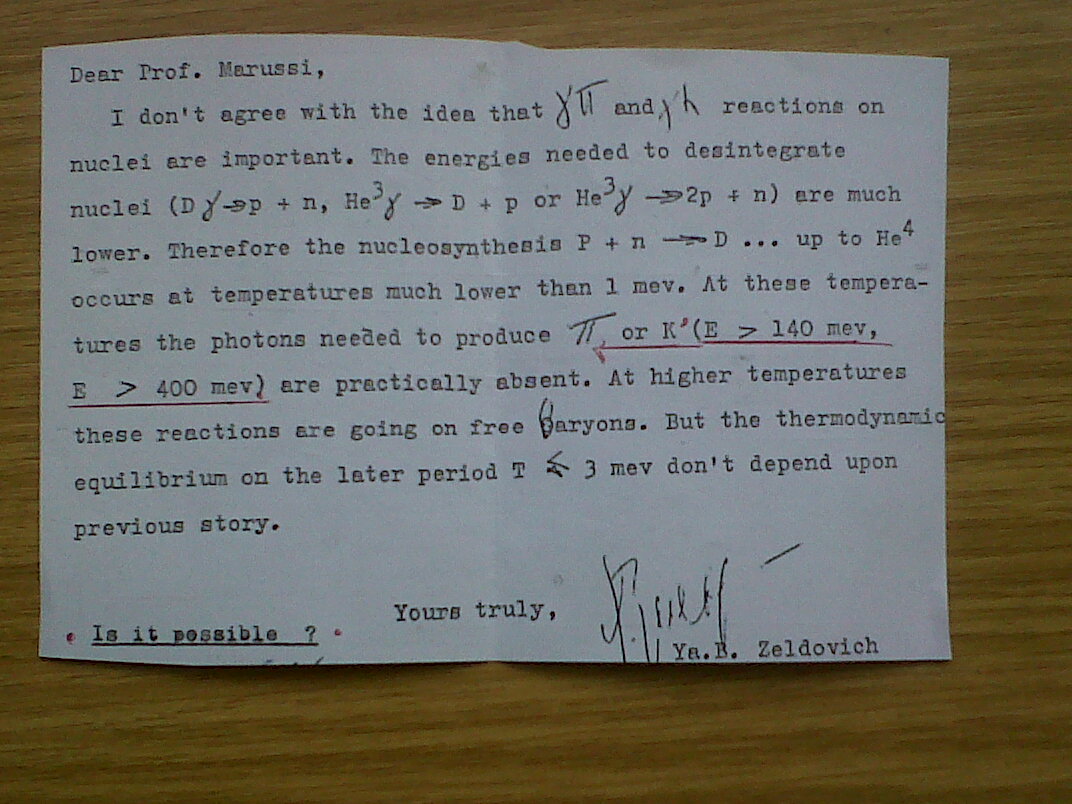
Among the delights (?) of being a scientist are those priceless pieces of unsolicited mail from members of the public. When I went to collect my mail this morning I found a prime example waiting in my pigeonhole. I knew what it was going to be like before I even opened it because the envelope was addressed (rather inaccurately) using an old-fashioned typewriter. Only a certain kind of person uses a typewriter these days.
I particularly enjoyed the “Emeritus Prof. ” bit. And Cardiff isn’t in “Engand”, by the way. Or even “England”.
Inside were six pieces of paper – all of different sizes – on which fascinating things had been typed and later highlighted with red and black pens in order to enhance both their scientific and artistic impact.
I’m in the middle of a load of project vivas today so haven’t had time to scan this masterpiece neatly, but it’s such a wonderful piece of correspondence that I couldn’t resist taking a few pictures of various elements for the edification of my vast readership. I think if you click on the images you might be able to read them more clearly but, if you do, I will not accept liability for the consequences.
Unfortunately I’m not sure whether I have them in the right order, as the logic that connects them together escapes me.
I have a large collection of similar missives but, despite some obvious deficiencie, such as a lack of drawings, this letter is one of the best and will now take pride of place in the bottom drawer of my filing cabinet. Perhaps one day I’ll write a book about them…
As the media frenzy abates after the latest experimental results from the Large Hadron Collider show tantalising but inconclusive evidence for the existence of the Higgs boson, it’s perhaps now time to focus on the hard facts surrounding this elusive particle. At yesterday’s Christmas lunch I stumbled upon one piece of information of which I was previously unaware and which is clearly of national importance. The eponymous creator of the Higgs particle, Professor Peter Higgs, was in fact born in the fine city of Newcastle upon Tyne, which really is in The North. This fact identifies him as a Geordie, although having just heard him on the radio I think there’s not much sign of it in his accent.
Anyway, in honour of this important discovery I respectfully submit that The Large Hadron Collider should be given a more appropriate name, i.e. The Geet Big Hadron Basher. And I’m sure God won’t mind if the Higg’s boson is henceforth known as the Geordie Particle.
I woke up this morning to the BBC Radio News at 7am announcing that scientists at CERN were going to report “hints” of the discovery of the Higgs Boson at the Large Hadron Collider; you can find a longer discussion by the BBC here. This was later accompanied by articles tackling the important questions of the day such as whether the discovery of the Higgs would justify the enormous expense of Brian Cox the LHC.
Prize for the most inaccurate science report goes to the Daily Fail:
‘God’ particle found:
Atom smasher reveals Higgs boson, the key to the universe
Evidence soon emerged however that this particular squib might be of the damp variety. Consistent with previous blogospheric pronouncements, a paper on the arXiv this morning suggested no convincing detection of the Higgs had actually been made by the ATLAS experiment.
I then had to make an important choice between watching the live webcast of the CERN seminar at which detailed information on the Higgs searches was to be presented or to accept a free lunch with the examiners of a PhD candidate. I chose the latter.
Catching up on events after lunch confirmed the underwhelming nature of the Higgs “detection”, but with some intriguing evidence an excess signal at around 126 GeV at the 2.3 sigma level, in the frequentist parlance favoured by particle physicists and others who don’t know how to do statistics properly. In the words of the late John Bahcall: “half of all three-sigma detections are false“. Of course if they used proper Bayesian language, scientists wouldn’t make so many nonsensical statements. Personally, I just don’t do sigmas.
My attention then switched to the CMS experiment. As a point of information you should be aware that CMS stands for Compact Muon Solenoid, where “compact” is a word used by particle physicists to mean “fucking enormous”. CMS makes pictures like this:
Anyway, it seems from the CMS part of the presentation that they find a bit of a peak at a similar mass ~ 125 GeV but spread out over a larger range, this time at a level of – sigh – 2.6 sigma.
All in all, it’s a definite maybe. Putting the results together in the way only a frequentist can the result is a 2.4 sigma detection. In other words, nothing any serious scientist would call convincing.
It’s interesting how certain these particle physicists are that the Higgs actually exists. It might, of course, and I think these results may be pointing the way to more convincing evidence based on more data. However, I still think we should bear in mind the words of Alfred North Whitehead:
There is no more common error than to assume that, because prolonged and accurate mathematical calculations have been made, the application of the result to some fact of nature is absolutely certain.
If there is a Higgs boson with a mass of 125 GeV then that would of course be an exciting discovery, but if there isn’t one at all wouldn’t that be even more exciting?
Final word from the Director of CERN:
We have not found it yet, we have not excluded it yet, stay tuned for next year.
Thunder and hail descended on Cardiff just as the webcast finished, which is clearly not a coincidence although I couldn’t say how many sigmas were involved.
And a final, final word from the Chief Executive of the Science & Technology Facilities Council, John Womersley:
There is still some way to go before the existence of the Higgs boson can be confirmed or not, but excitement is mounting. UK physicists and engineers have played a significant role in securing today’s results, and will continue to be at the forefront of exploring the new frontiers of knowledge opened by the results coming from the LHC. This is an incredibly exciting time to be involved in physics!
The internet, twitterdom, blogosphere, and even the mainstream media are all alive today with wild speculations about a curious claim that neutrinosmight travel faster than light.
If you’re interested in finding the source of this story, look at the arXiv paper here. I haven’t got time to go through the paper in detail, but I think it must be an instrumental artefact or some other sort of systematic error.
One major reason for doubting the veracity of the claim that neutrinos travel faster than light is provided by astronomical observations. Neutrinos produced by the explosion of Supernova SN1987a were detected when it went boom in 1987, approximately three hours before the visible light from SN 1987A reached the Earth.
The few hours delay between neutrinos and photons is explained by the fact that neutrino emission occurs when the core of the progenitor star collapses, whereas visible light is released only when a shock wave reaches the surface of the imploding object. Three different experiments detected (anti)neutrinos: Kamiokande II found 11 , IMB 8 and Baksan 5, in a burst lasting less than 13 seconds.
If the time delay reported by the OPERA detector over the distance between CERN and Gran Sasso were extrapolated to the distance between Earth and SN1987a then the neutrinos should have arrived not a few hours early, but a few years, and there would not have been coincident arrivals at the different detectors on Earth.
Do neutrinos go faster than light?
Some physicists think that they might.
In the cold light of day,
I am sorry to say,
The story is probably shite
UPDATE: Now that I’ve read the paper let me point out that the OPERA result is essentially
δv/c = (2.48 ± 0.28(stat) ± 0.30(syst)) × 10-5,
whereas the constraints from Supernova 1987a work out to be δv/c < 2 × 10⁻⁹ for neutrino energies of 10 MeV. See the comments below for discussion.
I’ll also mention at this point that the analysis done in the paper is entirely based on frequentist statistics. Somebody needs to do it properly.
I’m very pressed for time this week so I thought I’d cheat by resurrecting and updating an old post from way back when I had just started blogging, about three years ago. I thought of doing this because I just came across a Youtube clip of the late great Alfred Hitchcock, which you’ll now find in the post. I’ve also made a couple of minor editorial changes, but basically it’s a recycled piece and you should therefore read it for environmental reasons.
–0–
Unpick the plot of any thriller or suspense movie and the chances are that somewhere within it you will find lurking at least one MacGuffin. This might be a tangible thing, such the eponymous sculpture of a Falcon in the archetypal noir classic The Maltese Falcon or it may be rather nebulous, like the “top secret plans” in Hitchcock’s The Thirty Nine Steps. Its true character may be never fully revealed, such as in the case of the glowing contents of the briefcase in Pulp Fiction, which is a classic example of the “undisclosed object” type of MacGuffin. Or it may be scarily obvious, like a doomsday machine or some other “Big Dumb Object” you might find in a science fiction thriller. It may even not be a real thing at all. It could be an event or an idea or even something that doesn’t exist in any real sense at all, such the fictitious decoy character George Kaplan in North by Northwest.
Whatever it is or is not, the MacGuffin is responsible for kick-starting the plot. It makes the characters embark upon the course of action they take as the tale begins to unfold. This plot device was particularly beloved by Alfred Hitchcock (who was responsible for introducing the word to the film industry). Hitchcock was however always at pains to ensure that the MacGuffin never played as an important a role in the mind of the audience as it did for the protagonists. As the plot twists and turns – as it usually does in such films – and its own momentum carries the story forward, the importance of the MacGuffin tends to fade, and by the end we have often forgotten all about it. Hitchcock’s movies rarely bother to explain their MacGuffin(s) in much detail and they often confuse the issue even further by mixing genuine MacGuffins with mere red herrings.
Here is the man himself explaining the concept at the beginning of this clip. (The rest of the interview is also enjoyable, convering such diverse topics as laxatives, ravens and nudity..)
North by North West is a fine example of a multi-MacGuffin movie. The centre of its convoluted plot involves espionage and the smuggling of what is only cursorily described as “government secrets”. But although this is behind the whole story, it is the emerging romance, accidental betrayal and frantic rescue involving the lead characters played by Cary Grant and Eve Marie Saint that really engages the characters and the audience as the film gathers pace. The MacGuffin is a trigger, but it soon fades into the background as other factors take over.
There’s nothing particular new about the idea of a MacGuffin. I suppose the ultimate example is the Holy Grail in the tales of King Arthur and the Knights of the Round Table and, much more recently, the Da Vinci Code. The original Grail itself is basically a peg on which to hang a series of otherwise disconnected stories. It is barely mentioned once each individual story has started and, of course, is never found.
Physicists are fond of describing things as “The Holy Grail” of their subject, such as the Higgs Boson or gravitational waves. This always seemed to me to be an unfortunate description, as the Grail quest consumed a huge amount of resources in a predictably fruitless hunt for something whose significance could be seen to be dubious at the outset.The MacGuffin Effect nevertheless continues to reveal itself in science, although in different forms to those found in Hollywood.
The Large Hadron Collider (LHC), switched on to the accompaniment of great fanfares a few years ago, provides a nice example of how the MacGuffin actually works pretty much backwards in the world of Big Science. To the public, the LHC was built to detect the Higgs Boson, a hypothetical beastie introduced to account for the masses of other particles. If it exists the high-energy collisions engineered by LHC should reveal its presence. The Higgs Boson is thus the LHC’s own MacGuffin. Or at least it would be if it were really the reason why LHC has been built. In fact there are dozens of experiments at CERN and many of them have very different motivations from the quest for the Higgs, such as evidence for supersymmetry.
Particle physicists are not daft, however, and they have realised that the public and, perhaps more importantly, government funding agencies need to have a really big hook to hang such a big bag of money on. Hence the emergence of the Higgs as a sort of master MacGuffin, concocted specifically for public consumption, which is much more effective politically than the plethora of mini-MacGuffins which, to be honest, would be a fairer description of the real state of affairs.
Even this MacGuffin has its problems, though. The Higgs mechanism is notoriously difficult to explain to the public, so some have resorted to a less specific but more misleading version: “The Big Bang”. As I’ve already griped, the LHC will never generate energies anything like the Big Bang did, so I don’t have any time for the language of the “Big Bang Machine”, even as a MacGuffin.
While particle physicists might pretend to be doing cosmology, we astrophysicists have to contend with MacGuffins of our own. One of the most important discoveries we have made about the Universe in the last decade is that its expansion seems to be accelerating. Since gravity usually tugs on things and makes them slow down, the only explanation that we’ve thought of for this perverse situation is that there is something out there in empty space that pushes rather than pulls. This has various possible names, but Dark Energy is probably the most popular, adding an appropriately noirish edge to this particular MacGuffin. It has even taken over in prominence from its much older relative, Dark Matter, although that one is still very much around.
We have very little idea what Dark Energy is, where it comes from, or how it relates to other forms of energy we are more familiar with, so observational astronomers have jumped in with various grandiose strategies to find out more about it. This has spawned a booming industry in surveys of the distant Universe (such as the Dark Energy Survey) all aimed ostensibly at unravelling the mystery of the Dark Energy. It seems that to get any funding at all for cosmology these days you have to sprinkle the phrase “Dark Energy” liberally throughout your grant applications.
The old-fashioned “observational” way of doing astronomy – by looking at things hard enough until something exciting appears (which it does with surprising regularity) – has been replaced by a more “experimental” approach, more like that of the LHC. We can no longer do deep surveys of galaxies to find out what’s out there. We have to do it “to constrain models of Dark Energy”. This is just one example of the not necessarily positive influence that particle physics has had on astronomy in recent times and it has been criticised very forcefully by Simon White.
Whatever the motivation for doing these projects now, they will undoubtedly lead to new discoveries. But my own view is that there will never be a solution of the Dark Energy problem until it is understood much better at a conceptual level, and that will probably mean major revisions of our theories of both gravity and matter. I venture to speculate that in twenty years or so people will look back on the obsession with Dark Energy with some amusement, as our theoretical language will have moved on sufficiently to make it seem irrelevant.
But that’s how it goes with MacGuffins. Even the Maltese Falcon turned out to be a fake in the end.
My (probably ill-informed) earlier post about particle physics seems to have generated quite a lot of traffic, so I thought I’d reblog this short article (by a real particle physicist) for the benefit of those people who want to find out about the latest results from someone who actually knows what they’re talking about.
You would be forgiven for seeing the headlines from EPS-HEP 2011 and thinking the LHC is less interesting than maybe you were led to believe. A year or so ago you might have expected hints of supersymmetry, black holes, extra dimensions or even something more exotic to have been found in the ever increasing LHC datasets. But the current story is that the Standard Model is still describing all data analysed so far pretty damn well. There may or ma … Read More
The views presented here are personal and not necessarily those of my employer (or anyone else for that matter).
Feel free to comment on any of the posts on this blog but comments may be moderated; anonymous comments and any considered by me to be vexatious and/or abusive and/or defamatory will not be accepted. I do not necessarily endorse, support, sanction, encourage, verify or agree with the opinions or statements of any information or other content in the comments on this site and do not in any way guarantee their accuracy or reliability.


 and the other with
  . Instead of simply assuming the latter set were physically unrealistic, Dirac postulated that they might be real, but completely filled in “empty” space; these filled negative-energy states are usually called the “Dirac Sea”. Injection of an appropriate amount of energy can promote something from a negative state into a positive one, leaving behind a kind of
 into
into  has the same effect as changing
  into
into  . This is, in essence, the reason why, in

 As the

 In the Dark