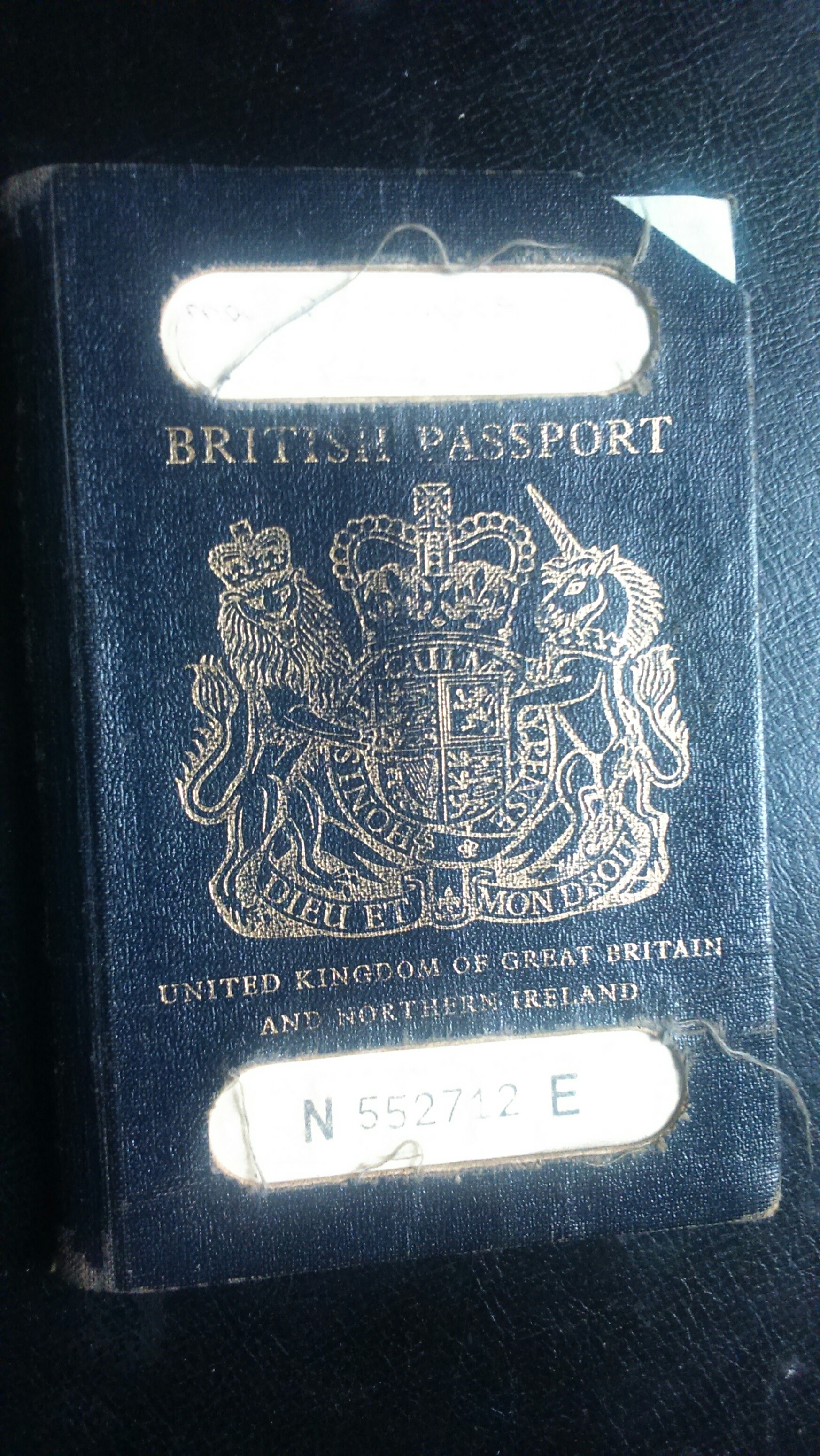
So, three weeks to the day since I completed the online formalities, I received delivery today, by courier, of my new UK passport. Fair play to the Passport Office for their extremely efficient service. The only thing I don’t have is my previous (expired) passport which I am assured will arrive under separate cover. It being less valuable than a new one, presumably it will be sent by a cheaper and slower method.
I thought I would compare the new one (right) with my oldest old one (left; the first passport I ever had, issued in 1986, with the corner now cut off to show it is defunct):
The new one is black (or perhaps a very dark blue) but the old one is more of a navy blue. The new one is a bit smaller. The size of the old one was not consistent with international ID standards and was changed in 1992, at which point the colour was changed to burgundy red. The 1986 vintage is not a biometric passport either. The biggest difference however is that the old one is a bit battered from extensive use but this is unlikely to happen to the new one. I’ve already put it away for safe keeping. I don’t think I’ll be using it much so it will probably remain in a pristine state until it expires (or I do).
UPDATE: 07/08/2026. Just two days after the new one arrived, I got the old one (minus corner).
I’ve been thinking for some time whether to renew my (expired) British passport, and finally decided to do so. No longer being resident in the UK I thought this would require a trip to the Embassy in Dublin, but that isn’t the case these days. One has to apply online, including supplying a digital photograph, send the old passport off by courier, then wait for the new one to arrive (by courier).
One problem with doing this is that the format of digital picture required for a British passport is not the same as for an Irish one, so most of the automatic machines (“Photo-Me”, etc) in Ireland are no use. I was able to take advantage of a recent trip to London, however, by using such a machine in Paddington station. I had plenty of time for that given the train delays. I got a few printed photos at the same time, in case I need them, but all you need for the passport is a photo code. The images are stored until used in the passport application.
And so it came to pass that today I completed the online application, paid the fees, and went to the local Post Office to send the old one to HM Passport Office. Now I have to wait and see how long it takes for my new passport to arrive. About a month, they say. We’ll see.
The new one will be dark-blue or black, like the very first one I ever had (left). That one was issued in 1986 and expired in 1996. I leave it as an exercise the reader to calculate how many I have had since then!
Whatever its design it will not allow me the right to live, work and retire freely within the European Union, so it will be of considerable less value than my Irish one.
I was for a time under the impression that having a British passport would make it easier should I ever want to enter the UK from somewhere other than Ireland, but I don’t think this is true. Unlike other EU citizens, according to the provisions of the Common Travel Area (CTA), Irish citizens do not require an ETA to enter the UK. They just need a valid Irish passport. Still, I think it will be useful to have a spare and I’m now used to having multiple identities!
I recently travelled to the UK and back by ferry. That journey being within the CTA a passport is not strictly required – other forms of photo-ID are acceptable – but I took mine anyway, as I don’t have a driver’s licence and we don’t have official government-issued ID cards in Ireland so I wasn’t sure whether they would accept any of the cards I have with my picture on it (e.g. my Maynooth staff card). As it happened the ID checks were very cursory. When I checked in at Dublin Ferry Port, the assitant there only wanted my ticket number and didn’t ask to see my ID at all. It was the same coming back from Holyhead. On arrival at Holyhead, there was a border post staffed by several officers, but they waved most passengers through (including me). On returning to Dublin the check was even more perfunctory: there was just one guy and he seemed more interested in welcoming everyone to Dublin than looking at any documents.
The CTA means that if you fly from Dublin to the UK you generally arrive at a place in the airport dedicated to such passengers. This is particularly convenient flying to Heathrow Terminal 2: on arrival you just walk through the Baggage Reclaim and out into the airport without passing any checks. You still need a passport, though, as airlines require this form of identification and it is scrutinized when you check in and when you board the plane. The only airport I know of that doesn’t have a simplified arrival system for CTA passengers is Dublin. They have no separate facilities, so you have to go through passport control with all the other passengers. That can be a bit inconvenient if lots of flights have arrived at the same time. I suppose the people who run Dublin Airport do not think it’s worth having a CTA arrivals facility.
The views presented here are personal and not necessarily those of my employer (or anyone else for that matter).
Feel free to comment on any of the posts on this blog but comments may be moderated; anonymous comments and any considered by me to be vexatious and/or abusive and/or defamatory will not be accepted. I do not necessarily endorse, support, sanction, encourage, verify or agree with the opinions or statements of any information or other content in the comments on this site and do not in any way guarantee their accuracy or reliability.