Archive for Planck

Planck (but only in name?)

Posted in Science Politics, The Universe and Stuff with tags , , , , , , on March 3, 2013 by telescoper

First, a serious announcement. It appears that the announcement of results from the Planck Mission will be streamed live from ESA HQ on 21st March from 10.00 to 12.00 CET (whatever that is). The UK will remain on GMT until 31st March so the  ESA web server will probably crash at 9am British time on 21st March.

There’s a short press release making this announcement here. It says:

On Thursday 21 March 2013, the main scientific findings from the European Space Agency’s Planck spacecraft will be announced at a press briefing to be held at ESA’s Headquarter in Paris. Simultaneously with this event, data products and scientific papers based on the “nominal” operations period will be made public through the Planck Legacy Archive.

I was interested in the appearance of the word “nominal” in quotes in there so I searched for its meaning in the One True Chambers Dictionary, where I found:

nominal, adj relating to or of the nature of a name or noun; of names; by name; only in name; so-called, but not in reality; inconsiderable, small, minor, in comparison with the real value, hardly more than a matter of form…

Interesting. It seems that the “nominal” could mean, on the one hand, that ESA are being unusually modest about the importance of the forthcoming Planck results or, on the other, that there will now be a host of conspiracy theorists suggesting that the Planck results aren’t real….

That reminds me that years and years ago I had an idea for a crime novel with a plot that revolves around the murder of a prominent cosmologist just as some important scientific discovery is about to be announced. Suspicion gathers that the whole thing is an enormous hoax and the discovery bogus. But the experiment is shrouded in secrecy, and so expensive that it can’t easily be repeated, so  who can tell, and how?

It’s very difficult to know for sure whether any scientific discoveries are genuine or not, even if the data and analysis procedures are made public. There’s always the possibility that everything might have been fabricated simulated, but in most cases the experiment can be repeated at a later date and the fraud eventually exposed, such as in the Schön Scandal.  In Big Science, this may not be practicable. However, Big Science requires big teams of people and the chances are someone would blow the whistle, or try to…

Anyway, I know that there are people out there who take everything I write on this blog absurdly literally so I’ll spell it out that I am in no way suggesting that the Planck mission is a fraud. Or predicting that there’ll be a murder just before the announcements on March 21st. Any similarity purely coincidental and all that. And I’ve never had time to write the book anyway – perhaps a publisher might read this and offer me an advance as an incentive?

Moreover, going back to the Chambers Dictionary, I note the final definition omitted above

…according to plan (space flight)

So that’s that. Nothing sinister. I’m not sure how “nominal” acquired that meaning, mind you, but that’s another story…

The End of Cosmology?

Posted in Biographical, The Universe and Stuff with tags , , on February 21, 2013 by telescoper

A very busy day interviewing candidates for a job in Experimental Particle Physics was made even busier by the arrival by the boxes containing all my books and other knick-knacks from Cardiff. Anyway, the net result of all this is that I only have time for a brief post before I go home and lapse into a coma. I can at least do something useful, however, which is to pass on the following announcement:

Presentation of the first cosmologic results of Planck mission as well as its first all-sky images of the Cosmic Microwave Background

Launched in 2009, Planck studies the Cosmic Microwave Background – the relic radiation from the Big Bang – to allow cosmologists to zero-in on theories that describe the Universe’s birth and evolution. The first all-sky images of the Cosmic Microwave Background will be presented at the press conference held in Paris ESA HQ on March 21st, 2013.

We’ve been expecting that the “cosmologic” results from Planck would be announced sometime early this year. Now we know when. March 21st 2013 is the date to put in your diary, and that’s only about a month from now. Exciting times.

Will Planck confirm the standard cosmological model and measure its parameters more precisely? Or will there be the first hints of physics outside the standard model? Will cosmology be all done and dusted, or will we find out that we didn’t understand the Universe as well as we originally thought?

I don’t know. Yet.

The Planck Rumour Mill

Posted in The Universe and Stuff with tags , , , , on December 28, 2012 by telescoper

I gather the internet is crawling with people searching for rumours about the Planck mission. It would obviously be entirely inappropriate for me to direct my readers to any website where they might obtain access to confidential information about this experiment, the results from which are embargoed until well into the New Year. So naturally that’s what I’m going to do. Well, blog traffic doesn’t generate itself does it?

As a Telescoper exclusive I am able to offer you a sneak preview of the top secret Planck data well in advance of official release. If you want to see what Planck scientists have been looking since Planck was launched in 2009, just click here.

Science and Politics

Posted in Politics, Science Politics with tags , , , , on December 22, 2012 by telescoper

It’s a dark dreary December day with a downright deluge descending outside to add to the alliteration.  Fortunately, it being almost Christmas, this weekend is offering a glut of crosswords with which I’ve been occupying myself while waiting for a break in the rain.

Among the puzzles I’ve done was a moderately challenging one in the New Statesman.  I have a subscription to the New Statesman, which means that I get it delivered in the post approximately two days after everyone else has had a chance to read it. After finishing the crossword, which contain a number of hidden (unclued) famous pseudonyms, I had a look at the rest of the magazine and discovered that this issue, the Christmas one, was edited by Brian Cox (who needs no introduction) and Robin Ince (who I believe is a comedian of some sort). It’s nice to see science featured so strongly in a political magazine, of course, but I did raise an eyebrow when I read this (about the LHC) in a piece written by Professor Cox:

The machine itself is 27 kilometres in circumference and is constructed from 9,300 superconducting electromagnets operating at -271.3°C. There is no known place in the universe that cold outside laboratories on earth…

Not so. The cryogenic systems on ESA’s Planck mission achieved a stable operating temperature at the 0.1 K level. This experiment has now reached the end of its lifetime and is warming up, but  the Herschel Space Observatory with a temperature of 1.4 K is still cooler than the Large Hadron Collider. Moreover, there are natural phenomena involving very low temperatures. The Boomerang Nebula has a measured temperature of −272.15°C, also lower than the LHC.  How does this system manage to cool itself down below the temperature of the cosmic microwave background, I hear you asking.  A detailed model is presented here; it’s “supercooled” because it is expanding so quickly compared to the rate at which it is absorbing CMB photons.

Anyway, if this all seems a bit pedantic then I suppose it is, but if prominent science advocates can’t be bothered to check their facts on things they claim to be authorities about, one wonders why the public show pay them any attention in the broader sphere. Fame and influence bring with them difficult responsibilities.

That brings me to another piece in the same issue, this one co-authored by Cox and Ince, about Science and Society entitled Politicians must not elevate mere opinion over science. I’d realised that there was a bit of a Twitter storm brewing about this item, but had to wait until the horse and cart arrived with my snail mail copy before I could try figure out what it was about. I still haven’t because although it’s not a particularly focussed piece it doesn’t seem to say anything all that controversial. In fact it just struck me that it seems to be a bit self-contradictory, on the one hand arguing that politicians should understand science better and on the other calling for a separation of science and politics.   There are two more detailed rejoinders here and here.

For my part I’ll just say that I think it is neither possible nor desirable to separate science from politics.  That’s because, whether we like it or not, we need them both. Science may help us understand the world around us, and (to a greater or lesser degree of reliability) predict its behaviour, but it does not make decisions for us. Cox and Ince argue that

Science is the framework within which we reach conclusions about the natural world. These conclusions are always preliminary, always open to revision, but they are the best we can do.

I’d put it differently, in terms of probabilities and evidence rather than “conclusions”, but I basically agree. The problem is that at some point we have to make decision which may not depend solely on the interpretation of evidence but on a host of other factors that science can say nothing about. Definite choices have to be made, even when the evidence is ambiguous. In other words we have to bring closure, much as we do when a jury delivers a verdict in a court of law, which is something that science on its own can rarely do. Mere opinion certainly counts in that context, and so it should. The point is that science is done by people, not machines. People decide what questions to ask, and what assumptions to proceed from. Choices of starting point are political (in the widest sense of the word) and sometimes what you get out of a scientific investigation  is little more than what you put in.

It’s always going to a problem in a democratic society that scientific knowledge is confined to a relatively small number of experts. We can do our best to educate as many as possible about what we do, but we’re always going to struggle to explain ourselves adequately. There will always be conspiracy theories and crackpots of various kinds. The way to proceed is not to retreat into a bunker and say “Trust me, I’m a scientist” but to be more open about the doubts and uncertainties and to present a more realistic picture of the strengths and limitations of science. That means to engage with public debate, not by preaching the gospel of science as if it held all the answers, but by acknowledging that science is a people thing and that as such it belongs in politics as much as politics belongs in it.

SPT and the CMB

Posted in The Universe and Stuff with tags , , , , , , , , , on November 30, 2012 by telescoper

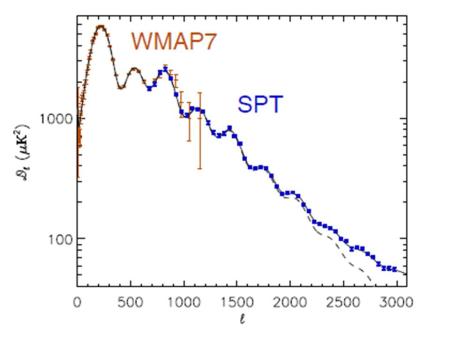
I’ve been remiss in not yet passing on news  from the South Pole Telescope, which has recently produced a number of breakthrough scientific results, including:  improved cosmological constraints from the SPT-SZ cluster survey (preprint here); a new catalogue of 224 SZ-selected cluster candidates from the first 720 square-degrees of the survey (preprint here); the first measurement of galaxy bias from the gravitational lensing of the CMB (preprint here); the first CMB-based constraint on the evolution of the ionized fraction during the epoch of reionization (preprint here); the most-significant detection of non-Gaussianity induced from the gravitational lensing of the CMB (preprint here); and the most precise measurement of the CMB damping tail and improved constraints on models of Inflation (preprint here).

Here’s the graph that drew my eye (from this paper). It shows the (angular) power spectrum of the cosmic microwave for very high (angular) frequency spherical harmonics; the resolution of SPT allows it to probe finer details of the spectrum that WMAP (also shown, at lower l).

Slide1

This is an amazing graph, especially for oldies like me who remember being so impressed by the emergence of the first “acoustic peak” at around l=200 way back in the days of Boomerang and Maxima and gobsmacked by WMAP’s revelation of the second and third. Now there are at least six acoustic peaks, although of progressively lower amplitude. The attenuation of the CMB fluctuations at high frequencies is the result of diffusion damping – similar to the way high-frequency sound waves are attenuated when they pass through a diffusive medium (e.g. a gas).  The phenomenon in this case is usually called Silk Damping, as it was first worked out back in the 1960s by Joe Damping Silk.

Anyway, there’ll be a lot more CMB news early (?) next year from Planck which will demonstrate yet again that cosmic microwave background physics has certainly come a long way from pigeon shit

The Long Weekend

Posted in Books, Talks and Reviews, The Universe and Stuff with tags , , , , , on April 5, 2012 by telescoper

It’s getting even warmer in Cape Town as we approach the Easter vacation. The few clouds to be found in the sky over the last couple of days have now disappeared and even the mountain behind the campus has lost its white fluffy hat:

It’s going to be a busy weekend in these parts over the forthcoming weekend. As in the UK, tomorrow (Good Friday) is a national holiday and there will be a 5K fun run around the campus. The temporary stands and marquees you can see in the picture are associated with that. On Saturday there’s a really big event finishing there too – the Two Oceans Marathon – which will finish on the University of Cape Town campus. At the moment it’s 30 degrees, but the forecast is to cool down a bit over the holiday weekend. Good news for the runners, but not I suspect for everyone who’s disappearing off for a weekend at the beach!

Anyway, I did my talk this morning which seemed to go down reasonably well. It was followed by a nice talk by Roberto Trotta from Imperial College in a morning that turned out to be devoted to statistical cosmology. I didn’t get the chance to coordinate with Roberto, but suspected he would focus on in the ins and outs of Bayesian methods (which turned out to be right), so I paved the way with a general talk about the enormous statistical challenges cosmology will face in the era after Planck. The main point I wanted to make – to an audience which mainly comprised theoretical folk  – was that we’ve really been lucky so far in that the nature of the concordance cosmology has enabled us to get away with using relatively simple statistical tools, i.e. the power spectrum.This is because the primordial fluctuations from which galaxies and large-scale structure grew are assumed to be the simplest possible statistical form, i.e. Gaussian.  Searching for physics beyond the standard model, e.g. searching for the  non-Gaussianities which might be key to understanding the physics of the very early stages of the evolution of the Universe,  will be more difficult  by an enormous factor and will require much more sophisticated tools than we’ve needed so far.

Anyway, that’s for the future. Cosmological results from Planck won’t be freely available until next year at the earliest, so I think I can still afford to take the long weekend off  without endangering the “Post-Planck Era” too much!

Planck Exclusive!

Posted in The Universe and Stuff with tags , , , , on January 25, 2012 by telescoper

I forgot to mention on this blog some important news about the Planck mission which many people here in the School of Physics & Astronomy at Cardiff University are heavily involved in.

Here is the official announcement from The Planck Science Team home page:

The High Frequency Instrument (HFI) on ESA’s Planck mission has completed its survey of the remnant light from the Big Bang. The sensor ran out of coolant on January 14 2012 as expected, ending its ability to detect this faint energy. Planck was launched in May 2009, and the minimum requirement for success was for the spacecraft to complete two whole surveys of the sky. In the end, Planck worked perfectly for 30 months, about twice the span originally required, and completed five full-sky surveys with both instruments. Able to work at slightly higher temperatures than HFI, the Low Frequency Instrument (LFI) will continue surveying the sky for a large part of 2012, providing even more data to improve the Planck final results.

For more details, see here. Basically, the HFI instrument consists of bolometers contained in a cryogenic system to keep them cool and thus suppress thermal noise in order to enable them to detect the very weak signals coming from the cosmic microwave background radiation. The helium required to maintain the low temperature is gradually lost as Planck operates, and has now run out. The HFI bolometers consequently warmed up, which makes them useless for cosmological work, so the instrument has been switched off. I’m sure you all understand how uncomfortable it is when your bolometers get too hot…

You can find a host of public information about Planck here but the scientific work is under strict embargo until early next year. However, as a Telescoper exclusive I am able to offer you a sneak preview of the top secret Planck data well in advance of official release. If you want to see what Planck scientists have been looking at for the last couple of years, just click here.

Planck Publications

Posted in Science Politics, The Universe and Stuff with tags , , , , on December 2, 2011 by telescoper

I just noticed that a Special Issue of Astronomy and Astrophysics which contains the early science papers from Planck has now finally appeared, swelling a considerable number of personal bibliographies just in time for the next round of grant and/or job applications!

The thing is, though, that these papers were all placed on the arXiv in January 2011, so it has taken almost 11 months for them to get officially published. Such a delay seems ridiculous to me in this digital age.  I wonder why it took A&A  so long to publish these papers? Were they all held up by refereeing delays? Are the final published versions significantly different from the arXiv version? I’ve only looked at a few, and can’t see any major changes.

Or maybe this is all normal for A&A?

If you know, please tell…

Of course the main science results from Planck won’t be out until 2013. I wonder how long they’ll take to referee?

Echo of Creation – the Trailer

Posted in Education, The Universe and Stuff with tags , , , on May 27, 2011 by telescoper

Each day I find myself pressed for time and unable to think of anything to post, something seems to come along to rescue me. I found this on Twitter this morning and couldn’t resist sharing it, partly because it’s a cute video in its own right, and partly because it gives me the chance to advertise the event that it trails. Here’s the film …

..and it advertises a forthcoming event at the Cheltenham Science Festival, featuring the excellent Andrew Pontzen who is based at the Institute of Astronomy in Cambridge. Andrew is not only a whizzkid cosmology theorist but also an excellent public speaker, so do go and see his lecture if you can. Here’s the blurb:

Billions of years after the birth of the Universe, scientists realised they could tune into an echo of creation itself using nothing more sophisticated than a de-tuned television set. Andrew Pontzen explains the cosmos’ ‘background noise’ with hula hoops, beach balls and amazing telescopic pictures. But hold onto your hats: all is not as it seems with space and time…

Sounds fascinating! The talk is on Saturday 11th June 2011, 10am at the Town Hall in Cheltenham. You can book tickets here.

Certain Scientists aren’t Good Scientists

Posted in Science Politics, The Universe and Stuff with tags , , , , , on January 30, 2011 by telescoper

Just time for a quickie today because tomorrow is the first day of teaching (in what we optimistically call the “Spring Semester”) and I’ve decided to head into the department this afternoon to prepare some handouts and concoct some appropriately fiendish examples for my first problem set.

I thought I’d take the opportunity to add a little postscript to some comments I made in a post earlier this week on the subject of misguided criticisms of science. Where I (sometimes) tend to agree with some such attacks is when they are aimed at scientists who have exaggerated levels of confidence in the certainty of their results. The point is that scientific results are always conditional, which is to say that they are of the form “IF we assume this theoretical framework and have accounted for all sources of error THEN we can say this”.

To give an example from my own field of cosmology we could say “IF we assume the general theory of relativity applies and the Universe is homogeneous and isotropic on large scales and we have dealt with all the instrumental uncertainties involved etc etc THEN 74% of the energy density in the Universe is in a form we don’t understand (i.e. dark energy).” We don’t know for sure that dark energy exists, although it’s a pretty solid inference, because it’s by no means certain that our assumptions – and there are a lot of them – are all correct.

Similar statements are made in the literature across the entire spectrum of science. We don’t deal with absolute truths, but always work within a given theoretical framework which we should always be aware might be wrong. Uncertainty also derives from measurement error and statistical noise. A scientist’s job is to deal with all these ifs buts and don’t-knows in as hard-nosed a way as possible.

The big problem is that, for a variety of reasons, many people out there don’t understand that this is the way science works. They think of science in terms of a collection of yes or no answers to well-posed questions, not the difficult and gradual process of gathering understanding from partial clues and (occasionally inspired) guesswork.

Why is this? There are several reasons. One is that our system of science education does not place sufficient emphasis on science-as-method as opposed to science-as-facts. Another is that the media don’t have time for scientists to explain the uncertainties. With only a two-minute slot on the news to explain cosmology to a viewer waiting for the football results all you can do is deliver a soundbite.
This is what I wrote in my book From Cosmos to Chaos:

Very few journalists or television producers know enough about science to report sensibly on the latest discoveries or controversies. As a result, important matters that the public needs to know about do not appear at all in the media, or if they do it is in such a garbled fashion that they do more harm than good. I have listened many times to radio interviews with scientists on the Today programme on BBC Radio 4. I even did such an interview once. It is a deeply frustrating experience. The scientist usually starts by explaining what the discovery is about in the way a scientist should, with careful statements of what is assumed, how the data is interpreted, and what other possible interpretations might be. The interviewer then loses patience and asks for a yes or no answer. The scientist tries to continue, but is badgered. Either the interview ends as a row, or the scientist ends up stating a grossly oversimplified version of the story.

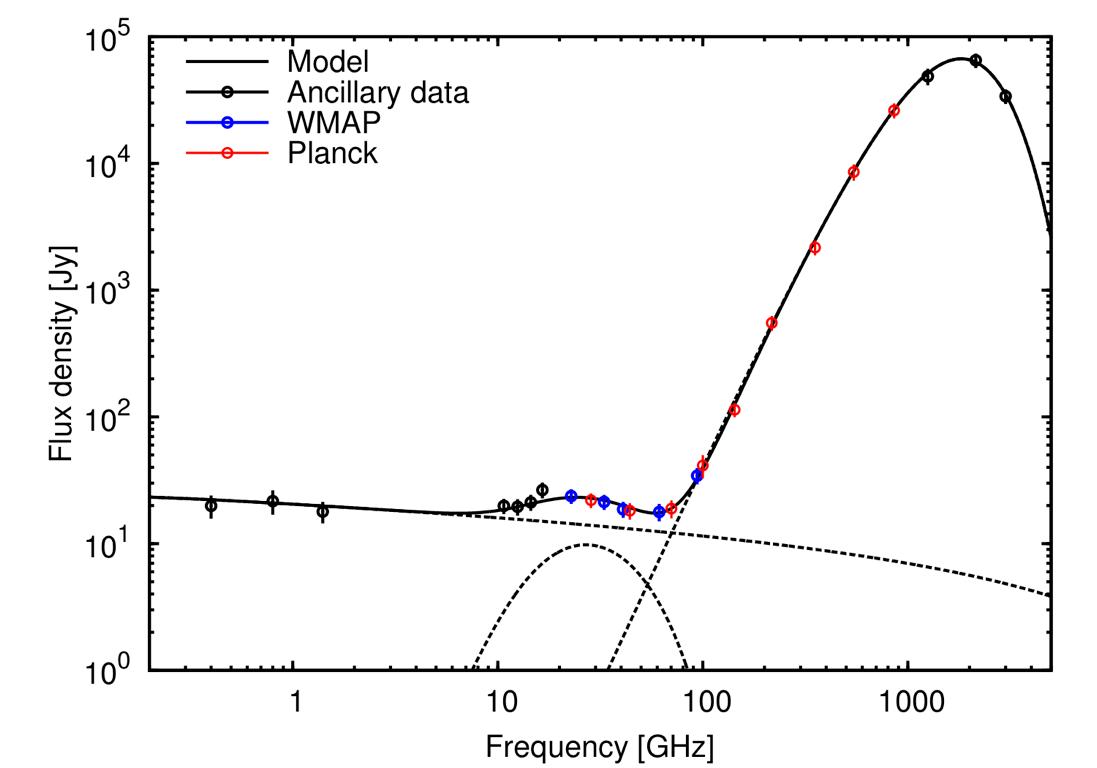
Here’s another, more recent, example. A couple of weeks ago, a clutch of early release papers from the Planck satellite came out; I blogged about them here. Among these results were some interesting new insights concerning the nature of the Anomalous Microwave Emission (AME) from the Milky Way; the subject of an excellent presentation by Clive Dickinson at the conference where the results were announced.

The title of a story in National Geographic is typical of the coverage this result received:

Fastest Spinning Dust Found; Solves Cosmic “Fog” Puzzle

Now look at the actual result. The little bump in the middle is the contribution from the anomalous emission, and the curve underneath it shows the corresponding “spinning dust” model:

There’s certainly evidence that supports this interpretation, but it’s clearly nowhere near the level of “proof”. In fact, in Clive’s talk he stated the result as follows:

Plausible physical models appear to fit the data

OK, so that would never do for a headline in a popular magazine, but I hope I’ve made my point. There’s a big difference between what this particular scientist said and what was presented through the media.

I hope you’re not thinking that I’m criticising this bit of work. Having read the papers I think it’s excellent science.

But it’s not just the fault of the educationalists and the media. Certain scientists play this dangerous game themselves. Some enjoy their 15 minutes – or, more likely, two minutes – of fame so much that they will happily give the journalists what they want regardless of the consequences. Worse still, even in the refereed scientific literature you can find examples of scientists clearly overstating the confidence that should be placed in their results. We’re all human, of course, but my point is that a proper statement of the caveats is at least as much a part of good science as theoretical calculation, clever instrument design or accurate observation and experiment.

We can complain all we like about non-scientists making ill-informed criticisms of science, but we need to do a much better job at being honest about what little we really know and resist the temptation to be too certain.


Share/Bookmark