It’s Saturday again, so it’s time for a summary of the week’s new papers at the Open Journal of Astrophysics. Since the last update we have published two new papers, which brings the number in Volume 8 (2025) up to 136, and the total so far published by OJAp up to 371.
The first paper to report this week is “The Moon as a possible source for Earth’s co-orbital bodies” by Rafael Sfair, L. C. Gomes, O. C. Winter & R. A. Moraes (São Paulo State University, Brazil), G. Borderes-Motta (Astronomical Institute of the Czech Academy of Sciences, Czech Republic) and C. M. Schäfer (Universität Tübingen, Germany). This paper was published on Monday 15th September, in the folder Earth and Planetary Astrophysics, and it presents a numerical exploration of the ejection velocities and launch locations necessary for lunar ejecta to evolve into Earth’s co-orbital bodies.
The overlay is here:
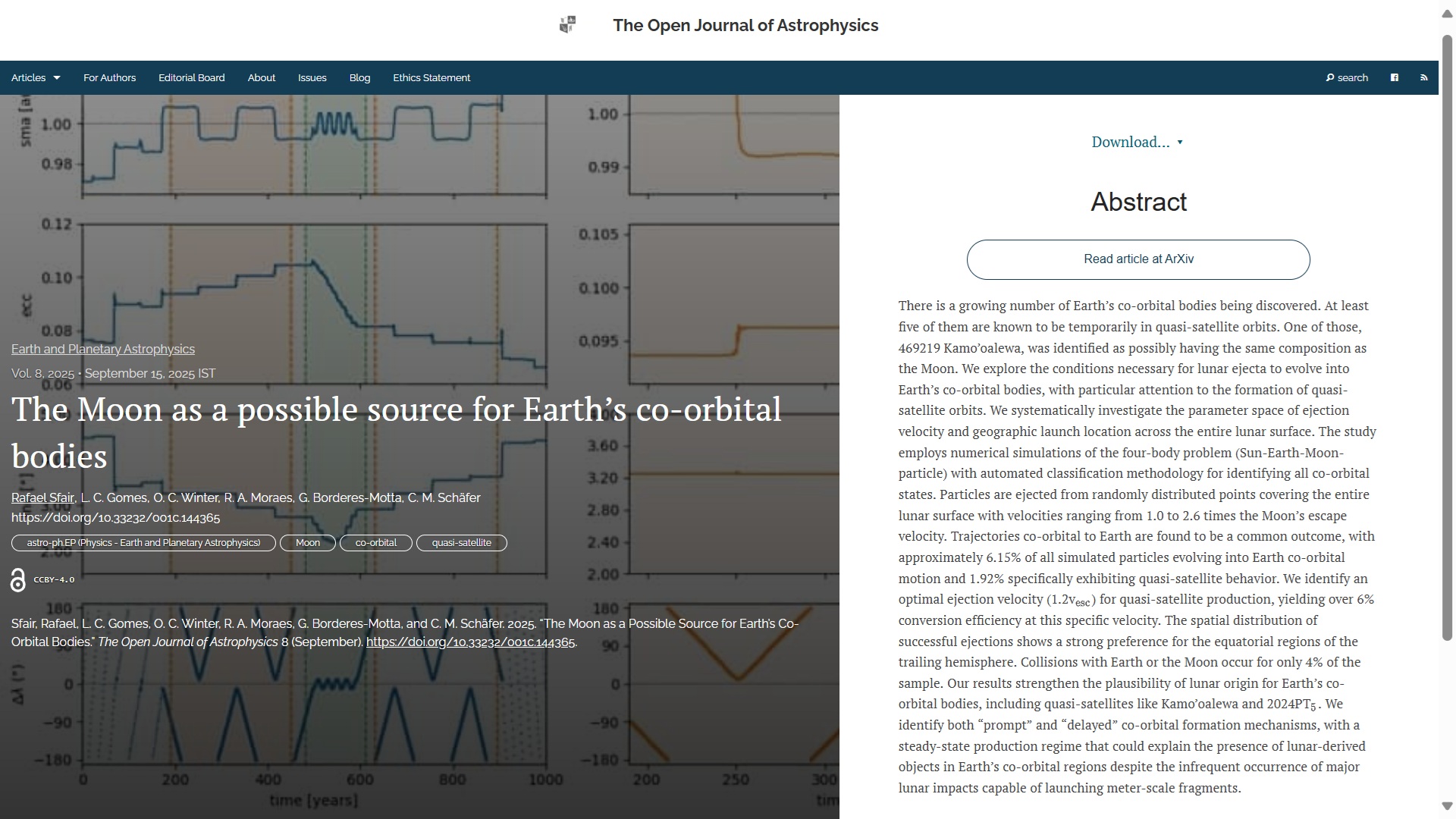
You can make this larger by clicking on it. The officially accepted version of this paper can be found on the arXiv here.
The second paper this week, published on Friday 19th September in the folder Solar and Stellar Astrophysics, is “Jet-Driven Formation of Bipolar Rings in Planetary Nebulae: Numerical Simulations Inspired by NGC 1514” by Muhammad Akashi, Ealeal Bear, and Noam Soker (Technion, Haifa, Israel). This paper presents evidence from numerical simulations notion that jets play a substantial role in shaping planetary nebulae (PNe).
The corresponding overlay is here:
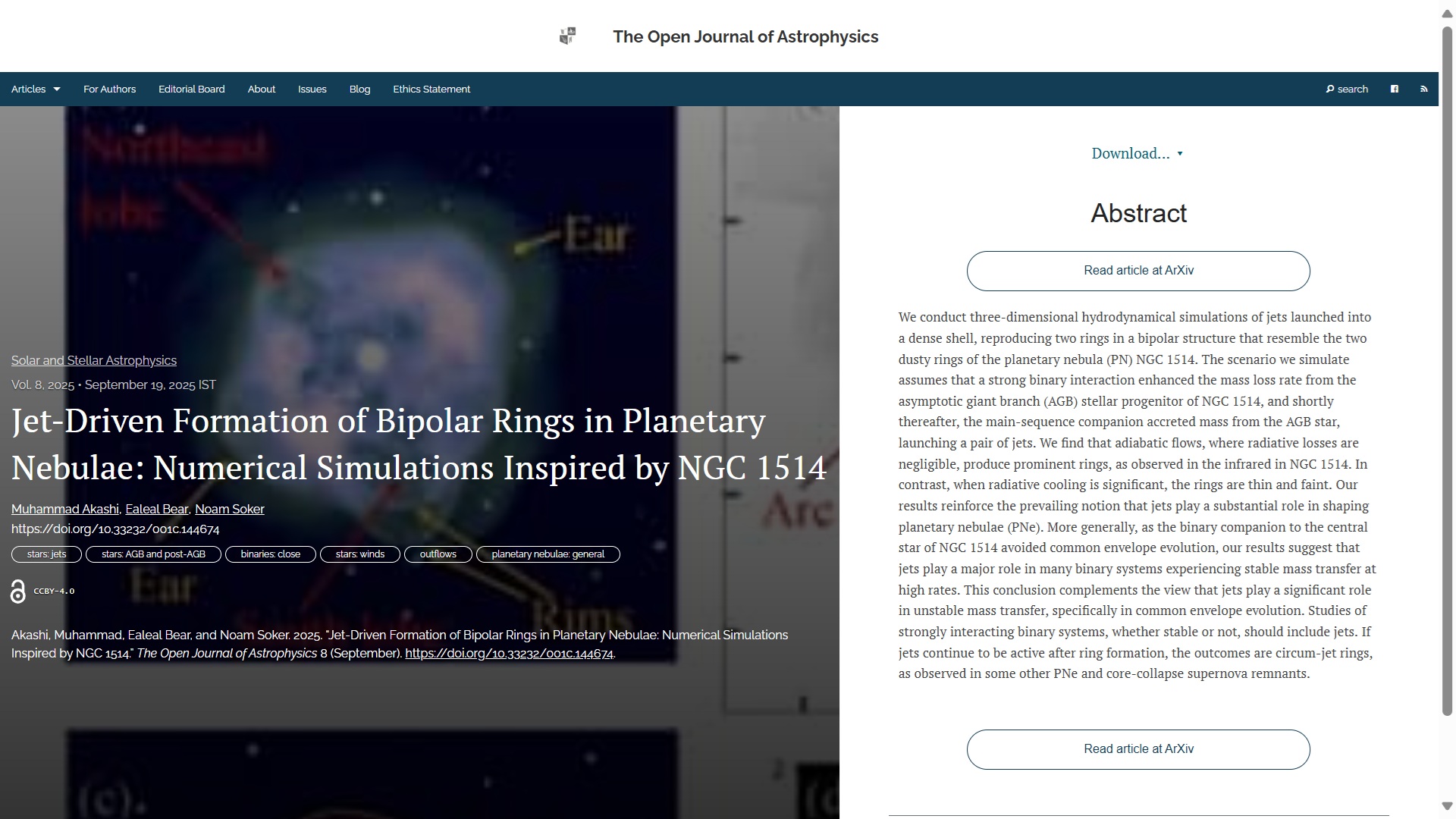
You can find the officially accepted version on arXiv here.



 In the Dark