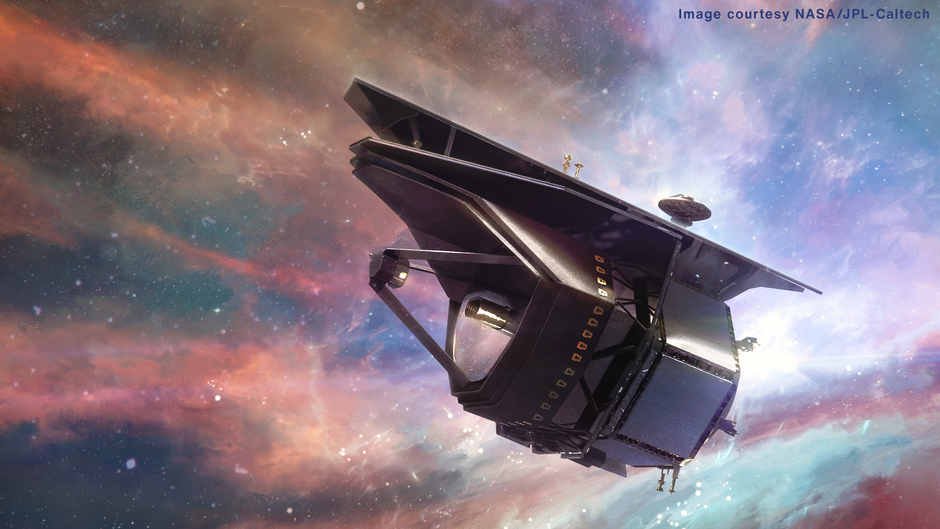
I’ve been remiss in not passing on significant news that involves former colleagues at Cardiff University and Sussex University, so I thought I would remedy that lapse today. A few weeks ago it was announced that NASA has selected a far-infrared space telescope called PRIMA as the first in a new series of missions to be launched around 2033. The mission now enters a Phase B study.
In a nutshell, PRIMA (PRobe far-Infrared Mission for Astrophysics) is a far-infrared observatory based around a 1.8-m diameter telescope, cryogenically-cooled (to 4.5 K). It includes both a sensitive wideband spectrometer FIRESS, and a multi-band spectrophotometric imager /polarimeter PRIMAger. PRIMA’s sensitivity unlocks the potential of the far-IR waveband to advance astrophysics across a broad range of topics spanning from galaxy and dust evolution in the early universe to the formation of planets and planetary atmospheres. FIRESS offers full-band instantaneous coverage from 24 to 235 μm in two modes. The low-res mode offers R~100 with long slits, while the high-resolution mode offers R up to 4,400 × (112 μm / λ) in smaller fields. PRIMAger offers rapid R=8 hyperspectral imaging with continuous coverage from 25 to 84 μm, and imaging polarimetry in 4 bands from 90 to 235 μm.
Although a NASA mission, several UK institutions are involved in PRIMA: Cardiff University, Imperial College London, the University of Sussex, and RAL Space. Cardiff University’s involvement is primarily (geddit?) in instrument development (see here) and former colleague at Sussex, Seb Oliver, will lead the UK’s overall contribution.
I wish everyone involved all the best for the planning, development and future operation of this mission. I will of course be long retired before it is launched!


