Archive for research

Global Talent Ireland

Posted in Maynooth, The Universe and Stuff with tags , , on July 18, 2025 by telescoper

The Government of Ireland has just announced details of a scheme called Global Talent Ireland. Full details of the scheme can be found here but, in a nutshell, the scheme aims to attract exceptional mid-career and established researchers from across the globe to Ireland. Researchers funded through this programme are required to transfer their research activities from their current location to any Eligible Research Body in Ireland. Given its commitment to equality, diversity and inclusion, Research Ireland welcomes applications from women and those from historically underserved communities.

The programme budget includes the resources to build a research team (e.g., staff, consumables and travel) to carry out high-impact, world-class research, and additional start-up costs to support the researcher’s move to Ireland. These positions are available for any area of research supported by Research Ireland.

The programme comprises two streams: Rising Stars and Research Leaders. High level details are outlined in the table below: 

The timescale for this is very short (as the window lies in the vacations for people likely to be recruited). In the case of Maynooth, which I assume is an Eligible Research Body, there is a first-stage internal process for Expressions of Interest to be completed by 29th July (i.e. less than two weeks away). There is then a selection for submissions to be forwarded to the Government by August 28th 2025.

As the timescale is so short I would ask anyone interested in taking up such a position in the Department of Physics at Maynooth University to contact me as soon as possible, as both the Head of Department and Dean of the Faculty of Science and Engineering are away at the moment. Ireland’s recent decision to join CERN as well as membership of the European Southern Observatory and the European Space Agency might be good strategic grounds for an application.

Those interested in other areas of research would be advised to contact the relevant Departments as soon as possible. The selection process is bound to be very competitive, but you can’t win the prize if you don’t buy a ticket!

The Hume Scholarship Scheme Returns…

Posted in Maynooth with tags , , , , on March 12, 2025 by telescoper

You may recall that I posted about the decision by the Management of Maynooth University to scrap the John and Pat Hume Doctoral Scholarships and followed this up with another post suggesting the decision might be reversed and another pointing out that it hadn’t been and then another at the start of this month (March) pointing out that the scheme was still “paused” for a “review” which was actually completed in January…

Well, all of a sudden there was an announcement yesterday from On High to the effect that the Hume Doctoral Scholarships are back. When I say “back”, it’s not really accurate as the scheme has changed. In the past it was entirely applicant driven: prospective students had to apply with their own project proposals (usually developed with the help of a prospective supervisor). The new scheme is quite the opposite: prospective supervisors have to submit Expressions of Interest (EoIs), outlining possible PhD projects which are then advertised. Students then have to apply.

You can find details of the new scheme here, where it says:

Established in honour of John Hume, an alumnus of Maynooth University, and in recognition of his important contribution to Ireland, the John & Pat Hume Doctoral Awards are offered across all disciplines at Maynooth University. 

No honour to Pat Hume, then.

The investigator-led approach is probably OK for science and engineering disciplines, but does not reflect how postgraduate research happens in the arts and humanities. There will be considerable resentment in some quarters about the way this change has been effected.

It is also worth mentioning that there are only 15 Hume Scholarships for the whole University; that’s just five per faculty. In the case of Science & Engineering that’s about 0.5 per Department. It will be a very competitive!

Having sat on this issue for the best part of two months, the deadline given to supervisors to submit EoIs is next Wednesday, 19th March. The EOI submission form went live today, giving just a week’s notice (Monday 17th is a national holiday and the rest of next week is a Study Break at Maynooth). The management of this whole issue has been very poor indeed, but at least we have some PhD opportunities to advertise. Prospective students can apply from March 20th until April 17th. It’s still too late, of course, as many students will already have accepted places elsewhere. I don’t know what’s been going on behind the scenes, but this is no way to run a University.

Term goes on…

Posted in Biographical, Education, Maynooth with tags , , , , , on March 2, 2025 by telescoper

Here we are, about to start the fifth week of the Spring semester at Maynooth University. Teaching isn’t going too badly, but I have come to realize that I have a lot of continuous assessment marking to do – classs tests and mini-projects for Computational Physics and assignments for Particle Physics. The numbers of students involved are 32 in the first case and 23 in the second, but I have to do all the corrections myself. Ho hum. Still, I’m enjoying teaching particle physics again after a gap of 15 years or so so I can’t complain about that.

Last week saw some important achievements by research students. Two students in the Department of Physics – one of them supervised by me – submitted their PhD theses last week. Nominations of examiners have to be approved by Faculty and Academic Council but that should be a formality and we then have the viva voce examinations, so the process is not over yet, but the submission of a thesis is a landmark in itself and is to be celebrated.

Something less worthy of celebration is the ongoing chaos at Maynooth over funding for future research students. You may recall that I posted about the terrible decision by the Management of Maynooth University to scrap the John and Pat Hume Doctoral Scholarships and followed this up with another post suggesting the decision might be reversed and another pointing out that it hadn’t been. The Hume scheme has been paused for a “review”. That review was actually completed in January. It is now March and academic staff have still had no word about the status of the Hume Scholarships. Someone is stalling.

I have received a number of enquiries in recent weeks from prospective students about when applications would open as I’m sure is also the case for several of my colleagues. It has been very depressing to have to reply saying that I have no idea. As far as I know the scheme is suspended indefinitely. It’s now effectively too late for this year anyway, as most prospective students will already have lined up offers elsewhere. Only students not able to secure a place elsewhere will be available to apply if and when the scheme does open.

The timing of this is especially sad for the new Department of Physics. Our final-year Theoretical Physics class sizes are larger than ever but the Maynooth is sending them a very clear signal that it doesn’t want any of them to stay here for their PhDs.

Open Access Week 2024: Community over Commercialization

Posted in Open Access with tags , , , , , on October 22, 2024 by telescoper

This week is Open Access Week 2024, the theme of which is Community over Commercialization. In light of this, among with some other journal editors I was contacted by Scholastica to provide some comments for their blog, Scholastica being the provider of the platform used by The Open Journal of Astrophysics. I was happy to respond to a couple of questions about how to build engaged communities.

Here are the comments of mine that they used in the blog post:

We started with a small editorial board basically formed from people who read various blog posts I’d written about the idea of the journal and followed its germination. We were lucky to have an initial group of high-profile scientists based all around the globe, including the USA. We started to get some papers from very well-known authors from leading institutes, and large international consortia. Some of these papers have generated large numbers of citations and have attracted coverage in the mainstream media, which also helped raise our profile.

Last year I was on sabbatical, which gave me the opportunity to travel and give invited talks about open access publishing in astrophysics at institutions in France, Spain, the UK, and Australia, and to audiences around the world via the Internet. Other members of the editorial board have also done their bit in promoting the journal. Our submission rate increased only slowly at first but is now more than doubling each year and we are currently receiving several submissions a day.  It has taken a while to establish the reputation of the Open Journal of Astrophysics this way, (i.e., mainly by word of mouth), but that has been good for us because it has enabled us to scale up our processes without becoming overwhelmed by a deluge.

My advice to others trying to set up a new journal would be to have a strong editorial board and clear policies, and above all to be patient. It takes a while — in our case more than 5 years — to establish a reputation in the academic community. These days there are too many people talking about this sort of publishing and not enough actually doing it. It’s time for researchers and research institutions to claim back the original purpose of academic publishing, the free dissemination of research for the public good.

You can read comments from three other editors of open access journals in the original Scholastica blog post.

The trouble with arXiv

Posted in Biographical, Open Access with tags , , , , on October 17, 2024 by telescoper

We’re now publishing papers at a steady rate at the Open Journal of Astrophysics. This is probably not obvious to outsiders, but our platform actually consists of two different sites, one handling submissions and the other dealing with publishing those papers accepted. Although we have a large (and still expanding) team of volunteer Editors to deal with the former, as Managing Editor I am the only person with the keys to the publishing side of things. This part of the process has been simplified enormously after the automation introduced earlier this year but it still takes some time to do, as I have to check the overlay and metadata before pressing the button to deposit everything with Crossref and make the overlay live. I also announce each paper on social media. This usually takes around 15 minutes per paper, give or take.

Now that I’ve returned to full teaching duties at Maynooth University, I’ve developed a routine to deal with this activity. During workdays I usually wake around 7am, make some coffee, and then check the day’s arXiv mailing to see if any of our accepted papers have been announced. If any have, I do the honours while I have my coffee, and then proceed to shower and breakfast (including Coffee no. 2); if none have, I go straight to shower and breakfast. I’ve been following this routine for quite a while now.

In the last couple of weeks, however, I have noticed quite often when I try to look up newly-announced papers on arXiv that the connection times out with a message saying ‘rate exceeded’. If that happens I just wait a while and try again. It’s not a very serious issue but it does slow down the process.

Well, today I found out the reason via a message on Mastodon. The loading errors at arXiv are caused by people doing many simultaneous downloads in attempts to scrape all the content from arXiv as soon as it is announced. This is almost certainly to provide material for Large Language Models, such as ChatGPT, which are essentially Automated Plagiarism Engines. I propose the acronym APE for the kind of person who engages in this sort of activity.

This is a very tedious development and I hope arXiv can find a way of putting a stop to it without inconveniencing its authentic users. I suggest that the people managing arXiv identify the culprits and send the boys round.

Failures of Scopus

Posted in Maynooth, Open Access with tags , , , , , on October 14, 2024 by telescoper

I think it’s time to provide an update on the continuing (lack of) progress getting The Open Journal of Astrophysics properly indexed in Scopus (which markets itself as a purveyor of “metrics you can trust”). You might recall back in June that I reported that OJAp had been included in the index, but unfortunately the Scopus team messed up very badly by omitting about one-third of our papers and most of our citations. I reported a month ago that Scopus had committed to fixing the issue within two weeks. Now almost FIVE WEEKS later they haven’t done a thing.

Here’s the problem:

In the column marked Documents 2020-23  you will see the number 67. In fact we published 99 articles between 2020 and 2023, not 67. This is easily established here. The number 67 relates to the period 2022-23 only. Accidentally or deliberately, Scopus has omitted a third of our papers from its database. But the error doesn’t end there. Papers published in OJAp between 2020 and 2023 have actually been cited 959 times, not 137. If you restrict the count to papers published in 2022-23 there are 526 citations. It’s no wonder that OJAp has such a low CiteScore, and consequently appears so far down the rankings, when the citation information is so woefully inaccurate.

“Metrics you can trust?” My arse!

If you want accurate bibliometric information about the papers published in the two years that Scopus has chosen to ignore you can look here.

This all merely demonstrates the folly that so many institutions place so much trust in Scopus. Unfortunately the powers that be have decided that Scopus listing is such a reliable indicator of quality that any article not published in a Scopus journal is worthless. Knowing that it has a monopoly, Scopus has no incentive to put any effort into its own quality assurance. It can peddle any error-ridden tripe to its subscribers, most of them paying for the product with taxpayers’ money. Unfortunately the bean-counters at Maynooth University are as credulous as any, mindlessly parroting spurious announcements based on the Scopus database.

Maynooth University is proud to offer undergraduates a course in Critical Skills. I suggest it that the gullible members of its management team would do well to take it.

Mental Health and Graduate Studies

Posted in Biographical, Mental Health with tags , , , , , , , , on October 3, 2024 by telescoper

There has been a lot of comment on social media about a recent article in Nature about the mental health of graduate students and the numbers looking for treatment. There are many sources of stress that can have a negative effect on mental health, including financial pressures and poor accommodation to name but two. These aren’t really specific to graduate studies. One that is is the pressure to produce results. That actually continues throughout an academic career – burnout is a very real phenomenon – but it’s probably worse during the “apprenticeship” phase when one is inexperienced and still learning the trade.

“Productivity” is indeed important but should not be interpreted as having to work ridiculously long hours. I remember many years ago commenting on an article that claimed 80-100 hours a week was not unusual. There are people who can sit at their desks for 12 hours a day without producing anything very much at all. It’s not the hours that matter, but what you do with them. In no way will indulging your outside interests (sporting, cultural, political, or “other”…),  or simply relaxing, detract from your ability to do research. As a matter of fact, I think such diversions actually improve your work, as well as (of course) your general well-being.

I think it is fair to say that you have to work hard to do a PhD. I worked hard on mine back in the day. But don’t think that means it has to be a grim slog. I can only speak for myself, but I greatly enjoyed my time as a graduate student. I think this was at least in part because when I was doing my PhD I had plenty of outside interests (including music, sport and (ahem) “nightlife”)  and took time out regularly to indulge them. I did experience mental health problems later during my PhD, but these were not caused by being a research student.

I can think of many times during my graduate studies when I was completely stuck on a problem – to the extent that it was seriously bothering me. On such occasions I learned to take a break. I often found that going for a walk, doing a crossword, or just trying to think about something else for a while, allowed me to return to the problem fresher and with new ideas. I think the brain gets into a rut if you try to make it work in one mode all the time.

There were indeed many times during my time as a research student – and have been since – that I worked extremely long hours – all night sometimes. I wouldn’t say exactly that was because I “enjoyed” it, but that I wanted to know an answer and couldn’t get the problem out of my head.  I’ve stayed up into the early hours of the morning trying to finish a crossword too. Not because I had to, but because I couldn’t put it down unfinished. I know that makes me a saddo in many minds, but I think that’s the sort of obsessiveness and tenacity a researcher needs: becoming so absorbed by the task in hand that you don’t notice the passage of time.

I don’t think anyone should try to infer too much from these personal reflections, but I do think there’s one important point that I try to point to every graduate student I advise and that is to look after your mental health. Perhaps the Nature article has a positive side, in that at least graduate students are seeking help. Recognizing that you might have a problem is a very important first step.

Academic Publishing is a Lucrative Scam

Posted in OJAp Papers, Open Access with tags , , , , , , , , on July 17, 2024 by telescoper

I saw an article in the Guardian yesterday with the title Academic journals are a lucrative scam – and we’re determined to change that. It’s written by Arash Abizadeh who is Professor of Political Science at McGill University in Canada. I urge you to read the piece if you’re interested in Open Access and the issues surrounding it.

I agree with virtually everything in the article. Indeed I’ve been saying much the same thing for about 15 years! I’m also determined to change things too, which is why we set up the Open Journal of Astrophysics, a “Diamond” Open Access Journal. Talking about the system of Gold Open Access, Prof. Abizadeh writes:

There is an obvious alternative: universities, libraries, and academic funding agencies can cut out the intermediary and directly fund journals themselves, at a far lower cost. This would remove commercial pressures from the editorial process, preserve editorial integrity and make research accessible to all. The term for this is “diamond” open access, which means the publishers charge neither authors, editors, nor readers (this is how our new journal will operate). Librarians have been urging this for years. So why haven’t academics already migrated to diamond journals?

I think the reason more academics haven’t already migrated to Diamond Open Access journals is that there are relatively few such journals. The reason for that is that although there are lots of people talking about Diamond Open Access there are many fewer actually taking steps to implement it. The initiative mentioned in the Guardian article is therefore very welcome. Although I think in the long run this transition is inevitable, it won’t happen by itself. It certainly won’t be helped by the Academic Publishing Industry either. We academics have to provide the push.

Here’s another excerpt:

Career advancement depends heavily on publishing in journals with established name recognition and prestige, and these journals are often owned by commercial publishers. Many academics – particularly early-career researchers trying to secure long-term employment in an extremely difficult job market – cannot afford to take a chance on new, untested journals on their own.

This is true, up to a point.

First of all any institution that has signed up to the San Francisco Declaration On Research Assessment (DORA) should not be relying on (often bogus) indicators of prestige such as the Journal Impact Factor or the journal’s presence in the Scopus index. If Diamond Open Access is to gain further traction it has to be accompanied to a wholesale change towards fairer research assessment practices.

Second, although it is true that it has taken some years to reach the volume it has now, I have been pleasantly surprised how many early career researchers in astrophysics have been keen to try out the Open Journal of Astrophysics. I think that’s because (a) early career researchers have not been indoctrinated into the absurdities of existing publishing practices and (b) they can see that the citation rates on OJAp are no worse than other allegedly more “prestigious” journals.

An All-Ireland Diamond Open Access Publishing Platform?

Posted in Maynooth, Open Access with tags , , , , , , on June 24, 2024 by telescoper

Here’s a report on an interesting development about Open Access in Ireland. The article belongs to the Special Issue 10th Anniversary Special Issue “PUBMET2023 Conference on Scholarly Communication in the Context of Open Science” and has the following abstract:

The Government of Ireland has set a target of achieving 100% open access to publicly funded scholarly publications by 2030. As a key element of achieving this objective, the PublishOA.ie project was established to evaluate the feasibility of establishing an all-island [Republic of Ireland and Northern Ireland] digital publishing platform for Diamond Open Access journals and monographs designed to advance best practice and meet the needs of authors, readers, publishers, and research funding organisations in Irish scholarly publishing. It should be noted in this context that there is substantial ‘north–south’ cooperation between public bodies in the Republic of Ireland and Northern Ireland in the United Kingdom, some of whom operate on what is commonly termed an ‘all-island’ basis. The project commenced in November 2022 and will run until November 2024, with the submission of a Final Report. This article originated as an interim project report presented in September 2023 at the PubMet2023 conference in Zadar, Croatia. The project is unique in its mandate to report on the feasibility of a shared platform that will encompass scholarly publishing across the two jurisdictions on the island of Ireland, which are now, post-Brexit, inside and outside the European Union (EU): the Republic of Ireland and Northern Ireland in the United Kingdom. The project is co-led by the Royal Irish Academy (RIA), Ireland’s leading body of experts in the Sciences and Humanities, and the Trinity Long Room Hub Arts & Humanities Research Institute of Trinity College Dublin. There are sixteen partners and affiliates from universities and organisations from the island of Ireland. The feasibility study will be based on a review of the publishing practices in the island of Ireland, with gap analysis on standards, technology, processes, copyright practices, and funding models for Diamond OA, benchmarking against other national platforms, and specifications of the requirements, leading to the delivery of a pilot national publishing platform. A set of demonstrator journals and monographs will be published using the platform, which will be actively trialled by the partner publishers and authors. PublishOA.ie aims to deliver an evidence-based understanding of Irish scholarly publishing and of the requirements of publishers to transition in whole or in part to Diamond OA. This paper provides an interim report on progress on the project as of September 2023, ten months after its commencement.

I think the idea of having a national Diamond Open Access publishing platform is a very interesting one. In principle it could facilitate the federated system of repositories linked by refereeing overlays which I think is the future of academic publishing. I think a national peer review platform would be more to the point than a publishing platform.

I have two comments:

  1. I am surprised that Maynooth University – publisher, among other things, of the Open Journal of Astrophysics (a Diamond Open Access journal) – is not among the partners in this project and does not even receive a mention as a publisher. I wonder how far this project will get if it excludes organizations that are already running Diamond Open Access Journals.
  2. Less of a comment, more of a question: why on Earth is the report published in a journal run by MDPI, a publisher that is controversial (to say the least)? It would be deeply ironic if they had to pay an APC to publish an article on Diamond Open Access!

Flying Visit(s)

Posted in Biographical, Education, The Universe and Stuff with tags , , , , , , , on June 2, 2024 by telescoper

So here I am, not in Barcelona. On Thursday night I flew to the fine city of Newcastle upon Tyne to act as external examiner for a PhD candidate. Since I knew I would be arriving quite late I stayed in a hotel near Newcastle Airport. It was just as well I did so because, it being Ryanair, I arrived even later than expected. On Friday morning I took the Metro from the Airport to Haymarket and spent the morning in the School of Mathematics, Statistics and Physics at Newcastle University ahead of the viva voce examination.

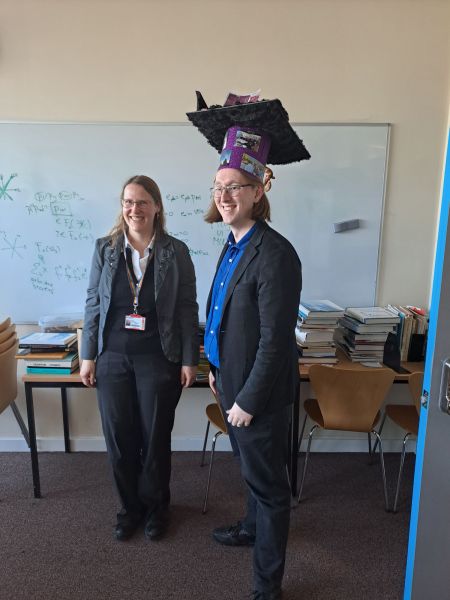
The PhD candidate was Alex Gough (pictured right, after the examination, with supervisor Cora Uhlemann). Cora being German we were treated to the tradition of successful PhD candidates having to wear a elaborate hat, after the examination (fortunately not during it). Some champagne was consumed, followed by dinner at a nice Indian restaurant on Clayton Street.

For those of you not familiar with how the PhD system works in the UK, it involves doing research into a particular topic and then writing up what you’ve done in a thesis. The thesis is a substantial piece of work, often in the region of 100,000 words (200 pages or so), which is then assessed by two examiners (one internal to the university at which the research was done, and one external). They read copies of the thesis and then the candidate has to defend it in an oral examination, which was what happened on Friday, after which they make a recommendation to the university about whether the degree should be awarded.

There aren’t many rules for how a viva voce examination should be conducted or how long it should last, but the can be as short as, say, 2 hours and can be as long as 5 hours or more. The examiners usually ask a mixture of questions, some about the details of the work presented and some about the general background. The unpredictable content of a viva voce examination makes it very difficult to prepare for, and it can be difficult and stressful for the candidate (as well as just tiring, as it can drag on for a long time). However, call me old-fashioned but I think if you’re going to get to call youself Doctor of Philosophy you should expect to have to work for it. Some might disagree.

Obviously I can’t give details of what went on in the examination except that it was quite long primarily because the thesis was very interesting and gave us lots to discuss. At the end internal examiner Danielle Leonard and I agreed to recommend the award of a PhD. In Newcastle as in other UK universities, the examiners simply make a recommendation to a higher authority (e.g. Board of Graduate Studies) to formally award the degree, but they almost always endorse the recommendation. I’ve never been sure exactly when a successful candidate is allowed to call themselves “Doctor”, actually, but congratulations to Dr Gough!

Anyway, the celebratory dinner ended just after Women’s International football match between England and France (which France won) had finished at St James’ Park and the Metro was consequently crammed full, but I got back to the hotel at a reasonable hour. Thank you to everyone in the group, especially Cora and Ian Moss, for being so friendly and making me feel so welcome during this brief visit.

Tomorrow I shall be heading to the part of not-Barcelona known as Oxford, where I believe there is a University of some sort, to give a lecture about which I’ll post more tomorrow.