I had a very busy day yesterday culminating in the Space Week event I blogged about a few weeks ago. There was a good attendance – lots of young kids as well as adults – and the lecture room was very full. We could probably have filled a much bigger room, actually, but had been moved to a smaller venue and had to close registrations very early to avoid having too many people. I’d guess we had about 350. My talk was the last one, and didn’t finish until 8.30 by which time I was definitely ready for a pint.
You can find the slides I used for my presentation, The Universe according to Euclid, here.
There was an official photographer there who took quite a few pictures but I haven’t seen any of them yet. I’ll post a selection if and when I get them.
A couple of week ago I posted about the event we are putting on at Maynooth University to mark Space Week in Ireland, which is is from October 4th – 10th this year. The event at Maynooth is on Wednesday October 9th, i.e. a week tomorrow. I’ll be doing a talk, the description of which reads:
Two of the greatest mysteries in modern science concern the nature of the dark matter and dark energy we think dominate the Universe. In this talk I will explain how the European Space Agency’s Euclid mission, launched last year, is designed to shed light on the “dark side” of the cosmos, present some of the early results, and show how you can get involved in analyzing Euclid data.
Anyway, I did think today would provide a good excuse to boost the bookings, but I’m afraid the venue is already full so I needn’t have bothered.
The annual Space Week in Ireland is from October 4th – 10th this year. As we have done for the previous couple of years, we will be putting on an event at Maynooth University. When I say “we”, I mean the Department of Physics collectively – I was away in Barcelona at the time of last year’s event so couldn’t give a talk, but I did one the year before. I’ll be doing a talk this year too. The description of my talk reads:
Two of the greatest mysteries in modern science concern the nature of the dark matter and dark energy we think dominate the Universe. In this talk I will explain how the European Space Agency’s Euclid mission, launched last year, is designed to shed light on the “dark side” of the cosmos, present some of the early results, and show how you can get involved in analyzing Euclid data.
Anyway, this year’s event will be on Wednesday 9th October. The event is open is open to all and will be held in the picturesque surroundings of the TSI building. Tickets are free but must be reserved in advance. You can do that here. The event has sold out for both the last two years – with over 400 attendees – so it’s best to book early!
Being away on sabbatical I almost forgot to post a reminder of the event I blogged about a few weeks ago at Maynooth University entitled Exploring the Cosmos. I’m told this has attracted a huge amount of interest, but the room for the event is very large and there may well be some space left.
Best wishes to everyone taking part and I hope it goes well!
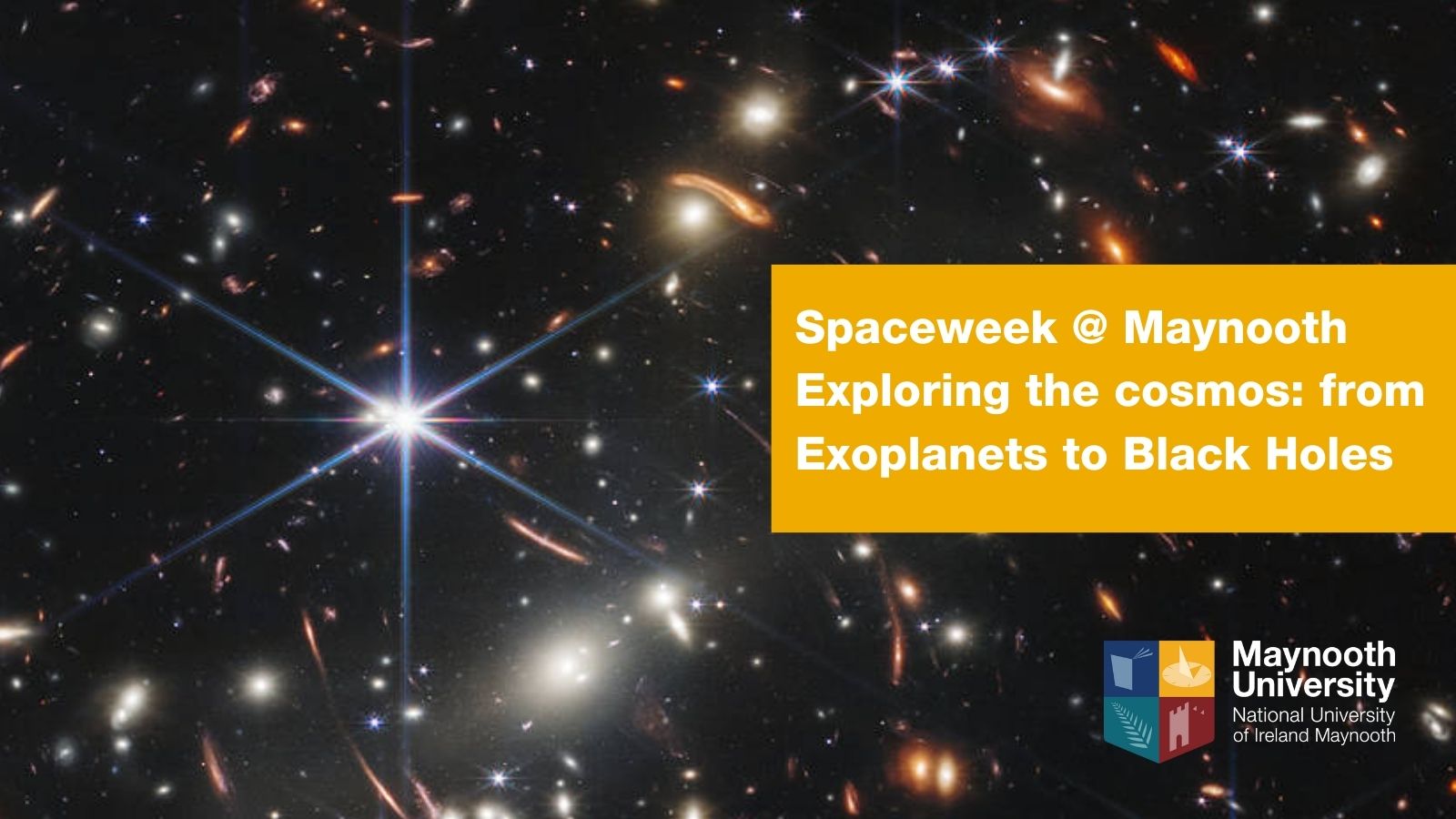
On the 5th of October, at 6.30pm, in the TSI Building Maynooth University will host an all-ages event to explore the vastness of space. Using stunning visualisations Maynooth University Astrophysicists will examine star and planet formation, peer back in time with our physicists trying to image the very edges of our visible universe, and take a journey into the unknown as we trace the origin and evolution of black holes.
Programme:
18.30 Welcome
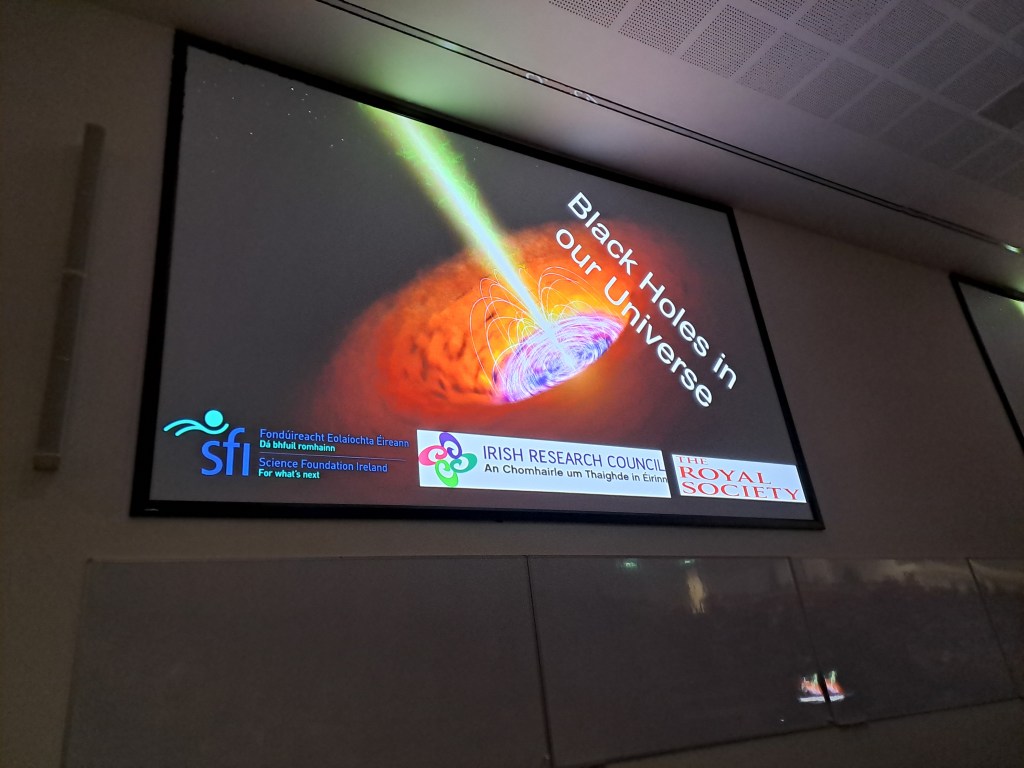
18.35: John Regan: “Black Holes in Our Universe”
Black Holes are among the most exotic objects in our Universe. In this talk John will discuss the basics of black hole formation, how we can detect them today and the future of black hole hunting using gravitational wave observatories that Maynooth University is a part of. John will also discuss some of the strange effects you might encounter near a black hole – like time slowing down!
18.55: Aoibhinn Gallagher: “The Dark Universe”
There is so much in our universe which is unknown to us, most of it in fact. What is dark matter, what is dark energy? We will go on a journey during this talk through the history of our universe and the history of cosmology (the study of the universe) itself to try and arrive at answers to these questions. Also I will talk about the real life science happening at Maynooth university on these very topics.
19.15: Tea & Coffee Break
19.45: Neil Trappe: “Seeing the Invisible Universe – Terahertz Astronomy”
When you look outside at the clear night sky you will see many thousands of stars overheard. The Moon, stars, planets, comets and galaxies can all be observed if you know where to look just using your eyes, binoculars or a telescope.
Astronomers spend many hours looking at the night sky with large automated telescopes from many exotic places around the world to add to our knowledge of the Universe and understand difficult questions like how did the Sun and our Solar System form, how are stars born and how do they die, is there life elsewhere in the Universe, and indeed how did the Universe come into existence at all?
In Maynooth University a team of researchers develop telescopes to see the Universe with different kinds of light, specifically far infrared or “terahertz” light. Why do we do this – we see the Universe differently and can learn lots more information ‘seeing’ with terahertz radiation that is invisible to our eyes.
20.05: Patrick Kavanagh: “The First Year of the James Webb Space Telescope”
The James Webb Space Telescope has made unexpected and groundbreaking discoveries almost routine in its first year. It has produced captivating images of our own Solar System, measured the content of atmospheres around other stars, viewed the stellar birth and death in amazing detail, revealed the skeletal structure of galaxies, and peered deep in to the cosmic past in search of the first stars and galaxies. In this talk Dr. Kavanagh will give an overview of Webb and present some of the highlights of the first year of this revolutionary telescope.
20.30: Finish
It should be a fun evening. If you’re around please come along. This event is free to attend but you need to register, which you can do here. Please feel free to share this with friends and colleagues.
Regular readers of this blog – both of them – may remember that last year there was an event at Maynooth University entitled Exploring the Cosmos which was very well attended, with over 400 people showing up. That event was held during Space Week 2022 and it was such a success that it’s being repeated during this year’s Space Week.
I gave a talk at last year’s event but won’t be there this year as I’ll be away on sabbatical. Some of the other speakers are different too. The fact that the line-up has changes is good because it means that people who came last year will get a different set of presentations.
On the 5th of October, at 6.30pm, in the TSI Building Maynooth University will host an all-ages event to explore the vastness of space. Using stunning visualisations Maynooth University Astrophysicists will examine star and planet formation, peer back in time with our physicists trying to image the very edges of our visible universe, and take a journey into the unknown as we trace the origin and evolution of black holes.
Programme:
18.30 Welcome
18.35: John Regan: “Black Holes in Our Universe”
Black Holes are among the most exotic objects in our Universe. In this talk John will discuss the basics of black hole formation, how we can detect them today and the future of black hole hunting using gravitational wave observatories that Maynooth University is a part of. John will also discuss some of the strange effects you might encounter near a black hole – like time slowing down!
18.55: Aoibhinn Gallagher: “The Dark Universe”
There is so much in our universe which is unknown to us, most of it in fact. What is dark matter, what is dark energy? We will go on a journey during this talk through the history of our universe and the history of cosmology (the study of the universe) itself to try and arrive at answers to these questions. Also I will talk about the real life science happening at Maynooth university on these very topics.
19.15: Tea & Coffee Break
19.45: Neil Trappe: “Seeing the Invisible Universe – Terahertz Astronomy”
When you look outside at the clear night sky you will see many thousands of stars overheard. The Moon, stars, planets, comets and galaxies can all be observed if you know where to look just using your eyes, binoculars or a telescope.
Astronomers spend many hours looking at the night sky with large automated telescopes from many exotic places around the world to add to our knowledge of the Universe and understand difficult questions like how did the Sun and our Solar System form, how are stars born and how do they die, is there life elsewhere in the Universe, and indeed how did the Universe come into existence at all?
In Maynooth University a team of researchers develop telescopes to see the Universe with different kinds of light, specifically far infrared or “terahertz” light. Why do we do this – we see the Universe differently and can learn lots more information ‘seeing’ with terahertz radiation that is invisible to our eyes.
20.05: Patrick Kavanagh: “The First Year of the James Webb Space Telescope”
The James Webb Space Telescope has made unexpected and groundbreaking discoveries almost routine in its first year. It has produced captivating images of our own Solar System, measured the content of atmospheres around other stars, viewed the stellar birth and death in amazing detail, revealed the skeletal structure of galaxies, and peered deep in to the cosmic past in search of the first stars and galaxies. In this talk Dr. Kavanagh will give an overview of Webb and present some of the highlights of the first year of this revolutionary telescope.
20.30: Finish
It should be a fun evening. If you’re around please come along. This event is free to attend but you need to register, which you can do here. Please feel free to share this with friends and colleagues.
Last night I participated in an event at Maynooth for Space Week which I think went very well. We had a big audience so the decision to move to a bigger lecture theatre was a good one. Nobody took count but I think we had as many as 400 people of all ages, including some very young kids, some students and a variety of others.
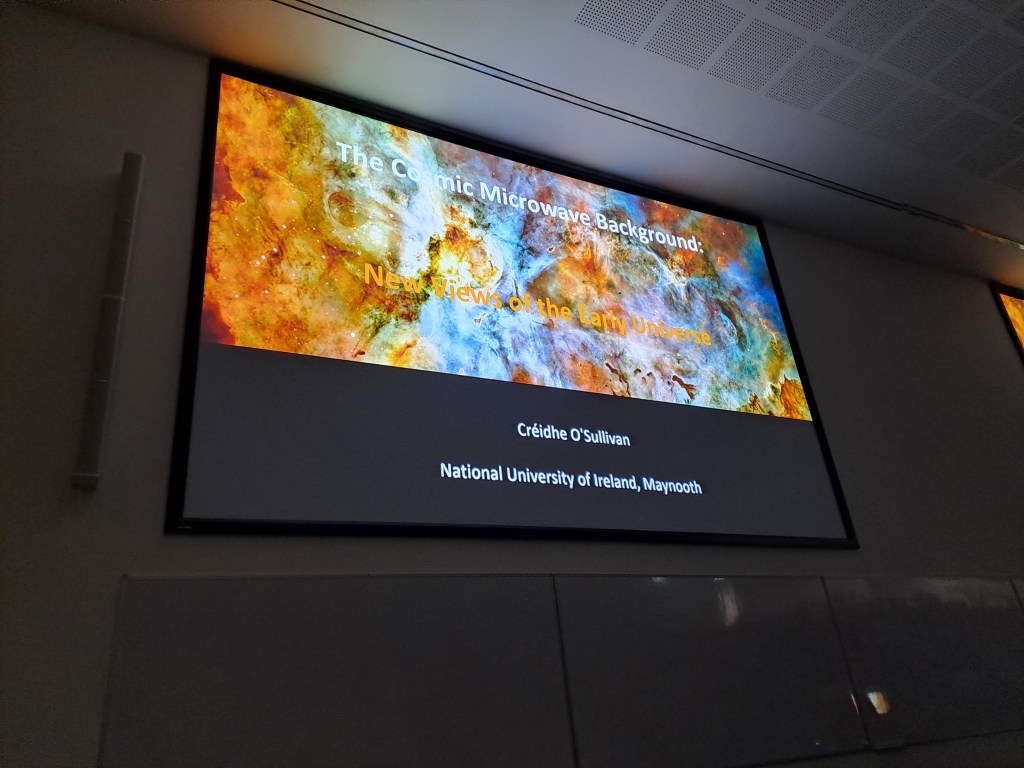
I was the last one up to speak and took a few pictures at the three talks before mine but obviously couldn’t take a picture of mine so I’ve included a pic of some of the hi-tech equipment I used for a couple of demonstrations:
If anyone wants to see the pictures I showed you can find them here:
There was an official photographer there last night so I’ll upload any pictures I come across in due course. Watch this space.
UPDATE: Here’s a picture of the four speakers
Last night’s four speakers: Créidhe O’Sullivan, Me, Emma Whelan and John Regan
Anyway, thank you to everyone for coming last night and especially to all the people who helped organize and run the event, including our student volunteers. We’re planning to do similar event for space week next year and hopefully this will become a regular feature in the calendar.
A couple of weeks ago I announced that we’re holding a Space Week event here at Maynooth University called Exploring the Cosmos. Well, the inexorable march of time means that event is actually tomorrow so I’m posting this as a last chance for you to register, which you can do here.
The demand for tickets so far has been a bit overwhelming. So much so, in fact, that we’ve moved to a bigger room, organized microphones, and enlisted various people to help, e.g. to guide people into the venue. Fortunately all I have to do is give the last talk and then go to the pub.
The views presented here are personal and not necessarily those of my employer (or anyone else for that matter).
Feel free to comment on any of the posts on this blog but comments may be moderated; anonymous comments and any considered by me to be vexatious and/or abusive and/or defamatory will not be accepted. I do not necessarily endorse, support, sanction, encourage, verify or agree with the opinions or statements of any information or other content in the comments on this site and do not in any way guarantee their accuracy or reliability.






 In the Dark