Archive for Square Kilometre Array

Wednesday at #EAS2025

Posted in Biographical, Euclid, The Universe and Stuff with tags , , , , on June 25, 2025 by telescoper

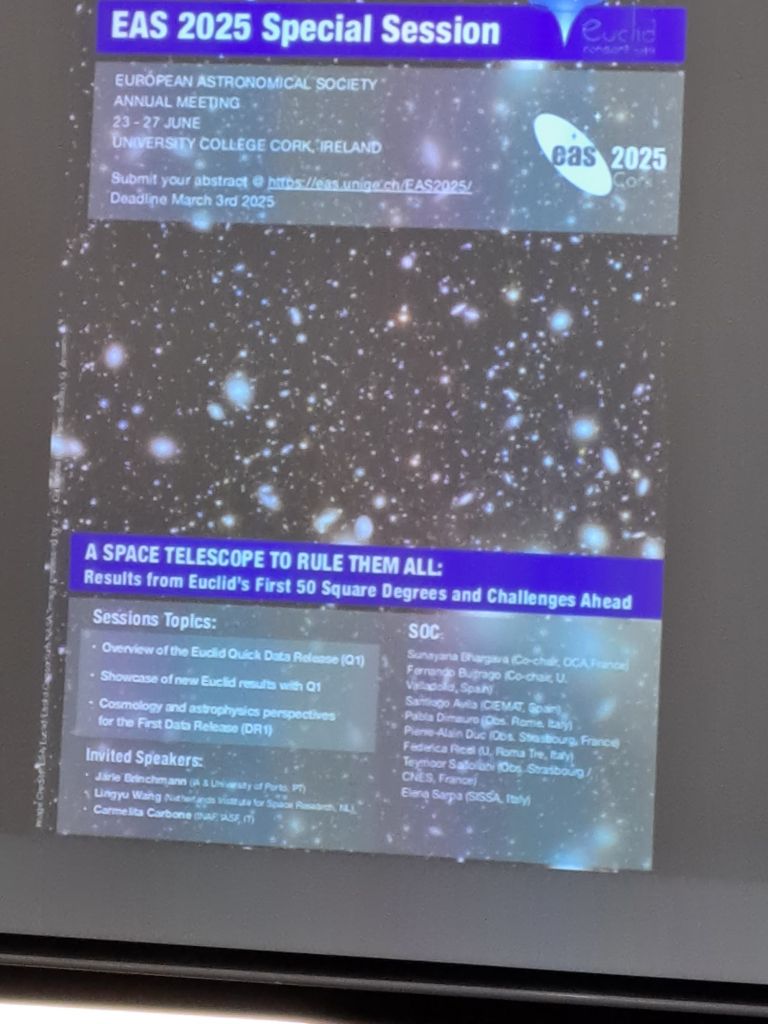
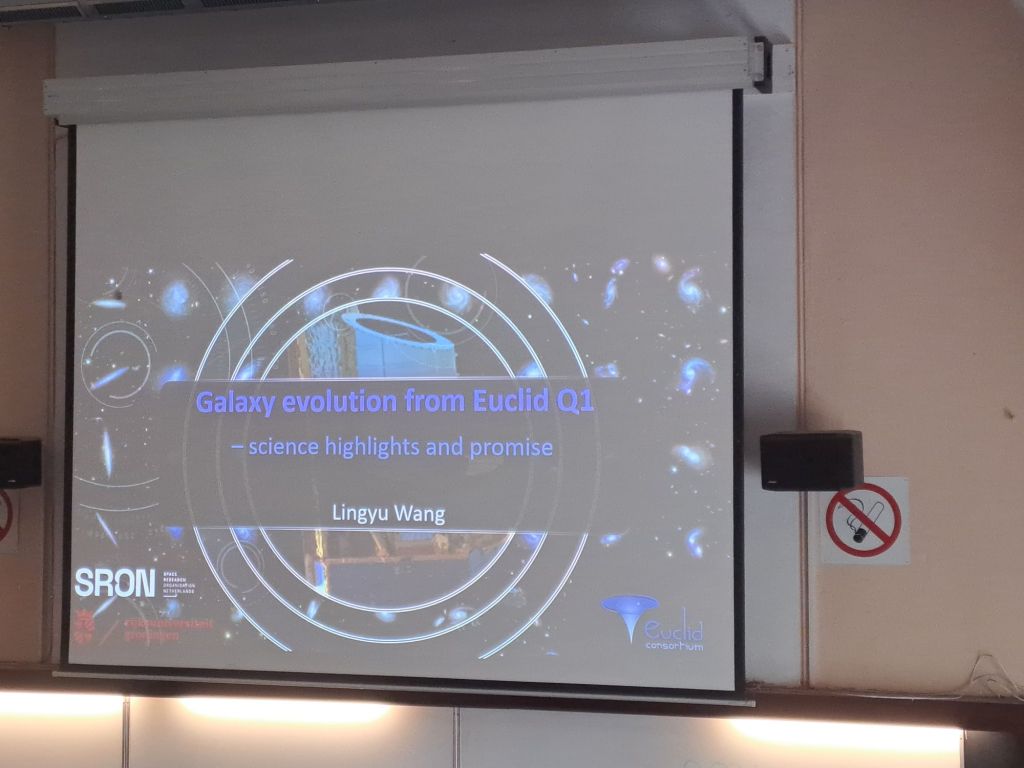
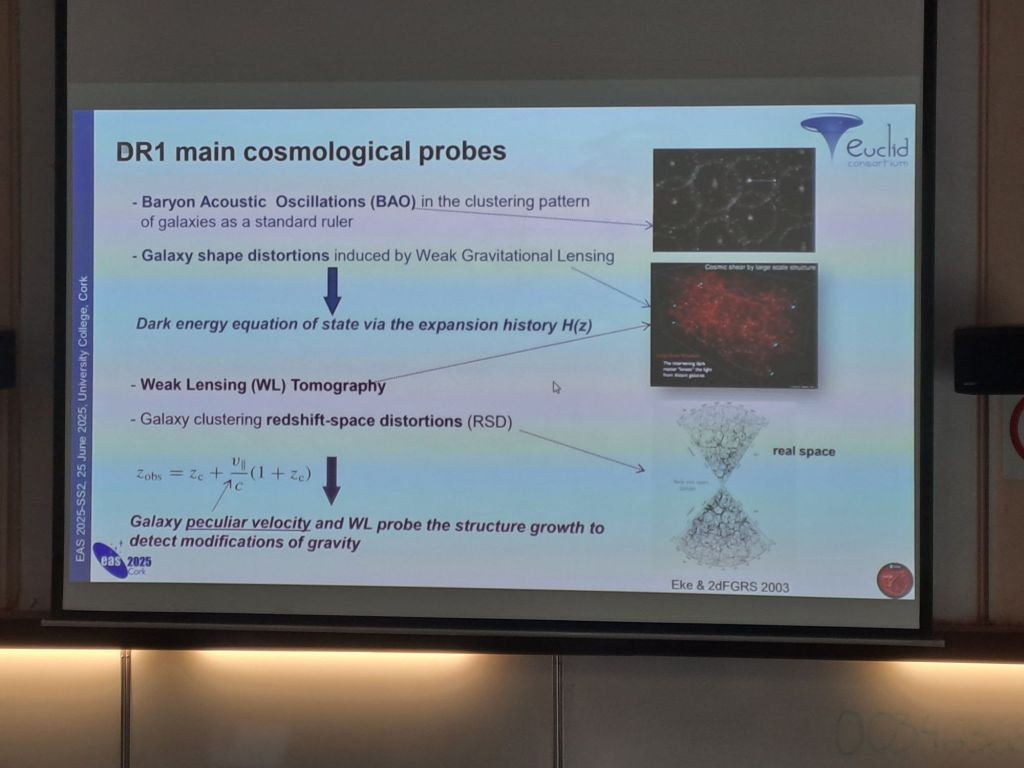
I spent most of today at the EAS 2025 sessions about Euclid. These were mainly about the Q1 data release I blogged about here, although there were some talks about what to expect about the first full data release (DR1), which is due towards the end of next year (2026), before I retire.

There were three Euclid sessions, one in the morning and two in the afternoon; I’m writing this during the last of these.

I was reminded this morning that the word “plenary” is derived from the Latin plenus, meaning “full”. This explains why there are no free seats for the plenary session, so I had to watch the stream in one of the overflow theatres.

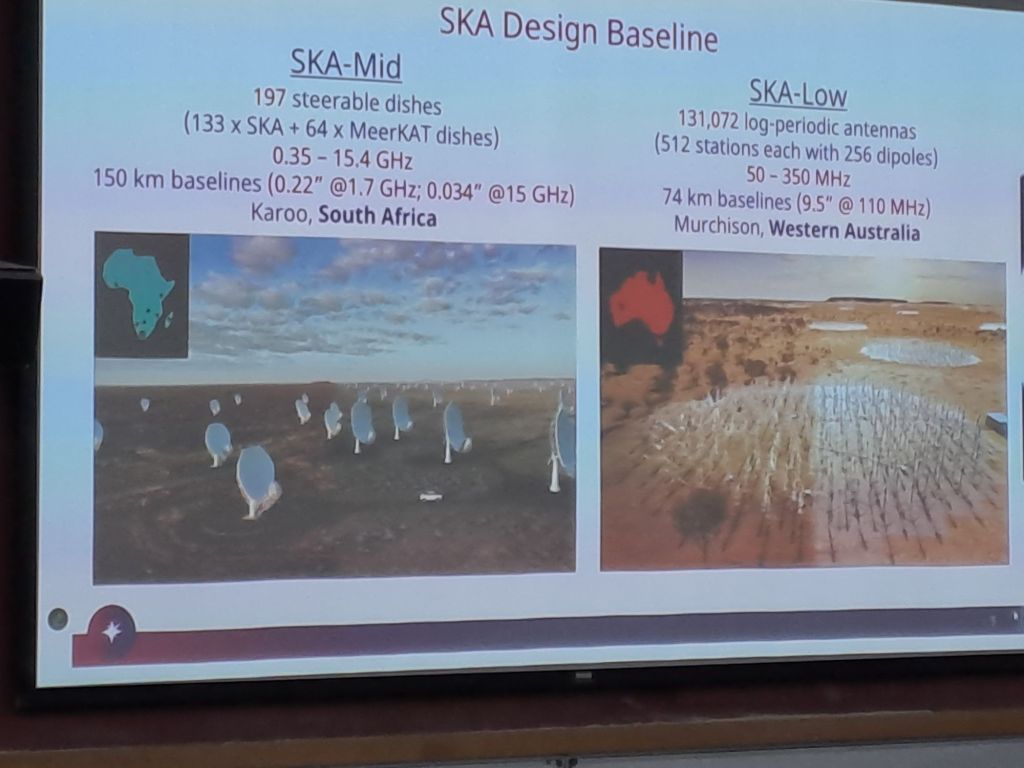
I also attended a lunchtime session about the Square Kilometre Array Observatory (SKAO). This was interesting, though the first full data release from SKAO will not happen until after I’ve retired.

And, to end the day, I’m at a reception and meeting of SKA Ireland, a group campaigning for Ireland to join the SKAO.. There’s win.

Astronomical Observatories on Indigenous Land

Posted in Euclid, Politics, The Universe and Stuff with tags , , , , , , , , on July 15, 2023 by telescoper

I’ve been meaning to post about for some time about the use of telescopes all around the world that reside in observatories on lands previously and/or presently occupied by indigenous peoples. The creation of these astronomical facilities has been accompanied by neglect (and sometimes violent displacement) of tribal communities native to the land on which they now stand. Though we exploit native lands for science, the astronomical community makes little reference to the people who are directly impacted by the advancement of astronomy through colonialism of this sort.

I know I’m not alone in thinking that, at the very least as a community we should do much more to acknowledge our use of astronomical facilities built on land that in many cases was basically “stolen” by colonial settlers. There was a talk about this issue at the recent Euclid Consortium Meeting in Copenhagen, and it came up at the National Astronomy Meeting in Cardiff in the context of the broad issue of the decolonization of astronomy.

Anyway, just for a start I have included here a small gallery of images of modern astronomical observatories of various kinds, with captions giving the names not of the observatory, but of the indigenous peoples upon whose land it is built:

There are many more than these, but hopefully you get the point. The question is: what to do about it?

The Future of Extragalactic Observations from the Past

Posted in Biographical, The Universe and Stuff with tags , , , , , , , , , on December 27, 2021 by telescoper

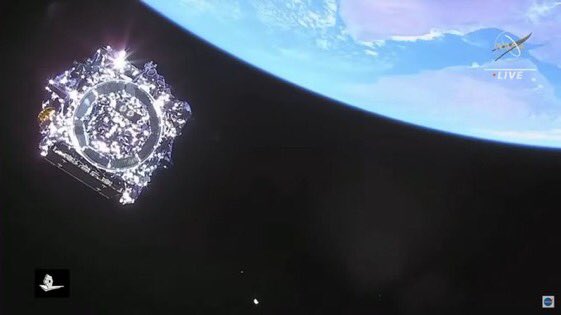
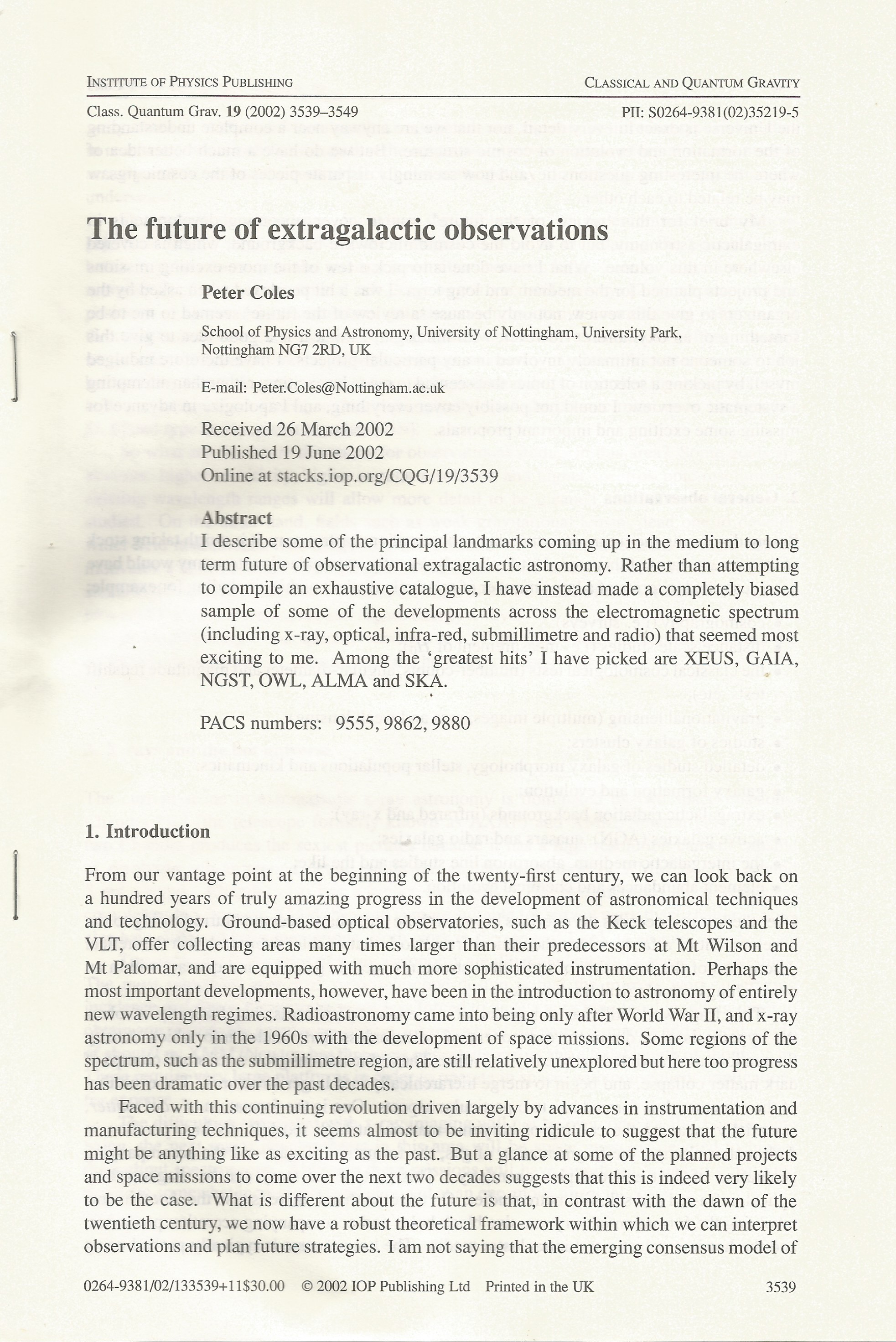
The launch of the James Webb Space Telescope on Christmas Day triggered a memory that twenty years ago, in July 2001, I was an invited speaker at a Conference in Cape Town entitled The Early Universe and Cosmological Observations: a Critical Review. That meeting was preceded by the 16th International Conference on General Relativity and Gravitation in Durban which I also attended, but did not speak at. For the Cape Town meeting I was asked to give a talk about some of the things coming up in the future to do with observational extragalactic astronomy, though I was told to avoid the cosmic microwave background and galaxy redshift surveys as other speakers were covering those areas. At the time I was serving on the Astronomy Advisory Panel for the (now defunct) Particle Physics and Astronomy Research Council so I was keeping up with developments fairly well then.

Anyway, I wrote up my talk and it was published in 2002 in a special issue of Classical and Quantum Gravity, along with the other talks (which were more theoretical, as opposed to hypothetical). I never bothered to put in on the arXiv so if you want a copy you’ll have to get it from the publisher.

I’m not claiming it is a particularly insightful article – and I did refrain from giving specific timescales – but, looking back at it, it is interesting which projects I mentioned in the abstract actually did get completed in the following twenty years.

The European X-ray mission XEUS was never completed. It was proposed for a while to merge it with a rival US mission Constellation-X in the International X-ray Observatory (IXO), but that was cancelled in 2011/12 owing to budget constraints at NASA. An ESA X-ray mission, called ATHENA (Advanced Telescope for High ENergy Astrophysics, based to some extent on the XEUS concept, is pencilled in for launch in 2034.

At the time of writing the article, JWST was called the Next Generation Space Telescope (NGST) and was envisaged to be an 8m class telescope, though I did suggest in the article would probably be “de-scoped” to involve a smaller mirror “perhaps 6m or thereabouts”. As we now know, it was finally launched on December 25 2021 and has a mirror of diameter 6.5m.

GAIA was developed and launched in 2013 and will operate until next year; it has been a tremendous success.

The Overwhelming Large (OWL) Telescope was planned to be a huge ground-based telescope, with a 100m diameter mirror and a target timescale of around 2015, to be built by the European Southern Observatory in Chile. I remember in informal discussions we used to call it the FLT. It was eventually decided that was not technically feasible and it was downgraded to a merely Extremely Large Telescope, which has a 39m mirror, underwhelming in comparison. Construction is in progress and it should see first light in 2027.

As well as the ELT there are now also the Thirty Metre Telescope and the Giant Magellan Telescope, which will come into operation on a similar timescale.

The Atacama Large Millimetre Array (ALMA) consisting of 66 telescopes working as an interferometer was completed and has been fully operational since 2013. That too has been a great success.

The Square Kilometre Array (SKA) also had its share of cost overruns and technical delays and although initial construction plans have been developed it is not expected to be operational until 2027.

Probably the most notable omission from my list is the Large Synoptic Survey Telescope (LSST) now called the Vera Rubin Observatory. That wasn’t really within my horizon in 2001, although its planning phase had started then. It really got under way around 2008 and is now nearing completion. I certainly would have mentioned it had I known more about it at the time!

P.S. In case you’re wondering, the Euclid Mission due to be launched in early 2023 was very far from the drawing board in 2001 so I don’t apologize for not mentioning it!

Cosmology Talks: Jurek Bauer on ‘Fuzzy’ Dark Matter

Posted in The Universe and Stuff with tags , , , , , on April 26, 2020 by telescoper

If you are missing your regular seminar experience because of the Coronavirus lockdown, Shaun Hotchkiss has set up a YouTube channel just for you!

The channel features technical talks rather than popular expositions so it won’t be everyone’s cup of tea but for those seriously interested in cosmology at a research level they should prove interesting.

Here’s another example from that series in which Jurek Bauer talks about ‘Fuzzy’ Dark Matter (ie matter in the form of a very light particle such as the axion) and the prospects for constraining its existence using the Square Kilometre Array.

P. S. The paper that accompanies this talk can be found on the arXiv here.

Post-Planck Cosmology: Day 3

Posted in The Universe and Stuff with tags , , , , on October 11, 2017 by telescoper

Before carrying on with my daily updates from this meeting on Post-Planck Cosmology I’ll just remark that this is a great venue: it has all the facilities necessary to keep a group of cosmologists happy…


At the tea break this morning I managed to find a shot that included all four of the statues in the main quadrangle too:

This morning kicked off with Roy Maartens discussing the cosmological potential of the Square Kilometre Array and other future galaxy surveys, one of his main points being the benefit of using multiple tracers to beat down some of the problems with single surveys.  The first phase of this project, SKA1,  will deliver 10 million redshifts with z<0.6. With SKA2 that will go up to 1 billion galaxies out to z<2, but many things can be done without redshifts using intensity mapping. SKA1 is some way off, but the precursor `Meerkat' consisting of 64 × 13.5 metre dishes will be hopefully starting next year in South Africa.

We then had a series of talks about reionization and the formation of the first stars, an epoch usually referred to as `Cosmic Dawn' or `First Light', taking us into lunch.

In the afternoon we had talks loosely grouped around the theme of `classical cosmology' – using geometric or other probes to study the expansion history of the Universe. This session included a talk by Chris Messenger of the LIGO collaboration about the beginnings of gravitational wave cosmology, though as the current generation of detectors is only sensitive to relatively nearby sources for the time being the main effort will be devoted to distance scale measurements, attempting to measure the Hubble constant directly without the need for the traditional distance ladder.

The last part of the day was devoted to a panel discussion, chaired by Francois Bouchet that was interesting and wide-ranging but largely motivated by responses to Paul Steinhardt's talk last night.

Now, no conference dinner to tear me away tonight – but I do have to finish my talk, which is at 9am tomorrow – so that will have to do for now. Toodle-pip!

What does “Big Data” mean to you?

Posted in The Universe and Stuff with tags , , , , on April 7, 2016 by telescoper

On several occasions recently I’ve had to talk about Big Data for one reason or another. I’m always at a disadvantage when I do that because I really dislike the term.Clearly I’m not the only one who feels this way:

say-big-data-one-more-time

For one thing the term “Big Data” seems to me like describing the Ocean as “Big Water”. For another it’s not really just the how big the data set is that matters. Size isn’t everything, after all. There is much truth in Stalin’s comment that “Quantity has a quality all its own” in that very large data sets allow you to do things you wouldn’t even try with smaller ones, but it can be complexity rather than sheer size that also requires new methods of analysis.

Planck_CMB_large

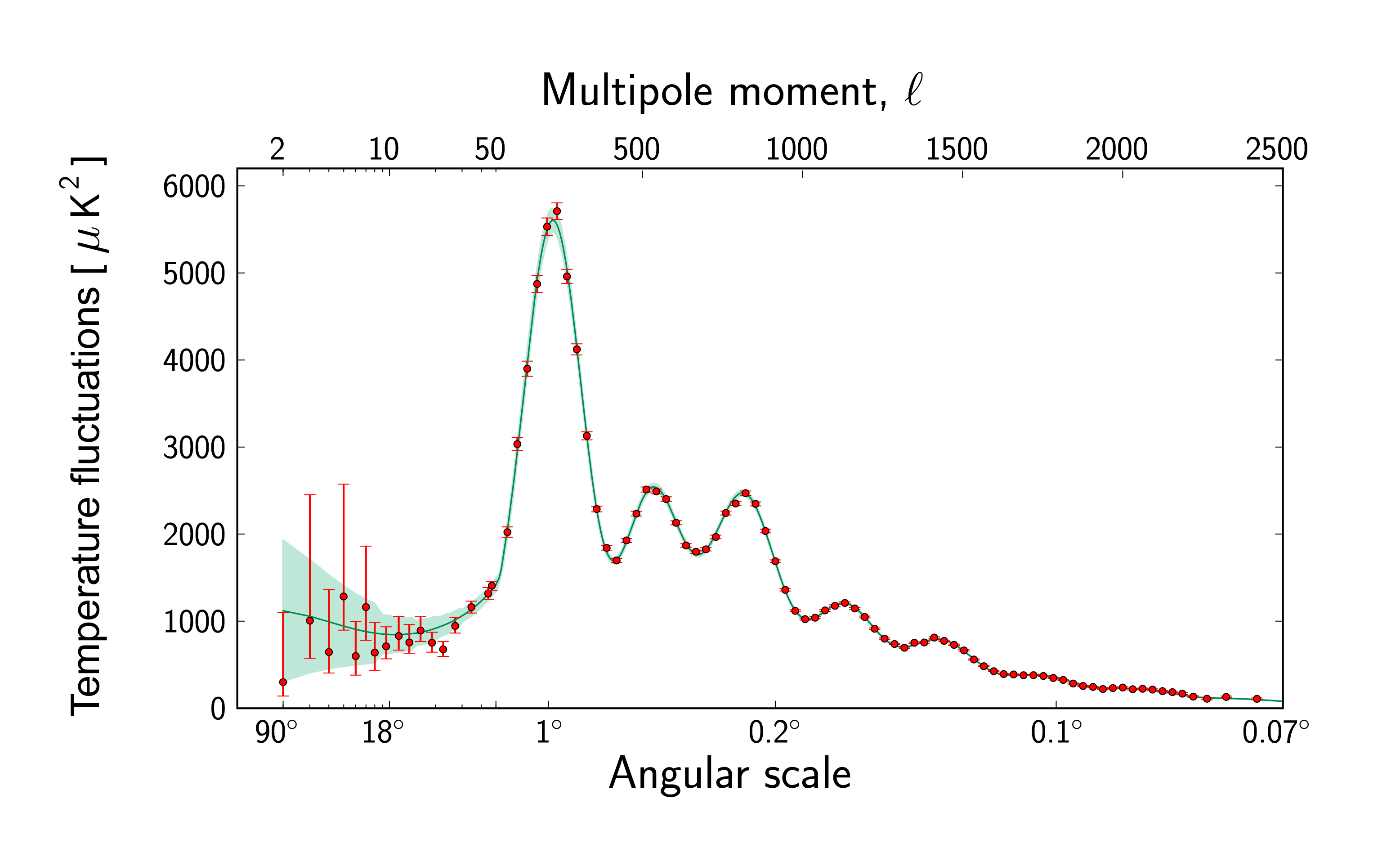
The biggest event in my own field of cosmology in the last few years has been the Planck mission. The data set is indeed huge: the above map of the temperature pattern in the cosmic microwave background has no fewer than 167 million pixels. That certainly caused some headaches in the analysis pipeline, but I think I would argue that this wasn’t really a Big Data project. I don’t mean that to be insulting to anyone, just that the main analysis of the Planck data was aimed at doing something very similar to what had been done (by WMAP), i.e. extracting the power spectrum of temperature fluctuations:

Planck_power_spectrum_origIt’s a wonderful result of course that extends the measurements that WMAP made up to much higher frequencies, but Planck’s goals were phrased in similar terms to those of WMAP – to pin down the parameters of the standard model to as high accuracy as possible. For me, a real “Big Data” approach to cosmic microwave background studies would involve doing something that couldn’t have been done at all with a smaller data set. An example that springs to mind is looking for indications of effects beyond the standard model.

Moreover what passes for Big Data in some fields would be just called “data” in others. For example, the Atlas Detector on the  Large Hadron Collider  represents about 150 million sensors delivering data 40 million times per second. There are about 600 million collisions per second, out of which perhaps one hundred per second are useful. The issue here is then one of dealing with an enormous rate of data in such a way as to be able to discard most of it very quickly. The same will be true of the Square Kilometre Array which will acquire exabytes of data every day out of which perhaps one petabyte will need to be stored. Both these projects involve data sets much bigger and more difficult to handle that what might pass for Big Data in other arenas.

Books you can buy at airports about Big Data generally list the following four or five characteristics:

  1. Volume
  2. Velocity
  3. Variety
  4. Veracity
  5. Variability

The first two are about the size and acquisition rate of the data mentioned above but the others are more about qualitatively different matters. For example, in cosmology nowadays we have to deal with data sets which are indeed quite large, but also very different in form.  We need to be able to do efficient joint analyses of heterogeneous data structures with very different sampling properties and systematic errors in such a way that we get the best science results we can. Now that’s a Big Data challenge!


SKA Matters

Posted in Science Politics, The Universe and Stuff with tags , , , , on March 13, 2015 by telescoper

There’s been quite a lot going on recently to do with the Square Kilometre Array (SKA), some of it scientific and some of it political, some of it good and some of it bad. At least those seem to me to be the appropriate descriptions.

First the scientific good news is the the SKA Board has decided which of the planned components of SKA should be constructed during the first phase, which has a budget of around €650M. Details can be found here but, in a nutshell, it seems that the SKA Survey Telescope, which was to be built around the existing pathfinder project ASKAP located in Australia is not going to be built in the first phase. This implies the low-frequency bit of SKA will be in Australia while the higher-frequency activities will be concentrated in South Africa. That seems a pragmatic decision to me based on the budgetary constraints and should lead to a lot of good science being done. At the very least it’s a clear decision.

This positive news has however been overshadowed by an unseemly spat over the choice of headquarters over the location of the SKA Headquarters which has culminated in a rather unhelpful story in Nature. SKA HQ has been temporarily housed at Jodrell Bank Observatory (in the Midlands) since 2012 and there are clearly some who would like it to be located there permanently. There is however a rival bid, from the historic Italian city of Padova, at whose university Galileo Galilei once lectured, and which remains one of the top universities in Italy.

I should put my cards on the table and say that I’ve enjoyed many visits to Padova in my career, starting when I was a PhD student back in the 1980s and have many fond memories of the place. The late co-author of my cosmology textbook, Francesco Lucchin was Director of the Department of Astronomy in Padova at that time. For many years Padova has been home to a large concentration of astronomers and is undoubtedly a centre of excellence. Moreover it is a city that is very well served by transport links, just a short distance from Venice so easily reachable by air, and also on a major railway line offering fast national and international services. It’s also a considerably better place to dine out than Jodrell Bank!

Specola

Padova’s astronomers are housed in the Castello Carrese which adjoins the Specola (above), a tower which was once a working astronomical observatory but, being right in the city centre, has not been useful for such purposes for many moons. When I first started going to Padova the Department of Astronomy was located in the tower and in some nearby buildings but the rest of the Castello Carrese was used as a prison. Now it’s been renovated and all the astronomers have been located there. I remember the frequent walks across the little bridge over the canal to a coffee bar where we often did some of our best research!

Given its strategically important location, Padova was bombed by Allied planes on a number of occasions in 1944 and 1945. My Italian colleagues would regularly draw my attention to the plaque near the entrance to the Specola pointing out that it was hit and badly damaged by Allied bombs during one raid.

Anyway I can certainly see the merits of locating SKA HQ in Padova but it’s not my decision to make. Those responsible have not yet made a final decision, but what’s sad is that a number of stories have been flying around in the media that imply that the UK is trying to exert undue political interference to stop SKA HQ being moved to Italy. Whether this is true or not I don’t know. As far as I’m concerned the powers that be are following proper process and that process has not yet been brought to a conclusion. Whatever the outcome, though, there’s no question that the language being used in the press coverage is very damaging. Let’s hope it can all be resolved amicably.

Now for a spot of lunch and then up to the Royal Astronomical Society where the topic of the Discussion Meeting is, somewhat ironically, Building an Open UK SKA-Science Consortium…

E-ELT: The Big Picture

Posted in Science Politics, The Universe and Stuff with tags , , , on March 4, 2013 by telescoper

Some astronomy news that made a bit of a splash over the weekend was the announcement that the UK is to invest £88 million in the European Extremely Large Telescope. This amount is to be spread over 10 years, so isn’t quite as astronomical as it sounds, but in any case it is only the UK’s contribution to a project that involves large contributions from the other countries involved in the European Southern Observatory. The UK announcement isn’t the end of the story, in fact, as not all the money needed to make the project work is yet in place.

This is all good news, especially because not long ago it seemed quite likely that the UK would have to make a choice between the E-ELT and the Square Kilometre Array. Now it looks like we’re going to be involved in both of the world’s leading ground-based observational facilities. There is a price to be paid, of course. In order to accommodate these projects within the flat-cash budget of the Science and Technology Facilities Council, difficult choices had to be made, and some things have to go. Not everyone will be happy about the outcome, but Big Science requires Big Decisions.

Anyway, it was nice to see the Observer run a piece about this story, although I was a bit baffled by the implication of the caption going with the picture used to illustrate the story:

The European Extremely Large Telescope will study the Magellanic Cloud.

I’ll avoid asking “which Magellanic Cloud (Large or Small)?” and just point out that E-ELT will study a lot more than either or both! Still, people are more likely to read web articles if they include images, so I’ll end this piece with an appropriate one.

Random Astronomical Image

Random Astronomical Image

SKA Site Duel ends in Dual Site for SKA

Posted in Science Politics, The Universe and Stuff with tags , , , , , on May 26, 2012 by telescoper

I wasn’t going to post about this but then I realised nobody seemed to have used the obvious headline so thought I might as well knock out a quickie.

Yesterday, after much to-ing and fro-ing an announcement was finally made  concerning the site of the Square Kilometre Array.  The two contenders for the honour of hosting this superb project were South Africa and Australasia (both Australia and New Zealand get a bit, actually).

So who won?

Well, formally the decision was to split the project between both. At first sight this looks like a political compromise, but wiser heads than me disagree and say that this an excellent outcome on science grounds. I’d be interested to hear  opinions on that, in fact.

In any case, a quick skim through the STFC announcement makes it clear that South Africa actually gets the lion’s share of the actual dishes, which will be operated alongside the  Meerkat facility, and will do what I think is the more exciting science.  Having been to Cape Town just recently I know how much the SKA project means for astronomy in South Africa so I’m delighted for them that the outcome is so positive.

It does, however, remain to be seen what the implications of this decision are for the overall cost and scientific value-for-money, but for the time being the thing I’m most pleased about is that a decision has been reached.  I think the SKA project is by far the most exciting ground-based astronomy project around, and it will be very exciting to watch it grow.

The SKA Propaganda Machine

Posted in Astrohype, Science Politics, The Universe and Stuff with tags , , , , on February 14, 2012 by telescoper

I’m a big fan of the Square Kilometre Array, a proposed new radio telescope that will revolutionize our understanding of many aspects of astrophysics.

I’m somewhat less keen on the intense lobbying being carried out on behalf of Australian astronomers in advance of the decision whether to site it in Australia or South Africa. The campaign is being orchestrated by a PR organization called Ogilvy and Mather who are making full use of social media to promote the Australian case.

Last week I was invited by email to attend a “webinar” (whatever that is) about the SKA, an invitation that I quietly ignored. Today I got a follow-up email from a person described as a “Digital Analyst” offering me the chance to “interview Dr Brian Boyle or Dr Lisa Harvey Smith”. They also sent me the following “infographic” (i.e. a picture) showing the case for siting the SKA in Australia, which they thought would be of interest to “my blog readers”.

Well, you can call me old-fashioned but I think there’s something a bit distasteful about engaging a glorified ad agency to lobby on behalf of one party in a discussion that should be resolved on purely scientific grounds. I wonder how much it cost, for a start, but I’d also have hoped scientists would be above that sort of thing anyway. Sign of the times, I suppose.

Anyway, even if the digital analysts at Ogilvy will be happy that I’ve shown their infographic, perhaps they might now realize that spin can work in two different ways…