Archive for STFC

STFC Budget 2010-11

Posted in Finance, Science Politics with tags , , on October 14, 2010 by telescoper

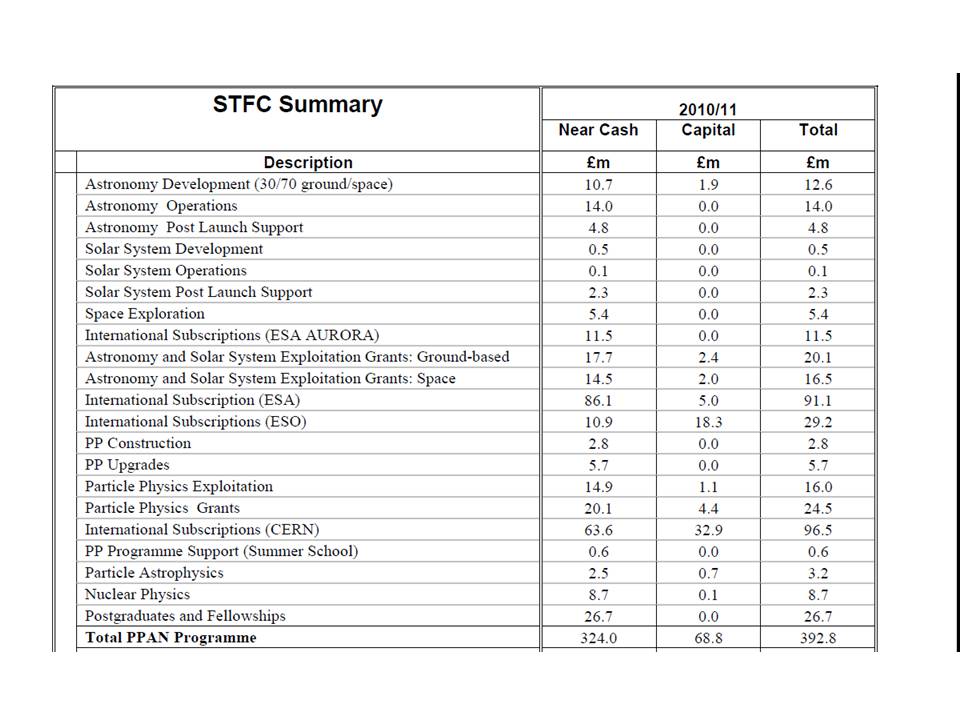
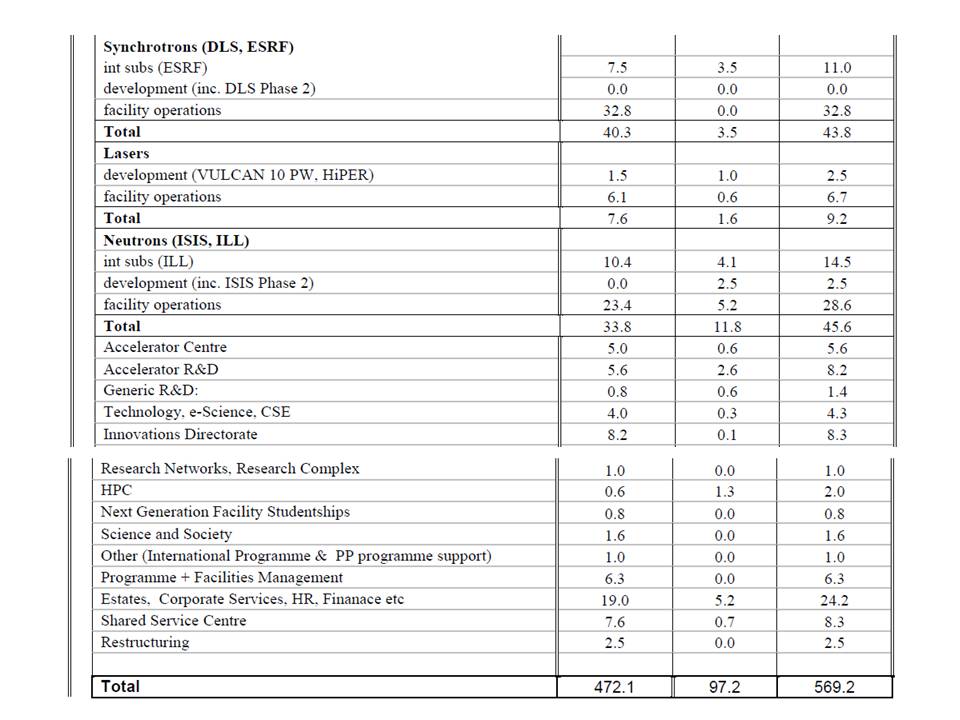
Just a quick post to point out that the Science and Technology Facilities Council have released a reasonably complete breakdown of their current budget. I’m sure many readers working in astronomy and particle physics will find it interesting reading, though others will probably find it incredibly boring.

Here it is, for easy reference, in bits, generated by a clumsy cut-and-paste-technique wholly unbefitting the hi-tech nature of STFC, starting with the PPAN Programme:

and now the rest

For those of you not up with the accounting lingo, “near cash” means assets investments and other things that could in principle be exchanged for cash in a relatively short period of time.

These are, of course, the figures before the impending cuts take place….

There’s a much more legible version of the whole thing here.


Share/Bookmark

(Guest Post) STFC – It isn’t just about money

Posted in Science Politics with tags , , , , , , on October 4, 2010 by telescoper

The following piece was written by Professor George Efstathiou, FRS, who is Professor of Astrophysics at the University of Cambridge and Director of the Kavli Institute for Cosmology. The views expressed therein are George’s own, but I’m not saying that out of a desire to distance myself from his opinions. As a matter of fact, I was one of the people who signed the petition he describes in the article…

–o–

As Peter has reported on this site, physicists around the country are anxiously awaiting the results of the forthcoming Comprehensive Spending Review. Scientists whose research is supported by the Science and Technology Facilities Council (STFC)  are particularly anxious.  Since its creation, STFC has gone through two difficult scientific prioritisation exercises. Many excellent projects have been cancelled and grants supporting University groups have been cut savagely, by about 35%. STFC science has already descended into the Royal Society’s ‘game over‘ scenario. All of this has happened before the consequences of the economic crisis have hit the science budget. STFC has left itself uniquely poorly placed amongst the Research Councils to absorb further reductions following the CSR.

It is for this reason, that I and a few others organised a petition expressing a loss of confidence in the Chief Executive of STFC. The petition was signed by 916 researchers, including 162 Professors and 18 Fellows of the Royal Society. It was formally submitted to the STFC Chair (Michael Sterling) on 1st July together with an explicit request that STFC Council should review its role in this loss of confidence.

People will have had many different reasons for signing the petition. I made my views public well in advance (see my Letter to Lord Drayson). In all of my letters to ministers and others concerning the STFC ‘crisis’, I have never asked for more money. More money would help, of course, but this is utterly unrealistic in the current economic circumstances. No, over the last three years I have been lobbying for good governance. The strutural difficulties with STFC were easy to identify and I believe that with good governance the STFC programme could have been managed without such a catastrophic loss of science. Over three years, STFC have failed to establish a compelling narrative, strategy and constructive engagement with its science community. When one bears in mind that about 40 % of Physics staff work in areas for which STFC is the primary funding source, the consequences of the STFC crisis for University Departments, and the rest of the science base, are indeed serious.

So, whatever the outcome of the CSR, there are governance issues that we should be concerned about. There are three that I would like to raise here:

1. Fellowships and grants. Senior scientists from outside the UK point to the Fellowships and Rolling Grants as two of the most effective features of the UK funding system. Both are now under threat. I was responsible for making the case for the current 5 year system to PPARC Council. In addition to the evident benefits of continuity and reduction in peer review, Council need to understand that recruitment for postdocs involves a substantial lead time. If we are to compete for the best postdocs around the world (and not lose our best post docs), grant funds must be committed four years in advance. The 5 year rolling grant system, even with tapers, allows groups to advertise posts on an international timetable and to vire funds to maximise science output. Any move to responsive mode 3 year grants is guaranteed to deliver less science for a fixed amount of money. I would vigorously defend the Fellowships. Fellowships encourage scientific independence and provide a valuable “bottom-up” correction to the increasingly narrow “top-driven” science programme of STFC. Attacks on Fellowships and Rolling Grants will inevitably lead to a more introspective and less internationally competitive science programme.

2. The Composition of STFC Council. STFC Council, with a minority of leading research scientists, differs from other Research Councils. I have had several vigorous discussions with Michael Sterling concerning this issue and, in particular, the recent decision by BIS to appoint three new non-academic members to STFC. This led me to write a long letter to Adrian Smith (Director General of the Research Councils) reproduced here. Professor Smith replied that he approved of the present balance of Council and thought that it was compatible with the recommendations of previous reviews. I will leave readers to decide whether they agree. This is not a minor point. My experience on PPARC Council was that `lay members’ can often provide interesting perspectives on problems, but if they lack understanding of the science (sometimes alarmingly so) they will tend to accept the recommendations of the Executive. STFC needs a scientifically strong Council. Competent management is not enough. It is easy to keep within budget – you can be tough about cutting things. It is much harder to maximise the amount of science that you can do on a fixed budget. For that you need a scientific strategy and scientific judgement.

3. The New CEO. The search has begun for a new Chief Executive. There is one school of thought that a suitable candidate may be found from the corporate sector. Someone who may not understand the science, but would be a capable manager and communicator. I think that this would be a disaster. In my view, it is essential that a new CEO have an understanding of the science programme at STFC and should be prepared to act as an enthusiastic advocate for STFC science. We need a CEO who can engage constructively with the academic community and, when times are tough, articulate a strategy to limit the loss of science rather than gloat at our misfortune.

It would be great to have more money for STFC science. But money isn’t everything – we need to pay attention to governance issues as well. If we had been braver back in 2008 and openly challenged the Executive, we might not be in such a weak position now. We should not be so reticent in the future.


Share/Bookmark

The Instinct of Hope

Posted in Biographical, Poetry, Science Politics with tags , , on September 23, 2010 by telescoper

A strenuous and stressful three days commuting to and from sunny Swindon for the STFC Astronomy Grants Panel are now over, just in time for the onset of teaching term next week. For reasons of confidentiality I can’t talk about the actual business of the grants panel, and it’s nowhere near finished anyway – there are several more meetings to come before any results come out. I would say, though, that it’s a curious job that manages to be both inspiring and depressing at the same time. The inspiring thing is that you get to read about so much really exciting science being done by all kinds of people in departments all over the country; the depressing thing is knowing that there isn’t anywhere near enough money to support all the things that one would like to in an ideal world. And our world is becoming less like an ideal one every day…

I decided for these three days not to stay in Swindon but to commute to and from from Cardiff. On balance, I think that was a good decision: I got to sleep in my own bed, didn’t have to arrange for someone to do Columbo’s jabs, and also saved STFC quite a bit of money – a day return from Cardiff to Swindon, a trip of almost exactly one hour each way, is only £26.80 at peak time. The downside was that I’ve been up at 5am each morning and have been in a vegetative state by the time I got home each evening, including this one!

Anyway, lacking the energy to put together a proper post, I’ll just put up this poem by John Clare which appeared in the  Guardian last saturday and which, for some reason, popped into my head during the train journey home. Somehow it seems apt.

Is there another world for this frail dust
To warm with life and be itself again?
Something about me daily speaks there must,
And why should instinct nourish hopes in vain?
‘Tis nature’s prophesy that such will be,
And everything seems struggling to explain
The close sealed volume of its mystery.
Time wandering onward keeps its usual pace
As seeming anxious of eternity,
To meet that calm and find a resting place.
E’en the small violet feels a future power
And waits each year renewing blooms to bring,
And surely man is no inferior flower
To die unworthy of a second spring?


Share/Bookmark

The Invisible Ma(so)n

Posted in Science Politics with tags , on September 12, 2010 by telescoper

I couldn’t resist sharing this little item I saw on the back page of the last issue of Research Fortnight:

WHERE’S KEITH? Once upon a time STFC chief executive
Keith Mason could be seen out and about, taking flak
in public for all manner of woes. But Research Fortnight
can’t help noticing that he has been remarkable only
by his absence recently. No site visits, no photo ops, no
community chit chats. He is due to stand down in March
2012, but how should we interpret his low profile in the
meantime? Surely no one can have built up that much
unused holiday?

On the other hand, the last time the Chief Executive of the Science and Technology Facilities Council (STFC) got involved in a Comprehensive Spending Review (in 2007), the outcome for his organization could hardly have been described as positive. Perhaps other members of the STFC Executive have decided to send him on a fact-finding mission to the Outer Hebrides in order to stop him messing up the negotations this time?


Share/Bookmark

Unravelling Cable

Posted in Politics, Science Politics with tags , , , , , , , on September 8, 2010 by telescoper

I woke up this morning with the Vince Cable Blues, owing to an item on the BBC News concerning a speech by the Secretary of State for Business, Innovation and Skills that clearly signals that the forthcoming Comprehensive Spending Review will entail big cuts to the UK’s science budget.

It was a depressing way to start the day, but I for one wasn’t particularly surprised by the news. We all know big cuts are coming, the only remaining questions are “how big?” and “where?”. However, when the text of the speech was released, I was shocked by what it revealed about the Secretary of State’s grasp of his brief.  Read it for yourself and see if you agree with me.

Vince Cable: Out of his Depth

Of course there are the obligatory  platitudes about the quality of the UK’s scientific research, a lot of flannel about the importance of “blue skies” thinking, before he settles on the utilitarian line favoured by the Treasury mandarins who no doubt wrote his speech for him: greater concentration of research funding into areas that are “theoretically outstanding” (judged how?) or “commercially useful” (when?). In fact one wonders what the point of this speech was, as it said very little that was specific except that the government is going to cut science. We knew that already.

For what it’s worth I’ll repeat my own view that “commercially useful” research should not be funded by the taxpayer through research grants. If it’s going to pay off in the short term it should be funded by private investors or venture capitalists of some sort. Dragon’s Den, even. When the public purse is so heavily constrained, it should only be asked to fund those things that can’t in practice be funded any other way. That means long-term, speculative, curiosity driven research. You know, science.

So was Cable’s speech was feeble-minded, riddled with clichés, and totally lacking in depth or detail? Yes.  Was it surprising? No.

What was surprising, at least to me, is Cable’s deliberate use of spurious numbers to back up his argument. For example,

Its is worth noting in the last RAE 54 per cent of submitted work was defined as world class and that is the area where funding should be concentrated.

This appears to be what Cable  was referring to when he stated on the BBC Radio 4 Today Programme that  “45% of research grants were not of excellent standard”.

For one thing, there’s a difference between a research grant and the money allocated by HEFCE through the Research Assessment Exercise (RAE); more about that in a moment. Moreover, at least in England,  RAE funding is only allocated to grades 3* and 4* anyway, so the concentration he talks about is already happening. The comment is made all the more meaningless, however, because the 54% was actually imposed on the assessment panels anyway; they were told to match the outcome of their deliberations to a target profile. The figure quoted is therefore hardly an objective measure of the quality of scientific research in the UK.

When it comes to research grants – usually obtained from one of the Research Councils, such as the Science and Technology Facilities Council (STFC) scientists apply for funding and their proposals are assessed by panels. In the case of STFC I can assure every one that the only proposals funded are those graded excellent, and there isn’t anything like enough money to fund all the proposals graded that way. Further cuts will simply mean that  even more excellent research will have to be scrapped, and even more excellent scientists will  go abroad.

This basic misunderstanding convinces me that Vince Cable is completely out of his depth in this job. That’s very unfortunate because it means he will probably be susceptible to manipulation by the dark side (i.e. the anti-science lobby in Whitehall). Already  someone – most likely a Civil Service mandarin with an axe to grind – seems to have  duped him into thinking that 45% of  taxpayer’s money funds mediocre research. What with him already singing so enthusiastically from the Treasury hymn sheet, I fear they have got him exactly where they want him. Rarely has a new arrival in the Whitehall jungle gone native so quickly.

Another remark of his that was quoted today is that “the bar will have to be raised somewhat” in terms of  science funding.  At the next General Election I hope the British people, especially those foolish enough to opt for the Liberal Democrats last time, will “raise the bar” when it comes to deciding who is worthy of their vote. I’m sure of one thing, though. The fraction of British politicians who are “mediocre” is an awful lot higher than 45%.


Share/Bookmark

STFC Grants Consultation

Posted in Science Politics with tags , , , , on August 31, 2010 by telescoper

I thought I’d put my community service badge on today and draw the attention of any astronomers or particle physicists reading this blog that the Science and Technology Facilities Council (STFC) is consulting on proposed changes to the ways it funds research grants. I can hardly over-emphasize the importance of this issue, especially for those of us working in University departments who rely on grant funding in order to carry out our research.

There is a consultation form on which you can post comments on the alternatives outlined in the accompanying document.

Regrettably, only three options are offered. In brief, they are

  1. All grants to be 3-year “standard” grants (i.e. no more “rolling” grants at all)
  2. Some (a small number?) of 6-year “core” grants introduced, mainly to cover the cost of technical support staff.
  3. The status quo (i.e. mixture of 3-year “standard” and 5-year “rolling” grants).

I’m not going to comment on these here, as my intention is just to draw your attention to the fact that this consultation is open and that the deadline is very soon: Monday 6th September 2010, at 4pm. I would have thought it’s probably a good idea for groups to submit collective responses where possible, but I’m sure all feedback would be welcomed.

We don’t know how much of a grant programme will remain after the forthcoming Comprehensive Spending Review, but it’s even more important to make the system as efficient and fair as possible when we know money is going to be tight.


Share/Bookmark

No Science Please, We’re British

Posted in Education, Politics, Science Politics with tags , , , , , , , , , on August 27, 2010 by telescoper

The time is getting closer when the Condem government’s hatchet men announce the detailed plans for spending cuts over the next few years. Those of us scientists working in British universities face an anxious few weeks waiting to see how hard the axe is going to fall. Funds for both teaching and research seem likely to be slashed and there’s fear of widespread laboratory closures across the sector, particularly in “pure” science that doesn’t satisfy the current desire for a rapid return on investment.

The mood is pretty accurately summarised by an article in the Guardian, in which John Womersley (who is the Director of Science Programmes at the Science and Technology Facilities Council) pointed out the very real possibility that the UK might be forced to mothball expensive national facilities such the recently built Diamond Light Source and/or withdraw from international collaborations such as CERN (which would also entail pulling out of the Large Hadron Collider). Astronomers also fear that cuts to STFC might force us to withdraw from the European Southern Observatory, which would basically destroy our international competitiveness in a field which for so long we have been world-leading. Withdrawal from CERN would similarly ensure the end of particle physics in Britain.

As well as the loss of facilities and involvement in ongoing international research programmes, big cuts in science funding – especially at STFC – will also lead to a “lost generation” of young scientists having little or no opportunity to carry out their research here in Britain. In fact the process of throwing away the UK’s future as a scientific nation has already begun and is likely to accelerate even without further cuts this year.

The STFC budgets for training young scientists at both postgraduate and postdoctoral levels were slashed even before the General Election because STFC was formed in 2007 with insufficient funds to meet its commitments. The total funding for research grants in astronomy – which is how many postdoctoral researchers are trained has been squeezed by an unsustainable level of 40% already. Many young scientists, whose contracts have been terminated with virtually no notice, have not unreasonably decided that the UK can offer them nothing but a kick in the teeth and gone abroad, taking their expertise (which was developed thanks to funding provided by the UK taxpayer) to one of our competitors in the global economy.

Some say the previous funding crisis was due to downright incompetence on behalf of the STFC Executive, some say it was part of a deliberate policy at the RCUK level to steer funding away from pure science towards technology-related areas. Either way the result is clear. Opportunities for young British scientists to do scientific research have been severely curtailed. Another round of cuts to STFC of the 25% being talked about by the new government will certainly lead to wholesale closures of labs and observatories, the withdrawal from international commitments such as CERN and ESO, and the loss of irreplaceable expertise to other countries.

On top of this, it seems not only STFC but also other research councils (such as EPSRC) are talking about clawing back funds they have already granted, by reneging on contracts they have already signed with Universities to fund research by scientists carried out there. If this does happen, there will be a catastrophic breakdown of trust between University-based scientists and the government government that will probably never be healed.

This government risks destroying the foundations of scientific excellence that have taken over 300 years to build, and all for what level of saving? The annual subscription the UK pays to CERN is about £70 million, a couple of pounds per British taxpayer per year, and a figure that most bankers would regard as small change. It would be madness to throw away so much long-term benefit to save so little in terms of short-term cost.

In the Guardian article, John Womersley is quoted as saying

Our competitor nations such as Germany and the US are investing in science and engineering right now because they recognise that they stimulate economic growth and can help to rebalance the economy. It is pretty obvious that if the UK does the exact opposite, those companies will look elsewhere. That would deepen the deficit – in a recession you need to invest in science and engineering to reap the benefits, not cut back.

Of course we don’t know how the Comprehensive Spending Review will turn out and there may be still time to influence the deliberations going on in Whitehall. I hope the government can be persuaded to see sense.

I’m trying very hard to be optimistic but, given what happened to STFC in 2007, I have to say I’m very worried indeed for the future of British science especially those areas covered by STFC’s remit. The reason for this is that STFC’s expenditure is dominated by the large facilities needed to do Big Science, many of which are international collaborations.

In order to be active in particle physics, for example, we have to be in CERN and that is both expensive and out of STFC’s control. The cost of paying the scientists to do the science is a relatively small add-on to that fixed cost, and that’s the only bit that can be cut easily. If we cut the science spend there’s no point in being in CERN, but we can’t do the science without being in CERN. The decision to be made therefore rapidly resolves itself into whether we do particle physics or not, a choice which once made would be irreversible (and catastrophic). It’s the same logic for ESO and ground-based astronomy. There’s a real possibility in a few years time that the UK will have killed off at least one of these immensely important areas of science (and possibly others too).

A decade ago such decisions would have been unthinkable, but now apparently they’re most definitely on the cards. I don’t know where it all went wrong, but given the (relatively) meagre sums involved and the fact that it started before the Credit Crunch anyway, it’s difficult to escape the conclusion that it’s a deliberate stitch-up by senior mandarins. All I can say is that the future looks so grim I’m glad I’m no longer young.

Share/Bookmark

The Next Decade of Astronomy?

Posted in Science Politics, The Universe and Stuff with tags , , , , , , , on August 14, 2010 by telescoper

I feel obliged to pass on the news that the results of the Decadal Review of US Astronomy were announced yesterday. There has already been a considerable amount of reaction to what the Review Panel (chaired by the esteemed Roger Blandford) came up with from people much more knowledgeable about observational astronomy and indeed US Science Politics, so I won’t try to do a comprehensive analysis here. I draw your attention instead to the report itself  (which you can download in PDF form for free)  and Julianne Dalcanton’s review of, and comments on, the Panel’s conclusions about the priorities for  space-based and ground-based astronomy for the next decade or so over on Cosmic Variance.  There’s also a piece by Andy Lawrence over on The e-Astronomer’s blog. I’ll just mention that Top of the Pops for space-based astronomy is the Wide-Field Infrared Survey Telescope (WFIRST) which you can read a bit more about here, and King of the Castle for the ground-based programme is the Large Synoptic Survey Telescope (LSST). Both of these hold great promise for the area I work in – cosmology and extragalactic astrophysics – so I’m pleased to see our American cousins placing such a high priority on them. The Laser Interferometer Space Antenna (LISA), which is designed to detect gravitational waves, also did very well, which is great news for Cardiff’s Gravitational Physics group.

It will be interesting to see what effect – if any – these priorities have on the ranking of corresponding projects this side of the Atlantic. Some of the space missions involved in the Decadal Review in fact depend on both NASA and ESA so there clearly will be a big effect on such cases. For example, the proposed International X-ray Observatory (IXO) did less well than many might have anticipated, with clear implications for  Europe (including the UK).  The current landscape  of X-ray astronomy is dominated by Chandra and XMM, both of which were launched in 1999 and which are both nearing the end of their operational lives. Since X-ray astronomy can only be done from space, abandoning IXO would basically mean the end of the subject  as we know it, but the question is how to bridge the  the gap between the end of these two missions and the start of IXO even if it does go ahead but not until long after 2020? Should we keep X-ray astronomers on the payroll twiddling their thumbs for the next decade when other fields are desperately short of manpower for science exploitation?

On a more general level, it’s not obvious how we should react when the US gives a high priority to a given mission anyway. Of course, it gives us confidence that we’re not being silly when very smart people across the Pond endorse missions and facilities similar to ones we are considering over here. However, generally speaking the Americans tend to be able to bring missions from the drawing board to completion much faster than we can in Europe. Just compare WMAP with Planck, for instance. Trying to compete with the US, rather than collaborate, seems likely to ensure only that we remain second best. There’s an argument, therefore, for Europe having a programme that is, in some respects at least, orthogonal to the United States; in matters where we don’t collaborate, we should go for facilities that complement rather than compete with those the Americans are building.

It’s all very well talking of priorities in the UK but we all know that the Grim Reaper is shortly going to be paying a visit to the budget of the  agency that administers funding for our astronomy, STFC. This organization went through a financial crisis all of its very own in 2007 from which it is still reeling. Now it has to face the prospect of further savage cuts. The level of “savings” being discussed  – at least 25%  -means that the STFC management must be pondering some pretty drastic measures, even pulling out of the European Southern Observatory (which we only joined in 2002). The trouble is that most of the other ground-based astronomical facilities used by UK astronomers have been earmarked for closure, or STFC has withdrawn from them. Britain’s long history of excellence in ground-based astronomy now hangs in the balance. It’s scary.

I hope the government can be persuaded that STFC should be spared another big cut and I’m sure that there’s extensive lobbying going on.  Indeed, STFC has already requested input to its plans for the ongoing Comprehensive Spending Review (CSR). With this in mind, the Royal Astronomical Society has produced a new booklet designed to point out the  relevance of astronomy to wider society. However I can’t rid from my mind the memory a certain meeting in London in 2007 at which the STFC Chief Executive revealed the true scale of STFC’s problems. He predicted that things would be much worse at the next CSR, i.e. this one. And that was before the Credit Crunch, and the consequent arrival of a new government swinging a very large axe. I wish I could be optimistic but, frankly, I’m not.

When the CSR is completed then STFC will have yet again to do another hasty re-prioritisation. Their Science Board has clearly been preparing:

… Science Board discussed a number of thought provoking scenarios designed to explore the sort of issues that the Executive may be confronted with if there were to be a significant funding reduction as a result of the 2010 comprehensive spending review settlement. As a result of these deliberations Science Board provided the Executive with guidance on how to take forward this strategic planning.

This illustrates a big difference in the way such prioritisation exercises are carried out in the UK versus the USA. The Decadal Review described above is a high-profile study, carried out by a panel of distinguished experts, which takes detailed input from a large number of scientists, and which delivers a coherent long-term vision for the future of the subject. I’m sure not everyone agrees with their conclusions, but the vast majority respect its impartiality and level-headedness and have confidence in the overall process. Here in the UK we have “consultation exercises” involving “advisory panels” who draw up detailed advice which then gets fed into STFC’s internal panels. That bit is much like the Decadal Review. However, at least in the case of the last prioritisation exercise, the community input doesn’t seem to bear any obvious relationship to what comes out the other end. I appreciate that there are probably more constraints on STFC’s Science Board than it has degrees of freedom, but there’s no getting away from the sense of alienation and cynicism this has generated across large sections of the UK astronomy community.

The problem with our is that we always seem to be reacting to financial pressure rather than taking the truly long-term “blue-skies” view that is clearly needed for big science projects of the type under discussion. The Decadal Review, for example, places great importance on striking a balance between large- and small-scale experiments. Here we tend slash the latter because they’re easier to kill than the former. If this policy goes on much longer, in the long run we’ll end up a with few enormous expensive facilities but none of the truly excellent science that can be done from using smaller kit.  A crucial aspect of this that that science seems to have been steadily relegated in importance in favour of technology ever since the creation of STFC.  This must be reversed. We need a proper strategic advisory panel with strong scientific credentials that stands outside the existing STFC structure but which has real influence on STFC planning, i.e. one which plays the same role in the UK as the Decadal Review does in the States.

Assuming, of course, that there’s any UK astronomy left in the next decade…

Science versus Engineering?

Posted in Science Politics with tags , , , , , , on July 13, 2010 by telescoper

I suppose it was inevitable that there would be infighting as academics jostle for an increase intheir share of what is likely to be a diminishing level of research funding to be announced at the end of the ongoing Comprehensive Spending Review.  The first professional society to try to barge its way to the front of the queue appears to be the Royal Academy of Engineering, which has written to the Department of Business, Innovation and Skills (BIS) in terms that make it clear that they think egineering should prosper at the expense of research in fundamental physics.

To quote the RAEng:

we believe that research should be concentrated on activities from which a contribution to the economy, within the short to medium term, is foreseeable. I recognise that this calls for significant changes in practice but I see no alternative in the next decade. This may mean disinvesting in some areas in order properly to invest in others.

And where should the axe fall?

BIS should also consider the productivity of investment by discipline and then sub-discipline. Once the cost of facilities is taken into account it is evident that ‘Physics and Maths’ receive several times more expenditure per research active academic compared to those in ‘Engineering and Technology’. This ratio becomes significantly more extreme if the comparison is made between particle physics researchers and those in engineering and technology. Much of particle physics work is carried out at CERN and other overseas facilities and therefore makes a lower contribution to the intellectual infrastructure of the UK compared to other disciplines. Additionally, although particle physics research is important it makes only a modest contribution to the most important challenges facing society today, as compared with engineering and technology where almost all the research is directly or indirectly relevant to wealth creation.

Obviously whoever wrote this hasn’t heard of the World Wide Web, invented at CERN – precisely the place singled out for vitriol.

I couldn’t agree less with what the RAEng say in their submission to BIS, but instead of going on a rant here I’ll direct you to John Butterworth’s riposte, which says most of what I would want to say, but I would like to add one comment along the lines I’ve blogged about before.

The reason I think that the RAEng is precisely wrong is that I think the Treasury (on behalf of the taxpayer) should only be investing in research that wouldn’t otherwise be carried out. In other words, the state should fund academic esearch precisely because of its “blue sky” nature, not in spite of it.

Conversely, engineering and technology R&D should be funded primarily by the commercial sector precisely because it can yield short-term economic benefits. The decline of the UK’s engineering base has been caused by the failure of British companies to invest sufficiently in research, expecting instead that the Treasury should fund it and all they have to do is cash in later.

I’m not calling for the engineering and technology budgets to be cut – I don’t have such a blinkered view as the RAEng – but I would argue that a much greater share should be funded by private companies. This also goes for energy research. As Martin Rees pointed out in a recent Reith Lecture, the UK’s energy companies spend a pathetically small proportion of their huge profits on R&D. The politicians should be “persuading” industry to get invest more in the future development of their products rather than expecting the taxpayer to fund it. I agree that the UK economy needs “rebalancing” but part of the balance  is private companies need to develop a much stronger sense of the importance of R&D investment.

And, while I’m tut-tutting about the short-sighted self-interest displayed by the RAEng, let me add that, following the logic I’ve stated above,  I see a far stronger case for the state to support research in history and the arts than, e.g. engineering and computer science. I’d even argue that large commercial companies should think about sponsoring pure science in much the same way as they do with the performing art exhibitions and the Opera. We need as a society to learn to celebrate curiosity-driven research not only as a means to economic return (which it emphatically is) but also as something worth doing for its own sake.

Finally, and most depressingly of all, let me point out that the Chief Executive Officer of the Royal Academy of Engineering, Philip Greenish, sits on the Council of the Science and Technology Facilities Council, an organisation whose aims include

To promote and support, by any means, high-quality basic, strategic and applied research and related post-graduate training in astronomy, particle physics, space science and nuclear physics.

Clearly, he should either disown the statements produced by the RAEng or resign from STFC Council. Unless he was put there deliberately as part of the ongoing stitch-up of British physics. If that’s the case we all have the dole queue to look forward to.

Stay of Execution

Posted in Education, Finance, Politics, Science Politics with tags , , , , on June 22, 2010 by telescoper

Another beautiful summer’s day here in Cardiff just happened to be the day when the new ConDem government unleashed its much-feared budget. I suppose we were all expecting some combination of  tax rises and spending cuts but nodody I know had managed to predict the details. A big rise in VAT (to 20%) is the headline figure most of the newspapers seem to be running with, but the other side is the one that caught my eye;  average cuts of 25% in “unprotected” Whitehall departments. That means basically everything outside Health and Education, and “Education” doesn’t include Higher Education which falls within the remit of the Department of Business Innovation and Skills.  Universities (in England; Scotland, Wales and Northern Ireland run their own budgets for HE) and the Research Councils are therefore bracing themselves for cuts of 25% or even more; if some departments are cut less than this average, then some will be cut more…

For informed comment, see here and here.

However, the details of how these cuts will be implemented – and, of particular relevance to me, how much the Science and Technology Facilities Council will be chopped – will have to wait until the Comprehensive Spending Review to be announced in October 2010. No doubt the STFC Executive will be using all their political skills and powers of persuasion to argue for a positive settlement. Like they did last time. In other words, we’re doomed.

Incidentally, you can hear Lord Rees’ scathing comments about the inept management of STFC here, although to so involves shaking hands with the devil that is iTunes.

There’s also a two-year freeze on public sector salaries – again, not entirely unexpected – but obviously that will only apply to those who keep their jobs after the departmental budgets are cut by a quarter.

Anyway, no point in griping. We all knew this was coming. The big question now is whether the increases in unemployment and tax rises will stop our feeble economic recovery in its tracks, and how badly the cuts in investment will jeoparside future growth. I’m not sufficiently knowledgeable about economics to comment sensibly on this.

Coincidentally today was also the day that STFC Council met here in Cardiff. Of course they did so behind closed doors, but they also had a quick tour of the buildings and a briefing by our Head of School, Swiss Tony Walter Gear. I’m told one of the Council members asked “Excuse me, but what is Planck?”. Apparently the question was posed by one of the non-scientists on STFC Council. So that’s alright then.

Still, there’s always the elimination of France from the World Cup to gladden the heart of an Englishman. Like STFC, the England  football team will learn its fate soon eough …