Archive for Sunyaev-Zel’dovich Effect

Two New Publications at the Open Journal of Astrophysics

Posted in OJAp Papers, Open Access, The Universe and Stuff with tags , , , , , , , , on July 13, 2024 by telescoper

Another Saturday, another update of the  Open Journal of Astrophysics.  Since the last update we have published two more papers, taking  the count in Volume 7 (2024) up to 56 and the total published by OJAp up to 171.  Both these papers were published on Thursday 11th July 2024.

The first paper of the most recent pair, published on July 3rd 2024,  is “Sunyaev-Zeldovich signatures from non-thermal, relativistic electrons using CMB maps” by Sandeep Kumar Acharya of The Open University of Israel, Ra’anana, Israel.  This article presents a discussion the possible effects of non-thermal electron energy distributions on the form of Sunyaev-Zeldovich distortions and how they might be measured. The paper is in the folder marked Cosmology and NonGalactic Astrophysics.

Here is a screen grab of the overlay which includes the abstract:


You can click on the image of the overlay to make it larger should you wish to do so. You can find the officially accepted version of the paper on the arXiv here.

The second paper has the title “On the contribution of dwarf galaxies to reionization of the Universe” and is by Zewei Wu and Andrey Kravtsov of the University of Chicago in the USA. This paper, which is in the folder marked Astrophysics of Galaxies, presents a model of galaxy formation that suggests that radiation from very faint galaxies may contribute significantly to the reionization of the Universe.

Here is a screen grab of the overlay which includes the abstract:


You can click on the image of the overlay to make it larger should you wish to do so. You can find the officially accepted version of the paper on the arXiv here.

That concludes this week’s update. No doubt I’ll have more for you next week!

New Publication at the Open Journal of Astrophysics

Posted in OJAp Papers, Open Access, The Universe and Stuff with tags , , , , , , on February 12, 2024 by telescoper

With all the excitement of my first weekend in Sydney I completely forgot to post an update from the Open Journal of Astrophysics. In fact there is only one paper to report from last week, being  the 12th paper in Volume 7 (2024)  and the 127th altogether. This one was published on 9th February 2024 and is the first published from Down Under.

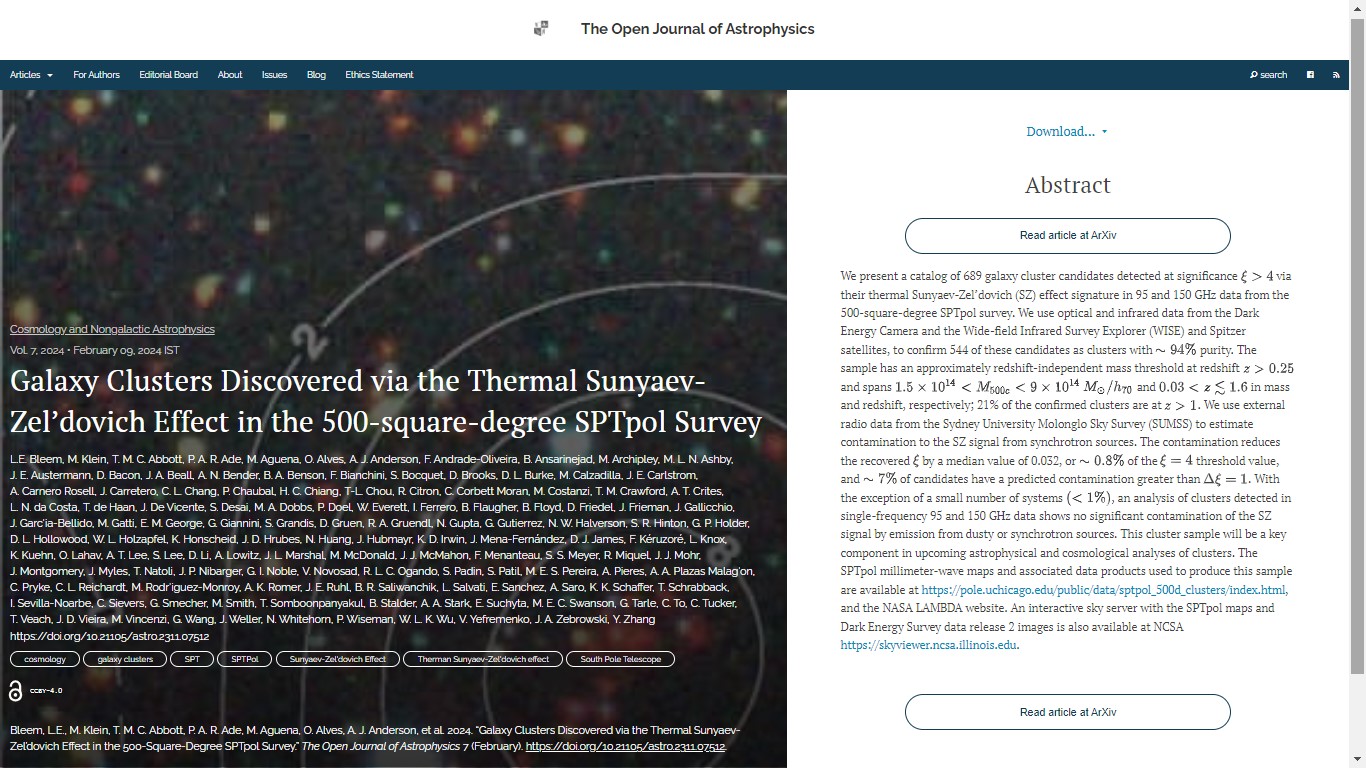
The title is “Galaxy Clusters Discovered via the Thermal Sunyaev-Zel’dovich Effect in the 500-square-degree SPTpol Survey” and it presents a catalogue of 689 galaxy clusters detected through the thermal Sunyaev-Zel’dovich using the dual-frequency polarization-sensitive camera SPTPol on the South Pole Telescope. This one is in the folder called Cosmology and NonGalactic Astrophysics.

This paper has lead author Lindsey Bleem  of the Argonne National Laboratory in the USA and has 127 other authors – too many to list individually here – but you can see them on the overlay below. I see quite a few names of people I know well!

Here is the overlay of the paper containing the abstract:


You can click on the image of the overlay to make it larger should you wish to do so. You can find the officially accepted version of the paper on the arXiv here.

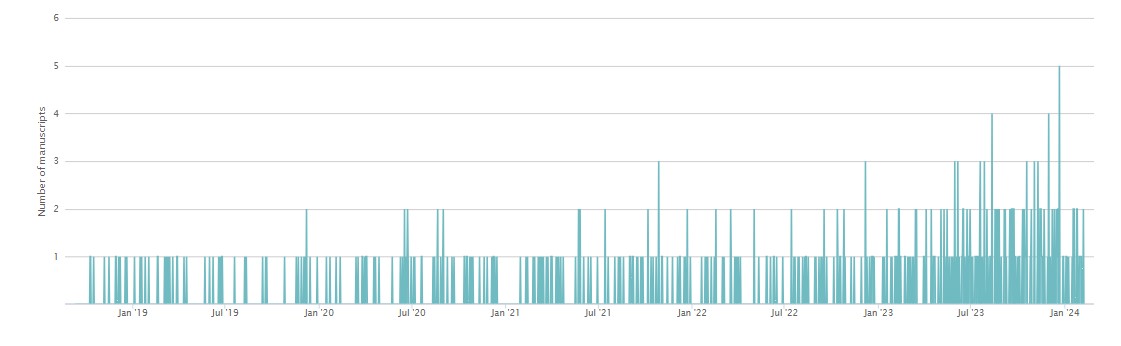
P.S. Incidentally, while I’m here I thought I’d share this little graphic I’ve generated (for other purposes) that shows how the rate of submissions to OJAp has increased over the last 5 years:

Three New Publications at the Open Journal of Astrophysics

Posted in OJAp Papers, Open Access, The Universe and Stuff with tags , , , , , , , , , , , , , , , , , on January 20, 2024 by telescoper

As promised yesterday, it’s time for a roundup of the week’s business at the  Open Journal of Astrophysics. This past week we have published three papers, taking  the count in Volume 7 (2024) up to 4 and the total published by OJAp up to 119. There are quite a few more ready to go as people return from the Christmas break.

In chronological order, the three papers published this week, with their overlays, are as follows. You can click on the images of the overlays to make them larger should you wish to do so.

First one up is “Prospects for studying the mass and gas in protoclusters with future CMB observations” by  Anna Gardner and Eric Baxter (Hawaii, USA), Srinivasan Raghunathan (NCSA, USA), Weiguang Cui (Edinburgh, UK), and Daniel Ceverino (Madrid, Spain). This paper, published on 17th January 2024, uses realistic hydrodynamical simulations to probe the ability of CMB Stage 4-like (CMB-S4) experiments to detect and characterize protoclusters via gravitational lensing and the Sunyaev-Zel’dovich effect. This paper is in the category of Cosmology and Nongalactic Astrophysics.

Here is a screen grab of the overlay, which includes the abstract:


You can find the officially accepted version of the paper on the arXiv here.

The second paper to announce is “SDSS J125417.98+274004.6: An X-ray Detected Minor Merger Dual AGN” and is by Marko Mićić, Brenna Wells, Olivia Holmes, and Jimmy Irwin (all of the University of Alabama, USA).  This presents the discovery of a dual AGN in a merger between the galaxy SDSS J125417.98+274004.6 and dwarf satellite, studied using X-ray observations from the Chandra satellite. The paper was also published on 18th January 2024 in the category Astrophysics of Galaxies . You can see the overlay here:


The accepted version of this paper can be found on the arXiv here.

The last paper of this batch is  entitled “Population III star formation: multiple gas phases prevent the use of an equation of state at high densities” and the authors are:  Lewis Prole (Maynooth, Ireland), Paul Clark (Cardiff, UK), Felix Priestley (Cardiff, UK), Simon Glover (Heidelberg, Germany) and John Regan (Maynooth, Ireland). This paper, which presents a comparison of results obtained using chemical networks and a simpler equation-of-state approach for primordial star formation (showing the limitations of the latter) was published on 19th January 2024 and also in the folder marked Astrophysics of Galaxies.

Here is the overlay:


You can find the full text for this one on the arXiv here.

And that concludes the update. There’ll be more next week!


Three New Publications at the Open Journal of Astrophysics

Posted in OJAp Papers, The Universe and Stuff with tags , , , , , , , , , on November 12, 2023 by telescoper

It’s been a busy week generally, and specifically at the  Open Journal of Astrophysics. In fact, this week we have published three papers, which I didn’t have time to post here at the time we published them but now present to you. These take the count in Volume 6 (2023) up to 44 and the total published by OJAp up to 109. With many more in the pipeline we’re still on for 50 by the end of the year.

In chronological order, the three papers published this week, with their overlays, are as follows. You can click on the images of the overlays to make them larger should you wish to do so. All three of these papers are in the folder Cosmology and Nongalactic Astrophysics.

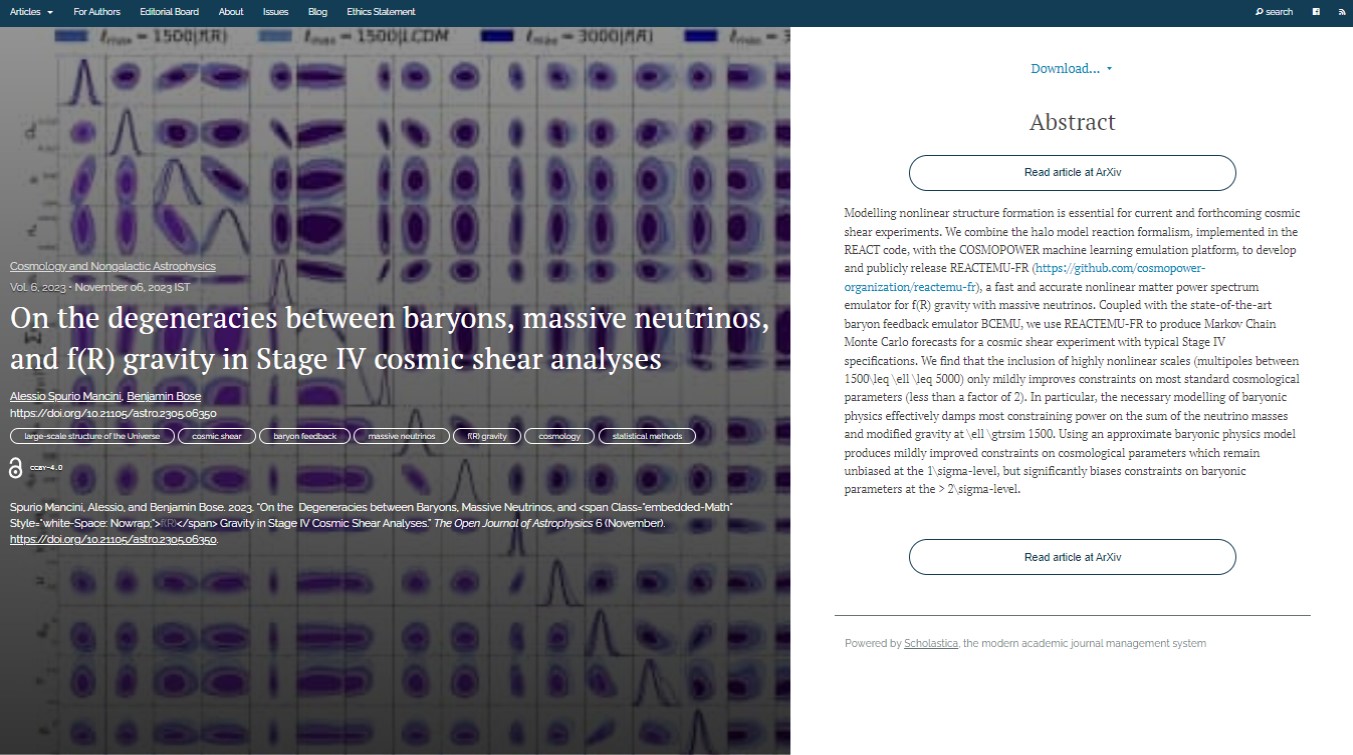
First one up is “On the degeneracies between baryons, massive neutrinos and f(R) gravity in Stage IV cosmic shear analyses” by Alessio Spurio Mancini (Mullard Space Sciences Laboratory, University College London, UK) and Benjamin Bose (Royal Observatory Edinburgh, UK). This presents a fast nonlinear matter power spectrum emulator for f(R) gravity with massive neutrinos, coupled with a baryon feedback emulator forecasts for a cosmic shear experiment with typical Stage IV specifications. This paper was published on 6th November 2023.

Here is a screen grab of the overlay, which includes the abstract:

You can find the officially accepted version of the paper on the arXiv here.

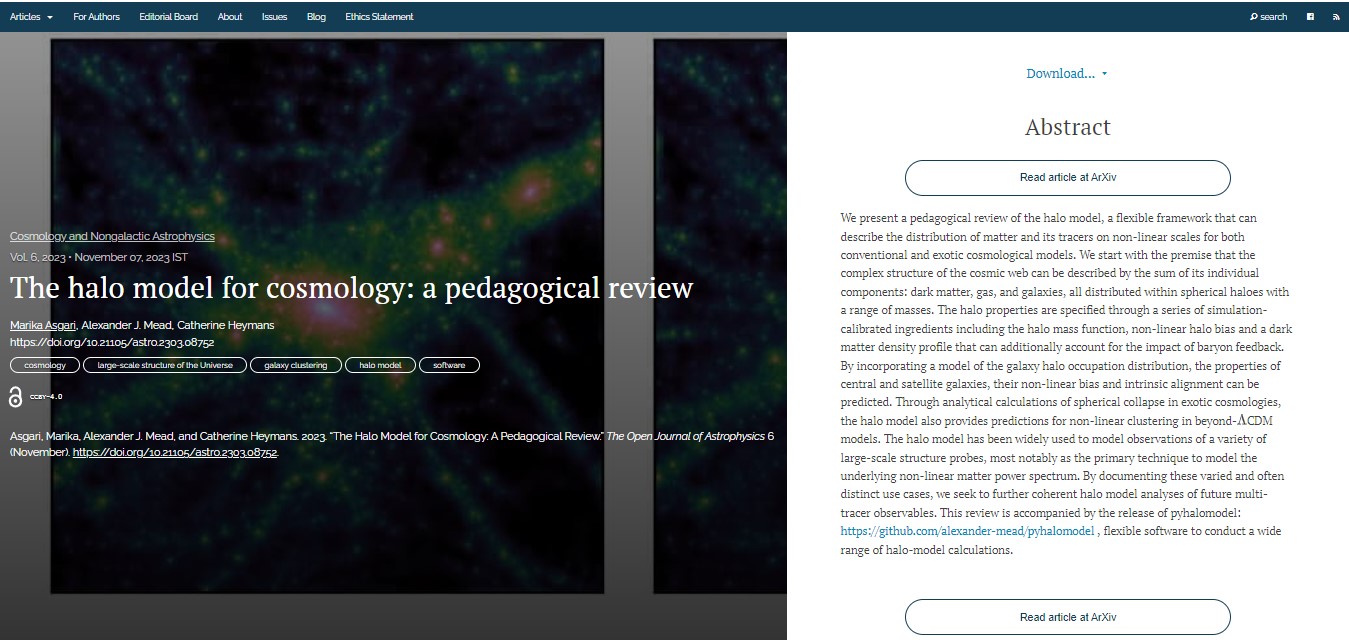
The second paper to announce is “” by Marika Asgari (Hull, UK), Alexander Mead (Bochum, Germany) and Catherine Heymans (Edinburgh, UK).  This presents a thorough discussion of the popular halo model for cosmological structure with applications, accompanied by the release of a software suite called pyhalomodel (which you can download here). The paper was also published on 7th November 2023 and you can see the overlay here:


The accepted version of this paper can be found on the arXiv here.

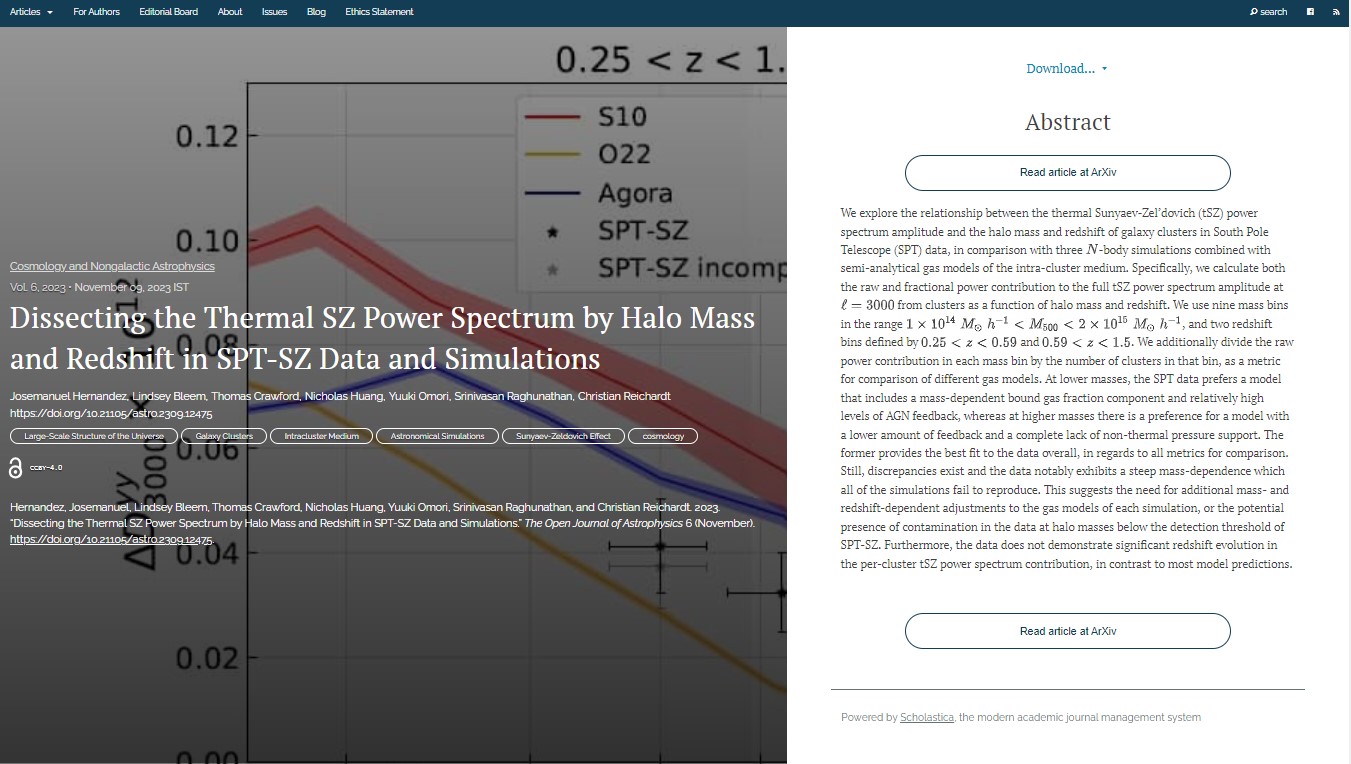
The last paper of this batch is  entitled “Dissecting the Thermal SZ Power Spectrum by Halo Mass and Redshift in SPT-SZ Data and Simulations” and the authors are: by Josemanuel Hernandez (Chicago), Lindsey Bleem (Chicago) , Thomas Crawford (Chicago), Nicholas Huang (Berkeley), Yuuki Omori (Chicago), Srinivasan Raghunathan (NCSA, Urbana) & Christian Reichardt (Melbourne). This paper, a study of the mass and redshift dependence of the thermal Sunyaev-Zeldovich effect in South Pole Telescope data and a comparison thereof with theoretical calculations, was published on 9th November 2023.

Here is the overlay:


You can find the full text for this one on the arXiv here.

R.I.P. Mark Birkinshaw (1954-2023)

Posted in Biographical, R.I.P., The Universe and Stuff with tags , , , , on August 17, 2023 by telescoper

I just heard this morning of the passing of Mark Birkinshaw (left) who was, since 1992, William P. Coldrick Professor of Cosmology and Astrophysics at the University of Bristol. Before that he held positions in Cambridge and Harvard.

I’m told that he died in hospital of a “short but serious illness”.

Among other important contributions to cosmology and astrophysics, in 1984, along with Steve Gull of Cambridge and Harry Hardebeck of the Owens Valley Observatory, was the first to measure experimentally the Sunyaev-Zel’dovich effect in a galaxy cluster; the reference is here.

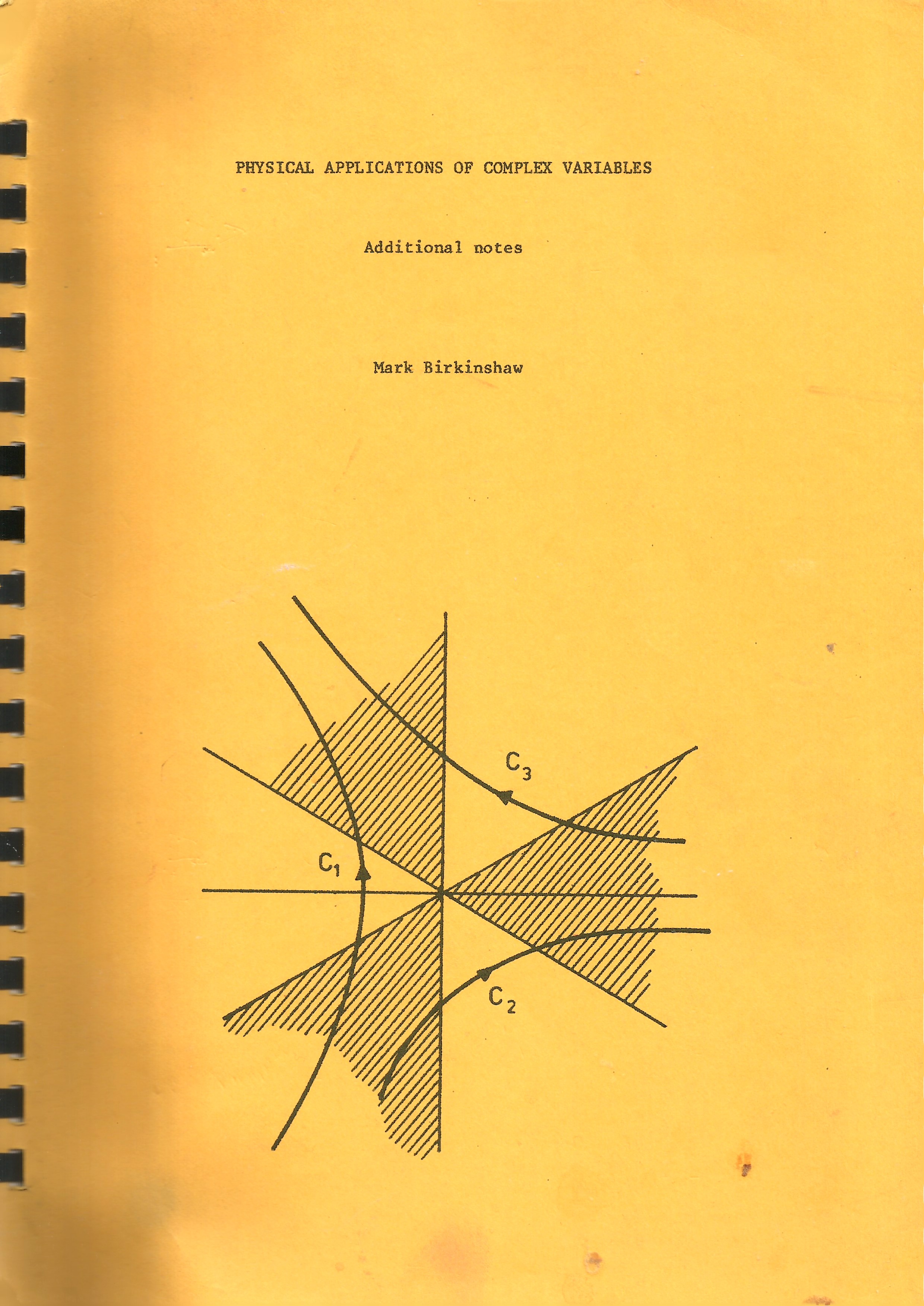
It was in Cambridge as an undergraduate that I first met Mark Birkinshaw. He taught the long vacation course on Physical Applications of Complex Variables that I took in the summer of 1984. It was a tough course but he was an excellent teacher. All these years later I still have my handwritten notes for that course as well as the handouts. I still use them too.

After that I saw him regularly at conferences and seminars and on various committees for PPARC and then STFC. He was extremely diligent in such “community service” roles and was an invaluable contributor owing to his wide range of knowledge beyond his own speciality.

Having been a mainstay of astrophysics research at Bristol University for over thirty years, Mark will be greatly missed. I send condolences to his friends and colleagues at Bristol and elsewhere in the world, and especially to Diana. You can send thoughts, tributes and condolences and/or make a charitable donation in Mark’s memory here, where there are also details of the funeral arrangements.

New Publication at the Open Journal of Astrophysics

Posted in OJAp Papers, Open Access, The Universe and Stuff with tags , , , , on March 10, 2023 by telescoper

It’s time to announce yet another new paper at the Open Journal of Astrophysics.

The latest paper is the 9th paper in Volume 6 (2023) and the 74th in all. This one is another one for the folder marked Instrumentation and Methods for Astrophysics. The title is “panco2: a Python library to measure intracluster medium pressure profiles from Sunyaev-Zeldovich observations”. The code described in the paper The Python code is available on GitHub and there isextensive technical documentation to complement this paper.

The authors are Florian Kéruzoré (Argonne National Laboratory, USA, and the University of University of Grenoble, France), Frédéric Mayet, Emmanuel Artis, Juan-Francisco Macías-Pérez, Miren Muñoz-Echeverría and Laurence Perotto (all of the University of Grenoble, France) and Florian Ruppin (of the University of Lyon, also in France).

Here is a screen grab of the overlay which includes the  abstract:


You can click on the image of the overlay to make it larger should you wish to do so. You can find the officially accepted version of the paper on the arXiv here.

High-resolution Observation of the Sunyaev-Zel’dovich Effect With ALMA

Posted in The Universe and Stuff with tags , , on August 1, 2016 by telescoper

I just saw a very interesting paper (by Kitayama et al.) on the arXiv, which I’m pretty sure presents the highest-ever resolution observations of the (Thermal) Sunyaev-Zel’dovich Effect in a galaxy cluster taken with the Atacama Large Millimetre Array (ALMA). This is basically a distortion of the spectrum of the cosmic microwave background seen in the direction of the cluster caused by scattering of CMB photons off electrons in the extremely hot plasma that pervades such an object. The key parameter to be measured along each line of sight is the Compton y-parameter, which is defined as

y = \tau \frac{kT}{m_ec^2},

where \tau the optical depth of the cluster (which in this case is essentially the fraction of CMB photons that get scattered) and T is the plasma temperature; for a more technical discussion of the process see here.

Here is the abstract of the paper:

We present the first image of the thermal Sunyaev-Zel’dovich effect (SZE) obtained by the Atacama Large Millimeter/submillimeter Array (ALMA). Combining 7-m and 12-m arrays in Band 3, we create an SZE map toward a galaxy cluster RXJ1347.5-1145 with 5 arc-second resolution (corresponding to the physical size of 20 kpc/h), the highest angular and physical spatial resolutions achieved to date for imaging the SZE, while retaining extended signals out to 40 arc-seconds. The 1-sigma statistical sensitivity of the image is 0.017 mJy/beam or 0.12 mK_CMB at the 5 arc-second full width at half maximum. The SZE image shows a good agreement with an electron pressure map reconstructed independently from the X-ray data and offers a new probe of the small-scale structure of the intracluster medium. Our results demonstrate that ALMA is a powerful instrument for imaging the SZE in compact galaxy clusters with unprecedented angular resolution and sensitivity. As the first report on the detection of the SZE by ALMA, we present detailed analysis procedures including corrections for the missing flux, to provide guiding methods for analyzing and interpreting future SZE images by ALMA.

And here is the key image, a map of the variation of the Compton y-parameter across the cluster:

SZ

It’s not at all easy to isolate the Sunyaev-Zeld’dovich effect, so this is an impressive result and the paper is well-worth reading. Observations at such high resolution will help greatly to understand the behaviour of hot gas in rich clusters, especially when combined with observations of the emission from the cluster plasma itself, which is hot enough to radiate in the X-ray part of the spectrum.

First Science from Planck

Posted in The Universe and Stuff with tags , , , , , , , , , on January 11, 2011 by telescoper

It’s been quite a long wait for results to emerge from the Planck satellite, which was launched in May 2009, but today the first science results have at last been released. These aren’t to do with the cosmological aspects of the mission – those will have to wait another two years – but things we cosmologists tend to think of as “foregrounds”, although they are of great astrophysical interest in themselves.

For an overview, with lots of pretty pictures,  see the European Space Agency’s Planck site and the UK Planck outreach site; you can also watch this morning’s press briefing in full here.

A repository of all 25 science papers can be found here and there’ll no doubt be a deluge of them on the arXiv tomorrow.

A few of my Cardiff colleagues are currently in Paris living it up at the junket working hard at the serious scientific conference at which these results are being discussed. I, on the other hand, not being one of the in-crowd, am back here in Cardiff, only have a short window in between meetings, project vivas and postgraduate lectures  to comment on the new data. I’m also sure there’ll be a huge amount of interest in the professional media and in the blogosphere for some time to come. I’ll therefore just mention a couple of things that struck me immediately as I went quickly through the papers while I was eating my sandwich; the following was cobbled together from the associated ESA press release.

The first concerns the so-called  ‘anomalous microwave emission’ (aka Foreground X) , which is a diffuse glow most strongly associated with the dense, dusty regions of our Galaxy. Its origin has been a puzzle for decades, but data collected by Planck seem to confirm the theory that it comes from rapidly spinning dust grains. Identifying the source of this emission will help Planck scientists remove foreground contamination which much greater precision, enabling them to construct much cleaner maps of the cosmic microwave background and thus, among other things, perhaps clarify the nature of the various apparent anomalies present in current cosmological data sets.

Here’s a nice composite image of a region of anomalous emission, alongside individual maps derived from low-frequency radio observations as well as two of the Planck channels (left).

Credits: ESA/Planck Collaboration

The colour composite of the Rho Ophiuchus molecular cloud highlights the correlation between the anomalous microwave emission, most likely due to miniature spinning dust grains observed at 30 GHz (shown here in red), and the thermal dust emission, observed at 857 GHz (shown here in green). The complex structure of knots and filaments, visible in this cloud of gas and dust, represents striking evidence for the ongoing processes of star formation. The composite image (right) is based on three individual maps (left) taken at 0.4 GHz from Haslam et al. (1982) and at 30 GHz and 857 GHz by Planck, respectively. The size of the image is about 5 degrees on a side, which is about 10 times the apparent diameter of the full Moon.

The second of the many other exciting results presented today that I wanted to mention is a release of new data on clusters of galaxies – the largest structures in the Universe, each containing hundreds or even thousands of galaxies. Owing to the Sunyaev-Zel’dovich Effect these show up in the Planck data as compact regions of lower temperature in the cosmic microwave background. By surveying the whole sky, Planck stands the best chance of finding the most massive examples of these clusters. They are rare and their number is a sensitive probe of the kind of Universe we live in, how fast it is expanding, and how much matter it contains.

Credits: ESA/Planck Collaboration; XMM-Newton image: ESA

This image shows one of the newly discovered superclusters of galaxies, PLCK G214.6+37.0, detected by Planck and confirmed by XMM-Newton. This is the first supercluster to be discovered through its Sunyaev-Zel’dovich effect. The effect is the name for the cluster’s silhouette against the cosmic microwave background radiation. Combined with other observations, the Sunyaev-Zel’dovich effect allows astronomers to measure properties such as the temperature and density of the cluster’s hot gas where the galaxies are embedded. The right panel shows the X-ray image of the supercluster obtained with XMM-Newton, which reveals that three galaxy clusters comprise this supercluster. The bright orange blob in the left panel shows the Sunyaev-Zel’dovich image of the supercluster, obtained by Planck. The X-ray contours are also superimposed on the Planck image.

UPDATES: For other early perspectives on the early release results, see the blogs of Andrew Jaffe and Stuart Lowe; as usual, Jonathan Amos has done a very quick and well-written news piece for the BBC.


Share/Bookmark

Hot Stuff, Looking Cool..

Posted in The Universe and Stuff with tags , , , , , on September 15, 2010 by telescoper

It’s nice for a change to have an excuse to write something about science rather than science funding, as a press release appeared today concerning the discovery of a new supercluster by Planck in collaboration with the X-ray observatory XMM-Newton.

The physics behind this new discovery concerns what happens to low-energy photons from the cosmic microwave background (CMB) when they are scattered by extremely hot plasma. Basically, incoming microwave photons collide with highly energetic electrons with the result that they gain energy and so are shifted to shorter wavelengths. The generic name given to this process is inverse Compton scattering, and it can happen in a variety of physical contexts. In cosmology, however, there is a particularly important situation where this process has observable consequences, when CMB photons travel through the extremely hot (but extremely tenuous) ionized gas in a cluster of galaxies. In this setting the process is called the Sunyaev-Zel’dovich effect.

The observational consequence is slightly paradoxical because what happens is that the microwave background can appears to have a lower temperature (at least for a certain range of wavelengths) in the direction of a galaxy cluster (in which the plasma can have a temperature of 10 million degrees or more). This is because fewer photons reach the observer in the microwave part of the spectrum that would if the cluster did not intervene; the missing ones have been kicked up to higher energies and are therefore not seen at their original wavelength, ergo the CMB looks a little cooler along the line of sight to a cluster than in other directions. To put it another way, what has actually happened is that the hot electrons have distorted the spectrum of the photons passing through it.

Here’s an example of the Sunyaev-Zel’dovich effect in action as seen by Planck in seven frequency bands:

At low frequencies (in the Rayleigh-Jeans part of the spectrum) the region where the cluster is looks cooler than average, although at high frequencies the effect is reversed.

The magnitude of the temperature distortion produced by a cluster depends on the density of electrons in the plasma pervading the cluster n, the temperature of the plasma T, and the overall size of the cluster; in fact, it’s propotional to n×T integrated along the line of sight through the cluster.

Why this new result is so interesting is that it combines very sensitive measurements of the microwave background temperature pattern  with sensitive measures of the X-ray emission over the same region of the sky. Plasma hot enough to produce a Sunyaev-Zel’dovich distortion of the CMB spectrum will also generate X-rays through a process known as thermal bremsstrahlung.  The power of the X-ray emission depends on the square of the electron density n2 multiplied by the Temperature T.

Since the Sunyaev-Zel’dovich and X-ray measurements depend on different mathematical combinations of the physical properties involved the amalgamation of these two techniques allows astronomers to probe the internal details of the cluster quite precisely.

The example shown here in the top two panels is of a familiar cluster – the Coma Cluster as mapped by Planck (in microwaves) and, by an older X-ray satellite called ROSAT, in X-rays. The two distributions have very similar morphology, strongly suggesting that they have a common origin in the cluster plasma.

The bottom panels show comparisons with the distribution of galaxies as seen in the optical part of the spectrum. You can see that the hot gas I’ve been talking about extends throughout the space between the galaxies. In fact, there is at least as much matter in the hot plasma as there is in the individual galaxies in objects like this, but it’s too hot to be seen in optical light. This could reasonably be called dark matter when it comes to its lack of optical emission, but it’s certainly not dark in X-rays!

The reason why the intracluster plasma is so hot boils down to the strength of the gravitational field in the cluster. Roughly speaking, the hot matter is in virial equilibrium within the gravitational potential generated by the mass distribution within the cluster. Since this is a very deep potential well, electrons move very quickly in response to it. In fact, the galaxies in the cluster are also roughly in virial equilibrium so they too are pulled about by the gravitational field. Galaxies don’t sit around quietly in clusters, they buzz about like bees in a bottle.

Anyway, the new data arising from the combination of Planck and XMM-Newton has revealed not just one cluster, but a cluster of clusters (i.e. a “supercluster”):

It’s early days for Planck, of course, and this is no more than a taster.
The Planck team is currently analysing the data from the first all-sky survey to identify both known and new galaxy clusters for the early Sunyaev-Zel’dovich catalogue, which will be released in January of 2011 as part of the Early Release Compact Source Catalogue. The full Sunyaev-Zel’dovich catalogue may well turn out to be the most enduring legacy of the Planck mission.


Share/Bookmark