Archive for protoclusters

Weekly Update from the Open Journal of Astrophysics 18/07/2026

Posted in OJAp Papers, Open Access, The Universe and Stuff with tags , , , , , , , , , , , , , , , , , , , , , , , , , , , , , , , , , , on July 18, 2026 by telescoper

It’s time once more for another Saturday update of activity at the Open Journal of Astrophysics. Since the last update we have published a further six papers, bringing the number in Volume 9 (2026) to 151 and the total so far published by OJAp up to 599.

I will continue to include the posts made on our Mastodon account (on Fediscience); these announcements also show the DOI for each paper.

The first paper to report this week, published on Tuesday 14th July, is “On combining estimated and analytic covariance matrices” by Alan Heavens (Imperial College London, UK), Lorne Whiteway (University College, London, UK) and Elena Sellentin (Leiden University, The Netherlands). This article, published in the folder Cosmology and Nongalactic Astrophysics, presents an accurate approximation for the combined likelihood function in cosmological data analysis, improving upon previous methods by better representing the heavy tails of the true distribution.

The overlay for this paper is here
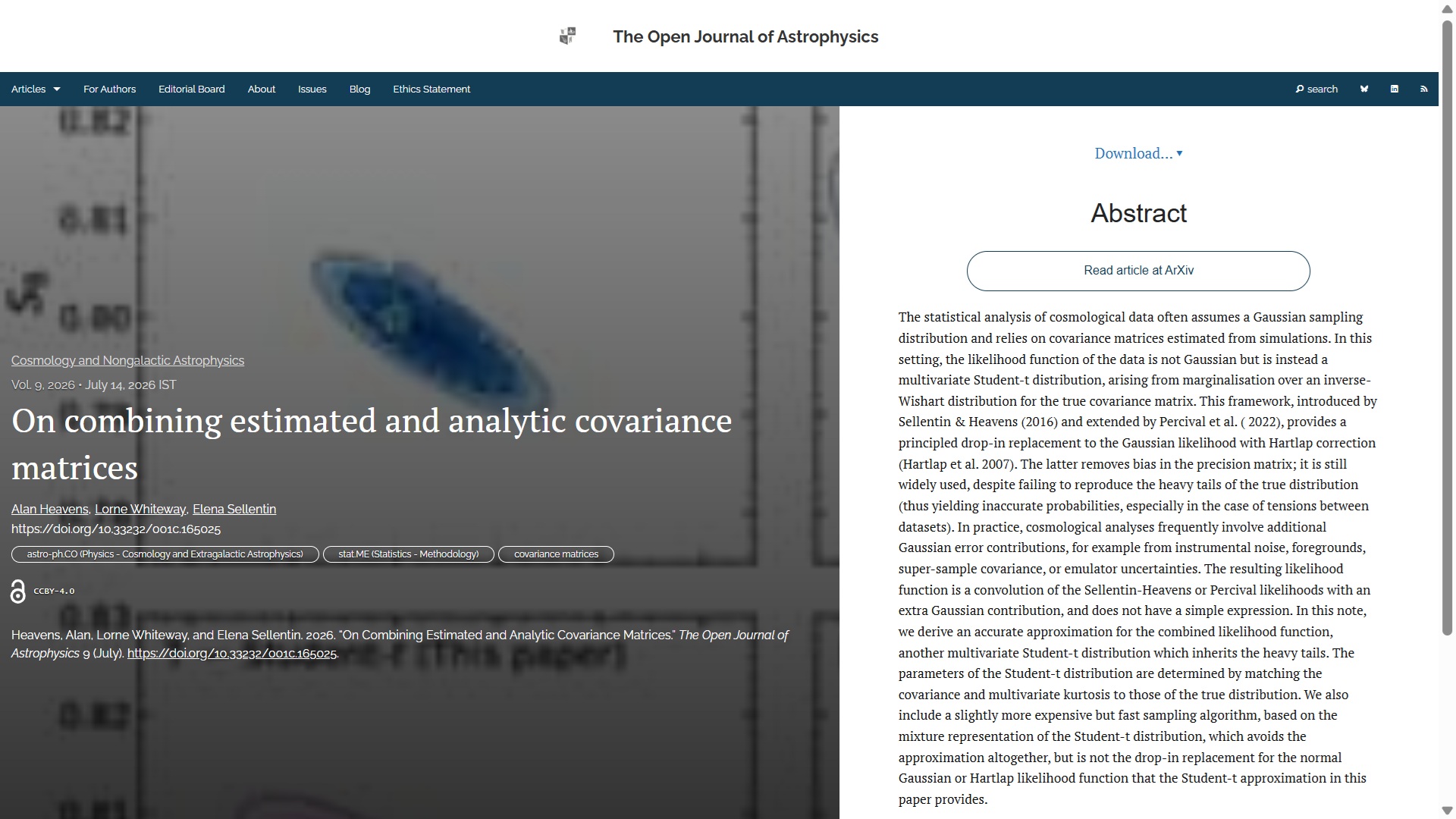
You can find the officially accepted version on arXiv here and the announcement on Fediverse here:

Open Journal of Astrophysics

New Publication at the Open Journal of Astrophysics: "On combining estimated and analytic covariance matrices" by Alan Heavens (Imperial College London, UK), Lorne Whiteway (University College, London, UK) and Elena Sellentin (Leiden University, The Netherlands)

doi.org/10.33232/001c.165025

July 14, 2026, 6:48 am 1 boosts 0 favorites

The second paper for this week, also published on Tuesday 14th July in the folder Cosmology and Nongalactic Astrophysics is: “Line-of-sight shear in SLACS strong lenses II: validation tests with an extended sample” by Natalie B. Hogg (U. Cambridge, UK), Daniel P. Johnson (Université de Montpellier, France), Anowar J. Shajib (U. Chicago, USA) and Julien Larena (Montpellier). The study described in this paper models 27 additional gravitational lenses, finding a significant fraction with unexpectedly large line-of-sight shears. Factors like redshift, filter, and signal-to-noise ratio don’t significantly affect shear magnitudes.

The overlay looks like this:
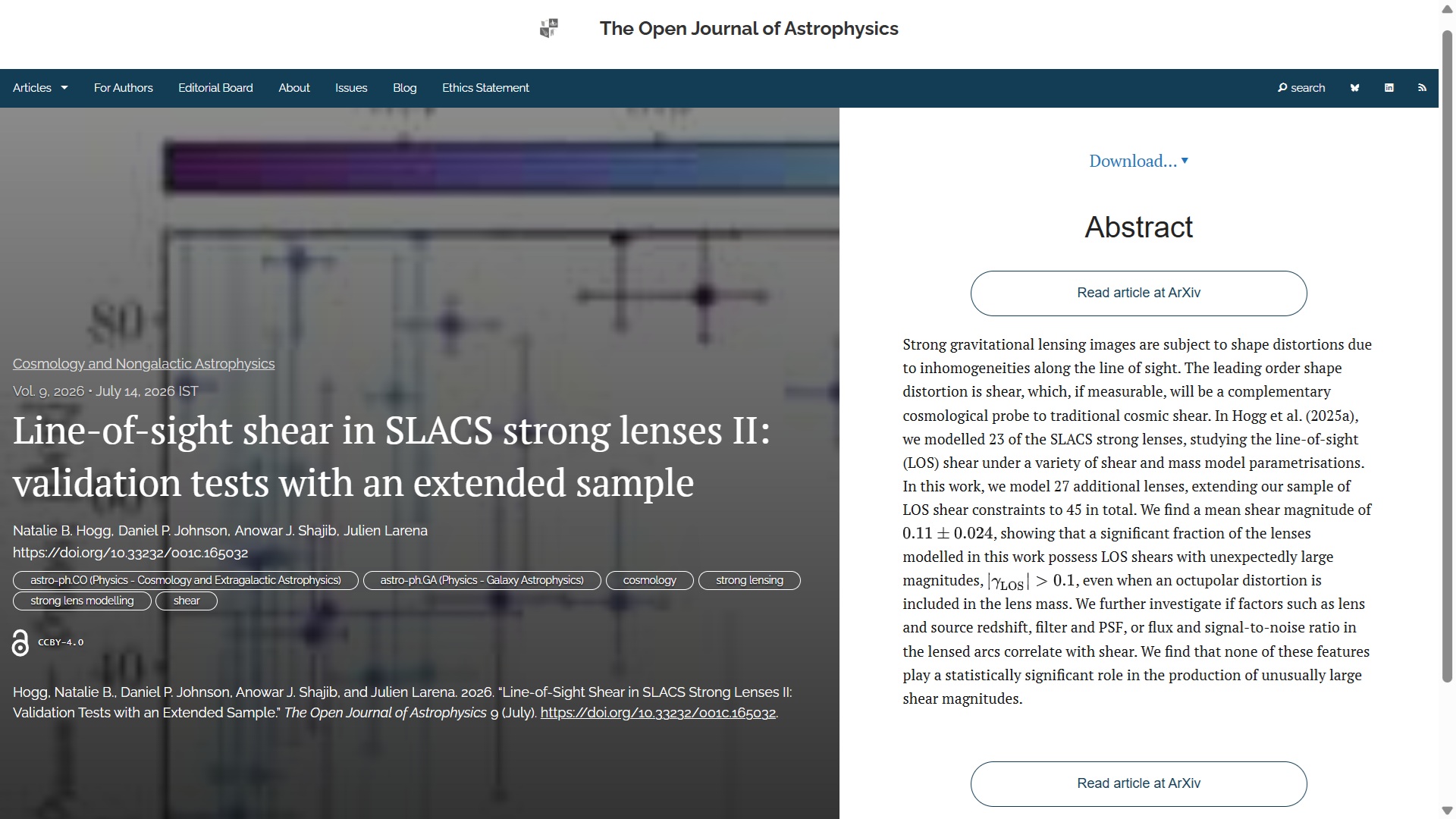
The official version of the paper can be found on arXiv here and the Fediverse announcement here:

Open Journal of Astrophysics

New Publication at the Open Journal of Astrophysics: "Line-of-sight shear in SLACS strong lenses II: validation tests with an extended sample" by Natalie B. Hogg (U. Cambridge, UK), Daniel P. Johnson (Université de Montpellier, France), Anowar J. Shajib (U. Chicago, USA) and Julien Larena (Montpellier)

doi.org/10.33232/001c.165032

July 14, 2026, 6:57 am 1 boosts 1 favorites

The third paper of the week, published on Wednesday 15th July, again in the folder Cosmology and Nongalactic AstrophysicsInvestigating the Dark Energy Constraint from Strongly Lensed AGN at LSST-Scale” by Sydney Erickson (Stanford University, USA) and 13 others on behalf of The LSST Dark Energy Science Collaboration. The study uses a new technique to analyze a large sample of lensed Active Galactic Nuclei, providing an independent probe of dark energy and improving constraints on the Universe’s expansion.

The overlay for this one is here:
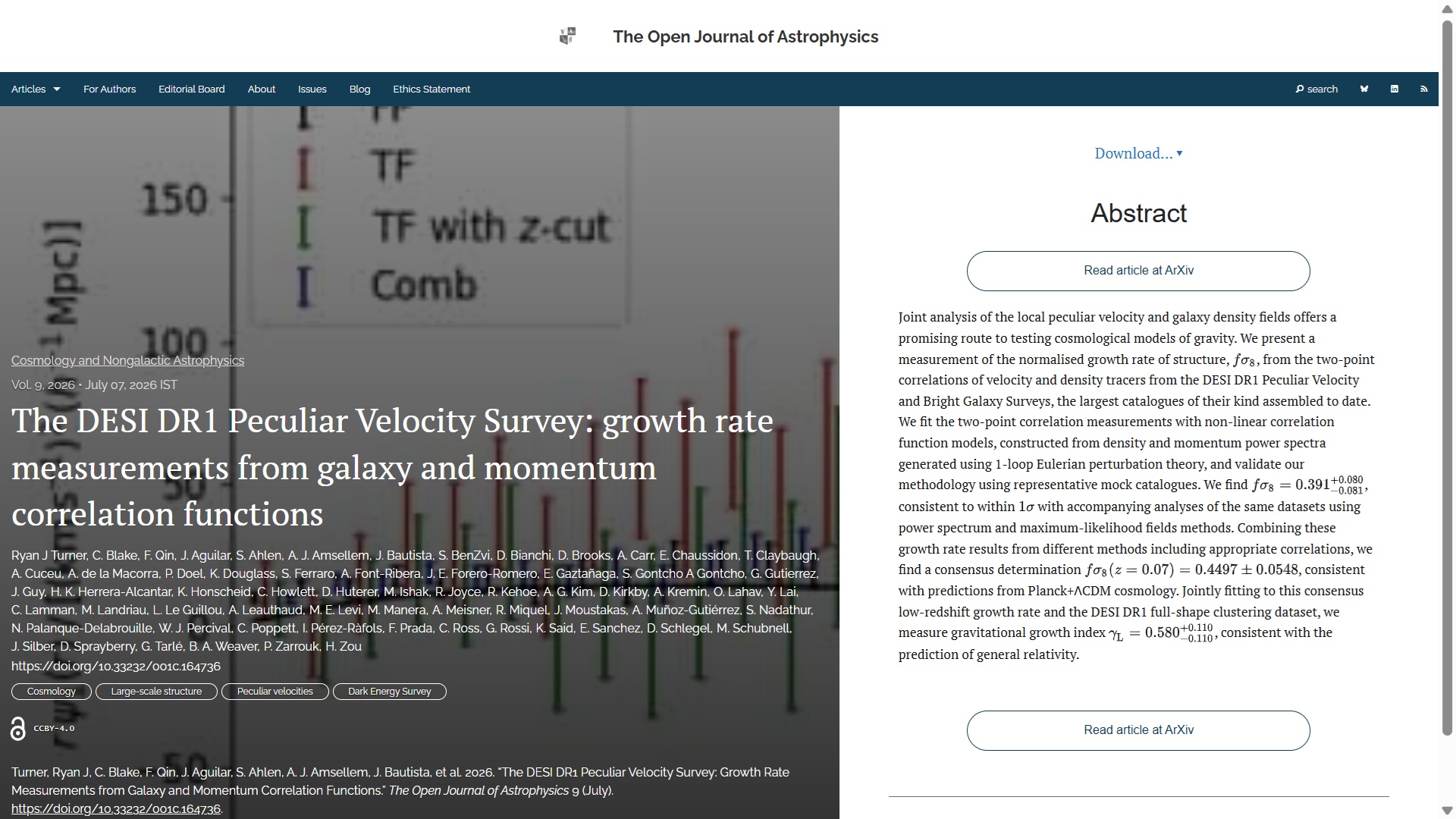
The final, accepted version can be found on arXiv here and the Mastodon announcement is here:

Open Journal of Astrophysics

New Publication at the Open Journal of Astrophysics: "Investigating the Dark Energy Constraint from Strongly Lensed AGN at LSST-Scale" by Sydney Erickson (Stanford University, USA) and 13 others on behalf of The LSST Dark Energy Science Collaboration

doi.org/10.33232/001c.164440

July 15, 2026, 7:08 am 1 boosts 1 favorites

The fourth paper of the week, also published on Wednesday 15th July but in the folder Earth and Planetary Astrophysics is “University of Hawaii 88-inch Telescope Observations of the Interstellar Comet 3I/ATLAS: Spectrophotometric Blue-Sensitive Spectral Time Series Spanning Two Months from Discovery” by W. B. Hoogendam (University of Hawaii, USA) and 24 others from around the world. The study presents observations of the third interstellar object, 3I/ATLAS, using the SuperNova Integral Field Spectrograph, revealing its properties and comparing it to bodies in our solar system.

The overlay for this one is here:
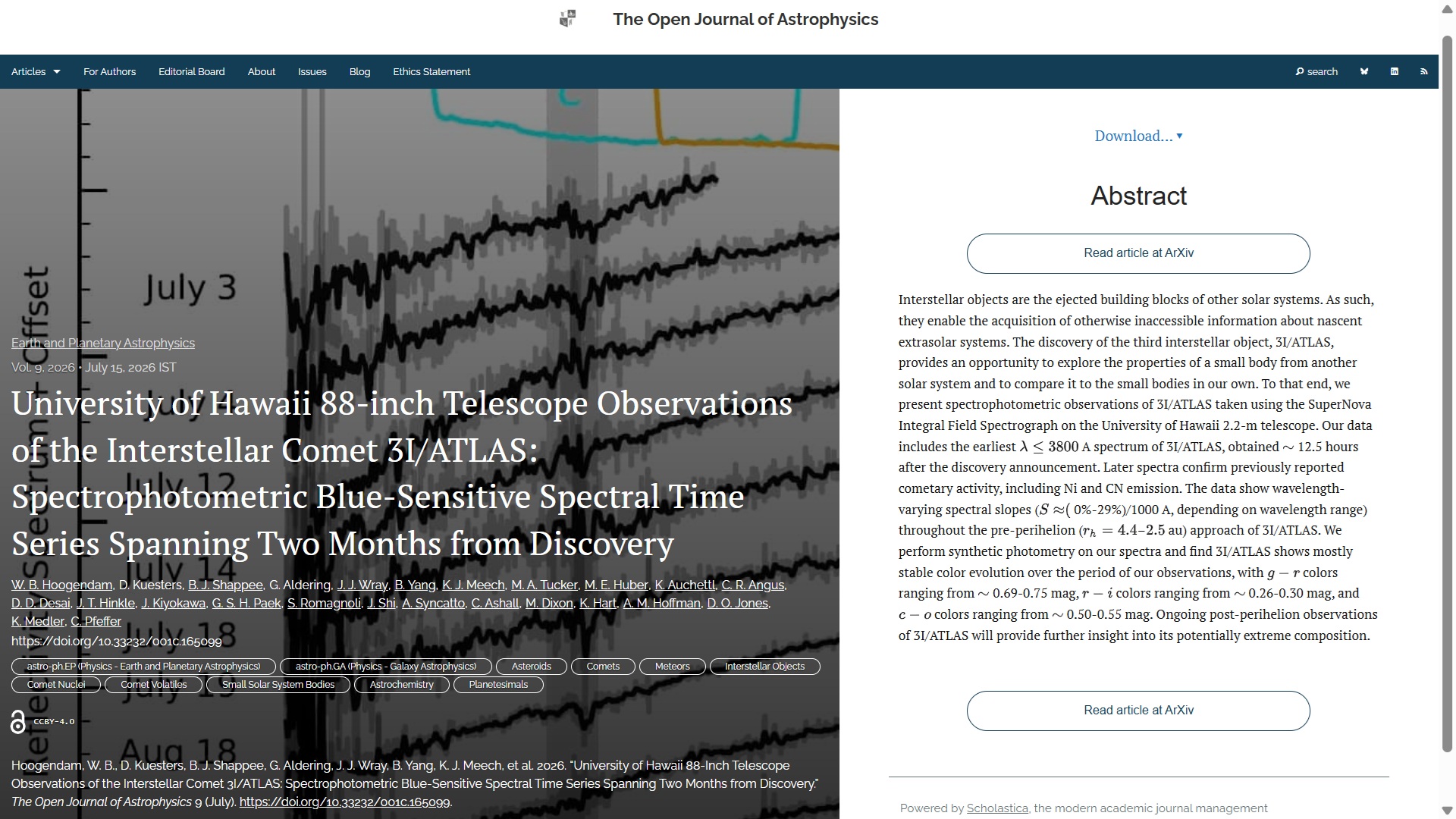
You can read the final version of this one on arXiv here and the Mastodon announcement is here:

Open Journal of Astrophysics

New Publication at the Open Journal of Astrophysics: "University of Hawaii 88-inch Telescope Observations of the Interstellar Comet 3I/ATLAS: Spectrophotometric Blue-Sensitive Spectral Time Series Spanning Two Months from Discovery" by W. B. Hoogendam (University of Hawaii, USA) and 24 others from around the world.

doi.org/10.33232/001c.165099

July 15, 2026, 7:21 pm 1 boosts 3 favorites

The fifth paper of the week, published on Friday 17th July in the folder Astrophysics of Galaxies, is “The birth of the intracluster medium: the evolution of multiphase gas and Lyman-α haloes in a z~3 simulated protocluster” by Jake S. Bennett (Harvard Smithsonian CfA, USA), Aaron Smith (U. Nottingham, UK), Fabrizio Arrigoni-Battaia (MPA Garching, Germany), Debora Sijacki (U. Cambridge, UK) , Cassandra Lochhaas (CfA) and Lars Hernquist (CfA). This study uses a cosmological simulation to explore the transition from complex galactic haloes to mature galaxy clusters, focusing on gas distribution, ionisation, and emission changes during this evolution.

The overlay for this one is here:
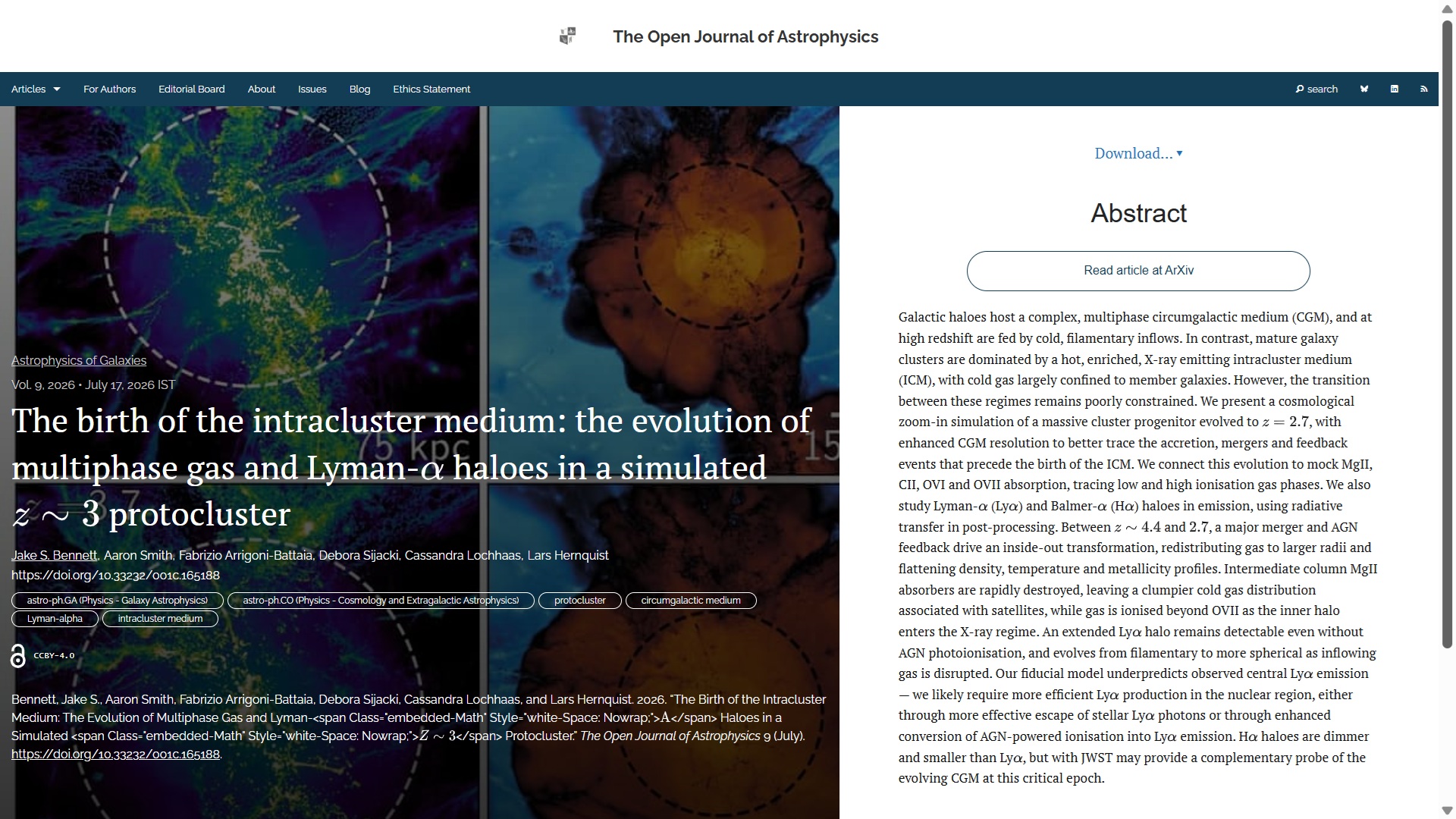
You can read the final version of this one on arXiv here and the Mastodon announcement is here:

Open Journal of Astrophysics

New Publication at the Open Journal of Astrophysics: "The birth of the intracluster medium: the evolution of multiphase gas and Lyman-α haloes in a z~3 simulated protocluster" by Jake S. Bennett (Harvard Smithsonian CfA, USA), Aaron Smith (U. Nottingham, UK), Fabrizio Arrigoni-Battaia (MPA Garching, Germany), Debora Sijacki (U. Cambridge, UK) , Cassandra Lochhaas (CfA) and Lars Hernquist (CfA).

doi.org/10.33232/001c.165188

July 17, 2026, 7:23 am 0 boosts 0 favorites

The sixth and final paper of this week is “Density reconstruction from biased tracers: Testing the equivalence principle through consistency relations” by Lawrence Dam and Omar Darwish (Université de Genève, Switzerland). This was published on Friday 17th July in the folder Cosmology and Nongalactic Astrophysics. It proposes using quadratic estimators to test the weak equivalence principle on cosmological scales, offering a practical alternative to the conventional bispectrum approach.

The overlay for this one is here:

You can find the final accepted version on arXiv here and the Mastodon announcement is here:

Open Journal of Astrophysics

New Publication at the Open Journal of Astrophysics: "Density reconstruction from biased tracers: Testing the equivalence principle through consistency relations" by Lawrence Dam and Omar Darwish (Université de Genève, Switzerland)

doi.org/10.33232/001c.165214

July 17, 2026, 7:42 am 0 boosts 0 favorites

As you can see we have now published over 150 papers this year and are just one shy of 600 in total. I expect we’ll pass that milestone next week. I’ll do another update next Saturday.

Three New Publications at the Open Journal of Astrophysics

Posted in OJAp Papers, Open Access, The Universe and Stuff with tags , , , , , , , , , , , , , , , , , on January 20, 2024 by telescoper

As promised yesterday, it’s time for a roundup of the week’s business at the  Open Journal of Astrophysics. This past week we have published three papers, taking  the count in Volume 7 (2024) up to 4 and the total published by OJAp up to 119. There are quite a few more ready to go as people return from the Christmas break.

In chronological order, the three papers published this week, with their overlays, are as follows. You can click on the images of the overlays to make them larger should you wish to do so.

First one up is “Prospects for studying the mass and gas in protoclusters with future CMB observations” by  Anna Gardner and Eric Baxter (Hawaii, USA), Srinivasan Raghunathan (NCSA, USA), Weiguang Cui (Edinburgh, UK), and Daniel Ceverino (Madrid, Spain). This paper, published on 17th January 2024, uses realistic hydrodynamical simulations to probe the ability of CMB Stage 4-like (CMB-S4) experiments to detect and characterize protoclusters via gravitational lensing and the Sunyaev-Zel’dovich effect. This paper is in the category of Cosmology and Nongalactic Astrophysics.

Here is a screen grab of the overlay, which includes the abstract:


You can find the officially accepted version of the paper on the arXiv here.

The second paper to announce is “SDSS J125417.98+274004.6: An X-ray Detected Minor Merger Dual AGN” and is by Marko Mićić, Brenna Wells, Olivia Holmes, and Jimmy Irwin (all of the University of Alabama, USA).  This presents the discovery of a dual AGN in a merger between the galaxy SDSS J125417.98+274004.6 and dwarf satellite, studied using X-ray observations from the Chandra satellite. The paper was also published on 18th January 2024 in the category Astrophysics of Galaxies . You can see the overlay here:


The accepted version of this paper can be found on the arXiv here.

The last paper of this batch is  entitled “Population III star formation: multiple gas phases prevent the use of an equation of state at high densities” and the authors are:  Lewis Prole (Maynooth, Ireland), Paul Clark (Cardiff, UK), Felix Priestley (Cardiff, UK), Simon Glover (Heidelberg, Germany) and John Regan (Maynooth, Ireland). This paper, which presents a comparison of results obtained using chemical networks and a simpler equation-of-state approach for primordial star formation (showing the limitations of the latter) was published on 19th January 2024 and also in the folder marked Astrophysics of Galaxies.

Here is the overlay:


You can find the full text for this one on the arXiv here.

And that concludes the update. There’ll be more next week!