Archive for Syksy Räsänen

New Publication at the Open Journal of Astrophysics

Posted in OJAp Papers, Open Access, The Universe and Stuff with tags , , , , , , on January 27, 2023 by telescoper

Time to announce another new paper at the Open Journal of Astrophysics. This one was published yesterday, 26th January 2023. The latest paper is the third paper in Volume 6 (2023) as well as the 68th in all. It’s yet another in the Cosmology and NonGalactic Astrophysics folder.

The latest publication is entitled “Palatini formulation for gauge theory: implications for slow-roll inflation” and the authors are Syksy Räsänen of the University of Helsinki in Finland and Yosef Verbin (The Open University of Israel, Ra’anana, Israel). The first author has  published a previous paper on the Palatini formulation in the Open Journal of Astrophysics.

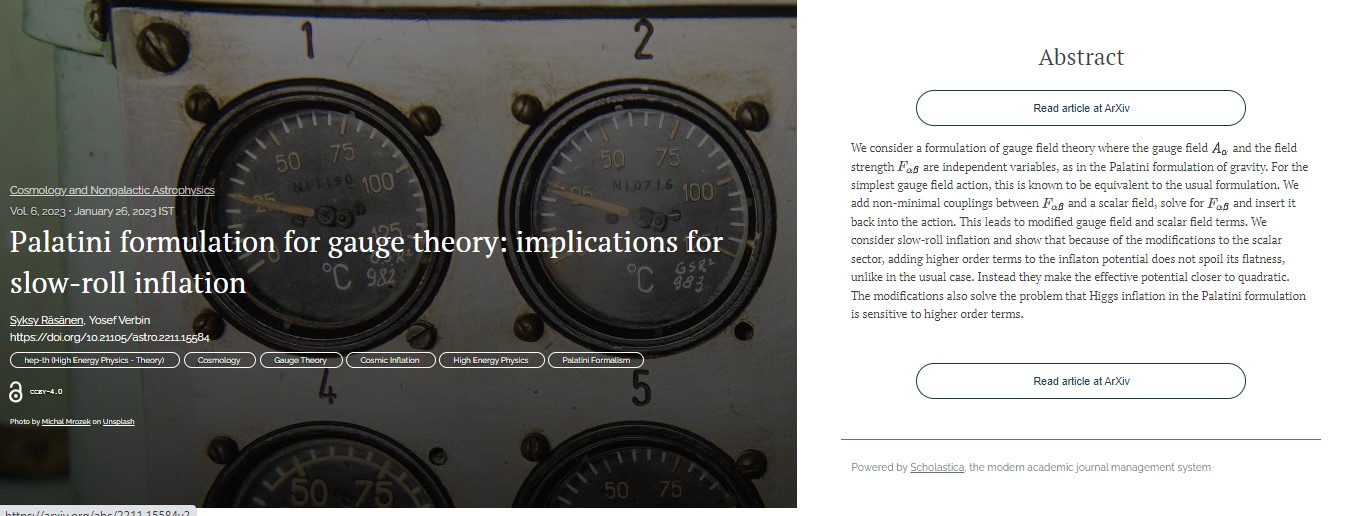
Here is a screen grab of the overlay which includes the  abstract:


You can click on the image to make it larger should you wish to do so. You can find the officially accepted version of the paper on the arXiv here.

P.S. You may be wondering about the image shown in the overlay. This paper doesn’t contain any figures or images so I tried out the collection of stock photographs that comes free with the Scholastica platform by typing in “gauge”. The result was a quite amusing collection of pictures of various kinds of dials and other gauges. I quite liked the one above so used it just for show!

The Verdict in the Ott Case

Posted in Harassment Bullying etc with tags , , , on November 17, 2022 by telescoper

Just time for a very quick post regarding the court case I mentioned last week initiated by Christian Ott.

You will recall that Christian Ott resigned from a position at Caltech in 2016 after being found guilty of gender-based harassment against two graduate students, I wrote about this case and some of the issues it raised here. Little information about the case was divulged publicly by Caltech at the time.

After leaving Caltech, Ott was offered a position at the University of Turku in Finland but that offer was rescinded after protests about this apparent case of “passing the harasser”. Syksy Räsänen and Till Sawala initiated an open letter that was signed by a large number of academics calling for Ott’s appointment to be cancelled. Syksy blogged about the case here (in Finnish; scroll down to see the English translation). Ott now works as a software consultant.

Not being at all knowledgeable about Finnish law, I wasn’t sure of the legal basis on which Ott’s case was being pursued but it seemed to involve an accusation of “aggravated defamation”; the second charge was “aggravated dissemination of information that violates privacy”.

Anyway, the relevant court issued its judgment today. The charges against Räsänen and Sawala were dismissed.I am delighted and relieved by this news. The only coverage I have seen so far is in Finnish – see here for example – but I’ll update with more when it becomes available.

Here is the text of a press release from Syksy Räsänen and Till Sawala about the verdict.

Two astrophysicists win defamation trial after calling out harassment

Two astrophysicists at the University of Helsinki, Finland, were today acquitted of “aggravated defamation” and “aggravated dissemination of information that violates privacy” in the district court of Southwest Finland in Turku [1]. They had spoken out when Christian Ott, an astrophysicist previously suspended due to harassment, was hired at the University of Turku. The prosecutor had demanded suspended prison sentences or substantial fines, while Ott demanded €60,000.

“I am relieved that our right to speak out was affirmed today, but I remain concerned how people in positions of power downplayed harassment in this case. The issue is harassment, not the fact that people are finally talking about it”, says Till Sawala, one of the defendants. “Too much attention has been paid to protecting the reputation of institutions or the perpetrators of harassment. Our attention should be on the rights of the victims and on creating a community where everyone can feel safe.”

 “I welcome the acquittal after over three years of process. I hope this case will set a precedent”, comments Syksy Räsänen, the other defendant. “No one should have to fear fines or a prison sentence for simply speaking out against harassment based on widely and reliably reported facts. The threat alone can have a chilling effect that can set back work against harassment. We had the financial resources, and support from our scientific community, to contest the baseless charges against us. If someone in a less secure position, such as a PhD student, were to be put in this situation, they might not fare so well.”

In 2015, an investigation at the California Institute of Technology (Caltech) had found that Ott had committed “unambiguous gender-based harassment” of two graduate students. The case received international media attention [2, 3, 4, 5, 6]. Ott had been placed on unpaid leave for nine months and his suspension was extended after he breached its terms. During the Turku trial, it was revealed that Ott received his full salary of over $200,000 from Caltech in 2017.

Following Ott’s resignation at the end of 2017, in January 2018, it emerged that Ott was due to be hired at the University of Turku [7]. Just prior to this, Ott had been offered a job at the University of Stockholm, but the offer was withdrawn after staff protests. Alexandra Veledina, who had recruited Ott to Stockholm, also works in the group of Juri Poutanen, the director of the observatory in Turku.

Räsänen and Sawala wrote a letter to the University of Turku leadership expressing their concern over the appointment. Räsänen and Sawala also published a statement against harassment in astronomy, which was signed by the majority of Finnish astronomers [8]. Referring to the response of the scientific community, the University of Turku cancelled the appointment [9].


Juri Poutanen acted as a witness for the prosecution in the trial. In emails shown in court, he had told Räsänen: “In my view there is no evidence” that Ott harassed anyone. When presented with Caltech’s findings in court, he responded that ”it really makes no difference what happened at Caltech“.

Poutanen also commented that only one of his staff had expressed concerns to him. Documents and testimony in court showed that several other astronomers at the University of Turku had reported their concerns to the rector, the university leadership, and to their trade union. The staff member who had spoken to Poutanen became the subject of a police investigation after Ott filed a criminal complaint, alleging they spoke to the press about the matter. They were ultimately not charged.

The prosecutor claimed that Sawala and Räsänen’s statements about Ott’s conduct violated privacy, in part because Caltech is a private institution. The prosecutor also alleged that the defendants’ writings were defamatory, arguing that being guilty of harassment implies being guilty of a crime, of which Ott has never been charged. The prosecutor also argued that because Ott’s actions had not involved physical contact, they did not constitute sexual harassment. Ott’s lawyers claimed that the defendants had repeated false claims from a “gossip website”.

Räsänen and Sawala argued that they were speaking about a matter of professional concern in their own scientific field, a protected category of speech under Finnish defamation law [10]. They also argued that the facts of the case were widely known and reported by many credible sources, including Caltech’s own public statements and the world’s premier scientific journals.

The court concluded that Räsänen and Sawala had spoken about a matter of public interest, based their statements on credible sources, and had at least not knowingly disseminated information they didn’t have good reason to consider true. As such, the violation of privacy and defamation charges were both dismissed.

As grounds for the financial compensation, Ott had stated that the sum of €50,000 was a “token”, intended “to hurt, but not bankrupt the respondents”. He asked for a further €10,000 in damages. Both claims were dismissed along with the criminal charges. Ott also appeared to dispute the findings of Caltech’s investigation, calling it a “kangaroo court”. According to Ott, the investigation started after “an activist got involved and urged the student to file a complaint”.  Caltech has stood by its process and findings. A 2019 investigation by NASA and the National Science Foundation found that Caltech followed the appropriate procedures in its Title IX investigation [11].

Links

Blog entries on the case by Syksy Räsänen

https://www.ursa.fi/blogi/kosmokseen-kirjoitettua/myos-me-kierros-3-we-too-round-3/

https://www.ursa.fi/blogi/kosmokseen-kirjoitettua/myos-me-taas-we-too-again/

https://www.ursa.fi/blogi/kosmokseen-kirjoitettua/myos-meus-too/

Sources referenced in the text

[1] Verdict (in Finnish):  https://telescoper.blog/wp-content/uploads/2022/11/tuomio-r-22-619.pdf

[2] https://www.nature.com/articles/nature.2016.19153 

[3] https://www.nature.com/articles/529255a

[4] https://www.science.org/content/article/caltech-suspends-professor-harassment 

[5] https://www.buzzfeednews.com/article/azeenghorayshi/ott-harassment-investigation 

[6] https://www.washingtonpost.com/news/speaking-of-science/wp/2016/01/13/astronomys-snowballing-sexual-harassment-scandal-picks-up-even-more-cases/ 

[7] https://www.utu.fi/en/news/news/recruitment-of-christian-ott-to-the-university-of-turku 

[8] https://blogs.helsinki.fi/sawala/statement-by-finnish-astronomers-and-astrophysicists-on-harassment/

[9] https://www.utu.fi/en/news/news/university-of-turku-cancels-the-employment-contract-of-christian-ott

[10] https://finlex.fi/en/laki/kaannokset/1889/en18890039_20150766.pdf

[11] https://www.nsf.gov/od/oecr/reports/Caltech_Title_IX_Report.pdf

The Ott Case Revisited

Posted in Harassment Bullying etc with tags , , , , on November 13, 2022 by telescoper

It is hard to keep up with everything that is surfacing these days to do with bullying and harassment in astronomy. A number of people have contacted me about the anonymous guest post that appeared here recently, all from different universities, and all convinced that the unidentified Department referred to in the post was theirs. I can only infer that there must be a lot of this sort of thing about.

Anyway, there was news of a different sort last week when the magazine Science reported on a legal case initiated by Christian Ott against two Finnish astrophysicists, Syksy Räsänen and Till Sawala. The verdict in this case is due next week, on 17th November to be precise.

Christian Ott resigned from a position at Caltech in 2016 after being found guilty of gender-based harassment against two graduate students, I wrote about this case and some of the issues it raised here. Little information about the case was divulged publicly by Caltech at the time.

After leaving Caltech, Ott was offered a position at the University of Turku in Finland but that offer was rescinded after protests about this apparent case of “passing the harasser”. Syksy Räsänen and Till Sawala initiated an open letter that was signed by a large number of academics calling for Ott’s appointment to be cancelled. Syksy blogged about the case here (in Finnish; scroll down to see the English translation). Ott now works as a software consultant.

Not being at all knowledgeable about Finnish law, I’m not sure of the legal basis on which Ott’s case is being pursued but it seems to involve an accusation of defamation and the publication of confidential documents. As far as I understand it in Finland defamation is a criminal offence, rather as it in Germany, and can lead to a substantial fine and/or a prison sentence on conviction. I sincerely hope that it doesn’t come to either of those, as I believe that Syksy and Till took a principled stand in this matter regardless of what the law says.

According to the Science article

Sawala’s lawyer, Jussi Sarvikivi, said the prosecutor’s position appears to be that “any commentary on the Caltech finding demonstrates an intent to harm” Ott because it inevitably casts Ott in a poor light.

I had better not say any more about this until the verdict is delivered, at which point I expect the defendants to make statements. I will say though that I doubt it was Ott’s intention to draw attention again to his past behaviour but that is something this case has definitely achieved…

The future of journal publishing here today – Guest Post by Syksy Räsänen

Posted in Open Access with tags , , , , on February 8, 2019 by telescoper

You may recall that the Open Journal of Astrophysics recently published a paper by Syksy Räsänen of the University of Helsinki. I invited Syksy to write a blog post on the Open Journal for Astrophysics about why he chose to publish with us, and I’m delighted to say that his post is now available there and, with the author’s permission, I am reproducing it below on this blog. It’s also available at Syksy’s own blog . It’s quite a long post, but there is some very interesting information in it, which will probably surprise you!

—0—

The bad news:: the scientific community can no longer afford commercial science journals.

The good news: the scientific community no longer needs commercial science journals.

The bottom line: open internet archives and overlay journals are the solution.

Scientific journal publishing is in crisis. Already 25 years ago librarians referred to the rising costs of journals as a “doomsday machine”. In 2012, Harvard University Library announced that it can no longer afford scientific journals, warning that publishers had created a “fiscally unsustainable” situation. The library took the unprecedented step of asking faculty to resign from publications that keep articles behind paywalls.

In its 2015 Open Access Policy White Paper, the Max Planck Digital Library assessed the annual revenue of scientific journal publishing as 7.6 billion euros. Divided by an estimated 1.5-2.0 million published articles, they arrived at a cost of €3800 to €5000 per article. The International Association of Scientific, Technical and Medical Publishers has estimated $10 billion in revenue and 2.5 million articles annually, which gives €3500 per article. According to them, 68-75% of the costs are borne by academic libraries.

These are enormous sums, funnelled from science to the pockets of large corporations. (Some journals are published by scientific societies, but this doesn’t change the overall picture.)

To put the numbers in perspective, the total construction cost of the Large Hadron Collider at CERN –the largest scientific experiment in the history of humanity–was around 5 billion euros, or 500 million euros per year. The cost of science publishing would cover the construction of 10 to 20 top-of-the-line successor experiments to the LHC. It is equivalent to the salaries and overheads of 150,000 to 200,000 postdoctoral researchers per year. This is likely more than the combined number of postdocs in the United States and the European Union.

Scientific publishing is a strange business. Scientists carry out research for free, write it up for free, give the article to the publisher for free, manage the peer review process as editors (some editors get paid), do peer-review for the publisher for free – and then the scientists’ institutions pay the publisher so that they can read the articles. In some cases scientists even pay the publisher to have their articles published. (Here “free” simply means the scientists are not paid by the publisher, but rather by their university or research institute – in the end, mostly by taxpayers.)

Is there any other industry where corporations pay nothing for the raw materials, have negligible processing costs and enjoy a captive market that automatically buys everything they produce? This setup leads to record profits. For example, the profit margin of Elsevier’s Scientific, Technical & Medical publishing division in the years 1991-2013 was consistently over 30%, and in 2013 it was 39%. For comparison, in the same year Apple, Google and Microsoft had profit margins of 22%, 20% and 28%, respectively. No wonder Robert Maxwell, a pioneer of scientific journal publishing, described the business as a “perpetual financing machine”.

In the past, publishers at least had the expenses of printing and shipping journals. With the internet, this cost has disappeared for many journals. However, prices have not come down – quite the opposite. Thankfully, the same technological advances that have made commercial journals so profitable have also rendered them unnecessary.

Journals used to be needed for registering and communicating research, for archiving it (via paper journals in libraries), and for performing quality control via peer review. In cosmology and particle physics, the first three services have been provided by the internet archive arXiv since 1991. Depositing articles to arXiv is free, and they can be read for free in perpetuity. In 2018, 140,616 articles appeared on arXiv, and its estimated total expenditures were $1,915,997, or 12€ per article. Other disciplines, such as economics and biology, have followed suit, either starting new categories on arXiv or setting up their own archives such as bioRxiv. There is no reason why this model cannot be extended to all fields of science.

A lot of discussion around the cost of journals centred on open access, so it is important to emphasise one thing: the issue is not open access. That problem has been solved by arXiv 27 years ago. The question is how to organise peer review in a cost-effective manner. This is where overlay journals come in.

The idea of overlay journals is simple: they are journals that concentrate on the only thing journals are needed for anymore, namely peer review. As articles appear on arXiv (or other online archives) anyway, there is no need to duplicate their work. An overlay journal has a website where papers (typically already available on arXiv) can be submitted. Peer review is conducted as usual, and in case of acceptance, the final version of the paper is updated on arXiv, with a journal reference and DOI link to the journal website.

Custom toolkits for overlay journals have been designed for more than 10 years, for example in the astrophysics RIOJA project. These days the necessary software is also available off the shelf from Scholastica. The service costs $99 per month plus $10 per submitted article, and getting a DOI from Crossref costs $1 per published article. As in the case of arXiv, the costs scale well with the number of papers. If a journal publishes 100 articles annually and has a 2/3 rejection rate, the cost works out to €38 per article – about 100 times less than the sum currently paid for article publishing.

Given that open archives and overlay journals could save 7 to 9 billion euros every year, why haven’t they already replaced commercial journals?

Unfortunately, the existence of a more optimal configuration does not automatically lead the community to shift there. Instead, people respond to individual incentives, and scientists are no exception. The publishing peer Robert Maxwell noted that “scientists are not as price-conscious as other professionals, mainly because they are not spending their own money”. As journal fees are paid centrally, there is little motivation for an individual researcher to change their publication pattern. Established journals are seen to provide a quality stamp that is necessary in the competition over positions and grants. Also, founding an overlay journal requires an investment of time that does not necessarily yieldproportionate professional rewards.

So researchers as individuals have rational reasons for not changing the system. What about libraries and scientific consortia that are struggling to bring the costs down? Unfortunately, institutional efforts have often concentrated on the narrow problem of getting journals to accept payment from the author rather than the reader (i.e. open access). However, the main issue is not whether the money is paid by the author or the reader (or rather their institutions), but what they are paying for.

Thus, for example, the SCOAP3 consortium has become part of the problem by providing life support to commercial journals. It has arranged to pay publishers vast amounts of money, entirely incommensurate with the actual costs, to make articles open access, guaranteeing them a steady stream of revenue.

The open access initiative Plan S launched last September is more ambitious. Particularly noteworthy is the commitment to provide incentives to establish new open access journals and platforms. However, open archives are only “acknowledged because of their long-term archiving function and their potential for editorial innovation”, not as publishing channels of their own right when paired with overlay journals. A lot depends on how the initiative will be implemented, but for now the scheme seems to focus on the old-fashioned aim of getting commercial publishers to convert journals to open access.

According to the Max Planck Digital Library White Paper, switching all commercial journals to an open access model would drop the cost of publication to between €1,100 and €2,000 per article. This would cut expenditures by a factor of 2 to 5, saving billions of euros every year – and continuing to waste billions of euros every year.

It is striking that the principles of Plan S contain no commitment to maximising the returns on public money and optimising financial sustainability, even though this is the heart of the matter. Instead, it supports the continuation of the commercial publishing model in co-operation with corporations, whose interests are at odds with those of the scientific community. We do not need to reform the business model of scientific journal publishing, we have to abandon it.

Open access consortia should start supporting a publishing model that begins from the needs of the scientific community and aims to fulfil them in an economical manner, while helping to make the transition as smooth as possible. This involves communicating with scientists about the costs of corporate publishing, following and expanding on Harvard’s example of calling on scientists to use the power of their labour (often given to the publishers for free) to change the situation, and providing incentives and support to establish and publish in overlay journals. Scientists, in turn, need to re-evaluate their brand loyalty to established journals, and give appropriate career merits for time spent on changing the publishing system.

Open archives and overlay journals are not a utopian solution for the future. Discrete Analysis, Open Journal of Astrophysics and others are publishing already. They are a proven model for open access publishing and quality peer review in a modern, cost-effective manner tailored to the needs of the scientific community. The sooner they become the new standard, the more money we will save for science.
New Publication at the Open Journal of Astrophysics!

Posted in OJAp Papers, Open Access, The Universe and Stuff with tags , , , , , on January 29, 2019 by telescoper

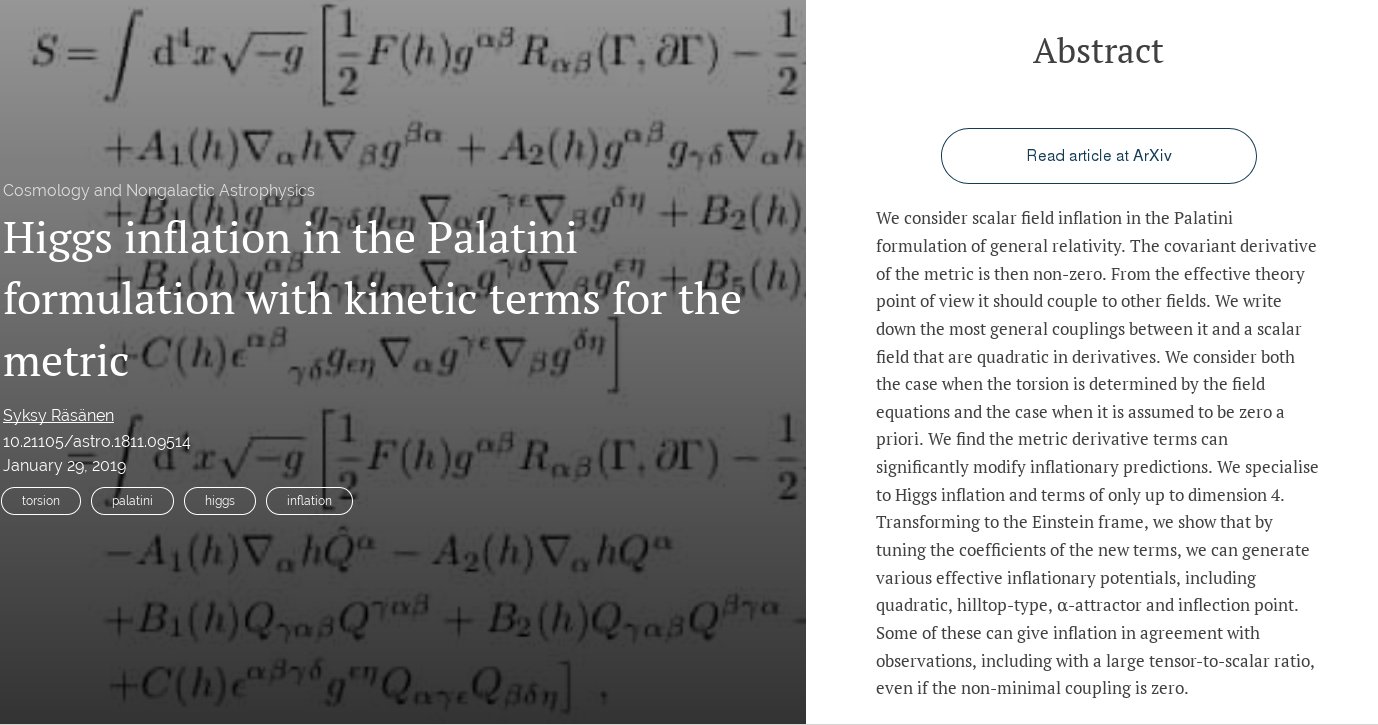
Well, it’s time at last to announce the first paper to be published by the new incarnation of the Open Journal of Astrophysics, which we just published this morning. Here it is!

It’s by Syksy Räsänen of the University of Helsinki. You can find the full article on the arXiv here.

This is the first published paper to have been submitted to the Open Journal of Astrophysics since its re-launch last October; the others on the OJA site were published on the old platform and imported into the new site after publication. This new paper has gone all the way through submission, refereeing, revision and publication on the new platform.

It’s been quite exciting for the last couple of months, as various papers have been working their way through the Editorial pipeline, to see which would win the race and get published first. Some submissions have been slowed down by folk reluctant to accept reviewing requests, presumably because the journal is not so well known and some are suspicious that it might not be bona fide. Hopefully that will pass with time. Moreover, after internal discussions, the Editorial Board have decided to ask for two referees for each paper by default and that has probably also slowed us down a bit.

We have a few other papers coming up for publication soon, and some have been sent back to authors for revise and resubmit. I think I know which one will be published next, but I’ll keep that to myself for now!