Well, that wasn’t too painful. I’ve completed my marking duties. The fact that it has been pouring with rain most of the day made it easy to concentrate on this task. I was going to have a break for lunch, but I decided to keep on going until I was finished, though I did have to take a break for a telecon this afternoon. I also had to dash out to the shops, primarily to replenish my stock of food for the garden birds but also to get some groceries for myself. Having skipped lunch I bought myself something nice for supper.
Looking at the departmental database I see that I appear to be the first member of staff to have finished and uploaded all their Semester 1 examination marking. Normally I’m just happy if I’m not the last!
It feels good to have finished this task. It’s definitely a weight off my mind. I wouldn’t want to leave any loose ends when Trumpageddon comes.
I can’t say anything about the results of course but the change I made to continuous assessment, from take-home assignments to class tests, does not seem to have had a negative effect on either group of students I have been teaching. The opposite may indeed have been the case, as the class tests perhaps provide better preparation for the final assessment than the previous method. I think some other lecturers might make a similar switch in future. Anyway, I definitely plan to do something similar for my Semester 2 module on Particle Physics.
Now I have a couple of weeks before teaching resumes so I can get on with other things. For the rest of this week my priority is to finish revising a paper that I hoped to do before Christmas. I’ll see how that goes before deciding what to do next.
I’ll also have to prepare teaching for Semester 2. That shouldn’t be too difficult, as I’ve taught both modules before, but I do have to give some thought as to precisely how I’m going to word the instructions on the use of AI for my Computational Physics module. That can wait a little while, though, as it mainly affects the mini-project to be done towards the end of the Semester. In the meantime I’ll be thinking about other things…
For last year’s words belong to last year’s language And next year’s words await another voice. And to make an end is to make a beginning.
From Four Quartets, ‘Little Gidding’ by T. S. Eliot.
So it’s New Year’s Day. Athbhliain faoi mhaise dhaoibh!
For me this brings the festive season to an end. I’ve been eating and drinking too much for the last week as one is supposed to. Last night I brought in the new year with a dish of roast duck and the last of the Christmas vegetables. I think I’ll be buying any sprouts and parsnips for a while. When the iron tongue of midnight told twelve, I had a glass of excellent Irish Whiskey in the form of Clonakilty Single Pot Still (46%). It has been a most enjoyable week, but heightened level of self-indulgence has been rather exhausting, and I’ll be taking things a bit easier for a few days before I go back to work on Monday. It’s hard work being a glutton.
Anyway, I thought I’d mention a few things looking forward to the New Year.
January will, as usual, be dominated by examinations, and especially the marking thereof. The first examination for which I am responsible is on January 12th. The examination, incidentally, will be held in the Glenroyal Hotel in Maynooth as the Sports Hall on campus – usually a major exam venue – is out of commission due to building work.
I have a couple of writing deadlines, in addition to having to correct the examinations, so it will be a busy January.
Then February sees the start of a new semester. I’ll be teaching Particle Physics again. I was a bit surprised to be asked to teach this again, as I was filling last year in for our resident particle physicist who was on sabbatical. I’m glad to be able to continue with it given the work I put in to do it last time. My other module is Computational Physics which I have taught at Maynooth every year since 2018, apart from 2024 when I was on sabbatical. This time, however, I will have to think hard about how to deal with the use of generative AI in the coursework.
Will I get to teach any astrophysics or cosmology at Maynooth before I retire? That’s looking very unlikely. I think it’s probable that the new academic year, starting in September, will find me teaching the same modules as last year.
The year ahead will also see the first data release (DR1) from the European Space Agency’s Euclid Mission. The date for that will be October 21st 2026. This is a hard deadline. There’s a huge amount of work going on within the Euclid Consortium to extract as much science as possible from the observations so far before the data becomes public, but you’ll have to wait until October to find out more!
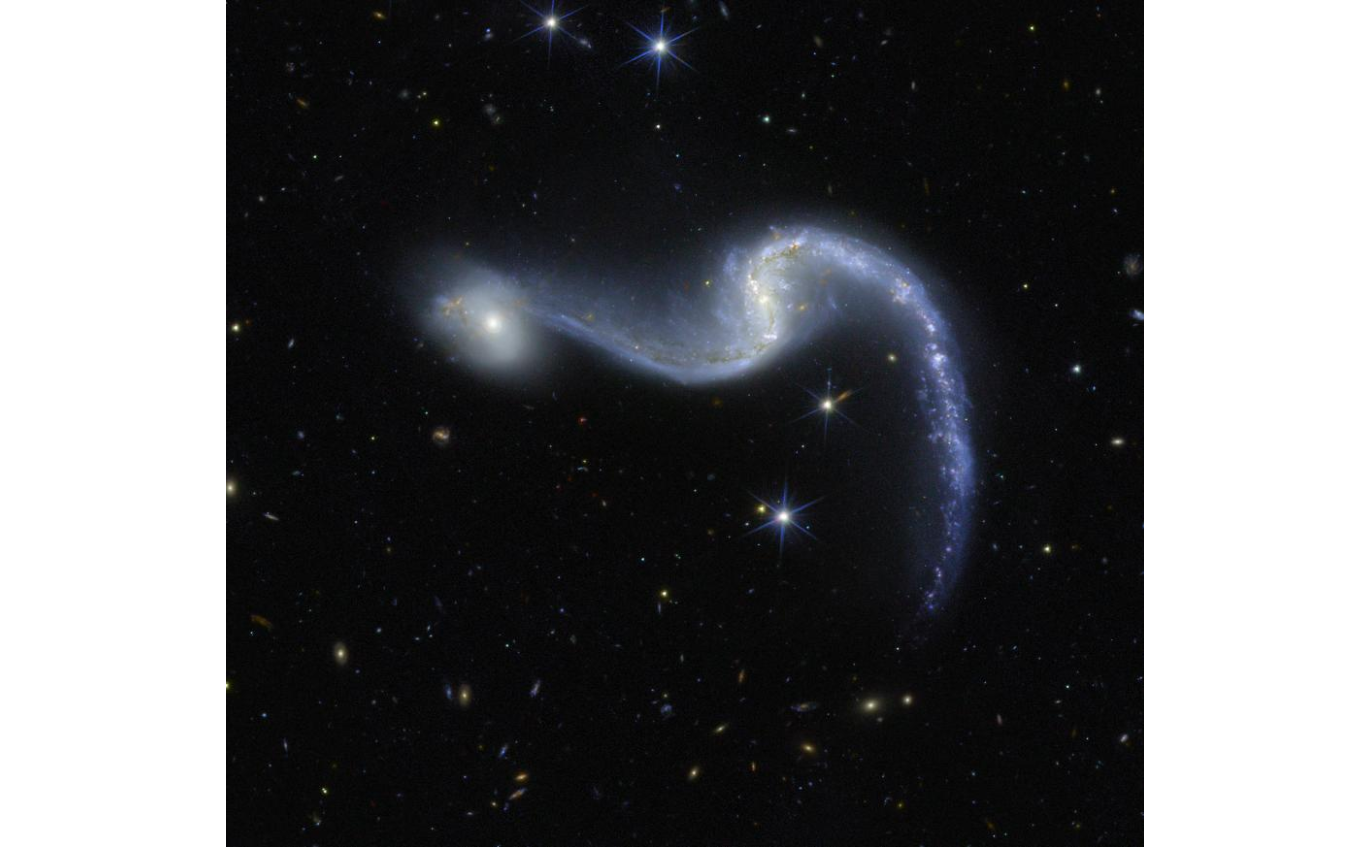
This reminds me that I forgot to share this nice image from Euclid that was released just before Christmas.
Galaxy NGC 646 looking like a cosmic holiday garland in this image from the European Space Agency’s Euclid space telescope.
Once upon a time, WordPress used to send an email about the year’s blog statistics, etc, but it stopped doing that some time ago. I checked this morning, however, and learned that traffice on the blog in 2025 was up by 2.6% since 2024. I’m not sure how meaningful this is, because there is so much scraping going on these days. That figure doesn’t include the people who get posts via email or RSS or via other platforms such as the Fediverse.
While I’m on about social media I’ll mention a stat about my Bluesky account. I joined Bluesky in 2023 when I abandoned Xitter. As of today I have 8,078 BlueSky followers, which is more than I ever had on X, and with far higher levels of engagement and much friendlier interactions.
I’m also on Mastodon, although with a much smaller following (1.4k). This blog also has a separate existence on Mastodon here. I very much like the federated structure of Mastodon (which, incidentally, accords with my view of how academic publishing should be configured) and am a bit disappointed that it doesn’t seem to have caught on as much as it should.
That disappointment pales into insignificance, however, with the outrage I feel that my employer – along with most other universities – persists in using Xitter. Touting for trade in a far-right propaganda channel is no way for a institution of higher education to behave. You can read my views on this matter here.
And finally there’s the Open Journal of Astrophysics. The year ahead will see the 10th anniversary of our first ever publication – on an experimental prototype platform, long before we moved to Scholastica. It will be next Monday before we resume publishing, starting Volume 9. Which author(s) will be the first to get their final versions on arXiv in 2026? Stay tuned to find out!
One of the useless facts stored in the increasingly inaccessible recesses of my memory is that the first Sunday after Easter is sometimes called Quasimodo Sunday, not for Hunchback of Notre Dame, but from the start of the traditional introit to the roman liturgy for this day: Quasi modo géniti infántes… (“in the manner of newborn babes”).
This year in Maynooth University Quasimodo Sunday is the last day before the students return after a short Easter break for the remaining two weeks of teaching of the Spring Semester. It’s just less than two weeks of teaching, actually, because Monday 5th May is a public holiday. This will be a very busy period as we have not only to finish teaching our modules, but also to complete grading any remaining assessments ahead of the examinations that start on 16th May. I have just four lectures and two tutorials remaining in Particle Physics but I have one assignment still to correct (which I intend to do this afternoon) and there will be one more due in at the end of term (Friday 9th May). In Computational Physics the only item on the agenda for students is the project work also due in on 9th May, at which point I will have reports from 32 students to grade. Then there’s the examinations…
I also have another important job to do over the next couple of weeks, which I can’t write about here. I had hoped to start on it a few weeks ago but that plan was stymied by a bureaucratic delay, so I actually only got started last Friday. It looks like I’ll have to do it alongside everything else during the next two weeks. I won’t post about it until it’s finished, but I’m optimistic that it will turn out well.
Oh, and I’m giving a Colloquium in the Department of Physics on 9th May too. It’s all go.
The weather was mostly rather grim over the Easter break but has improved today and the forecast for the next few days is good. I propose to mow the lawn before starting on my grading tasks. I have let the grass grow for a while, resulting in a splendid crop of dandelions which, among other things, are good for the bees. Dandelions are generally thought of as weeds but the I find the splashes of yellow colour all around very easy on the eye and do not share the desire that some people have to destroy them on sight. In fact there seem to be more around than I’ve noticed in previous years. I’ll let the ones at the back of my house carry on for a while, but I’m sure others will soon grow in the front after I mow the lawn.
Update: mowing was hard work because the grass was still rather wet. I gave it a rough cut and will go over it again in a couple of days when what’s left will hopefully be dry.
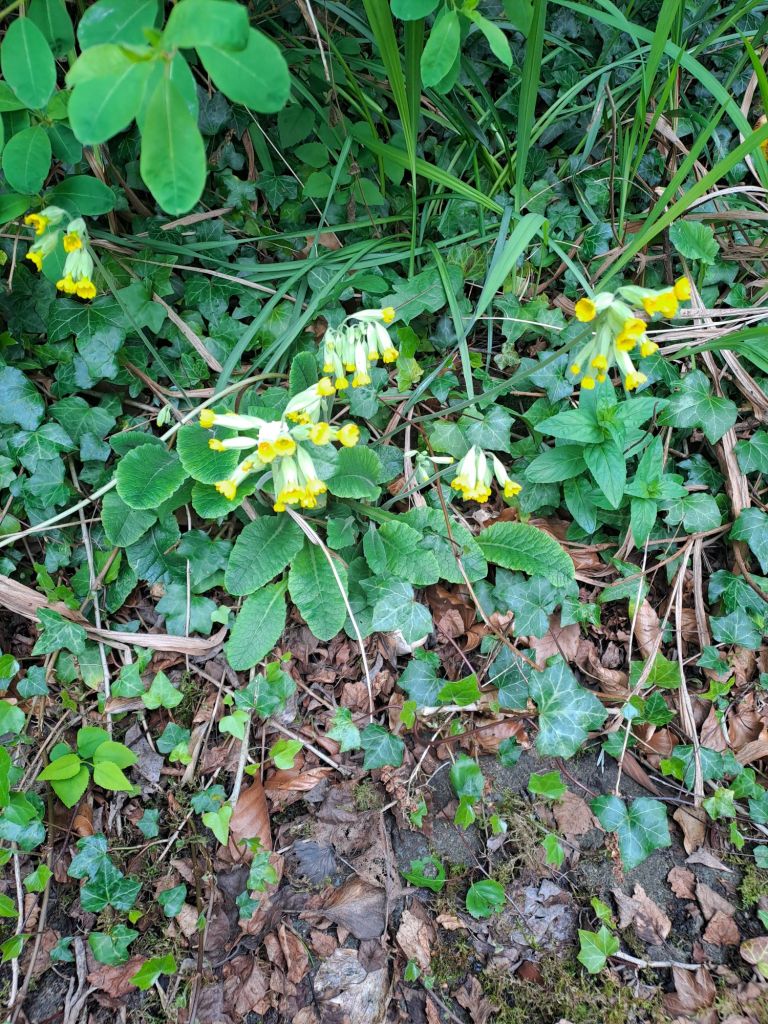
As well as dandelions, there are quite a few cowslips here and there:
After a Departmental meeting this afternoon being the last item on the agenda for this week, at last we’ve reached the Mid-Semester Half-Term Study-Week Break. Six weeks down, six weeks to go (not including an extra week off for Easter). This coming Monday is St Patrick’s Day, a national holiday here in Ireland, and the rest of the week is free from lectures, labs and tutorials. I have two batches of computational physics tests and a particle physics assignment to grade, four examination papers to write and a graduation ceremony to attend before we return, so it’s not exactly a holiday. I plan to try to make the most of the time freed up by not having to teach to finishing writing up at least one, and possibly two, papers.
I’m glad of the arrival of this break, as I’ve been running on empty for the last several days, the general sense of fatigue exacerbated by a flare-up of the arthritis in my knees. Doctors say that there’s no reliable evidence that arthritis pain correlates with the weather, but in my case it does seem to come on when the weather changes, especially when it suddenly becomes cold or damp as it has done over the past few days. I’ll be due for another steroid shot soon, which should help, and hopefully the weather will improve over the next few weeks. Possibly. It seems to be a tradition for St Patrick’s Day to take place during inclement weather so, while I plan to go and watch the parade in Maynooth on Monday, I won’t linger outside if it’s cold. I will be taking the whole day off though.
The second half of term should be a bit easier than the first. For one thing, we have another break coming up four weeks after the resumption. Good Friday is on April 18th, so that is a holiday, as is the following week. The second 6 weeks of the Semester is therefore split 4-2 with a week off in between. Moreover, I usually only give lectures in Computational Physics for 9 or 10of the 12 teaching weeks in the Semester, after which the students will be working on the mini-projects which form part of the assessment for this module.
Anyway, it’s time to head home via the shops and buy something to eat while I watch St Pat’s versus Bohemians on the telly box. I haven’t got the energy for anything else!
Here we are, about to start the fifth week of the Spring semester at Maynooth University. Teaching isn’t going too badly, but I have come to realize that I have a lot of continuous assessment marking to do – classs tests and mini-projects for Computational Physics and assignments for Particle Physics. The numbers of students involved are 32 in the first case and 23 in the second, but I have to do all the corrections myself. Ho hum. Still, I’m enjoying teaching particle physics again after a gap of 15 years or so so I can’t complain about that.
Last week saw some important achievements by research students. Two students in the Department of Physics – one of them supervised by me – submitted their PhD theses last week. Nominations of examiners have to be approved by Faculty and Academic Council but that should be a formality and we then have the viva voce examinations, so the process is not over yet, but the submission of a thesis is a landmark in itself and is to be celebrated.
I have received a number of enquiries in recent weeks from prospective students about when applications would open as I’m sure is also the case for several of my colleagues. It has been very depressing to have to reply saying that I have no idea. As far as I know the scheme is suspended indefinitely. It’s now effectively too late for this year anyway, as most prospective students will already have lined up offers elsewhere. Only students not able to secure a place elsewhere will be available to apply if and when the scheme does open.
The timing of this is especially sad for the new Department of Physics. Our final-year Theoretical Physics class sizes are larger than ever but the Maynooth is sending them a very clear signal that it doesn’t want any of them to stay here for their PhDs.
For last year’s words belong to last year’s language And next year’s words await another voice. And to make an end is to make a beginning.
From Four Quartets, ‘Little Gidding’ by T. S. Eliot.
January is named after the Roman deity Janus, who according to Wikipedia, is the god of beginnings, gates, transitions, time, duality, doorways, passages, frames, and endings. Since I did a retrospective post yesterday about 2024 in retrospect, I thought I’d do a quick one today (1st January 2025) to mention a few things looking forward.
January will, as usual, be dominated by examinations, and especially the marking thereof. The first examination for which I am responsible is on January 13th.
February sees the start of a new semester. I’ll be teaching Particle Physics for the first time at Maynooth. I taught this subject for many years at Nottingham and Cardiff (the latter combined with Nuclear Physics), so it should be OK. My other module is Computational Physics which I have taught at Maynooth every year since 2018, apart from 2024 when I was on sabbatical.
The big event in March will be the release of “Q1” data from Euclid. This is only a very small part of the full survey, but is an important milestone and will no doubt attract a lot of press coverage. There’s a blog post by Knud Jahnke here. No doubt I’ll do a few blog posts too. The first full data release DR1 will take place in 2026. The Q1 release is timed to coincide with the annual Euclid Consortium Meeting, which this year takes place in Leiden. I won’t be able to attend in person, as it happens during teaching term, but may be able to follow some of the sessions remotely.
In April we will have a very special visitor to Maynooth to deliver the Dean’s Lecture (of which more anon). Much less significantly, I’ll be giving a Colloquium in the Department of Physics.
May will largely be taken up with second semester exams and assessments – there will be a lot of computational physics projects to correct as well as the usual examinations.
And then it will be summer. I did a lot of travelling during my sabbatical so I am not planning to travel much in 2025, though I may try to visit some more places in Ireland. Hopefully I’ll be able to get on with some research too. This year I am supervising my first MSc project at Maynooth, so that will be an interesting new experience.
And then we’re more-or-less into the next academic year 25/26. That’s beyond my planning horizon. I don’t know what I’ll be teaching, but it may be the same as 2024 (at least for Semester 1). I wonder if I’ll get to teach any astrophysics or cosmology here before I retire? It doesn’t look likely…
Today I completed the lectures for one of my modules, the one on Differential Equations and Transform Methods for Engineering students, and gave the penultimate lecture for Differential Equations and Complex Analysis for final-year Mathematical Physics students. Both were revision lectures. As campus has been very quiet for the last few days I didn’t expect many (if any) students to show up for either of these classes, but some did, although numbers were a long way down on the start of the year.
Campus is always quiet this close to the holiday, but this time there has been a bug going around which has led to a few more absences than usual among students. Some staff have been affected too. I had a mild dose of whatever it was earlier in the week but got over it relatively quickly.
Tomorrow, the last day of Semester 1, I have my last lecture of this term, followed by a couple of final-year project presentations. Then that’s it until 2025. I am already thinking about what to do tomorrow evening to mark the end of term. I haven’t reached any definite conclusions yet, but it will almost certainly involve wine. Then I suppose I’ll have to start my Christmas shopping which will include buying more wine.
I am a bit flush this week because I’ve finally received rebates of overpayment from OVO Energy and Dŵr Cymru Welsh Water relating to my former house in Cardiff. I sold this property months ago, after much tedious to-ing and fro-ing, but getting money back from utility companies is like getting blood out of a stone. OVO Energy were particularly bad, violating their statutory obligations. The offer3d me £60 additional payment in recognition of this but, although they eventually settled the bill, they never paid the compensation. It seems they just lied.
In contrast, and giving credit where it’s due, I am grateful to Cardiff City Council for paying back my overpaid Council Tax very promptly.
The forthcoming week is the second-to-last week of teaching term at Maynooth and, as usual at this stage of the Semester, we’re getting busier and busier.
The examinations for January have been sent off for printing and are (presumably) ready to go, so that’s one item crossed off the to-do list. I’m still behind on the coursework grading for one of my two modules, but should be able to catch up in the next few days. Other than that, I am miraculously on schedule as far as teaching is concerned. I should finish covering the respective syllabuses by Friday 13th, which means the following week will be devoted to revision. I expect attendance on campus will be fairly sparse in the last week of term, especially later on. I’ll be there until the bitter end, however, as I have a lecture scheduled on Friday 20th and have to attend final-year student presentations that afternoon. After that I will probably collapse in a state of exhaustion into the welcoming arms of the Christmas break.
While the week ahead will be fairly normal from the point of view of teaching itself, there are quite a few extra things in my calendar, as people try to get various things done before the break. Extra items for next week including a meeting about a staff recruitment (of which, hopefully, more anon) and another about the possible reorganization of teaching in the light of the merger of the Departments of Theoretical and Experimental Physics. Rationalization of teaching could lead to an improvement in the courses offered and also, by removing duplication, reduce our very heavy teaching workloads. Whether it will actually be possible to achieve either or both of these aims remains to be seen. In any case I’m not sure if any significant changes to teaching will be implemented before I retire, but I’ll probably go along to the meeting anyway in case there’s anything I can contribute.
I’ve also agreed to give a talk on Wednesday to the student Pride Society which I am looking forward to, although such events invariably make me feel very old!
As it happens, Friday 13th December is the date for the first Christmas dinner of the newly formed Department of Physics; previously, the Departments of Theoretical Physics and Experimental Physics held separate celebrations. It will be a much bigger group this time and, it being on a Friday evening we’ll have the weekend to recover before the last week of term.
Anyway, although it’s a Sunday I’ll be working all afternoon as I have a task to finish that is due tomorrow so I had better sign off. When I was younger I used to look forward to Christmas as a time for feasts and parties and socialising. Now that I’m older I look forward to it more than anything as a time for the sense of relaxation that comes from the lack of deadlines.
We’re in Week 9 of teaching in the Autumn Semester at Maynooth University, which means we’ve got one eye on the forthcoming Examination Period, which starts on 10th January 2025. Examination papers have already been prepared in draft form, and are now being checked ahead of printing. A draft examination timetable has also been released to staff, but not yet to students in case it has to be revised because of clashes.
I’m still on schedule with both my modules to finish the actual content in time to do use the last week for revision classes, going through past examination papers and generally helping the students prepare for the ordeals of January. There is a continuously-assessed component of both my modules, which counts 20% of the overall grade. One purpose of these assignments is to give the students some practice at the sort of problems they might encounter in the examinations: if they can do the assignments, they shouldn’t be too fazed by the examination questions. The purpose of the coursework is not just about passing examinations, however. I think the only way really to learn about mathematical physics is by doing it; the coursework is at least as important as the lectures and tutorials in terms of actually learning the subject. I think that modern higher education involves drastic over-assessment. Too much emphasis on grades and scores can be detrimental to real learning, but assessment that is formative can be extremely beneficial. Continuous assessment provides a way to give feedback to students on how they are doing, and to lecturers on how well the message is getting across; giving grades to such coursework is really just an incentive to the students to do it. It’s not primarily intended to be summative.
Anyway, back to examinations. One big difference between our examinations in Theoretical Physics in Maynooth and those at other institutions at which I’ve taught (in the UK) is that most of the papers here offer no choice of questions to be answered. Elsewhere it is quite common to find a choice of two or three questions from four or five on the paper. In my module on Differential Equations and Complex Analysis, for example, there are four questions on the examination paper and students have to do all of them for full marks.
One advantage of our system is that it makes it much harder for students to question-spot in the hope that they can get a good grade by only revising a fraction of the syllabus. If they’re well designed, a few longish questions can cover most of the syllabus for a module, which they have to in order to test all the learning outcomes. To accomplish this, questions can be split into parts that may be linked to each other to a greater or lesser extent in order to explore the connections between different ideas, but also sufficiently separate that a student who can’t do one part can still have a go at others. With such a paper, however, it is a dangerous strategy for a student to focus only on selected parts of the material in order to pass.
As an examiner, the Maynooth style of examination also has the advantage that you don’t have to worry too much if one question turns out to be harder than the others. That can matter if different students attempt different questions, as students might be penalized if they chose a particularly hard one, but not if everyone has to do everything.
But it’s not just the number of questions that’s important, it’s the duration. I’ve never felt that it was even remotely sensible for undergraduate physics examinations to be speed tests, which was often the case when I was a student. Why the need for time pressure? It’s better to be correct than to be fast, I think. I always try to set examination questions that could be done inside two hours by a student who knew the material, including plenty of time for checking so that even a student who made a mistake would have time to correct it and get the right answer. If a student does poorly in this style of examination it will be because they haven’t prepared well enough rather than because they weren’t fast enough.
So, after an absence from teaching of over a year, this afternoon I returned to the lecture theatre to give a double session on the module EE206 Differential Equations and Transform Methods. I was a bit apprehensive about having a two-hour slot and it is fair to say that I felt a bit knackered after it, but `then I am getting on a bit. I did have time for a ten-minute break in the middle during which the students could relax and stretch their legs a little. Some of them even came back afterwards.
This module is meant for students on two courses, Electronic Engineering and Robotics and Intelligent Devices, so I will have to think of relevant examples. I’ve got the RLC circuit, of course, but I’ll have to more than that!
If you’re interested you can find an old summary of the module here to see what topics are covered.
The good news from my point of view is that I have a decent room to teach in – complete with chalk boards – and the students seemed pleasant and engaged. I always like to get some interaction going in my classes so it was good to find a reasonable number of people willing to offer answers to questions I asked and indeed willing to ask me questions or request clarification. Overall, I was quite pleased with how it went. You will have to ask the students to see if they agree. At any rate I did manage to get through everything I planned to cover. The class size is about 55, incidentally.
Anyway, today I just warmed up for the module with some revision of basic calculus. I had pessimistically imagined that the students would have forgotten what they did in the first year about this, but in fact quite a few of them remembered quite a lot. I have my second session with this group on Thursday, though that should be a bit easier as it is only one hour instead of two. I will start differential equations proper then.
My remaining teaching sessions this week are all in the Arts Building. I have been quite worried that the rooms I am supposed to use would not be ready in time, but I took a walk around yesterday morning and they are ready (although construction work is going on elsewhere in the block). I was thinking I might have to give these lectures via a remote connection from home as in the old days of the pandemic, but that fortunately is not the case.
The views presented here are personal and not necessarily those of my employer (or anyone else for that matter).
Feel free to comment on any of the posts on this blog but comments may be moderated; anonymous comments and any considered by me to be vexatious and/or abusive and/or defamatory will not be accepted. I do not necessarily endorse, support, sanction, encourage, verify or agree with the opinions or statements of any information or other content in the comments on this site and do not in any way guarantee their accuracy or reliability.