Archive for teaching

2025: The Year Ahead

Posted in Biographical, Euclid, Maynooth with tags , , , , on January 1, 2025 by telescoper
For last year’s words belong to last year’s language
And next year’s words await another voice.
And to make an end is to make a beginning.

From Four Quartets, ‘Little Gidding’ by T. S. Eliot.

January is named after the Roman deity Janus, who according to Wikipedia, is the god of beginnings, gates, transitions, time, duality, doorways, passages, frames, and endings. Since I did a retrospective post yesterday about 2024 in retrospect, I thought I’d do a quick one today (1st January 2025) to mention a few things looking forward.

January will, as usual, be dominated by examinations, and especially the marking thereof. The first examination for which I am responsible is on January 13th.

February sees the start of a new semester. I’ll be teaching Particle Physics for the first time at Maynooth. I taught this subject for many years at Nottingham and Cardiff (the latter combined with Nuclear Physics), so it should be OK. My other module is Computational Physics which I have taught at Maynooth every year since 2018, apart from 2024 when I was on sabbatical.

The big event in March will be the release of “Q1” data from Euclid. This is only a very small part of the full survey, but is an important milestone and will no doubt attract a lot of press coverage. There’s a blog post by Knud Jahnke here. No doubt I’ll do a few blog posts too. The first full data release DR1 will take place in 2026. The Q1 release is timed to coincide with the annual Euclid Consortium Meeting, which this year takes place in Leiden. I won’t be able to attend in person, as it happens during teaching term, but may be able to follow some of the sessions remotely.

In April we will have a very special visitor to Maynooth to deliver the Dean’s Lecture (of which more anon). Much less significantly, I’ll be giving a Colloquium in the Department of Physics.

May will largely be taken up with second semester exams and assessments – there will be a lot of computational physics projects to correct as well as the usual examinations.

The annual meeting of the European Astronomical Society takes place in Cork in June. I’ve been to Cork before, but am looking forward to going again.

And then it will be summer. I did a lot of travelling during my sabbatical so I am not planning to travel much in 2025, though I may try to visit some more places in Ireland. Hopefully I’ll be able to get on with some research too. This year I am supervising my first MSc project at Maynooth, so that will be an interesting new experience.

And then we’re more-or-less into the next academic year 25/26. That’s beyond my planning horizon. I don’t know what I’ll be teaching, but it may be the same as 2024 (at least for Semester 1). I wonder if I’ll get to teach any astrophysics or cosmology here before I retire? It doesn’t look likely…

Nearly there…

Posted in Biographical, Cardiff, Education, Maynooth with tags , , , on December 19, 2024 by telescoper

Today I completed the lectures for one of my modules, the one on Differential Equations and Transform Methods for Engineering students, and gave the penultimate lecture for Differential Equations and Complex Analysis for final-year Mathematical Physics students. Both were revision lectures. As campus has been very quiet for the last few days I didn’t expect many (if any) students to show up for either of these classes, but some did, although numbers were a long way down on the start of the year.

Campus is always quiet this close to the holiday, but this time there has been a bug going around which has led to a few more absences than usual among students. Some staff have been affected too. I had a mild dose of whatever it was earlier in the week but got over it relatively quickly.

Tomorrow, the last day of Semester 1, I have my last lecture of this term, followed by a couple of final-year project presentations. Then that’s it until 2025. I am already thinking about what to do tomorrow evening to mark the end of term. I haven’t reached any definite conclusions yet, but it will almost certainly involve wine. Then I suppose I’ll have to start my Christmas shopping which will include buying more wine.

I am a bit flush this week because I’ve finally received rebates of overpayment from OVO Energy and Dŵr Cymru Welsh Water relating to my former house in Cardiff. I sold this property months ago, after much tedious to-ing and fro-ing, but getting money back from utility companies is like getting blood out of a stone. OVO Energy were particularly bad, violating their statutory obligations. The offer3d me £60 additional payment in recognition of this but, although they eventually settled the bill, they never paid the compensation. It seems they just lied.

In contrast, and giving credit where it’s due, I am grateful to Cardiff City Council for paying back my overpaid Council Tax very promptly.

To the Penultimate…

Posted in Education, LGBTQ+, Maynooth with tags , , on December 8, 2024 by telescoper

The forthcoming week is the second-to-last week of teaching term at Maynooth and, as usual at this stage of the Semester, we’re getting busier and busier.

The examinations for January have been sent off for printing and are (presumably) ready to go, so that’s one item crossed off the to-do list. I’m still behind on the coursework grading for one of my two modules, but should be able to catch up in the next few days. Other than that, I am miraculously on schedule as far as teaching is concerned. I should finish covering the respective syllabuses by Friday 13th, which means the following week will be devoted to revision. I expect attendance on campus will be fairly sparse in the last week of term, especially later on. I’ll be there until the bitter end, however, as I have a lecture scheduled on Friday 20th and have to attend final-year student presentations that afternoon. After that I will probably collapse in a state of exhaustion into the welcoming arms of the Christmas break.

While the week ahead will be fairly normal from the point of view of teaching itself, there are quite a few extra things in my calendar, as people try to get various things done before the break. Extra items for next week including a meeting about a staff recruitment (of which, hopefully, more anon) and another about the possible reorganization of teaching in the light of the merger of the Departments of Theoretical and Experimental Physics. Rationalization of teaching could lead to an improvement in the courses offered and also, by removing duplication, reduce our very heavy teaching workloads. Whether it will actually be possible to achieve either or both of these aims remains to be seen. In any case I’m not sure if any significant changes to teaching will be implemented before I retire, but I’ll probably go along to the meeting anyway in case there’s anything I can contribute.

I’ve also agreed to give a talk on Wednesday to the student Pride Society which I am looking forward to, although such events invariably make me feel very old!

As it happens, Friday 13th December is the date for the first Christmas dinner of the newly formed Department of Physics; previously, the Departments of Theoretical Physics and Experimental Physics held separate celebrations. It will be a much bigger group this time and, it being on a Friday evening we’ll have the weekend to recover before the last week of term.

Anyway, although it’s a Sunday I’ll be working all afternoon as I have a task to finish that is due tomorrow so I had better sign off. When I was younger I used to look forward to Christmas as a time for feasts and parties and socialising. Now that I’m older I look forward to it more than anything as a time for the sense of relaxation that comes from the lack of deadlines.

Approaching Examinations

Posted in Education, Maynooth with tags , , , , , , , , on November 27, 2024 by telescoper

We’re in Week 9 of teaching in the Autumn Semester at Maynooth University, which means we’ve got one eye on the forthcoming Examination Period, which starts on 10th January 2025. Examination papers have already been prepared in draft form, and are now being checked ahead of printing. A draft examination timetable has also been released to staff, but not yet to students in case it has to be revised because of clashes.

I’m still on schedule with both my modules to finish the actual content in time to do use the last week for revision classes, going through past examination papers and generally helping the students prepare for the ordeals of January. There is a continuously-assessed component of both my modules, which counts 20% of the overall grade. One purpose of these assignments is to give the students some practice at the sort of problems they might encounter in the examinations: if they can do the assignments, they shouldn’t be too fazed by the examination questions. The purpose of the coursework is not just about passing examinations, however. I think the only way really to learn about mathematical physics is by doing it; the coursework is at least as important as the lectures and tutorials in terms of actually learning the subject. I think that modern higher education involves drastic over-assessment. Too much emphasis on grades and scores can be detrimental to real learning, but assessment that is formative can be extremely beneficial. Continuous assessment provides a way to give feedback to students on how they are doing, and to lecturers on how well the message is getting across; giving grades to such coursework is really just an incentive to the students to do it. It’s not primarily intended to be summative.

Anyway, back to examinations. One big difference between our examinations in Theoretical Physics in Maynooth and those at other institutions at which I’ve taught (in the UK) is that most of the papers here offer no choice of questions to be answered. Elsewhere it is quite common to find a choice of two or three questions from four or five on the paper. In my module on Differential Equations and Complex Analysis, for example, there are four questions on the examination paper and students have to do all of them for full marks.

One  advantage of our system is that it makes it much harder for students to question-spot in the hope that they can get a good grade by only revising a fraction of the syllabus. If they’re well designed, a few longish questions can cover most of the syllabus for a module, which they have to in order to test all the learning outcomes. To accomplish this, questions can be split into parts that may be linked to each other to a greater or lesser extent in order to explore the connections between different ideas, but also sufficiently separate that a student who can’t do one part can still have a go at others. With such a paper, however, it is a  dangerous strategy for a student to focus only on selected parts of the material in order to pass.

As an examiner, the Maynooth style of examination also has the advantage that you don’t have to worry too much if one question turns out to be harder than the others. That can matter if different students attempt different questions, as students might be penalized if they chose a particularly hard one, but not if everyone has to do everything.

But it’s not just the number of questions that’s important, it’s the duration. I’ve never felt that it was even remotely sensible for undergraduate physics examinations to be speed tests, which was often the case when I was a student. Why the need for time pressure? It’s better to be correct than to be fast, I think. I always try to set examination questions that could be done inside two hours by a student who knew the material, including plenty of time for checking so that even a student who made a mistake would have time to correct it and get the right answer. If a student does poorly in this style of examination it will be because they haven’t prepared well enough rather than because they weren’t fast enough.

Back to Teaching

Posted in Education, mathematics, Maynooth with tags , , on September 24, 2024 by telescoper

So, after an absence from teaching of over a year, this afternoon I returned to the lecture theatre to give a double session on the module EE206 Differential Equations and Transform Methods. I was a bit apprehensive about having a two-hour slot and it is fair to say that I felt a bit knackered after it, but `then I am getting on a bit. I did have time for a ten-minute break in the middle during which the students could relax and stretch their legs a little. Some of them even came back afterwards.

This module is meant for students on two courses, Electronic Engineering and Robotics and Intelligent Devices, so I will have to think of relevant examples. I’ve got the RLC circuit, of course, but I’ll have to more than that!

If you’re interested you can find an old summary of the module here to see what topics are covered.

The good news from my point of view is that I have a decent room to teach in – complete with chalk boards – and the students seemed pleasant and engaged. I always like to get some interaction going in my classes so it was good to find a reasonable number of people willing to offer answers to questions I asked and indeed willing to ask me questions or request clarification. Overall, I was quite pleased with how it went. You will have to ask the students to see if they agree. At any rate I did manage to get through everything I planned to cover. The class size is about 55, incidentally.

Anyway, today I just warmed up for the module with some revision of basic calculus. I had pessimistically imagined that the students would have forgotten what they did in the first year about this, but in fact quite a few of them remembered quite a lot. I have my second session with this group on Thursday, though that should be a bit easier as it is only one hour instead of two. I will start differential equations proper then.

My remaining teaching sessions this week are all in the Arts Building. I have been quite worried that the rooms I am supposed to use would not be ready in time, but I took a walk around yesterday morning and they are ready (although construction work is going on elsewhere in the block). I was thinking I might have to give these lectures via a remote connection from home as in the old days of the pandemic, but that fortunately is not the case.

Back to Barcelona Again

Posted in Barcelona, Biographical, Education, Maynooth with tags , , , , , , on June 12, 2024 by telescoper

Last night I arrived back in a very rainy Barcelona. Although I got a bit damp on the way back to my flat from the bus stop, the journey was otherwise uneventful. The one thing worthy of note is that although the approach to Barcelona Airport was a little bumpy owing to bad weather, the pilot managed to perform one of the softest of soft landings I’ve ever experienced. It was so well done that there was a spontaneous round of applause from the passengers. Clapping when the plane lands used to be fairly common, but nowadays is a rarity reserved for occasions such as this.

The end of my stint in Barcelona is now in sight so I plan to see the sights I haven’t yet seen, or at least as many of them as I can manage. Next week I have to travel to Rome for the 2024 Euclid Consortium Meeting, at which I’m doing a plenary talk on the first morning. The week after that I have to travel to Valencia to give a seminar, so it will be a busy second half of the month.

Talking of the Euclid Consortium, my term as Chair of the Euclid Consortium Diversity Committee (ECDC) closes at the end of June 2024, at which point I will also be leaving the Committee after 4 years on it. Hopefully I will find a bit more time to do research in the last two months of my sabbatical; I’ve spent about 50% of it so far on ECDC matters, and progress on writing papers has consequently been slower than I’d have liked. I hadn’t anticipated such a big increase in papers submitted to the Open Journal of Astrophysics, either but fortunately I’ve managed to get the most time-consuming aspects of that automated and since that it hasn’t taken up that much of my time.

As it happens, yesterday was the day of the Departmental Examination Board for the Department of Theoretical Physics at Maynooth. I haven’t been teaching this year, so wasn’t involved. I do know quite a few students who will be graduating this summer, though, and am a little sad I won’t be around to congratulate them. I might see some of them at their conferring ceremonies in September though.

And then there’s next academic year to look forward to. What will I be teaching, I wonder? I’m not going to think about that until I have to…

General Science at Maynooth

Posted in Education, Maynooth with tags , , , , , , , on May 27, 2024 by telescoper

Following on – sort of – from yesterday’s post – here is a little promotional video about the ‘Omnibus’ Bachelor of Science undergraduate course (codename MH201). I have blogged about this course before (e.g. here) but this gives me an opportunity to repeat the salient points.

Currently, most students doing Science subjects here in Maynooth enter on the General Science programme a four-year Omnibus BSc course that involves doing four subjects in the first year, but becoming increasingly specialized thereafter. That’s not unlike the Natural Sciences course I did at Cambridge, except that students at Maynooth can do both Mathematical Physics and Experimental Physics in the first year as separate choices. I’d recommend anyone who wants to do Physics in the long run to do both of these, as they do complement each other. Other possibilities include Chemistry, Computer Science, Biology, etc.

In Year 1 students do four subjects (one of which has to be Mathematics). That is narrowed down to three in Year 2 and two in Year 3. In their final year, students can stick with two subjects for a Joint Honours (Double Major) degree, or specialise in one, for Single Honours.

I like this programme very much because it does not force the students to choose a specialism before they have had a taste of the subject, and that it is flexible enough to accommodate Joint Honours qualifications in, e.g., Theoretical Physics and Mathematics. It also allows us to enrol students onto Physics degrees who have not done Physics or Applied Mathematics as part of the Leaving Certificate.

Anyway, this video features Oisín Davey, who took Mathematical Physics, Experimental Physics, Chemistry and Mathematics in his first year. As a matter of fact I taught him in Year 1 (Mechanics & Special Relativity) and Year 2 (Vector Calculus and Fourier Series) but, despite that, as he explains, he has decided to persist with Mathematical Physics. He will be in the final year next academic year, after he returns from his summer in CERN, and I’ll be back from sabbatical.

The Term Ahead

Posted in Biographical, Education, Maynooth with tags , , , , on January 29, 2023 by telescoper

It’s the day before the start of a new Semester in Maynooth. Last week we finished all due processes relating to the First Semester examinations and the provisional results will be uploaded to “The System” next week. They’re provisional at this stage because they’re not set in stone until the final meeting of the Examination Board. Obviously I can’t discuss the results here. I could comment here about how clunky the whole process is, including multiple downloads of spreadsheets and subsequent uploads somewhere else, but I won’t bother. Nobody seems to be interesting in fixing it. Perhaps by the time I retire “The System” will have been replaced by something that doesn’t waste an enormous amount of staff time. But I doubt it.

It’s a curiosity of the teaching allocation in the Department of Theoretical Physics that I do first-year and second-year modules (MP110 Mechanics and Special Relativity and MP201 Vector Calculus & Fourier Series) in Semester 1 while in Semester 2 it’s the third and fourth year students who have to put up with my ramblings.

The menu for this term involves MP354 Computational Physics 1, which entails just one hour of lectures per week but two two-hour lab sessions. Each student attends one of these sessions, so they get 3 contact hours per week but I have to look after both sessions. Our computer lab has a small cluster of Linux machines and, this term, a brand new display screen which I am looking forward to playing with. I’m also looking forward to seeing how the infamous ChatGPT copes with the Python coding exercises I give the students to do in class: I’ve only tried one so far, without much success. This is the first module I taught at Maynooth, back in 2018, so this will be the 6th time I’ve done it.

My other class is MP465 Advanced Electromagnetism, which I’m doing for the 3rd time now. This is a standard chalk-and-talk kind of module covering a well-established syllabus, and involving two lectures per week plus a tutorial. At least I’m teaching in a classroom rather than online like when I first did this module!

In 2020/21 (during the Pandemic restrictions) I did five modules as well as being Head of Department. At this time two academic staff departures left us severely short-staffed and struggling to deliver our programmes. My workload then was unmanageable and I asked to step down. I changed my mind when were eventually allowed to recruit two lecturers and saw out my three-year term to the end. I had better not repeat here what I think of the deliberate management decisions that left us reeling and had such negative effects on staff morale and on the education of students in the Department. I just hope the damage is not irreparable.

Although I am doing the same number of modules as last term, the number of contact hours I have to do is higher (8 versus 5) because of the labs and the fact that we don’t have tutors for 4th-year modules so lecturers have to do the tutorials themselves. Four modules a year is a much heavier teaching load than a Full Professor at a UK university would be expected to carry, but it seems normal in Ireland where the funding for sciences is far less than adequate. The impact on research productivity is obvious and is systemic. There are excellent physicists in Maynooth but they are given little time or other resources. It’s a big waste of potential. That’s another “System” that needs changing, but I see little appetite for change of the required sort at institutional level. It’s all about recruiting more and more students to be taught with fewer and fewer resources.

The impact of this on staff careers is severe: teaching loads are so heavy that it’s very difficult to reach the level of research productivity required for promotion. For myself, though, the next career step will be retirement so I don’t have to worry about promotion. Fortunately too, I enjoy teaching, so I’ll just get on with it. So I’ll stop writing and get on with preparing my first week of lectures and lab sessions!

Teaching + Learning ≠ Lecturing

Posted in Biographical, Education, Maynooth with tags , , , , , on January 13, 2022 by telescoper
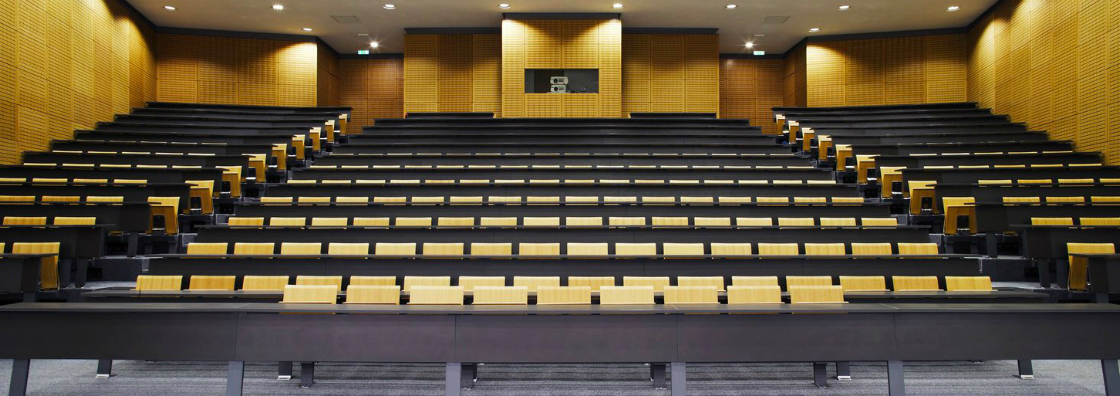
Iontas Lecture Theatre, Maynooth University

The main purpose of this post is to encourage you to read a piece written by a second-year student at the blog run by Phil Moriarty of Nottingham University entitled Death of the Lecture: Musings of a second year student as it provides at least some first-hand reflections from a current student about the difficulties being faced by a student. So, go on, or as they say round here, gwan. Read it.

I couldn’t resist making a few tangential comments of my own.

First, on my philosophy of teaching (such as it is) which is largely formed by my own experiences both as a student many years ago and as a lecturer for many years since then. When I was an undergraduate I didn’t get much out of the lectures I attended at Cambridge and my attendance dropped off a bit as my course went on (though I still attended most). This was because the majority of lectures just involved transparency after transparency being put on and taken off the overhead projector, with students frantically writing down as much as they could but with little time to think. I think that’s what people nowadays call a “traditional” lecture. I agree with Phil Moriarty that these are pedagogically useless. If there ever is a return to normality, the New Normal – to use a very hackneyed phrase – should not be based on this as the primary mode of teaching.

I think this form of non-teaching evolved because it is cost-effective, but academics have gone along with it largely because lots of them actually enjoy standing up and talking about their subject; sometimes it’s difficult to get them to stop. As a matter of fact, that applies to me too. I enjoy talking about physics and astrophysics. I like to think that I can at least communicate some enthusiasm for the subjects through lectures, but I do realize that this does not necessarily make me a very effective teacher.

But in many ways I think the “traditional lecture” described above is a straw man. Many lecturers actually use the traditional format (50 minutes with a class in a large room) to do much more than I’ve just described. When we had to switch teaching online I bought a blackboard and did my lectures from home using it. I know a lot of people found it quaint that I adopted this “traditional” approach but I think explaining mathematical concepts through examples works well via a chalkboard and by standing up I could put more energy into the session than I could if sitting at a screen.

The point is that nowadays we provide students with many more resources to back up this kind of activity – besides my sessions the students get tutorials, and besides the live sessions they get printed notes, problem sets to do on their own, various online resources and of course video recordings. Having all that allows the lecturer to free themselves from the task of delivering material and instead try to cultivate understanding. I never lecture verbatim from notes; I prefer to cover the material in a complementary fashion, expanding on the bits I think need most explanation and/or are most important.

When I was a student I found I learned best not by attending lectures but by reading textbooks and doing problems. That’s just me though. Over the years I realized that different students learn in very different ways. The most important thing for teachers to do is to provide as many ways as possible for the students to learn so they can use what works best for them. In some respects I think of higher education as being more like a smorgasbord than a set menu.

But there lies the difficulty. There is now so much extra material available that many students find it hard to know where to start, just as when you arrive at a buffet table: it might look appetizing but you might not even know what’s in many of the dishes. There needs to be some structure, especially in the early years of a degree to help students find their own way to navigate the more independent methods of study required in an undergraduate degree.

The question for me is not whether lectures have a role to play in the New Normal – I think they do – but what is the best way to incorporate them in a blend. More importantly we need to do a lot more to help students develop their study skills and structure their time so they can learn most effectively. There was no time to do this when the pandemic forced us to change and we were given few resources to assist in the task, but it’s going to be necessary in future as we move inevitably to a more flexible future. Timetabled lectures do of course provide a structure, but there’s almost certainly a better way. As one concrete proposal, I’d call for a vastly expanded induction programme for new students focussing on study skills and other aspects of learning to put in place for the benefit of future intakes.

Like most universities, Maynooth University has a “Teaching & Learning Committee”. I sometimes wonder whether there is as strong a connection between these two words as we’d like to believe. At any rate, switching teaching online does not necessarily mean that learning goes with it!

End of Term Blog

Posted in Biographical, Covid-19, Education, Maynooth with tags , , , , , on December 18, 2021 by telescoper

Yesterday was the last day of teaching at Maynooth University for 2021 and, although I didn’t have any teaching to do, I walked to the Department partly to get a bit of fresh air having been stuck at home on Thursday after my booster jab, and partly to collect a few things before the break. I also discovered that a lovely parcel of goodies had been sent to me and I was anxious to collect the items before Christmas.

I’ll be keeping myself to myself over the break, apart from the odd trip to the shops, and am glad to be doing so. We are yet to see the steep increase in Covid-19 cases associated with the omicron variant happening in the UK and elsewhere in Europe. If anything case numbers are currently declining slowly. But the new wave will undoubtedly hit Ireland soon.

UPDATE: not half an hour after I posted this, the HSE announced 7333 new cases of Covid-19 in Ireland, more than double yesterday’s figure and the highest number seen since early January. And this is before the Christmas surge.

The jury is still out on whether omicron is more or less dangerous than previous variants but it is clearly more transmissible, and I don’t see the point of taking chances, so I agree with the Irish Government on the need to take precautions. I don’t think the latest restrictions go anywhere near far enough though.

Yesterday we received at work an email from University management that said, among other things, that

At present the aim is to resume teaching on 31 January, as in Semester 1.

The phrase “as in Semester 1” means that large lectures will be online-only but everything else will be face-to-face. That is a reasonable starting point because the extent of the omicron wave is as yet unknown, but I think it’s more likely than not that in the end we’ll find ourselves doing everything online. I just hope a decision on that is made in reasonable time for us to put Plan B into action. We don’t start lectures again until January 31st and there should be enough data by then to make an informed decision.

I don’t want to sound unduly pessimistic but I don’t see any sign that we are anywhere near the end of this pandemic. With a bit of luck we might find that we’re roughly halfway through, but as long as governments allow large pools of virus to circulate, mutations will continue to occur and new variants will continue to emerge. To end this cycle will require a majority of the world’s population to be vaccinated, and I don’t see that happening soon.