It’s Saturday morning again, so it’s time again for an update of papers published at the Open Journal of Astrophysics. Since the last update we have published six new papers, which brings the number in Volume 8 (2025) up to 98, and the total so far published by OJAp up to 333. I expect we’ll pass the century for this year sometime next week.
The papers published this week, with their overlays, are as follows. You can click on the images of the overlays to make them larger should you wish to do so.
The first paper to report is “Reconstructing Galaxy Cluster Mass Maps using Score-based Generative Modeling” by Alan Hsu (Harvard), Matthew Ho (CMU), Joyce Lin (U. Wisconsin-Madison), Carleen Markey (CMU), Michelle Ntampaka (STScI), Hy Trac (CMU) & Barnabás Póczos (CMU), all based in the USA. This paper was published on 14th July 2025 in the folder Cosmology and NonGalactic Astrophysics. It presents a diffusion-based generativbe AI model for reconstructing density profiles for galaxy clusters from observational data.
The overlay is here:

The officially-accepted version can be found on arXiv here.
The second and third papers are related. They were both published on 14th July in the folder Cosmology and NonGalactic Astrophysics.
The first of the pair is “J-PLUS: Tomographic analysis of galaxy angular density and redshift fluctuations in Data Release 3. Constraints on photo-z errors, linear bias, and peculiar velocities” by Carlos Hernández-Monteagudo (IAC, Tenerife, Spain) and 21 others. This presents an analysis of the Javalambre Photometric Local Universe Survey (J-PLUS) in redshift slices with a discussion of prospects for extracting cosmological information. The overlay is here:

You can find the final version of the manuscript on arXiv here.
The second of this pair is “The J-PLUS collaboration. Additive versus multiplicative systematics in surveys of the large scale structure of the Universe” by Carlos Hernández-Monteagudo (IAC) and 21 others (the same authors as the previous paper). This paper presents an analysis of systematic effects in the Javalambre Photometric Local Universe Survey (J-PLUS), and a new model for handling such errors in this and other cosmological surveys. The overlay for this paper is here:
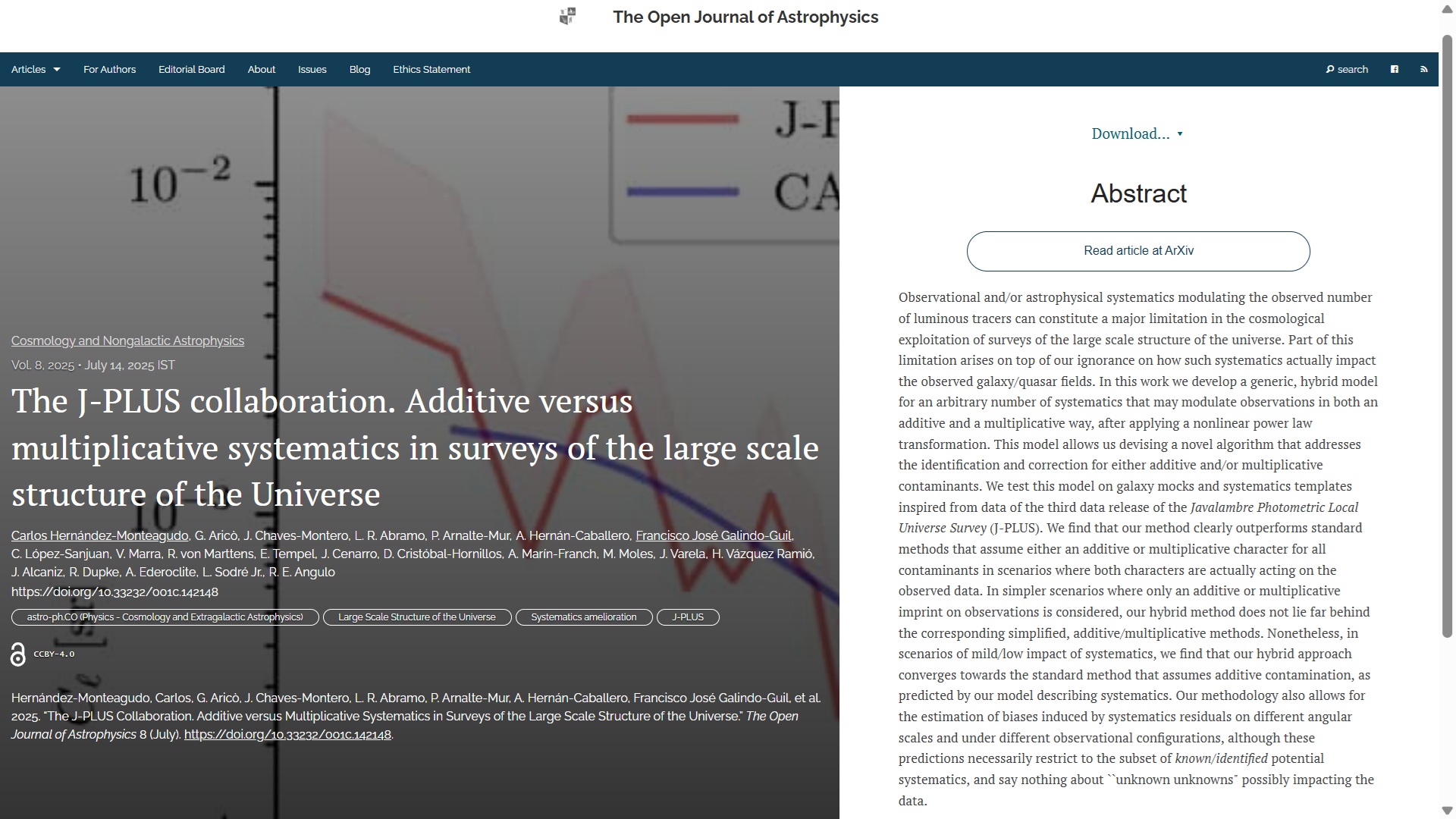
You can find the officially accepted version of this paper on arXiv here.
The fourth paper this week is “Why Machine Learning Models Systematically Underestimate Extreme Values” by Yuan-Sen Ting (Ohio State University). This one was published on July 16th in the folder marked Instrumentation and Methods for Astrophysics. This paper presents a theoretical framework for understanding and addressing a bias that suppresses the dynamic range of variables in applications of machine learning to astronomical data analysis. Here is the overlay:
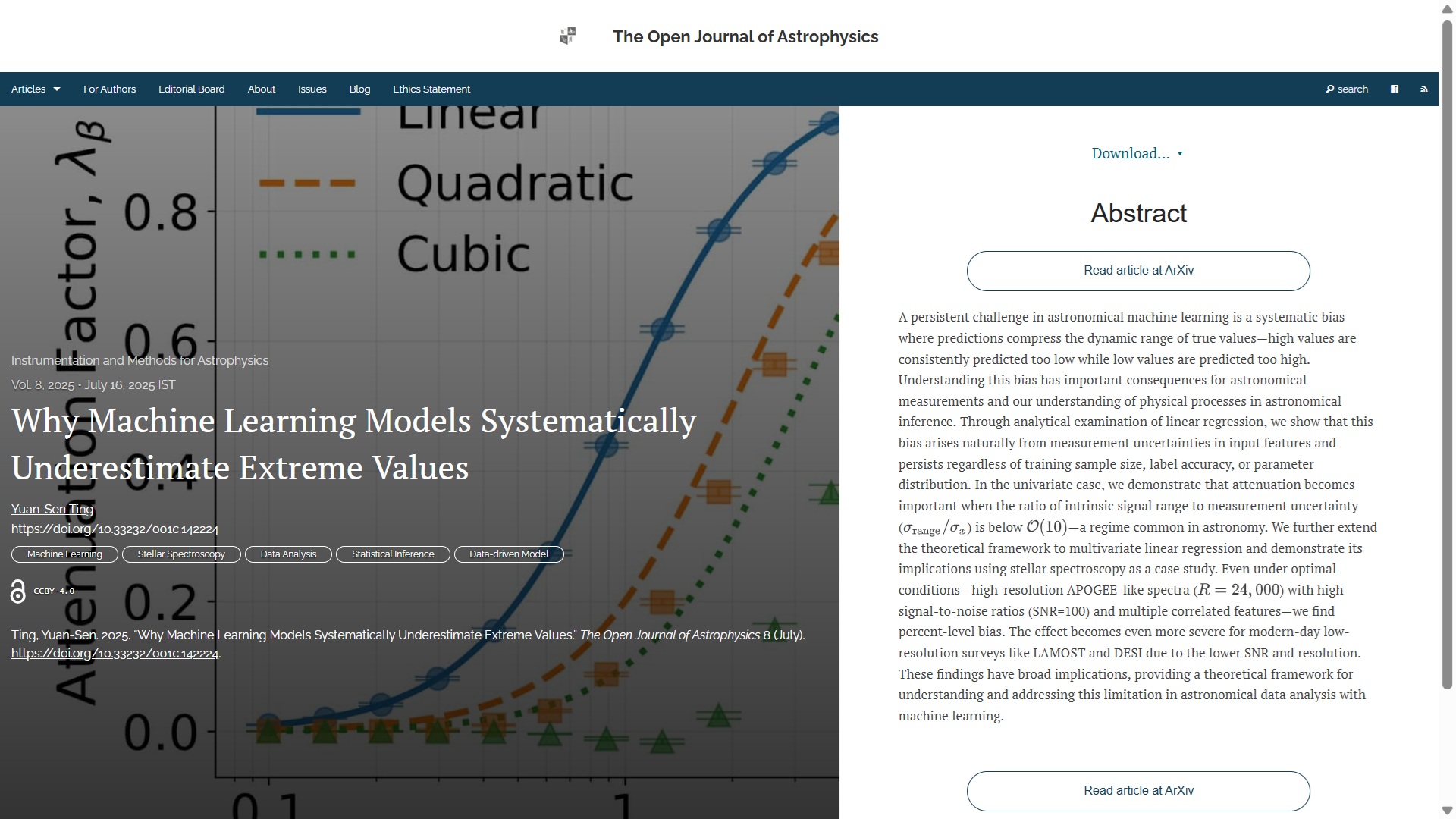
You can find the officially accepted version of this paper on arXiv here.
The penultimate article for this week is “Bridging Machine Learning and Cosmological Simulations: Using Neural Operators to emulate Chemical Evolution” by Pelle van de Bor, John Brennan & John A. Regan (Maynooth University) and Jonathan Mackey (Dublin Institute for Advanced Studies), all based in Ireland. This paper uses machine learning, in the form of neural operators, to emulate the Grackle method of solving non-equilibrium chemistry equations in cosmological hydrodynamic simulations and was published on 16th July also in the folder Instrumentation and Methods for Astrophysics. The overlay is here:

The final, accepted version of the paper is on arXiv here.
The last article published this week is “Astronomical Cardiology: A Search For Heartbeat Stars Using Gaia and TESS” by Jowen Callahan, D. M. Rowan, C. S. Kochanek and K. Z. Stanek (all of Ohio State University, USA). This paper presents a study of a sample of 112 new spectroscopic binaries called hearbeat stars (because their light curves resemble electrocardiagrams). It was published on 16th July 2025 in the folder marked Solar and Stellar Astrophysics. The overlay is here:

You can find the officially-accepted version on arXiv here.
And that’s all the papers for this week. I’ll do another update next Saturday.

 In the Dark