Archive for The Open Journal of Astrophysics

The trouble with arXiv

Posted in Biographical, Open Access with tags , , , , on October 17, 2024 by telescoper

We’re now publishing papers at a steady rate at the Open Journal of Astrophysics. This is probably not obvious to outsiders, but our platform actually consists of two different sites, one handling submissions and the other dealing with publishing those papers accepted. Although we have a large (and still expanding) team of volunteer Editors to deal with the former, as Managing Editor I am the only person with the keys to the publishing side of things. This part of the process has been simplified enormously after the automation introduced earlier this year but it still takes some time to do, as I have to check the overlay and metadata before pressing the button to deposit everything with Crossref and make the overlay live. I also announce each paper on social media. This usually takes around 15 minutes per paper, give or take.

Now that I’ve returned to full teaching duties at Maynooth University, I’ve developed a routine to deal with this activity. During workdays I usually wake around 7am, make some coffee, and then check the day’s arXiv mailing to see if any of our accepted papers have been announced. If any have, I do the honours while I have my coffee, and then proceed to shower and breakfast (including Coffee no. 2); if none have, I go straight to shower and breakfast. I’ve been following this routine for quite a while now.

In the last couple of weeks, however, I have noticed quite often when I try to look up newly-announced papers on arXiv that the connection times out with a message saying ‘rate exceeded’. If that happens I just wait a while and try again. It’s not a very serious issue but it does slow down the process.

Well, today I found out the reason via a message on Mastodon. The loading errors at arXiv are caused by people doing many simultaneous downloads in attempts to scrape all the content from arXiv as soon as it is announced. This is almost certainly to provide material for Large Language Models, such as ChatGPT, which are essentially Automated Plagiarism Engines. I propose the acronym APE for the kind of person who engages in this sort of activity.

This is a very tedious development and I hope arXiv can find a way of putting a stop to it without inconveniencing its authentic users. I suggest that the people managing arXiv identify the culprits and send the boys round.

Six New Publications at the Open Journal of Astrophysics

Posted in OJAp Papers, Open Access, The Universe and Stuff with tags , , , , , , , , , , , , , , , , , , , , , , , , , on October 12, 2024 by telescoper

Regular readers of this blog (both of them) will have noticed that I didn’t post an update of activity at the Open Journal of Astrophysics last weekend. Despite having accepted several papers for publication in the preceding week, no final versions had made it onto the arXiv. We can’t published a paper until the authors post the final version, so that meant a bit of a backlog developed. This week included one day with no arXiv update (owing to a US holiday on Tuesday 8th October) and a major glitch on Crossref on Thursday which delayed a couple, but even so we’ve published six papers which is the most we’ve ever managed in a week. This week saw the publication of our 200th article; the total as of today is 202.  The count in Volume 7 (2024) is now up to 87; we have four papers in the queue for publication so we should pass 90 next week if all goes well.

In chronological order, the six papers published this week, with their overlays, are as follows. You can click on the images of the overlays to make them larger should you wish to do so.

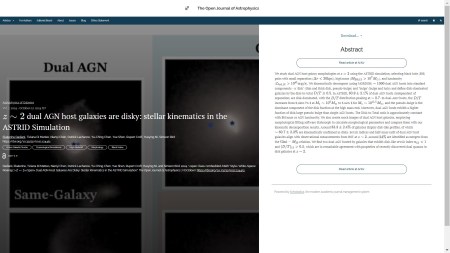
First one up, published on Monday 7th October 2024 is “z~2 dual AGN host galaxies are disky: stellar kinematics in the ASTRID Simulation” by Ekaterina Dadiani (CMU; Carnegie Mellon U.) Tiziana di Matteo (CMU), Nianyi Chen (CMU), Patrick Lachance (CMU), Yue Shen (U. Illinois at Urbana-Champaign), Yu-Ching Chen (Johns Hopkins U.), Rupert Croft (CMU), Yueying Ni (CfA Harvard) and Simeon Bird (U. California Riverside) – all based in the USA. The paper, which is in the folder marked Astrophysics of Galaxies describes a numerical study of the morphology of AGN host galaxies containing close pairs of black holes.

Here is a screen grab of the overlay, which includes the abstract:
 

You can find the officially accepted version of the paper on the arXiv here.

The second paper to announce, published on 8th October 2024, is “Origin of LAMOST J1010+2358 Revisited” by S.K. Jeena and Projjwal Banerjee of the Indian Institute of Technology Palakkad, Kerala, India. This paper discusses  the possible formation mechanisms for Very Metal Poor (VMP) stars and the implications for the origin of LAMOST J1010+2358 and is in the folder marked Solar and Stellar Astrophysics.

You can see the overlay here:

The accepted version of this paper can be found on the arXiv here.

The third paper is very different in both style and content: “Assessing your Observatory’s Impact: Best Practices in Establishing and Maintaining Observatory Bibliographies” by Raffaele D’Abrusco (Harvard CfA and 14 others; the Observatory Bibliographers Collaboration) and is in the folder marked Instrumentation and Methods for Astrophysics. It presents discussion of the methods used by astronomical observatories to construct and analyze bibliographic databases. The overlay is here:

(This one gave me a rare opportunity to use the library of stock images that comes with the Scholastica platform!) The officially accepted version can be found on arXiv here.

The fourth paper, also published on 8th October 2024, and our 200th publication, is in the folder marked Cosmology and NonGalactic Astrophysics, and is called “CombineHarvesterFlow: Joint Probe Analysis Made Easy with Normalizing Flows“. The authors are Peter L. Taylor, Andrei Cuceu, Chun-Hao To, and Erik A. Zaborowski of Ohio State University, USA. The article presents a new method that speeds up the sampling of joint posterior distributions in the context of inference using combinations of data sets. The overlay is here

You can find the officially accepted version of this paper here.

The fifth paper in this batch is “Estimating Exoplanet Mass using Machine Learning on Incomplete Datasets” by Florian Lalande (Okinawa Institute of Science and Technology), Elizabeth Tasker (Institute of Space and Astronautical Science, Kanagawa) and Kenji Doya (Okinawa); all based in Japan. This one was published on 10th October 2024 in the folder marked Earth and Planetary Astrophysics. It compares different methods for inferring exoplanet masses in catalogues with missing data


You can find the official accepted version on the arXiv here.

Finally for this week we have “Forecasting the accuracy of velocity-field reconstruction” by Chris Blake and Ryan Turner of Swinburne University of Technology, Melbourne, Australia. This was also published on 10th October 2024 and is in the folder marked Cosmology and NonGalactic Astrophysics. The paper describes a numerical study of the reliability and precision of different methods of velocity-density reconstruction. The overlay is here

You can find the officially-accepted version on arXiv here.

That’s it for now. We have published six papers, with a very wide geographical spread of authors, and in five of the six astro-ph categories we cover. I think it’s been a good week!

Four New Publications at the Open Journal of Astrophysics

Posted in OJAp Papers, Open Access, The Universe and Stuff with tags , , , , , , , , , , , , on September 29, 2024 by telescoper

A day later than has been usual for such things, it’s now time for a quick update of activity at the Open Journal of Astrophysics. This week we have published another batch of four papers which takes the count in Volume 7 (2024) up to 81 and the total published altogether by OJAp up to 196. I think there may come a week in we publish papers on every day of that week, but it was not this week…

In chronological order, the four papers published this week, with their overlays, are as follows. You can click on the images of the overlays to make them larger should you wish to do so.

First one up is “Finding the unusual red giant remnants of cataclysmic variable mergers” by Nicholas Z. Rui and Jim Fuller of California Institute of Technology (Caltech), USA. It presents a discussion of the possible photometric, astroseismological, and surface abundance signatures of red giants formed by mergers of cataclysmic variable stars. It was published on 23rd September 2024 and is in the folder marked Solar and Stellar Astrophysics.

Here is a screen grab of the overlay, which includes the abstract:


You can find the officially accepted version of the paper on the arXiv here.

The second paper to announce, also published on 23rd September 2024, is “Notes on the Practical Application of Nested Sampling: MultiNest, (Non)convergence, and Rectification” by Alexander Dittmann (U. Maryland, USA). A critical analysis of the MultiNest algorithm together with suggestions for approving its applicability. It is in the folder Instrumentation and Methods for Astrophysics.

You can see the overlay here:


The accepted version of this paper can be found on the arXiv here.

The third paper, published on 24th September 2024 in the folder marked High-Energy Astrophysical Phenomena, is called  “Merger Precursor: Year-long Transients Preceding Mergers of Low-mass Stripped Stars with Compact Objects” and is by Daichi Tsuna, Samantha Wu & Jim Fuller (Caltech), Yize Dong (UCLA) and Anthony Piro (Carnegie Observatories), all based in the USA.

Here is the overlay


The final version accepted on arXiv is here.

Last in this batch is “Spectroscopic Observations of the GALEX Nearby Young Star Survey Sample. I. Nearby Moving Group Candidates” by Navya Nagananda (Rochester, NY, USA), Laura Vican (UCLA), Ben Zuckerman (UCLA), David Rodriguez (STScI), Alexander Binks (Tübingen, Germany) & Joel Kastner (Rochester). It describes investigations of the spectra of the GALNYSS sample of over 2000 young stars and the assignment of these stars into moving groups. It is is in the folder marked Solar and Stellar Astrophysics, and was published on 25th September 2024 with this overlay:


You can find the official accepted version on the arXiv here.

That’s all for now. I will post another update in a week.

Four New Publications at the Open Journal of Astrophysics

Posted in OJAp Papers, Open Access, The Universe and Stuff with tags , , , , , , , , , , , , , , , , , , , on September 14, 2024 by telescoper

Once again, it’s time for a quick update of activity at the Open Journal of Astrophysics. This week we have published another batch of four papers which takes the count in Volume 7 (2024) up to 77 and the total published altogether by OJAp up to 192. Things are picking up again after the summer lull, and we’re moving towards a double century. If we keep up a steady average of four per week we’ll be at 200 per year.

In chronological order, the four papers published this week, with their overlays, are as follows. You can click on the images of the overlays to make them larger should you wish to do so.

First one up is “Quasi-two-dimensionality of three-dimensional, magnetically dominated, decaying turbulence” by Shreya Dwivedi, Chandranathan Anandavijayan, and Pallavi Bhat of TIFR, Bangalore, India. The paper presents an analysis of numerical simulations of MHD turbulence using Minkowski Functionals, with implications for local anisotropies revealed therein. It was published on 9th September 2024 and is in the folder marked High-Energy Astrophysical Phenomena.

Here is a screen grab of the overlay, which includes the abstract:


You can find the officially accepted version of the paper on the arXiv here.

The second paper to announce, also published on 9th September 2024, is “mochi_class: Modelling Optimisation to Compute Horndeski In class” by  Matteo Cataneo (Universität Bonn, Germany) and Emilio Bellini (SISSA, Trieste, Italy). This article presents a cosmological Einstein-Boltzmann solver adapted to work with Horndeski gravity, together with validation tests. It is in the folder Cosmology and NonGalactic Astrophysics.

You can see the overlay here:


The accepted version of this paper can be found on the arXiv here.

The third paper, published on 11th September 2024 in the folder marked High-Energy Astrophysical Phenomena, is by Jonathan Katz of Washington University, St Louis, USA. The title is “The Sources of Fast Radio Bursts” and it presents a discussion of the possible physical origin of Fast Radio Bursts, arguing that they fall into two distinct groups.


The final version accepted on arXiv is here.

Last in this batch, but by no means least, is “RMS asymmetry: a robust metric of galaxy shapes in images with varied depth and resolution” by Elizaveta Sazonova (U. Waterloo, Canada) with 15 other authors spread around the world (in Canada, USA, Australia, Italy, Chile, UK, Poland, Mexico, Germany, and Spain). This paper presents a method of quantifying distortion of galaxy images connected with mergers or other instabilities. It is in the folder marked Astrophysics of Galaxies and was published on September 12th 2024 with this overlay:


You can find the official accepted version on the arXiv here.

That’s all for now. I will post another update in a week.

An Anniversary of a Century

Posted in Open Access, The Universe and Stuff with tags on September 11, 2024 by telescoper

While I remember, here is a quick post to mark the fact that the 100th paper at the Open Journal of Astrophysics was published a year ago today (on 11th September 2023).

In the year that has passed since that milestone we have published a further 91 papers. I expect we will pass the 200 mark sometime next month. It’s an accelerating Universe!

Two New Publications at the Open Journal of Astrophysics

Posted in OJAp Papers, Open Access, The Universe and Stuff with tags , , , , , , , , , on September 7, 2024 by telescoper

It’s Saturday morning again so here’s another report on activity at the  Open Journal of Astrophysics.  Since the last update we have published two more papers, taking  the count in Volume 7 (2024) up to 73 and the total published by OJAp up to 188.  We’ve still got a few in the pipeline waiting for the final versions to appear on arXiv so I expect we’ll reach the 200 mark fairly soon.

The first paper of the most recent pair, published on September 4th 2024,  and in the folder marked Astrophysics of Galaxies, is “Massive Black Hole Seeds”  by John Regan of the Department of Theoretical Physics at Maynooth University and Marta Volonteri (Sorbonne Université, Paris, France). This article presents a discussion of the pathways to the formation of massive black holes, including both light and heavy initial seeds.

Here is a screen grab of the overlay which includes the abstract:


You can click on the image of the overlay to make it larger should you wish to do so. Those of you who are paying attention will see that there is a bit of a glitch on the left hand side where software has thrown a line break in between the two author names. I have no idea what caused this so I raised a ticket with Scholastica and no doubt it will soon be fixed.  (Update: it is now fixed, 12th September 2024). You can find the officially accepted version of this paper on the arXiv here.

The second paper has the title “The future of cosmological likelihood-based inference: accelerated high-dimensional parameter estimation and model comparison” and was published on 5th September 2024. The authors are Davide Piras (Université de Genève), Alicja Polanska (MSSL) , Alessio Spurio Mancini (Royal Holloway, London), Matthew A. Price(UCL) & Jason D. McEwen (UCL); the latter four are all based in the UK. This paper, which is in  the folder marked Cosmology and NonGalactic Astrophysics, describes an accelerated approach to Bayesian inference in higher-dimensional settings, as required for cosmology, based on recent developments in machine learning and its underlying technology.

Here is a screen grab of the overlay which includes the abstract:


You can click on the image of the overlay to make it larger should you wish to do so. You can find the officially accepted version of the paper on the arXiv here.

That concludes this week’s update. More  next week!

Two New Publications at the Open Journal of Astrophysics

Posted in OJAp Papers, Open Access, The Universe and Stuff with tags , , , , , , , , , , , , on August 31, 2024 by telescoper

I am back in circulation after my little break and, since it’s Saturday, I will resume blogging with another report on activity at the  Open Journal of Astrophysics.  Since the last update we have published two more papers, taking  the count in Volume 7 (2024) up to 71 and the total published by OJAp up to 186.  We’ve still got a few in the pipeline waiting for the final versions to appear on arXiv so I expect we’ll reach the 200 mark fairly soon.

The first paper of the most recent pair, published on August 26th 2024,  is “Impact of lensing of gravitational waves on the observed distribution of neutron star masses”  by Sofia Canevarolo, Loek van Vonderen and Nora Elisa Chisari, all of Utrecht University in the Netherlands. This article presents a discussion of the bias in neutron star mass determinations caused by gravitational lensing of the gravitational waves they produceThe paper is in the folder marked Cosmology and NonGalactic Astrophysics.

Here is a screen grab of the overlay which includes the abstract:


You can click on the image of the overlay to make it larger should you wish to do so. You can find the officially accepted version of the paper on the arXiv here.

The second paper has the title “FORGE’d in FIRE III: The IMF in Quasar Accretion Disks from STARFORGE” and was published (in the early hours of the morning) on 29th August 2024. The authors, all based in the USA, are Philip F. Hopkins (Caltech), Michael Y. Grudic (Carnegie Observatories), Kyle Kremer (Caltech), Stella S. R. Offner (UT Austin), David Guszejnov (UT Austin) and Anna L. Rosen (UCSD). This paper, which is in the folder marked Astrophysics of Galaxies, presents a numerical study of star formation and the initial mass function in quasar accretion disks. The previous two papers in this series have also been published in the OJAp: you can find them here and here; images and movies related to this project can be found here.

Here is a screen grab of the overlay which includes the abstract:


You can click on the image of the overlay to make it larger should you wish to do so. You can find the officially accepted version of the paper on the arXiv here.

That concludes this week’s update. We still have quite a few papers in the pipeline after the summer lull so I expect I’ll have a larger update for you next week!

New Publication at the Open Journal of Astrophysics

Posted in OJAp Papers, Open Access, The Universe and Stuff with tags , , , , on August 24, 2024 by telescoper

It’s Saturday morning so it’s time for the usual weekly update of publications at the Open Journal of Astrophysics. Once again this week’s report will be short because there is only one paper to report this week, being  the 69th paper in Volume 7 (2024)  and the 184th  altogether. It was published on Wednesday 21st August 2024.

This week has been a bit strange, actually. We have actually accepted four papers that I was expecting to publish this week but only one has been published because the authors of the others have not yet put the final versions on arXiv. I suppose this is due to ongoing holidays and they’ll appear in due course. The other thing that happened was that when I published the paper below I discovered that the Crossref system was down for a scheduled upgrade that took a whole day to complete. Although I published the paper on 21st August I couldn’t register the metadata, etc, until 22nd August. Just as well I didn’t have more to do really!

Anyway, the title of the latest paper is is The compact circumstellar material of SN 2024ggi: another supernova with a pre-explosion effervescent zone and jet-driven explosion and it  is in the folder marked High-Energy Astrophysical Phenomena. The author is Noam Soker of Technion, Haifa, in Israel; the paper presents a possible explanation of then properties of recently-observed supernova SN 2024ggi.

Here is the overlay of the paper containing the abstract:


You can click on the image of the overlay to make it larger should you wish to do so. You can also find the officially accepted version of the paper on the arXiv here.

Four New Publications at the Open Journal of Astrophysics

Posted in OJAp Papers, Open Access, The Universe and Stuff with tags , , , , , , , , , , , , , , , , , , on July 27, 2024 by telescoper

It’s Saturday morning, so once again it’s time for an update of activity at the Open Journal of Astrophysics. This week we have published another batch of four papers, the same number as last week, which takes the count in Volume 7 (2024) up to 64 and the total published altogether by OJAp up to 179.

Before announcing the week’s papers I’ll add three other updates you might find interesting:

  1.  When I looked at NASA/ADS this morning to help construct this post I saw that papers published in OJAp have now garnered over 2500 citations between them;
  2. We had a good response to our recent call for new members of the Editorial Board and have added four new members here;
  3. Last week we received a significant (unsolicited) cash donation from a higher education institution based in Europe to help with our work in Diamond Open Access. If any other organizations or individuals would like to do similar then please contact me!

Now, in chronological order, the four papers published this week, with their overlays, are as follows. You can click on the images of the overlays to make them larger should you wish to do so.

First one up is: “Widespread disruption of resonant chains during protoplanetary disk dispersal by Bradley M S Hansen (UCLA), Tze-Yeung Yu (UCLA) and Yasuhiro Hasegawa (JPL), all based in California, USA.  The paper presents a discussion of the effect of a dispersing protoplanetary disk on the evolution of low-mass planets around a Solar mass star.  It was published on 21st July 2024 and is in the folder marked Earth and Planetary Astrophysics.

Here is a screen grab of the overlay, which includes the abstract:


You can find the officially accepted version of the paper on the arXiv here.

The second paper to announce is “Using A One-Class SVM To Optimize Transit Detection” by Jakob Roche of the University of South Florida, also in the USA (but not in California). This articles discusses the advantages of One-Class Support Vector Machines (SVMs) over Convolutional Neural Networks (CNN) in the context of exoplanet detection. Its in the folder called Instrumentation and Methods for Astrophysics and was published on 25th July 2024.

You can see the overlay here:


The accepted version of this paper can be found on the arXiv here.

The next paper, also published on 25th July 2024, is in the folder marked High-Energy Astrophysical Phenomena. Its primary classification on arXiv is General Relativity and Quantum Cosmology (gr-qc), but it is cross-listed on astro-ph so we considered it for publication and had it refereed, with favourable results. It is entitled “What no one has seen before: gravitational waveforms from warp drive collapse” and is by Katy Clough (QMUL, UK), Tim Dietrich (Potsdam, Germany) and Sebastian Khan (Cardiff, UK).  Looking at the title of this paper you might be tempted to dismiss it on the grounds that warp drives are the stuff of science fiction (which they are), but this paper is really a rigorous technical study of the dynamical evolution and stability of spacetimes that violate the null energy condition, inspired by the idea of a warp drive.

Here is the overlay:


You can find the full text for this one on the arXiv here.

Last, published on 26th July 2024, we have a paper with the title “A study of gamma-ray emission from OJ 287 using Fermi-LAT from 2015-2023” by Vibhavasu Pasumarti and Shantanu Desai of the Indian Institute of Technology, Hyderabad, India. It is an investigation of the properties of gamma-ray emission from OJ287 (a BL Lac object) using the Fermi Large Area Telescope (LAT).  This one is also in the folder marked High-Energy Astrophysical Phenomena; here is the overlay

You can find the officially accepted version of this paper on the arXiv here.

That’s all for this week. Stay tuned for another update next week.

Four New Publications at the Open Journal of Astrophysics

Posted in OJAp Papers, Open Access, The Universe and Stuff with tags , , , , , , on July 20, 2024 by telescoper

This week we have published four papers at the Open Journal of Astrophysics, which I now present to you here. These four take the count in Volume 7 (2024) up to 60 and the total published altogether by OJAp up to 175. It is gratifying to see the range of high-quality papers published steadily increasing. We are getting several papers submitted every day now.

In chronological order, the four papers published this week, with their overlays, are as follows. You can click on the images of the overlays to make them larger should you wish to do so.

First one up is: “A population of neutron star candidates in wide orbits from Gaia astrometry” by Kareem El-Badry (Caltech, USA) and 12 others based across the world.  The paper presents  a spectroscopic study of neutron star candidates identified using GAIA astrometry to be in wide binary orbits around main sequence stars,  was published on 15th July 2024 and is in the folder marked Solar and Stellar Astrophysics. For more information about this one, see here.

Here is a screen grab of the overlay, which includes the abstract:


You can find the officially accepted version of the paper on the arXiv here.

The second paper to announce is “Systematic Effects in Galaxy-Galaxy Lensing with DESI” and was written by Johannes Ulf Lange (University of Michigan, Ann Arbor, USA) and 58 others, again distributed internationally.  This one reports a study of systematic effects (such as incompleteness and intrinsic alignment) on galaxy-galaxy lensing results from the Dark Energy Spectroscopic Instrument (DESI) survey. This one is in the folder called Cosmology and NonGalactic Astrophysics and was published on 16th July 2024.

You can see the overlay here:


The accepted version of this paper can be found on the arXiv here.

The next paper is also in the folder called Cosmology and NonGalactic Astrophysics.  It is entitled “Unleashing cosmic shear information with the tomographic weak lensing PDF” and is by by Lina Castiblanco (Newcastle Univresity, UK), Cora Uhlemann (Bielefeld University, Germany), Joachim Harnois-Déraps (Newcastle University, UK) and Alexandre Barthelemy (Ludwig-Maximilians-Universität, Germany). This one was published on 17th July 2024.

Here is the overlay:


You can find the full text for this one on the arXiv here.

Last but by no means least, published on 18th July 2024, we have a paper  entitled “When to interfere with dark matter? The impact of wave dynamics on statistics“. The primary classification for this one is again Cosmology and Nongalactic Astrophysics and it discusses the imprint of wave-mechanical behaviour, perhaps associated with ultra-light scalar field dark matter on the statistical properties of large-scale structure. The authors are Alex Gough (Newcastle University, UK) and Cora Uhlemann (Bielefeld University, Germany; who also featured in the author list of the previous paper). This is a paper close to my own interests, but because I know both authors well and was the PhD examiner of the first author I thought it best to recuse myself from an editorial role on this one.


You can click on the image of the overlay to make it larger should you wish to do so. You can find the officially accepted version of the paper on the arXiv here.

It did look likely at one stage that we might publish a paper every day last week, but the final version of one other paper didn’t make it onto arXiv in time to be announced on Friday so I will publish that one on Monday.